REVIEW 4 major objections 6 minor 20 references
Safe Bottom-Up Flexibility Provision from Distributed Energy Resources
T0 review · 4 major / 6 minor · reviewed 2026-08-16 · deepseek-v4-flash
Pith's one-line read A safe multi-agent reinforcement learning framework lets distributed energy resources provide flexibility services while respecting voltage limits without knowing the distribution network's topology.
desk verdict A clean extension of safe MARL to DSO-free DER coordination; the safety guarantee is heuristic, not by-design. read the letter →
The pith
A machine-rendered reading of the paper's core claim, the machinery that carries it, and where it could break.
The reading
What carries the argument
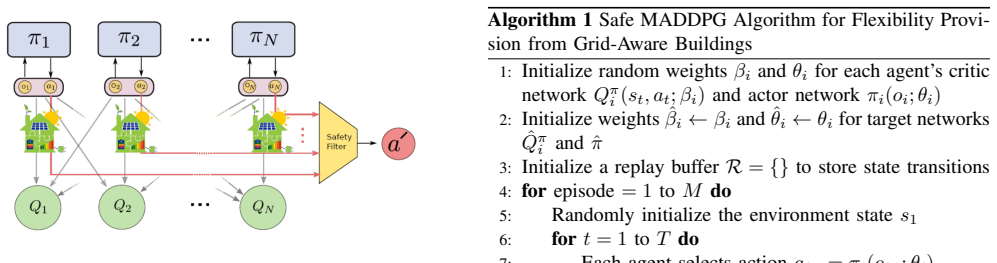
The load-bearing mechanism is the voltage regressor $f(o_t, a_t; W)$ of Eq. (16), trained offline in a supervised, cross-validated manner on power-flow-generated scenarios, paired with the safety-layer projector of Eq. (17), which solves $\min_{a'_t} \|a'_t - a_t\|^2$ subject to $\underline{V} \leq f(o_t, a'_t; W) \leq \overline{V}$. Because $f$ is multi-output linear in the joint action, the projection is a convex quadratic program that needs no network physics. The regressor achieves a mean absolute error around 0.00138 per unit and $R^2$ of about 0.993, and the agents are trained with the multi-agent actor-critic method MADDPG, with each node's agent controlling its own building and storage. These two pieces, predictor and projector, convert an unknown voltage constraint into an enforceable data-driven constraint.
What would settle it
Run the trained safety layer on a batch of out-of-distribution or adversarial joint actions, for instance all batteries charging at full power while local generation peaks, solve Eq. (17), and feed the projected actions into the true power flow; if any case has predicted voltages inside the limits but actual voltages outside, the claimed by-design zero-violation guarantee fails. A quantitative version would search for the smallest voltage-boundary gap at which the regressor's error flips the projection from safe to unsafe.
Extended reading notes
Core claim
The central claim is that a model-free, linear-in-action voltage predictor can replace the distribution network model inside a safe reinforcement learning loop. The paper argues that when the predictor is trained on voltage measurements across all buses and is linear in the joint action, the safety-layer projection is a convex problem and can be solved online to enforce voltage limits without any knowledge of topology or line parameters. Tests on the 33-bus network show the learned policy follows the spending pattern of a perfect-hindsight optimal power flow but acts conservatively, keeping end-of-horizon storage and cumulative demand-reduction limits, and achieving a 12 percent net-benefit gap with zero voltage violations over a week of testing.
Load-bearing premise
The safety guarantee rests on treating the learned voltage regressor as the exact constraint model: if the regressor's error is nonzero for some reachable state-action pair, the projected action can still push a true bus voltage out of limits, and the reported average-error and R-squared statistics do not rule that out.
Editorial extensions
If this is right
- A DER community can offer distribution-network-safe flexibility using only local voltage measurements and market prices, without the DSO providing topology or engaging online.
- Training does not need voltage-violation penalties: the safety layer keeps the normalized violation cost at zero throughout training, which the paper credits for faster, closer-to-optimal convergence.
- The same safety-layer design can enforce other operational limits, such as line current limits, by training additional predictors and adding constraints to the projection.
- The tested Safe-MADDPG policy lands 12% from the ideal hindsight OPF net benefit with zero voltage violations, outperforming heavy-penalty baselines at 15% and 16% gaps with 1 and 3 violations.
Reading between the lines
- Outside the paper: the 'zero violations by design' guarantee is really a guarantee on the training distribution; a topology reconfiguration or new load regime can break it until the regressor is retrained, unless a worst-case error bound or a robust safety margin is added.
- Outside the paper: the 12 percent gap to hindsight-optimal OPF can be read as the empirical price of model-free safety, and it would be testable to vary the regressor's accuracy and measure how the benefit gap and violation rate move together.
- Outside the paper: a similar predictor-plus-projector pattern could be applied to other data-driven safety constraints, such as line-current or thermal limits, and could be made verifiable by adding a conformal or quantile error margin around the voltage prediction.
Signed reviews
Editorial analysis
A structured set of objections, weighed in public.
Referee Report
Summary. The paper proposes a decentralized safe multi-agent reinforcement learning framework for DER flexibility provision in distribution networks. Each agent controls a building's demand response and an energy storage system, and a safety layer projects the joint action onto a feasible set defined by a learned linear voltage regressor. The regressor is trained offline on power-flow-generated data, and the resulting Safe-MADDPG policy is evaluated on an IEEE 33-bus network, achieving a 12% net-benefit gap to an optimal-in-hindsight OPF benchmark with zero voltage violations, compared to 15% and 16% gaps and 1 and 3 violations for MADDPG and MAPPO. The central claimed contribution is that voltage limits can be respected without online DSO engagement or knowledge of network topology and characteristics.
Significance. If the central guarantee were established, this would be a valuable step toward bottom-up, data-driven DER coordination, addressing a real gap in the safe MARL literature where safety layers typically require network models. The paper has clear strengths: the problem formulation is relevant, the use of a learned regressor inside a safety layer is a sensible and timely idea, the algorithm is specified in reasonable detail, and the experimental comparison against an OPF benchmark and two MARL baselines is useful. However, the claimed by-design voltage guarantee is not supported by the analysis presented, and several implementation-level issues affect the validity of the reported results. The contribution is potentially defensible if reframed as an empirical safety mechanism with supporting guarantees, but as written the central claim requires substantial additional support.
major comments (4)
- [Section III-B, Eq. (17)] The safety projection in Eq. (17) enforces constraints on the regressor output f(o_t, a'_t; W), not on the true voltages obtained from the power-flow equations. Since f is a fitted linear regressor, any nonzero prediction error at the projected action can place true voltages outside [V̲, V̄]. The reported MAE (0.00138 pu) and R² (0.993) are average cross-validated training statistics, not worst-case bounds over the reachable state-action set, so they do not establish a guarantee. The zero violations in Table I are an empirical outcome on a single one-week test of one 33-bus network, not a by-design guarantee. The manuscript should either provide a formal error bound with a safety margin that maps regressor error to true voltage feasibility, or explicitly restate the claim as empirical safety and provide supporting experiments across networks, loading conditions, and random seeds.
- [Section IV-B vs. Section I-C] Section IV.B states that the voltage-regressor training dataset was generated by 'solving power flow calculations,' which requires full knowledge of network topology and line characteristics. This directly conflicts with the contribution stated in Section I.C—'ensuring the satisfaction of voltage limits without assuming access to the network topology and characteristics'—and with Section II.C, which emphasizes that the DERs are not aware of the network's topology. If a DSO or another party must run a full power-flow model offline to produce training labels, the practical contribution should be restated as avoiding online DSO engagement rather than avoiding access to network characteristics. Please clarify the data-generation pipeline and explicitly state what information is assumed available at training time versus execution time.
- [Algorithm 1, lines 10-12] The order of operations in Algorithm 1 is: project actions onto the safety set (line 10), inject exploratory noise (line 11), then apply a'_t (line 12). This means that whenever the exploration noise n is nonzero, the action actually applied can leave the safe set, defeating the purpose of the safety layer. This contradicts the claim in Section IV.C.1 and Fig. 3(b) that Safe-MADDPG maintains zero normalized violation cost throughout training. The noise should be injected before the projection, or the text should clarify that the projected action (without noise) is the one applied, with noise used only in the actor update.
- [Eq. (14)] The per-step reward in Eq. (14) contains penalty terms involving Σ_{t∈T} P_DR_{b,t} and e_{j,|T|}, which are end-of-horizon or cumulative quantities not available at time t when r_i,t is computed. As written, the reward is non-causal and cannot be used in the online MARL loop described in Section III.C. If these penalties are in fact applied only at the end of an episode, that should be stated explicitly and the equation should be revised to separate per-step rewards from terminal penalties; otherwise the handling of intertemporal constraints (5) and (7) is not correctly implemented.
minor comments (6)
- [Section III-B, Eq. (16)] Please clarify the exact inputs to the voltage regressor: are the normalized actions α_DR, α_ESS used, or the physical powers P_DR, P_ch, P_dis? This affects reproducibility of Eq. (17).
- [Fig. 1] The schematic would benefit from explicitly labeling the inputs and outputs of the safety-layer projection module, including the regressor's role, to make the data flow consistent with Algorithm 1.
- [Table I] The testing results report a single one-week realization with no confidence intervals or number of random seeds. Given that the violation counts are 0, 1, and 3, a single run provides limited statistical evidence; please report multiple seeds or a distribution over test periods.
- [Section II-C] The global state includes reactive loads q_{n,t} at all nodes, but the agents are said to use local observations only, while the regressor in Eq. (16) uses joint observations o_t. Please clarify how the agents obtain the joint observation vector needed by the safety layer, and whether this requires communication or a central module.
- [Eq. (18)] The notation v_{b,t} is ambiguous: v was defined as squared voltage magnitude in Section II.B, and b indexes buildings. Please use consistent bus/agent indexing and define the units of the penalty coefficient κ_V.
- [Throughout] The phrase 'zero voltage violations by design' (Table I and Section IV.C.2) is stronger than what the experiments establish; consider replacing it with 'zero violations observed in the tested scenarios' unless a formal guarantee is added.
Circularity Check
No significant circularity: the safety-layer projection acts on a fitted voltage regressor, while the reported zero-violation result is evaluated on actual power-flow voltages.
full rationale
The paper's central claim is that Safe-MADDPG satisfies voltage limits without in-the-loop network knowledge. The derivation chain is: train a linear voltage regressor f(ot, at; W) from power-flow-generated data (Eq. (16)); then project actions to keep f within [V, Vbar] (Eq. (17)); then evaluate voltage violations using the environment's actual power-flow model (Table I). This chain is not circular: the safety layer's constraints are on f's predictions, not on the true voltages, and the test counts violations computed from true power-flow equations, not from f. The zero-violation result is therefore an empirical outcome, not a tautology. The main weaknesses are non-circular: Eq. (17) provides no worst-case error bound for f, so 'zero voltage violations by design' is an overclaim; and the training data come from solving power-flow calculations, which requires the same network model the method claims not to need at execution. These are correctness and generalization gaps, not definitional reductions. No load-bearing self-citation was found; reference [3] is a co-authored related-work citation in a non-central context.
Assumptions & free parameters
free parameters (4)
- Voltage regressor weights W =
33-output linear regression trained with 5-fold cross-validation on simulated power flow data
- Penalty coefficient kappa_V =
1 C/pu
- Penalty coefficient kappa_DR =
10 C/kWh
- Penalty coefficient kappa_ESS =
10 C/kWh
assumptions (6)
- domain assumption Branch-flow (DistFlow) model Eqs. (8)-(12) exactly describes the distribution network voltages and currents.
- ad hoc to paper The linear voltage regressor is accurate enough that projecting actions onto its predicted feasible set guarantees true voltage feasibility.
- domain assumption Voltage measurements at all buses or sufficient network-wide observations are available to train and evaluate the regressor.
- domain assumption The training scenarios (varying active and reactive power profiles) cover the operational conditions seen in testing.
- domain assumption One ESS and one building per node is without loss of generality.
- domain assumption Agents' local observations and a centralized safety layer communication channel are available without DSO participation.
Cite this review
Pith. "Pith review of Safe Bottom-Up Flexibility Provision from Distributed Energy Resources." pith.science (2026). https://pith.science/paper/2LBBGLMC
@misc{pith2026250420529,
  author       = {Pith},
  title        = {Pith review of: Safe Bottom-Up Flexibility Provision from Distributed Energy Resources},
  year         = {2026},
  howpublished = {\url{https://pith.science/paper/2LBBGLMC}},
  note         = {Machine review of arXiv:2504.20529}
}
read the original abstract
Modern renewables-based power systems need to tap on the flexibility of Distributed Energy Resources (DERs) connected to distribution networks. It is important, however, that DER owners/users remain in control of their assets, decisions, and objectives. At the same time, the dynamic landscape of DER-penetrated distribution networks calls for agile, data-driven flexibility management frameworks. In the face of these developments, the Multi-Agent Reinforcement Learning (MARL) paradigm is gaining significant attention, as a distributed and data-driven decision-making policy. This paper addresses the need for bottom-up DER management decisions to account for the distribution network's safety-related constraints. While the related literature on safe MARL typically assumes that network characteristics are available and incorporated into the policy's safety layer, which implies active DSO engagement, this paper ensures that self-organized DER communities are enabled to provide distribution-network-safe flexibility services without relying on the aspirational and problematic requirement of bringing the DSO in the decision-making loop.
Figures


Figures from the paper (1 more)

Reference graph
Works this paper leans on
-
[1]
C. D. S. W. Group, et al., CEER paper on DSO procedures of procure- ment of flexibility, Council of European Energy Regulators (CEER), Brussels, Report C19-DS-55–05 (2020)
work page 2020
-
[2]
D. K. Molzahn, F. D ¨orfler, H. Sandberg, S. H. Low, S. Chakrabarti, R. Baldick, J. Lavaei, A survey of distributed optimization and control algorithms for electric power systems, IEEE Transactions on Smart Grid 8 (6) (2017) 2941–2962
work page 2017
-
[3]
G. Tsaousoglou, R. Junker, M. Banaei, S. S. Tohidi, H. Madsen, Integrating distributed flexibility into TSO-DSO coordinated electricity markets, IEEE Transactions on Energy Markets, Policy and Regulation (2023)
work page 2023
- [4]
-
[5]
F. Charbonnier, T. Morstyn, M. D. McCulloch, Scalable multi-agent reinforcement learning for distributed control of residential energy flexibility, Applied Energy 314 (2022) 118825
work page 2022
-
[6]
Y . Ye, D. Papadaskalopoulos, Q. Yuan, Y . Tang, G. Strbac, Multi-agent deep reinforcement learning for coordinated energy trading and flexibil- ity services provision in local electricity markets, IEEE Transactions on Smart Grid (2022)
work page 2022
-
[7]
I. ElSayed-Aly, S. Bharadwaj, C. Amato, R. Ehlers, U. Topcu, L. Feng, Safe multi-agent reinforcement learning via shielding, arXiv preprint arXiv:2101.11196 (2021)
arXiv 2021
-
[8]
S. Gu, J. G. Kuba, M. Wen, R. Chen, Z. Wang, Z. Tian, J. Wang, A. Knoll, Y . Yang, Multi-agent constrained policy optimisation, arXiv preprint arXiv:2110.02793 (2021)
arXiv 2021
Show all 20 references
-
[9]
S. Lu, K. Zhang, T. Chen, T. Bas ¸ar, L. Horesh, Decentralized policy gradient descent ascent for safe multi-agent reinforcement learning, in: Proceedings of the AAAI Conference on Artificial Intelligence, V ol. 35, 2021, pp. 8767–8775
2021
-
[10]
Sheebaelhamd, K
Z. Sheebaelhamd, K. Zisis, A. Nisioti, D. Gkouletsos, D. Pavllo, J. Kohler, Safe deep reinforcement learning for multi-agent systems with continuous action spaces, arXiv preprint arXiv:2108.03952 (2021)
2021 arXiv
-
[11]
Y . Wang, D. Qiu, M. Sun, G. Strbac, Z. Gao, Secure energy management of multi-energy microgrid: A physical-informed safe reinforcement learning approach, Applied Energy 335 (2023) 120759
2023
-
[12]
Y . Gao, N. Yu, Model-augmented safe reinforcement learning for volt- var control in power distribution networks, Applied Energy 313 (2022) 118762
2022
-
[13]
Zhang, L
J. Zhang, L. Sang, Y . Xu, H. Sun, Networked multiagent-based safe re- inforcement learning for low-carbon demand management in distribution networks, IEEE Transactions on Sustainable Energy (2024)
2024
-
[14]
P. Chen, S. Liu, X. Wang, I. Kamwa, Physics-shielded multi-agent deep reinforcement learning for safe active voltage control with pho- tovoltaic/battery energy storage systems, IEEE Transactions on Smart Grid (2022)
2022
-
[15]
G. Guo, M. Zhang, Y . Gong, Q. Xu, Safe multi-agent deep reinforcement learning for real-time decentralized control of inverter based renewable energy resources considering communication delay, Applied Energy 349 (2023) 121648
2023
-
[16]
Zhang, K
Q. Zhang, K. Dehghanpour, Z. Wang, F. Qiu, D. Zhao, Multi-agent safe policy learning for power management of networked microgrids, IEEE Transactions on Smart Grid 12 (2) (2020) 1048–1062
2020
-
[17]
R. Lowe, Y . I. Wu, A. Tamar, J. Harb, O. Pieter Abbeel, I. Mordatch, Multi-agent actor-critic for mixed cooperative-competitive environments, Advances in neural information processing systems 30 (2017)
2017
-
[18]
S. H. Dolatabadi, M. Ghorbanian, P. Siano, N. D. Hatziargyriou, An enhanced IEEE 33 bus benchmark test system for distribution system studies, IEEE Transactions on Power Systems 36 (3) (2020) 2565–2572
2020
-
[19]
J. Wang, W. Xu, Y . Gu, W. Song, T. C. Green, Multi-agent reinforcement learning for active voltage control on power distribution networks, Advances in Neural Information Processing Systems 34 (2021) 3271– 3284
2021
-
[20]
Hirth, J
L. Hirth, J. M ¨uhlenpfordt, M. Bulkeley, The ENTSO-E transparency platform–a review of europe’s most ambitious electricity data platform, Applied energy 225 (2018) 1054–1067
2018
Reviewed August 16, 2026 · model on record in the stance chip above.
Discussion (0). Continue with ORCID to comment.