REVIEW 4 major objections 4 minor 22 references
Collaborative Computation Offloading in Wireless Powered Mobile-Edge Computing Systems
T0 review · 4 major / 4 minor · reviewed 2026-08-14 · deepseek-v4-flash
Pith's one-line read The paper claims that in a two-user wireless powered mobile-edge computing system, the weighted sum computation rate can be maximized exactly by a golden-section search over one time variable after a convexifying change of variables.
desk verdict New model worth a referee, but the 'optimal' claim rests on an unproved unimodality assumption. read the letter →
The pith
A machine-rendered reading of the paper's core claim, the machinery that carries it, and where it could break.
The reading
What carries the argument
The load-bearing object is the auxiliary vector $\boldsymbol{\tau} = (\tau_0, \tau_1, \tau_2^{(1)}, \tau_2^{(2)}, \tau_3)$ with $\tau_i = t_i p_i$, which turns rate expressions of the form $t B \log_2(1 + \rho p)$ into $t B \log_2(1 + \rho \tau/t)$. These transformed constraints are jointly convex in $(t, \tau, b)$. Fixing the scalar $t_2^c$ removes the remaining bilinear terms involving the helping user's CPU frequency and time, leaving a convex program whose optimal value defines $S(t_2^c)$; the golden-section search then selects the best collaborative-computing time, and the original powers are recovered via $p = \tau/t$.
What would settle it
Compute the optimal value S(z) on a fine grid for the channel gains, path-loss exponents, weights, and distances used in Section V; if the grid shows two local maxima of different heights in [0,1], the golden-section search can converge to the lower one, settling the question against the paper's claim.
Extended reading notes
Core claim
The central claim is that the non-convex joint optimization of task partition, time, power, and CPU frequency is equivalent to a transformed problem after substituting $\tau = t p$ for each transmission. For any fixed value of $t_2^c$, the time the helping user spends computing the other user's task, the transformed problem is convex and solvable by standard convex solvers. The paper asserts that the optimal value of this problem as a function of $t_2^c$ on $[0,1]$ can be maximized globally by a golden-section search, so the original problem is solved optimally. The optimal transmit powers are then recovered from the relation $p = \tau/t$.
Load-bearing premise
The global-optimality claim depends on the optimal weighted sum computation rate being single-peaked as the helper's collaborative-computing time varies over [0,1]; the paper does not prove this unimodality.
Editorial extensions
If this is right
- For a fixed two-user frame, the optimal resource allocation can be found by solving a small number of convex programs, one per golden-section evaluation, so the method is computationally light enough for practical scheduling.
- The optimal solution makes the blocked user's task a three-way split among itself, the helper, and the edge server, and the helper's task a two-way split, without requiring a binary offloading approximation.
- At the optimum both users work throughout the block: the blocked user computes for the whole frame, while the helper divides its time between its own local computation and helping the other user.
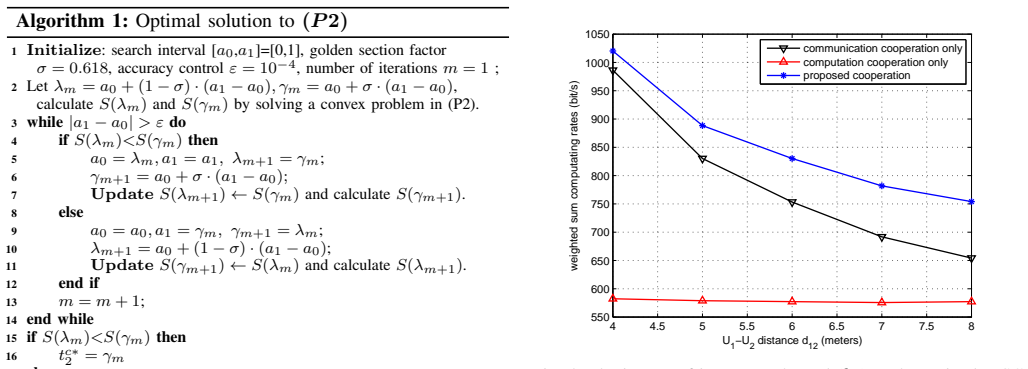
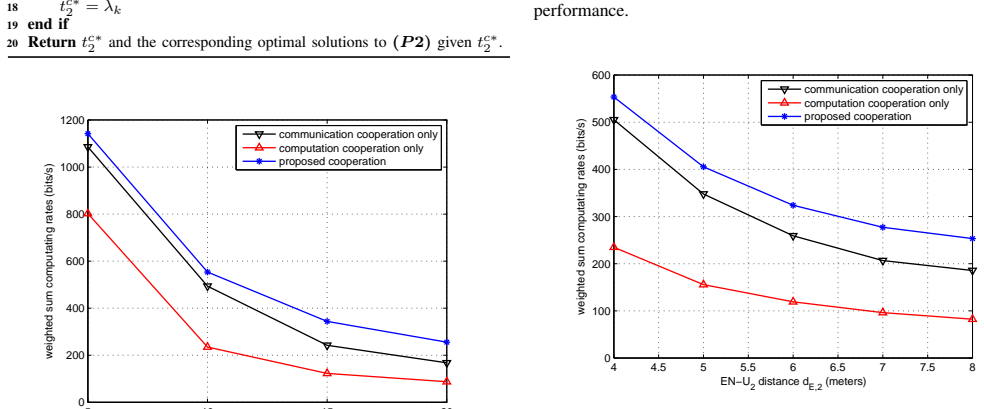
- In the reported simulations, the joint cooperation raises the weighted sum computation rate by roughly 24 to 28 percent over relay-only cooperation and by 48 to 173 percent over compute-only cooperation, with the largest gains on weak relay or access channels.
- For the path-loss exponents tested, the achievable rate region of the proposed scheme contains that of the relay-only benchmark, so both the weak user and the helper can benefit.
Reading between the lines
- A step the paper leaves implicit is that the golden-section search is globally valid only if $S(t_2^c)$ is unimodal on $[0,1]$; a fine-grid evaluation of $S$ over the paper's simulation parameters would reveal whether this property actually holds.
- The same convexifying substitution could in principle extend to more than two users or multiple relays, but then fixing a single helper-time leaves a higher-dimensional search that golden-section cannot guarantee to solve.
- A natural variant would let the helper compute the blocked user's task in parallel with its own task rather than sequentially; that would change the time-coupling constraint $t_2 = \max(t_2^c, t_2^a)$ and likely require a new optimality argument.
- If unimodality ever fails, replacing the golden-section step with a coarse grid followed by local refinement would give a near-optimal schedule at a modest complexity increase.
Signed reviews
Editorial analysis
A structured set of objections, weighed in public.
Referee Report
Summary. The paper studies a two-user wireless powered mobile-edge computing system in which one user (U1) has no direct link to the edge server and the other user (U2) acts both as a relay and as a local computing agent for U1's task. The authors formulate problem P1 to maximize the weighted sum-computation-rate by jointly optimizing the amounts of task data processed at each device, the CPU frequencies, transmit powers, and time allocation. They introduce auxiliary energy variables tau and transform P1 into P2, claiming that P2 is convex for a fixed value of tc2, the time U2 spends computing U1's task. They define S(tc2) as the optimal value of P2 for fixed tc2 and propose a golden-section search over tc2 (Algorithm 1) to obtain the global optimum. Simulations compare the proposed joint cooperation scheme with communication-only and computation-only cooperation benchmarks.
Significance. The cooperation model is well motivated: it extends prior relay-only or helper-only designs to the case where the helping user has its own task, is energy-constrained, and must decide how much of U1's task to compute locally versus forward. If the claimed optimal solution method is correct, the paper provides an efficient algorithm for a useful problem class and demonstrates meaningful gains over the benchmarks, including a rate-region comparison showing that both users can benefit. The change of variables that convexifies the rate constraints is a sensible and standard step, and the numerical study is relevant. However, the central global-optimality claim currently rests on structural properties of S(tc2) and on an equivalence between P1 and P2 that are not established in the manuscript, so the contribution cannot be considered complete as written.
major comments (4)
- [Section IV, Eq. (18) and the statement of P2] The equivalence between P1 and P2 is not established because the constraint tau0 = t0 p0 is missing from P2's constraint list. In P1, p0 is a fixed parameter (Section II-A and the simulation setting p0 = 3 W), so tau0 = t0 p0 is not a free variable but is determined by t0. As written, P2 leaves tau0 unbounded; since tau0 appears only on the right-hand sides of (23) and (24), the objective can be made arbitrarily large by increasing tau0 for a fixed t0. The paper must either include the linear constraint tau0 = t0 p0 in P2 or explicitly explain why it is implied; otherwise the subsequent convexity and optimality claims concern a different, unbounded problem.
- [End of Section IV and Algorithm 1] The claim that Algorithm 1 returns the global optimum requires the function S(z), the optimal value of P2 for tc2 = z, to be unimodal on [0,1]; the paper neither states nor proves this. S(z) is the value function of a convex problem parameterized by z, and such value functions are not unimodal in general. The paper itself notes that P2 is not jointly convex because of the multiplicative terms in (24) and (25), so concavity of S(z) does not follow automatically. Without a proof of unimodality or concavity, the bracketing deletions in Lines 4-14 of Algorithm 1 can discard the global maximizer, and the returned tc2* is not certified as optimal. This gap affects the interpretation of all simulation results that are described as optimal.
- [Section IV, Eqs. (23)-(25)] The reductions t11 = 1 and tc2 + t22 = 1 are imported from [9] without proof, but [9] treats a binary computation-offloading setting that differs from the present partial-offloading model. In P1, U2's local computation of U1's task and U2's own offloading compete for the same harvested energy, so it is not immediate that a user should always compute throughout the whole block; spending energy on local computation can reduce the power available for offloading. Because this full-time-local-computation lemma is the basis for replacing constraints (15)-(16) and (4) with (23)-(25), the equivalence of P1 and P2 depends on it. Please provide a self-contained proof or a precise citation that covers the current partial-offloading and relaying model.
- [Section IV, constraint (1) in P2] Constraint (1), t2 = max(tc2, t2^(1)+t2^(2)), is an equality involving a maximum and is not a convex constraint. The paper states that P2 becomes convex once tc2 is fixed, but as written the feasible set of P2 includes this nonconvex equality. The intended argument appears to be that (1) can be relaxed to t2 >= tc2 and t2 >= t2^(1)+t2^(2), with equality holding at an optimum because enlarging t2 only consumes time. However, this relaxation and the accompanying optimality argument are not stated. Without them, the claim that P2 is a convex problem for fixed tc2 is not literally correct.
minor comments (4)
- [Algorithm 1, line 18] The text 'tc2* = lambda_k' uses an undefined index k; it should be lambda_m, consistent with the rest of the algorithm.
- [Problem P1, Eq. (4)] The variables t11 and t22 appear in constraint (4) but are not listed in the optimization variable set t in the statement of P1; please define them explicitly or state that they are determined by the full-time-computation lemma.
- [Eq. (24)] The coefficient k2c is not defined; presumably it is the effective capacitance coefficient of U2, but it should be introduced explicitly.
- [Section III-E] The statement that (8) and (9) are 'non-concave functions' is imprecise: each has the form t log2(1 + c p/t), which is concave in (t,p) as a perspective function. The nonconvexity of P1 is better attributed to the bilinear products such as those in (4) and the max constraint (1).
Circularity Check
No significant circularity: the derivation is a convex reformulation with an unproved-but-not-circular search step, and benchmark gains come from simulation, not from fitted predictions.
full rationale
The paper's central claim is an optimization derivation. P1 is transformed via the τ substitution into P2, and convexity for fixed tc2 follows from the perspective form of the log constraints and the convexity of the energy constraints; the one-dimensional search over S(tc2) is algorithmic, not statistical. No parameter is fitted to a subset of data and then renamed a prediction: all simulation constants (p0, μ, N0, Γ, distances, k, fmax, φ, ν) are fixed system parameters, and the benchmark comparisons are direct simulation outputs. The only notable self-citation is [9], used for the lemma that each energy-constrained user computes throughout the time block, giving t11=1 and tc2+t22=1. That lemma is prior independent work by one of the authors; it is not the target WSCR-optimality result, and it can be verified from the energy-budget structure rather than presupposing the present optimum. Under the review's definition, this is real evidence and does not create circularity. Separately, the paper does not prove that S(tc2) is unimodal, so the golden-section search's global-optimality claim has a rigor gap; however, an omitted proof is a correctness concern, not a circular reduction of the kind required for a positive circularity finding.
Assumptions & free parameters
assumptions (6)
- domain assumption All channels are independent, reciprocal, and quasi-static flat-fading, remaining constant during each block.
- domain assumption Each user can compute throughout the whole time block without interruption by energy harvesting or information transmission.
- domain assumption At optimum each energy-constrained user computes throughout the block, so t11=1 and tc2+t22=1, as imported from reference [9].
- domain assumption The edge server has negligible computation time and negligible result-download time and energy.
- domain assumption Energy harvesting is linear with common efficiency mu, justified by parallel nonlinear harvesting circuits rectifying the nonlinearity.
- ad hoc to paper S(z), the optimal value of P2 given tc2=z, is unimodal on [0,1], so golden-section search returns the global maximizer.
Cite this review
Pith. "Pith review of Collaborative Computation Offloading in Wireless Powered Mobile-Edge Computing Systems." pith.science (2026). https://pith.science/paper/2LGIZ6AG
@misc{pith2026190809334,
  author       = {Pith},
  title        = {Pith review of: Collaborative Computation Offloading in Wireless Powered Mobile-Edge Computing Systems},
  year         = {2026},
  howpublished = {\url{https://pith.science/paper/2LGIZ6AG}},
  note         = {Machine review of arXiv:1908.09334}
}
read the original abstract
This paper studies a novel user cooperation model in a wireless powered mobile edge computing system where two wireless users harvest wireless power transferred by one energy node and can offload part of their computation tasks to an edge server (ES) for remote execution. In particular, we consider that the direct communication link between one user to the ES is blocked, such that the other user acts as a relay to forward its offloading data to the server. Meanwhile, instead of forwarding all the received task data, we also allow the helping user to compute part of the received task locally to reduce the potentially high energy and time cost on task offloading to the ES. Our aim is to maximize the amount of data that can be processed within a given time frame of the two users by jointly optimizing the amount of task data computed at each device (users and ES), the system time allocation, the transmit power and CPU frequency of the users. We propose an efficient method to find the optimal solution and show that the proposed user cooperation can effectively enhance the computation performance of the system compared to other representative benchmark methods under different scenarios.
Figures


Figures from the paper (2 more)

Reference graph
Works this paper leans on
-
[9]
S. Bi and Y . J. Zhang, “Computation rate maximization for wireless powered mobile-edge computing with binary computation offloading,” IEEE Trans. Wireless Commun. , vol. 17, no. 6, pp. 4177-4190, Jun. 2018
work page 2018
-
[1]
A survey on mobile edge computing: the communication perspective,
Y . Mao, C. You, J. Zhang, K. Huang, and K. B. Letaief, “A survey on mobile edge computing: the communication perspective,” IEEE Commun. Surveys Tuts., vol. 19, no. 4, pp. 2322-2358, 4th Quart., 2017
work page 2017
-
[2]
Y . Wu, J. Chen, L.P. Qian, J. Huang, and X. S. Shen, “Energy- aware cooperative traffic offloading via device-to-device cooperations: an analytical approach, IEEE Trans. Mobile Comput. , vol. 16, no. 1, pp. 97-114, Jan. 2017
work page 2017
-
[3]
H. Xing, L. Liu, J. Xu, and A. Nallanathan, “Joint task assignment and wireless resource allocation for cooperative mobile-edge computing, in Proc. IEEE ICC , 2018
work page 2018
-
[4]
Price-based distributed offloading for mobile- edge computing with computation capacity constraints,
M. Liu and Y . Liu, “Price-based distributed offloading for mobile- edge computing with computation capacity constraints,” IEEE Wireless Commun. Lett., vol. 7, no. 3, pp. 420-423, Jun. 2018
work page 2018
-
[5]
Wireless powered communication networks: an overview,
S. Bi, Y . Zeng, and R. Zhang, “Wireless powered communication networks: an overview,” IEEE Wireless Commun. Mag. , vol. 23, no. 2, pp. 10-18, Apr. 2016
work page 2016
-
[6]
Multiuser computation offloading and downloading for edge computing with virtualization,
Z. Liang, Y . Liu, T. Lok, and K. Huang, “Multiuser computation offloading and downloading for edge computing with virtualization,” IEEE Trans. Wireless Commun., 2019
work page 2019
-
[7]
Energy- efficient secure noma-enabled mobile edge computing networks,
W. Wu, F. Zhou, P. Li, P. Deng, B. Wang, and V . C. M. Leung, “Energy- efficient secure noma-enabled mobile edge computing networks,” in Proc. IEEE ICC, 2019
work page 2019
Show all 22 references
-
[8]
Energy efficient mobile cloud computing powered by wireless energy transfer,
C. You, K. Huang, and H. Chae, “Energy efficient mobile cloud computing powered by wireless energy transfer,”IEEE J. Sel. Areas Commun., vol. 34, no. 5, pp. 1757-1771, May. 2016
2016
-
[10]
Joint offloading and computing optimization in wireless powered mobile-edge computing systems,
F. Wang, J. Xu, X. Wang, and S. Cui, “Joint offloading and computing optimization in wireless powered mobile-edge computing systems,” IEEE Trans. Commun., vol. 17, no. 3, pp. 1784-1797, Mar. 2018
2018
-
[11]
Online learning for offloading and autoscal- ing in energy harvesting mobile edge computing,
J. Xu, L. Chen, and S. Ren, “Online learning for offloading and autoscal- ing in energy harvesting mobile edge computing,” IEEE Trans. Cogn. Com- mun. Netw., vol. 3, no. 3, pp. 361-373, Sep. 2017
2017
-
[12]
Deep reinforcement learning for online computation offloading in wireless powered mobile-edge computing networks,
L. Huang, S. Bi, and Y . J. Zhang, “Deep reinforcement learning for online computation offloading in wireless powered mobile-edge computing networks,” to appear in IEEE Trans. Mobile Compt
-
[13]
Power- efficient communication in UA V-aided wireless sensor networks,
M. Hua, Y . Wang, Z. Zhang, C. Li, Y . Huang, and L. Yang, “Power- efficient communication in UA V-aided wireless sensor networks,” IEEE Commun. Lett., vol. 22, no. 6, pp. 1264-1267, Jun. 2018
2018
-
[14]
Computation rate maximization in UA V-enabled wireless-powered mobile-edge computing systems,
F. Zhou, Y . Wu, R. Q. Hu, and Y . Qian, “Computation rate maximization in UA V-enabled wireless-powered mobile-edge computing systems,”IEEE J. Sel. Areas Commun. , vol. 36, no. 9, pp. 1927-1941, Sep. 2018
1927
-
[15]
User cooperation in wireless powered communica- tion networks,
H. Ju and R. Zhang, “User cooperation in wireless powered communica- tion networks,” in Proc. IEEE GLOBECOM , 2014
2014
-
[16]
Multi-antenna enabled cluster-based cooperation in wireless powered communication networks,
L. Yuan, S. Bi, S. L. Zhang, X. Lin, and H. Wang, “Multi-antenna enabled cluster-based cooperation in wireless powered communication networks,” IEEE Access, vol. 5, pp. 13941-13950, Jul. 2017
2017
-
[17]
User cooperation for enhanced throughput fairness in wireless powered communication networks,
M. Zhong, S. Bi, and X. Lin, “User cooperation for enhanced throughput fairness in wireless powered communication networks,” Wirel. Netw., vol. 23, no. 4, pp. 1315-1330, Apr. 2017
2017
-
[18]
Wireless powered cooperation-assisted mobile edge computing,
X. Hu, K. Wong, and K. Yang, “Wireless powered cooperation-assisted mobile edge computing,” IEEE Trans. Commun. , vol. 17, no. 4, pp. 2375- 2388, Apr. 2018
2018
-
[19]
Wireless powered user cooper- ative computation in mobile edge computing systems,
D. Wu, F. Wang, X. Cao, and J. Xu, “Wireless powered user cooper- ative computation in mobile edge computing systems,” in Proc. IEEE Globecom, 2018
2018
-
[20]
Joint computation and communication cooperation for energy-efficient mobile edge computing,
X. Cao, F. Wang, J. Xu, R. Zhang, and S. Cui, “Joint computation and communication cooperation for energy-efficient mobile edge computing,” IEEE Internet Things J. , vol. 6, no. 3, pp. 4188-4200, Jun. 2019
2019
-
[21]
Wireless information and power transfer: architecture design and rate-energy tradeoff,
X. Zhou, R. Zhang, and C. K. Ho, “Wireless information and power transfer: architecture design and rate-energy tradeoff,” IEEE Trans. Commun., vol. 61, no. 11, pp. 4754-4767, Nov. 2013
2013
-
[22]
Joint tx power allocation and rx power splitting for SWIPT system with multiple nonlinear energy harvesting circuits,
J. Kang, I. Kim, and D. I. Kim, “Joint tx power allocation and rx power splitting for SWIPT system with multiple nonlinear energy harvesting circuits,” IEEE Wireless Commun. Lett., vol. 8, no. 1, pp. 53-56, Feb. 2019
2019
Reviewed August 14, 2026 · model on record in the stance chip above.
Discussion (0). Continue with ORCID to comment.