REVIEW 4 major objections 4 minor 94 references
A global mass-preserving numerical method for low-Mach-number real-gas flows in closed systems
T0 review · 4 major / 4 minor · reviewed 2026-08-03 · deepseek-v4-flash
Pith's one-line read A low-Mach-number flow solver now enforces exact global mass conservation for real fluids with nonlinear equations of state.
desk verdict Solid, useful method paper: the Newton–Raphson thermodynamic-pressure update is a genuine, well-derived contribution, but the pressure-splitting projection is undertested and the verification omits the very quantity it claims to verify. read the letter →
The pith
A machine-rendered reading of the paper's core claim, the machinery that carries it, and where it could break.
The reading
What carries the argument
The load-bearing identity is the Newton-Raphson update p0^(m+1) = p0^m + (M0 - ∫ρ dV) / (∫ρχ dV), where χ = (1/ρ) ∂ρ/∂p|T is the isothermal compressibility. This converts the global mass constraint into a root-finding problem whose derivative is a standard thermodynamic quantity, so the method is agnostic to the equation of state's analytical form. The second mechanism is the pressure-splitting projection: the reciprocal density in the pressure gradient is replaced by a constant reference reciprocal density, chosen at or below the minimum density, plus a correction built from a linearly extrapolated pressure. That turns a variable-coefficient Poisson equation into a constant-coefficient one
What would settle it
Run a closed-system differentially heated cavity with the same van der Waals fluid at progressively larger wall temperature differences, producing wall density ratios of roughly 10, 20, and 50, and compare mean Nusselt number and velocity profiles with a variable-coefficient Poisson solver as ground truth. If the mass-preserving solution's velocity statistics depart from the reference as the density ratio grows, the pressure-splitting approximation is the cause.
Extended reading notes
Core claim
The central claim is that global mass conservation in a closed low-Mach-number system can be enforced exactly and efficiently for any single-phase equation of state by solving the nonlinear constraint M0 = ∫ρ(p0,T)dV at each stage. The paper derives a Newton-Raphson update for p0 whose residual derivative is the volume integral of ρ times isothermal compressibility, a quantity available from analytic equations of state or property tables; in the ideal-gas limit the update reduces to the standard explicit formula. The algorithm separates thermodynamic from hydrodynamic updates: temperature is advanced first, p0 is corrected, density and properties come from the equation of state, and only the
Load-bearing premise
The scheme assumes that replacing the variable-density pressure gradient with a constant-reference-density gradient plus a linearly extrapolated pressure correction remains accurate enough at the density contrasts of interest; the paper reports no error estimate for that splitting, so a failure there would corrupt velocities while leaving the global mass property intact.
Editorial extensions
If this is right
- In the ideal-gas limit the Newton-Raphson update collapses to the known explicit thermodynamic-pressure formula, so existing low-Mach solvers are recovered as a special case.
- Any fluid whose tables supply isothermal compressibility can be simulated without coding a new analytic equation of state; the paper demonstrates this with lookup-table CO2 properties.
- Closed-system real-fluid simulations no longer need to prescribe a constant thermodynamic pressure; the pressure evolves and mass is conserved during thermal transients.
- The method reaches regimes where fully compressible solvers are impractical, such as differentially heated cavity flows at characteristic Mach numbers near 10^-7.
- Second-order spatial accuracy in velocity and temperature holds for a nonlinear equation of state, as verified by manufactured solutions.
Reading between the lines
- The exact-mass property is independent of the projection's accuracy: p0 is forced to satisfy ∫ρ dV = M0 even if the pressure-splitting velocity error grows at large density ratios, so future work should separate these two errors in convergence tests.
- Because the update uses only ρ and χ, the same iteration could be applied to mixtures or to tabulated single-fluid models beyond single-component single-phase cases, though the paper only presents the latter.
- A direct test of the splitting assumption would be a closed cavity with wall density ratios above the tested range (roughly 7 in the van der Waals case and 3 in the transcritical channel), comparing velocity statistics against a variable-coefficient Poisson or fully compressible reference; divergence of statistics with unchanged mass conservation would isolate the splitting error.
- The Newton iteration converges in two to three iterations because the previous stage's p0 is a good initial guess; cases with very rapid pressure transients or noisy table interpolation could need more iterations or a safeguarded root-finder.
Editorial analysis
A structured set of objections, weighed in public.
Referee Report
Summary. The manuscript develops a low-Mach-number numerical method for closed systems with a general, possibly tabulated, equation of state. The thermodynamic pressure p0 is advanced at each Runge–Kutta stage by a Newton–Raphson iteration that enforces global mass conservation, using the isothermal compressibility to form the Jacobian. The method is implemented in the CaNS finite-difference framework with a segregated temperature/momentum update, WENO for the temperature equation, and a constant-coefficient pressure-splitting projection so that FFT-based Poisson solvers can be retained. The method of manufactured solutions is used for verification, followed by validation against a differentially heated cavity (ideal gas and van der Waals fluid), ideal-gas turbulent channel flow, and transcritical CO2 turbulent channel flow.
Significance. If the results hold, the main contribution is a genuinely EoS-agnostic, mass-preserving update of the thermodynamic pressure for closed-system low-Mach-number flows. Equation (14d) is parameter-free and reduces exactly to the classical ideal-gas update in the linear limit, which is a clean and useful property. The use of isothermal compressibility allows direct coupling to tabulated thermodynamic data, and the validation against the transcritical CO2 DNS is encouraging. The paper therefore addresses a real gap in low-Mach-number real-gas solvers, where closed-system global mass conservation is often only approximate.
major comments (4)
- [§4.2, Table 2] The abstract and §4.2 state that the manufactured-solution study verifies thermodynamic-pressure evolution, but Table 2 reports only L2(eT), L2(eu), and L2(ev) with convergence orders. No error norm, convergence order, or pointwise comparison for p0 is reported. Since the p0 update in Eq. (14d) is the central novelty, the verification is incomplete without at least L2(p0) or a comparison of p0(t) against the manufactured p0,M(t). Please add this result or explicitly state what aspect of the thermodynamic-pressure evolution is being verified.
- [§3.3, Eqs. (17a)–(18c)] The constant-coefficient pressure splitting replaces the variable-density pressure gradient with 1/ρ*∇p1 + (1/ρ − 1/ρ*)∇p*1. The paper gives only the stability constraint ρ* ≤ min(ρ) in footnote 2, citing Dong & Shen (2012) and Demou et al. (2019), but does not report the ρ* values used in the VdW differentially heated cavity (density ratio 7.34) or the CO2 channel (density ratio ≈3), nor a sensitivity study, nor an error estimate for the splitting. This is load-bearing for the claimed accuracy and robustness in real-gas regimes: an inaccurate hydrodynamic pressure due to the splitting can bias the velocity field, temperature advection, and turbulence statistics even though global mass conservation remains exact. Please report the actual ρ* values and either provide a sensitivity study with respect to ρ*/minρ or an error estimate for the tested conditions.
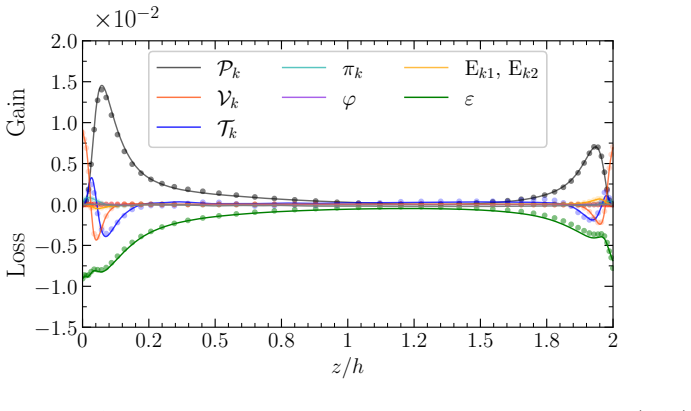
- [§5.2.2, supercritical CO2 channel] The transcritical channel is initialized at p0(0) = 8.4 MPa, which the authors state was chosen so that the steady-state thermodynamic pressure is close to the constant reference pressure of 8 MPa used by Wan et al. (2025). This tuning weakens the independence of the validation. Because the central claim is about closed-system mass preservation, please report the thermodynamic-pressure history p0(t) and the global mass residual over the transient and statistically stationary periods. If possible, show sensitivity to the initial pressure (e.g., starting at 8.0 MPa) or otherwise quantify how the closed-system evolution differs from the constant-pressure reference.
- [§4.1, Eqs. (8) and (23)] The manufactured velocity field is constructed from continuity, Eq. (23), while the projection method enforces the thermodynamic divergence constraint, Eq. (8). The text states that non-zero residuals are added to the temperature transport equation, but it does not state whether the corresponding manufactured source term also enters the divergence constraint in Eq. (8). If the source is included only in the temperature equation, the enforced divergence differs from the manufactured velocity divergence by an extra βS/(ρCp) term, and the verification of the projection step is incomplete. Please clarify the construction or adjust the manufactured fields so that Eq. (8) is satisfied consistently with the added source.
minor comments (4)
- [§3.1, Eqs. (14a)–(14d)] The paper claims that the Newton–Raphson procedure converges in at most two to three iterations for all cases considered, but no iteration counts or convergence tolerance are reported. Adding a short table or statement of the typical iteration count would support this claim.
- [§5.2.2] The turbulent transcritical CO2 case is presented at a single grid resolution. A coarse-grid comparison, even qualitative, would strengthen the confidence in the turbulence statistics.
- [Figure 11] The caption states that the ordinate multiplier is shown on the axis, but the printed axis label does not display the numerical multiplier. Including the multiplier on the axis would improve readability.
- [§3.3, Eq. (17a)] The reference density ρ* is introduced with only a footnote on the stability condition. It would help to state explicitly how ρ* is selected in practice and whether it is fixed or updated during the simulation.
Circularity Check
No load-bearing circularity: the mass-preservation update solves its defining constraint exactly and validation uses external benchmarks; only minor self-citations and a transparently tuned initial pressure are noted.
full rationale
The central derivation is self-contained rather than circular. Eq. (14d) is the exact Newton-Raphson solution of the defining constraint M0 = ∫ρ(p0,T)dV (Eq. 11), with the Jacobian F' = −∫ρχ dV obtained directly from the definition of isothermal compressibility; it reduces exactly to the ideal-gas formula Eq. (13), so it is not a fit renamed as a prediction. The divergence constraint Eq. (8) and dp0/dt Eq. (9) are derived from the EoS and mass conservation, and the projection Eq. (18c) enforces the divergence regardless of the pressure-splitting approximation, so the claimed global-mass property holds by construction. Verification (MMS, Sec. 4) is standard code-consistency testing, with manufactured fields built to satisfy the same EoS and mass constraint. Validation targets are external: Le Quéré et al. (2005), Demou et al. (2019), Nicoud (2000), and Wan et al. (2025). Self-citations (CaNS code, Costa 2018; VdW heat capacities, Boldini et al. 2025a; the isentropic exponent, Nederstigt & Pecnik 2023) are code infrastructure or externally published property relations, i.e., independent support that does not raise the circularity score. The transcritical-CO2 validation tunes p0(0) = 8.4 MPa so that the steady-state pressure lands near the reference 8 MPa (Sec. 5.2.2: 'the simulation is set up such that the thermodynamic state once the flow is fully developed is close enough for meaningful comparison'); this is a disclosed setup choice, and the compared mean profiles and TKE budgets are genuine outputs against external DNS. The unquantified reference density in the pressure splitting (footnote 2, Sec. 3.3) and the absence of a splitting-error estimate are accuracy/robustness gaps, not circularity.
Assumptions & free parameters
free parameters (2)
- Reference density ρ* in pressure-splitting projection =
not reported; constrained to be ≤ min ρ in the domain
- Initial thermodynamic pressure for transcritical CO2 validation =
8.4 MPa
assumptions (6)
- domain assumption Low-Mach asymptotic expansion in γpυ Ma²: p = p0(t) + p1(x,t), with p1/p0 ~ O(γpυ Ma²) and acoustic modes neglected.
- standard math Thermodynamic identities such as Cp − Cυ = β²T/(ρχ) hold, allowing Eq. (7) to be rearranged into Eq. (8) with the χCυ/Cp coefficient.
- domain assumption Closed impermeable domain gives ∫V ∇·u dV = 0, used to derive the thermodynamic-pressure evolution in Eq. (9).
- domain assumption The Newton–Raphson iteration for p0 (Eq. 14d) converges from the previous time-step pressure, with F′(p0) = −∫ρχ dV ≠ 0 and differentiable density over the accessed thermodynamic states.
- ad hoc to paper The pressure-splitting projection with constant ρ* ≤ min ρ and linearly extrapolated p*1 is stable and accurate for the variable-density cases considered.
- domain assumption CoolProp tabulated data at 0.04 K and 7.22×10⁻² MPa resolution, interpolated with third-order Lagrange, are accurate enough for the transcritical CO2 validation.
Cite this review
Pith. "Pith review of A global mass-preserving numerical method for low-Mach-number real-gas flows in closed systems." pith.science (2026). https://pith.science/paper/2LJOMTBB
@misc{pith2026260729224,
  author       = {Pith},
  title        = {Pith review of: A global mass-preserving numerical method for low-Mach-number real-gas flows in closed systems},
  year         = {2026},
  howpublished = {\url{https://pith.science/paper/2LJOMTBB}},
  note         = {Machine review of arXiv:2607.29224}
}
abstract
A mass-preserving low-Mach-number framework is proposed for closed-system real-fluid flows governed by general nonlinear equations of state. The formulation enforces consistency between the spatially uniform thermodynamic pressure, the equation of state, and global mass conservation. Moreover, the numerical algorithm employs a segregated strategy in which the thermodynamic state is updated before the momentum equations, and the velocity field is advanced using a pressure-correction method. This approach enables an efficient solution procedure by decoupling the thermodynamic and momentum updates and retaining the use of FFT-based solvers for the pressure correction. The resulting formulation is implemented with second-order spatial accuracy. The implementation is first verified using the method of manufactured solutions, in which the thermodynamic state is prescribed through analytical density and thermodynamic-pressure fields, enabling verification of the nonlinear equation of state, thermodynamic-pressure evolution, and the low-Mach-number divergence constraint. The framework is subsequently validated against benchmark laminar and turbulent flows for both ideal and real fluids, particularly transcritical CO$_2$ channel flow, demonstrating its accuracy and robustness in the presence of strong thermodynamic nonlinearities.
Figures


Figures from the paper (9 more)




Reference graph
Works this paper leans on
-
[1]
Almgren, A. S. and Bell, J. B. and Rendleman, C. A. and Zingale, M. , title =. Astrophys. J. , year =
-
[2]
and Harlow, Francis H
Amsden, Anthony A. and Harlow, Francis H. , title =. J. Comput. Phys. , year =
-
[3]
Bartholomew, Paul and Laizet, Sylvain , title =. Comput. Phys. Commun. , year =
-
[4]
and Picano, F
Battista, F. and Picano, F. and Casciola, C. M. , title =. Phys. Fluids , year =
-
[5]
and Wronski, Jorrit and Quoilin, Sylvain and Lemort, Vincent , title =
Bell, Ian H. and Wronski, Jorrit and Quoilin, Sylvain and Lemort, Vincent , title =. Ind. Eng. Chem. Res. , year =
-
[6]
and Riley, James J
Cook, Andrew W. and Riley, James J. , title =. J. Comput. Phys. , year =
-
[7]
Costa, Pedro , title =. Comput. Math. Appl. , year =
-
[8]
Demou, A. D. and Frantzis, C. and Grigoriadis, D. G. E. , title =. Int. J. Heat Mass Transfer , year =
Show all 94 references
-
[9]
and Ferrante, Antonino , title =
Dodd, Michael S. and Ferrante, Antonino , title =. J. Comput. Phys. , year =
-
[10]
Dong, Suchuan and Shen, Jie , title =. J. Comput. Phys. , year =
-
[11]
and Grigoriadis, D
Frantzis, C. and Grigoriadis, D. G. E. , title =. J. Comput. Phys. , year =
-
[12]
and Giorgini, Aldo , title =
Gray, Donald D. and Giorgini, Aldo , title =. Int. J. Heat Mass Transfer , year =
-
[13]
and Yang, X
Guo, J. and Yang, X. I. A. and Ihme, M. , title =. J. Fluid Mech. , year =
-
[14]
, title =
Johnston, Ian A. , title =. 2005 , number =
2005
-
[15]
, title =
Knikker, R. , title =. Int. J. Numer. Methods Fluids , year =
-
[16]
2002 , series =
Knupp, Patrick and Salari, Kambiz , title =. 2002 , series =
2002
-
[17]
and Cohen, Ira M
Kundu, Pijush K. and Cohen, Ira M. and Dowling, David R. and Capecelatro, Jesse , title =. 2024 , edition =
2024
-
[18]
and Lifshitz, Evgenii M
Landau, Lev D. and Lifshitz, Evgenii M. , title =. 1987 , edition =
1987
-
[19]
Le M. The. Phys. Fluids , year =
-
[20]
Accurate solutions to the square thermally driven cavity at high
Le Qu. Accurate solutions to the square thermally driven cavity at high. Comput. Fluids , year =
-
[21]
Modelling of natural convection flows with large temperature differences: A benchmark problem for low
Le Qu. Modelling of natural convection flows with large temperature differences: A benchmark problem for low. ESAIM Math. Model. Numer. Anal. , year =
-
[22]
Majda, Andrew and Sethian, James , title =. Combust. Sci. Technol. , year =
-
[23]
McMurtry, P. A. and Jou, W.-H. and Riley, J. and Metcalfe, R. W. , title =. AIAA J. , year =
-
[24]
and Abraham, J
Motheau, E. and Abraham, J. , title =. J. Comput. Phys. , year =
-
[25]
and Wyckoff, Peter S
Najm, Habib N. and Wyckoff, Peter S. and Knio, Omar M. , title =. J. Comput. Phys. , year =
-
[26]
Energies , year =
Nederstigt, Pim and Pecnik, Rene , title =. Energies , year =
-
[27]
Proceedings of the First Symposium on Turbulence and Shear Flow Phenomena , year =
Nicoud, Franck and Poinsot, Thierry , title =. Proceedings of the First Symposium on Turbulence and Shear Flow Phenomena , year =
-
[28]
, title =
Nicoud, F. , title =. J. Comput. Phys. , year =
-
[29]
and Bell, John B
Nonaka, Andrew and Day, Marcus S. and Bell, John B. , title =. Combust. Theory Model. , year =
-
[30]
, title =
Oberbeck, A. , title =. Ann. Phys. , year =
-
[31]
Patel, Ashish and Peeters, Jurriaan W. R. and Boersma, Bendiks J. and Pecnik, Rene , title =. Phys. Fluids , year =
-
[32]
Peeters, Jurriaan W. R. and Pecnik, R. and Rohde, M. and van der Hagen, T. H. J. J. and Boersma, B. J. , title =. J. Fluid Mech. , year =
-
[33]
2005 , edition =
Poinsot, Thierry and Veynante, Denis , title =. 2005 , edition =
2005
-
[34]
Rinaldi, Enrico and Pecnik, Rene and Colonna, Piero , title =. J. Comput. Phys. , year =
-
[35]
Shunn, Lee and Ham, Frank and Moin, Parviz , title =. J. Comput. Phys. , year =
-
[36]
and Wang, X
Wan, T. and Wang, X. J. and Jin, Y. X. and Zhao, P. H. , title =. J. Fluid Mech. , year =
-
[37]
Yu, Rixin and Yu, Jiangfei and Bai, Xue-Song , title =. J. Comput. Phys. , year =
-
[38]
2015 , journal =
Nemati, Hassan and Patel, Ashish and Boersma, Bendiks Jan and Pecnik, Rene , pages =. 2015 , journal =
2015
-
[39]
Accary, Gilbert and Raspo, Isabelle , journal=. A 3. 2006 , publisher=
2006
-
[40]
Turbulent
Accary, Gilbert and Bontoux, Patrick and Zappoli, Bernard , journal=. Turbulent. 2009 , publisher=
2009
-
[41]
Nonideal compressible fluid dynamics of dense vapors and supercritical fluids , author=. Annu. Rev. Fluid Mech. , volume=. 2024 , publisher=
2024
-
[42]
The turbulent flows of supercritical fluids with heat transfer , author=. Annu. Rev. Fluid Mech. , volume=. 2013 , publisher=
2013
-
[43]
Stably. Appl. Mech. Rev. , author =. 2018 , pages =
2018
-
[44]
Compressible flow at high pressure with linear equation of state , author=. J. Fluid Mech. , volume=. 2018 , publisher=
2018
-
[45]
Direct numerical simulation of complete transition to turbulence with a fluid at supercritical pressure , author=. J. Fluid Mech. , volume=. 2025 , publisher=
2025
-
[46]
Schumann, Ulrich and Sweet, Roland A , journal=. Fast. 1988 , publisher=
1988
-
[47]
A numerical methodology for efficient simulations of non-
Demou, AD and Frantzis, C and Grigoriadis, Dimokratis GE , journal=. A numerical methodology for efficient simulations of non-. 2018 , publisher=
2018
-
[48]
An efficient method for two-fluid incompressible flows appropriate for the immersed boundary method , author=. J. Comput. Phys. , volume=. 2019 , publisher=
2019
-
[49]
Boldini, P. C. and Hirai, R. and Costa, P. and Peeters, J. W. R. and Pecnik, R. , journal=. 2025 , publisher=
2025
-
[50]
Accary and I
G. Accary and I. Raspo. A 3 D finite volume method for the prediction of a supercritical fluid buoyant flow in a differentially heated cavity. Comput. Fluids, 35 0 (10): 0 1316--1331, 2006
2006
-
[51]
Accary, P
G. Accary, P. Bontoux, and B. Zappoli. Turbulent R ayleigh-- B \'e nard convection in a near-critical fluid by three-dimensional direct numerical simulation. J. Fluid Mech., 619: 0 127--145, 2009
2009
-
[52]
A. S. Almgren, J. B. Bell, C. A. Rendleman, and M. Zingale. Low Mach number modeling of type Ia supernovae. I. Hydrodynamics . Astrophys. J., 637 0 (2): 0 922--936, 2006
2006
-
[53]
A. A. Amsden and F. H. Harlow. A simplified MAC technique for incompressible fluid flow calculations. J. Comput. Phys., 6 0 (2): 0 322--325, 1970
1970
-
[54]
Bartholomew and S
P. Bartholomew and S. Laizet. A new highly scalable, high-order accurate framework for variable-density flows: Application to non- Boussinesq gravity currents. Comput. Phys. Commun., 242: 0 83--94, 2019
2019
-
[55]
Battista, F
F. Battista, F. Picano, and C. M. Casciola. Turbulent mixing of a slightly supercritical Van der Waals fluid at low- Mach number. Phys. Fluids, 26 0 (5): 0 055101, 2014
2014
-
[56]
I. H. Bell, J. Wronski, S. Quoilin, and V. Lemort. Pure and pseudo-pure fluid thermophysical property evaluation and the open-source thermophysical property library CoolProp . Ind. Eng. Chem. Res., 53 0 (6): 0 2498--2508, 2014
2014
-
[57]
P. C. Boldini, B. Bugeat, J. W. R. Peeters, M. Kloker, and R. Pecnik. Direct numerical simulation of complete transition to turbulence with a fluid at supercritical pressure. J. Fluid Mech., 1025: 0 A59, 2025 a
2025
-
[58]
P. C. Boldini, R. Hirai, P. Costa, J. W. R. Peeters, and R. Pecnik. CUBENS : a GPU -accelerated high-order solver for wall-bounded flows with non-ideal fluids. Comput. Phys. Commun., 309: 0 109507, 2025 b
2025
-
[59]
A. W. Cook and J. J. Riley. Direct numerical simulation of a turbulent reactive plume on a parallel computer. J. Comput. Phys., 129 0 (2): 0 263--283, 1996
1996
-
[60]
P. Costa. A FFT -based finite-difference solver for massively-parallel direct numerical simulations of turbulent flows. Comput. Math. Appl., 76 0 (8): 0 1853--1862, 2018
2018
-
[61]
A. D. Demou, C. Frantzis, and D. G. E. Grigoriadis. A low- Mach methodology for efficient direct numerical simulations of variable property thermally driven flows. Int. J. Heat Mass Transfer, 132: 0 539--549, 2019
2019
-
[62]
M. S. Dodd and A. Ferrante. A fast pressure-correction method for incompressible two-fluid flows. J. Comput. Phys., 273: 0 416--434, 2014
2014
-
[63]
Dong and J
S. Dong and J. Shen. A time-stepping scheme involving constant coefficient matrices for phase-field simulations of two-phase incompressible flows with large density ratios. J. Comput. Phys., 231 0 (17): 0 5788--5804, 2012
2012
-
[64]
Frantzis and D
C. Frantzis and D. G. Grigoriadis. An efficient method for two-fluid incompressible flows appropriate for the immersed boundary method. J. Comput. Phys., 376: 0 28--53, 2019
2019
-
[65]
D. D. Gray and A. Giorgini. The validity of the Boussinesq approximation for liquids and gases. Int. J. Heat Mass Transfer, 19 0 (5): 0 545--551, 1976
1976
-
[66]
Guardone, P
A. Guardone, P. Colonna, M. Pini, and A. Spinelli. Nonideal compressible fluid dynamics of dense vapors and supercritical fluids. Annu. Rev. Fluid Mech., 56 0 (1): 0 241--269, 2024
2024
-
[67]
J. Guo, X. I. A. Yang, and M. Ihme. Structure of the thermal boundary layer in turbulent channel flows at transcritical conditions. J. Fluid Mech., 934: 0 A45, 2022
2022
-
[68]
R. Knikker. A comparative study of high-order variable-property segregated algorithms for unsteady low Mach number flows. Int. J. Numer. Methods Fluids, 66 0 (4): 0 403--427, 2011
2011
-
[69]
Knupp and K
P. Knupp and K. Salari. Verification of Computer Codes in Computational Science and Engineering . Discrete Mathematics and Its Applications. Chapman & Hall/CRC, Boca Raton, FL, 2002
2002
-
[70]
P. K. Kundu, I. M. Cohen, D. R. Dowling, and J. Capecelatro. Fluid Mechanics . Academic Press, Cambridge, MA, 7th Edition, 2024
2024
-
[71]
L. D. Landau and E. M. Lifshitz. Fluid Mechanics , volume 6 of Course of Theoretical Physics. Pergamon Press, Oxford, 2nd Edition, 1987
1987
-
[72]
Le Qu \'e r \'e
P. Le Qu \'e r \'e . Accurate solutions to the square thermally driven cavity at high Rayleigh number. Comput. Fluids, 20 0 (1): 0 29--41, 1991
1991
-
[73]
Le Qu \'e r \'e , C
P. Le Qu \'e r \'e , C. Weisman, H. Paill \`e re, J. Vierendeels, E. Dick, R. Becker, M. Braack, and J. Locke. Modelling of natural convection flows with large temperature differences: A benchmark problem for low Mach number solvers. Part 1: Reference Solutions . ESAIM Math. M...
2005
-
[74]
Majda and J
A. Majda and J. Sethian. The derivation and numerical solution of the equations for zero Mach number combustion. Combust. Sci. Technol., 42 0 (3--4): 0 185--205, 1985
1985
-
[75]
P. A. McMurtry, W.-H. Jou, J. Riley, and R. W. Metcalfe. Direct numerical simulations of a reacting mixing layer with chemical heat release. AIAA J., 24 0 (6): 0 962--970, 1986
1986
-
[76]
Motheau and J
E. Motheau and J. Abraham. A high-order numerical algorithm for DNS of low- Mach -number reactive flows with detailed chemistry and quasi-spectral accuracy. J. Comput. Phys., 313: 0 430--454, 2016
2016
-
[77]
H. N. Najm, P. S. Wyckoff, and O. M. Knio. A semi-implicit numerical scheme for reacting flow. I. Stiff chemistry . J. Comput. Phys., 143 0 (2): 0 381--402, 1998
1998
-
[78]
Nederstigt and R
P. Nederstigt and R. Pecnik. Generalised isentropic relations in thermodynamics. Energies, 16 0 (5): 0 2281, 2023
2023
-
[79]
Nemati, A
H. Nemati, A. Patel, B. J. Boersma, and R. Pecnik. Mean statistics of a heated turbulent pipe flow at supercritical pressure . Int. J. Heat Mass Transfer, 83: 0 741--752, 2015
2015
-
[80]
F. Nicoud. Conservative high-order finite-difference schemes for low- Mach number flows. J. Comput. Phys., 158 0 (1): 0 71--97, 2000
2000
-
[81]
Nicoud and T
F. Nicoud and T. Poinsot. DNS of a channel flow with variable properties. In Proceedings of the First Symposium on Turbulence and Shear Flow Phenomena, pages 697--702, Santa Barbara, California, 1999. Begell House
1999
-
[82]
Nonaka, M
A. Nonaka, M. S. Day, and J. B. Bell. A conservative, thermodynamically consistent numerical approach for low Mach number combustion. Part I : Single-Level Integration . Combust. Theory Model., 22 0 (1): 0 156--184, 2018
2018
-
[83]
a rmeleitung der F l \
A. Oberbeck. Ueber die W \"a rmeleitung der F l \"u ssigkeiten bei B er \"u cksichtigung der S tr \"o mungen infolge von T emperaturdifferenzen. Ann. Phys., 243 0 (6): 0 271--292, 1879
-
[84]
Patel, J
A. Patel, J. W. R. Peeters, B. J. Boersma, and R. Pecnik. Semi-local scaling and turbulence modulation in variable property turbulent channel flows. Phys. Fluids, 27 0 (9): 0 095101, 2015
2015
-
[85]
J. W. R. Peeters, R. Pecnik, M. Rohde, T. H. J. J. van der Hagen, and B. J. Boersma. Turbulence attenuation in simultaneously heated and cooled annular flows at supercritical pressure. J. Fluid Mech., 799: 0 505--540, 2016
2016
-
[86]
Poinsot and D
T. Poinsot and D. Veynante. Theoretical and Numerical Combustion . R. T. Edwards, Philadelphia, PA, 2nd Edition, 2005
2005
-
[87]
Rinaldi, R
E. Rinaldi, R. Pecnik, and P. Colonna. Exact J acobians for implicit Navier--Stokes simulations of equilibrium real gas flows. J. Comput. Phys., 270: 0 459--477, 2014
2014
-
[88]
Schumann and R
U. Schumann and R. A. Sweet. Fast F ourier transforms for direct solution of P oisson's equation with staggered boundary conditions. J. Comput. Phys., 75 0 (1): 0 123--137, 1988
1988
-
[89]
Shunn, F
L. Shunn, F. Ham, and P. Moin. Verification of variable-density flow solvers using manufactured solutions. J. Comput. Phys., 231 0 (9): 0 3801--3827, 2012
2012
-
[90]
W. A. Sirignano. Compressible flow at high pressure with linear equation of state. J. Fluid Mech., 843: 0 244--292, 2018
2018
-
[91]
T. Wan, X. J. Wang, Y. X. Jin, and P. H. Zhao. Effects of large density variations on near-wall turbulence and heat transfer in channel flow at supercritical pressure. J. Fluid Mech., 1007: 0 A68, 2025
2025
-
[92]
J. Y. Yoo. The turbulent flows of supercritical fluids with heat transfer. Annu. Rev. Fluid Mech., 45 0 (1): 0 495--525, 2013
2013
-
[93]
R. Yu, J. Yu, and X.-S. Bai. An improved high-order scheme for DNS of low Mach number turbulent reacting flows based on stiff chemistry solver. J. Comput. Phys., 231 0 (16): 0 5504--5521, 2012
2012
-
[94]
Zonta and A
F. Zonta and A. Soldati. Stably Stratified Wall - Bounded Turbulence . Appl. Mech. Rev., 70 0 (4): 0 040801, 2018
2018
Reviewed August 3, 2026 · model on record in the stance chip above.
Discussion (0). Continue with ORCID to comment.