REVIEW 2 major objections 4 minor 26 references
Higher Rank Numerical Ranges of Jordan-Like Matrices
T0 review · 2 major / 4 minor · reviewed 2026-08-14 · deepseek-v4-flash
Pith's one-line read The higher rank numerical range of a Jordan block plus a scalar matrix is fully described by an explicit seven-case table.
desk verdict A solid, specialized classification of higher-rank numerical ranges for a natural Jordan-plus-scalar family, with a real but localized and patchable gap in the β=α case. read the letter →
The pith
A machine-rendered reading of the paper's core claim, the machinery that carries it, and where it could break.
The reading
What carries the argument
The machinery is the half-plane characterization of $\Lambda_k$: for every $k$, $\Lambda_k(T)$ is the set of $\mu$ such that $\operatorname{Re}(e^{i\theta}\mu)\le \lambda_k(\operatorname{Re}(e^{i\theta}T))$ for all $\theta\in[0,2\pi]$. The paper combines this with a unitary-conjugation argument showing that the eigenvalues of $\operatorname{Re}(e^{i\theta}e^{-i\psi}J_n(0))$ are exactly $\cos(j\pi/(n+1))$, $j=1,\dots,n$, independent of $\theta$ and $\psi$. Thus $\lambda_k(\operatorname{Re}(e^{i\theta}T^0))$ is an explicitly known piecewise function of $\theta$ with pieces $\cos\phi_k$, $\cos\psi_{k,m}$, and $|\beta-\alpha|\cos\theta$. The angles $\phi_k=k\pi/(n+1)$, $\psi_{k,m}=(k-m)\pi/(n+1)$, the auxiliary angles $\delta_k$ and $\eta_{k,m}$, the sectors $D_k$ and $C_{k,m}$, and the cones $R_{r,k}$ serve as bookkeeping for the $\theta$-intervals on which each piece governs; the final shapes are obtained by intersecting the corresponding half-planes.
What would settle it
Take $T=J_4(0)\oplus I_4$ and $k=2$. The table predicts $\Lambda_2(T)=B_{\cos(2\pi/5)}(0)\cup(\widetilde E_2\cap R_{1,2})$. Enumerating all rank-2 projections $P$ and computing the set of $\lambda$ for which $PTP=\lambda P$ would settle this case: any point outside the predicted union, or any predicted point that fails to appear, falsifies the classification.
Extended reading notes
Core claim
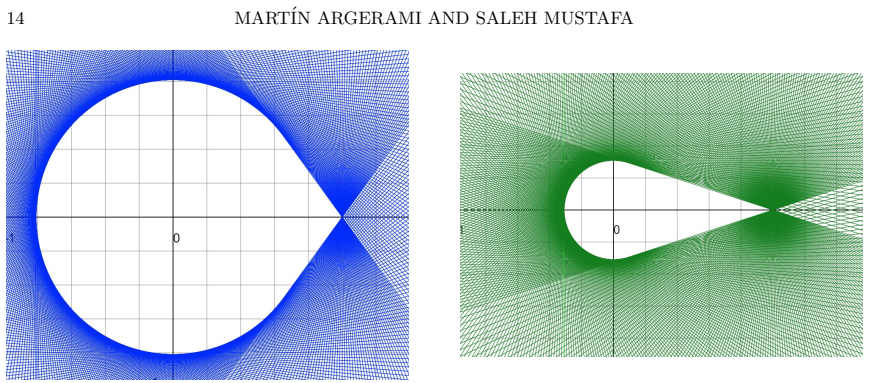
The central claim is Theorem 3.7. For $T=J_n(\alpha)\oplus\beta I_m$ and $1\le k\le n+m$, $\Lambda_k(T)$ is exactly one of the following: the disk $B_{\cos\phi_k}(\alpha)$; that disk together with the wedge $\widetilde E^\psi_k\cap R^\psi_{|\beta-\alpha|,k}$; the same union with an additional cut $B_{\cos\psi_{k,m}}(\alpha)$; the segment $[\alpha,\beta]$; the segment $\{\alpha+t(\beta-\alpha)\cos\eta_{k,m}: t\in[0,1]\}$; the singleton $\{\beta\}$; or the empty set. Which case occurs is determined by comparing $k$ with $n/2$, $k$ with $m$, and $|\beta-\alpha|$ with $\cos(k\pi/(n+1))$ and $\cos((k-m)\pi/(n+1))$. The proof reduces $T$ by translation and rotation to $T^0=e^{-i\psi}J_n(0)\oplus|\beta-\alpha|I_m$; there the eigenvalues of $\operatorname{Re}(e^{i\theta}T^0)$ are $|\beta-\alpha|\cos\theta$ with multiplicity $m$ and $\cos(j\pi/(n+1))$, $j=1,\dots,n$, so the $k$-th eigenvalue is a piecewise function with three possible values. Feeding this into the half-plane characterization turns $\Lambda_k$ into an intersection of half-planes, one for each $\theta$, and the paper evaluates that intersection explicitly in every regime.
Load-bearing premise
The load-bearing premise is the external half-plane characterization of $\Lambda_k(T)$ as the intersection over $\theta$ of the half-planes $\operatorname{Re}(e^{i\theta}\mu)\le\lambda_k(\operatorname{Re}(e^{i\theta}T))$; if that equality failed for arbitrary non-normal matrices the whole table collapses, and a smaller fragility is that the statement sets $\psi=\arg(\beta-\alpha)$ without excluding $\beta=\alpha$ even though several proof steps implicitly assume $\beta\ne\alpha$.
Editorial extensions
If this is right
- For $k\le n/2$ the range is a disk centered at $\alpha$ whenever $|\beta-\alpha|\le\cos(k\pi/(n+1))$; when the separation is larger it is a disk with a wedge attached along tangent lines.
- For $k>n/2$ the range degenerates into a segment, a scaled segment, a singleton, or the empty set; in particular it is empty whenever $k>m$ and $|\beta-\alpha|>\cos((k-m)\pi/(n+1))$.
- The class supplies explicit non-normal matrices, with explicit compressing projections, for which $\Lambda_k$ is nonempty unusually close to the top rank for $n=2,3$ and empty for $n\ge 4$ at rank $N-1$.
- Corners of $\Lambda_k$ need not be eigenvalues and can appear or disappear as $k$ crosses $m$, so the classical circle-boundary theorem for numerical ranges has no higher-rank analogue.
- If two matrices of this form have identical $\Lambda_k$ for every $k$, they are equal; the full hierarchy of higher rank numerical ranges is a complete invariant on this class.
Reading between the lines
- The same half-plane strategy could plausibly handle direct sums of several Jordan blocks with a common eigenvalue plus a scalar block, since the spectrum of the real part would still be an ordered union of cosine sequences; the main difficulty would be combinatorial rather than conceptual.
- The explicit projections exhibited for the singleton cases give a constructive membership certificate for those extreme ranges, which could be useful in compression problems where one must actually build the projection that witnesses $\lambda\in\Lambda_k$.
- The table can be read as an $O(1)$ decision procedure for emptiness and membership in this family; such a procedure could serve as a test oracle for conjectures about higher rank numerical ranges of more general matrices.
- At the threshold $|\beta-\alpha|=\cos(k\pi/(n+1))$ the wedge term collapses into the disk, a phase transition in shape that may be a general phenomenon for sparse non-normal matrices.
Signed reviews
Editorial analysis
A structured set of objections, weighed in public.
Referee Report
Summary. The paper gives a complete explicit description of the higher-rank numerical ranges Λ_k(J_n(α)⊕β I_m) for all k=1,...,n+m. The method applies the Li–Sze half-plane characterization: Λ_k(T) is the intersection of the half-planes Re(e^{iθ}μ)≤λ_k(Re(e^{iθ}T)). The authors reduce the eigenvalue computation to the known spectrum of Re(J_n(0)) and to the scalar block, and then assemble the resulting inequalities into a seven-case table (Theorem 3.7). The paper closes with applications to extremal examples of empty and singleton higher-rank numerical ranges, to corner behaviour, and to a unitary-equivalence rigidity statement (Corollary 4.9).
Significance. If the classification is correct, it is a genuine contribution: it is one of the very few complete higher-rank numerical range computations for a non-normal family, and the shapes that occur (disks, tangent cones, segments, singletons, empty sets) are substantially richer than in earlier examples such as powers of shifts or elliptic Toeplitz matrices. The applications are concrete and interesting, particularly the non-normal examples attaining emptiness for k as low as (n+m)/3+1 and the discussion of the failure of an Anderson-type theorem for k>1. The derivation is structurally sound: it relies on the external Li–Sze theorem and on exact eigenvalue formulas, with no fitted constants or hidden normalizations. The main weaknesses are localized degenerate-case gaps, described below, which do not appear to affect the final formulas but do affect the completeness of the proof as written.
major comments (2)
- [Theorem 3.7 and Proposition 3.6] The statement of Theorem 3.7 begins 'Put ψ = arg(β−α)' without excluding β=α; for β=α this is undefined. This is not merely cosmetic: the degenerate cases in Proposition 3.6 (cases 4, 6 and 7) are proved by asserting that cos φ_k=0 forces δ_k=π/2, but according to the definition in Section 2, δ_k=0 when β=α. The paper's own applications, including Remark 4.3 and Corollary 4.9, explicitly use β=α. A direct Li–Sze computation gives the same listed formulas in the β=α case, so the classification appears salvageable, but as stated Theorem 3.7 is not a well-formed statement for an important case the paper relies on, and the supplied proof does not establish that case.
- [Section 2, Lemma 2.3 and definition of R_{r,k}] Lemma 2.3 is stated under the hypothesis 0<δ_k<π, and the cone R_{r,k} is defined using cot δ_k. However, δ_k attains the values 0 and π inside the parameter range of the theorem: δ_k=0 when β=α (or more generally when the 'otherwise' branch applies), and δ_k=π when k>(n+1)/2 and |β−α|=−cos φ_k>0, e.g., n=5, m=3, k=4, |β−α|=1/2. Proposition 3.2 and the proof of Proposition 3.6 cases 4–7 invoke Lemma 2.3 in precisely these regimes, so the proof does not cover them. The final claims are true (the cone degenerates to {r} in the relevant cases), but a separate argument or an extended statement of Lemma 2.3 is needed for these boundary values.
minor comments (4)
- [Proposition 3.6] The proposition statement reads 'Let T^0_{α,β}=e^{iψ}J_n(0)⊕|β−α|I_m', but throughout Section 3 and in the table inside Proposition 3.6 the correct expression is e^{-iψ}J_n(0)⊕|β−α|I_m; this is a sign typo.
- [Examples 3.8] The description of the drawing script says 'the lines x cosθ−y cosθ = λ_k(T)'; this should be 'x cosθ−y sinθ'.
- [Proposition 3.6, proof of case 4] The text says that ~E_k consists of those μ with non-negative real part; since D_k=[π/2,3π/2], the complement consists of angles in (-π/2,π/2), which give positive real part. The point 0 also belongs to the set and needs to be accounted for separately, for instance by the definition of ~D_k∩B_0(0).
- [Reference [19]] The reference is given as 'J.-L. de Lagrange'; the usual name is J.-L. Lagrange, and the entry should be checked for consistency with the citation in the text.
Circularity Check
No circularity: the classification of Λ_k(J_n(α)⊕βI_m) is derived from the external Li–Sze theorem and explicit eigenvalue computations, with no fitted inputs or load-bearing self-citations.
full rationale
The paper's derivation chain is self-contained in the sense required by the circularity review. The central tool is Theorem 1.1, quoted from Li–Sze [6], an external half-plane characterization of higher-rank numerical ranges. The subsequent work is to compute λ_k(Re(e^{iθ}T^0_{α,β})) for T^0_{α,β} = e^{-iψ}J_n(0)⊕|β−α|I_m; this is done by a standard unitary conjugation reducing Re(e^{i(θ−ψ)}J_n(0)) to Re(J_n(0)), whose eigenvalues are the known numbers cos(jπ/(n+1)). The auxiliary angles δ_k and η_{k,m}, the sets D_k and C_{k,m}, and the cone R_{r,k} are defined from |β−α|, cos φ_k, and cos ψ_{k,m}, not from any measured or fitted value of Λ_k. Lemma 2.3 is a purely analytic equivalence about half-plane inequalities, and Proposition 3.2 converts the Li–Sze inequalities into the stated union of a disk and a cone region. The final table in Theorem 3.7 is exactly the rotated and translated version of Proposition 3.6, with no additional assumption imported from the authors' own prior work. The references used as ingredients—Li–Sze's convexity theorem, the Lagrange eigenvalue computation, and the later extremal examples in Remarks 4.1 and 4.3—are external to this paper and are not invoked to define the target set. There is a real edge-case defect: Theorem 3.7 says 'Put ψ = arg(β−α)' without excluding β=α, and Remark 4.3 later applies the theorem with β=α; also Proposition 3.6's proof of case 4 uses δ_k=π/2 in a situation where the definition would give δ_k=0 when β=α. That is a correctness/rigor gap in a degenerate case, not a circularity: the missing case is not being forced by the definition of Λ_k, and the table's asserted answer {α} is still what a direct Li–Sze computation gives. Overall, no step reduces a prediction to its own input, no fitted parameter is renamed as a prediction, and no load-bearing self-citation chain appears, so the appropriate circularity score is 0.
Assumptions & free parameters
assumptions (3)
- domain assumption Li-Sze formula: Λ_k(T) = {μ : Re(e^{iθ}μ) ≤ λ_k(Re(e^{iθ}T)) for all θ} for T∈M_n(C), 1≤k≤n.
- standard math Affine invariance of higher-rank numerical ranges: Λ_k(αI + e^{iψ}T) = α + e^{iψ}Λ_k(T), and unitary conjugation invariance.
- standard math The eigenvalues of Re(e^{iθ}J_n(0)) are {cos(jπ/(n+1)): j=1,...,n}.
Cite this review
Pith. "Pith review of Higher Rank Numerical Ranges of Jordan-Like Matrices." pith.science (2026). https://pith.science/paper/2MIEVJ22
@misc{pith2026190805692,
  author       = {Pith},
  title        = {Pith review of: Higher Rank Numerical Ranges of Jordan-Like Matrices},
  year         = {2026},
  howpublished = {\url{https://pith.science/paper/2MIEVJ22}},
  note         = {Machine review of arXiv:1908.05692}
}
abstract
We completely characterize the higher rank numerical range of the matrices of the form $J_n(\alpha)\oplus\beta I_m$, where $J_n(\alpha)$ is the $n\times n$ Jordan block with eigenvalue $\alpha$. Our characterization allows us to obtain concrete examples of several extreme properties of higher rank numerical ranges.
Figures


Reference graph
Works this paper leans on
-
[1]
T. Ando. Structure of operators with numerical radius one. Acta Sci. Math. (Szeged), 34:11–15, 1973
work page 1973
-
[2]
K. Bickel and P. Gorkin. Compressions of the shift on the bidisk and their numerical ranges. J. Operator Theory, 79(1):225–265, 2018. HIGHER RANK NUMERICAL RANGES OF JORDAN-LIKE MATRICES 19
work page 2018
-
[3]
H.-L. Gau and C.-K. Li. C ∗-isomorphisms, Jordan isomorphisms, and numerical range pre- serving maps. Proc. Amer. Math. Soc., 135(9):2907–2914, 2007
work page 2007
-
[4]
T. Kato. Perturbation theory for linear operators . Classics in Mathematics. Springer-Verlag, Berlin, 1995. Reprint of the 1980 edition
1995
-
[5]
D. W. Kribs, A. Pasieka, M. Laforest, C. Ryan, and M. P. da Silva. Research problems on numerical ranges in quantum computing. Linear Multilinear Algebra, 57(5):491–502, 2009
work page 2009
-
[6]
C.-K. Li and N.-S. Sze. Canonical forms, higher rank numerical ranges, totally isotropic sub- spaces, and matrix equations. Proceedings of the American Mathematical Society, 136(9):3013– 3023, 2008
work page 2008
- [7]
-
[8]
C.-K. Li. Inequalities relating norms invariant under unitary similarities.Linear and Multilinear Algebra, 29(3-4):155–167, 1991
work page 1991
Show all 26 references
-
[9]
M. N. Spijker. Numerical ranges and stability estimates. Applied Numerical Mathematics, 13(1- 3):241–249, 1993
1993
-
[10]
Horn and R
R. Horn and R. Johnson, Charles. Topics in matrix analysis . Cambridge University Press, Cambridge, UK, 1994
1994
-
[11]
P. R. Halmos. A Hilbert space problem book , volume 19 of Graduate Texts in Mathematics . Springer-Verlag, New York, second edition, 1982. Encyclopedia of Mathematics and its Appli- cations, 17
1982
-
[12]
M.-D. Choi, D. W. Kribs, and K. ˙Zyczkowski. Higher-rank numerical ranges and compression problems. Linear algebra and its applications , 418(2–3):828–839, 2006
2006
-
[13]
H. J. Woerdeman. The higher rank numerical range is convex. Linear Multilinear Algebra , 56(1-2):65–67, 2008
2008
-
[14]
M.-D. Choi, J. A. Holbrook, D. W. Kribs, and K. Zyczkowski. Higher-rank numerical ranges of unitary and normal matrices. Operators and Matrices, 1(3):409–426, 2007
2007
-
[15]
H. Gaaya. On the higher rank numerical range of the shift operator. J. Math. Sci. Adv. Appl. , 13(1):1–19, 2012
2012
-
[16]
M. Adam, A. Aretaki, and I. M. Spitkovsky. Elliptical higher rank numerical range of some Toeplitz matrices. Linear Algebra Appl., 549:256–275, 2018
2018
-
[17]
Chien and H
M.-T. Chien and H. Nakazato. The boundary of higher rank numerical ranges. Linear Algebra Appl., 435(11):2971–2985, 2011
2011
-
[18]
Haagerup and P
U. Haagerup and P. de la Harpe. The numerical radius of a nilpotent operator on a Hilbert space. Proc. Amer. Math. Soc., 115(2):371–379, 1992
1992
-
[19]
de Lagrange
J.-L. de Lagrange. Recherches sur la nature et la propagation du son. Miscellanea Taurinensia, 1:39–148, 1759
-
[20]
Chang, H.-L
C.-T. Chang, H.-L. Gau, and K.-Z. Wang. Equality of higher-rank numerical ranges of matrices. Linear Multilinear Algebra, 62(5):626–638, 2014
2014
-
[21]
W. F. Donoghue. On the numerical range of a bounded operator. The Michigan Mathematical Journal, 4(3):261–263, 1957
1957
-
[22]
Li, Y.-T
C.-K. Li, Y.-T. Poon, and N.-S. Sze. Condition for the higher rank numerical range to be non-empty. Linear Multilinear Algebra, 57(4):365–368, 2009
2009
-
[23]
Tam and S
B.-S. Tam and S. Yang. On matrices whose numerical ranges have circular or weak circu- lar symmetry. Linear Algebra Appl. , 302/303:193–221, 1999. Special issue dedicated to Hans Schneider (Madison, WI, 1998)
1999
-
[24]
P. Y. Wu. Numerical ranges as circular discs. Appl. Math. Lett. , 24(12):2115–2117, 2011
2011
-
[25]
Gau and P
H.-L. Gau and P. Wu. Anderson’s theorem for compact operators. Proceedings of the American Mathematical Society, 134(11):3159–3162, 2006
2006
-
[26]
Gau and P
H.-L. Gau and P. Y. Wu. Higher-rank numerical ranges and Kippenhahn polynomials. Linear Algebra Appl., 438(7):3054–3061, 2013. 20 MART ´IN ARGERAMI AND SALEH MUSTAFA Department of Mathematics and Statistics, University of Regina E-mail address : argerami@uregina.ca
2013
Reviewed August 14, 2026 · model on record in the stance chip above.
Discussion (0). Continue with ORCID to comment.