Semantics-Aware Bilevel Co-Evolution: Towards Automated Multicomponent Algorithm Design
Pith reviewed 2026-06-30 03:52 UTC · model grok-4.3
The pith
STABLE uses bilevel co-evolution and a multi-faceted semantic model to automate the design of multicomponent algorithms.
A machine-rendered reading of the paper's core claim, the machinery that carries it, and where it could break.
Core claim
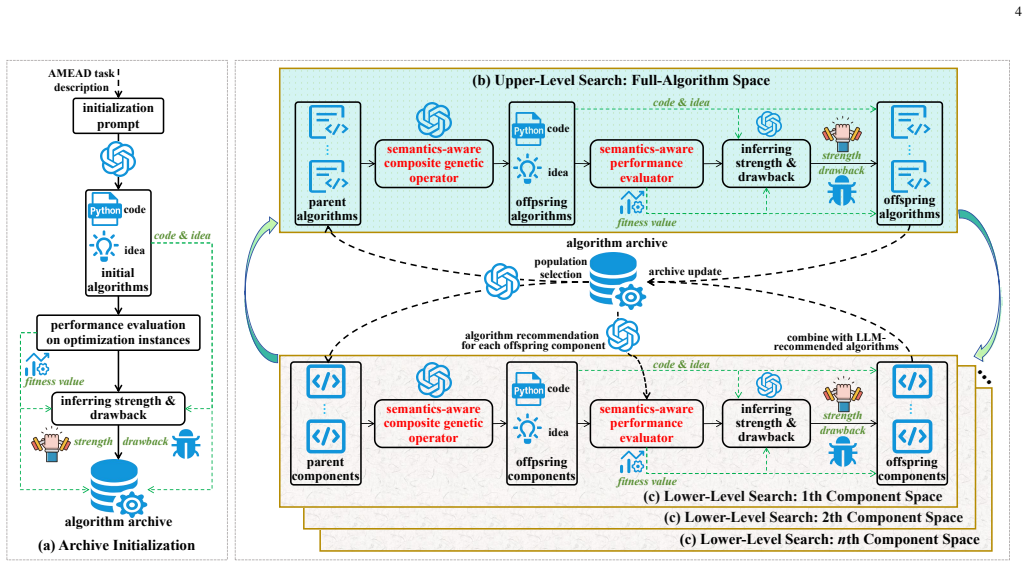
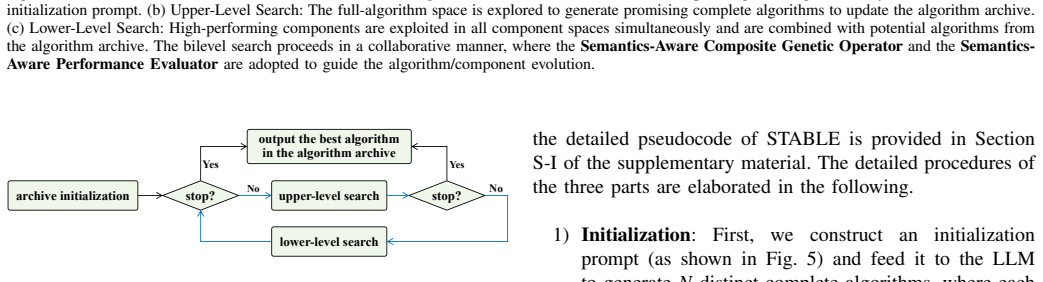
STABLE organizes complex algorithms into hierarchical and modular architectures rooted in domain knowledge. It simultaneously optimizes high-level multicomponent configurations and low-level functional components through coordinated cross-level updates. At each level, a multi-faceted semantic model assists LLMs in capturing structural correlations, functional compatibilities, and inherent rationalities among algorithm components, serving as core guidance for evolutionary search and enabling principled generation and evaluation of algorithms.
What carries the argument
Bilevel co-evolution guided by a multi-faceted semantic model that captures structural correlations, functional compatibilities, and inherent rationalities among algorithm components.
If this is right
- Coordinated updates across levels allow suitable granularities for design space exploration.
- The semantic model enables principled algorithm generation and evaluation.
- High-quality components can be reused more effectively in multicomponent setups.
- Search efficiency improves for complex design spaces compared to existing LES methods.
- Resulting algorithms outperform human-designed baselines in experiments.
Where Pith is reading between the lines
- Semantic guidance could be applied to other automated design tasks beyond algorithms.
- The hierarchical structure might generalize to different types of multicomponent systems.
- Testing the method on additional problem domains would reveal its broader applicability.
- Integrating more domain knowledge could further enhance the semantic model's effectiveness.
Load-bearing premise
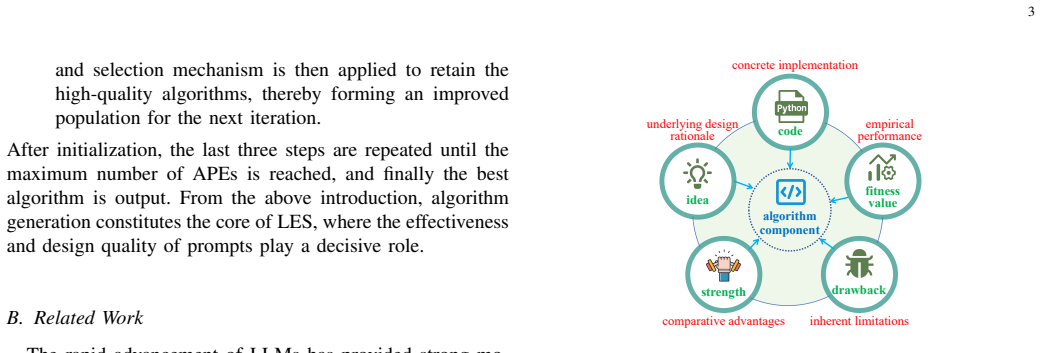
The multi-faceted semantic model accurately captures structural correlations, functional compatibilities, and inherent rationalities among algorithm components so that LLM-guided evolution produces valid and superior designs.
What would settle it
Experiments showing that designs generated with the semantic model are no better or more often invalid than those from non-semantic or single-level evolution methods.
Figures

read the original abstract
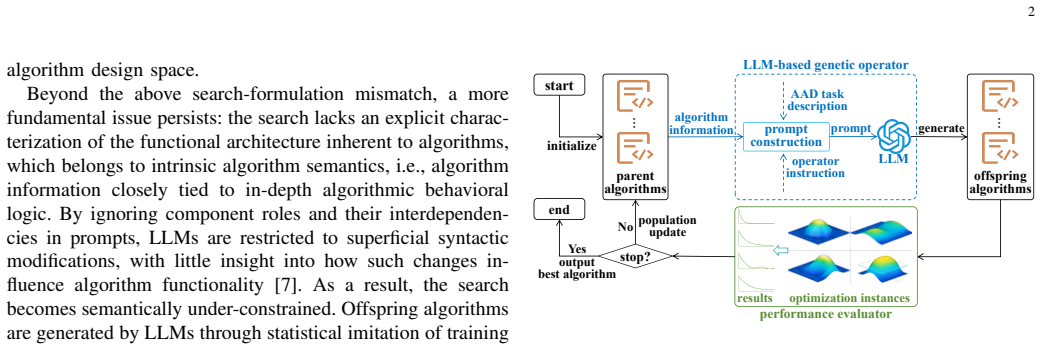
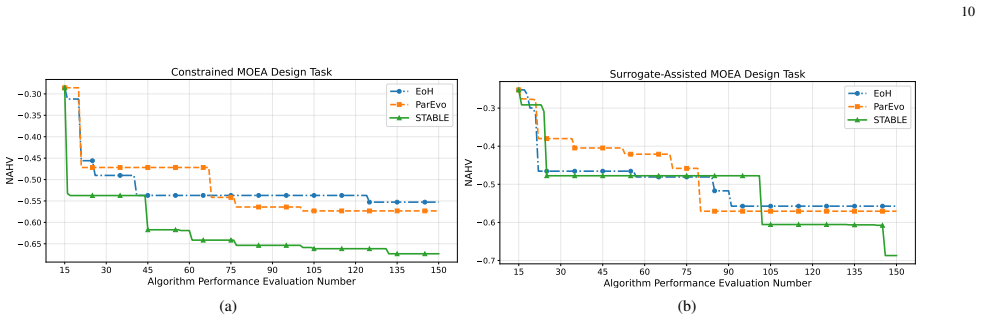
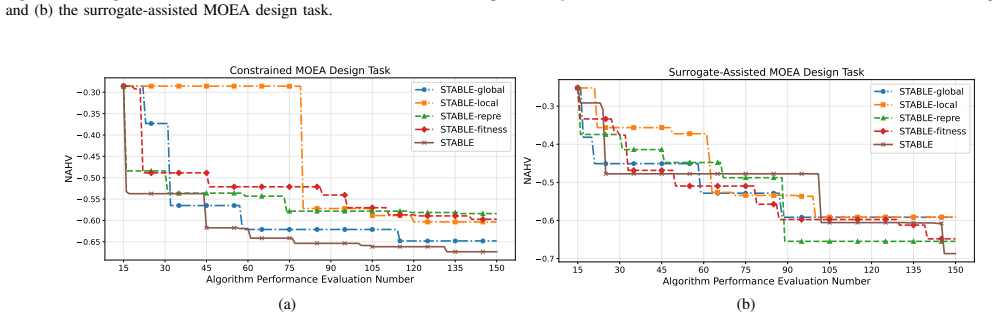
LLM-assisted evolutionary search (LES) has emerged as a promising paradigm for automated algorithm design. However, existing methods usually suffer from two inherent limitations when facing the automated design of real-world complex algorithms that usually consist of multiple components. The first limitation is that they either focus on modifying entire algorithms, making it difficult to reuse high-quality components, or concentrate on component refinement within a limited set of predefined multicomponent configurations. The second limitation is the insufficient explicit modeling and exploitation of algorithm semantics. These limitations severely degrade search efficiency and hinder effective exploration of complex design spaces. Therefore, this paper proposes STABLE (Semantics-Aware Bilevel Co-Evolution), an LES method purpose-built for automated multicomponent algorithm design that introduces structural algorithm formulation and semantics-driven evolution. In STABLE, complex algorithms are organized into hierarchical and modular architectures rooted in domain knowledge, aligning the search space with their intrinsic compositional traits. Based on this structured algorithm formulation, STABLE simultaneously optimizes high-level multicomponent configurations and low-level functional components, enabling coordinated cross-level updates while maintaining suitable granularities for design space exploration. At each level, STABLE establishes a multi-faceted semantic model to assist LLMs in capturing structural correlations, functional compatibilities, and inherent rationalities among algorithm components. This semantic model serves as the core guidance for evolutionary search, enabling principled algorithm generation and algorithm evaluation. Extensive experiments demonstrate that STABLE outperform both human-designed baselines and those from advanced LES methods.
Editorial analysis
A structured set of objections, weighed in public.
Referee Report
Summary. The manuscript proposes STABLE, a semantics-aware bilevel co-evolution framework for LLM-assisted evolutionary search (LES) targeted at automated design of multicomponent algorithms. Complex algorithms are organized into hierarchical modular architectures; the method performs simultaneous bilevel optimization over high-level multicomponent configurations and low-level functional components while using a multi-faceted semantic model (capturing structural correlations, functional compatibilities, and inherent rationalities) to guide LLM-based generation and evaluation at each level. The central claim is that extensive experiments show STABLE outperforming both human-designed baselines and advanced LES methods.
Significance. If the empirical results are robust and the contribution of the semantic model is isolated, the bilevel hierarchical formulation combined with explicit semantic guidance could meaningfully advance automated multicomponent algorithm design by improving search efficiency and validity in large compositional spaces. The approach directly targets two stated limitations of prior LES work (whole-algorithm vs. limited-configuration focus and insufficient semantic modeling).
major comments (2)
- [Experiments] Experiments section: The central empirical claim attributes outperformance to the multi-faceted semantic model guiding component choices. No ablation is described that compares semantics-guided prompts against random or generic LLM prompts (or bilevel evolution without the semantic model) at either level. Without such controls, gains cannot be attributed to the claimed mechanism rather than the bilevel structure or LLM prompting alone; this is load-bearing for the methodological contribution.
- [Abstract / §1] Abstract and §1: The abstract states that 'extensive experiments demonstrate that STABLE outperform both human-designed baselines and those from advanced LES methods' yet supplies no quantitative metrics, error bars, baseline specifications, statistical tests, or number of runs. This absence prevents evaluation of the strength of evidence supporting the outperformance claim.
minor comments (1)
- [Method] The description of the semantic model (structural correlations, functional compatibilities, inherent rationalities) is high-level; concrete implementation details (e.g., how these facets are encoded as prompts or features) would improve reproducibility.
Simulated Author's Rebuttal
We thank the referee for the constructive feedback. We address each major comment below and will revise the manuscript to strengthen the presentation of results and attribution of contributions.
read point-by-point responses
-
Referee: [Experiments] Experiments section: The central empirical claim attributes outperformance to the multi-faceted semantic model guiding component choices. No ablation is described that compares semantics-guided prompts against random or generic LLM prompts (or bilevel evolution without the semantic model) at either level. Without such controls, gains cannot be attributed to the claimed mechanism rather than the bilevel structure or LLM prompting alone; this is load-bearing for the methodological contribution.
Authors: We agree that an explicit ablation isolating the multi-faceted semantic model's contribution is necessary to substantiate the central claim. While the existing comparisons to advanced LES methods provide some differentiation, they do not fully control for prompting variations or the absence of semantic guidance. In the revised manuscript we will add targeted ablation experiments at both the high-level configuration and low-level component stages, directly comparing semantics-guided prompts against random/generic LLM prompts and against bilevel evolution without the semantic model. These controls will clarify the incremental benefit of the semantic component. revision: yes
-
Referee: [Abstract / §1] Abstract and §1: The abstract states that 'extensive experiments demonstrate that STABLE outperform both human-designed baselines and those from advanced LES methods' yet supplies no quantitative metrics, error bars, baseline specifications, statistical tests, or number of runs. This absence prevents evaluation of the strength of evidence supporting the outperformance claim.
Authors: We acknowledge that the abstract and introduction would be strengthened by including representative quantitative details. The full experimental section reports performance metrics, run counts, and statistical comparisons, but these were not summarized at the front matter. We will revise the abstract and §1 to incorporate key quantitative findings (e.g., mean performance deltas, number of independent runs, standard deviations or error bars, baseline specifications, and mention of the statistical tests employed) while remaining within length constraints. revision: yes
Circularity Check
No circularity: empirical method with no self-referential derivations or fitted predictions
full rationale
The paper proposes STABLE as an LES framework for multicomponent algorithm design, relying on hierarchical formulation, bilevel optimization, and a multi-faceted semantic model to guide LLMs. No equations, parameter fits, or derivation chains are described that would reduce a claimed result to its own inputs by construction. Claims of superiority rest on experimental comparisons rather than any self-definitional, fitted-input, or self-citation load-bearing structure. The method is self-contained as an empirical proposal; external benchmarks or ablations would address evidence strength but do not indicate circularity in the presented chain.
Axiom & Free-Parameter Ledger
Reference graph
Works this paper leans on
-
[1]
A novel evolutionary Bayesian optimization algorithm based on decomposition for expensive constrained multiobjective optimization problems,
Z. Zhang, Y . Wang, G. Sun, and T. Pang, “A novel evolutionary Bayesian optimization algorithm based on decomposition for expensive constrained multiobjective optimization problems,”IEEE Transactions on Systems, Man, and Cybernetics: Systems, vol. 56, no. 2, pp. 945– 957, 2026
2026
-
[2]
Toward automated algorithm design: A survey and practical guide to meta-black-box- optimization,
Z. Ma, H. Guo, Y .-J. Gong, J. Zhang, and K. C. Tan, “Toward automated algorithm design: A survey and practical guide to meta-black-box- optimization,”IEEE Transactions on Evolutionary Computation, pp. 1– 1, 2025
2025
-
[3]
Large language model-enhanced algorithm selection: Towards comprehensive algorithm representation,
X. Wu, Y . Zhong, J. Wu, B. Jiang, and K. C. Tan, “Large language model-enhanced algorithm selection: Towards comprehensive algorithm representation,” inProceedings of the 33rd International Joint Confer- ence on Artificial Intelligence, IJCAI 2024, 2024, pp. 5235–5244. 13 TABLE II RESULTS ONMWTESTSUITE. Problemm D CCMO θ-DEA-CPBI ShiP DRLOS-EMCMO DVCEA C...
2024
-
[4]
LLM-driven evolutionary algorithm selection: Bidirectional framework and sampling paradigm,
X. Wu, Y . Feng, and J. Wu, “LLM-driven evolutionary algorithm selection: Bidirectional framework and sampling paradigm,” in2025 International Conference on Machine Intelligence and Nature-Inspired Computing (MIND). IEEE, 2025, pp. 1–7
2025
-
[5]
Z. Li, H. Rahmani, J. Zhang, Y . Xue, M. Mirmehdi, J. Kuen, J. Gu, and J. Liu, “DiffGraph: An automated agent-driven model merging framework for in-the-wild text-to-image generation,”ArXiv Preprint ArXiv:2603.20470, 2026
-
[6]
Evolutionary computation in the era of large language model: Survey and roadmap,
X. Wu, S.-H. Wu, J. Wu, L. Feng, and K. C. Tan, “Evolutionary computation in the era of large language model: Survey and roadmap,” IEEE Transactions on Evolutionary Computation, vol. 29, no. 2, pp. 534–554, 2025
2025
-
[7]
A systematic survey on large language models for algorithm design,
F. Liu, Y . Yao, P. Guo, Z. Yang, X. Lin, Z. Zhao, X. Tong, K. Mao, Z. Lu, Z. Wanget al., “A systematic survey on large language models for algorithm design,”ACM Computing Surveys, vol. 58, no. 8, pp. 1–32, 2026
2026
-
[8]
Partition to evolve: Niching-enhanced evolution with LLMs for automated algorithm discovery,
Q. Hu and Q. Zhang, “Partition to evolve: Niching-enhanced evolution with LLMs for automated algorithm discovery,” inThe Thirty-ninth Annual Conference on Neural Information Processing Systems, 2025
2025
-
[9]
Multiobjective evolutionary algorithms: A survey of the state of the art,
A. Zhou, B.-Y . Qu, H. Li, S.-Z. Zhao, P. N. Suganthan, and Q. Zhang, “Multiobjective evolutionary algorithms: A survey of the state of the art,”Swarm and Evolutionary Computation, vol. 1, no. 1, pp. 32–49, 2011
2011
-
[10]
Large language model-driven neural–heuristic optimiza- tion for large-scale routing problems,
G. Li, X. Dong, L. Cui, W. Gao, Y . Zhou, Q. Lin, and C. A. 14 Coello Coello, “Large language model-driven neural–heuristic optimiza- tion for large-scale routing problems,”IEEE Transactions on Evolution- ary Computation, 2026, in press. DOI: 10.1109/TEVC.2026.3690665
-
[11]
A survey on cooperative co-evolutionary algorithms,
X. Ma, X. Li, Q. Zhang, K. Tang, Z. Liang, W. Xie, and Z. Zhu, “A survey on cooperative co-evolutionary algorithms,”IEEE Transactions on Evolutionary Computation, vol. 23, no. 3, pp. 421–441, 2019
2019
-
[12]
Exploring automated algorithm design synergiz- ing large language models and evolutionary algorithms: Survey and insights,
H. Yu and J. Liu, “Exploring automated algorithm design synergiz- ing large language models and evolutionary algorithms: Survey and insights,”Evolutionary Computation, pp. 1–28, 2026
2026
-
[13]
Fitness landscape of large language model-assisted automated algorithm search,
F. Liu, Q. Zhang, J. Shi, X. Tong, K. Mao, and M. Yuan, “Fitness landscape of large language model-assisted automated algorithm search,” ArXiv Preprint ArXiv:2504.19636, 2025
-
[14]
Towards robustness and explainability of automatic algorithm selection,
X. Wu, J. Wu, Y . Zhou, L. Feng, and K. C. Tan, “Towards robustness and explainability of automatic algorithm selection,” inForty-second International Conference on Machine Learning, 2025
2025
-
[15]
Unlock the power of algorithm features: A generalization analysis for algorithm selection,
X. Wu, Y . Zhong, J. Wu, Y . Huang, S.-h. Wu, and K. C. Tan, “Unlock the power of algorithm features: A generalization analysis for algorithm selection,”arXiv preprint arXiv:2405.11349, 2024
-
[16]
Mathematical discoveries from program search with large language models,
B. Romera-Paredes, M. Barekatain, A. Novikov, M. Balog, M. P. Kumar, E. Dupont, F. J. Ruiz, J. S. Ellenberg, P. Wang, O. Fawziet al., “Mathematical discoveries from program search with large language models,”Nature, vol. 625, no. 7995, pp. 468–475, 2024
2024
-
[17]
HSEvo: Elevating automatic heuristic design with diversity-driven harmony search and genetic algori- thm using LLMs,
P. V . T. Dat, L. Doan, and H. T. T. Binh, “HSEvo: Elevating automatic heuristic design with diversity-driven harmony search and genetic algori- thm using LLMs,” inProceedings of the AAAI Conference on Artificial Intelligence, vol. 39, no. 25, 2025, pp. 26 931–26 938
2025
-
[18]
Multi-objective evolution of heuristic using large language model,
S. Yao, F. Liu, X. Lin, Z. Lu, Z. Wang, and Q. Zhang, “Multi-objective evolution of heuristic using large language model,” inProceedings of the AAAI Conference on Artificial Intelligence, vol. 39, no. 25, 2025, pp. 27 144–27 152
2025
-
[19]
AutoMOAE: Multi- objective auto-algorithm evolution,
S. Mo, Y . Yang, K. Wu, X. Zhang, and H. Wang, “AutoMOAE: Multi- objective auto-algorithm evolution,” 2025
2025
-
[20]
Evolution of heuristics: Towards efficient automatic algori- thm design using large language model,
F. Liu, T. Xialiang, M. Yuan, X. Lin, F. Luo, Z. Wang, Z. Lu, and Q. Zhang, “Evolution of heuristics: Towards efficient automatic algori- thm design using large language model,” inForty-first International Conference on Machine Learning, 2024
2024
-
[21]
EoH-S: Evolution of heuristic set using llms for automated heuristic design,
F. Liu, Y . Liu, Q. Zhang, T. Xialiang, and M. Yuan, “EoH-S: Evolution of heuristic set using llms for automated heuristic design,” inProceedings of the AAAI Conference on Artificial Intelligence, vol. 40, no. 43, 2026, pp. 37 090–37 098
2026
-
[22]
Gener- alizable heuristic generation through LLMs with meta-optimization,
Y . Shi, J. Zhou, W. Song, J. Bi, Y . Wu, Z. Cao, and J. Zhang, “Gener- alizable heuristic generation through LLMs with meta-optimization,” in The Fourteenth International Conference on Learning Representations, 2026
2026
-
[23]
ReEvo: Large language models as hyper-heuristics with reflective evolution,
H. Ye, J. Wang, Z. Cao, F. Berto, C. Hua, H. Kim, J. Park, and G. Song, “ReEvo: Large language models as hyper-heuristics with reflective evolution,”Advances in Neural Information Processing Systems, vol. 37, pp. 43 571–43 608, 2024
2024
-
[24]
EvolCAF: Automatic cost-aware acquisition function design using large language models,
Y . Yao, F. Liu, J. Cheng, and Q. Zhang, “EvolCAF: Automatic cost-aware acquisition function design using large language models,” Evolutionary Computation, pp. 1–24, 01 2026, in press. DOI: 10.1162/EVCO.a.379
-
[25]
Au- tonomous multi-objective optimization using large language model,
Y . Huang, S. Wu, W. Zhang, J. Wu, L. Feng, and K. C. Tan, “Au- tonomous multi-objective optimization using large language model,” IEEE Transactions on Evolutionary Computation, pp. 1–1, 2025, in press. DOI: 10.1109/TEVC.2025.3561001
-
[26]
Adaptive kernel design for Bayesian optimization is a piece of CAKE with LLMs,
R. C. Suwandi, F. Yin, J. Wang, R. Li, T.-H. Chang, and S. Theodor- idis, “Adaptive kernel design for Bayesian optimization is a piece of CAKE with LLMs,” inThe Thirty-ninth Annual Conference on Neural Information Processing Systems, 2025
2025
-
[27]
CodeBLEU: a Method for Automatic Evaluation of Code Synthesis
S. Ren, D. Guo, S. Lu, L. Zhou, S. Liu, D. Tang, N. Sundaresan, M. Zhou, A. Blanco, and S. Ma, “CodeBLEU: A method for automatic evaluation of code synthesis,”ArXiv Preprint ArXiv:2009.10297, 2020
work page internal anchor Pith review Pith/arXiv arXiv 2009
-
[28]
Fitness inheritance in multi-objective optimization
J.-H. Chen, D. E. Goldberg, S.-Y . Ho, and K. Sastry, “Fitness inheritance in multi-objective optimization.” inGECCO, vol. 2. Citeseer, 2002, pp. 319–326
2002
-
[29]
An indicator- based evolutionary algorithm for large-scale constrained multiobjective optimization,
X. Zhong, X. Yao, K. Qiao, D. Gong, and Y . Jin, “An indicator- based evolutionary algorithm for large-scale constrained multiobjective optimization,”IEEE Transactions on Evolutionary Computation, vol. 30, no. 1, pp. 271–285, 2026
2026
-
[30]
A multitasking-based constrained multi-objective evolutionary algorithm with forward and backward stages,
X. Zhong, X. Yao, K. Qiao, and D. Gong, “A multitasking-based constrained multi-objective evolutionary algorithm with forward and backward stages,”IEEE Transactions on Emerging Topics in Compu- tational Intelligence, vol. 8, no. 5, pp. 3474–3488, 2024
2024
-
[31]
X. Zhong, X. Yao, K. Qiao, D. Gong, and Y . Jin, “A large-scale con- strained multi-objective evolutionary algorithm with promising region detection and diversity enhancement,”IEEE Transactions on Evolution- ary Computation, 2026, in press. DOI:10.1109/TEVC.2026.3681168
-
[32]
ExTrEMO: Transfer evolu- tionary multiobjective optimization with proof of faster convergence,
J. Liu, A. Gupta, C. Ooi, and Y .-S. Ong, “ExTrEMO: Transfer evolu- tionary multiobjective optimization with proof of faster convergence,” IEEE Transactions on Evolutionary Computation, vol. 29, no. 1, pp. 102–116, 2025
2025
-
[33]
A Kriging-assisted evolutionary algorithm with dual perspectives and dual indicators for expensive robust multiobjective optimization,
W. Chen, Y . Wang, Z. Zhang, G. Sun, and T. Pang, “A Kriging-assisted evolutionary algorithm with dual perspectives and dual indicators for expensive robust multiobjective optimization,”IEEE Transactions on Cybernetics, vol. 56, no. 3, pp. 1296–1309, 2026
2026
-
[34]
Constrained probabilistic Pareto dominance for expensive constrained multiobjective optimization problems,
Z. Zhang, Y . Wang, G. Sun, T. Pang, and K. Tang, “Constrained probabilistic Pareto dominance for expensive constrained multiobjective optimization problems,”IEEE Transactions on Evolutionary Computa- tion, vol. 29, no. 4, pp. 1138–1152, 2025
2025
-
[35]
A fast and elitist multiobjective genetic algorithm: NSGA-II,
K. Deb, A. Pratap, S. Agarwal, and T. Meyarivan, “A fast and elitist multiobjective genetic algorithm: NSGA-II,”IEEE Transactions on Evolutionary Computation, vol. 6, no. 2, pp. 182–197, 2002
2002
-
[36]
MOEA/D: A multiobjective evolutionary algorithm based on decomposition,
Q. Zhang and H. Li, “MOEA/D: A multiobjective evolutionary algorithm based on decomposition,”IEEE Transactions on Evolutionary Compu- tation, vol. 11, no. 6, pp. 712–731, 2007
2007
-
[37]
Indicator-based selection in multiobjective search,
E. Zitzler and S. K ¨unzli, “Indicator-based selection in multiobjective search,” inInternational Conference on Parallel Problem Solving from Nature. Springer, 2004, pp. 832–842
2004
-
[38]
Shift-based penalty for evolutionary constrained multiobjective optimization and its application,
Z. Ma and Y . Wang, “Shift-based penalty for evolutionary constrained multiobjective optimization and its application,”IEEE Transactions on Cybernetics, vol. 53, no. 1, pp. 18–30, 2023
2023
-
[39]
A comprehensive survey of fitness approximation in evolutionary computation,
Y . Jin, “A comprehensive survey of fitness approximation in evolutionary computation,”Soft Computing, vol. 9, no. 1, pp. 3–12, 2005
2005
-
[40]
Evolutionary constrained multiobjective opti- mization: Test suite construction and performance comparisons,
Z. Ma and Y . Wang, “Evolutionary constrained multiobjective opti- mization: Test suite construction and performance comparisons,”IEEE Transactions on Evolutionary Computation, vol. 23, no. 6, pp. 972–986, 2019
2019
-
[41]
Scalable test problems for evolutionary multiobjective optimization,
K. Deb, L. Thiele, M. Laumanns, and E. Zitzler, “Scalable test problems for evolutionary multiobjective optimization,” inEvolutionary Multiob- jective Optimization: Theoretical Advances and Applications. Springer, 2005, pp. 105–145
2005
-
[42]
DeepSeek-V3.2: Pushing the Frontier of Open Large Language Models
A. Liu, A. Mei, B. Lin, B. Xue, B. Wang, B. Xu, B. Wu, B. Zhang, C. Lin, C. Donget al., “DeepSeek-V3.2: Pushing the frontier of open large language models,”ArXiv Preprint ArXiv:2512.02556, 2025
work page internal anchor Pith review Pith/arXiv arXiv 2025
-
[43]
A coevolutionary framework for constrained multiobjective optimization problems,
Y . Tian, T. Zhang, J. Xiao, X. Zhang, and Y . Jin, “A coevolutionary framework for constrained multiobjective optimization problems,”IEEE Transactions on Evolutionary Computation, vol. 25, no. 1, pp. 102–116, 2021
2021
-
[44]
A constraint-handling tech- nique for decomposition-based constrained many-objective evolutionary algorithms,
F. Ming, W. Gong, L. Wang, and L. Gao, “A constraint-handling tech- nique for decomposition-based constrained many-objective evolutionary algorithms,”IEEE Transactions on Systems, Man, and Cybernetics: Systems, vol. 53, no. 12, pp. 7783–7793, 2023
2023
-
[45]
Constrained multi-objective op- timization with deep reinforcement learning assisted operator selection,
F. Ming, W. Gong, L. Wang, and Y . Jin, “Constrained multi-objective op- timization with deep reinforcement learning assisted operator selection,” IEEE/CAA Journal of Automatica Sinica, vol. 11, no. 4, pp. 919–931, 2024
2024
-
[46]
A decision variables classification-based evolutionary algorithm for constrained multi-objective optimization problems,
X. Ban, J. Liang, K. Qiao, K. Yu, Y . Wang, J. Peng, and B. Qu, “A decision variables classification-based evolutionary algorithm for constrained multi-objective optimization problems,”IEEE/CAA Journal of Automatica Sinica, vol. 12, no. 9, pp. 1830–1849, 2025
2025
-
[47]
Constrained test problems for multi-objective evolutionary optimization,
K. Deb, A. Pratap, and T. Meyarivan, “Constrained test problems for multi-objective evolutionary optimization,” inInternational Conference on Evolutionary Multi-Criterion Optimization. Springer, 2001, pp. 284– 298
2001
-
[48]
A surrogate-assisted reference vector guided evolutionary algorithm for computationally expensive many-objective optimization,
T. Chugh, Y . Jin, K. Miettinen, J. Hakanen, and K. Sindhya, “A surrogate-assisted reference vector guided evolutionary algorithm for computationally expensive many-objective optimization,”IEEE Trans- actions on Evolutionary Computation, vol. 22, no. 1, pp. 129–142, 2018
2018
-
[49]
Evolutionary optimization of high-dimensional multiobjective and many-objective expensive problems assisted by a dropout neural network,
D. Guo, X. Wang, K. Gao, Y . Jin, J. Ding, and T. Chai, “Evolutionary optimization of high-dimensional multiobjective and many-objective expensive problems assisted by a dropout neural network,”IEEE Trans- actions on Systems, Man, and Cybernetics: Systems, vol. 52, no. 4, pp. 2084–2097, 2022
2084
-
[50]
Multiple classifiers-assisted evolutionary algorithm based on decomposition for high-dimensional multiobjective problems,
T. Sonoda and M. Nakata, “Multiple classifiers-assisted evolutionary algorithm based on decomposition for high-dimensional multiobjective problems,”IEEE Transactions on Evolutionary Computation, vol. 26, no. 6, pp. 1581–1595, 2022
2022
-
[51]
Self-organizing surrogate-assisted non-dominated sorting differential evolution,
A. F. Araujo, L. R. Farias, and A. R. Goncalves, “Self-organizing surrogate-assisted non-dominated sorting differential evolution,”Swarm and Evolutionary Computation, vol. 91, p. 101703, 2024. 15
2024
-
[52]
A distribution information- based Kriging-assisted evolutionary algorithm for expensive many- objective optimization problems,
Z. Zhang, Y . Wang, G. Sun, and T. Pang, “A distribution information- based Kriging-assisted evolutionary algorithm for expensive many- objective optimization problems,”IEEE Transactions on Evolutionary Computation, vol. 29, no. 6, pp. 2656–2670, 2025
2025
-
[53]
Multiobjective optimization test instances for the CEC 2009 special session and competition
Q. Zhang, A. Zhou, S. Zhao, P. N. Suganthan, W. Liu, S. Tiwariet al., “Multiobjective optimization test instances for the CEC 2009 special session and competition.”
2009
-
[54]
Modified distance calculation in generational distance and inverted generational distance,
H. Ishibuchi, H. Masuda, Y . Tanigaki, and Y . Nojima, “Modified distance calculation in generational distance and inverted generational distance,” inInternational Conference on Evolutionary Multi-Criterion Optimization. Springer, 2015, pp. 110–125
2015
-
[55]
PlatEMO: A MATLAB plat- form for evolutionary multi-objective optimization [educational forum],
Y . Tian, R. Cheng, X. Zhang, and Y . Jin, “PlatEMO: A MATLAB plat- form for evolutionary multi-objective optimization [educational forum],” IEEE Computational Intelligence Magazine, vol. 12, no. 4, pp. 73–87, 2017
2017
discussion (0)
Sign in with ORCID, Apple, or X to comment. Anyone can read and Pith papers without signing in.