REVIEW 1 major objections 4 minor 12 references
Projectively equivalent Finsler metrics on surfaces of negative Euler characteristic
T0 review · 1 major / 4 minor · reviewed 2026-08-14 · deepseek-v4-flash
Pith's one-line read On a closed surface with negative Euler characteristic, two real-analytic Finsler metrics are projectively equivalent exactly when one is a constant scaling of the other plus a closed 1-form.
desk verdict Plausible and likely correct Finsler analogue of Matveev–Topalov, held back by a fixable gap in the positive-entropy input. read the letter →
The pith
A machine-rendered reading of the paper's core claim, the machinery that carries it, and where it could break.
The reading
What carries the argument
The driving object is the fiber-Hessian proportionality factor $I(x,\xi) = \operatorname{tr}\hat{h}/\operatorname{tr}\check{h}$, where $\hat{h}_{ij} = \hat{F}_{\xi^i\xi^j}$ and $\check{h}_{ij} = \check{F}_{\xi^i\xi^j}$. On a surface the fiber Hessian is determined by its trace through equation (1), which is why $I$ is well-defined; differentiating the projective-equivalence equations shows $S(I) = 0$ along the geodesic spray. The argument then pits two entropy facts against each other: exponential growth of $\pi_1(S)$ forces positive topological entropy of the geodesic flow, while a real-analytic integral independent of the Hamiltonian would force zero topological entropy. Together with real analyticity, this clash forces $I$ to be constant.
What would settle it
A decisive check is whether the volume-growth argument in Section 3 can be completed without assuming the maximal generator length $s_0$ satisfies $s_0 < 2$; for a generating set with $s_0 \ge 2$, the inequality $\tilde{\mu}(U_{r_i}) \ge e^{(k/2)r_i}$ is not derived. Finding a compact surface with exponentially growing fundamental group and a Finsler geodesic flow of zero topological entropy would also refute the entropy proposition outright.
Extended reading notes
Core claim
The central claim is Theorem 1: on a closed surface $S$ with negative Euler characteristic, two real-analytic Finsler metrics are projectively equivalent exactly when $\hat{F} = \lambda \check{F} + \beta$ for a constant $\lambda > 0$ and a closed 1-form $\beta$. The proof shows that projective equivalence makes the fiber-Hessian proportionality factor $I(x,\xi) = \operatorname{tr}\hat{h}/\operatorname{tr}\check{h}$ independent of local coordinates and constant along the geodesic sprays of both metrics. Since the fundamental group of $S$ grows exponentially, the geodesic flow has positive topological entropy, while a classical theorem on integrable Hamiltonian systems says a real-analytic integral independent of the Hamiltonian would make the entropy vanish. By real analyticity this contradiction forces $I$ to be constant, making the two Hessians proportional; projective equivalence of the rescaled pair then forces the remaining 1-form to be closed.
Load-bearing premise
Everything depends on the claim that the geodesic flow of a compact manifold with exponentially growing fundamental group has positive topological entropy; the paper's proof of that claim assumes a bound on the length of generating loops that is not shown to hold.
Editorial extensions
If this is right
- On every closed surface of negative Euler characteristic, real-analytic Finsler metrics have no nontrivial real-analytic projective deformations: any two with the same unparametrized geodesics are related by a constant dilation and a closed 1-form.
- Real-analytic projective equivalence on such surfaces is therefore described by an affine-linear family: one positive scalar parameter plus the linear space of closed 1-forms.
- The entropy argument carries Riemannian geodesic rigidity over to Finsler geometry in the real-analytic category, so any counterexample to the rigidity statement must fail to be real-analytic.
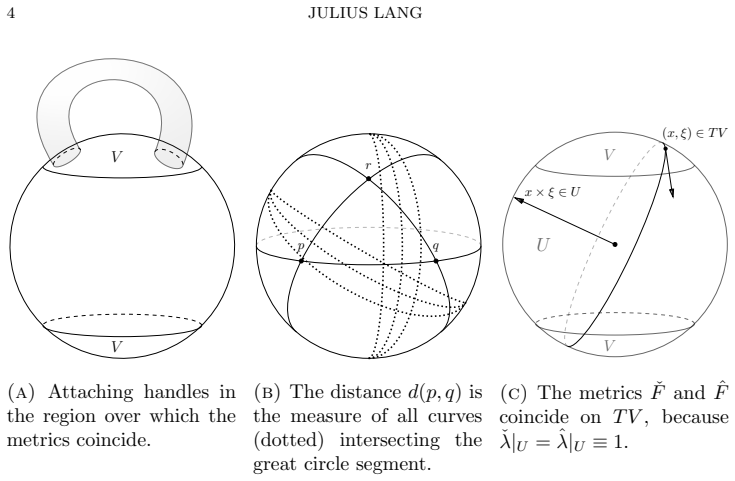
- The smooth construction on the sphere, combined with attaching handles away from the region where the two metrics agree, produces projectively equivalent but not affinely related Finsler metrics on every closed surface, showing the real-analytic assumption is essential.
Reading between the lines
- Because the proof relies only on the dimension-two trace identity for fiber Hessians, an analogous real-analytic rigidity statement in higher dimensions would need a different source of integrals; the paper leaves that question open.
- A direct test of the entropy proposition would be to search for a Finsler metric on a compact surface with exponentially growing fundamental group whose geodesic flow has zero topological entropy; a positive example would block this proof route even if the final theorem remains true.
- The counterexample construction from measures on the space of geodesics is flexible enough that the smooth non-real-analytic phenomenon is probably generic, making real-analyticity the natural sharp boundary for projective rigidity.
Signed reviews
Editorial analysis
A structured set of objections, weighed in public.
Referee Report
Summary. The paper proves that on a closed surface of negative Euler characteristic, two real-analytic Finsler metrics are projectively equivalent if and only if they differ by a constant positive scale and the addition of a closed 1-form (Theorem 1). The proof proceeds in three steps: (a) the ratio I of the traces of the vertical Hessians of the two metrics is a common integral of the two geodesic flows; (b) the geodesic flow of a Finsler metric on a compact manifold whose fundamental group has exponential growth has positive topological entropy; and (c) a theorem of Paternain stating that a real-analytic Hamiltonian system with an independent real-analytic integral has zero topological entropy. Combining (a)–(c) forces I to be constant, which yields the rigidity conclusion. The paper also presents a smooth counterexample to show that the real-analyticity assumption is necessary.
Significance. If the proof is completed, the result is a natural Finsler analogue of the known Riemannian rigidity theorem on surfaces of negative Euler characteristic. The strategy is elegant: it reduces a geometric rigidity question to integrability and topological entropy, and the paper gives a largely self-contained proof of the positive-entropy proposition (b), a clean computation of the integral in (a), and a concrete counterexample in the introduction demonstrating optimality of the real-analytic assumption. The paper is clearly written and the main line of reasoning is convincing, but the proof of (b) contains a gap that affects the central theorem.
major comments (1)
- [Section 3, proof of (b), annulus estimate after Eq. (3)] The proof that the annuli U_r eventually satisfy μ(U_r) ≥ e^{(k/2)r} is incomplete. From Eq. (3) the lower bound is μ(B_{s0 n + d0}) ≥ μ0 e^{k n}, which grows like e^{(k/s0) r} in terms of the radius r. The purported contradiction sums the supposed upper bounds μ(U_{iδ}) < e^{(k/2) iδ} to get ball growth of order e^{(k/2) r}. This only contradicts the lower bound when k/s0 > k/2, i.e. when s0 < 2. However, s0 is the maximum F-length of a finite generating set of π1(S), and for a fixed Finsler metric this number can exceed 2; no argument in the paper ensures s0 < 2. Since Proposition (b) is the load-bearing input that gives positive entropy of the geodesic flow of \hat F before invoking Paternain's theorem (c), this gap must be repaired for the proof of Theorem 1 to go through. The proposition itself is true (e.g., one can rescale the metric to make s0 < 2, noting that positivity of entropy is unaffected by a constant time change), but the proof as written does not establish it.
minor comments (4)
- [Abstract and Introduction] There are typos: 'We proof' should be 'We prove', and 'real-analicity' should be 'real-analyticity'.
- [Section 2, proof of (a)] The proportionality of the fiber-Hessians is asserted without proof. It follows because in dimension 2 each vertical Hessian h_{ij} is a rank-one symmetric matrix with kernel spanned by ξ, so any two such matrices are proportional; adding this one-line explanation would make the definition of I fully self-contained.
- [Section 3, proof of (b)] The diameter d0 is defined using the possibly asymmetric distance d; the authors should specify whether they use the symmetrized distance or the supremum over ordered pairs, and adapt the covering argument accordingly.
- [Section 3, proof of (b)] In the sentence 'Because H_t^ε is monotonously increasing as ε→0', the direction of monotonicity is correct but would benefit from the explicit statement that smaller ε permits more points, since the limit is over decreasing ε.
Circularity Check
No circularity found: the central claim is derived from the projective-equivalence PDE, the trace-ratio integral, and independent entropy theorems; no fitted parameter or self-citation chain is load-bearing.
full rationale
The paper's derivation chain is self-contained in the relevant sense. The only-if direction of Theorem 1 is obtained by (a) showing that I = tr(hhat)/tr(hcheck) is a well-defined first integral using the projective-equivalence condition (2) and the Rapcsak-type trace computation; (b) invoking an independent topological-entropy result for geodesic flows (proved in the paper for Finsler metrics by adapting Dinaburg/Manning), and (c) invoking Paternain's zero-entropy theorem for real-analytic integrable Hamiltonian systems. Proposition (a) is a direct computation: equation S(tr h) = c tr h forces any two positive solutions along a spray orbit to be constant multiples, so S(I)=0. No output equation is inserted as an input; the factor I is defined from the two metrics and its constancy is concluded, not assumed. The positive-entropy input (Proposition (b)) is proved from exponential growth of pi_1, and the zero-entropy theorem (c) is an external result with stated hypotheses not containing the conclusion. There are no fitted parameters renamed as predictions, and no self-citations are load-bearing (the bibliography cites external authors; the author does not rely on prior work by the same author). One non-circular correctness gap should be noted: the annulus argument in Section 3 proves its summation estimate only if s0 < 2 (or with an adjusted exponent), since (3) gives growth of order e^{k r/s0}; the printed argument silently assumes this. That is a flaw in the proof as written, but it is not a circularity: the proposition would follow by rescaling the metric or changing the threshold, and the theorem does not assume what it proves. Thus the circularity score is 0.
Assumptions & free parameters
assumptions (5)
- standard math The fundamental group of a closed surface of negative Euler characteristic has exponential growth.
- domain assumption The geodesic flow of a Finsler metric on a compact manifold with exponentially growing fundamental group has positive topological entropy (proposition (b)).
- domain assumption A real-analytic Hamiltonian system on a 4-dimensional phase space with an independent real-analytic first integral has zero topological entropy (Paternain's theorem, cited [11]).
- domain assumption The Rapcsak conditions / multiplier approach for projective Finsler metrizability (Crampin, Mestdag, Saunders [3]) imply the trace ratio I is an integral.
- standard math Standard Finsler geometry facts: 1-homogeneity, the formula h = (tr h / sum xi_i^2) [xi_j xi_i matrix] in 2D, and the existence of the geodesic spray.
Cite this review
Pith. "Pith review of Projectively equivalent Finsler metrics on surfaces of negative Euler characteristic." pith.science (2026). https://pith.science/paper/2O6P34NM
@misc{pith2026190802701,
  author       = {Pith},
  title        = {Pith review of: Projectively equivalent Finsler metrics on surfaces of negative Euler characteristic},
  year         = {2026},
  howpublished = {\url{https://pith.science/paper/2O6P34NM}},
  note         = {Machine review of arXiv:1908.02701}
}
read the original abstract
We proof that on a surface of negative Euler characteristic, two real-analytic Finsler metrics have the same unparametrized oriented geodesics, if and only if they differ by a scaling constant and addition of a closed 1-form.
Figures
Reference graph
Works this paper leans on
-
[1]
J. ´Alvarez Paiva and G. Berck. Finsler surfaces with prescribed geodesics. ArXiv e-prints, February 2010
work page 2010
-
[2]
Arcostanzo
M. Arcostanzo. Des m´ etriques finsl´ eriennes sur le disque ` a partir d’une fonction dis- tance entre les points du bord. In S´ eminaire de Th´ eorie Spectrale et G´ eom´ etrie, No. 10, Ann´ ee 1991–1992, volume 10 of S´ emin. Th´ eor. Spectr. G´ eom., pages 25–33. Univ. Grenoble I, Saint-Martin-d’H` eres, 1992
1991
-
[3]
M. Crampin, T. Mestdag, and D. J. Saunders. The multiplier approach to the pro- jective Finsler metrizability problem. Differential Geom. Appl., 30(6):604–621, 2012
work page 2012
- [4]
-
[5]
A. Manning. Topological entropy for geodesic flows. Ann. of Math. (2) , 110(3):567– 573, 1979
work page 1979
-
[6]
V. Matveev and P. Topalov. Trajectory equivalence and corresponding integrals. Regul. Chaotic Dyn., 3(2):30–45, 1998
work page 1998
-
[7]
V. Matveev and P. Topalov. Metric with ergodic geodesic flow is completely deter- mined by unparameterized geodesics. Electron. Res. Announc. Amer. Math. Soc. , 6:98–104, 2000
work page 2000
-
[8]
V. Matveev and P. Topalov. Geodesic equivalence via integrability. Geom. Dedicata, 96:91–115, 2003
work page 2003
Show all 12 references
-
[9]
T. Mettler. Geodesic rigidity of conformal connections on surfaces. Math. Z., 281(1- 2):379–393, 2015
2015
-
[10]
Mettler and G
T. Mettler and G. Paternain. Convex projective surfaces with compatible weyl con- nection are hyperbolic, 2018. arXiv:1804.04616
2018 arXiv
-
[11]
Paternain
G. Paternain. Entropy and completely integrable Hamiltonian systems. Proc. Amer. Math. Soc., 113(3):871–873, 1991
1991
-
[12]
Paternain
G. Paternain. Finsler structures on surfaces with negative Euler characteristic. Hous- ton J. Math. , 23(3):421–426, 1997. Affilation and adresses of the author: Friedrich-Schiller University Jena, FMI, Ernst-Abbe-Platz 2, 07743 Jena, Germany, julius.lang@uni-jena.de
1997
Reviewed August 14, 2026 · model on record in the stance chip above.
Discussion (0). Continue with ORCID to comment.