REVIEW 4 major objections 6 minor 22 references
Travel Time Based Task Mapping for NoC-Based DNN Accelerator
T0 review · 4 major / 6 minor · reviewed 2026-08-12 · deepseek-v4-flash
Pith's one-line read This paper claims that assigning DNN tasks to NoC processing elements in proportion to measured travel time—rather than evenly or by distance—balances workload and cuts single-layer latency by up to 12.1% and whole-model latency by 8.17%…
desk verdict A practical, incremental runtime mapping heuristic for NoC-based DNN accelerators; the simulator results are consistent, but the load-bearing stationarity assumption needs explicit validation before I'd trust the numbers. read the letter →
The pith
A machine-rendered reading of the paper's core claim, the machinery that carries it, and where it could break.
The reading
What carries the argument
The load-bearing rule is the equalization identity $T_{\mathrm{askcount}}\_i \cdot T_{\mathrm{travel}}\_i = \mathrm{constant}$ (Eq.~4), solved together with the total-task constraint to yield per-PE task counts. For runtime operation, the paper replaces the unmeasured exact travel time with a sampled time $T_s$ from a short sampling window and rebalances only the residual tasks (Eqs.~7--8). The travel-time decomposition $T_{\mathrm{travel}} = T_{\mathrm{req}} + T_{\mathrm{mem\_access}} + T_{\mathrm{resp}} + T_{\mathrm{comp}}$ is the mechanism that makes one scalar per PE encode both architecture and congestion. The sampling-window length is the trade-off knob: whole-model improvement grows from 1.78% (window 1) to 8.17% (window 10), approaching the post-run ideal of 10.37%.
What would settle it
Run the sampling-window method on a NoC trace with bursty, non-stationary traffic, such as varying batch sizes or interleaved models, and compare each PE's final completion time against the equalized target. If the post-mapping unevenness significantly exceeds the 5.81% reported, or the whole-model speedup over row-major mapping drops below 8.17%, the stationarity assumption has failed. A direct check is to compare the travel-time ratios measured in the sampling window with those measured after reallocation: a large divergence means the mapping rule is chasing a moving target.
Extended reading notes
Core claim
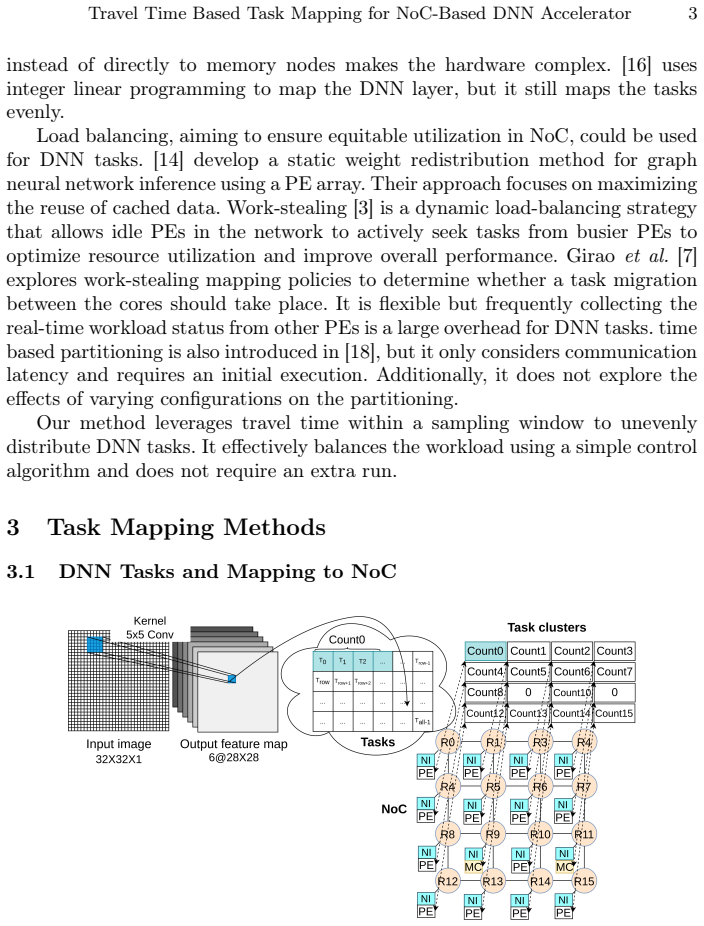
The central discovery is that the per-PE travel time, $T_{\mathrm{travel}} = T_{\mathrm{req}} + T_{\mathrm{mem\_access}} + T_{\mathrm{resp}} + T_{\mathrm{comp}}$, is a sufficient statistic for allocating convolution tasks in a NoC-based DNN accelerator. Allocating task counts so that $T_{\mathrm{askcount}}\_i \times T_{\mathrm{travel}}\_i$ is constant across PEs (Eq.~4) nearly equalizes per-PE completion times, cutting the unevenness of per-task completion time from 22.09% under row-major mapping to 5.81% under the proposed mapping. The method works because travel time implicitly encodes both the static NoC topology (distance to memory controllers) and dynamic congestion, which pure distance-based or static-latency mappings miss. A runtime sampling window of ten tasks achieves 8.17% whole-model improvement, while a post-run mapping using exact recorded travel times achieves 10.37%, both relative to row-major mapping; the gap reflects that sampled travel times are only approximations of the true post-reallocation values.
Load-bearing premise
The load-bearing premise is that the travel time measured on a PE before reallocation remains valid after tasks are repartitioned, even though network congestion depends on the mapping itself; if travel times shift substantially after rebalancing, the equalization is miscalibrated and the reported gains degrade.
Editorial extensions
If this is right
- A layer's completion time is set by its slowest PE, so cutting per-PE unevenness from 22.09% to 5.81% yields latency improvements of 9.7% to 12.1% across the tested mapping iterations, packet sizes, and NoC topologies.
- Because the method needs no extra run and only a short sampling window, it can be applied on the fly during inference, with window length as a tunable knob: longer windows give better approximations but require more samples before rebalancing.
- The benefit shrinks when the NoC has more memory controllers: with four MCs the improvement drops to 5.6% because the distance variance between PEs is smaller, leaving less room for rebalancing.
- A post-run mapping that uses exact travel times is the upper bound of what any runtime estimator can achieve, so the 10.37% figure bounds the potential of sampling-based approaches for this architecture.
- Distance-based mapping can sometimes be worse than even mapping, showing that static topology information alone is insufficient; only travel time that includes dynamic congestion captures the true cost.
Reading between the lines
- The stationarity assumption—that travel times measured under the current mapping remain valid after tasks are reallocated—is the fragile point: if congestion shifts substantially after rebalancing, the equalization is miscalibrated. The paper's own 8.17% versus 10.37% gap is a partial measure of this effect.
- The method is designed for the regular, repetitive traffic of CNN layers, which the paper notes makes predictions accurate. A testable extension is applying it to transformer or attention workloads whose communication patterns are input-dependent; the sampling window may need to be much longer or adaptive there.
- The residual-task rebalancing means the benefit scales with layer size: small layers like the 84-packet layer already show degradation at short windows, so for tiny layers a fully static mapping or a post-run approach would be preferable—a policy the paper only implicitly hints at.
- The post-run ideal could be approached at runtime by predicting congestion-aware travel times (e.g., from queue occupancy) rather than purely sampling history; a longer window only averages the past, it does not anticipate the future.
Signed reviews
Editorial analysis
A structured set of objections, weighed in public.
Referee Report
Summary. The paper proposes a travel-time-based task mapping method for NoC-based DNN accelerators. Instead of assigning equal task counts, it allocates tasks to PEs in inverse proportion to measured per-task travel time (Eq. 4), so that each PE's total time is roughly equalized. The travel time includes request, memory-access, response, and computation components (Eq. 3). To avoid an extra run, the authors sample travel times during runtime using a sampling window (Eqs. 7-8) and apply the resulting ratios to residual tasks. Experiments on a cycle-accurate simulator compare against row-major and distance-based mappings across mapping iterations, packet sizes, and two NoC architectures, reporting improvements up to 12.1% for a single layer and 8.17% for the full LeNet with sampling window 10, versus 10.37% for post-run ideal mapping.
Significance. The work addresses a practical problem and has some strengths: it targets a real bottleneck (load imbalance in NoC-based accelerators), introduces a simple runtime-sampling mechanism that avoids an extra execution, and evaluates over multiple configurations including different architectures. The simulator results consistently show improvements over both baselines. However, the central equalization rule is a heuristic whose optimality is not derived, and the key stationarity assumption—that travel times remain valid after task reallocation—is not validated. The reported gains are plausible but not yet robustly supported. No code or artifacts are provided, so reproducibility relies on the textual description.
major comments (4)
- [§4.2, Eqs. (4) and (7)-(8)] The mapping rule assumes each PE's total time equals Taskcount * Ttravel and that Ttravel is independent of the task allocation. However, Ttravel in Eq. (3) contains Treq and Tresp, which include NoC queuing and congestion delays, and these depend on how many tasks each PE injects and where the traffic goes. After reallocating tasks toward low-travel-time PEs, those PEs inject more traffic and the shared memory controllers and routers experience different load, so the per-PE travel-time vector can shift. The paper never reports a check comparing the Ttravel values used in Eq. (4)/(7) with the travel times actually experienced after remapping. I request such a validation (e.g., a table or scatter plot of predicted vs. actual per-PE completion times) or a sensitivity analysis that perturbs the travel-time vector; without this, the 8.17% whole-LeNet improvement is not established as a stable property of the method.
- [§5.6] The gap between the sampling-window result (8.17%) and the post-run result (10.37%) is attributed to sampling noise, but it could equally reflect a systematic bias from using travel times measured under the old mapping. A concrete way to separate these effects is to run the sampling-window algorithm with increasing window sizes and check whether the improvement saturates at 10.37% or at a lower value; the paper currently tests only windows 1, 5, and 10, which is insufficient to distinguish the two hypotheses.
- [§5.1 and §5.6] All reported numbers appear to come from a single simulation run per configuration, and no error bars, confidence intervals, or seed variations are provided. Since the claimed improvements (8-12%) are modest and the paper is about congestion-dependent behavior, the results need to be shown to be stable across repeated runs (or the simulator's determinism must be justified). This is required before the quantitative headline claims can be accepted.
- [§4.2, Eq. (4)] The statement that 'ideally, the overall latency is balanced' by Eq. (4) is asserted rather than derived. Equalizing Taskcount * Ttravel per PE is a plausible load-balancing heuristic, but it is not obviously optimal for makespan on a shared NoC, where interactions between PEs matter. Please either provide a derivation or explicitly frame the method as a heuristic; the word 'ideal' for post-run mapping in §5.6 and the abstract should be adjusted accordingly.
minor comments (6)
- [Abstract] The sentence 'For a complete NN example, our method achieves 10.37% and 13.75% overall improvements...' is confusing because 10.37% is later identified as the post-run (ideal) result, while the runtime sampling-window result is 8.17%. Please attribute the numbers to the correct variants.
- [§3.3, Eq. (1)] The distance values are labels (1, 2, 3), not continuous variables; the notation 'Taskcount1 * Distance1 = ...' should be explained more explicitly to avoid implying that Distance is a numeric multiplier.
- [§5.2] The text 'Nodes 13, 5, and 8 are the fastest as they have only one distance' should read 'distance 1'; also, the subfigures of Fig. 7 are not individually referenced in the text, making it hard to map the discussion to the panels.
- [§5.4 and §5.6] Numbers such as 'up to 12.1%' for one layer, '9.7%' for mapping iterations, and '8.17%' for the whole LeNet should be cross-checked for consistency with figures; there is no table summarizing all results, which would help.
- [§4.1-4.2] The paper would benefit from a notation table or glossary for Ttravel, Ts, Taskcount, and SamplingWindowLength; these are introduced across Sections 4.1-4.2 and used later without restatement.
- [General] Minor language issues: 'the travel time recorded in the sampling window' and 'sampling window 10' are used interchangeably; choose one phrasing consistently.
Circularity Check
No significant circularity: travel-time task counts are a heuristic equalization rule, and the reported latency improvements are independent simulation outcomes.
full rationale
The paper's derivation chain is self-contained as an empirical evaluation. Eq. (4) and Eqs. (7)-(8) define a mapping rule: task counts are chosen so that count times measured travel time is approximately equal; this is a heuristic control law, not a quantity whose definition already contains the reported latency. The reported gains (up to 12.1% per layer, 8.17% for sampling-window LeNet, 10.37% post-run) are obtained by cycle-accurate simulation after applying the resulting counts, and no free parameter is fitted to maximize these percentages. The sampling-window vs. post-run comparison is a genuine finite-sample approximation study. The main limitation—travel time measured under the initial mapping may change after reallocation because congestion is mapping-dependent—is an untested stationarity assumption and a robustness concern, not a circular reduction: Eq. (3) does not define Ttravel in terms of the final task counts, and the evaluation does not assume the gain. Self-citations ([20], [22]) are used only for simulation infrastructure or as contextual architecture references and are not load-bearing for the central claim. No equation reduces to its own input, so the paper receives score 0.
Assumptions & free parameters
free parameters (1)
- sampling_window_length =
10 (default); 1, 5, 10 explored
assumptions (3)
- domain assumption Per-PE total time is approximately n_i * Ttravel_i, so equalizing Ttravel_i * n_i equalizes completion times (Eqs. (4), (7)).
- domain assumption Travel times measured in the sampling window under the initial mapping are representative of travel times of residual tasks after reallocation.
- domain assumption The cycle-accurate simulator based on Gem5-Garnet faithfully models the target NoC behavior.
Cite this review
Pith. "Pith review of Travel Time Based Task Mapping for NoC-Based DNN Accelerator." pith.science (2026). https://pith.science/paper/2OJDJMDS
@misc{pith2026241112710,
  author       = {Pith},
  title        = {Pith review of: Travel Time Based Task Mapping for NoC-Based DNN Accelerator},
  year         = {2026},
  howpublished = {\url{https://pith.science/paper/2OJDJMDS}},
  note         = {Machine review of arXiv:2411.12710}
}
read the original abstract
Network-on-Chip (NoC) based architectures are recently proposed to accelerate deep neural networks in specialized hardware. Given that the hardware configuration is fixed post-manufacture, proper task mapping attracts researchers' interest. We propose a travel time-based task mapping method that allocates uneven counts of tasks across different Processing Elements (PEs). This approach utilizes the travel time recorded in the sampling window and implicitly makes use of static NoC architecture information and dynamic NoC congestion status. Furthermore, we examine the effectiveness of our method under various configurations, including different mapping iterations, flit sizes, and NoC architecture. Our method achieves up to 12.1% improvement compared with even mapping and static distance mapping for one layer. For a complete NN example, our method achieves 10.37% and 13.75% overall improvements to row-major mapping and distance-based mapping, respectively. While ideal travel time-based mapping (post-run) achieves 10.37% overall improvements to row-major mapping, we adopt a sampling window to efficiently map tasks during the running, achieving 8.17% (sampling window 10) improvement.
Figures


Figures from the paper (8 more)


Reference graph
Works this paper leans on
-
[1]
In: 2009 IEEE international symposium on performance analysis of systems and software
Agarwal, N., Krishna, T., Peh, L.S., Jha, N.K.: GARNET: a detailed on-chip net- work model inside a full-system simulator. In: 2009 IEEE international symposium on performance analysis of systems and software. pp. 33–42. IEEE (2009)
work page 2009
-
[2]
IEEE Access8, 63607–63631 (2020).https://doi.org/10.1109/ACCESS
Amin, W., Hussain, F., Anjum, S., Khan, S., Baloch, N.K., Nain, Z., Kim, S.W.: Performance evaluation of application mapping approaches for network-on-chip designs. IEEE Access8, 63607–63631 (2020).https://doi.org/10.1109/ACCESS. 2020.2982675
arXiv 2020
-
[3]
Journal of the ACM (JACM)46(5), 720–748 (1999)
Blumofe, R.D., Leiserson, C.E.: Scheduling multithreaded computations by work stealing. Journal of the ACM (JACM)46(5), 720–748 (1999)
work page 1999
-
[4]
IEEE Design & Test of Computers27(5), 26–35 (2010)
Carvalho, E.L.d.S., Calazans, N.L.V., Moraes, F.G.: Dynamic task mapping for MPSoCs. IEEE Design & Test of Computers27(5), 26–35 (2010). https://doi. org/10.1109/MDT.2010.106
-
[5]
In: 2021 Interna- tional Symposium on VLSI Design, Automation and Test (VLSI-DAT)
Chen, K.C.J., Wang, C.C., Tsai, C.K., Liang, J.W.: Dynamic mapping mechanism to compute DNN models on a resource-limited NoC platform. In: 2021 Interna- tional Symposium on VLSI Design, Automation and Test (VLSI-DAT). pp. 1–4 (2021). https://doi.org/10.1109/VLSI-DAT52063.2021.9427320
arXiv 2021
-
[6]
IEEE Journal on Emerging and Selected Topics in Circuits and Systems9(2), 292–308 (2019)
Chen, Y.H., Yang, T.J., Emer, J., Sze, V.: Eyeriss v2: A flexible accelerator for emerging deep neural networks on mobile devices. IEEE Journal on Emerging and Selected Topics in Circuits and Systems9(2), 292–308 (2019)
work page 2019
-
[7]
In: 2013 Design, Automation & Test in Europe Conference & Exhibition (DATE)
Girão, G., Santini, T., Wagner, F.R.: Exploring resource mapping policies for dy- namic clustering on NoC-based MPSoCs. In: 2013 Design, Automation & Test in Europe Conference & Exhibition (DATE). pp. 681–684. IEEE (2013) 16 Y. Chen et al
work page 2013
-
[8]
ACM Transactions on Embedded Computing Systems (2022)
Hu, X., Huang, H., Li, X., Zheng, X., Ren, Q., He, J., Xiong, X.: High-performance reconfigurable dnn accelerator on a bandwidth-limited embedded system. ACM Transactions on Embedded Computing Systems (2022)
work page 2022
Show all 22 references
-
[9]
In: 2020 IEEE/ACM International Conference On Computer Aided Design (ICCAD)
Kao, S.C., Krishna, T.: GAMMA: automating the hw mapping of dnn models on accelerators via genetic algorithm. In: 2020 IEEE/ACM International Conference On Computer Aided Design (ICCAD). pp. 1–9 (2020)
2020
-
[10]
IEEE micro40(3), 20–29 (2020)
Kwon, H., Chatarasi, P., Sarkar, V., Krishna, T., Pellauer, M., Parashar, A.: Mae- stro: A data-centric approach to understand reuse, performance, and hardware cost of DNN mappings. IEEE micro40(3), 20–29 (2020)
2020
-
[11]
Proceedings of the IEEE86(11), 2278–2324 (1998).https: //doi.org/10.1109/5.726791
Lecun, Y., Bottou, L., Bengio, Y., Haffner, P.: Gradient-based learning applied to document recognition. Proceedings of the IEEE86(11), 2278–2324 (1998).https: //doi.org/10.1109/5.726791
1998 doi
-
[12]
In: 2018 23rd Asia and South Pacific Design Automation Conference (ASP-DAC)
Liu, X., Wen, W., Qian, X., Li, H., Chen, Y.: Neu-NoC: a high-efficient inter- connection network for accelerated neuromorphic systems. In: 2018 23rd Asia and South Pacific Design Automation Conference (ASP-DAC). pp. 141–146 (2018). https://doi.org/10.1109/ASPDAC.2018.8297296
2018
-
[13]
IEEE Transactions on Computers70(8), 1160–1174 (2021).https://doi.org/10.1109/ TC.2021.3059962
Mei, L., Houshmand, P., Jain, V., Giraldo, S., Verhelst, M.: Zigzag: Enlarging joint architecture-mapping design space exploration for dnn accelerators. IEEE Transactions on Computers70(8), 1160–1174 (2021).https://doi.org/10.1109/ TC.2021.3059962
2021
-
[14]
In: Proceedings of the 59th ACM/IEEE Design Automation Conference
Mondal, S., Manasi, S.D., Kunal, K., Sapatnekar, S.S.: GNNIE: GNN inference engine with load-balancing and graph-specific caching. In: Proceedings of the 59th ACM/IEEE Design Automation Conference. pp. 565–570 (2022)
2022
-
[15]
arXiv preprint arXiv:2311.01598 (2023)
Neda, N., Ebel, A., Reynwar, B., Reagen, B.: CiFlow: dataflow analysis and optimization of key switching for homomorphic encryption. arXiv preprint arXiv:2311.01598 (2023)
2023 arXiv
-
[16]
In: Pro- ceedings of the 20th ACM International Conference on Computing Frontiers
Russo, E., Palesi, M., Ascia, G., Patti, D., Monteleone, S., Catania, V.: Memory- aware DNN algorithm-hardware mapping via integer linear programming. In: Pro- ceedings of the 20th ACM International Conference on Computing Frontiers. pp. 134–143 (2023)
2023
-
[17]
ACM Transactions on Architecture and Code Opti- mization (TACO)16(3), 1–25 (2019)
Sadeghi, M.S., Sarmadi, S.B., Hessabi, S.: Toward on-chip network security using runtime isolation mapping. ACM Transactions on Architecture and Code Opti- mization (TACO)16(3), 1–25 (2019)
2019
-
[18]
In: Proceedings of the 52nd An- nual IEEE/ACM International Symposium on Microarchitecture
Shao, Y.S., Clemons, J., Venkatesan, R., Zimmer, B., Fojtik, M., Jiang, N., Keller, B., Klinefelter, A., Pinckney, N., Raina, P., et al.: Simba: Scaling deep-learning in- ference with multi-chip-module-based architecture. In: Proceedings of the 52nd An- nual IEEE/ACM Internati...
2019
-
[19]
Journal of Systems Architecture54(3-4), 411–426 (2008)
Stuijk, S., Basten, T., Geilen, M., Ghamarian, A.H., Theelen, B.: Resource-efficient routing and scheduling of time-constrained streaming communication on networks- on-chip. Journal of Systems Architecture54(3-4), 411–426 (2008)
2008
-
[20]
IEEE Transactions on Computer-Aided Design of Integrated Circuits and Systems41(5), 1523–1536 (2021)
Wang, B., Lu, Z.: Flexible and efficient QoS provisioning in AXI4-based network- on-chip architecture. IEEE Transactions on Computer-Aided Design of Integrated Circuits and Systems41(5), 1523–1536 (2021)
2021
-
[21]
In: 2022 IEEE 40th International Conference on Computer Design (ICCD)
Xue,Y.,Ji,J.,Li,X.,Li,S.,Zhou,S.,Cheng,T.,Li,L.,Fu,Y.:AOME:autonomous optimal mapping exploration using reinforcement learning for NoC-based acceler- ators running neural networks. In: 2022 IEEE 40th International Conference on Computer Design (ICCD). pp. 364–367. IEEE (2022)
2022
-
[22]
In: 2024 International VLSI Symposium on Technology, Systems and Applications (VLSI-TSA/VLSI-DAT)
Zhu, W., Chen, Y., Lu, Z.: Activation in network for NoC-based deep neural net- work accelerator. In: 2024 International VLSI Symposium on Technology, Systems and Applications (VLSI-TSA/VLSI-DAT). pp. 1–4. IEEE (2024)
2024
Reviewed August 12, 2026 · model on record in the stance chip above.
Discussion (0). Continue with ORCID to comment.