REVIEW 4 major objections 5 minor 42 references
The nature of the two-peak structure in NiO valence band photoemission
T0 review · 4 major / 5 minor · reviewed 2026-08-14 · deepseek-v4-flash
Pith's one-line read The two-peak structure in NiO valence-band photoemission arises from a coincidence of a magnetic and a hopping-induced splitting.
desk verdict A credible new mechanism for NiO's two-peak valence photoemission, but the central 'matching' of two splittings is asserted, not quantitatively shown, and the reported magnetic-splitting numbers conflict between text and figure caption. read the letter →
The pith
A machine-rendered reading of the paper's core claim, the machinery that carries it, and where it could break.
The reading
What carries the argument
The central object is the ab initio LQSGW+DMFT framework, which couples non-local electronic screening from linearized quasiparticle self-consistent GW with the local self-energy of single-site dynamical mean-field theory. Within it, the decisive quantity is the imaginary part of the Ni-eg hybridization function; its sharp divergence at the oxygen-p energy signals formation of a Zhang-Rice bound state, here a local singlet between a Ni hole and a neighboring oxygen hole cloud, and the strength of that divergence sets the size of the majority-spin t2g-eg splitting. An auxiliary Green's function, constructed by swapping the LQSGW+DMFT Ni-eg hybridization for the weaker LDA+DMFT one, isolates the role of enhanced intersite hopping in shifting the eg level and thereby enlarging the t2g-eg splitting.
What would settle it
A spin-resolved photoemission experiment on a single-domain antiferromagnetic NiO crystal could settle the claim: if the higher-binding-energy B peak shows predominantly minority-spin or O-p character rather than majority-spin Ni-t2g character, the proposed mechanism is false.
Extended reading notes
Core claim
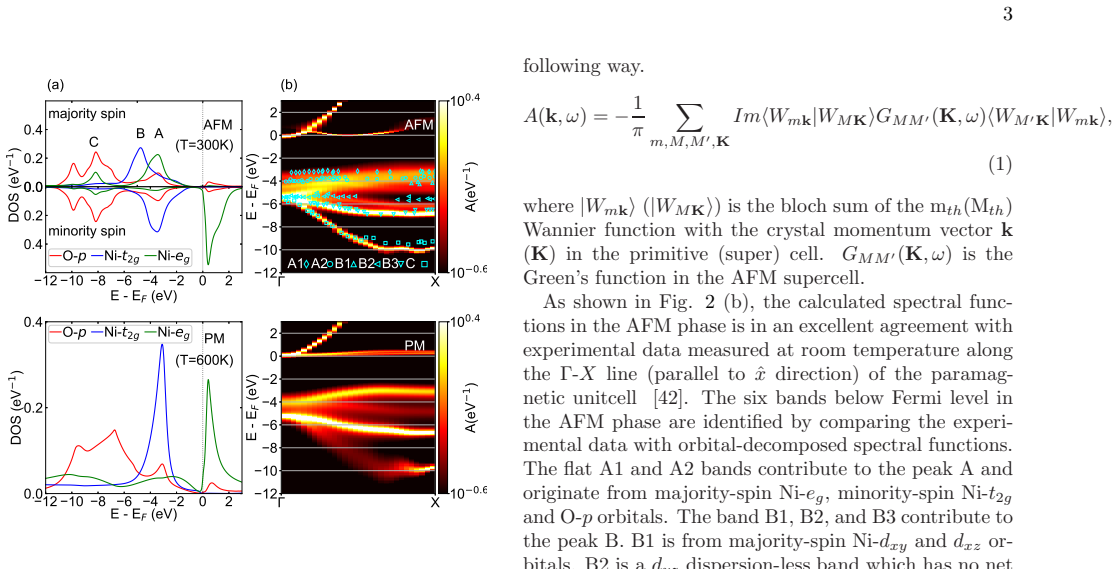
Below the Néel temperature, antiferromagnetic order in the Ni-eg orbitals creates an exchange splitting between majority- and minority-spin Ni-t2g levels via the local Hund's coupling. In parallel, strong hybridization between O-p and Ni-eg orbitals, which is the hallmark of a Zhang-Rice bound state, boosts an oxygen-mediated intersite hopping that increases the majority-spin Ni t2g-eg splitting. The paper's central claim is that these two splittings, one local and magnetic, the other non-local and hopping-driven, are nearly equal in energy, and it is this matching that produces the observed two-peak structure. The claim is supported by ab initio LQSGW+DMFT calculations that reproduce the experimental density of states and the momentum-resolved spectra along Γ-X, and by a control calculation showing that LDA+DMFT, with weaker Ni-eg hybridization, does not achieve the matching and therefore does not yield two distinct peaks.
Load-bearing premise
The explanation rests on the LQSGW+DMFT calculation being quantitatively right about the near equality of the Hund-induced exchange splitting and the hopping-enhanced t2g-eg splitting; if that equality is an artifact of the chosen Coulomb parameters (U=10 eV, J=0.9 eV) or of the single-site local self-energy approximation, the two-peak mechanism would not be robust.
Editorial extensions
If this is right
- Peak B carries mostly majority-spin Ni-t2g spectral weight, so its intensity is a direct measure of antiferromagnetic order in the valence band.
- Above the Néel temperature the two peaks merge into one; the residual B weight at 525 K is attributed to short-range magnetic order neglected in the ideal paramagnetic simulation.
- The mechanism explains the dilution experiment in which NiO embedded in MgO loses peak B: interrupting the oxygen-mediated intersite hopping removes the non-local enhancement of the t2g-eg splitting.
- Because the two splittings must match in size, any perturbation that changes the Ni-O-Ni hopping or the Hund coupling is expected to alter the two-peak separation and the valence-band line shape.
Reading between the lines
- A natural next step is to apply the same LQSGW+DMFT analysis to other late-transition-metal monoxides (for example, MnO and CoO); if the coincidence of magnetic and hopping splittings is the controlling factor, the calculation predicts whether those compounds show a two-peak valence band and how the peaks move with temperature.
- The paper suggests a design rule for NiO-based hole transport layers: tuning the Ni-O-Ni bond angle or applying epitaxial strain should shift the t2g-eg splitting relative to the Hund-exchange splitting, which would show up as a controlled change in the valence-band line shape and hole mobility.
- A spin-resolved version of the proposed mechanism implies that the B peak's intensity could serve as a spectroscopic thermometer for short-range magnetic correlations even in the paramagnetic phase.
Signed reviews
Editorial analysis
A structured set of objections, weighed in public.
Referee Report
Summary. The paper presents an ab initio LQSGW+DMFT study of the valence band photoemission of NiO, aiming to explain the origin of the two-peak structure (peaks A and B) observed below the Neel temperature. The authors reproduce the two-peak structure in the AFM phase and show it is absent in their PM calculation. They attribute the two peaks to a coincidence of two distinct splittings: the magnetic exchange splitting of Ni-t2g states caused by AFM ordering via Hund's coupling, and the majority-spin Ni t2g-eg splitting enhanced by oxygen-mediated intersite hopping, identified as a signature of Zhang-Rice physics. The paper supports this picture with orbital-resolved DOS, hybridization functions, a comparison of LQSGW+DMFT with LDA+DMFT, an auxiliary Green's function calculation that swaps the Ni-eg hybridization, and an ARPES comparison. The authors conclude that the two splittings 'match' for LQSGW+DMFT, producing the two-peak structure, and claim the approach is parameter-free.
Significance. If the proposed mechanism is correct, it offers a unified first-principles explanation of a long-debated spectral feature in a canonical charge-transfer insulator, linking local magnetic energy scales with non-local hopping scales. The paper's strengths include the use of an internally consistent ab initio framework (LQSGW+DMFT), direct comparison with both angle-integrated and angle-resolved photoemission, and explicit control calculations (AFM vs PM, LQSGW+DMFT vs LDA+DMFT, auxiliary Green's function with swapped hybridization). These controls give the qualitative picture credibility. However, the central assertion of a quantitative 'match' between the two splittings is not actually demonstrated numerically in the manuscript, and there is a direct inconsistency between values quoted in the text and in the Fig. 3 caption. In addition, the 'parameter-free' claim is weakened by the use of U and J taken from the EDMFTF database (or cRPA), and by the nominal double-counting occupancy n_d=8.0.
major comments (4)
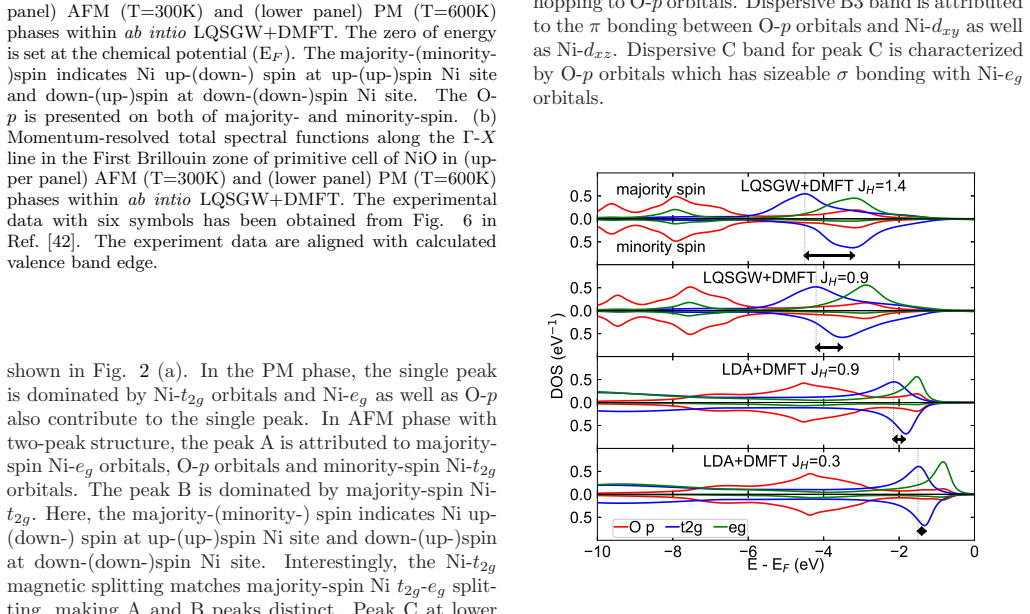
- [Results, 'The concerted effect...' paragraph vs Fig. 3 caption] The numerical value of the magnetic Ni-t2g splitting is inconsistent between the text and the Fig. 3 caption. The text lists 1.5, 1.06, 0.89, and 0.35 eV for LQSGW+DMFT (JH=1.4 eV), LQSGW+DMFT (JH=0.9 eV), LDA+DMFT (JH=0.9 eV), and LDA+DMFT (JH=0.3 eV), respectively, while the Fig. 3 caption lists 1.25, 0.72, 0.31, and 0.15 eV for the same four calculations. This is not a typo of secondary importance: the claimed coincidence of the magnetic t2g splitting with the t2g-eg splitting is the entire physical mechanism of the paper, so the reader must be able to rely on the quoted values. Please resolve the discrepancy and state which set of values is correct.
- [Results, 'The concerted effect...' paragraph and Fig. 4] The central claim that the magnetic Ni-t2g splitting 'matches' the majority-spin Ni t2g-eg splitting is asserted but never quantified. The manuscript nowhere reports the numerical value of the majority-spin Ni t2g-eg splitting for any of the calculations. Fig. 4 shows horizontal arrows for this quantity but gives no numbers in the text or caption. Without explicit numbers for both splittings (and for the A-B peak separation in the total DOS) for each method and each JH value, the near-equality that is the core of the paper remains unverified. Please add a table (or state numbers in the text) listing the magnetic t2g splitting, the t2g-eg splitting, and the A-B peak separation for at least the four calculations in Fig. 3 and for the LQSGW+DMFT JH=1.4 case.
- [Results, LDA+DMFT counterexample] The LDA+DMFT counterexample is described only qualitatively: 'majority-spin Ni t2g-eg splitting is two times larger than the magnetic Ni-t2g splitting.' Since the LDA+DMFT case supposedly fails precisely because the two splittings do not match, the actual numerical values are needed to make the argument convincing. Moreover, given the text/caption discrepancy in the magnetic splitting values, the 'two times larger' statement cannot currently be checked. Please report the underlying numbers for this comparison.
- [Methods and Conclusion, 'parameter-free' claim] The manuscript repeatedly describes the LQSGW+DMFT calculation as 'parameter-free' (Introduction, Conclusion, abstract). However, the Coulomb parameters F0=10.0 eV, F2=7.8 eV, F4=4.8 eV (U=10 eV, J=0.9 eV) are imported from the EDMFTF database, and an alternative J=1.4 eV from cRPA is also used; the double-counting scheme fixes n_d=8.0. These are external or tuned inputs, not derived within the calculation. The qualitative mechanism may well be robust, but the 'parameter-free' wording is inaccurate and should be revised, or the paper should demonstrate that results are insensitive to the choice of U, J, and double-counting within a reasonable range.
minor comments (5)
- [Title and throughout] The title contains a typo ('phot oemission'), and the text has duplicated phrases such as 'playing the role of playing the role of Zhang-Rice doublet bound state' in the Introduction. Please proofread carefully.
- [Introduction, 'ab intio'] The phrase 'ab intio' appears in the Fig. 2 caption and elsewhere; the correct Latin form is 'ab initio'.
- [Fig. 4 caption] The caption says 'the imaginary part of the hybridization function' while the text refers to hybridization functions; please make the terminology uniform and clarify that the plotted quantity is -Im Δ(ω) or similar.
- [Methods, Wannier construction] The sentence 'To define five Ni-d orbitals, Wannier functions for Ni-s, Ni-p Ni-d, and O-p orbitals are constructed...' appears twice with slightly different wording; the repetition should be removed and the notation 'Ni-d' made consistent.
- [References] Reference [18] is listed as 'ArXiv12106675 Cond-Mat (2012)' with a preprint identifier; if the paper has been published, please cite the journal version. Reference [39] is a URL for the EDMFTF database; a more formal citation or description would help reproducibility.
Circularity Check
No significant circularity: the two-peak mechanism is an output of an ab initio LQSGW+DMFT calculation benchmarked against external photoemission experiments, not a fitted input or self-citation chain.
full rationale
The derivation chain is self-contained: the two-peak structure is an output of LQSGW+DMFT calculations using U=10 eV and J=0.9 eV from the EDMFTF database, with J=1.4 eV from cRPA tested as a comparison; these values are not fitted to the A/B peak positions. The central claim that the magnetic Ni-t2g splitting and the majority-spin Ni t2g-eg splitting coincide is read off the calculated projected density of states in Figs. 2-4 and is not defined into existence by the equations. The comparison to valence-band photoemission and ARPES data provides an external benchmark independent of the model inputs. The only author self-citation is to the COMSUITE code, which is computational infrastructure rather than the source of the physical conclusion. The internal discrepancy between the magnetic-splitting values in the text (1.5, 1.06, 0.89, 0.35 eV) and the Fig. 3 caption (1.25, 0.72, 0.31, 0.15 eV) is a reproducibility or correctness concern, not circularity, because neither set of values is an input used to construct the prediction. No equation reduces the predicted splitting to a fitted parameter, and no load-bearing claim rests on a self-citation chain.
Assumptions & free parameters
free parameters (4)
- Hubbard U (F0) for Ni d orbitals =
10.0 eV
- Hund coupling J (EDMFTF) =
0.9 eV
- Hund coupling J (cRPA) =
1.4 eV
- Double-counting occupancy n_d =
8.0
assumptions (4)
- domain assumption LQSGW+DMFT provides an accurate one-particle spectral function for NiO.
- domain assumption The DMFT approximation of a local self-energy is sufficient to capture the oxygen-mediated intersite hopping effect on the t2g-eg splitting.
- domain assumption The frozen Wannier window (-10 eV to +10 eV around E_F) and the choice of five Ni-d correlated orbitals adequately represent the low-energy physics.
- domain assumption The experimental spectra from Refs. [10] and [42] are representative, and the energy alignment (zero at peak A) is correct.
Cite this review
Pith. "Pith review of The nature of the two-peak structure in NiO valence band photoemission." pith.science (2026). https://pith.science/paper/2OZGONNR
@misc{pith2026190805643,
  author       = {Pith},
  title        = {Pith review of: The nature of the two-peak structure in NiO valence band photoemission},
  year         = {2026},
  howpublished = {\url{https://pith.science/paper/2OZGONNR}},
  note         = {Machine review of arXiv:1908.05643}
}
abstract
In spite of extensive studies on NiO and their accomplishments, the rich physics still raises unsolved physical problems. In particular, the nature of the two-peak structure in the valence band photoemission spectra is still controversial. By using \textit{ab initio} LQSGW+DMFT, the two-peak structure is shown to be driven by the concerted effect of antiferromagnetic ordering and intersite electron hopping. Magnetic ordering in the Ni-$e_{g}$ orbitals splits majority- and minority-spin Ni-$t_{2g}$ levels due to local Hund's coupling. Strong hybridization between O-$p$ and Ni-$e_g$, a signature of the Zhang-Rice bound state formation, boosts oxygen-mediated intersite Ni-$e_g$ orbital hopping, resulting in the enhancement of majority-spin Ni $t_{2g}$-$e_{g}$ splitting. Interestingly, these two splittings of distinct physical origins match and give rise to the observed two-peak structure in NiO. Our new understanding should be useful in designing advanced devices based on the NiO for the hole transport.
Figures

Figures from the paper (1 more)

Reference graph
Works this paper leans on
-
[1]
Zaanen, G
J. Zaanen, G. A. Sawatzky, and J. W. Allen, Phys. Rev. Lett. 55, 418 (1985)
1985
-
[2]
J. Ba/suppress la, A. M. Ole´ s, and J. Zaanen, Physical review letters 72, 2600 (1994)
work page 1994
-
[3]
J. Kuneˇ s, V. Anisimov, S. Skornyakov, A. Lukoyanov, and D. Vollhardt, Physical review letters 99, 156404 (2007)
work page 2007
-
[4]
T. Abzieher, S. Moghadamzadeh, F. Schackmar, H. Eg- gers, F. Sutterl¨ uti, A. Farooq, D. Kojda, K. Habicht, R. Schmager, A. Mertens, et al. , Advanced Energy Ma- terials , 1802995 (2019)
work page 2019
-
[5]
J. You, L. Meng, T.-B. Song, T.-F. Guo, Y. M. Yang, W.- H. Chang, Z. Hong, H. Chen, H. Zhou, Q. Chen, et al. , Nature nanotechnology 11, 75 (2016)
work page 2016
-
[6]
T. Kampfrath, A. Sell, G. Klatt, A. Pashkin, S. M¨ ahrlein, T. Dekorsy, M. Wolf, M. Fiebig, A. Leitenstorfer, and R. Huber, Nature Photonics 5, 31 (2011)
work page 2011
-
[7]
T. Satoh, S.-J. Cho, R. Iida, T. Shimura, K. Kuroda, H. Ueda, Y. Ueda, B. Ivanov, F. Nori, and M. Fiebig, Physical review letters 105, 077402 (2010)
work page 2010
-
[8]
W. Lin, K. Chen, S. Zhang, and C. Chien, Physical review letters 116, 186601 (2016)
work page 2016
Show all 42 references
-
[9]
Machado, P
F. Machado, P. Ribeiro, J. Holanda, R. Rodr´ ıguez- Su´ arez, A. Azevedo, and S. Rezende, Physical Review B 95, 104418 (2017)
2017
-
[10]
C.-Y. Kuo, T. Haupricht, J. Weinen, H. Wu, K.- D. Tsuei, M. Haverkort, A. Tanaka, and L. Tjeng, The European Physical Journal Special Topics 226, 2445 (2017)
2017
-
[11]
H¨ ufner and G
S. H¨ ufner and G. Wertheim, Physical Review B8, 4857 (1973)
1973
-
[12]
van Elp, H
J. van Elp, H. Eskes, P. Kuiper, and G. A. Sawatzky, Phys. Rev. B 45, 1612 (1992)
1992
-
[13]
Alders, F
D. Alders, F. Voogt, T. Hibma, and G. Sawatzky, Phys- ical Review B 54, 7716 (1996)
1996
-
[14]
J. C. Woicik, E. Nelson, D. Heskett, J. Warner, L. Berman, B. Karlin, I. Vartanyants, M. Hasan, T. Kendelewicz, Z. Shen, et al. , Physical Review B 64, 125115 (2001)
2001
-
[15]
S.-J. Oh, J. Allen, I. Lindau, and J. Mikkelsen Jr, Phys- ical Review B 26, 4845 (1982)
1982
-
[16]
Taguchi, M
M. Taguchi, M. Matsunami, Y. Ishida, R. Eguchi, A. Chainani, Y. Takata, M. Yabashi, K. Tamasaku, Y. Nishino, T. Ishikawa, Y. Senba, H. Ohashi, and S. Shin, Phys. Rev. Lett. 100, 206401 (2008)
2008
-
[17]
J. C. Woicik, J. M. Ablett, N. F. Quackenbush, A. K. Ru- maiz, C. Weiland, T. C. Droubay, and S. A. Chambers, Phys. Rev. B 97, 245142 (2018)
2018
-
[18]
Haupricht, J
T. Haupricht, J. Weinen, A. Tanaka, R. Gierth, S. G. Altendorf, Y.-Y. Chin, T. Willers, J. Gegner, H. Fu- jiwara, F. Strigari, A. Hendricks, D. Regesch, Z. Hu, H. Wu, K.-D. Tsuei, Y. F. Liao, H. H. Hsieh, H.-J. Lin, C. T. Chen, and L. H. Tjeng, ArXiv12106675 Cond-Mat (2012), a...
2012 arXiv
-
[19]
Fujimori and F
A. Fujimori and F. Minami, Physical Review B 30, 957 (1984)
1984
-
[20]
Koller, F
D. Koller, F. Tran, and P. Blaha, Physical Review B 83, 195134 (2011)
2011
-
[21]
Gillen and J
R. Gillen and J. Robertson, Journal of Physics: Con- densed Matter 25, 165502 (2013)
2013
-
[22]
Trimarchi, Z
G. Trimarchi, Z. Wang, and A. Zunger, Physical Review B 97, 035107 (2018)
2018
-
[23]
Li, G.-M
J.-L. Li, G.-M. Rignanese, and S. G. Louie, Physical Review B 71, 193102 (2005)
2005
-
[24]
Jiang, R
H. Jiang, R. I. Gomez-Abal, P. Rinke, and M. Scheffler, Physical Review B 82, 045108 (2010)
2010
-
[25]
S. Das, J. E. Coulter, and E. Manousakis, Physical Re- view B 91, 115105 (2015)
2015
-
[26]
Kuneˇ s, V
J. Kuneˇ s, V. Anisimov, A. Lukoyanov, and D. Vollhardt, Physical Review B 75, 165115 (2007)
2007
-
[27]
Miura and T
O. Miura and T. Fujiwara, Physical Review B77, 195124 6 (2008)
2008
-
[28]
I. A. Nekrasov, V. Pavlov, and M. V. Sadovskii, JETP letters 95, 581 (2012)
2012
-
[29]
X. Ren, I. Leonov, G. Keller, M. Kollar, I. Nekrasov, and D. Vollhardt, Physical Review B 74, 195114 (2006)
2006
-
[30]
Thunstr¨ om, I
P. Thunstr¨ om, I. Di Marco, and O. Eriksson, Physical review letters 109, 186401 (2012)
2012
-
[31]
Q. Yin, A. Gordienko, X. Wan, and S. Y. Savrasov, Physical review letters 100, 066406 (2008)
2008
-
[32]
Lechermann, W
F. Lechermann, W. K¨ orner, D. F. Urban, and C. Els¨ asser, arXiv preprint arXiv:1902.07000 (2019)
2019 arXiv
-
[33]
S. Choi, P. Semon, B. Kang, A. Kutepov, and G. Kotliar, arXiv preprint arXiv:1810.01679 (2018)
2018 arXiv
-
[34]
A. L. Kutepov, V. S. Oudovenko, and G. Kotliar, Com- puter Physics Communications 219, 407 (2017)
2017
-
[35]
Kutepov, S
A. Kutepov, S. Y. Savrasov, and G. Kotliar, Physical Review B 80, 041103 (2009)
2009
-
[36]
Kutepov, K
A. Kutepov, K. Haule, S. Y. Savrasov, and G. Kotliar, Physical Review B 85, 155129 (2012)
2012
-
[37]
Bartel and B
L. Bartel and B. Morosin, Physical Review B 3, 1039 (1971)
1971
-
[38]
Terakura, T
K. Terakura, T. Oguchi, A. Williams, and J. K¨ ubler, Physical Review B 30, 4734 (1984)
1984
-
[39]
http://hauleweb.rutgers.edu/database_w2k/
-
[40]
Haule, C.-H
K. Haule, C.-H. Yee, and K. Kim, Physical Review B 81, 195107 (2010)
2010
-
[41]
Haule, T
K. Haule, T. Birol, and G. Kotliar, Physical Review B 90, 075136 (2014)
2014
-
[42]
Z.-X. Shen, R. List, D. Dessau, B. Wells, O. Jepsen, A. Arko, R. Barttlet, C. Shih, F. Parmigiani, J. Huang, et al. , Physical Review B 44, 3604 (1991)
1991
Reviewed August 14, 2026 · model on record in the stance chip above.
Discussion (0). Continue with ORCID to comment.