REVIEW 1 major objections 14 references
Magic Polygons and Degenerated Magic Polygons: Characterization and Properties
T0 review · 1 major / 0 minor · reviewed 2026-05-25 · grok-4.3
Pith's one-line read Magic polygons P(n, k) and degenerated forms D(n, k) have a fixed magic sum and root vertex value determined by the parameters.
desk verdict This paper defines two new families of polygons with additive labeling rules, derives closed forms for the magic sum and root value, and checks existence for some n and k, but stays within a narrow combinatorial exercise. read the letter →
The pith
A machine-rendered reading of the paper's core claim, the machinery that carries it, and where it could break.
The reading
What carries the argument
The definitions of magic polygon P(n, k) and degenerated magic polygon D(n, k) as n-sided figures whose vertices receive number labels satisfying multiple equal-sum conditions; these definitions carry the argument by converting the sum requirements into fixed values for the magic constant and root vertex.
What would settle it
An explicit check for a pair (n, k) asserted to admit a magic polygon that produces either inconsistent line sums or no valid distinct-integer labeling at all.
Extended reading notes
Core claim
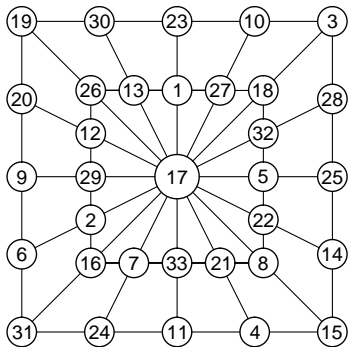
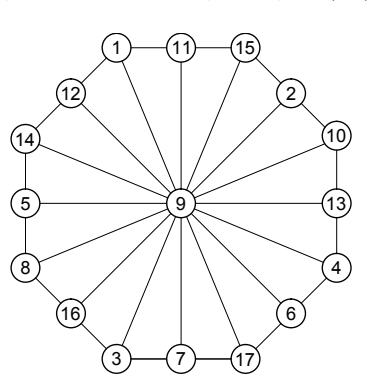
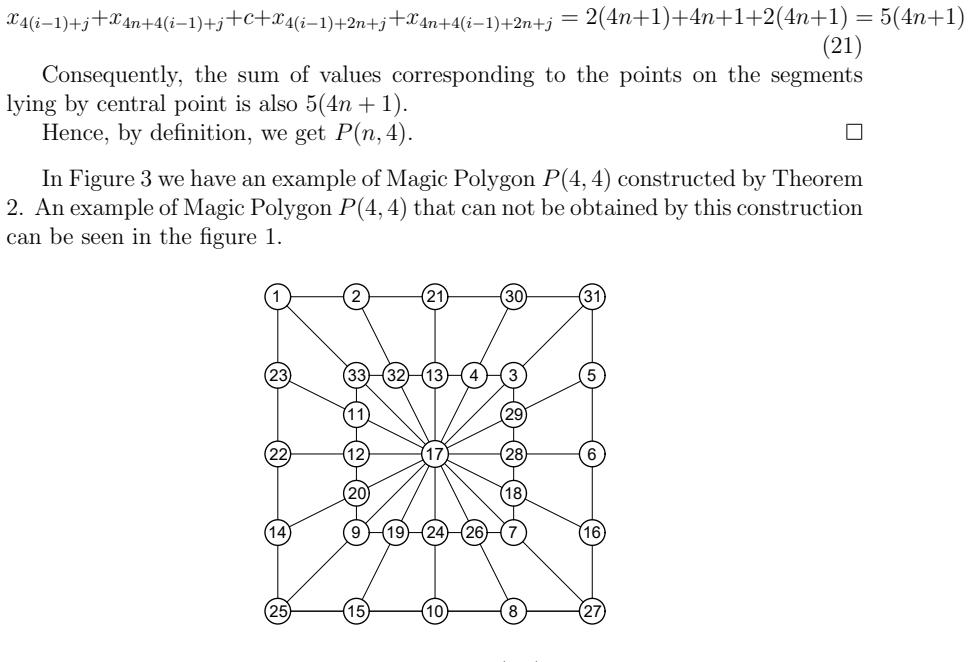
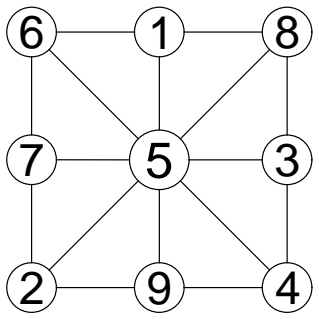
In this work we define Magic Polygons P (n, k) and Degenerated Magic Polygons D(n, k) and we obtain their main properties, such as the magic sum and the value corresponding to the root vertex. The existence of magic polygons P (n, k) and degenerated magic polygons D(n, k) are discussed for certain values of n and k.
Load-bearing premise
The combinatorial definitions of P(n,k) and D(n,k) admit consistent number assignments to vertices that satisfy the stated additive conditions for at least some n and k.
Editorial extensions
If this is right
- Once n and k are fixed the magic sum takes a single determined value.
- The root vertex is forced to a single specific number.
- Valid labelings exist only for the pairs (n, k) identified by the existence analysis.
- The degenerated versions obey parallel formulas under their relaxed geometric conditions.
Reading between the lines
- The same vertex-sum approach could be applied to labelings on polyhedra or other graphs with multiple intersecting lines.
- The forced root value may allow a canonical ordering of all valid labelings by rotation or reflection.
- Small-n computational enumeration could confirm or refute the existence claims for the smallest parameter pairs.
Editorial analysis
A structured set of objections, weighed in public.
Referee Report
Summary. The paper defines Magic Polygons P(n, k) and Degenerated Magic Polygons D(n, k), claims to derive their main properties including the magic sum and root-vertex value, and discusses existence for selected parameter pairs (n, k).
Significance. If the claimed closed-form expressions and existence results hold with explicit constructions, the work would introduce new parameterized families of combinatorial labelings that could be of interest in magic-figure and design theory. The approach rests on explicit definitions rather than fitted or self-referential quantities.
major comments (1)
- [Abstract] Abstract: the abstract asserts that properties and existence results are obtained, yet supplies no derivations, constructions, or verification steps; the central claims therefore cannot be checked against the paper's own evidence.
Simulated Author's Rebuttal
We thank the referee for their report and the opportunity to respond. The single major comment concerns the abstract. We address it below and note that the manuscript body contains the requested derivations and constructions.
read point-by-point responses
-
Referee: [Abstract] Abstract: the abstract asserts that properties and existence results are obtained, yet supplies no derivations, constructions, or verification steps; the central claims therefore cannot be checked against the paper's own evidence.
Authors: The abstract is a concise summary by design and does not contain derivations, as is standard. The closed-form expressions for the magic sum and root vertex, together with existence conditions and explicit constructions for selected (n, k), are derived and verified in Sections 2–4 of the manuscript. The claims can therefore be checked directly against the paper's evidence. revision: no
Circularity Check
Explicit combinatorial definitions yield derived properties without reduction to inputs or self-citation
full rationale
The paper introduces fresh definitions for P(n,k) and D(n,k) as combinatorial objects on polygons with additive labeling constraints, then derives closed-form expressions for the magic sum and root-vertex value directly from those definitions. Existence statements for selected parameter pairs are likewise obtained by checking consistency against the same additive conditions. No fitted parameters are renamed as predictions, no self-citations supply load-bearing uniqueness theorems, and no ansatz is smuggled in; the derivation chain is therefore self-contained and non-circular.
Assumptions & free parameters
Cite this review
Pith. "Pith review of Magic Polygons and Degenerated Magic Polygons: Characterization and Properties." pith.science (2026). https://pith.science/paper/2PXP6RLT
@misc{pith2026190611342,
  author       = {Pith},
  title        = {Pith review of: Magic Polygons and Degenerated Magic Polygons: Characterization and Properties},
  year         = {2026},
  howpublished = {\url{https://pith.science/paper/2PXP6RLT}},
  note         = {Machine review of arXiv:1906.11342}
}
read the original abstract
In this work we define Magic Polygons P (n, k) and Degenerated Magic Polygons D(n, k) and we obtain their main properties, such as the magic sum and the value corresponding to the root vertex. The existence of magic polygons P (n, k) and degenerated magic polygons D(n, k) are discussed for certain values of n and k.
Figures
Figures from the paper (6 more)
Reference graph
Works this paper leans on
-
[1]
Andress, Basic properties of pandiagonal magic squares, Amer
W.R. Andress, Basic properties of pandiagonal magic squares, Amer. Math. Monthly 67 (1960) 143–152. 20
work page 1960
-
[2]
Cammann, The evolution of magic squares in China, J
S. Cammann, The evolution of magic squares in China, J. Am. Oriental Soc. 80 (1960) 116–124
work page 1960
-
[3]
C.Y.J. Chan et al., A construction of regular magic squares of odd order, Linear Algebra and its Applications 457 (2014) 293–302
work page 2014
- [4]
-
[5]
G. Ganapathy, K. Mani, Add-on security model for public-key cryptosystem based on magic square implementation, in: Proc. World Congress on Engi- neering and Computer Science 1 WCECS, 2009
work page 2009
-
[6]
Magic Polygons and Their Properties
V. Jakicic, R. Bouchat, Magic Polygons and their properties, http://www.arxiv.org/abs/1801.02262v1, 2018
work page Pith review arXiv 2018
-
[7]
Y. Kim, J. Yoo, An algorithm for constructing magic squares, Discrete Applied Mathematics 156 (2008) 2804–2809
work page 2008
-
[8]
P.D. Loly, Franklin squares: a chapter in the scientific studies of magical squares, Complex Systems 17 (2007) 143–161
work page 2007
Show all 14 references
-
[9]
Mattingly, Even order regular magic squares are singular, Amer
R.B. Mattingly, Even order regular magic squares are singular, Amer. Math. Monthly 107 (2000) 777–782
2000
-
[10]
Nordgren, New constructions for special magic squares, Int
R.P. Nordgren, New constructions for special magic squares, Int. J. Pure Appl. Math., in press
-
[11]
Ollerenshaw, D.S
K. Ollerenshaw, D.S. Br´ ee, Most-Perfect Pandiagonal Magic Squares: Their Construction and Enumeration, The Institute of Mathematics and its Appli- cations, Southend-on-Sea, UK, 1998
1998
-
[12]
C.A. Pickover, The Zen of Magic Squares, Circles, and Stars, second printing and first paperback printing, Princeton University Press, Princeton, NJ, 2003 (original printing and e-book: 2002)
2003
-
[13]
Planck, Pandiagonal magic squares of orders 6 and 10 without minimal numbers, Monist 29 (1919) 307–316
C. Planck, Pandiagonal magic squares of orders 6 and 10 without minimal numbers, Monist 29 (1919) 307–316
1919
-
[14]
Rosser, R.J
B. Rosser, R.J. Walker, The algebraic theory of diabolic magic squares, Duke Math. J. 5 (1939) 705–728. 21
1939
Reviewed May 25, 2026 · model on record in the stance chip above.
Discussion (0). Continue with ORCID to comment.