REVIEW 2 major objections 4 minor 39 references
Intrinsic Meshing of Closed Surfaces Using Geodesic Distances
T0 review · 2 major / 4 minor · reviewed 2026-07-11 · grok-4.5
Pith's one-line read Local geodesic operations build intrinsic meshes that keep the original surface exact and support both coarsening and refinement.
desk verdict Working open-source intrinsic mesher that finally coarsens non-developable discrete surfaces; angle-quality claim is only partially realized but openly reported. read the letter →
The pith
A machine-rendered reading of the paper's core claim, the machinery that carries it, and where it could break.
The reading
What carries the argument
Intrinsic local operators (edge swap/split/collapse and triangle split) whose decisions rest on exact shortest-path geodesics computed by continuous Dijkstra with A* guidance, plus a simple opposite-angle swap heuristic that replaces the classical empty-circumcircle test.
What would settle it
On a closed manifold from the filtered Thingi10K suite, run the algorithm with prescribed angle bounds and check whether the final intrinsic mesh still contains intersecting geodesics, violates the size field, or leaves angles outside the requested range on more than a few percent of models after the iteration limit.
Extended reading notes
Core claim
A complete intrinsic meshing pipeline exists: repeated local geodesic operations driven by a characteristic-length field and an opposite-angle heuristic produce triangulations whose edges are shortest geodesics, whose faces inherit the input geometry, that obey size and angle constraints wherever feasible, and that support both refinement and coarsening on closed discrete surfaces.
Load-bearing premise
The opposite-angle swap heuristic plus occasional circumcenter insertion is enough to reach a usable Delaunay-like mesh even when true geodesic circumcenters are missing or non-unique.
Editorial extensions
If this is right
- Coarsening and refinement of discrete surfaces can be performed while preserving the exact input geometry.
- High-order finite-element meshes can be generated directly from geodesic edges without first building and then curving a linear mesh.
- Size- and angle-controlled remeshing becomes available for any watertight closed triangulation, independent of parametrization.
- Exact geodesic distances need only be computed locally and can be accelerated by simple Euclidean lower bounds.
Reading between the lines
- The same local geodesic operators could be adapted to open surfaces once boundary and feature edges are treated as constrained non-geodesic paths.
- Because each intrinsic triangle is already a piecewise-linear patch of the original mesh, it supplies an exact domain for integration or for fitting non-polynomial bases without geometric error.
- Parallel execution of independent cavities would be the natural next performance step once sequential geodesic queries dominate runtime.
Editorial analysis
A structured set of objections, weighed in public.
Referee Report
Summary. The paper presents a constructive algorithm for intrinsic triangulations of closed watertight discrete surfaces: edges are shortest geodesic paths and faces are unions of input primitives. Starting from an input triangulation, local operations (edge swaps, splits, collapses, and triangle splits) are performed intrinsically, driven by a characteristic-length field and angle-based quality criteria derived from exact geodesic distances. Distances use continuous Dijkstra (MMP/ICH) accelerated by an A* Euclidean lower-bound heuristic that reduces cost to roughly 3% of standard propagation. The framework supports both refinement and coarsening (overcoming a limitation of developable-triangle methods) and yields a foundation for direct high-order meshing. Validation on a filtered Thingi10K subset reports 99.6% success (4943/4963 models) under explicit time/memory limits, with open implementation in Gmsh.
Significance. If the claims hold, the work is a solid practical advance in discrete differential geometry and mesh generation: it produces isogeometric intrinsic meshes without parametrization or geometry alteration, enables coarsening (unlike prior developable intrinsic Delaunay schemes), and supplies a direct route to high-order elements that bypasses the classical linear-then-curve pipeline. The A* acceleration, fully specified pseudo-code, large-scale public-dataset validation, and open Gmsh code are concrete strengths that make the method usable rather than purely theoretical. The contribution is primarily algorithmic/engineering rather than a new existence theorem, but it fills a clear gap for closed organic surfaces.
major comments (2)
- [Sec. 5.2, Table 1] Sec. 5.2 and Table 1: under the experimental bounds (20°–140°), only 27.5% of the 4943 successful runs strictly satisfy the prescribed angles. The abstract and introduction claim that “quality is enforced through angle-based criteria,” yet the text itself attributes the shortfall to non-existence or numerical failure of geodesic circumcenters (Sec. 4.4, Fig. 6) and the heuristic opposite-angle test (Alg. 2). Residual statistics—histograms of min/max angles, fraction of violating triangles, or maximum violation magnitude—for the remaining 72.5% are needed to quantify how well quality is actually controlled; without them the enforcement claim remains only partially evidenced.
- [Sec. 3.1.4, Alg. 2] Sec. 3.1.4 / Alg. 2 and Sec. 3.2.4 / Fig. 10: the opposite-angle-sum heuristic is adopted because true geodesic circumcenters need not exist or be unique. While it recovers the planar Delaunay criterion for developable triangles, no convergence guarantee is supplied for non-developable surfaces, and the paper itself exhibits unstable swap cycles that must be aborted by iteration limits. Empirical counts of residual non-locally-Delaunay edges after the main loop (or after each local operation) would clarify how often the heuristic leaves the mesh short of a usable Delaunay-like state.
minor comments (4)
- [Fig. 20] Fig. 20 color bars are labeled “0 1800 180”; the middle value appears to be a typographical artifact and should be clarified or removed.
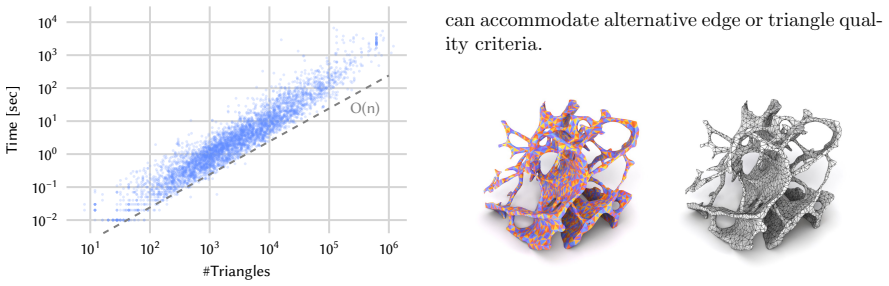
- [Sec. 4.3] The A* speed-up is stated as “roughly 3%” both in the abstract and Sec. 4.3; a short table or plot of wall-clock ratios versus model size (or versus classical MMP) would make the claim more precise and reproducible.
- [Sec. 3.2] Notation for characteristic length occasionally switches between cl_min / cl_max and the integral form R dl/cl; a single consistent definition early in Sec. 3.2 would improve readability.
- [Appendix A] Appendix A solutions for the circumcenter system are useful, but a brief numerical-stability note (conditioning when D_B or Y_C approach zero) would help implementers.
Circularity Check
No circularity: constructive local-optimization algorithm whose success metrics are measured on an external public dataset, with no fitted parameters presented as predictions and no load-bearing self-citation chain.
full rationale
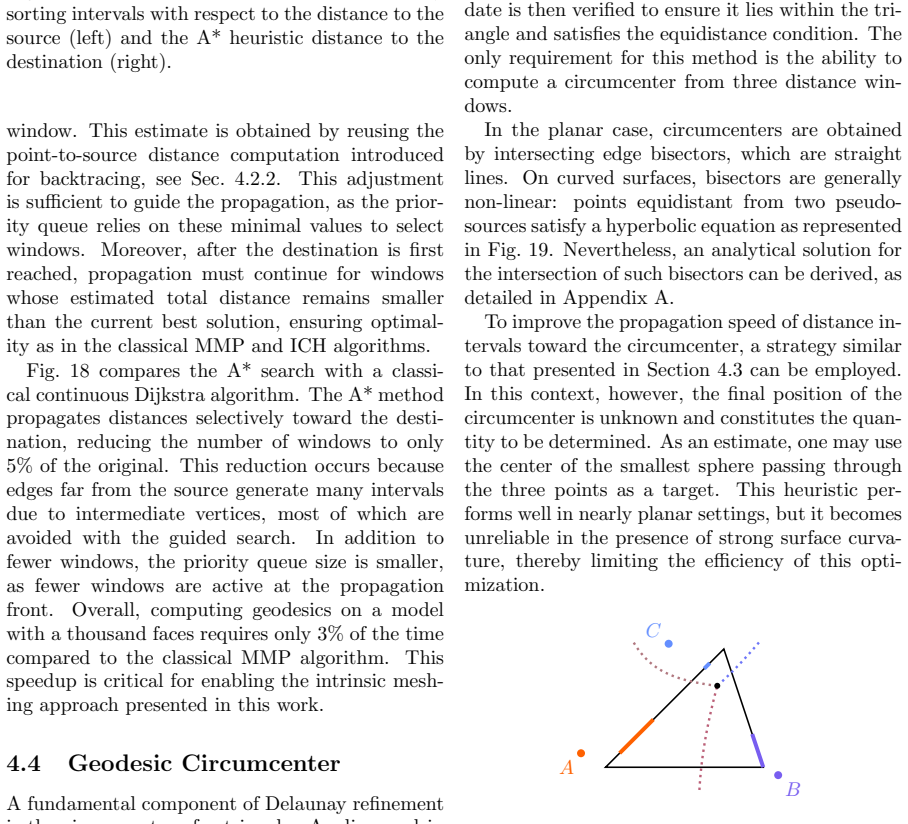
The paper describes a self-contained algorithmic pipeline (edge swaps via opposite-angle heuristic Alg. 2, splits/collapses driven by characteristic-length integrals Algs. 4-5, triangle splits via geodesic circumcenters Sec. 4.4/App. A, all using exact continuous-Dijkstra geodesics accelerated by A*). Every claimed property (shortest-path edges, size control, angle-based quality, refinement+coarsening) is realized by explicit local operations whose correctness is checked by intersection and quality predicates (Algs. 1, 6, 15-17). Validation consists of success rates, element counts and run-times on the filtered Thingi10K corpus (Table 1, Fig. 21); these numbers are not forced by any parameter fitted to the same data. Self-citations ([19], [31]) appear only for parallel-meshing context and classical high-order curving; none supply a uniqueness theorem or ansatz that the present construction relies upon. The acknowledged incompleteness of angle enforcement (only 27.5 % of runs meet the 20°-140° bounds) is an empirical limitation, not a circular reduction of claim to input. Hence the derivation chain contains no self-definitional, fitted-prediction, or self-citation circularity.
Assumptions & free parameters
free parameters (3)
- min/max intrinsic angle bounds =
20°–140° (default)
- characteristic-length margins
- A* Euclidean lower-bound weight =
1.0 (implicit)
assumptions (4)
- standard math Shortest geodesic paths on a polyhedral surface can be computed exactly by continuous Dijkstra (MMP/ICH) algorithms.
- domain assumption Input is a closed, manifold, consistently oriented triangulation.
- ad hoc to paper Opposite-angle sum heuristic is a sufficient proxy for the local intrinsic Delaunay criterion on non-developable triangles.
- standard math A geodesic circumcenter, when it exists, can be recovered by intersecting hyperbolic bisectors of three pseudo-source windows.
Cite this review
Pith. "Pith review of Intrinsic Meshing of Closed Surfaces Using Geodesic Distances." pith.science (2026). https://pith.science/paper/2QDYZTSZ
@misc{pith2026260704989,
  author       = {Pith},
  title        = {Pith review of: Intrinsic Meshing of Closed Surfaces Using Geodesic Distances},
  year         = {2026},
  howpublished = {\url{https://pith.science/paper/2QDYZTSZ}},
  note         = {Machine review of arXiv:2607.04989}
}
abstract
We present a method for constructing intrinsic triangulations of closed discrete surfaces, in which edges correspond to shortest geodesic paths and faces decompose into geometric primitives inherited from the underlying mesh. Starting from a watertight input triangulation, the method progressively builds an intrinsic mesh through local optimization operations -- edge swaps, edge splits, edge collapses, and triangle splits -- performed directly on the surface without modifying the original geometry. Element size is controlled via a characteristic length field, and quality is enforced through angle-based criteria derived from intrinsic distances. Geodesic distances are computed exactly using a continuous Dijkstra approach, accelerated by an A* search strategy that reduces computation to roughly $3\%$ of the cost of standard propagation. The framework supports both refinement and coarsening, overcoming a key limitation of prior intrinsic methods based on developable triangles. As a by-product, the intrinsic triangulation provides a natural foundation for direct high-order mesh generation, bypassing the classical pipeline of first constructing a linear mesh and subsequently curving it. The method is validated on the Thingi10K dataset across nearly 5,000 geometrically complex models.
Figures


Figures from the paper (18 more)



Reference graph
Works this paper leans on
-
[1]
Bobenko and Boris A
Alexander I. Bobenko and Boris A. Spring- born. A discrete laplace–beltrami operator for simplicial surfaces.Discrete & Computational Geometry, 38(4):740–756, 2007. 3
2007
-
[2]
Provably good sampling and meshing of sur- faces.Graphical Models, 67(5):405–451, 2005
Jean-Daniel Boissonnat and Steve Oudot. Provably good sampling and meshing of sur- faces.Graphical Models, 67(5):405–451, 2005. Solid Modeling and Applications. 3
2005
-
[3]
Shortest paths on a polyhedron
Jindong Chen and Yijie Han. Shortest paths on a polyhedron. InProceedings of the Sixth Annual Symposium on Computational Geom- etry, SCG ’90, page 360–369, New York, NY, USA, 1990. Association for Computing Ma- chinery. 4
1990
-
[4]
Paul Chew
L. Paul Chew. Guaranteed-quality mesh gen- eration for curved surfaces. InProceedings of the Ninth Annual Symposium on Computa- tional Geometry, SCG ’93, page 274–280, New York, NY, USA, 1993. Association for Com- puting Machinery. 3, 11
1993
-
[5]
A survey of algorithms for geodesic paths and distances, 2020
Keenan Crane, Marco Livesu, Enrico Puppo, and Yipeng Qin. A survey of algorithms for geodesic paths and distances, 2020. 4
2020
-
[6]
Dijkstra.A Note on Two Prob- lems in Connexion with Graphs, page 287–290
Edsger W. Dijkstra.A Note on Two Prob- lems in Connexion with Graphs, page 287–290. Association for Computing Machinery, New York, NY, USA, 1 edition, 2022. 4, 12
2022
-
[7]
Multiresolution analysis of arbitrary meshes
Matthias Eck, Tony DeRose, Tom Duchamp, Hugues Hoppe, Michael Lounsbery, and Werner Stuetzle. Multiresolution analysis of arbitrary meshes. InProceedings of the 22nd annual conference on Computer graphics and interactive techniques, pages 173–182, 1995. 3
1995
-
[8]
Matthew Fisher, Boris Springborn, Peter Schr¨ oder, and Alexander I. Bobenko. An algo- rithm for the construction of intrinsic delau- nay triangulations with applications to digital geometry processing.Computing, 81(2):199– 213, 2007. 3
2007
Show all 39 references
-
[9]
Parameterization of manifold trian- gulations
Michael S Floater, Kai Hormann, and Martin Reimers. Parameterization of manifold trian- gulations. InApproximation Theory X: Ab- stract and Classical Analysis, pages 197–209. Vanderbilt University Press, Nashville, 2002. 3, 5
2002
-
[10]
Gonzaga de Oliveira
Sanderson L. Gonzaga de Oliveira. A review on delaunay refinement techniques. In Be- niamino Murgante, Osvaldo Gervasi, Sanjay Misra, Nadia Nedjah, Ana Maria A. C. Rocha, David Taniar, and Bernady O. Apduhan, ed- itors,Computational Science and Its Applica- tions – ICCSA 2012,...
2012
-
[11]
Hart, Nils J
Peter E. Hart, Nils J. Nilsson, and Bertram Raphael. A formal basis for the heuristic de- termination of minimum cost paths.IEEE Transactions on Systems Science and Cyber- netics, 4(2):100–107, 1968. 5, 14
1968
-
[12]
Mesh optimization
Hugues Hoppe, Tony DeRose, Tom Duchamp, John McDonald, and Werner Stuetzle. Mesh optimization. InProceedings of the 20th an- nual conference on Computer graphics and in- teractive techniques, pages 19–26, 1993. 3
1993
-
[13]
Delaunay triangulations and voronoi diagrams for rie- mannian manifolds
Greg Leibon and David Letscher. Delaunay triangulations and voronoi diagrams for rie- mannian manifolds. InProceedings of the six- teenth annual symposium on Computational geometry, pages 341–349, 2000. 3
2000
-
[14]
Surface simplification using intrinsic error metrics.ACM Transac- tions on Graphics, 42(4), 2023
Hsueh-Ti Derek Liu, Mark Gillespie, Ben- jamin Chislett, Nicholas Sharp, Alec Jacob- son, and Keenan Crane. Surface simplification using intrinsic error metrics.ACM Transac- tions on Graphics, 42(4), 2023. 3
2023
-
[15]
Exact geodesic metric in 2- manifold triangle meshes using edge-based data structures.Computer-Aided Design, 45(3):695–704, 2013
Yong-Jin Liu. Exact geodesic metric in 2- manifold triangle meshes using edge-based data structures.Computer-Aided Design, 45(3):695–704, 2013. 5
2013
-
[16]
Construction of iso-contours, bisectors, and voronoi diagrams on triangulated surfaces
Yong-Jin Liu, Zhanqing Chen, and Kai Tang. Construction of iso-contours, bisectors, and voronoi diagrams on triangulated surfaces. IEEE Transactions on Pattern Analysis and Machine Intelligence, 33(8):1502–1517, 2011. 3, 5, 15 19
2011
-
[17]
Constructing intrinsic delaunay tri- angulations from the dual of geodesic voronoi diagrams.ACM Trans
Yong-Jin Liu, Dian Fan, Chun-Xu Xu, and Ying He. Constructing intrinsic delaunay tri- angulations from the dual of geodesic voronoi diagrams.ACM Trans. Graph., 36(2), April
-
[18]
The duality of geodesic voronoi/delaunay diagrams for an intrinsic discrete laplace-beltrami operator on simpli- cial surfaces
Yong-Jin Liu, Chunxu Xu, Ying He, and Deok-Soo Kim. The duality of geodesic voronoi/delaunay diagrams for an intrinsic discrete laplace-beltrami operator on simpli- cial surfaces. InCanadian Conference on Computational Geometry, 2014. 7, 8
2014
-
[19]
One machine, one minute, three billion tetrahedra.International Jour- nal for Numerical Methods in Engineering, 117(9):967–990, 2019
C´ elestin Marot, Jeanne Pellerin, and Jean- Fran¸ cois Remacle. One machine, one minute, three billion tetrahedra.International Jour- nal for Numerical Methods in Engineering, 117(9):967–990, 2019. 18
2019
-
[20]
Joseph S. B. Mitchell, David M. Mount, and Christos H. Papadimitriou. The discrete geodesic problem.SIAM Journal on Comput- ing, 16(4):647–668, 2026/05/12 1987. 4
2026
-
[21]
Shortest paths on polyhedral surfaces
Joseph O’Rourke, Subhash Suri, and Heather Booth. Shortest paths on polyhedral surfaces. In K. Mehlhorn, editor,STACS 85, pages 243– 254, Berlin, Heidelberg, 1985. Springer Berlin Heidelberg. 4
1985
-
[22]
Gabriel Peyr´ e and Laurent D. Cohen. Surface segmentation using geodesic centroidal tesse- lation. InProceedings. 2nd International Sym- posium on 3D Data Processing, Visualization and Transmission, 2004. 3DPVT 2004., pages 995–1002, 2004. 3
2004
-
[23]
Gabriel Peyr´ e and Laurent D. Cohen. Geodesic Computations for Fast and Accu- rate Surface Remeshing and Parameteriza- tion, pages 157–171. Birkh¨ auser Basel, Basel,
-
[24]
Fast and exact discrete geodesic computation based on triangle-oriented wavefront propagation
Yipeng Qin, Xiaoguang Han, Hongchuan Yu, Yizhou Yu, and Jianjun Zhang. Fast and exact discrete geodesic computation based on triangle-oriented wavefront propagation. ACM Trans. Graph., 35(4), July 2016. 5
2016
-
[25]
A delaunay refinement algo- rithm for quality 2-dimensional mesh gener- ation.Journal of Algorithms, 18(3):548–585,
Jim Ruppert. A delaunay refinement algo- rithm for quality 2-dimensional mesh gener- ation.Journal of Algorithms, 18(3):548–585,
-
[26]
James A. Sethian. A fast marching level set method for monotonically advancing fronts. Proceedings of the National Academy of Sci- ences, 93(4):1591–1595, 1996. 4
1996
-
[27]
James A. Sethian. Fast marching methods. SIAM Review, 41(2):199–235, 1999. 4
1999
-
[28]
Navigating intrinsic triangulations
Nicholas Sharp, Yousuf Soliman, and Keenan Crane. Navigating intrinsic triangulations. ACM Trans. Graph., 38(4), July 2019. 3, 4, 18
2019
-
[29]
Shewchuk
Jonathan R. Shewchuk. Delaunay refine- ment algorithms for triangular mesh genera- tion.Computational Geometry, 22(1):21–74,
-
[30]
16th ACM Symposium on Computa- tional Geometry. 3, 11
-
[31]
Gortler, and Hugues Hoppe
Vitaly Surazhsky, Tatiana Surazhsky, Danil Kirsanov, Steven J. Gortler, and Hugues Hoppe. Fast exact and approximate geodesics on meshes.ACM Trans. Graph., 24(3):553–560, July 2005. 5, 16
2005
-
[32]
Robust untangling of curvilinear meshes.Journal of Computational Physics, 254:8–26, 2013
Thomas Toulorge, Christophe Geuzaine, Jean-Fran¸ cois Remacle, and Jonathan Lam- brechts. Robust untangling of curvilinear meshes.Journal of Computational Physics, 254:8–26, 2013. 18
2013
-
[33]
Wang and Matthew Yuen
Charlie C.L. Wang and Matthew Yuen. A generic algorithm for mesh optimisation.The International Journal of Advanced Manufac- turing Technology, 18(10):739–744, 2001. 3
2001
-
[34]
Isotropic mesh simplification by evolving the geodesic delaunay triangulation
Shi-Qing Xin, Shuang-Min Chen, Ying He, Guo-Jin Wang, Xianfeng Gu, and Hong Qin. Isotropic mesh simplification by evolving the geodesic delaunay triangulation. In2011 Eighth International Symposium on Voronoi Diagrams in Science and Engineering, pages 39–47, 2011. 3
2011
-
[35]
Improv- ing chen and han’s algorithm on the discrete geodesic problem.ACM Trans
Shi-Qing Xin and Guo-Jin Wang. Improv- ing chen and han’s algorithm on the discrete geodesic problem.ACM Trans. Graph., 28(4), September 2009. 4, 5
2009
-
[36]
Applying the improved chen and han’s algorithm to dif- ferent versions of shortest path problems on a polyhedral surface.Computer-Aided Design, 42(10):942–951, 2010
Shi-Qing Xin and Guo-Jin Wang. Applying the improved chen and han’s algorithm to dif- ferent versions of shortest path problems on a polyhedral surface.Computer-Aided Design, 42(10):942–951, 2010. 5
2010
-
[37]
Wang, Yong-Jin Liu, Ligang Liu, and Ying He
Chunxu Xu, Tuanfeng Y. Wang, Yong-Jin Liu, Ligang Liu, and Ying He. Fast wave- front propagation (fwp) for computing exact geodesic distances on meshes.IEEE Transac- tions on Visualization and Computer Graph- ics, 21(7):822–834, 2015. 5
2015
-
[38]
Par- allel chen-han (pch) algorithm for discrete geodesics.ACM Trans
Xiang Ying, Shi-Qing Xin, and Ying He. Par- allel chen-han (pch) algorithm for discrete geodesics.ACM Trans. Graph., 33(1), Febru- ary 2014. 5
2014
-
[39]
Thingi10k: A dataset of 10, 000 3d-printing models
Qingnan Zhou and Alec Jacobson. Thingi10k: A dataset of 10, 000 3d-printing models. CoRR, abs/1605.04797, 2016. 16 20 A Circumcenter Computa- tion With Pseudo-Sources As detailed in Sec. 4.4, it is necessary to compute the position of the circumcenter, if it exists, de- fined ...
2016 arXiv
Reviewed July 11, 2026 · model on record in the stance chip above.
Discussion (0). Continue with ORCID to comment.