REVIEW 4 major objections 5 minor 158 references
Talking to an AI Mirror: Designing Self-Clone Chatbots for Enhanced Engagement in Digital Mental Health Support
T0 review · 4 major / 5 minor · reviewed 2026-08-04 · deepseek-v4-flash
Pith's one-line read Beat generic counselors: AI self-clones win user engagement
desk verdict A genuinely new design contribution undermined by a headline claim that rests on a post-hoc subgroup split. read the letter →
The pith
A machine-rendered reading of the paper's core claim, the machinery that carries it, and where it could break.
The reading
What carries the argument
The self-clone chatbot is the central object: a fine-tuned GPT-4-based conversational agent prompted to act as the user's future self, trained on a chat log in which the user advised a fictional friend ('A Friend in Need'). The two design levers are conversational style replication (SCX) and Social Support Prompting (SSP, SCS), which classifies the user's support behavior into informational, esteem, and emotional support categories with intensity ratings and feeds that classification into the prompt. The load-bearing empirical device is the perceived believability score: its bimodal distribution defines the high- and low-believability subgroups, and the engagement advantage appears only in t
What would settle it
A pre-registered study that measures believability before the main chat (or varies clone believability independently, e.g., by the amount of personal data used) and finds no engagement advantage for believable clones over a generic counselor—or finds the overall comparison significant without the believability split—would refute the claim.
Extended reading notes
Core claim
The central claim is that a self-clone chatbot—an LLM prompted to speak as the user's future self using their own conversational style and support strategies—can increase cognitive and emotional engagement with a digital mental-health tool compared with a generic counselor persona, provided the clone is perceived as believable. Believability scores were bimodal, splitting the sample into high and low subgroups; only the high-believability subgroup showed significantly higher engagement, and overall engagement correlated strongly with believability (rs = 0.718). The authors propose that engagement arises from an externalized self-dialogue: users effectively receive their own advice back throu
Load-bearing premise
The positive result only appears after splitting participants into high- and low-believability groups using a rating collected after the interaction; if believability is a consequence of engagement rather than its cause, the claim that self-clones enhance engagement does not survive.
Editorial extensions
If this is right
- Self-clone personas are a viable design direction for raising engagement in mental-health chatbots, if believability can be engineered.
- Because the overall comparison collapsed across believability was not significant, believability is a moderator to measure and design for rather than a side effect.
- Adding support-strategy matching (SSP) produced a trend toward higher emotional engagement than style-only cloning, suggesting the support-pattern layer adds value beyond style.
- Ten-week follow-up results suggest the engagement effect is not just first-use novelty.
- Design guidance follows: frame the persona as a future self, avoid factual-knowledge claims that trigger breakdown moments, and select traits (style plus support patterns) rather than collecting extensive personal data.
Reading between the lines
- If believability is causal, deliberately manipulating it—more training data, voice modality, or memory of user-stated facts—should convert part of the low-believability group into high engagement; the paper's own multimodal discussion points this way.
- The direction of causality is open: believability was measured after the interaction, so a design that measures believability before the main chat (e.g., after a fixed first message) would test whether believability is a precursor or a consequence of engaged conversation.
- The Solomon's-paradox framing suggests a broader 'decision mirror' use beyond mental health: the mechanism is applying one's own advice to oneself, which could extend to reflection, planning, and behavior change.
- The very strong correlations between engagement, acceptance, and motivation (r ≈ 0.8) raise the question of whether the self-clone adds unique variance beyond general chatbot acceptance; a study with discriminant validity checks could settle that.
Editorial analysis
A structured set of objections, weighed in public.
Referee Report
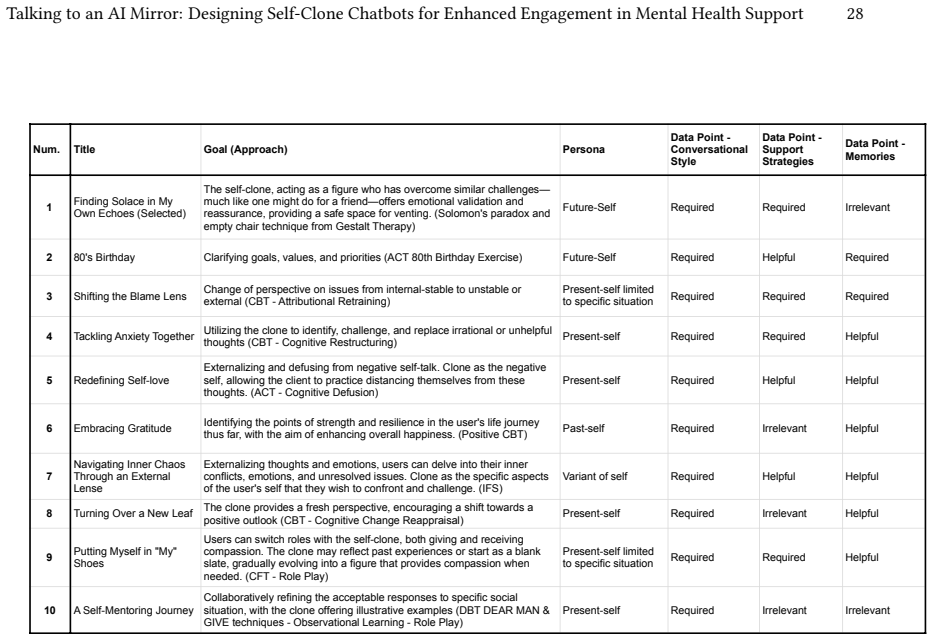
Summary. The manuscript introduces self-clone chatbots for mental health support: a GPT-4-based conversational agent is prompted to act as the user's future self, using chat logs from a preparatory 'A Friend in Need' interaction and, in one condition, an SSP-based classification of the user's support strategies. In a semi-controlled experiment (N=180; baseline counselor, self-clone without SSP, self-clone with SSP), the authors measure engagement, motivation, acceptance, AI-related attitudes, and perceived believability. They report significantly higher cognitive and emotional engagement for self-clones relative to baseline, with believability as a mediator, and support this with qualitative analysis and a 10-week follow-up. The central difficulty is that the quantitative headline rests on a post-hoc split of self-clone participants into high- and low-believability groups; without that split the overall condition effect is not significant.
Significance. The idea of a self-clone chatbot for engagement in digital mental health is original and practically motivated, and the SSP prompting technique is a useful design contribution. The paper also provides unusually rich qualitative material and a follow-up check on novelty effects. However, the main quantitative claim is not established by the primary analysis: the significant engagement effect appears only after selecting a high-believability subgroup defined by a post-outcome measure that is strongly correlated with engagement. If reframed as an exploratory design study, the contribution is meaningful; as presented, the abstract and conclusions overstate the evidence.
major comments (4)
- [Abstract and §4.2.3] The abstract claims 'significantly higher emotional and cognitive engagement was demonstrated with self-clone chatbots than a chatbot with a generic counselor persona.' The full text does not support this as a main effect. The ANOVA in §4.2.3 is significant only after restricting to the high-believability self-clone subgroups, and the text explicitly states that 'without dividing participants into high- and low-believability groups, the analysis revealed no significant differences between the conditions' (Appendix F.3 also shows this). The headline claim should be revised to report the overall null and present the subgroup result as exploratory.
- [§4.2.1, §4.2.2, and Abstract] Believability is treated as both a subgrouping variable and a 'mediator,' but neither role is justified by the analysis. Believability was measured after the engagement outcomes (§4.1.2), the high/low threshold (2.81) was derived from the same sample via Hartigan's dip test and Gaussian mixture modeling (§4.2.1), and believability correlates r_s=.718 with engagement (§4.2.2). The high-believability subgroup is therefore selected on a post-treatment variable that is strongly associated with the outcome, opening the door to reverse causality: engagement may cause perceived believability rather than the reverse. No mediation model is reported, so the mediator language in the abstract and introduction is unsupported. The causal direction is also conceded in §5.4.
- [§4.1.3 and §4.2.3] The inferential comparison in §4.2.3 uses N=60 baseline participants but only N=29 (SCX) and N=35 (SCS) self-clone participants selected for high believability. This is far from the planned power analysis targeting N=180 to detect f=0.25, and the group sizes are unbalanced. Combined with the post-hoc selection issue, the significant F(2,121)=4.366 is not a reliable estimate of a population effect. The paper should either report this as a clearly labeled exploratory analysis with appropriate caution, or provide a pre-registered replication or a separate confirmatory test that does not use the same data to define the subgroup and then test it.
- [§4.2.5] The section title states that motivation and acceptance 'exhibited similar improved patterns in both self-clone conditions compared to baseline,' but the reported tests are not significant (p=.261 and p=.060 respectively). The text does acknowledge the lack of significance, but the framing in the title and the surrounding narrative overstates the evidence. This is secondary to the main claim, but the wording should be aligned with the statistical results.
minor comments (5)
- [Abstract] The phrase 'believability as a mediator' should be replaced with 'correlate' or 'associated factor' unless a formal mediation analysis is added.
- [§4.1.2] Believability is listed as an independent variable, but it was measured post-treatment and is not experimentally manipulated. The terminology should be changed to 'post-hoc measured variable' to avoid implying causal status.
- [Appendix F.2, Table 3] The correlation between condition and AI literacy is reported as -0.34 with p=.648; this appears to be a typo for -0.034. Please check.
- [§4.2.4] The follow-up sample is self-selected (66 of 120 invited participants). This is acknowledged in §5.4, but it should also be stated in the results section where the follow-up statistics are first presented.
- [§3.2] The phrase 'ten potential scenarios' followed by only one selected scenario is clear, but a one-line rationale for excluding the other scenarios (beyond the 'anticipated impact, broad applicability, and scalability' criterion) would help readers understand the design space.
Circularity Check
Only significant engagement effect is obtained after a post-hoc believability split derived from the same data; unsplit analysis is null.
-
fitted input called prediction
[Section 4.2.3 (threshold from 4.2.1; believability timing from 4.1.2)]
"A one-way analysis of variance (ANOVA), with Holm-Bonferroni corrections... revealed a significant effect of condition (highly believable SCX or SCS and baseline) on overall engagement, F(2,121)=4.366, p=.015... When believability was not considered as a mediating factor (i.e., without dividing participants into high- and low-believability groups), the analysis revealed no significant differences between the conditions."
The paper's positive engagement claim is conditional on a subgroup split that is not independent of the outcome. The 2.81 threshold was fit to the same sample by Hartigan's dip test and Gaussian mixture modeling (4.2.1); believability was collected post-study (4.1.2) and correlates r_s=.718 with engagement (4.2.2). Thus the 'high believability' group is selected, at least in part, on the outcome it is then used to explain. The abstract's statement that significantly higher engagement 'was demonstrated' with self-clones is not a prediction from the unsplit randomized comparison; it is the result of re-analyzing a subgroup defined by a post-hoc, outcome-correlated measure.
full rationale
No mathematical derivation or self-citation chain is circular: the system design, prompts, and questionnaires are original, and the baseline comparison is external. The circularity concern is statistical rather than definitional. The only significant condition effect in the primary analysis appears after the self-clone sample is split into high/low believability using a threshold estimated from the same data. The paper explicitly reports that without this split there were no significant differences between conditions. Because believability was measured after the engagement outcomes and is strongly correlated with them (r_s=.718), the subgroup analysis is a selection-on-outcome contrast, and the abstract's main-effect claim overstates it. The follow-up consistency check and qualitative themes provide supplementary evidence but do not repair the primary contrast. This is partial circularity/selection, not a fully circular derivation.
Assumptions & free parameters
free parameters (3)
- Believability split threshold =
2.81
- Early/late segment split in SSP
- Minimum message thresholds =
10 and 12 messages
assumptions (5)
- domain assumption Self-talk and self-distancing techniques (empty chair, journaling) can be externalized into an interactive AI tool without loss of efficacy.
- domain assumption The 'A Friend in Need' interaction reveals the user's genuine support strategies.
- domain assumption A 10-12 turn single session interaction provides a meaningful measure of engagement relevant to long-term mental health chatbot use.
- domain assumption TWEETS cognitive and emotional items, without behavioral items, measure engagement dimensions that can be compared across conditions.
- domain assumption Random assignment creates comparable groups despite self-selection into an online Prolific sample.
invented entities (2)
-
Self-clone chatbot (future-self persona)
-
Social Support Prompting (SSP) technique
Cite this review
Pith. "Pith review of Talking to an AI Mirror: Designing Self-Clone Chatbots for Enhanced Engagement in Digital Mental Health Support." pith.science (2026). https://pith.science/paper/2R4TFMQI
@misc{pith2026250906393,
  author       = {Pith},
  title        = {Pith review of: Talking to an AI Mirror: Designing Self-Clone Chatbots for Enhanced Engagement in Digital Mental Health Support},
  year         = {2026},
  howpublished = {\url{https://pith.science/paper/2R4TFMQI}},
  note         = {Machine review of arXiv:2509.06393}
}
read the original abstract
Mental health conversational agents have the potential to deliver valuable therapeutic impact, but low user engagement remains a critical barrier hindering their efficacy. Existing therapeutic approaches have leveraged clients' internal dialogues (e.g., journaling, talking to an empty chair) to enhance engagement through accountable, self-sourced support. Inspired by these, we designed novel AI-driven self-clone chatbots that replicate users' support strategies and conversational patterns to improve therapeutic engagement through externalized meaningful self-conversation. Validated through a semi-controlled experiment (N=180), significantly higher emotional and cognitive engagement was demonstrated with self-clone chatbots than a chatbot with a generic counselor persona. Our findings highlight self-clone believability as a mediator and emphasize the balance required in maintaining convincing self-representation while creating positive interactions. This study contributes to AI-based mental health interventions by introducing and evaluating self-clones as a promising approach to increasing user engagement, while exploring implications for their application in mental health care.
Figures


Figures from the paper (4 more)



Reference graph
Works this paper leans on
-
[1]
URL https://www.scirp.org/journal/paperinformation.aspx?paperid= 93302
Gestalt therapy effectiveness: A systematic review of empirical evidence, 2019. URL https://www.scirp.org/journal/paperinformation.aspx?paperid= 93302
2019
-
[2]
URL https://mhanational.org/issues/2022/mental-health-america-access-care-data
Access to Care Data 2022, 2022. URL https://mhanational.org/issues/2022/mental-health-america-access-care-data
2022
-
[3]
An overview of the features of chatbots in mental health: A scoping review.International journal of medical informatics, 132:103978, 2019
Alaa A Abd-Alrazaq, Mohannad Alajlani, Ali Abdallah Alalwan, Bridgette M Bewick, Peter Gardner, and Mowafa Househ. An overview of the features of chatbots in mental health: A scoping review.International journal of medical informatics, 132:103978, 2019
2019
-
[4]
Perceptions and opinions of patients about mental health chatbots: scoping review.Journal of medical Internet research, 23(1):e17828, 2021
Alaa A Abd-Alrazaq, Mohannad Alajlani, Nashva Ali, Kerstin Denecke, Bridgette M Bewick, and Mowafa Househ. Perceptions and opinions of patients about mental health chatbots: scoping review.Journal of medical Internet research, 23(1):e17828, 2021
2021
-
[5]
Bryan Abendschein, Autumn Edwards, and Chad Edwards. Novelty experience in prolonged interaction: A qualitative study of socially-isolated college students’ in-home use of a robot companion animal.Frontiers in Robotics and AI, 9:733078, 2022
2022
-
[6]
Designing personality-adaptive conversational agents for mental health care.Information Systems Frontiers, 24(3):923–943, 2022
Rangina Ahmad, Dominik Siemon, Ulrich Gnewuch, and Susanne Robra-Bissantz. Designing personality-adaptive conversational agents for mental health care.Information Systems Frontiers, 24(3):923–943, 2022
2022
-
[7]
Guidelines for human-ai interaction
Saleema Amershi, Dan Weld, Mihaela Vorvoreanu, Adam Fourney, Besmira Nushi, Penny Collisson, Jina Suh, Shamsi Iqbal, Paul N Bennett, Kori Inkpen, et al. Guidelines for human-ai interaction. InProceedings of the 2019 chi conference on human factors in computing systems, pages 1–13, 2019
2019
-
[8]
Human-computer interaction in digital mental health
Luke Balcombe and Diego De Leo. Human-computer interaction in digital mental health. InInformatics, volume 9, page 14. MDPI, 2022
2022
Show all 158 references
-
[9]
The strength of self-acceptance: Theory, practice and research
Michael E Bernard. The strength of self-acceptance: Theory, practice and research. Springer, 2014. ISBN 978-1-4614-6806-6. doi: 10.1007/978-1- 4614-6806-6_1. URL https://doi.org/10.1007/978-1-4614-6806-6_1
2014 doi
-
[10]
Laura Esther Bijkerk, Anke Oenema, Nicole Geschwind, and Mark Spigt. Measuring engagement with mental health and behavior change interventions: an integrative review of methods and instruments.International Journal of Behavioral Medicine, 30(2):155–166, 2023
2023
-
[11]
Barriers to and facilitators of user engagement with digital mental health interventions: systematic review.Journal of medical Internet research, 23(3):e24387, 2021
Judith Borghouts, Elizabeth Eikey, Gloria Mark, Cinthia De Leon, Stephen M Schueller, Margaret Schneider, Nicole Stadnick, Kai Zheng, Dana Mukamel, and Dara H Sorkin. Barriers to and facilitators of user engagement with digital mental health interventions: systematic review.Jo...
2021
-
[12]
Artificially intelligent chatbots in digital mental health interventions: a review.Expert Review of Medical Devices, 18(sup1):37–49, 2021
Eliane M Boucher, Nicole R Harake, Haley E Ward, Sarah Elizabeth Stoeckl, Junielly Vargas, Jared Minkel, Acacia C Parks, and Ran Zilca. Artificially intelligent chatbots in digital mental health interventions: a review.Expert Review of Medical Devices, 18(sup1):37–49, 2021
2021
-
[13]
Reflecting on reflexive thematic analysis.Qualitative research in sport, exercise and health, 11(4):589–597, 2019
Virginia Braun and Victoria Clarke. Reflecting on reflexive thematic analysis.Qualitative research in sport, exercise and health, 11(4):589–597, 2019
2019
-
[14]
Individual differences in self-talk frequency: Social isolation and cognitive disruption.Frontiers in Psychology, 10:1088, 2019
Thomas M Brinthaupt. Individual differences in self-talk frequency: Social isolation and cognitive disruption.Frontiers in Psychology, 10:1088, 2019
2019
-
[15]
Self-talk: research challenges and opportunities.Frontiers in Psychology, 14:1210960, 2023
Thomas M Brinthaupt and Alain Morin. Self-talk: research challenges and opportunities.Frontiers in Psychology, 14:1210960, 2023
2023
-
[16]
Gamification and adherence to web-based mental health interventions: a systematic review.JMIR mental health, 3(3):e5710, 2016
Menna Brown, Noelle O’Neill, Hugo van Woerden, Parisa Eslambolchilar, Matt Jones, Ann John, et al. Gamification and adherence to web-based mental health interventions: a systematic review.JMIR mental health, 3(3):e5710, 2016
2016
-
[17]
Zana Buçinca, Maja Barbara Malaya, and Krzysztof Z Gajos. To trust or to think: cognitive forcing functions can reduce overreliance on ai in ai-assisted decision-making.Proceedings of the ACM on Human-computer Interaction, 5(CSCW1):1–21, 2021
2021
-
[18]
i just can’t help but smile sometimes
Eleanor R Burgess, Madhu C Reddy, and David C Mohr. " i just can’t help but smile sometimes": Collaborative self-management of depression. Proceedings of the ACM on Human-Computer Interaction, 6(CSCW1):1–32, 2022
2022
-
[19]
Ai chatbots for mental health: A scoping review of effectiveness, feasibility, and applications.Applied Sciences, 14(13):5889, 2024
Mirko Casu, Sergio Triscari, Sebastiano Battiato, Luca Guarnera, and Pasquale Caponnetto. Ai chatbots for mental health: A scoping review of effectiveness, feasibility, and applications.Applied Sciences, 14(13):5889, 2024
2024
-
[20]
Character.ai - conversational ai platform
Character.AI. Character.ai - conversational ai platform. URL https://beta.character.ai/
-
[21]
User perceptions and experiences of an ai-driven conversational agent for mental health support
Beenish Moalla Chaudhry and Happy Rani Debi. User perceptions and experiences of an ai-driven conversational agent for mental health support. Mhealth, 10:22, 2024
2024
-
[22]
How should my chatbot interact? a survey on social characteristics in human–chatbot interaction design.International Journal of Human–Computer Interaction, 37(8):729–758, 2021
Ana Paula Chaves and Marco Aurelio Gerosa. How should my chatbot interact? a survey on social characteristics in human–chatbot interaction design.International Journal of Human–Computer Interaction, 37(8):729–758, 2021
2021
-
[23]
Hybrid care in mental health: a framework for understanding care, research, and future opportunities
Kelly Chen, Jack J Huang, and John Torous. Hybrid care in mental health: a framework for understanding care, research, and future opportunities. NPP—Digital Psychiatry and Neuroscience, 2(1):16, 2024
2024
-
[24]
In the shades of the uncanny valley: An experimental study of human–chatbot interaction.Future Generation Computer Systems, 92:539–548, 2019
Leon Ciechanowski, Aleksandra Przegalinska, Mikolaj Magnuski, and Peter Gloor. In the shades of the uncanny valley: An experimental study of human–chatbot interaction.Future Generation Computer Systems, 92:539–548, 2019
2019
-
[25]
A developer made software to turn anyone into an ai girlfriend—and he’s starting with his own partner.Vice, August 22 2023
Joseph Cox. A developer made software to turn anyone into an ai girlfriend—and he’s starting with his own partner.Vice, August 22 2023. Retrieved September 10, 2024, from https://www.vice.com/en/article/a-developer-made-software-to-turn-anyone-into-an-ai-girlfriendand-hes- sta...
2023
-
[26]
Springer Science & Business Media, 2013
Edward L Deci and Richard M Ryan.Intrinsic motivation and self-determination in human behavior. Springer Science & Business Media, 2013
2013
-
[27]
gamification
Sebastian Deterding, Dan Dixon, Rilla Khaled, and Lennart Nacke. From game design elements to gamefulness: defining" gamification". In Proceedings of the 15th international academic MindTrek conference: Envisioning future media environments, pages 9–15, 2011
2011
-
[28]
Safeguarding data privacy and informed consent: Ethical imperatives in ai-driven mental healthcare
Souvik Dhar and Utsa Sarkar. Safeguarding data privacy and informed consent: Ethical imperatives in ai-driven mental healthcare. InIntersections of Law and Computational Intelligence in Health Governance, pages 197–219. IGI Global, 2024
2024
-
[29]
A systematic review of the impact of adherence on the effectiveness of e-therapies.Journal of medical Internet research, 13(3):e1772, 2011
Liesje Donkin, Helen Christensen, Sharon L Naismith, Bruce Neal, Ian B Hickie, and Nick Glozier. A systematic review of the impact of adherence on the effectiveness of e-therapies.Journal of medical Internet research, 13(3):e1772, 2011. Talking to an AI Mirror: Designing Self-...
2011
-
[30]
From static to dynamic: A continual learning framework for large language models.arXiv preprint arXiv:2310.14248, 2023
Mingzhe Du, Anh Tuan Luu, Bin Ji, and See-kiong Ng. From static to dynamic: A continual learning framework for large language models.arXiv preprint arXiv:2310.14248, 2023
2023 arXiv
-
[31]
Hillcrest Publishing Group, 2009
Jay Earley.Self-Therapy: A Step-By-Step Guide to Creating Inner Wholeness Using Ifs, a New, Cutting-Edge Therapy. Hillcrest Publishing Group, 2009
2009
-
[32]
Unique effects of setting goals on behavior change: Systematic review and meta-analysis
Tracy Epton, Sinead Currie, and Christopher J Armitage. Unique effects of setting goals on behavior change: Systematic review and meta-analysis. Journal of consulting and clinical psychology, 85(12):1182, 2017
2017
-
[33]
Kathleen Kara Fitzpatrick, Alison Darcy, and Molly Vierhile. Delivering cognitive behavior therapy to young adults with symptoms of depression and anxiety using a fully automated conversational agent (woebot): a randomized controlled trial.JMIR mental health, 4(2):e7785, 2017
2017
-
[34]
Persuasive technology: using computers to change what we think and do.Ubiquity, 2002(December):2, 2002
Brian J Fogg. Persuasive technology: using computers to change what we think and do.Ubiquity, 2002(December):2, 2002
2002
-
[35]
Fraia.ai - conversational ai for therapists
Fraia.ai. Fraia.ai - conversational ai for therapists. URL https://www.fraia.ai/
-
[36]
Using psychological artificial intelligence (tess) to relieve symptoms of depression and anxiety: randomized controlled trial.JMIR mental health, 5(4):e9782, 2018
Russell Fulmer, Angela Joerin, Breanna Gentile, Lysanne Lakerink, Michiel Rauws, et al. Using psychological artificial intelligence (tess) to relieve symptoms of depression and anxiety: randomized controlled trial.JMIR mental health, 5(4):e9782, 2018. doi: 10.2196/mental.9782....
2018 doi
-
[37]
Iason Gabriel, Arianna Manzini, Geoff Keeling, Lisa Anne Hendricks, Verena Rieser, Hasan Iqbal, Nenad Tomašev, Ira Ktena, Zachary Kenton, Mikel Rodriguez, Seliem El-Sayed, Sasha Brown, Canfer Akbulut, Andrew Trask, Edward Hughes, A. Stevie Bergman, Renee Shelby, Nahema Marchal...
2024 arXiv
-
[38]
Distanced self-talk changes how people conceptualize the self.Journal of Experimental Social Psychology, 88: 103969, 2020
Izzy Gainsburg and Ethan Kross. Distanced self-talk changes how people conceptualize the self.Journal of Experimental Social Psychology, 88: 103969, 2020. doi: 10.1016/j.jesp.2020.103969. URL https://www.sciencedirect.com/science/article/pii/S0022103119303531
2020
-
[40]
Effect of engagement with digital interventions on mental health outcomes: a systematic review and meta-analysis.Frontiers in digital health, 3:764079, 2021
Daniel ZQ Gan, Lauren McGillivray, Jin Han, Helen Christensen, and Michelle Torok. Effect of engagement with digital interventions on mental health outcomes: a systematic review and meta-analysis.Frontiers in digital health, 3:764079, 2021
2021
-
[41]
Dialectic contradictions in postmarital relationships.Journal of Family Communication, 3(4):193–214, 2003
Elizabeth E Graham. Dialectic contradictions in postmarital relationships.Journal of Family Communication, 3(4):193–214, 2003
2003
-
[42]
Development and validation of the ai attitude scale (aias-4): a brief measure of general attitude toward artificial intelligence
Simone Grassini. Development and validation of the ai attitude scale (aias-4): a brief measure of general attitude toward artificial intelligence. Frontiers in psychology, 14:1191628, 2023. doi: 10.3389/fpsyg.2023.1191628. URL https://www.frontiersin.org/journals/psychology/ar...
2023
-
[43]
Exploring solomon’s paradox: Self-distancing eliminates the self-other asymmetry in wise reasoning about close relationships in younger and older adults, 2014
Igor Grossmann and Ethan Kross. Exploring solomon’s paradox: Self-distancing eliminates the self-other asymmetry in wise reasoning about close relationships in younger and older adults, 2014
2014
-
[44]
Trait mindfulness, self-compassion, and self-talk: A correlational analysis of young adults
Jocelyn Grzybowski and Thomas M Brinthaupt. Trait mindfulness, self-compassion, and self-talk: A correlational analysis of young adults. Behavioral Sciences, 12(9):300, 2022. doi: 10.3390/bs12090300. URL https://www.mdpi.com/2076-328X/12/9/300
2022 doi
-
[45]
for an app supposed to make its users feel better, it sure is a joke
Md Romael Haque and Sabirat Rubya. " for an app supposed to make its users feel better, it sure is a joke"-an analysis of user reviews of mobile mental health applications.Proceedings of the ACM on Human-Computer Interaction, 6(CSCW2):1–29, 2022
2022
-
[46]
Speaking clearly: A critical review of the self-talk literature.Psychology of sport and exercise, 7(1):81–97, 2006
James Hardy. Speaking clearly: A critical review of the self-talk literature.Psychology of sport and exercise, 7(1):81–97, 2006. doi: 10.1016/j. psychsport.2005.04.002. URL https://www.sciencedirect.com/science/article/pii/S1469029205000476
2006 doi
-
[47]
Antonis Hatzigeorgiadis, Nikos Zourbanos, Sofia Mpoumpaki, and Yannis Theodorakis. Mechanisms underlying the self-talk–performance relationship: The effects of motivational self-talk on self-confidence and anxiety.Psychology of Sport and exercise, 10(1):186–192, 2009
2009
-
[48]
Human-ai collaboration: the effect of ai delegation on human task performance and task satisfaction
Patrick Hemmer, Monika Westphal, Max Schemmer, Sebastian Vetter, Michael Vössing, and Gerhard Satzger. Human-ai collaboration: the effect of ai delegation on human task performance and task satisfaction. InProceedings of the 28th International Conference on Intelligent User In...
2023
-
[49]
Personalization strategies in digital mental health interventions: a systematic review and conceptual framework for depressive symptoms.Frontiers in digital health, 5:1170002, 2023
Silvan Hornstein, Kirsten Zantvoort, Ulrike Lueken, Burkhardt Funk, and Kevin Hilbert. Personalization strategies in digital mental health interventions: a systematic review and conceptual framework for depressive symptoms.Frontiers in digital health, 5:1170002, 2023. doi: 10....
2023
-
[50]
Becky Inkster, Shubhankar Sarda, Vinod Subramanian, et al. An empathy-driven, conversational artificial intelligence agent (wysa) for digital mental well-being: real-world data evaluation mixed-methods study.JMIR mHealth and uHealth, 6(11):e12106, 2018. doi: 10.2196/12106. URL...
2018 doi
-
[51]
Evaluating and informing the design of chatbots
Mohit Jain, Pratyush Kumar, Ramachandra Kota, and Shwetak N Patel. Evaluating and informing the design of chatbots. InProceedings of the 2018 designing interactive systems conference, pages 895–906, 2018. ISBN 978-1-4503-5198-0. doi: 10.1145/3196709.3196735. URL https: //doi.o...
2018
-
[52]
Human heuristics for ai-generated language are flawed.Proceedings of the National Academy of Sciences, 120(11):e2208839120, 2023
Maurice Jakesch, Jeffrey T Hancock, and Mor Naaman. Human heuristics for ai-generated language are flawed.Proceedings of the National Academy of Sciences, 120(11):e2208839120, 2023
2023
-
[53]
Letters from future self: Augmenting the letter-exchange exercise with llm-based agents to enhance young adults’ career exploration
Hayeon Jeon, Suhwoo Yoon, Keyeun Lee, Seo Hyeong Kim, Esther Hehsun Kim, Seonghye Cho, Yena Ko, Soeun Yang, Laura Dabbish, John Zimmerman, et al. Letters from future self: Augmenting the letter-exchange exercise with llm-based agents to enhance young adults’ career exploration...
2025
-
[54]
Neural effects of one’s own voice on self-talk for emotion regulation.Brain Sciences, 14(7):637, 2024
Hye-jeong Jo, Chanmi Park, Eunyoung Lee, Jee Hang Lee, Jinwoo Kim, Sujin Han, Joohan Kim, Eun Joo Kim, Eosu Kim, and Jae-Jin Kim. Neural effects of one’s own voice on self-talk for emotion regulation.Brain Sciences, 14(7):637, 2024. doi: 10.3390/brainsci14070637. URL https://w...
2024 doi
-
[55]
Eline C Jochems, Hugo J Duivenvoorden, Arno van Dam, Christina M van der Feltz-Cornelis, and Cornelis L Mulder. Motivation, treatment engagement and psychosocial outcomes in outpatients with severe mental illness: a test of self-determination theory.International journal of me...
2017
-
[56]
Peer support, self-determination, and treatment engagement: a qualitative investigation.Psychiatric rehabilitation journal, 36(3):209, 2013
Nev Jones, Patrick W Corrigan, Drexler James, Janice Parker, and Nanette Larson. Peer support, self-determination, and treatment engagement: a qualitative investigation.Psychiatric rehabilitation journal, 36(3):209, 2013
2013
-
[57]
Human resources for mental health care: current situation and strategies for action.The Lancet, 378(9803):1654–1663, 2011
Ritsuko Kakuma, Harry Minas, Nadja Van Ginneken, Mario R Dal Poz, Keshav Desiraju, Jodi E Morris, Shekhar Saxena, and Richard M Scheffler. Human resources for mental health care: current situation and strategies for action.The Lancet, 378(9803):1654–1663, 2011. doi: 10.1016/S0...
2011 doi
-
[58]
Curiosity and interest: The benefits of thriving on novelty and challenge.Oxford handbook of positive psychology, 2:367–374, 2009
Todd B Kashdan and Paul J Silvia. Curiosity and interest: The benefits of thriving on novelty and challenge.Oxford handbook of positive psychology, 2:367–374, 2009
2009
-
[59]
Personal digital twins and their socio-morphic networks: Current research trends and possibilities of the approach
Vladislav V Kazakov, Vitaly G Kazakov, Ekaterina M Katsel, AV Nechiporenkov, Nina L Panina, Boris N Pischik, and Alexander A Shershnev. Personal digital twins and their socio-morphic networks: Current research trends and possibilities of the approach. InCEUR Workshop Proceedin...
2020
-
[60]
Psychometric evaluation of the twente engagement with ehealth technologies scale (tweets): evaluation study.Journal of medical internet research, 22(10):e17757, 2020
Saskia Marion Kelders, Hanneke Kip, and Japie Greeff. Psychometric evaluation of the twente engagement with ehealth technologies scale (tweets): evaluation study.Journal of medical internet research, 22(10):e17757, 2020. doi: 10.2196/17757. URL https://www.jmir.org/2020/10/e17757
2020 doi
-
[61]
Conceptual metaphors impact perceptions of human-ai collaboration.Proceedings of the ACM on Human-Computer Interaction, 4(CSCW2):1–26, 2020
Pranav Khadpe, Ranjay Krishna, Li Fei-Fei, Jeffrey T Hancock, and Michael S Bernstein. Conceptual metaphors impact perceptions of human-ai collaboration.Proceedings of the ACM on Human-Computer Interaction, 4(CSCW2):1–26, 2020
2020
-
[62]
In helping a vulnerable bot, you help yourself: Designing a social bot as a care-receiver to promote mental health and reduce stigma
Taewan Kim, Mintra Ruensuk, and Hwajung Hong. In helping a vulnerable bot, you help yourself: Designing a social bot as a care-receiver to promote mental health and reduce stigma. InProceedings of the 2020 CHI conference on human factors in computing systems, pages 1–13, 2020
2020
-
[63]
Mindfuldiary: Harnessing large language model to support psychiatric patients’ journaling
Taewan Kim, Seolyeong Bae, Hyun Ah Kim, Su-woo Lee, Hwajung Hong, Chanmo Yang, and Young-Ho Kim. Mindfuldiary: Harnessing large language model to support psychiatric patients’ journaling. InProceedings of the CHI Conference on Human Factors in Computing Systems, pages 1–20, 20...
2024
-
[64]
Mindfuldiary: Harnessing large language model to support psychiatric patients’ journaling
Taewan Kim, Seolyeong Bae, Hyun Ah Kim, Su-woo Lee, Hwajung Hong, Chanmo Yang, and Young-Ho Kim. Mindfuldiary: Harnessing large language model to support psychiatric patients’ journaling. InProceedings of the CHI Conference on Human Factors in Computing Systems, pages 1–20. 20...
2024 doi
-
[65]
Conversational agents for health and wellbeing
A Baki Kocaballi, Juan C Quiroz, Liliana Laranjo, Dana Rezazadegan, Rafal Kocielnik, Leigh Clark, Q Vera Liao, Sun Young Park, Robert J Moore, and Adam Miner. Conversational agents for health and wellbeing. InExtended Abstracts of the 2020 CHI Conference on Human Factors in Co...
2020
-
[66]
From promise to practice: towards the realisation of ai-informed mental health care.The Lancet Digital Health, 4(11):e829–e840, 2022
Nikolaos Koutsouleris, Tobias U Hauser, Vasilisa Skvortsova, and Munmun De Choudhury. From promise to practice: towards the realisation of ai-informed mental health care.The Lancet Digital Health, 4(11):e829–e840, 2022
2022
-
[67]
Self-talk as a regulatory mechanism: how you do it matters.Journal of personality and social psychology, 106(2):304, 2014
Ethan Kross, Emma Bruehlman-Senecal, Jiyoung Park, Aleah Burson, Adrienne Dougherty, Holly Shablack, Ryan Bremner, Jason Moser, and Ozlem Ayduk. Self-talk as a regulatory mechanism: how you do it matters.Journal of personality and social psychology, 106(2):304, 2014. doi: 10.1...
2014 doi
-
[68]
An overview of and recommendations for more accessible digital mental health services.Nature Reviews Psychology, 1(2):87–100, 2022
Emily G Lattie, Colleen Stiles-Shields, and Andrea K Graham. An overview of and recommendations for more accessible digital mental health services.Nature Reviews Psychology, 1(2):87–100, 2022. doi: 10.1038/s44159-021-00003-1. URL https://www.nature.com/articles/s44159-021-00003-1
2022 doi
-
[69]
Patrick Yung Kang Lee, Ning F Ma, Ig-Jae Kim, and Dongwook Yoon. Speculating on risks of ai clones to selfhood and relationships: Doppelganger- phobia, identity fragmentation, and living memories.Proceedings of the ACM on Human-Computer Interaction, 7(CSCW1):1–28, 2023. doi: 1...
2023 doi
-
[70]
Designing a chatbot as a mediator for promoting deep self-disclosure to a real mental health professional.Proceedings of the ACM on Human-Computer Interaction, 4(CSCW1):1–27, 2020
Yi-Chieh Lee, Naomi Yamashita, and Yun Huang. Designing a chatbot as a mediator for promoting deep self-disclosure to a real mental health professional.Proceedings of the ACM on Human-Computer Interaction, 4(CSCW1):1–27, 2020
2020
-
[71]
Can you be in a relationship with replika?Vice, August 16 2023
Jess Lennig. Can you be in a relationship with replika?Vice, August 16 2023. Retrieved September 10, 2024, from https://www.vice.com/en/article/can- you-be-in-relationship-with-replika/
2023
-
[72]
Jessica M Lipschitz, Chelsea K Pike, Timothy P Hogan, Susan A Murphy, and Katherine E Burdick. The engagement problem: a review of engagement with digital mental health interventions and recommendations for a path forward.Current treatment options in psychiatry, 10(3): 119–135, 2023
2023
-
[73]
Motivation and engagement: Same or different? does it matter?Learning and individual differences, 55:150–162, 2017
Andrew J Martin, Paul Ginns, and Brad Papworth. Motivation and engagement: Same or different? does it matter?Learning and individual differences, 55:150–162, 2017
2017
-
[74]
Mimetic models: Ethical implications of ai that acts like you
Reid McIlroy-Young, Jon Kleinberg, Siddhartha Sen, Solon Barocas, and Ashton Anderson. Mimetic models: Ethical implications of ai that acts like you. InProceedings of the 2022 AAAI/ACM Conference on AI, Ethics, and Society, pages 479–490, 2022. ISBN 978-1-4503-9247-1. doi: 10....
2022
-
[75]
Ai companions for lonely individuals and the role of social presence.Communication Research Reports, 39(2):93–103, 2022
Kelly Merrill Jr, Jihyun Kim, and Chad Collins. Ai companions for lonely individuals and the role of social presence.Communication Research Reports, 39(2):93–103, 2022. Talking to an AI Mirror: Designing Self-Clone Chatbots for Enhanced Engagement in Mental Health Support 25
2022
-
[76]
inner child
michelle huang [@michellehuang42]. I trained an ai chatbot on my childhood journal entries - so that i could engage in real-time dialogue with my "inner child" some reflections below:, 2022. URL https://x.com/michellehuang42/status/1597005489413713921
2022
-
[77]
The uncanny valley [from the field].IEEE Robotics & automation magazine, 19(2):98–100, 2012
Masahiro Mori, Karl F MacDorman, and Norri Kageki. The uncanny valley [from the field].IEEE Robotics & automation magazine, 19(2):98–100, 2012
2012
-
[78]
Towards an artificially empathic conversational agent for mental health applications: system design and user perceptions.Journal of medical Internet research, 20(6):e10148, 2018
Robert R Morris, Kareem Kouddous, Rohan Kshirsagar, and Stephen M Schueller. Towards an artificially empathic conversational agent for mental health applications: system design and user perceptions.Journal of medical Internet research, 20(6):e10148, 2018
2018
-
[79]
Third-person self-talk facilitates emotion regulation without engaging cognitive control: Converging evidence from erp and fmri.Scientific reports, 7(1):4519, 2017
Jason S Moser, Adrienne Dougherty, Whitney I Mattson, Benjamin Katz, Tim P Moran, Darwin Guevarra, Holly Shablack, Ozlem Ayduk, John Jonides, Marc G Berman, et al. Third-person self-talk facilitates emotion regulation without engaging cognitive control: Converging evidence fro...
2017
-
[80]
Adaptive systems for internet-delivered psychological treatments, 2020
Suresh Kumar Mukhiya, Jo Dugstad Wake, Yavuz Inal, and Yngve Lamo. Adaptive systems for internet-delivered psychological treatments, 2020
2020
-
[81]
Promoting wellbeing with sunny, a chatbot that facilitates positive messages within social groups
Jaya Narain, Tina Quach, Monique Davey, Hae Won Park, Cynthia Breazeal, and Rosalind Picard. Promoting wellbeing with sunny, a chatbot that facilitates positive messages within social groups. InExtended abstracts of the 2020 CHI conference on human factors in computing systems...
2020
-
[82]
Interrogating ai: Characterizing emergent playful interactions with chatgpt.arXiv preprint arXiv:2401.08405, 2024
Mohammad Ronagh Nikghalb and Jinghui Cheng. Interrogating ai: Characterizing emergent playful interactions with chatgpt.arXiv preprint arXiv:2401.08405, 2024
2024 arXiv
-
[83]
Heather L O’Brien and Elaine G Toms. What is user engagement? a conceptual framework for defining user engagement with technology.Journal of the American society for Information Science and Technology, 59(6):938–955, 2008. doi: 10.1002/asi.20801. URL https://onlinelibrary.wile...
2008 doi
-
[84]
Types of inner dialogues and functions of self-talk: Comparisons and implications.Frontiers in Psychology, 11:227, 2020
Piotr K Oleś, Thomas M Brinthaupt, Rachel Dier, and Dominika Polak. Types of inner dialogues and functions of self-talk: Comparisons and implications.Frontiers in Psychology, 11:227, 2020. doi: 10.3389/fpsyg.2020.00227. URL https://www.frontiersin.org/journals/psychology/artic...
2020
-
[85]
Heather L O’Brien, Paul Cairns, and Mark Hall. A practical approach to measuring user engagement with the refined user engagement scale (ues) and new ues short form.International Journal of Human-Computer Studies, 112:28–39, 2018. doi: 10.1016/j.ijhcs.2018.01.004. URL https://...
2018 doi
-
[86]
Artificial intelligence is set to transform mental health services.CNS spectrums, 29(3):155–157, 2024
Seithikurippu R Pandi-Perumal, Meera Narasimhan, Mary V Seeman, and Haitham Jahrami. Artificial intelligence is set to transform mental health services.CNS spectrums, 29(3):155–157, 2024
2024
-
[87]
Stepping back to move forward: Expressive writing promotes self-distancing.Emotion, 16(3):349,
Jiyoung Park, Özlem Ayduk, and Ethan Kross. Stepping back to move forward: Expressive writing promotes self-distancing.Emotion, 16(3):349,
-
[88]
Generative agent simulations of 1,000 people.arXiv preprint arXiv:2411.10109, 2024
Joon Sung Park, Carolyn Q Zou, Aaron Shaw, Benjamin Mako Hill, Carrie Cai, Meredith Ringel Morris, Robb Willer, Percy Liang, and Michael S Bernstein. Generative agent simulations of 1,000 people.arXiv preprint arXiv:2411.10109, 2024
2024 arXiv
-
[89]
A framework for the implementation of digital mental health interventions: The importance of feasibility and acceptability research.Cureus, 14(9), 2022
Susanna Y Park, Chloe Nicksic Sigmon, and Debra Boeldt. A framework for the implementation of digital mental health interventions: The importance of feasibility and acceptability research.Cureus, 14(9), 2022. doi: 10.7759/cureus.29329. URL https://www.ncbi.nlm.nih.gov/pmc/ art...
2022 doi
-
[90]
Future you: a conversation with an ai-generated future self reduces anxiety, negative emotions, and increases future self-continuity
Pat Pataranutaporn, Kavin Winson, Peggy Yin, Auttasak Lapapirojn, Pichayoot Ouppaphan, Monchai Lertsutthiwong, Pattie Maes, and Hal E Hershfield. Future you: a conversation with an ai-generated future self reduces anxiety, negative emotions, and increases future self-continuit...
2024
-
[91]
Client motivation for therapy scale: A measure of intrinsic motivation, extrinsic motivation, and amotivation for therapy.Journal of personality assessment, 68(2):414–435, 1997
Luc G Pelletier, Kim M Tuson, and Najwa K Haddad. Client motivation for therapy scale: A measure of intrinsic motivation, extrinsic motivation, and amotivation for therapy.Journal of personality assessment, 68(2):414–435, 1997. doi: 10.1207/s15327752jpa6802_11. URL https://doi...
1997 doi
-
[92]
Writing about emotional experiences as a therapeutic process, 1997
James W Pennebaker. Writing about emotional experiences as a therapeutic process, 1997
1997
-
[93]
Gestalt therapy verbatim real people press.Moab, Utah, 1969
F Perls. Gestalt therapy verbatim real people press.Moab, Utah, 1969
1969
-
[94]
Olga Perski, Ann Blandford, Robert West, and Susan Michie. Conceptualising engagement with digital behaviour change interventions: a systematic review using principles from critical interpretive synthesis.Translational behavioral medicine, 7(2):254–267, 2017. doi: 10.1007/s131...
2017 doi
-
[95]
dbci engagement scale
Olga Perski, Ann Blandford, Claire Garnett, David Crane, Robert West, and Susan Michie. A self-report measure of engagement with digital behavior change interventions (dbcis): development and psychometric evaluation of the “dbci engagement scale”.Translational behavioral medic...
2020 doi
-
[96]
Personal.ai - ai memory for your conversations and ideas
Personal.ai. Personal.ai - ai memory for your conversations and ideas. URL https://www.personal.ai/
-
[97]
Designing for motivation, engagement and wellbeing in digital experience.Frontiers in psychology, 9:300159, 2018
Dorian Peters, Rafael A Calvo, and Richard M Ryan. Designing for motivation, engagement and wellbeing in digital experience.Frontiers in psychology, 9:300159, 2018
2018
-
[98]
Responsible ai—two frameworks for ethical design practice.IEEE Transactions on Technology and Society, 1(1):34–47, 2020
Dorian Peters, Karina Vold, Diana Robinson, and Rafael A Calvo. Responsible ai—two frameworks for ethical design practice.IEEE Transactions on Technology and Society, 1(1):34–47, 2020
2020
-
[99]
Cultural bias in explainable ai research: A systematic analysis.Journal of Artificial Intelligence Research, 79: 971–1000, 2024
Uwe Peters and Mary Carman. Cultural bias in explainable ai research: A systematic analysis.Journal of Artificial Intelligence Research, 79: 971–1000, 2024
2024
-
[100]
The role of self-determination in mental health recovery.Psychiatric rehabilitation journal, 39(1):77, 2016
Cynthia Ann Piltch. The role of self-determination in mental health recovery.Psychiatric rehabilitation journal, 39(1):77, 2016. Talking to an AI Mirror: Designing Self-Clone Chatbots for Enhanced Engagement in Mental Health Support 26
2016
-
[101]
Narrative and self-concept.Journal of narrative and life history, 1(2-3):135–153, 1991
Donald E Polkinghorne. Narrative and self-concept.Journal of narrative and life history, 1(2-3):135–153, 1991. doi: 10.1075/jnlh.1.2-3.04nar. URL https://www.jbe-platform.com/content/journals/10.1075/jnlh.1.2-3.04nar
1991 doi
-
[102]
Global burden of disease and the impact of mental and addictive disorders.Current psychiatry reports, 21:1–7,
Jürgen Rehm and Kevin D Shield. Global burden of disease and the impact of mental and addictive disorders.Current psychiatry reports, 21:1–7,
-
[103]
The executive mind: leader self-talk, effectiveness and strain.Journal of Managerial Psychology, 28(2): 183–201, 2013
Steven G Rogelberg, Logan Justice, Phillip W Braddy, Samantha C Paustian-Underdahl, Eric Heggestad, Linda Shanock, Benjamin E Baran, Tammy Beck, Shawn Long, Ashley Andrew, et al. The executive mind: leader self-talk, effectiveness and strain.Journal of Managerial Psychology, 2...
2013
-
[104]
Houghton, 1951
Carl R Rogers.Client-centerd therapy: its current practice. Houghton, 1951
1951
-
[105]
User perception of text-based chatbot personality
Elayne Ruane, Sinead Farrell, and Anthony Ventresque. User perception of text-based chatbot personality. InChatbot Research and Design: 4th International Workshop, CONVERSATIONS 2020, Virtual Event, November 23–24, 2020, Revised Selected Papers 4, pages 32–47. Springer, 2021
2020
-
[106]
Voice Cloning: A Multi-Speaker Text-to-Speech Synthesis Approach based on Transfer Learning
Giuseppe Ruggiero, Enrico Zovato, Luigi Di Caro, and Vincent Pollet. Voice Cloning: A Multi-Speaker Text-to-Speech Synthesis Approach based on Transfer Learning. URL https://arxiv.org/abs/2102.05630v1
-
[107]
Chiara Ruini and Cristina C Mortara. Writing technique across psychotherapies—from traditional expressive writing to new positive psychology interventions: A narrative review.Journal of Contemporary Psychotherapy, pages 1–12, 2022. doi: 10.1007/s10879-021-09520-9. URL https: /...
2022 doi
-
[108]
Self-determination theory
Richard M Ryan and Edward L Deci. Self-determination theory. InEncyclopedia of quality of life and well-being research, pages 6229–6235. Springer, 2024
2024
-
[109]
Guilford Publications, 2019
Richard C Schwartz and Martha Sweezy.Internal family systems therapy. Guilford Publications, 2019
2019
-
[110]
Mental health concerns in the digital age.International journal of mental health and addiction, 15:604–613, 2017
David A Scott, Bart Valley, and Brooke A Simecka. Mental health concerns in the digital age.International journal of mental health and addiction, 15:604–613, 2017
2017
-
[111]
Paschal Sheeran, Charles E Wright, Aya Avishai, Megan E Villegas, Jan Willem Lindemans, William MP Klein, Alexander J Rothman, Eleanor Miles, and Nikos Ntoumanis. Self-determination theory interventions for health behavior change: Meta-analysis and meta-analytic structural equ...
2020
-
[112]
Jocelyn Shen, Daniella DiPaola, Safinah Ali, Maarten Sap, Hae Won Park, Cynthia Breazeal, et al. Empathy toward artificial intelligence versus human experiences and the role of transparency in mental health and social support chatbot design: Comparative study.JMIR Mental Healt...
2024
-
[113]
My chatbot companion-a study of human-chatbot relationships
Marita Skjuve, Asbjørn Følstad, Knut Inge Fostervold, and Petter Bae Brandtzaeg. My chatbot companion-a study of human-chatbot relationships. International Journal of Human-Computer Studies, 149:102601, 2021
2021
-
[114]
An experimental study of a virtual reality counselling paradigm using embodied self-dialogue.Scientific reports, 9 (1):10903, 2019
Mel Slater, Solène Neyret, Tania Johnston, Guillermo Iruretagoyena, Mercè Álvarez de la Campa Crespo, Miquel Alabèrnia-Segura, Bernhard Spanlang, and Guillem Feixas. An experimental study of a virtual reality counselling paradigm using embodied self-dialogue.Scientific reports...
2019 doi
-
[115]
Catharina V Smedegaard. Novelty knows no boundaries: why a proper investigation of novelty effects within shri should begin by addressing the scientific plurality of the field.Frontiers in Robotics and AI, 9:741478, 2022
2022
-
[116]
Reframing the role of novelty within social hri: from noise to information
Catharina Vesterager Smedegaard. Reframing the role of novelty within social hri: from noise to information. In2019 14th acm/ieee international conference on human-robot interaction (hri), pages 411–420. IEEE, 2019
2019
-
[117]
Digital mental health: challenges and next steps, 2023
Katharine A Smith, Charlotte Blease, Maria Faurholt-Jepsen, Joseph Firth, Tom Van Daele, Carmen Moreno, Per Carlbring, Ulrich W Ebner-Priemer, Nikolaos Koutsouleris, Heleen Riper, et al. Digital mental health: challenges and next steps, 2023
2023
-
[118]
The social support behavior code (ssbc)
Julie A Suhr, Carolyn E Cutrona, Krista K Krebs, and Sandra L Jensen. The social support behavior code (ssbc). InCouple observational coding systems, pages 307–318. Routledge, 2004
2004
-
[119]
Sullivan and Anthony R
Gail M. Sullivan and Anthony R. Artino, Jr. Analyzing and Interpreting Data From Likert-Type Scales. 5(4):541–542. ISSN 1949-8349. doi: 10.4300/JGME-5-4-18. URL https://doi.org/10.4300/JGME-5-4-18
1949 doi
-
[120]
Digital twin in healthcare: Recent updates and challenges.Digital Health, 9:20552076221149651, 2023
Tianze Sun, Xiwang He, and Zhonghai Li. Digital twin in healthcare: Recent updates and challenges.Digital Health, 9:20552076221149651, 2023. doi: 10.1177/20552076221149651. URL https://doi.org/10.1177/20552076221149651
2023 doi
-
[121]
Anja Thieme, Maryann Hanratty, Maria Lyons, Jorge Palacios, Rita Faia Marques, Cecily Morrison, and Gavin Doherty. Designing human-centered ai for mental health: Developing clinically relevant applications for online cbt treatment.ACM Transactions on Computer-Human Interaction...
2023
-
[122]
A call to action on assessing and mitigating bias in artificial intelligence applications for mental health.Perspectives on Psychological Science, 18(5):1062–1096, 2023
Adela C Timmons, Jacqueline B Duong, Natalia Simo Fiallo, Theodore Lee, Huong Phuc Quynh Vo, Matthew W Ahle, Jonathan S Comer, LaPrincess C Brewer, Stacy L Frazier, and Theodora Chaspari. A call to action on assessing and mitigating bias in artificial intelligence applications...
2023
-
[123]
Effects of self-talk: A systematic review.Journal of Sport and Exercise Psychology, 33(5):666–687, 2011
David Tod, James Hardy, and Emily Oliver. Effects of self-talk: A systematic review.Journal of Sport and Exercise Psychology, 33(5):666–687, 2011. doi: 10.1123/jsep.33.5.666. URL https://journals.humankinetics.com/view/journals/jsep/33/5/article-p666.xml
2011 doi
-
[124]
Clinical review of user engagement with mental health smartphone apps: evidence, theory and improvements.BMJ Ment Health, 21(3):116–119, 2018
John Torous, Jennifer Nicholas, Mark E Larsen, Joseph Firth, and Helen Christensen. Clinical review of user engagement with mental health smartphone apps: evidence, theory and improvements.BMJ Ment Health, 21(3):116–119, 2018. doi: 10.1136/eb-2018-102891. URL https: //mentalhe...
2018 doi
-
[125]
Beyond privacy trade-offs with structured transparency, 2024
Andrew Trask, Emma Bluemke, Teddy Collins, Ben Garfinkel Eric Drexler, Claudia Ghezzou Cuervas-Mons, Iason Gabriel, Allan Dafoe, and William Isaac. Beyond privacy trade-offs with structured transparency, 2024. URL https://arxiv.org/abs/2012.08347. Talking to an AI Mirror: Desi...
2024 arXiv
-
[126]
Human digital thought clones: the holy grail of artificial intelligence for big data.Information & Communications Technology Law, 30(2):140–168, 2021
Jon Truby and Rafael Brown. Human digital thought clones: the holy grail of artificial intelligence for big data.Information & Communications Technology Law, 30(2):140–168, 2021. doi: 10.1080/13600834.2020.1850174. URL https://doi.org/10.1080/13600834.2020.1850174
2021
-
[127]
Meta-analyses of the relation of goal consensus and collaboration to psychotherapy outcome.Psychotherapy, 55(4):372, 2018
Georgiana Shick Tryon, Sarah E Birch, and Jay Verkuilen. Meta-analyses of the relation of goal consensus and collaboration to psychotherapy outcome.Psychotherapy, 55(4):372, 2018
2018
-
[128]
Mozer, and Jessica Brooks
Emre Umucu, Karen Fortuna, Hyejin Jung, Anita Bialunska, Beatrice Lee, Thenral Mangadu, Marianne Storm, Gul Ergun, Donyeill A. Mozer, and Jessica Brooks. A National Study to Assess Validity and Psychometrics of the Short Kessler Psychological Distress Scale (K6). 65(2):140–149...
-
[129]
Reapproaching rogers: A discursive examination of client-centered therapy.Person-centered & experiential psychotherapies, 17(3):253–269, 2018
Pocholo Andrew E Velasquez and Cristina J Montiel. Reapproaching rogers: A discursive examination of client-centered therapy.Person-centered & experiential psychotherapies, 17(3):253–269, 2018. doi: 10.1080/14779757.2018.1527243. URL https://doi.org/10.1080/14779757.2018.1527243
2018
-
[130]
Consumer acceptance and use of information technology: extending the unified theory of acceptance and use of technology.MIS quarterly, pages 157–178, 2012
Viswanath Venkatesh, James YL Thong, and Xin Xu. Consumer acceptance and use of information technology: extending the unified theory of acceptance and use of technology.MIS quarterly, pages 157–178, 2012. doi: 10.2307/41410412. URL https://www.jstor.org/stable/41410412
2012
-
[131]
Robots, ai, and cognitive training in an era of mass age-related cognitive decline: a systematic review.Ieee Access, 8:18284–18304, 2020
Alistair A Vogan, Fady Alnajjar, Munkhjargal Gochoo, and Sumayya Khalid. Robots, ai, and cognitive training in an era of mass age-related cognitive decline: a systematic review.Ieee Access, 8:18284–18304, 2020
2020
-
[132]
Bingcheng Wang, Pei-Luen Patrick Rau, and Tianyi Yuan. Measuring user competence in using artificial intelligence: validity and reliability of artificial intelligence literacy scale.Behaviour & information technology, 42(9):1324–1337, 2023. doi: 10.1080/0144929X.2022.2072768. ...
2023
-
[133]
What limits llm-based human simulation: Llms or our design?arXiv preprint arXiv:2501.08579, 2025
Qian Wang, Jiaying Wu, Zhenheng Tang, Bingqiao Luo, Nuo Chen, Wei Chen, and Bingsheng He. What limits llm-based human simulation: Llms or our design?arXiv preprint arXiv:2501.08579, 2025
2025 arXiv
-
[134]
William D Weisman and Jorge F Peña. Face the uncanny: the effects of doppelganger talking head avatars on affect-based trust toward artificial intelligence technology are mediated by uncanny valley perceptions.Cyberpsychology, behavior, and social networking, 24(3):182–187, 2021
2021
-
[135]
this chatbot would never
Joel Wester, Henning Pohl, Simo Hosio, and Niels van Berkel. " this chatbot would never... ": Perceived moral agency of mental health chatbots. Proceedings of the ACM on human-computer Interaction, 8(CSCW1):1–28, 2024
2024
-
[136]
The emergence of deepfake technology: A review.Technology innovation management review, 9(11), 2019
Mika Westerlund. The emergence of deepfake technology: A review.Technology innovation management review, 9(11), 2019. doi: 10.22215/ timreview/1282. URL https://timreview.ca/article/1282
2019
-
[137]
Jules White, Quchen Fu, Sam Hays, Michael Sandborn, Carlos Olea, Henry Gilbert, Ashraf Elnashar, Jesse Spencer-Smith, and Douglas C. Schmidt. A Prompt Pattern Catalog to Enhance Prompt Engineering with ChatGPT. URL http://arxiv.org/abs/2302.11382
-
[138]
Gina Wildeboer, Saskia M Kelders, and Julia EWC van Gemert-Pijnen. The relationship between persuasive technology principles, adherence and effect of web-based interventions for mental health: A meta-analysis.International journal of medical informatics, 96:71–85, 2016. doi: 1...
2016 doi
-
[139]
Motivation to persist with internet-based cognitive behavioural treatment using blended care: a qualitative study.BMC psychiatry, 13:1–9, 2013
Maja Wilhelmsen, Kjersti Lillevoll, Mette Bech Risør, Ragnhild Høifødt, May-Lill Johansen, Knut Waterloo, Martin Eisemann, and Nils Kolstrup. Motivation to persist with internet-based cognitive behavioural treatment using blended care: a qualitative study.BMC psychiatry, 13:1–...
2013 doi
-
[140]
My avatar, my self: Virtual harm and attachment.Ethics and information technology, 9:111–119, 2007
Jessica Wolfendale. My avatar, my self: Virtual harm and attachment.Ethics and information technology, 9:111–119, 2007
2007
-
[141]
Depression and other common mental disorders: Global health estimates, 2017
World Health Organization. Depression and other common mental disorders: Global health estimates, 2017. URL https://iris.who.int/bitstream/ handle/10665/254610/WHO-MSD-MER-2017.2-eng.pdf
2017
-
[142]
Global strategy on digital health 2020-2025
World Health Organization. Global strategy on digital health 2020-2025. Technical report, World Health Organization, Geneva, Switzerland, 2021. URL https://www.who.int/docs/default-source/documents/gs4dhdaa2a9f352b0445bafbc79ca799dce4d.pdf
2020
-
[143]
Agent, gatekeeper, drug dealer: How content creators craft algorithmic personas.Proceedings of the ACM on Human-Computer Interaction, 3(CSCW):1–27, 2019
Eva Yiwei Wu, Emily Pedersen, and Niloufar Salehi. Agent, gatekeeper, drug dealer: How content creators craft algorithmic personas.Proceedings of the ACM on Human-Computer Interaction, 3(CSCW):1–27, 2019
2019
-
[144]
Attachment theory as a framework to understand relationships with social chatbots: a case study of replika
Tianling Xie and Iryna Pentina. Attachment theory as a framework to understand relationships with social chatbots: a case study of replika. 2022
2022
-
[145]
doi: 10.1016/j.amepre.2016.06.015
Lucy Yardley, Bonnie J Spring, Heleen Riper, Leanne G Morrison, David H Crane, Kristina Curtis, Gina C Merchant, Felix Naughton, and Ann Blandford.American journal of preventive medicine, 51(5):833–842, 2016. doi: 10.1016/j.amepre.2016.06.015. URL https://www.sciencedirect.com...
2016 doi
-
[146]
The proteus effect: Implications of transformed digital self-representation on online and offline behavior.Communication Research, 36(2):285–312, 2009
Nick Yee, Jeremy N Bailenson, and Nicolas Ducheneaut. The proteus effect: Implications of transformed digital self-representation on online and offline behavior.Communication Research, 36(2):285–312, 2009
2009
-
[147]
A sample result from this analysis is presented below:
Lingxuan Zhu, Weiming Mou, Yancheng Lai, Junda Lin, and Peng Luo. Language and cultural bias in ai: comparing the performance of large language models developed in different countries on traditional chinese medicine highlights the need for localized models.Journal of Translati...
2024
-
[150]
AI Literacy -0.34 1 (0.648)
-
[151]
Attitude toward AI -0.100 0.576** 1 (0.180) (<0.001)
-
[152]
Engagement -0.038 0.347** 0.397** 1 (0.611) (<0.001) (<0.001)
-
[153]
Acceptance -0.34 0.350** 0.394 0.800** 1 (0.648) (<0.001) (<0.001) (<0.001)
-
[154]
Correlation Matrix (N=180) - Significance shown as ** for𝑝<0.001 1 2 3 4 5 6
Motivation -0.035 0.356** 0.394** 0.785** 0.844** 1 (0.642) (<0.001) (<0.001) (<0.001) (<0.001) Table 3. Correlation Matrix (N=180) - Significance shown as ** for𝑝<0.001 1 2 3 4 5 6
-
[155]
AI Literacy 0.25 1 (0.779)
-
[156]
Attitude toward AI -0.002 0.625** 1 (0.981) (<0.001)
-
[157]
Engagement 0.247** 0.379** 0.351** 1 (0.006) (<0.001) (<0.001)
-
[158]
Acceptance 0.129 0.426** 0.348** 0.719** 1 (0.154) (<0.001) (<0.001) (<0.001)
-
[159]
Motivation 0.132 0.383** 0.325** 0.701** 0.777** 1 (0.145) (<0.001) (<0.001) (<0.001) (<0.001) Table 4. Correlation Matrix for All Samples in Baseline and High Believability Self-Clones (N=124) - Significance shown as ** for 𝑝<0.001 Talking to an AI Mirror: Designing Self-Clon...
-
[2016]
doi: 10.1037/emo0000121
-
[2019]
URL https://doi.org/10.1007/s11920-019-0997-0
doi: 10.1007/s11920-019-0997-0. URL https://doi.org/10.1007/s11920-019-0997-0
Reviewed August 4, 2026 · model on record in the stance chip above.
Discussion (0). Sign in to comment.