REVIEW 2 major objections 4 minor 43 references
Controlling the Photoelectric Effect in the Time Domain
T0 review · 2 major / 4 minor · reviewed 2026-08-14 · deepseek-v4-flash
Pith's one-line read Helium photoionized by two or three attosecond pulses in a weak infrared field emits electrons whose energy can be shifted continuously and whose emission direction becomes asymmetric, contradicting standard photoelectric predictions.
desk verdict Solid experimental demonstration of CEP-controlled photoelectron steering with a few attosecond pulses, but the analytic model overreaches because the slow-phase approximation fails at the stated IR intensity. read the letter →
The pith
A machine-rendered reading of the paper's core claim, the machinery that carries it, and where it could break.
The reading
What carries the argument
The load-bearing object is the interfering set of electron wave packets (EWPs) created by the attosecond pulses, treated as temporal slits separated by half the infrared period. The infrared field enters as a phase modulation on each EWP, $\Phi_{\mathrm{IR}}(\mathbf{p},t)\approx -(e/m_e\hbar)\int_t^\infty \mathbf{p}\cdot\mathbf{A}(t')\,dt'$, which for pulses centered at $m\pi/\omega$ becomes $-(-1)^m \eta_p$ with $\eta_p = e\,\mathbf{p}\cdot\mathbf{A}_0\sin(\omega\tau)/(m_e\hbar\omega)$, where $\tau$ is the XUV-IR delay and $\Omega = I_p/\hbar + p^2/(2m_e\hbar)$ is the XUV frequency. The two-pulse interference formula $\sin^2[\pi\Omega/(2\omega)+\eta_p]$ produces energy shifts, while the three-pulse formula, involving the spectral phase difference $s(\Omega)$ between central and side pulses, produces direction-dependent sideband enhancement. The key approximation is that the infrared phase does not vary appreciably over the duration of each attosecond pulse.
What would settle it
Record the two-pulse photoelectron energy shift while scanning the XUV-IR delay $\tau$: the model predicts a shift proportional to $\sin(\omega\tau)$, with the up and down emission directions shifting oppositely; a measurement that deviates from this dependence, or that shows sidebands and directional asymmetry with a single attosecond pulse under the same weak field, would rule out the phase-modulation interference picture.
Extended reading notes
Core claim
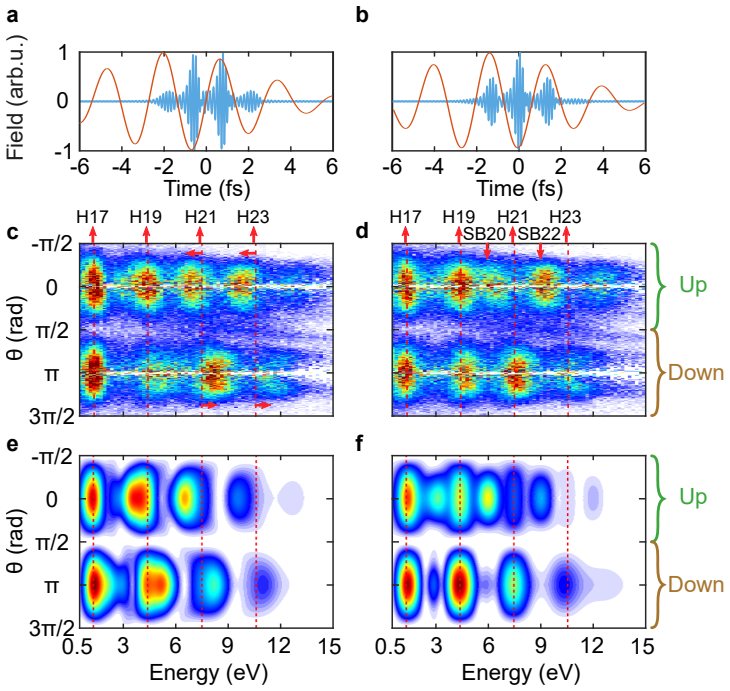
The central discovery is that a weak infrared dressing field, acting during less than one optical cycle, changes the photoelectron spectrum from quantized peaks to continuously shifted peaks, or to direction-dependent sidebands, depending on how many attosecond pulses ionize the atom. For two pulses the probability is proportional to $\sin^2[\pi\Omega/(2\omega)+\eta_p]$, so the odd-harmonic peaks move by $2\eta_p\omega/\pi$, with $\eta_p$ proportional to $\mathbf{p}\cdot\mathbf{A}_0$; the shift therefore grows with electron momentum and reverses sign with emission direction. For three pulses the probability contains a term $\cos[s(\Omega)+2\eta_p]$ that enhances sidebands in one direction and suppresses them in the other. The same physics is presented as a two- or three-slit interference problem in time, where the infrared field adds a momentum-dependent phase to one or more electron wave packets. The experiment measures these effects in helium with a three-dimensional momentum spectrometer and reproduces them with strong-field-approximation simulations, including the carrier-envelope-phase dependence.
Load-bearing premise
The argument treats the weak infrared field as a pure, slowly varying phase shift on each attosecond pulse, with the vector potential $\mathbf{A}(t)=\mathbf{A}_0\cos[\omega(t-\tau)]$ and a fitted delay near $0.6$ optical cycles; if the field is not weak enough, or varies significantly within a pulse, the simple two- or three-slit interference picture and the extracted energy shifts would need revision.
Editorial extensions
If this is right
- The carrier-envelope phase becomes a control knob for photoelectron energy and direction: changing it between $0$, $\pi/2$, $\pi$, and $3\pi/2$ reverses or removes the asymmetry in a predictable way.
- Energy quantization is not intrinsic to IR-assisted XUV photoionization; it emerges only when the light-matter interaction lasts at least one full optical cycle, as in the three-pulse case.
- Tailored few-pulse XUV sequences plus a synchronized weak infrared field constitute a time-domain coherent-control scheme that can be applied to one of the fastest processes in nature.
- The spectral phase (chirp) between consecutive attosecond pulses is observable through the up-down sideband asymmetry, providing a way to characterize attosecond pulse trains.
Reading between the lines
- The two- and three-pulse results can be read as a proof of principle for programmable photoelectron spectral shaping: choosing the number, amplitudes, and relative phases of attosecond pulses could engineer the energy-angle interference pattern beyond the two cases shown here.
- The same phase-modulation mechanism should apply to other small quantum systems; if a molecule or solid shows the same carrier-envelope-phase-dependent directional asymmetry, time-domain control of photoemission could be extended to more complex samples.
- A natural next experiment is to scan the XUV-IR delay $\tau$ continuously and check that the two-pulse energy shift follows $\sin(\omega\tau)$ while the sideband asymmetry follows the same phase; this would test whether the extracted $\eta_p$ is really the infrared-imposed momentum-dependent phase.
Signed reviews
Editorial analysis
A structured set of objections, weighed in public.
Referee Report
Summary. The manuscript reports an experiment in which helium is photoionized by a tailored sequence of two or three attosecond XUV pulses in the presence of a weak infrared dressing field, with full 3D momentum detection. For two pulses separated by about half the IR period, the photoelectron peaks are continuously shifted in energy, with opposite shifts in the two emission directions along the polarization axis. For three pulses, sidebands appear predominantly in one direction and are suppressed in the other. The authors interpret these observations as interference of two or three electron wave packets that acquire an IR-induced, momentum-dependent phase, summarized by the analytical formulas in Eqs. (1) and (2), and they support the interpretation with strong-field-approximation (SFA) simulations that integrate Eq. (4). The central conceptual claim is that time-domain confinement of the light-matter interaction to less than one optical cycle enables continuous, direction-dependent control of photoelectron energy, in contrast to the usual quantized, parity-conserving picture of the photoelectric effect.
Significance. If the claims are quantitatively established, this is a valuable contribution to attosecond science: it demonstrates coherent control of the photoelectric effect with a few attosecond pulses and a weak IR field, and it provides a simple wave-packet-interference picture that connects continuous streaking-like energy shifts with discrete sideband formation. The experimental setup is sophisticated, with CEP-stable few-cycle driving, harmonic generation, and 3D electron-ion coincidence detection, and the SFA simulations agree with the measured angular-resolved spectra in both the two-pulse and three-pulse configurations. The analytical two- and three-slit picture is attractive and provides falsifiable predictions about the p·A0 scaling of the shift and the direction-dependent sideband asymmetry. However, the analytical derivation rests on the slow-phase approximation of Eq. (5), which is shown in the report to be violated at the stated experimental parameters, and the quantitative comparison uses a fitted temporal offset and simulation field parameters. The work is therefore significant and plausible but requires revision before the quantitative explanation can be accepted.
major comments (2)
- [Methods, Analytical derivation, Eq. (5)] The assumption that the IR phase does not vary much over the attosecond pulse duration is quantitatively violated at the stated experimental conditions. With I_IR=6×10^11 W/cm^2, λ=820 nm, τ≈0.6 cycles, and a photoelectron energy of about 20 eV (p≈2.4×10^-24 kg·m/s), the estimated phase slope dΦIR/dt at the pulse center is of order 3×10^15 rad/s, giving a phase change of roughly 1 rad over a 300-as pulse. This is not negligible and is comparable to the interference phase itself, so Eq. (5) is not a controlled approximation under the parameters claimed in the paper. Consequently Eqs. (1) and (2) do not follow quantitatively from the stated assumptions; the linear phase ramp across each wave packet would shift its spectral envelope by several eV before the interference is evaluated. The SFA simulation, which integrates Eq. (4) rather than using Eq. (5), may still reproduce the data, but the analytical model presented as the explanatory core of the paper needs either a finite-pulse-width treatment or an explicit statement that Eqs. (1)-(2) are heuristic and not a derivation from the stated assumptions.
- [Methods, Simulations] The agreement between experiment and simulation is obtained with a temporal offset τ≈0.6 optical cycles between the attosecond pulses and the IR dressing field, and with the IR and XUV field parameters chosen in the simulation. Since τ is not independently measured in the experiment (e.g., by an in-situ streaking calibration), the comparison does not constitute a parameter-free test of the central prediction. The extracted value of τ directly enters the phase ηp in Eqs. (1) and (2), so the reported shift and sideband asymmetry are conditioned on this fitted parameter. The authors should either provide an independent determination of τ (for example from the same 3D momentum data using a known streaking feature) or demonstrate that the qualitative and quantitative conclusions are robust over the plausible uncertainty range of τ and of the amplitude ratio r and spectral phase s(Ω) used in the three-pulse analysis.
minor comments (4)
- [Abstract and Introduction] The abstract's phrase 'thus contradicting well established quantum-mechanical predictions' is stronger than the introduction's 'apparent contradiction'; the observed effects are fully consistent with quantum mechanics once the coherent IR field is included, so the framing should be softened to avoid implying a breakdown of quantum-mechanical laws.
- [Methods, Eq. (4)] The integral in Eq. (4) is written over an infinite time range with A(t) as a pure cosine; for a nonvanishing vector potential the integral is only conditionally convergent, and the derivation would benefit from a statement that the IR pulse envelope is assumed finite and slowly varying, or from a regularization prescription.
- [Fig. 3 caption and panels] The color plots in Fig. 3 would be easier to evaluate quantitatively if the color scale (and ideally its normalization) were given in the caption, and if the peak positions quoted in the text were marked with symbols or vertical lines in the two-pulse case.
- [General presentation] There are several typographical errors, including 'loosing data' (should be 'losing data') in the Methods section and 'bewteen' (should be 'between') in the Fig. 4 caption; these should be corrected in a revision.
Circularity Check
No significant circularity: multi-slit interference formulas follow algebraically from stated SFA phase-modulation assumptions; the fitted IR delay does not by construction produce the predicted observables.
full rationale
The derivation chain is self-contained. The paper starts from the SFA amplitude (Eq. 3), approximates the weak IR action as a phase modulation (Eq. 4), evaluates that phase at the attosecond pulse centers under an explicitly stated slow-phase assumption (Eq. 5), and obtains the two- and three-EWP interference formulas (Eqs. 1, 2, and 6). These are algebraic consequences of the stated model, not redefinitions of the experimental output: the phase eta_p is computed from the IR vector potential and electron momentum, while the predicted observables are the energy-dependent shift and up/down asymmetry of the interference pattern. The temporal offset tau ~ 0.6 cycles is adjusted for agreement, but it is a single global parameter controlling the overall magnitude/sign of the IR-induced phase; it does not by itself encode the energy dependence, the direction asymmetry, or the sideband enhancement, which follow from the interference structure. The paper therefore does not fit the predicted quantity and call it a prediction. Self-citations ([34], [37], [42], [43]) are used for source characterization, standard SFA theory, and spectrometer design; they are not invoked as a uniqueness theorem or as the sole justification of the central physical claim. The concern raised by the skeptic about the slow-phase approximation being quantitatively marginal at 6e11 W/cm^2 is a question of the model's accuracy/validity, not circularity: even if Eq. (5) required correction, that would alter the numerical predictions without making the derivation depend on its conclusion. No circular step can be exhibited from the text.
Assumptions & free parameters
free parameters (3)
- temporal offset tau =
~0.6 optical cycles
- IR vector potential amplitude A0 =
corresponding to 6e11 W/cm2 in simulation
- amplitude ratio r and spectral phase difference s(Omega) =
not given as specific numbers
assumptions (4)
- domain assumption The IR field effect on the photoelectron can be reduced to a pure phase modulation (Eq. 4), with the phase varying slowly over the attosecond pulse duration.
- domain assumption The dipole moment d(p) for helium can be calculated with a hydrogenic approximation.
- domain assumption The attosecond pulses are separated by half the laser period and have a phase difference of pi between consecutive pulses.
- domain assumption The XUV field is weak enough that the SFA and the perturbative limit eta_p << 1 apply.
Cite this review
Pith. "Pith review of Controlling the Photoelectric Effect in the Time Domain." pith.science (2026). https://pith.science/paper/2R74AUGC
@misc{pith2026190809508,
  author       = {Pith},
  title        = {Pith review of: Controlling the Photoelectric Effect in the Time Domain},
  year         = {2026},
  howpublished = {\url{https://pith.science/paper/2R74AUGC}},
  note         = {Machine review of arXiv:1908.09508}
}
read the original abstract
When an atom or molecule absorbs a high-energy photon, an electron is emitted with a well-defined energy and a highly-symmetric angular distribution, ruled by energy quantization and parity conservation. These rules seemingly break down when small quantum systems are exposed to short and intense light pulses, which raise the question of their universality for the simplest case of the photoelectric effect. Here we investigate the photoionization of helium by a sequence of attosecond pulses in the presence of a weak infrared dressing field. We continuously control the energy and introduce an asymmetry in the emission direction of the photoelectrons, thus contradicting well established quantum-mechanical predictions. This control is possible due to an extreme temporal confinement of the light-matter interaction. Our work extends time-domain coherent control schemes to one of the fastest processes in nature, the photoelectric effect.
Figures


Figures from the paper (1 more)

Reference graph
Works this paper leans on
-
[1]
Ueber das gesetz der energieverteilung im normalspectrum
Planck, M. Ueber das gesetz der energieverteilung im normalspectrum. Ann. Phys. 309, 1 (1901)
work page 1901
-
[2]
¨Uber einen die erzeugung und verwandlung des lichtes betreffenden heuris- tischen gesichtspunkt
Einstein, A. ¨Uber einen die erzeugung und verwandlung des lichtes betreffenden heuris- tischen gesichtspunkt. Ann. Phys. 322, 132–148 (1905)
work page 1905
-
[3]
Laporte, O., Meggers, W. F. Some rules of spectral structure. J. Opt. Soc. Am. A 11, 459–463 (1925)
work page 1925
-
[4]
Yang, C. N. On the angular distribution in nuclear reactions and coincidence measure- ments. Phys. Rev. 74, 764 (1948)
work page 1948
-
[5]
Cooper, J., Zare, R. N. Angular Distribution of Photoelectrons. J. Chem. Phys 48, 942 (1968)
work page 1968
-
[6]
Maiman, T. H. Stimulated optical radiation in ruby. Nature 187, 493 (1960). 11
work page 1960
-
[7]
Rowe, E. M., Mills, F. E. Tantalus. 1. A Dedicated Storage Ring Synchrotron Radiation source. Part. Accel. 4, 211-227 (1973)
work page 1973
-
[8]
Handbook of high-resolution spectroscopy
Quack, M., Merkt, F. Handbook of high-resolution spectroscopy. Wiley-Blackwell (2011)
work page 2011
Show all 43 references
-
[9]
Becker, U., Shirley, D. A. VUV and Soft X-ray Photoionization . Springer Science & Business Media (2012)
2012
-
[10]
Agostini, P., Fabre, F., Mainfray, G., Petite, G., Rahman, N. K. Free-Free Transitions Following Six-Photon Ionization of Xenon Atoms. Phys. Rev. Lett. 42, 1127 (1979)
1979
-
[11]
H., Bashkansky, M., McIlrath, T
Bucksbaum, P. H., Bashkansky, M., McIlrath, T. J. Scattering of Electrons by Intense Coherent Light. Phys. Rev. Lett. 58, 349 (1987)
1987
-
[12]
S., Smith, A
Yin, Y ., Chen, C., Elliott, D. S., Smith, A. V . Asymmetric Photoelectron Angular Distri- butions from Interfering Photoionization Processes. Phys. Rev. Lett. 69, 2353 (1992)
1992
-
[13]
Attosecond control of orbital parity mix interferences and the relative phase of even and odd harmonics in an attosecond pulse train.Phys
Laurent, G., et al. Attosecond control of orbital parity mix interferences and the relative phase of even and odd harmonics in an attosecond pulse train.Phys. Rev. Lett.109, 083001 (2012)
2012
-
[14]
G., et al
Paulus, G. G., et al. Absolute-phase phenomena in photoionization with few-cycle laser pulses. Nature 414, 182 (2001)
2001
-
[15]
G., et al
Paulus, G. G., et al. Measurement of the phase of few-cycle laser pulses. Phys. Rev. Lett. 91, 253004 (2003)
2003
-
[16]
Studies of multiphoton production of vacuum-ultraviolet radiation in the rare gases
McPherson, A., et al. Studies of multiphoton production of vacuum-ultraviolet radiation in the rare gases. J. Opt. Soc. Am. B 4, 595 (1987). 12
1987
-
[17]
Multiple-harmonic conversion of 1064 nm radiation in rare gases
Ferray, M., et al. Multiple-harmonic conversion of 1064 nm radiation in rare gases. J. Phys. B 21, L31 (1988)
1988
-
[18]
Delay in photoemission
Schultze, M., et al. Delay in photoemission. Science 328, 1658-1662 (2010)
2010
-
[19]
Probing single-photon ionization on the attosecond time scale
Kl ¨under, K., et al. Probing single-photon ionization on the attosecond time scale. Phys. Rev. Lett. 106, 143002 (2011)
2011
-
[20]
Attosecond correlation dynamics
Ossiander, M., et al. Attosecond correlation dynamics. Nature Physics 13, 280 - 285 (2017)
2017
-
[21]
Photoionization in the time and frequency domain
Isinger, M., et al. Photoionization in the time and frequency domain. Science 358, 893– 896 (2017)
2017
-
[22]
Huppert, M., Jordan, I., Baykusheva, D., Conta, A., W ¨orner, H. J. Attosecond delays in molecular photoionization. Phys. Rev. Lett. 117, 093001 (2016)
2016
-
[23]
Attosecond coupled electron and nuclear dynamics in dissociative ionization of h-2
Cattaneo, L., et al. Attosecond coupled electron and nuclear dynamics in dissociative ionization of h-2. (2018)
2018
-
[24]
Orientation-dependent stereo wigner time delay and electron localization in a small molecule
V os, J., et al. Orientation-dependent stereo wigner time delay and electron localization in a small molecule. Science 360, 1326 - 1330 (2018)
2018
-
[25]
L., et al
Cavalieri, A. L., et al. Attosecond spectroscopy in condensed matter. Nature 449, 1029 (2007)
2007
-
[26]
Attosecond dynamical franz-keldysh effect in polycrystalline dia- mond
Lucchini, M., et al. Attosecond dynamical franz-keldysh effect in polycrystalline dia- mond. Science 353, 916–919 (2016)
2016
-
[27]
Steering Attosecond Electron Wave Packets with Light
Kienberger, R., et al. Steering Attosecond Electron Wave Packets with Light. Science 297, 1144 (2002). 13
2002
-
[28]
Attosecond chronoscopy of photoemission
Pazourek, R., Nagele, S., Burgd ¨orfer, J. Attosecond chronoscopy of photoemission. Rev. Mod. Phys. 87, 765–802 (2015)
2015
-
[29]
Phase dependence of (N+1) - color (N>1) ir-uv pho- toionization of atoms with higher harmonics
V ´eniard, V ., Ta¨ıeb, R., Maquet, A. Phase dependence of (N+1) - color (N>1) ir-uv pho- toionization of atoms with higher harmonics. Phys. Rev. A 54, 721 (1996)
1996
-
[30]
Observation of a train of attosecond pulses from high harmonic generation
Paul, P., et al. Observation of a train of attosecond pulses from high harmonic generation. Science 292, 1689 (2001)
2001
-
[31]
Reconstruction of attosecond harmonic beating by interference of two-photon transitions
Muller, H. Reconstruction of attosecond harmonic beating by interference of two-photon transitions. Appl. Phys. B 74, 17 (2002)
2002
-
[32]
Attosecond coherent control of single and double photoionization in argon
Hogle, C., et al. Attosecond coherent control of single and double photoionization in argon. Phys. Rev. Lett. 115, 173004 (2015)
2015
-
[33]
Angular dependence of photoemission time delay in helium
Heuser, S., et al. Angular dependence of photoemission time delay in helium. Phys. Rev. A 94, 063409 (2016)
2016
-
[34]
Phase control of attosecond pulses in a train
Guo, C., et al. Phase control of attosecond pulses in a train. J. Phys. B 51, 034006 (2018)
2018
-
[35]
Cold Target Recoil Ion Momentum Spectroscopy: a ’momentum micro- scope’ to view atomic collision dynamics
Dorner, R., et al. Cold Target Recoil Ion Momentum Spectroscopy: a ’momentum micro- scope’ to view atomic collision dynamics. Physics Reports 330, 95-192 (2000)
2000
-
[36]
Recoil-ion and electron momentum spectroscopy: reaction-microscopes
Ullrich, J., et al. Recoil-ion and electron momentum spectroscopy: reaction-microscopes. Reports on Progress in Physics 66, 1463-1545 (2003)
2003
-
[37]
Theory of high-order harmonic generation by low-frequency laser fields
Lewenstein, M., Balcou, P., Ivanov, M., L’Huillier, A., Corkum, P. Theory of high-order harmonic generation by low-frequency laser fields. Phys. Rev. A 49, 2117 (1994)
1994
-
[38]
Temporal characterization of attosecond XUV fields.J
Qu ´er´e, F., Mairesse, Y ., Itatani, J. Temporal characterization of attosecond XUV fields.J. Mod. Opt. 52, 339 (2005). 14
2005
-
[39]
Gramajo, A. A., R. Della Picca, R., Garibotti, C. R., Arb ´o, D. G. Intra- and intercycle interference of electron emissions in laser-assisted xuv atomic ionization.Phys. Rev. A 94, 053404 (2016)
2016
-
[40]
Attosecond Double-Slit Experiment
Lindner, F., et al. Attosecond Double-Slit Experiment. Phys. Rev. Lett. 95, 040401 (2005)
2005
-
[41]
Streaking temporal double-slit interference by an orthogonal two-color laser field
Richter, M., et al. Streaking temporal double-slit interference by an orthogonal two-color laser field. Phys. Rev. Lett. 114, 143001 (2015)
2015
-
[42]
Compact 200 kHz HHG source driven by a few-cycle OPCPA
Harth, A., et al. Compact 200 kHz HHG source driven by a few-cycle OPCPA. J. Opt. 20, 014007 (2017)
2017
-
[43]
secondary
Gisselbrecht, M., Huetz, A., Lavolle, M., Reddish, T. J., Seccombe, D. P. Optimization of momentum imaging systems using electric and magnetic fields. Rev. Sci. Instrum. 76, 013105 (2005). Acknowledgments The authors thank Marcus Dahlstr ¨om, David Busto, Ivan Sytcevich and Fab...
2005
Reviewed August 14, 2026 · model on record in the stance chip above.
Discussion (0). Continue with ORCID to comment.