REVIEW 3 major objections 4 minor 49 references
SynthLens: Visual Analytics for Facilitating Multi-step Synthetic Route Design
T0 review · 3 major / 4 minor · reviewed 2026-08-12 · deepseek-v4-flash
Pith's one-line read SynthLens is a visual analytics system that lets chemists construct synthetic routes step by step, retrieving reactions from papers and comparing partial and complete routes on yield, duration, step count, and experimental difficulty.
desk verdict A well-structured design-study paper with a real extraction benchmark, but the PubMed/SMILES retrieval step is unvalidated and likely weak, so the time-saving claims need to be taken with salt. read the letter →
The pith
A machine-rendered reading of the paper's core claim, the machinery that carries it, and where it could break.
The reading
What carries the argument
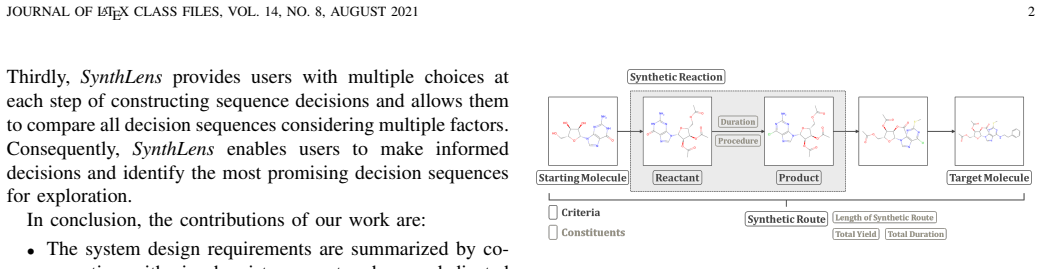
The load-bearing mechanism is a tree-form data structure for decision sequences, where the root is the starting molecule, each node is a synthetic reaction whose reactant is the product of its parent node, and each path from root to leaf is a candidate synthetic route. Node glyphs juxtapose current and cumulative yield and duration with a donut glyph encoding the user's annotated difficulty in three aspects, namely materials, instruments, and operations, so partial routes can be assessed before completion. A rank view computes weighted scores from step count, yield, and duration, while a molecule-similarity view lets users find structurally similar intermediates and compare decision sequences. On the data side, an LLM-based extraction pipeline with chain-of-verification supplies the reaction details, with a context-relevancy score and direct paper links to keep the extraction auditable.
What would settle it
Take a set of previously published reactions whose starting-molecule SMILES strings are known, query the PubMed API with each SMILES as SynthLens does, and measure what fraction of the papers describing those reactions is retrieved; if recall is low, the system's route exploration is incomplete. Separately, a controlled study in which independent chemists design the same route with and without SynthLens could test whether the time reduction and route quality claimed in the case studies hold.
Extended reading notes
Core claim
The paper's central claim is that multi-step synthetic route design can be treated as a visual, multi-criteria decision problem, and that a tree-form interface makes the process markedly faster while preserving the essential element of manual decision-making. In SynthLens, the user draws a starting molecule and names an expected reaction; the system retrieves relevant papers, extracts reactants, products, solvents, catalysts, duration, operations, and yield from each paper using an LLM-based extraction agent, and lets the user attach candidate reactions to the route tree. Each node encodes current and cumulative yield and duration, plus the user's annotations of material, instrument, and operation difficulty, and a rank view sorts partial and complete routes by user-weightable criteria such as step count, yield, and duration. Two case studies, one for a linker of Adcetris and one for a class of purine derivatives, produced complete route explorations in about 50 and 35 minutes, which the paper offers as evidence of the time reduction over traditional expert-driven search.
Load-bearing premise
The system's entire paper-discovery stage assumes that the PubMed API treats a drawn molecule's SMILES string as a search term and returns the papers relevant to that structure; the paper does not validate retrieval recall or relevance, so a failure there would silently remove the reactions needed to build viable routes.
Editorial extensions
If this is right
- Chemists can compare incomplete candidate routes against completed ones, so unpromising branches can be abandoned before expensive exploration.
- Experts can adjust the weights on step count, yield, and duration, making the ranking reflect task-specific priorities rather than a fixed objective.
- The same tree construction can be applied to retrosynthesis by starting from the target molecule, which expert interviewees identified as a natural extension.
- The extraction pipeline's reported precision of 0.944, recall of 0.798, and F1 of 0.865 on a 100-paper benchmark suggest that LLM-based extraction can supply structured reaction data useful for route design.
- Providing links back to original papers and a context-relevancy score lets chemists verify extracted reaction details, preserving human authority over the final choice.
Reading between the lines
- The paper leaves retrieval recall untested; if the literature API misses papers that describe the same reaction under alternative naming, the route tree is silently incomplete.
- The tree-of-decision-sequences pattern generalizes to any sequential multi-criteria planning task, such as clinical treatment paths or infrastructure siting, but the paper only sketches this transfer.
- The two case-study durations are demonstrations, not controlled measurements; a head-to-head comparison with traditional manual search would be the natural next test.
Signed reviews
Editorial analysis
A structured set of objections, weighed in public.
Referee Report
Summary. SynthLens is a visual analytics system whose stated goal is to speed up multi-step synthetic route design while keeping human decisions in the loop. The user draws a starting molecule; the system queries PubMed with the generated SMILES string, projects the retrieved papers with PubMedBERT and t-SNE, and uses an LLM agent (Eunomia) with chain-of-verification to extract reaction details. The main visualization is a tree ('Synthetic Route Overview') in which each node is a reaction glyph encoding yield, duration, and experimental difficulty, supported by a rank view with user-adjusted weights, a molecule similarity view, and an experimental procedure comparison view. The authors distill five design requirements from six chemistry experts, report two case studies (~50 and ~35 minutes), compare their automatic extraction method against three baseline tools on 100 papers (F1 0.865 versus up to 0.753), and present a qualitative user study with ten experts.
Significance. If the system works as described, it addresses an important multi-criteria, multi-step decision problem, and the tree-plus-ranking design could transfer to other sequential decision-making domains. The extraction benchmark is a real strength: it is run against 100 papers and three external tools with a strict all-fields-correct criterion, and the reported F1 is clearly higher than the baselines. The design requirements and the documented design alternatives for the node glyph also show a serious design study. However, the paper's headline time-saving claim rests on a retrieval step that is not validated and on qualitative, partly self-referential user evidence; as presented, the evidence supports the system's usefulness as a design concept more than it supports the runtime-performance claim. With a validated retrieval mechanism, or with the claims re-scoped to a user-supplied paper set, the contribution would be significant for visual analytics in chemistry and beyond.
major comments (3)
- [Section V-B] Section V-B states that the system searches papers using the PubMed API, 'which accepts SMILES strings as search terms.' This is the linchpin of the whole pipeline, because every node in the Synthetic Route Overview is discovered through this query. The statement is accurate only in the trivial sense that any text string can be submitted to Entrez; PubMed does not resolve SMILES strings into chemical structures and does not index molecular structures. For a typical drawn starting material, the exact canonical SMILES will often not appear in the title, abstract, or indexed metadata, so retrieval recall is likely to be low and biased toward texts that happen to print SMILES. The paper provides no retrieval evaluation: the Section VIII-A extraction benchmark starts from 100 papers preselected as proposing synthetic routes, so it cannot validate paper discovery. Because the same retrieval mechanism is used at every step of route construction (Section V-D), low recall shrinks the candidate-reaction set and directly compromises the 35-50 minute case-study timings and the Discussion claim that SynthLens 'markedly reduces the time consumption.' The authors should either replace this step with a structure-aware retrieval source (for example, PubChem PUG REST to convert SMILES to CIDs and then search associated literature) or report recall and precision on a gold-standard set of papers known to contain reactions of a set of query molecules. The Limitations section should also acknowledge this dependency explicitly.
- [Section VIII-A and Table I] The extraction benchmark in Section VIII-A is the strongest quantitative evidence in the paper, but it does not support the system-level claim about route design. The F1 = 0.865 is computed only for extracting reactants, products, and yields from papers already known to contain synthetic routes; retrieval and relevant-paper identification are not tested. In addition, the comparison reports no confidence intervals, significance tests, or inter-annotator agreement, so it is unclear whether the improvement over ChemRxnExtractor (F1 = 0.753) is reliable; with a strict all-fields-correct criterion over a small sample, small annotation differences can move the scores substantially. The benchmark also covers only three fields, whereas the system displays duration, experimental difficulty, and procedural text, whose extraction accuracy is not measured. Please report per-field performance, bootstrap confidence intervals, agreement statistics, and explicitly state that the benchmark does not cover paper discovery.
- [Section VII and Section VIII-B] The evidence for the central usability claim is not yet convincing. The two case studies are conducted by E4 and E2, who are among the six experts that co-designed the system (Section IV), and the timings (~50 and ~35 minutes) are reported without a baseline condition, without a definition of the measurement window, and without any comparison to the traditional expert-driven workflow. The user study in Section VIII-B also reuses E1-E6 and adds only four new participants; it has no control condition, no task-completion data, and the questionnaire results in Fig. 8 are analyzed descriptively rather than statistically. As a result, the Discussion statement that SynthLens 'markedly reduces the time consumption and preserves the essential element of manual decision-making in comparison to traditional expert-driven approaches' is not supported by the reported data. Please add a controlled comparison (even a small within-subject study against manual search, with counterbalanced molecules), or downgrade the runtime claim to a design goal.
minor comments (4)
- [Section V-D] The term 'bread exploration strategy' should be 'breadth exploration strategy'; the misspelling appears in the definition and again in Section VII-A.
- [Section V-C] In the sentence 'Although Eunomia claims that it is able to sace the agent's output in JSON format,' the word 'sace' should be 'save.'
- [References [13]/[14]] References [13] and [14] are both the AiZynthFinder citation; the ICSYNTH tool is cited without its actual source, so the intended reference for [14] is missing.
- [Section VI-B] Several figure references are inconsistent with the Fig. 4 caption: the Molecule Similarity View is called Fig. 4(F) in Section VI-B2 (the caption labels (F) as the Rank View), and the Rank View is called Fig. 4(E2) in Section VI-B3 (the caption labels (E) as the Similarity View).
Circularity Check
No significant circularity: SynthLens reports a system design and qualitative evaluation with no fitted-parameter prediction or self-citation chain driving its central claims.
full rationale
SynthLens is a visual analytics systems paper rather than a derivation-based result. The central claims—that the tree-form visualization supports multi-step route comparison and that experts find the workflow useful—are supported by case studies, expert interviews, and an automatic extraction benchmark against external tools (ChemDataExtractor, ReactionDataExtractor, ChemRxnExtractor), not by a mathematical derivation from assumed outputs. No equation is present whose later terms are defined by earlier fitted values, and no fitted parameter is renamed as a prediction. The only apparent self-citation is RetroLens [22], co-authored by one of the present authors; it is used in related work as a point of differentiation, not as evidence for SynthLens's effectiveness, so it is not load-bearing. The PubMed/SMILES retrieval premise, if technically incorrect, is a factual and validation gap rather than circular reasoning, because the system's downstream behavior is not defined in terms of the conclusion it is supposed to establish. Finally, the reuse of the six design-study experts in the user study is a methodological evaluation-bias concern, but it does not make any measured outcome equivalent to the system's design input by construction. Accordingly, no circular step can be exhibited with a specific quoted reduction, and the honest finding is no significant circularity.
Assumptions & free parameters
assumptions (5)
- domain assumption Chemists prefer manual route construction from reference papers over automated retrosynthesis (Sections I, V-D).
- domain assumption A synthetic route can be modeled as a tree in which each reaction has exactly one reactant, the product of the parent node (Section V-D).
- ad hoc to paper PubMed API accepts SMILES strings as search terms and returns chemically relevant papers (Section V-B).
- domain assumption The Eunomia LLM agent with Chain-of-Verification extracts sufficiently accurate structured reaction data (Section V-C).
- domain assumption User-annotated difficulty levels reliably encode experimental procedure quality (Section VI-B).
Cite this review
Pith. "Pith review of SynthLens: Visual Analytics for Facilitating Multi-step Synthetic Route Design." pith.science (2026). https://pith.science/paper/2RDVHPYP
@misc{pith2026241200729,
  author       = {Pith},
  title        = {Pith review of: SynthLens: Visual Analytics for Facilitating Multi-step Synthetic Route Design},
  year         = {2026},
  howpublished = {\url{https://pith.science/paper/2RDVHPYP}},
  note         = {Machine review of arXiv:2412.00729}
}
read the original abstract
Designing synthetic routes for novel molecules is pivotal in various fields like medicine and chemistry. In this process, researchers need to explore a set of synthetic reactions to transform starting molecules into intermediates step by step until the target novel molecule is obtained. However, designing synthetic routes presents challenges for researchers. First, researchers need to make decisions among numerous possible synthetic reactions at each step, considering various criteria (e.g., yield, experimental duration, and the count of experimental steps) to construct the synthetic route. Second, they must consider the potential impact of one choice at each step on the overall synthetic route. To address these challenges, we proposed SynthLens, a visual analytics system to facilitate the iterative construction of synthetic routes by exploring multiple possibilities for synthetic reactions at each step of construction. Specifically, we have introduced a tree-form visualization in SynthLens to compare and evaluate all the explored routes at various exploration steps, considering both the exploration step and multiple criteria. Our system empowers researchers to consider their construction process comprehensively, guiding them toward promising exploration directions to complete the synthetic route. We validated the usability and effectiveness of SynthLens through a quantitative evaluation and expert interviews, highlighting its role in facilitating the design process of synthetic routes. Finally, we discussed the insights of SynthLens to inspire other multi-criteria decision-making scenarios with visual analytics.
Figures


Figures from the paper (4 more)


Reference graph
Works this paper leans on
-
[1]
L. Chen, H. Wang, Y . Ouyang, Y . Zhou, N. Wang, and Q. Li, “FSLens: A Visual Analytics Approach to Evaluating and Optimizing the Spatial Lay- out of Fire Stations,” IEEE Transactions on Visualization and Computer Graphics, vol. 30, pp. 847-857, 2024
work page 2024
-
[2]
Q. Li, Q. Q. Liu, C. F. Tang, Z. W. Li, S. C. Wei, X. R. Peng, M. H. Zheng, T. J. Chen, and Q. Yang, “Warehouse Vis: A Visual Analytics Approach to Facilitating Warehouse Location Selection for Business Districts,” Computer Graphics Forum, vol. 39, pp. 483-495, 2020
work page 2020
-
[3]
AI-Driven Synthetic Route Design Incorporated with Retrosynthesis Knowledge,
S. Ishida, K. Terayama, R. Kojima, K. Takasu, and Y . Okuno, “AI-Driven Synthetic Route Design Incorporated with Retrosynthesis Knowledge,” Journal of Chemical Information and Modeling , vol. 62, pp. 1357-1367, 2022
work page 2022
-
[4]
Enzyme Cascade Design: Retrosynthesis Ap- proach,
W. A. F. S. Finnigan, “Enzyme Cascade Design: Retrosynthesis Ap- proach,”, S. A. R. F. Kara, Ed. Cham: Springer International Publishing, 2021, pp. 7–30
work page 2021
-
[5]
Gerasimchuk, Chemical Literacy and Writing Chemical Reactions : Cambridge Scholars Publishing, 2022
N. Gerasimchuk, Chemical Literacy and Writing Chemical Reactions : Cambridge Scholars Publishing, 2022
work page 2022
-
[6]
Combined Main-Chain/Side-Chain Liquid Crystalline Poly- mers: Synthesis and Supramolecular Ordering,
W. Huang, “Combined Main-Chain/Side-Chain Liquid Crystalline Poly- mers: Synthesis and Supramolecular Ordering,”, V . K. A. K. Thakur, Ed. Cham: Springer International Publishing, 2016, pp. 363–389
work page 2016
-
[7]
Using automated synthesis to understand the role of side chains on molecular charge transport,
S. A. J. E. Li, “Using automated synthesis to understand the role of side chains on molecular charge transport,” Nature Communications, vol. 13, p. 2102, 2022
work page 2022
-
[8]
Robert Robinson Lecture. Retrosynthetic thinking—essentials and examples,
E. J. Corey, “Robert Robinson Lecture. Retrosynthetic thinking—essentials and examples,” Chem. Soc. Rev., vol. 17, no. 0, pp. 111–133, 1988
work page 1988
Show all 49 references
-
[9]
Exploring Optimal Reaction Conditions Guided by Graph Neural Networks and Bayesian Optimization,
Y . Kwon, D. Lee, J. W. Kim, Y . Choi, and S. Kim, “Exploring Optimal Reaction Conditions Guided by Graph Neural Networks and Bayesian Optimization,” ACS Omega, vol. 7, pp. 44939-44950, 2022
2022
-
[10]
Prediction of Chemical Reaction Yields using Deep Learning,
P. Schwaller, A. C. Vaucher, T. Laino, and J. Reymond, “Prediction of Chemical Reaction Yields using Deep Learning,” ChemRxiv, 2020
2020
-
[11]
Reaction duration- dependent formation of two Cu(ii)-MOFs with selective adsorption prop- erties of C3H4 over C3H6,
M. Xu, X. Kong, T. He, X. Wu, L. Xie, and J. Li, “Reaction duration- dependent formation of two Cu(ii)-MOFs with selective adsorption prop- erties of C3H4 over C3H6,” Dalton Transactions, vol. 48, pp. 8617-8624, 2019
2019
-
[12]
Simulation of Organic Reactions: From the Degradation of Chemicals to Combinatorial Synthesis,
R. H ¨ollering, J. Gasteiger, L. Steinhauer, K. Schulz, and A. Herwig, “Simulation of Organic Reactions: From the Degradation of Chemicals to Combinatorial Synthesis,” Journal of Chemical Information and Com- puter Sciences, vol. 40, pp. 482-494, 2000
2000
-
[14]
AiZynthFinder: a fast, robust and flexible open- source software for retrosynthetic planning,
S. A. T. A. Genheden, “AiZynthFinder: a fast, robust and flexible open- source software for retrosynthetic planning,” Journal of Cheminformatics, vol. 12, p. 70, 2020
2020
-
[15]
LinChemIn: SynGraph—a data model and a toolkit to analyze and compare synthetic routes,
M. A. S. M. Pasquini, “LinChemIn: SynGraph—a data model and a toolkit to analyze and compare synthetic routes,” Journal of Cheminfor- matics, vol. 15, p. 41, 2023
2023
-
[16]
Visualization of the Chemical Space in Drug Discovery,
L. J. Medina-Franco, K. Martinez-Mayorga, A. M. Giulianotti, A. R. Houghten, and C. Pinilla, “Visualization of the Chemical Space in Drug Discovery,” Current Computer-Aided Drug Design , vol. 4, pp. 322-333, 2008
2008
-
[17]
Promoting understanding of chemical representations: Students’ use of a visualization tool in the classroom,
H. Wu, J. S. Krajcik and E. Soloway, “Promoting understanding of chemical representations: Students’ use of a visualization tool in the classroom,” Journal of Research in Science Teaching , vol. 38, pp. 821- 842, 2001
2001
-
[18]
Supporting Knowledge Integration in Chemistry with a Visualization-Enhanced Inquiry Unit,
J. L. A. L. Chiu, “Supporting Knowledge Integration in Chemistry with a Visualization-Enhanced Inquiry Unit,” Journal of Science Education and Technology, vol. 23, pp. 37-58, 2014
2014
-
[19]
DataWarrior: An Open-Source Program For Chemistry Aware Data Visualization And Analysis,
T. Sander, J. Freyss, M. von Korff, and C. Rufener, “DataWarrior: An Open-Source Program For Chemistry Aware Data Visualization And Analysis,” Journal of Chemical Information and Modeling , vol. 55, pp. 460-473, 2015
2015
-
[20]
Finding constellations in chemical space through core analysis,
J. J. U. S. Naveja and J. E. L. Medina-Franco, “Finding constellations in chemical space through core analysis,” Frontiers in chemistry, vol. 7, p. 510, 2019
2019
-
[21]
ChemoGraph: Interactive Visual Exploration of the Chemical Space,
B. Kale, A. Clyde, M. Sun, A. Ramanathan, R. Stevens, and M. E. Papka, “ChemoGraph: Interactive Visual Exploration of the Chemical Space,” Computer Graphics Forum, vol. 42, pp. 13-24, 2023
2023
-
[22]
RetroLens: A Human-AI Collaborative System for Multi-step Retrosyn- thetic Route Planning,
C. Shi, Y . Hu, S. Wang, S. Ma, C. Zheng, X. Ma, and Q. Luo, “RetroLens: A Human-AI Collaborative System for Multi-step Retrosyn- thetic Route Planning,” in CHI ’23 New York, NY , USA, 2023
2023
-
[23]
A Typology of Decision-Making Tasks for Visualization,
C. D. Brumar, S. Molnar, G. Appleby, K. Potter, and R. Chang, “A Typology of Decision-Making Tasks for Visualization,” ArXiv, vol. abs/2404.08812, 2024
2024
-
[24]
LineUp: Visual Analysis of Multi-Attribute Rankings,
S. Gratzl, A. Lex, N. Gehlenborg, H. Pfister, and M. Streit, “LineUp: Visual Analysis of Multi-Attribute Rankings,” IEEE Transactions on Visualization and Computer Graphics , vol. 19, pp. 2277-2286, 2013
2013
-
[25]
RankAxis: Towards a Systematic Combination of Projection and Ranking in Multi-Attribute Data Exploration,
Q. Liu, Y . Ren, Z. Zhu, D. Li, X. Ma, and Q. Li, “RankAxis: Towards a Systematic Combination of Projection and Ranking in Multi-Attribute Data Exploration,” IEEE Transactions on Visualization and Computer Graphics, vol. 29, pp. 701-711, 2023
2023
-
[26]
Optimizing search engines using clickthrough data,
T. Joachims, “Optimizing search engines using clickthrough data,” in KDD ’02 New York, NY , USA, 2002, pp. 133–142
2002
-
[27]
Inspecting the Process of Bank Credit Rating via Visual Analytics,
L. Q., L. Q., Z. Z., Y . T., and M. X., “Inspecting the Process of Bank Credit Rating via Visual Analytics,” in 2021 IEEE Visualization Conference (VIS), 2021, pp. 136-140
2021
-
[28]
SmartAdP: Visual Analytics of Large-scale Taxi Trajectories for Selecting Billboard Locations,
D. Liu, D. Weng, Y . Li, J. Bao, Y . Zheng, H. Qu, and Y . Wu, “SmartAdP: Visual Analytics of Large-scale Taxi Trajectories for Selecting Billboard Locations,” IEEE Transactions on Visualization and Computer Graphics , vol. 23, pp. 1-10, 2017. JOURNAL OF LATEX CLASS FILES, VOL...
2017
-
[29]
Pathfinder: Visual Analysis of Paths in Graphs,
C. Partl, S. Gratzl, M. Streit, A. M. Wassermann, H. Pfister, D. Schmal- stieg, and A. Lex, “Pathfinder: Visual Analysis of Paths in Graphs,” Computer Graphics Forum, vol. 35, pp. 71-80, 2016
2016
-
[30]
SkiVis: Visual Exploration and Route Planning in Ski Resorts,
J. Rauscher, R. Buchm ¨uller, D. A. Keim, and M. Miller, “SkiVis: Visual Exploration and Route Planning in Ski Resorts,” IEEE Transactions on Visualization and Computer Graphics , vol. 30, pp. 869-879, 2024
2024
-
[31]
Towards Better Bus Networks: A Visual Analytics Approach,
D. Weng, C. Zheng, Z. Deng, M. Ma, J. Bao, Y . Zheng, M. Xu, and Y . Wu, “Towards Better Bus Networks: A Visual Analytics Approach,” IEEE Transactions on Visualization and Computer Graphics, vol. 27, pp. 817-827, 2021
2021
-
[32]
RCMVis: A Visual Analytics System for Route Choice Modeling,
D. Shin, J. Jo, B. Kim, H. Song, S. Cho, and J. Seo, “RCMVis: A Visual Analytics System for Route Choice Modeling,” IEEE Transactions on Visualization and Computer Graphics , vol. 29, pp. 1799-1817, 2023
2023
-
[33]
Pajer, M
S. Pajer, M. Streit, T. Torsney-Weir, F. Spechtenhauser, T. M ¨oller, and H. Piringer, ”WeightLifter: Visual Weight Space Exploration for Multi-Criteria Decision Making,” IEEE Transactions on Visualization and Computer Graphics, vol. 23, pp. 611-620, 2017
2017
-
[34]
A Comparative Visual Analytics Framework for Evaluating Evolutionary Processes in Multi-Objective Optimization,
Y . Huang, Z. Zhang, A. Jiao, Y . Ma, and R. Cheng, “A Comparative Visual Analytics Framework for Evaluating Evolutionary Processes in Multi-Objective Optimization,” IEEE Transactions on Visualization and Computer Graphics, vol. 30, pp. 661-671, 2024
2024
-
[35]
Entrez Programming Utilities Help,
N. C. F. B. US, “Entrez Programming Utilities Help,”, 2010
2010
-
[36]
Domain-Specific Language Model Pretraining for Biomedical Natural Language Processing,
Y . Gu, R. Tinn, H. Cheng, M. Lucas, N. Usuyama, X. Liu, T. Naumann, J. Gao, and H. Poon, “Domain-Specific Language Model Pretraining for Biomedical Natural Language Processing,” A CM Trans. Comput. Healthcare, vol. 3, 2021
2021
-
[37]
Visualizing Data using t-SNE,
L. van der Maaten and G. Hinton, “Visualizing Data using t-SNE,” Journal of Machine Learning Research, vol. 9, no. 86, pp. 2579–2605, 2008
2008
-
[38]
Agent-based Learning of Materials Datasets from Scientific Literature,
M. Ansari and S. M. Moosavi, “Agent-based Learning of Materials Datasets from Scientific Literature,”, 2023
2023
-
[39]
PaperQA: Retrieval-Augmented Generative Agent for Scientific Research,
J. L ´ala, O. O’Donoghue, A. Shtedritski, S. Cox, S. G. Rodriques, and A. D. White, “PaperQA: Retrieval-Augmented Generative Agent for Scientific Research,” arXiv preprint arXiv:2312.07559, 2023
2023 arXiv
-
[40]
Chain-of-Verification Reduces Hallucination in Large Language Models,
S. Dhuliawala et al., “Chain-of-Verification Reduces Hallucination in Large Language Models,” in Findings of the Association for Computa- tional Linguistics: ACL 2024, L.-W. Ku, A. Martins, and V . Srikumar, Eds., Bangkok, Thailand: Association for Computational Linguistics, A...
2024 doi
-
[41]
D³ Data-Driven Documents,
M. Bostock, V . Ogievetsky and J. Heer, “D³ Data-Driven Documents,” IEEE Transactions on Visualization and Computer Graphics , vol. 17, pp. 2301-2309, 2011
2011
-
[42]
RAGAs: Automated Evaluation of Retrieval Augmented Generation,
E. S. Shahul, J. James, L. E. Anke, and S. Schockaert, “RAGAs: Automated Evaluation of Retrieval Augmented Generation,” ArXiv, vol. abs/2309.15217, 2023
2023 arXiv
-
[43]
ChemDataExtractor 2.0: Autopopulated Ontologies for Materials Sci- ence,
J. Mavra ˇci´c, C. J. Court, T. Isazawa, S. R. Elliott, and J. M. Cole, “ChemDataExtractor 2.0: Autopopulated Ontologies for Materials Sci- ence,” Journal of Chemical Information and Modeling , vol. 61, pp. 4280- 4289, 2021
2021
-
[44]
ReactionDataExtractor 2.0: A Deep Learning Approach for Data Extraction from Chemical Reaction Schemes,
D. M. Wilary and J. M. Cole, “ReactionDataExtractor 2.0: A Deep Learning Approach for Data Extraction from Chemical Reaction Schemes,” Journal of Chemical Information and Modeling , vol. 63, pp. 6053-6067, 2023
2023
-
[45]
Automated Chemical Reaction Extraction from Scientific Literature,
J. Guo, A. S. Ibanez-Lopez, H. Gao, V . Quach, C. W. Coley, K. F. Jensen, and R. Barzilay, “Automated Chemical Reaction Extraction from Scientific Literature,” Journal of Chemical Information and Modeling , vol. 62, pp. 2035-2045, 2022
2022
-
[46]
ChemDataExtractor: A Toolkit for Auto- mated Extraction of Chemical Information from the Scientific Literature,
M. C. Swain and J. M. Cole, “ChemDataExtractor: A Toolkit for Auto- mated Extraction of Chemical Information from the Scientific Literature,” Journal of Chemical Information and Modeling , vol. 56, pp. 1894-1904, 2016
1904
-
[47]
Vismon: Facilitating Analysis of Trade-Offs, Uncertainty, and Sensitivity In Fish- eries Management Decision Making,
M. Booshehrian, T. M ¨oller, R. M. Peterman, and T. Munzner, “Vismon: Facilitating Analysis of Trade-Offs, Uncertainty, and Sensitivity In Fish- eries Management Decision Making,” Computer Graphics Forum , vol. 31, pp. 1235-1244, 2012
2012
-
[48]
A review of application of multi-criteria decision making methods in construction,
D. Jato-Espino, E. Castillo-Lopez, J. Rodriguez-Hernandez, and J. C. Canteras-Jordana, “A review of application of multi-criteria decision making methods in construction,” Automation in Construction , vol. 45, pp. 151-162, 2014
2014
-
[49]
Multi-criteria clinical decision support: A primer on the use of multiple criteria decision making methods to promote evidence- based, patient-centered healthcare.,
J. G. Dolan, “Multi-criteria clinical decision support: A primer on the use of multiple criteria decision making methods to promote evidence- based, patient-centered healthcare.,” Patient, vol. 3, no. 4, pp. 229–248, 2010, doi: 10.2165/11539470-000000000-00000
2010 doi
-
[50]
Ap- plication of Multicriteria Analysis to select the best highway alignment,
G. S. Kalamaras, L. Brino, G. Carrieri, C. Pline, and P. Grasso, “Ap- plication of Multicriteria Analysis to select the best highway alignment,” Tunnelling and Underground Space Technology , vol. 15, pp. 415-420, 2000. Qipeng Wang received his BS in computer science from Sichu...
2000
Reviewed August 12, 2026 · model on record in the stance chip above.
Discussion (0). Continue with ORCID to comment.