REVIEW 4 major objections 5 minor 51 references
Time-like Extra Dimensions: Quantum Nonlocality, Spin, and Tsirelson Bound
T0 review · 4 major / 5 minor · reviewed 2026-08-07 · deepseek-v4-flash
Pith's one-line read The paper argues the EPR paradox dissolves if the universe has six spacetime dimensions, three of them time-like: quantum systems traverse all six, classical detectors only four, so collapse is local in 6D and nonlocality is a projection…
desk verdict A transparent but flawed speculative paper: the spin derivation is competent and honestly credited, but the Tsirelson-bound argument is an inequality error and the EPR resolution lacks a measurement rule. read the letter →
The pith
A machine-rendered reading of the paper's core claim, the machinery that carries it, and where it could break.
The reading
What carries the argument
The central object is a six-dimensional spacetime with signature (3,3), three time-like and three space-like dimensions, in which special relativity holds. The argument runs on two machines. First, the 6D Dirac operator is built from split biquaternions as $D_6 = \hat{i}\partial_{01} + \hat{j}\partial_{02} + \hat{k}\partial_{03} + \omega(\hat{l}\partial_1 + \hat{m}\partial_2 + \hat{n}\partial_3)$, whose square $D_6\tilde{D}_6$ gives the 6D Klein–Gordon operator; this operator decomposes into $D_4$ and $D'_4$, yielding two overlapping 4D spacetimes of flipped signature, and projecting the non-relativistic limit onto each slice gives Pauli equations whose spin matrices $\Sigma_i$ (spatial, for M4) and $\tilde{\Sigma}_i$ (temporal, for M′4) supply the 6D interpretation of spin. Second, the CHSH analysis introduces the cross-term $r$ from the superposition $\psi = \alpha\psi_1 + \beta\psi_2$ across the two Hilbert spaces H and H′: if the measured operators $AB$ rotate between the sectors, $r$ is nonzero and $F^2 \le 8 + r^2 + 4\sqrt{2}\, r$, which exceeds the Tsirelson bound $2\sqrt{2}$ when $r > 0$ or $r < -4\sqrt{2}$ and reaches the Popescu–Rohrlich value 4 when $r = 4 - 2\sqrt{2}$.
What would settle it
Perform a Bell-CHSH test in which Bob's measurement is forced to occur within $10^{-26}$ seconds of Alice's in the cosmic-microwave-background rest frame; the paper predicts the violation should vanish in that window, whereas ordinary quantum mechanics predicts full violation regardless of relative timing. Alternatively, detect the predicted weak waves (wavelength below $10^{-16}$ cm) or the massless dark photon messenger, whose absence would remove the proposed local carrier of collapse information.
Extended reading notes
Core claim
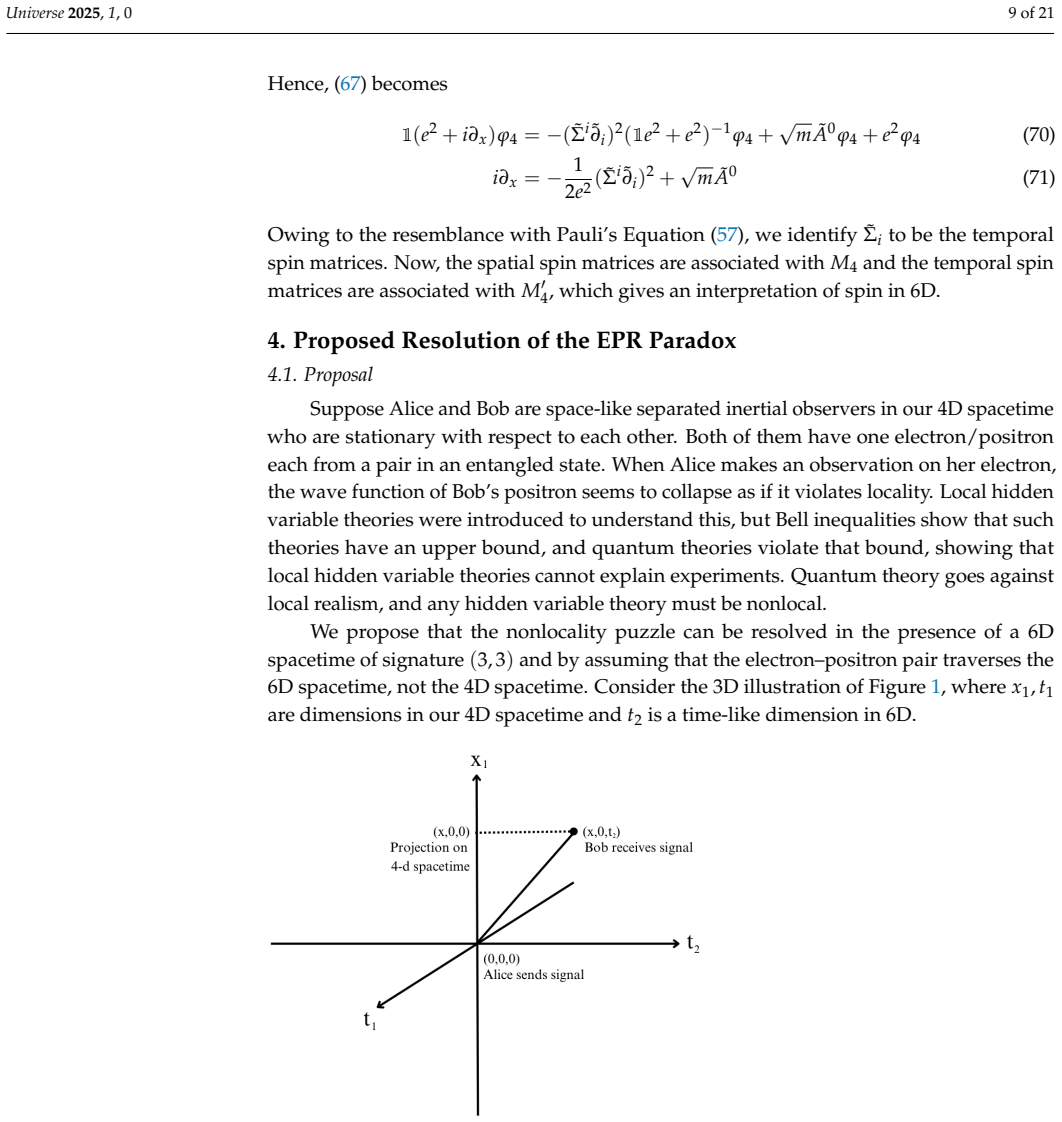
The paper claims that the nonlocality of quantum mechanics is an illusion created by a mismatch in dimensionality. Physical spacetime is six-dimensional with signature (3,3); classical detectors live on a 4D submanifold with one time direction, while quantum systems are superpositions spread over two 4D slices that share one space and one time direction. Since a correlated pair is actually time-like separated in 6D, the collapse of one particle's wave function reaches the other causally at light speed, and what looks like a space-like, faster-than-light influence in 4D is really a short path through the flipped-signature slice M′4. Bell violations survive because quantum correlations are unchanged; what is excluded is only local determinism, not indeterministic local collapse. As a corollary, the paper shows the CHSH correlation bound 2√2 can be exceeded when a superposition across the two slices produces an interference term r, with the value r = 4 − 2√2 attaining the Popescu–Rohrlich bound of 4.
Load-bearing premise
The proposal stands on the assumption that classical detectors are confined to one 4D slice while quantum systems access the extra time-like dimensions; if a classical system could couple to the hidden time direction, the seemingly space-like separation could be probed directly and the nonlocality would be real.
Editorial extensions
If this is right
- Bell inequalities remain violated in both 4D and 6D; what is discarded is only local deterministic hidden variables, not local indeterministic collapse.
- The collapse influence takes a finite time $t_{1P} = L_2/c < 10^{-26}$ s to reach Bob, so correlations arriving ‘instantly’ are consistent with a subluminal signal through the flipped-signature slice.
- The Tsirelson bound $2\sqrt{2}$ can be exceeded in 6D when the cross-term $r$ is nonzero; the Popescu–Rohrlich bound 4 is reached for $r = 4 - 2\sqrt{2}$.
- Observables that rotate between the two Hilbert-space sectors are physical and should be weak-interaction-related, making high-energy collider Bell tests a plausible place to look for violations of the Tsirelson bound.
Reading between the lines
- The paper's split between classical and quantum access to $t_2$ implies a sharp quantum-classical boundary tied to the weak-interaction scale; one could test it by checking whether mesoscopic superposition states, for example in matter-wave interferometry, show a small delay in establishing spatially separated correlations, something the paper does not quantify.
- The cross-term mechanism that lifts the Tsirelson bound acts like a continuous interpolation between quantum and Popescu–Rohrlich correlations; if real, it would imply that the set of physical correlations depends on how strongly the observed operators can rotate between the two 4D slices, suggesting a search for CHSH values near the 6D prediction in collider Bell tests.
- If the messenger is a massless dark photon coupling to the square root of mass, existing dark-photon search limits could be reinterpreted as constraints on the length scale $L_2$ of the hidden slice; the absence of such a particle would not refute the EPR resolution but would remove the proposed local carrier of collapse information.
Signed reviews
Editorial analysis
A structured set of objections, weighed in public.
Referee Report
Summary. The paper proposes that the physical spacetime is six-dimensional with signature (3,3), with two extra time-like dimensions. It argues that quantum systems access all six dimensions while classical detectors only access a 4D submanifold, so that correlated events which appear space-like separated in 4D are in fact time-like separated in 6D. This is offered as a resolution of the EPR paradox that preserves locality. The paper constructs a 6D Dirac equation from quaternions, derives spin matrices for the two 4D submanifolds, and attempts to show that the Tsirelson bound can be violated through cross-terms arising from the superposition of states in the two submanifolds. It also speculates about experimental tests and connects the proposal to the authors' E8⊗E8 unification program.
Significance. If the central claims were established, the paper would offer a physically motivated mechanism for EPR correlations that avoids nonlocality while retaining Bell violations, and it would provide a route beyond the Tsirelson bound. The authors engage in a self-critique (Section 7) and explicitly identify falsifiable predictions (dark photon, weak waves). However, the two load-bearing arguments — the Tsirelson violation and the measurement/collapse rule that projects onto the 4D Hilbert space — are not supported by the presented mathematics. The paper also relies heavily on the authors' own unification program, including a forthcoming paper, which weakens the independence of the proposal.
major comments (4)
- [Section 6, Eqs. (84)-(86)] The derivation of a possible Tsirelson violation is logically invalid because it only establishes an upper bound on F^2, not an actual value. From the chain F^2 ≤ 8(a^4+b^4)+16a^2b^2+r^2+2r(...) ≤ 8+r^2+4√2 r, one cannot conclude that F^2 > 8 for any r. In particular, inserting r = 4-2√2 gives F^2 ≤ 16, which permits F ≤ 4, including the standard quantum value 2√2. The statement that 'the Popescu-Rohrlich bound of 4 on the CHSH correlation F is reached' is therefore unsupported by the inequality. Similarly, the condition 'provided that r > 0 or r < -4√2' is derived from the upper bound and is not a sufficient condition for violation.
- [Section 4.1 and Section 7] The proposed EPR resolution requires that a measurement on the entangled state ψ = αψ1 + βψ2 (with ψ1∈H, ψ2∈H') collapses onto H with probability one. But in the Hilbert-space framework of Eqs. (4)-(5), an observable acting only on H has no matrix elements on H', so applying the standard Born rule to the H⊕H' state gives total probability |α|^2 < 1 for outcomes in H. Section 7 asserts that the usual Born rule 'cannot be directly applied' because the observables are associated with H, but it does not provide an alternative collapse rule that would eliminate the H' component with probability one. Without such a rule, the claim that measurements necessarily lead to a state in H is an additional postulate, not a consequence of the stated formalism.
- [Sections 4.1, 5, and 7] The postulate that classical detectors do not probe the t2 direction, while quantum systems do, is the load-bearing premise of the entire proposal. The justification in Section 7 invokes electroweak symmetry breaking and the claim that detectors 'do not experience the weak force,' but this is not derived from the 6D Dirac equation or from the mathematics presented. Instead, it refers to the authors' E8⊗E8 program and to the forthcoming paper [26]. At the level of this manuscript, the 6D spacetime and its properties (weak-length compactification, dark photon mediator, holographic length scaling) are justified by the same research program that they are used to support, making the argument circular.
- [Section 6, Eq. (79)] The cross-term r is introduced as an unconstrained free parameter. The paper does not show how r follows from the 6D dynamics or from the proposed dark-photon interaction; it merely notes that off-block-diagonal operators could produce such terms. Since the claimed possibility of violating the Tsirelson bound depends entirely on the magnitude and sign of r, the statement that the bound 'can in principle be violated' is an unsubstantiated possibility rather than a derived prediction. For the claim to be meaningful, the paper would need to exhibit a concrete operator or measurement scenario that yields a nonzero r and show that the resulting F exceeds 2√2.
minor comments (5)
- [Section 2.2] The reduction of the quaternionic Dirac operator to the standard 4D Dirac equation via the mapping i→γ0, ωl→γ1, etc. is asserted without demonstration; citing [4] is not sufficient for a step that is later used to identify spin matrices and to support the dimensional split.
- [Section 3.1] In the non-relativistic limit, the replacements Σ~i → 1 and i∂~i → i∂t are imposed without a clear derivation, and the operator ordering in Eq. (52) is ambiguous, making it difficult to verify the claimed recovery of the Pauli equation.
- [Section 6] The introduction of z = r + 2√2 and the statement that the cross-term contribution can be 'suggestively written' as (z^2 - (2√2)^2) is not explained; this appears to be a purely algebraic rearrangement with no physical interpretation, and it does not add support to the argument.
- [Abstract and Section 4.2] The abstract states that the idea 'can be tested experimentally,' but Section 4.2 explains that the proposed experiment is 'essentially impossible with current technology' because the predicted signal travel time is below 10^-26 s. The abstract should be qualified to reflect this practical limitation.
- [Throughout] The manuscript contains numerous typographical and formatting issues, such as inconsistent spacing in author names and equations, and it cites several references that are either preprints or in preparation; careful proofreading and reference completion would be needed before publication.
Circularity Check
The Tsirelson-violation claim reduces to an arbitrary cross-term r, and the EPR resolution's classical/quantum split is deferred to the authors' own forthcoming paper [26].
-
fitted input called prediction
[Section 6, Eq. (79) and (86), paragraph after Eq. (86)]
"This shows the possibility that the Tsirelson bound can be violated in some cases, provided that r > 0 or r < −4√2. If −4√2 ≤ r ≤ 0, the CHSH inequality is obeyed. For r = 4 − 2√2, the Popescu–Rohrlich bound of 4 on the CHSH correlation F is reached."
The quantity r is defined in Eq. (77) as the cross-term contribution and enters Eq. (79) as a free additive parameter in the CHSH expression F = |α|²F1 + |β|²F2 + r. No 6D Hamiltonian, state, or observable is used to compute r; it is simply chosen to lie outside [−4√2, 0] to produce a violation. The value r = 4 − 2√2 is then inserted by hand to reach the Popescu–Rohrlich bound. Thus the paper's conclusion that the Tsirelson bound 'can be violated in 6D' is not a derivation but an assumption: the algebraic bound F² ≤ 8 + r² + 4√2r makes any chosen value of r consistent, so the 'prediction' reduces to the choice of the free parameter.
-
ansatz smuggled in via citation
[Section 5, E8 program paragraph; Section 7, second bullet ('Why should that be so?')]
"A detailed analysis leading to these results will be presented in a forthcoming paper [26]. / Detectors, which are by definition classical and macroscopic, effectively reside in our 4D spacetime because they do not experience the weak force. On the other hand, quantum systems experience the universal weak force and, hence, effectively reside in all six dimensions."
The resolution of the EPR paradox in Section 4.1 requires the postulate that 'Classical systems do not probe the t2 direction. Only quantum systems, which obey quantum linear superposition, probe t2.' This is the load-bearing premise that makes the timelike 6D interval appear spacelike in 4D. When the reader asks why this split holds, the paper answers by asserting that electroweak symmetry breaking localizes classical systems to 4D, and the detailed derivation is deferred to [26], a forthcoming paper by the same research group. The premise is therefore not independently established; it is an ansatz whose justification is a self-citation chain, and the EPR 'resolution' is the geometric restatement of that assumed split.
full rationale
The paper's central EPR claim has genuine geometric content: a timelike interval in a (3,3) spacetime can project to a spacelike interval in a (1,3) submanifold. That projection step is not circular. The quaternionic construction of the 6D Dirac operator and the nonrelativistic reduction to Pauli equations are also self-contained algebraic exercises. However, two load-bearing steps are circular. First, the Tsirelson-bound claim is not derived: the cross-term r is introduced as a free parameter in Eq. (79), and the paper then chooses values of r (e.g., 4 − 2√2) that force a violation. The inequality in Eq. (86) is an algebraic identity, so the 'prediction' is equivalent to the input choice. Second, the EPR resolution depends on the assumption that classical detectors are confined to M4 while quantum systems access the extra time dimension. That assumption is asserted in Section 4.1 and later justified only by reference to the authors' own E8 × E8 program, with the detailed analysis deferred to a forthcoming paper [26]. This is an ansatz smuggled in via self-citation rather than a demonstrated consequence of the 6D Dirac equation. The paper also cites the authors' earlier result [29] on Tsirelson violations, further reinforcing the self-citation chain. These issues make the two headline claims partially circular, so a score of 7 is appropriate.
Assumptions & free parameters
free parameters (4)
- r (cross-term in CHSH expression) =
not fixed; set to 4-2√2 to reach the PR bound
- m' (source charge in M4') =
e²
- coupling constant for M4' gauge field =
√m
- L2 (spatial distance in M4') =
about 10^-13 cm (from holographic relation)
assumptions (8)
- domain assumption 6D spacetime with signature (3,3) exists before electroweak symmetry breaking
- ad hoc to paper Quantum systems access all six dimensions; classical detectors only four
- domain assumption A mediating field (dark photon or weak waves) transmits collapse information at c through M4'
- domain assumption Absolute time (Connes time) exists to give a definite causal order for Bell measurements
- standard math CHSH identity F1² = <4I - [A,A'][B,B']> for ±1 observables
- standard math AM-GM inequality
- ad hoc to paper Projection mapping i→γ0, ωi→γ1 gives the 4D Dirac equation
- domain assumption Holographic length uncertainty relations scale distances in M4'
invented entities (3)
-
Dark photon (U(1)DEM gauge boson)
independent evidence
-
Weak waves
-
Second 4D spacetime M4' with flipped signature
Cite this review
Pith. "Pith review of Time-like Extra Dimensions: Quantum Nonlocality, Spin, and Tsirelson Bound." pith.science (2026). https://pith.science/paper/2RIXLWCV
@misc{pith2026250518797,
  author       = {Pith},
  title        = {Pith review of: Time-like Extra Dimensions: Quantum Nonlocality, Spin, and Tsirelson Bound},
  year         = {2026},
  howpublished = {\url{https://pith.science/paper/2RIXLWCV}},
  note         = {Machine review of arXiv:2505.18797}
}
abstract
The $E_8 \otimes E_8$ octonionic theory of unification suggests that our universe is six-dimensional and that the two extra dimensions are time-like. These time-like extra dimensions, in principle, offer an explanation of the quantum nonlocality puzzle, also known as the EPR paradox. Quantum systems access all six dimensions, whereas classical systems such as detectors experience only four dimensions. Therefore, correlated quantum events that are time-like separated in 6D can appear to be space-like separated and, hence, nonlocal, when projected to 4D. Our lack of awareness of the extra time-like dimensions creates the illusion of nonlocality, whereas, in reality, the communication obeys special relativity and is local. Bell inequalities continue to be violated because quantum correlations continue to hold. In principle, this idea can be tested experimentally. We develop our analysis after first constructing the Dirac equation in 6D using quaternions and using the equation to derive spin matrices in 6D and then in 4D. We also show that the Tsirelson bound of the CHSH inequality can in principle be violated in 6D.
Figures
Reference graph
Works this paper leans on
-
[26]
Gravi-weak unification in a six-dimensional spacetime with signature (3,3)
Asselmeyer-Maluga, T.; Finster, F.; Gresnigt, N.; Isidro, J.; Marciano, A.; Paganini, C.; Singh, T.P .; Samuel Wesley, P . Gravi-weak unification in a six-dimensional spacetime with signature (3,3). 2025, in preparation for Phys. Rev. D
work page 2025
-
[1]
Quantum nonlocality: How does nature do it? Science 2009, 326, 1357
Gisin, N. Quantum nonlocality: How does nature do it? Science 2009, 326, 1357
work page 2009
-
[2]
Maudlin, T. Quantum Non-Locality and Relativity—Metaphysical Intimations of Modern Physics , 3rd ed.; Wiley-Blackwell: Hoboken, NJ, USA, 2011
work page 2011
-
[3]
Trace dynamics, octonions, and unification: An E8 ⊗ E8 theory of unification
Singh, T.P . Trace dynamics, octonions, and unification: An E8 ⊗ E8 theory of unification. J. Phys. Conf. Ser. 2024, 2912, 012009
work page 2024
-
[4]
Remarks on the Group-Theoretical Foundations of Particle Physics
Wilson, R.A. Remarks on the Group-Theoretical Foundations of Particle Physics. 2020. Available online: https://www.newton.ac. uk/files/preprints/ni19011.pdf (accessed on 1 January, 2025)
work page 2020
-
[5]
Quaternions and Three Temporal Dimensions
Lambek, J. Quaternions and Three Temporal Dimensions. 2014. Available online: https://www.math.mcgill.ca/barr/lambek/ pdffiles/Quater2014.pdf (accessed on 1 January 2025)
work page 2014
-
[6]
Testing the speed of spooky action at a distance
Salart, D.; Baas, A.; Branciard, C.; Gisin, N.; Zbinden, H. Testing the speed of spooky action at a distance. Nature 2008, 454, 861–864
work page 2008
-
[7]
An improved lower bound for superluminal quantum communications
Cocciaro, B.; Faetti, S.; Fronzoni, L. An improved lower bound for superluminal quantum communications. Phys. Rev. A 2018, 97, 052124
work page 2018
Show all 51 references
-
[8]
spooky action at a distance
Santamaria Amato, L.; Pallotti, D.K.; Siciliani de Cumis, M.; Dequal, D.; Andrisani, A.; Slussarenko, S. Testing the speed of “spooky action at a distance” in a tabletop experiment. Sci. Rep. 2023, 13, 8201
2023
-
[9]
Session 5: Open Discussion
Gisin, N. Session 5: Open Discussion. 2024. Time Stamp 25:00, Conference on 100 Years of Quantum Mechanics, IISER Kolkata. Available online: https://www.youtube.com/live/KcWmBW6PyfE?si=jOVqsRI2xOGRM4mR (accessed on 1 February, 2025)
2024
-
[10]
Cool horizons for entangled black holes
Maldacena, J.; Susskind, L. Cool horizons for entangled black holes. Fortschritte Phys. 2013, 61, 781–811
2013
-
[11]
Germ of a synthesis: Space-time is spinorial, extra dimensions are time-like
Sparling, G.A. Germ of a synthesis: Space-time is spinorial, extra dimensions are time-like. Proc. R. Soc. A 2007, 463, 1665
2007
-
[12]
Dirac equation in a six-dimensional spacetime: temporal polarisation for subluminal interactions
Patty, C.E., Jr.; Smalley, L.L. Dirac equation in a six-dimensional spacetime: temporal polarisation for subluminal interactions. Phys. Rev. D 1985, 32, 891
1985
-
[13]
An extended theory of relativity in a six-dimensional manifold
Hagston, W.E.; Cox, I.D. An extended theory of relativity in a six-dimensional manifold. Found. Phys. 1985, 15, 773
1985
-
[14]
Space-time transformations in six-dimensional special relativity
Cole, E.A.B.; Buchanan, S.A. Space-time transformations in six-dimensional special relativity. J. Phys. A Math. Gen. 1982, 15, L255
1982
-
[15]
General Lorentz transformations in six-dimensional spacetime
Teli, M.T. General Lorentz transformations in six-dimensional spacetime. Phys. Lett. A 1987, 122, 447. Universe 2025, 1, 0 20 of 21
1987
-
[16]
Quaternions and Quantum Mechanics
Conway, A.W. Quaternions and Quantum Mechanics. Pontificia Academia Scientiarum. 1948. Volume 12. p. 204. Available online: https://www.pas.va/content/dam/casinapioiv/pas/pdf-volumi/acta/acta12pas.pdf (accessed on 1 January, 2025)
1948
-
[17]
Gravitation with cosmological term, expansion of the universe as uniform acceleration in Clifford coordinates.Symmetry 2021, 13, 366
Kritov, A. Gravitation with cosmological term, expansion of the universe as uniform acceleration in Clifford coordinates.Symmetry 2021, 13, 366
2021
-
[18]
Electroweak
Dartora, C.A.; Cabrera, G.G. The Dirac Equation in Six-dimensional SO(3,3) Symmetry Group and a Non-chiral “Electroweak” Theory. Int. J. Theo. Phys. 2010, 49, 51
2010
-
[19]
Unified field theory in six dimensions
Podolanski, J. Unified field theory in six dimensions. Proc. R. Soc. Lond. Ser. A Math. Phys. Sci. 1950, 201, 234
1950
-
[20]
Two-Component spinorial formalism using quaternions for six-dimensional spacetimes
Venancio, J.; Batista, C. Two-Component spinorial formalism using quaternions for six-dimensional spacetimes. Adv. Appl. Clifford Algebras 2021, 31, 46
2021
-
[21]
Six-dimensional Dirac equation
Boyling, J.B.; Cole, E.A.B. Six-dimensional Dirac equation. Int. J. Theor. Phys. 1993, 32, 801
1993
-
[22]
Six-dimensional space-time from quaternionic quantum mechanics
Brody, D.C.; Graefe, E.-M. Six-dimensional space-time from quaternionic quantum mechanics. Phys. Rev. D 2011, 84, 125016
2011
-
[23]
Bouncing braneworlds
Shtanov, Y.; Sahni, V . Bouncing braneworlds. Phys. Lett. B 2003, 557, 1–6
2003
-
[24]
Towards understanding quantum mechanics, general relativity and the tachyonic causality paradoxes
Pavsic, M. Towards understanding quantum mechanics, general relativity and the tachyonic causality paradoxes. Lett. Nuovo C. 1981, 30, 111
1981
-
[25]
Unified kinematics of bradyons and tachyons in six-dimensional spacetime
Pavsic, M. Unified kinematics of bradyons and tachyons in six-dimensional spacetime. J. Phys. A Math. Gen. 1981, 14, 3217
1981
-
[27]
Quantum generalization of Bell’s inequalities
Tsirelson, B.S. Quantum generalization of Bell’s inequalities. Lett. Math. Phys. 1980, 4, 93–100
1980
-
[28]
Nonlocality as an axiom for quantum theory
Rohrlich, D.; Popescu, S. Nonlocality as an axiom for quantum theory. arXiv 1995, arXiv:quant-ph/9508009
1995 arXiv
-
[29]
A violation of the Tsirelson bound in the pre-quantum theory of trace dynamics
Ahmed, R.G.; Singh, T.P . A violation of the Tsirelson bound in the pre-quantum theory of trace dynamics. arXiv 2022, arXiv:2208.02209
2022 arXiv
-
[30]
Quantum entanglement and Bell inequality violation at colliders
Barr, A.J.; Fabbrichesi, M.; Floreanini, R.; Gabrielli, E.; Marzola, L. Quantum entanglement and Bell inequality violation at colliders. Prog. Part. Nucl. Phys. 2024, 139, 104134. https://doi.org/10.1016/j.ppnp.2024.104134
2024
-
[31]
Von Neumann algebra automorphisms and time-thermodynamics relation in generally covariant quantum theories
Connes, A.; Rovelli, C. Von Neumann algebra automorphisms and time-thermodynamics relation in generally covariant quantum theories. Class. Quant. Grav. 1994, 11, 2899–2918. https://doi.org/10.1088/0264-9381/11/12/007
1994 doi
-
[32]
Gravitation, and quantum theory, as emergent phenomena.J
Singh, T.P . Gravitation, and quantum theory, as emergent phenomena.J. Phys. Conf. Ser. 2023, 2533, 012013. https://doi.org/10.1 088/1742-6596/2533/1/012013
2023
-
[33]
Quantum Theory as an Emergent Phenomenon: The Statistical Mechanics of Matrix Models as the Precursor of Quantum Field Theory; Cambridge University Press: Cambridge, UK, 2004
Adler, S.L. Quantum Theory as an Emergent Phenomenon: The Statistical Mechanics of Matrix Models as the Precursor of Quantum Field Theory; Cambridge University Press: Cambridge, UK, 2004
2004
-
[34]
The Spectral action principle
Chamseddine, A.H.; Connes, A. The Spectral action principle. Commun. Math. Phys. 1997, 186, 731–750. https://doi.org/10.1007/ s002200050126
1997
-
[35]
General relativity in terms of Dirac eigenvalues
Landi, G.; Rovelli, C. General relativity in terms of Dirac eigenvalues. Phys. Rev. Lett. 1997, 78, 3051–3054. https://doi.org/10.110 3/PhysRevLett.78.3051
1997
-
[36]
AnE8 ⊗ E8 unification of the standard model with pre-gravitation, on an octonion-valued twistor space
Kaushik, P .; Vaibhav, V .; Singh, T.P . AnE8 ⊗ E8 unification of the standard model with pre-gravitation, on an octonion-valued twistor space. arXiv 2022, arXiv:2206.06911
2022 arXiv
-
[37]
Majorana neutrinos, exceptional Jordan algebra, and mass ratios for charged fermions
Bhatt, V .; Mondal, R.; Vaibhav, V .; Singh, T.P . Majorana neutrinos, exceptional Jordan algebra, and mass ratios for charged fermions. J. Phys. G 2022, 49, 045007. https://doi.org/10.1088/1361-6471/ac4c91
2022 doi
-
[38]
CKM Matrix Parameters from the Exceptional Jordan Algebra.Universe 2023, 9, 440
Patel, A.A.; Singh, T.P . CKM Matrix Parameters from the Exceptional Jordan Algebra.Universe 2023, 9, 440. https://doi.org/10.3 390/universe9100440
2023
-
[39]
Models of Wave-function Collapse, Underlying Theories, and Experimental Tests
Bassi, A.; Lochan, K.; Satin, S.; Singh, T.P .; Ulbricht, H. Models of Wave-function Collapse, Underlying Theories, and Experimental Tests. Rev. Mod. Phys. 2013, 85, 471–527. https://doi.org/10.1103/RevModPhys.85.471
2013 doi
-
[40]
Spontaneous localisation from a coarse-grained deterministic and non-unitary dynamics.Phys
Kakade, K.; Singh, A.; Singh, T.P . Spontaneous localisation from a coarse-grained deterministic and non-unitary dynamics.Phys. Lett. A 2023, 490, 129191. https://doi.org/10.1016/j.physleta.2023.129191
2023
-
[41]
Das Relativitätsprinzip
Lorentz, H.A.; Einstein, A.; Minkowski, H. Das Relativitätsprinzip. Eine Sammlung von Abhandlungen ; B.G. Teubner: Leipzig, Germany; Berlin, Germany, 1913
1913
-
[42]
A generalization of the Lorentz ether to gravity with general-relativistic limit
Schmelzer, I. A generalization of the Lorentz ether to gravity with general-relativistic limit. Adv. Appl. Clifford Algebras 2012, 22, 203–242. https://doi.org/10.1007/s00006-011-0303-7
2012 doi
-
[43]
Reconsidering a scientific revolution: The case of Einstein versus Lorentz
Janssen, M. Reconsidering a scientific revolution: The case of Einstein versus Lorentz. Phys. Perspect. 2002, 4, 421–446
2002
-
[44]
Relativistic Quantum Mechanics; Springer: Dordrecht, The Netherlands, 2015
Horowitz, L.P . Relativistic Quantum Mechanics; Springer: Dordrecht, The Netherlands, 2015
2015
-
[45]
Noncommutative geometry: Year 2000
Connes, A. Noncommutative geometry: Year 2000. arXiv 2000, arXiv:math/0011193
2000 arXiv
-
[46]
Time in Noncommutative Geometry
Connes, A. Time in Noncommutative Geometry. Available online: https://noncommutativegeometry.blogspot.com/2007/03/ time.html (accessed on 1 January, 2025)
2007
-
[47]
Quantum gravity, minimum length and holography.Pramana 2021, 95, 40
Singh, T.P . Quantum gravity, minimum length and holography.Pramana 2021, 95, 40. https://doi.org/10.1007/s12043-020-02052 -2. Universe 2025, 1, 0 21 of 21
2021 doi
-
[48]
Quantum Entanglement without nonlocal causation in (3,2)-dimensional spacetime, Physical Review RESEARCH 2025, 7, 013261
Pettini, M. Quantum Entanglement without nonlocal causation in (3,2)-dimensional spacetime, Physical Review RESEARCH 2025, 7, 013261
2025
-
[49]
Multiple time dimensions
Weinstein, S. Multiple time dimensions. arXiv 2008, arXiv:0812.3869
2008 arXiv
-
[50]
Can quantum nonlocality be connected to extra dimensions? Int
Genovese, M. Can quantum nonlocality be connected to extra dimensions? Int. J. Quant. Inf. 2023, 21, 2340003. https: //doi.org/10.1142/S0219749923400038
2023 doi
-
[51]
ER = EPR, entanglement topology and tensor networks
Kauffman, L.H. ER = EPR, entanglement topology and tensor networks. Proc. SPIE Int. Soc. Opt. Eng. 2022, 12093, 76. https://doi.org/10.1117/12.2618551. Disclaimer/Publisher’s Note: The statements, opinions and data contained in all publications are solely those of the individu...
2022 doi
Reviewed August 7, 2026 · model on record in the stance chip above.
Discussion (0). Continue with ORCID to comment.