Repair-before-veto control for safe lithium-ion fast charging under unknown ambient and cooling-fault conditions
Pith reviewed 2026-06-29 03:36 UTC · model grok-4.3
The pith
A margin-aware controller completes fast charging safely in all nine unknown ambient and cooling conditions while charging 37.9 percent faster than fixed safe currents.
A machine-rendered reading of the paper's core claim, the machinery that carries it, and where it could break.
Core claim
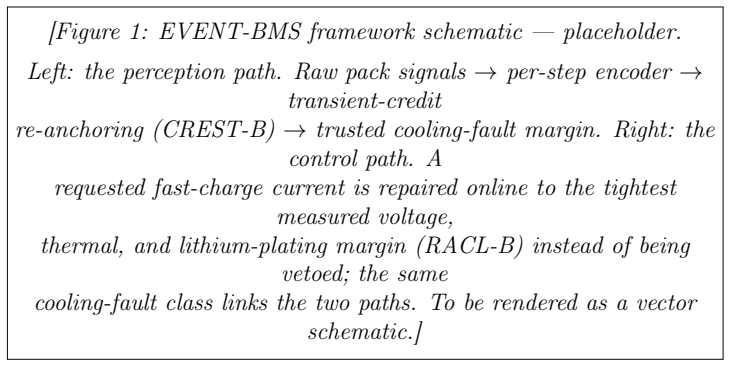
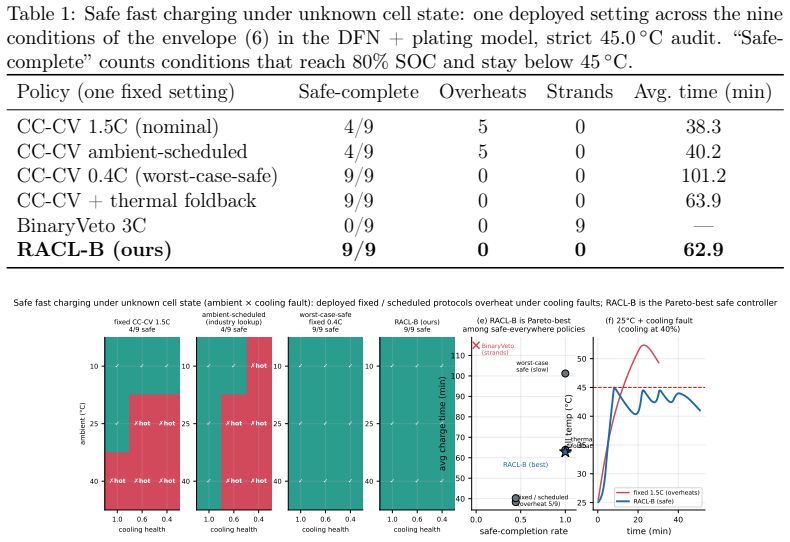
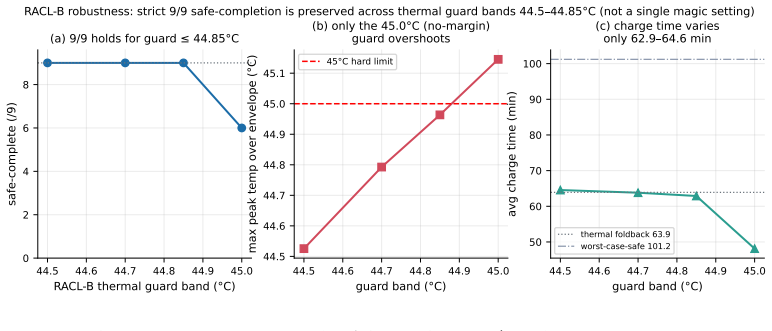
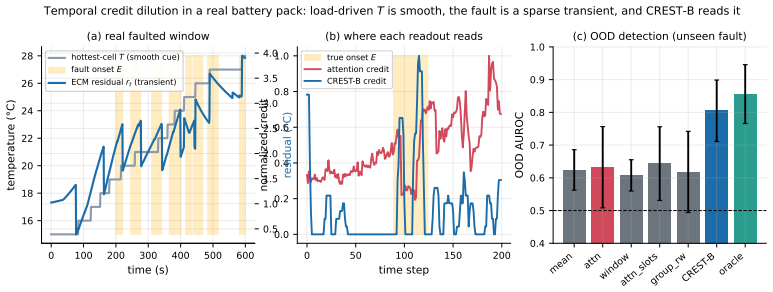
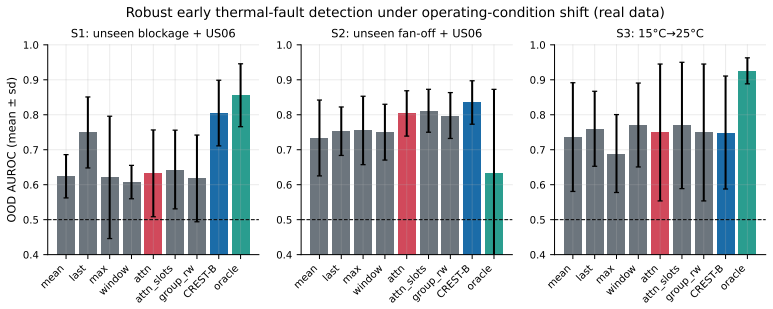
RACL-B requests an aggressive current and repairs it online to the tightest measured margin among terminal voltage, cell temperature, and negative-electrode lithium-plating overpotential, rather than committing to a fixed schedule or shutting charging down. Under a strict 45.0 °C peak-temperature audit the method safely completes all nine conditions spanning 10/25/40 °C ambient temperature and 100/60/40 % cooling health, is 37.9 % faster than the fastest fixed current safe across the whole envelope, produces the least plated lithium, and remains safe across thermal guard bands. The same margin-aware principle drives a transient-credit fault readout that gives the strongest learned sequence-t
What carries the argument
The repair-before-veto controller (RACL-B) that continuously sets current to the minimum of the three real-time measured margins instead of a preset profile or immediate shutdown.
If this is right
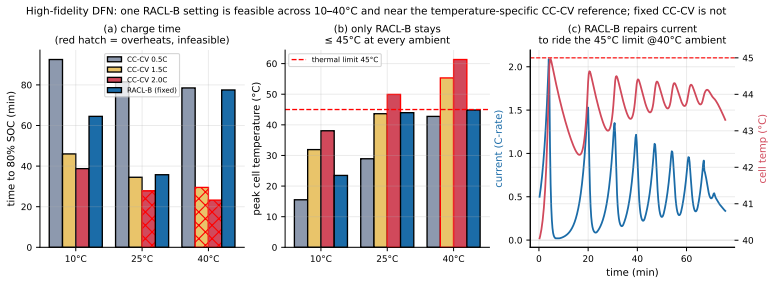
- The controller finishes charging in every one of the nine tested ambient-temperature and cooling-health combinations without exceeding the 45 °C limit.
- Charging completes 37.9 % faster than the fastest fixed current that remains safe over the entire set of conditions.
- The method produces less lithium plating than fixed-current or scheduled protocols while still completing the charge.
- Safety holds when thermal guard bands are applied around the measured margins.
- The identical margin principle yields a monitor that localizes cooling-fault onset more accurately than other sequence-to-global methods on real pack data.
Where Pith is reading between the lines
- The separation of an aggressive request from margin-based repair could be applied to other battery constraints if corresponding real-time measurements become available.
- Real-pack deployment would require confirming that voltage, temperature, and plating-overpotential estimates remain reliable when sensor noise and pack-level effects are present.
- The same repair logic might reduce risk in grid-storage or second-life battery systems that also face variable cooling performance.
- Because the controller only reduces current when a margin is approached, it could be combined with separate speed-optimization layers without changing the safety layer.
Load-bearing premise
The high-fidelity model with partially reversible lithium plating and lumped thermal coupling accurately captures how the three measurable margins evolve under unknown cooling degradation so that online repairs keep the cell inside safe limits.
What would settle it
A laboratory test that applies the controller to a physical cell with an introduced cooling fault at 40 °C ambient and records whether peak temperature stays below 45 °C and total plated lithium stays below the model's prediction.
Figures
read the original abstract
Fast charging is decisive for electric-vehicle adoption, but field chargers are deployed as one setting while the cell's true thermal state, ambient temperature, and cooling-system health are uncertain. A current that is safe for a healthy cell at room temperature can overheat the same cell when it is hot or its cooling is degraded. We formulate this as a single-setting, unknown-state safe-fast-charging problem and solve it with a margin-aware repair-before-veto controller (RACL-B). RACL-B requests an aggressive current and repairs it online to the tightest measured margin among terminal voltage, cell temperature, and negative-electrode lithium-plating overpotential, rather than committing to a fixed schedule or shutting charging down. We evaluate one deployed setting across nine conditions, spanning 10/25/40 $^\circ$C ambient temperature and 100/60/40\% cooling health, in a high-fidelity Doyle--Fuller--Newman model with partially reversible lithium plating and lumped thermal coupling. Under a strict 45.0 $^\circ$C peak-temperature audit, fixed and ambient-scheduled protocols overheat in five of nine conditions because neither observes hidden cooling degradation, and rigid protective shutdown fails to deliver the charge in every condition. RACL-B safely completes all nine conditions, is 37.9\% faster than the fastest fixed current safe across the whole envelope, produces the least plated lithium, and remains safe across thermal guard bands. The same margin-aware principle drives a transient-credit fault readout (CREST-B) that, on a real introduced-fault battery-pack dataset, gives the strongest learned sequence-to-global monitor for localizing cooling-fault onset under operating-condition shift. The framework provides a deployable thermal-safety guarantee for fast charging together with a margin-aware monitor for the same physical fault class.
Editorial analysis
A structured set of objections, weighed in public.
Referee Report
Summary. The manuscript presents a repair-before-veto control strategy (RACL-B) for safe lithium-ion battery fast charging under uncertain ambient temperature and cooling system health. The controller dynamically adjusts the charging current based on the minimum margin among terminal voltage, temperature, and lithium plating overpotential to avoid violations while maximizing speed. Simulations in a Doyle-Fuller-Newman model across nine combinations of ambient temperatures (10/25/40°C) and cooling health levels (100/60/40%) demonstrate that RACL-B completes charging safely in all cases, achieves 37.9% faster charging than the safest fixed-current protocol, minimizes lithium plating, and outperforms fixed and ambient-scheduled methods which fail in multiple conditions. Additionally, a related margin-aware monitor (CREST-B) is shown to perform well on a real battery-pack dataset for detecting cooling faults.
Significance. If the observability of the plating overpotential margin holds under real conditions, the work offers a practical single-setting control approach for robust fast charging that provides explicit thermal safety guarantees despite unknown cooling degradation, outperforming static protocols in simulation. The multi-condition evaluation in a high-fidelity DFN model with reversible plating and thermal coupling, plus the CREST-B extension validated on real fault data, strengthens the case for margin-aware methods in EV battery management. The absence of real-cell controller validation and sensitivity analysis tempers immediate impact but does not negate the simulation-based insight.
major comments (2)
- [Abstract and §3] Abstract and §3: The RACL-B controller is defined to repair current to the 'tightest measured margin' among terminal voltage, cell temperature, and negative-electrode lithium-plating overpotential. The manuscript provides no sensor model, state estimator, or noise analysis showing how the internal plating overpotential can be obtained from terminal measurements alone when cooling health is unknown and the thermal model is degraded. This is load-bearing for the central claim, as the reported safety in all nine conditions and 37.9% speed-up rest on accurate real-time access to these margins.
- [Evaluation across nine conditions (abstract)] Evaluation across nine conditions (abstract): The performance numbers (37.9% faster, safe completion, least plated lithium) are obtained from DFN simulation without reported error bars, sensitivity analysis on margin thresholds, or checks against model mismatch induced by the unknown cooling fault. This weakens the guarantee that the margin-based decisions translate when the plant deviates from the model used to compute the 'measured' margins.
minor comments (1)
- The abstract is lengthy and packs multiple claims; consider splitting or condensing the description of RACL-B and CREST-B for improved readability.
Simulated Author's Rebuttal
We thank the referee for the detailed and constructive report. Below we respond point-by-point to the two major comments. We agree that additional discussion is warranted on both observability assumptions and evaluation robustness, and we will incorporate clarifications and new analysis in the revision.
read point-by-point responses
-
Referee: [Abstract and §3] Abstract and §3: The RACL-B controller is defined to repair current to the 'tightest measured margin' among terminal voltage, cell temperature, and negative-electrode lithium-plating overpotential. The manuscript provides no sensor model, state estimator, or noise analysis showing how the internal plating overpotential can be obtained from terminal measurements alone when cooling health is unknown and the thermal model is degraded. This is load-bearing for the central claim, as the reported safety in all nine conditions and 37.9% speed-up rest on accurate real-time access to these margins.
Authors: We agree that the manuscript does not supply a sensor model, state estimator, or noise analysis for recovering the lithium-plating overpotential margin from terminal measurements under unknown cooling health. The reported results are obtained inside a perfect-information DFN simulation in which all internal states are directly available; the controller is therefore evaluated under the assumption that the three margins can be measured or estimated in real time. The central contribution is the repair-before-veto logic itself rather than an observer design. We will add an explicit paragraph in §3 stating this modeling assumption and noting that practical realization requires a separate observer (e.g., an extended Kalman filter or neural observer) whose design is left for future work. No change to the numerical results is required. revision: partial
-
Referee: [Evaluation across nine conditions (abstract)] Evaluation across nine conditions (abstract): The performance numbers (37.9% faster, safe completion, least plated lithium) are obtained from DFN simulation without reported error bars, sensitivity analysis on margin thresholds, or checks against model mismatch induced by the unknown cooling fault. This weakens the guarantee that the margin-based decisions translate when the plant deviates from the model used to compute the 'measured' margins.
Authors: The nine-condition study is deterministic: the same DFN model supplies both the plant dynamics and the “measured” margins, so model mismatch is deliberately absent by construction. The experiment therefore isolates the effect of unknown ambient temperature and cooling health on a fixed controller. Because the simulations contain no stochastic disturbances, error bars were not reported. We accept that a sensitivity study on the margin thresholds and a brief discussion of potential model mismatch would strengthen the claims. In the revision we will add (i) a sensitivity sweep over the three margin thresholds and (ii) a short paragraph in the discussion section addressing how observer error or thermal-model mismatch could affect closed-loop behavior. revision: yes
Circularity Check
No circularity; RACL-B defined from external physical margins evaluated in independent DFN simulation.
full rationale
The paper defines the controller directly from observable margins (voltage, temperature, plating overpotential) and evaluates performance against a high-fidelity DFN plant across nine conditions. No equations, parameters, or predictions reduce the claimed 37.9% speed-up or safety results to quantities fitted or defined by the authors' own prior work. The derivation chain remains self-contained against the stated model benchmarks with no self-citation load-bearing steps or fitted-input predictions.
Axiom & Free-Parameter Ledger
Reference graph
Works this paper leans on
-
[1]
A. Tomaszewska, Z. Chu, X. Feng, S. O’Kane, X. Liu, J. Chen, C. Ji, E. Endler, R. Li, L. Liu, Y. Li, S. Zheng, S. Vetterlein, M. Gao, J. Du, 17 meanlastmax window attn attn_slotsgroup_rwCREST-Boracle 0.4 0.5 0.6 0.7 0.8 0.9 1.0OOD AUROC (mean ± sd) S1: unseen blockage + US06 meanlastmax window attn attn_slotsgroup_rwCREST-Boracle 0.4 0.5 0.6 0.7 0.8 0.9 1...
-
[2]
T. Waldmann, B.-I. Hogg, M. Wohlfahrt-Mehrens, Li plating as un- wanted side reaction in commercial li-ion cells – a review, Journal of Power Sources 384 (2018) 107–124.doi:10.1016/j.jpowsour.2018. 02.063
-
[3]
S. E. J. O’Kane, W. Ai, G. Madabattula, D. Alonso-Alvarez, R. Timms, V. Sulzer, J. S. Edge, B. Wu, G. J. Offer, M. Marinescu, Lithium-ion battery degradation: how to model it, Physical Chemistry Chemical Physics 24 (13) (2022) 7909–7922.doi:10.1039/D2CP00417H
-
[4]
T. Waldmann, M. Wilka, M. Kasper, M. Fleischhammer, M. Wohlfahrt- Mehrens, Temperaturedependentageingmechanismsinlithium-ionbat- teries – a post-mortem study, Journal of Power Sources 262 (2014) 129– 135.doi:10.1016/j.jpowsour.2014.03.112
-
[5]
D. P. Finegan, J. Zhu, X. Feng, M. Keyser, M. Ulmefors, W. Li, M. Z. Bazant, S. J. Cooper, The application of data-driven methods and physics-based learning for improving battery safety, Joule 5 (2) (2021) 316–329.doi:10.1016/j.joule.2020.12.009. 18 10 1 event fraction 10 3 10 2 10 1 E (a) pooled event credit vanishes as ( 2) E (event credit share) 2 refe...
-
[6]
K. A. Severson, P. M. Attia, N. Jin, N. Perkins, B. Jiang, Z. Yang, M. H. Chen, M. Aykol, P. K. Herring, D. Fraggedakis, M. Z. Bazant, S. J. Harris, W. C. Chueh, R. D. Braatz, Data-driven prediction of battery cycle life before capacity degradation, Nature Energy 4 (5) (2019) 383– 391.doi:10.1038/s41560-019-0356-8
-
[7]
P. M. Attia, A. Grover, N. Jin, K. A. Severson, T. M. Markov, Y.- H. Liao, M. H. Chen, B. Cheong, N. Perkins, Z. Yang, P. K. Her- ring, M. Aykol, S. J. Harris, R. D. Braatz, S. Ermon, W. C. Chueh, Closed-loop optimization of fast-charging protocols for batteries with machine learning, Nature 578 (7795) (2020) 397–402.doi:10.1038/ s41586-020-1994-5
2020
-
[8]
H. E. Perez, X. Hu, S. Dey, S. J. Moura, Optimal charging of li-ion bat- teries with coupled electro-thermal-aging dynamics, IEEE Transactions on Vehicular Technology 66 (9) (2017) 7761–7770.doi:10.1109/TVT. 2017.2676044
work page doi:10.1109/tvt 2017
-
[9]
M. Naguib, J. Chen, P. Kollmeyer, A. Emadi, Thermal fault detection of lithium-ion battery packs through an integrated physics and deep neural network based model, Communications Engineering 4 (2025) 79. doi:10.1038/s44172-025-00409-2
-
[10]
M.Doyle, T.F.Fuller, J.Newman, Modelingofgalvanostaticchargeand 19 discharge of the lithium/polymer/insertion cell, Journal of The Electro- chemical Society 140 (6) (1993) 1526–1533.doi:10.1149/1.2221597
-
[11]
T. F. Fuller, M. Doyle, J. Newman, Simulation and optimization of the dual lithium ion insertion cell, Journal of The Electrochemical Society 141 (1) (1994) 1–10.doi:10.1149/1.2054684
-
[12]
V. Sulzer, S. G. Marquis, R. Timms, M. Robinson, S. J. Chapman, Python battery mathematical modelling (PyBaMM), Journal of Open Research Software 9 (1) (2021) 14.doi:10.5334/jors.309
-
[13]
L. Lu, X. Han, J. Li, J. Hua, M. Ouyang, A review on the key issues for lithium-ion battery management in electric vehicles, Journal of Power Sources 226 (2013) 272–288.doi:10.1016/j.jpowsour.2012.10.060
-
[14]
M.Naguib, P.Kollmeyer, A.Emadi, Applicationofdeepneuralnetworks for lithium-ion battery surface temperature estimation under driving and fast charge conditions, IEEE Transactions on Transportation Elec- trification 9 (1) (2023) 1153–1165.doi:10.1109/TTE.2022.3200225
-
[15]
Geirhos, J.-H
R. Geirhos, J.-H. Jacobsen, C. Michaelis, R. Zemel, W. Brendel, M. Bethge, F. A. Wichmann, Shortcut learning in deep neural net- works, Nature Machine Intelligence 2 (11) (2020) 665–673.doi:10. 1038/s42256-020-00257-z
2020
-
[16]
M. Arjovsky, L. Bottou, I. Gulrajani, D. Lopez-Paz, Invariant risk min- imization, arXiv preprint arXiv:1907.02893 (2019)
work page internal anchor Pith review Pith/arXiv arXiv 1907
-
[17]
Sagawa, P
S. Sagawa, P. W. Koh, T. B. Hashimoto, P. Liang, Distributionally robust neural networks for group shifts: On the importance of regu- larization for worst-case generalization, in: International Conference on Learning Representations (ICLR), 2020
2020
-
[18]
M. Naguib, P. Kollmeyer, J. Chen, A. Emadi, Battery pack with intro- duced faults dataset – air cooled SBLimotive 5Ah, Borealis Data (2025). doi:10.5683/SP3/THZTJC. 20
discussion (0)
Sign in with ORCID, Apple, or X to comment. Anyone can read and Pith papers without signing in.