REVIEW 2 major objections 5 minor 8 references
Eigenvalues of the Laplacian with density
T0 review · 2 major / 5 minor · reviewed 2026-08-14 · deepseek-v4-flash
Pith's one-line read This paper proves that (n-2)/n is the sharp threshold for universal upper bounds on the weighted Laplacian spectrum under fixed mass.
desk verdict The paper identifies the correct critical exponent and the dichotomy is plausible, but Theorem 1's proof has a real covering-property gap that needs repair before the upper bound is fully established. read the letter →
The pith
A machine-rendered reading of the paper's core claim, the machinery that carries it, and where it could break.
The reading
What carries the argument
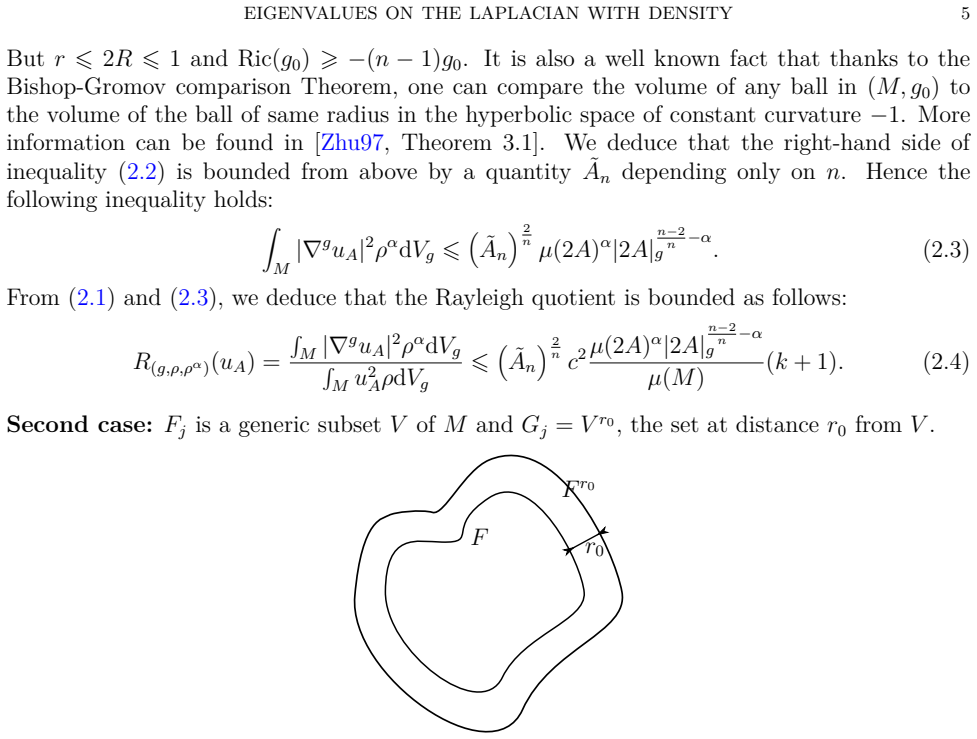
The argument is carried by the Rayleigh quotient $R(g,\rho,\rho^\alpha)(u)=\int_M|\nabla u|^2\rho^\alpha\,dV_g\big/\int_M u^2\rho\,dV_g$ and by a Hölder interpolation inequality that exposes the threshold: $$\int_G |\nabla u|^2\rho^\$\alpha$\,dV_g \le \left(\int_G |\nabla u|^n\,dV_{g_0}\right)^{2/n}\mu(G)^\$\alpha$ |G|_{g}^{(n-2)/n-\$\alpha$},$$ with $\mu=\rho\,dV_g$. The factor $\left(\int_G|\nabla u|^n\,dV_{g_0}\right)^{2/n}$ is conformally invariant, so the only metric-dependent volume factor has exponent $(n-2)/n-\alpha$, positive exactly below the threshold. A metric-measure covering property (every ball of radius $r\le1$ covered by $N$ balls of radius $r/2$) provides $k+1$ disjoint annuli or neighbourhoods with controlled volumes and masses, and Bishop–Gromov comparison bounds the conformal energy on each piece.
What would settle it
On the unit ball in $\mathbb{R}^3$ with $\alpha=1/2$, take densities $\rho_m=e^{-m|x|^2}$ normalized to total mass $|B|$ and compute $\lambda_1(\rho_m,\rho_m^{1/2})|B|^{2/3}$ numerically for increasing $m$; Theorem 2 predicts growth at least like $m^{1/4}$, so a bounded sequence would falsify the unboundedness claim for manifolds of revolution.
Extended reading notes
Core claim
The central discovery is that $(n-2)/n$ is the sharp dividing line between boundedness and unboundedness of the conformally normalized weighted spectrum. On any bounded $C^1$ domain of a complete Riemannian manifold with Ricci curvature at least $-(n-1)$, Theorem 1 proves that for every metric conformal to the restricted metric, every $\alpha\in(0,(n-2)/n)$, and every density with fixed total mass, $\lambda_k(\rho,\rho^\alpha)|M|_g^{2/n}\le A_n k^{2/n}+B_n|M|_{g_0}^{2/n}$ with constants depending only on $n$. Conversely, on a manifold of revolution of dimension $n>2$ and $\alpha\in((n-2)/n,1)$, Theorem 2 shows the supremum $\lambda^*_{k,\alpha}$ is infinite; the proof uses radial Gaussian densities $e^{-m|x|^2}$, whose first eigenvalue grows like a positive power of $m$. In dimension 1 the same unboundedness is proved for every $\alpha\in(0,1)$.
Load-bearing premise
The upper-bound proof assumes that the distance on the domain $M$ obtained by restricting the ambient distance still has the uniform small-ball covering property needed for the $k+1$ disjoint test functions; the paper verifies this property for the ambient complete manifold but not for its restriction to $M$, so a boundary geometry that makes the restricted covering constant blow up would break the proof of Theorem 1.
Editorial extensions
If this is right
- For any admissible domain with $\alpha< (n-2)/n$, the normalized $k$-th weighted eigenvalue is bounded by $A_n k^{2/n}+B_n|M|_{g_0}^{2/n}$ uniformly over conformal metrics and fixed-mass densities.
- On revolution manifolds with $\alpha> (n-2)/n$, $\lambda^*_{k,\alpha}=+\infty$ already at $k=1$, so no upper bound depending only on the geometry can exist.
- In dimension 1, the supremum $\lambda^*_{1,\alpha}$ is infinite for every $\alpha\in(0,1)$, making the one-dimensional case even more unstable than the higher-dimensional threshold.
- At the threshold $\alpha=(n-2)/n$, the weighted problem becomes the unweighted Laplacian in the conformal metric $\rho^{2/n}g$, which recovers the known conformal-spectrum upper bound depending on the conformal volume invariant $V([g])$.
- If the Ricci lower bound is written as $\mathrm{Ric}(\tilde g)>-(n-1)\mathrm{ric}_0\tilde g$, the additive constant in the bound is multiplied by $\mathrm{ric}_0$, so the estimate scales correctly under homothetic changes.
Reading between the lines
- Editorial extension: the Gaussian blow-up construction in Theorem 2 only uses a small Euclidean cube around the origin, so the same argument may show $\lambda^*_{1,\alpha}=+\infty$ for $\alpha>(n-2)/n$ on every compact manifold with boundary, not only manifolds of revolution.
- Editorial extension: Theorem 1 is stated on the open interval below the threshold, but the Hölder estimate with $\alpha=(n-2)/n$ has a vanishing volume exponent and still leaves a $k^{2/n}$ factor; one would therefore expect the same uniform bound to hold at the critical exponent, consistent with the conformal-spectrum result.
- Editorial extension: the one-dimensional proof constructs densities whose $\alpha-1$ power is quadratic; the same explicit family could be used to test sharp growth rates or explicit eigenfunctions for Sturm–Liouville operators with power-law weights.
Signed reviews
Editorial analysis
A structured set of objections, weighed in public.
Referee Report
Summary. The paper studies the spectrum of the weighted Neumann Laplacian associated to the equation −div(σ∇u)=λρu on a compact Riemannian manifold M with C^1 boundary, in the conformal case σ=ρ^α with α>0 and fixed total mass of ρ. The main results are: (i) for n>2 and α∈(0,(n−2)/n), a uniform upper bound λ_k(ρ,ρ^α)|M|_g^{2/n} ≤ A_n k^{2/n} + B_n |M|_{g0}^{2/n} holds for every metric g conformal to the restriction g0 of a complete background metric with Ricci curvature bounded below; (ii) for α∈((n−2)/n,1), the supremum λ*_{k,α} is infinite on manifolds of revolution of dimension n>2; (iii) in dimension one, the same unboundedness holds for all α∈(0,1). The paper also discusses the critical exponent α=(n−2)/n via previous conformal-spectrum results.
Significance. The results give a clean dichotomy at α=(n−2)/n for eigenvalue bounds under a mass constraint, extending previous work by Colbois–El Soufi and Colbois–El Soufi–Savo. The proofs are constructive: no free parameters are fitted, the densities are explicit, and the upper-bound proof relies on standard tools (Bishop–Gromov comparison, Hassannezhad's covering lemma, and Hölder interpolation). The unboundedness proofs for α>(n−2)/n are short and appear correct. If the gap in the proof of Theorem 1 is repaired, the paper will make a solid contribution to the spectral geometry of weighted Laplacians.
major comments (2)
- [Section 2, proof of Theorem 1] The proof verifies the (2,N;1)-covering property for the ambient space (M~,d~0,μ) and then declares 'we can apply Lemma 4', but the subsequent construction treats the sets from Lemma 4 as subsets of M and uses the restricted distance d0. Lemma 4 requires the metric measured space to be complete and locally compact, which (M,d0) is not: M is a bounded open domain with C^1 boundary, so Cauchy sequences may converge to boundary points outside M. The proof therefore does not establish the hypotheses of Lemma 4 for the space on which the test functions are actually defined.
- [Section 2, proof of Theorem 1] Even setting completeness aside, the (2,N;1)-covering property for (M,d0) is not proved. The property for the ambient space does not automatically imply the same property for its subset M, because an M-ball of radius r with center near the boundary is the intersection of an ambient ball with M, and it is not immediate that this intersection can be covered by N M-balls of radius r/2; the paper contains no boundary-truncation argument. Since the construction of k+1 disjointly supported test functions with the lower bound μ(F_j)>μ(M)/(c^2(k+1)) depends on applying Lemma 4 to (M,d0,μ), Theorem 1 is not established as written. The gap appears fixable, for example by applying Lemma 4 to a complete metric space containing M such as the metric completion of M, or by applying it to the ambient and then intersecting the G_j with M and proving the needed measure bounds for the intersections; the authors should supply one of these arguments.
minor comments (5)
- [Page 1, title] The title contains a typo: 'EIGENV ALUES' should be 'EIGENVALUES'.
- [Page 1, introduction] The sentence 'We said in the introduction that the spectrum of (1.2) is discrete' is self-referential and should be rephrased.
- [Page 3, Remark 1] The relation 'g0 = ric0 g' is confusing; consider writing g = ric0^{-1} g0 or using a clearer wording to indicate that g0 and g are homothetic.
- [Page 4, inequality (2.2)] It would clarify to state explicitly that Bishop–Gromov comparison is applied to the ambient balls, and that the balls in M have volume no larger than the corresponding ambient balls.
- [Page 8, proof of Proposition 7] The inequality 'λ1(˜ρm, ˜ρα_m)>m·m^{-1/2}=m^{1/2}' omits the constant from the lower bound of ∫ρ_m; the conclusion is valid for m large, but the step should be worded as 'for m sufficiently large'.
Circularity Check
No significant circularity: Theorem 1 and Theorem 2 rest on independent published bounds, not on fitted inputs or self-citation.
full rationale
The paper's main upper bound (Theorem 1) is obtained by constructing explicit test functions and applying Lemma 4 (from [Has11], itself based on [GYY04] and [CM08]) to the ambient metric-measure space, then combining Hölder inequalities with Bishop–Gromov volume comparison. The constants A_n and B_n are not fitted to the target eigenvalues; they come from the covering constant and volume comparison. The α = (n−2)/n case is a conformal-change observation using [Has11]'s eigenvalue bound, not a renaming of the conclusion. Theorem 2 borrows the lower bound λ1(ρ_m,ρ_m)>m from [CESS15, Theorem 5.2]; although this is an external published theorem (not a self-citation of the present authors), it is used as an independent input, and the unboundedness for α>(n−2)/n follows by an explicit comparison ρ_m^α > ρ_m and a normalization computation that does not rest on the theorem being proved. The skeptical concern about Lemma 4 being verified for the ambient space rather than for the restricted metric on M is a possible technical gap in the proof, not a circularity: no equation of the paper is equivalent to its input by construction, and no fitted parameter is relabeled as a prediction. No self-citation chain is load-bearing.
Assumptions & free parameters
assumptions (5)
- domain assumption Theorem 5.2 of [CESS15]: on a compact manifold of revolution of dimension n>2 with Gaussian radial density ρ_m=e^{-m|x|^2}, λ_1(ρ_m,ρ_m)>m for m large.
- domain assumption The (2,N;1)-covering property of [Has11] holds for (M,d0,μ) where M is a C^1 bounded domain in a complete Ricci-lower-bounded manifold with the restricted distance.
- standard math Bishop-Gromov comparison for balls in (M,g0) with Ricci ≥ -(n-1) gives uniform bounds on (2/r)^n|B(a,r)|+(1/R)^n|B(a,2R)|.
- standard math The n-Dirichlet integral ∫|∇u|^n dV_g is invariant under conformal changes of the metric.
- standard math The variational (min-max) characterization of eigenvalues of (1.2) is valid for positive continuous ρ and σ.
Cite this review
Pith. "Pith review of Eigenvalues of the Laplacian with density." pith.science (2026). https://pith.science/paper/2RU3L6X4
@misc{pith2026190805051,
  author       = {Pith},
  title        = {Pith review of: Eigenvalues of the Laplacian with density},
  year         = {2026},
  howpublished = {\url{https://pith.science/paper/2RU3L6X4}},
  note         = {Machine review of arXiv:1908.05051}
}
abstract
Let $(M,g)$ be a compact Riemannian manifold with a boundary of class $\mathscr{C}^{1}$. We are interested in the spectrum of the weighted Laplacian on $M$ with Neumann boundary conditions. More precisely, given $\rho$ and $\sigma$ two positive functions on $M$, we study the eigenvalues of the equation $-\operatorname{div}(\sigma \nabla u)=\lambda\rho u$. Inspired by a recent work of B. Colbois and A. El Soufi, we investigate upper bounds for the eigenvalues in the case where $\sigma=\rho^{\alpha}$, $\alpha>0$. We show that $\alpha = \frac{n-2}{n}$ plays a critical role in the estimation of the spectrum when the total mass of $\rho$ is fixed.
Figures


Reference graph
Works this paper leans on
-
[1]
Extremal eigenvalues of the L aplacian in a conformal class of metrics: The `conformal spectrum'
Bruno Colbois and Ahmad El Soufi. Extremal eigenvalues of the L aplacian in a conformal class of metrics: The `conformal spectrum'. Annals of Global Analysis and Geometry , 24(4):337--349, 2003
work page 2003
-
[2]
Spectrum of the L aplacian with weights
Bruno Colbois and Ahmad El Soufi. Spectrum of the L aplacian with weights. Ann. Global Anal. Geom. , 55(2):149--180, 2019
work page 2019
-
[3]
Eigenvalues of the L aplacian on a compact manifold with density
Bruno Colbois, Ahmad El Soufi, and Alessandro Savo. Eigenvalues of the L aplacian on a compact manifold with density. Communications in Analysis and Geometry , 23(3):639--670, 2015
work page 2015
-
[4]
Eigenvalues estimate for the Neumann problem of a bounded domain
Bruno Colbois and Daniel Maerten. Eigenvalues estimate for the Neumann problem of a bounded domain . Journal of Geometric Analysis , 18(4):1022--1032, 2008
work page 2008
-
[5]
Eigenvalues of elliptic operators and geometric applications
Alexander Grigor'yan, Netrusov Yu, and Shing-Tung Yau. Eigenvalues of elliptic operators and geometric applications. Surveys in Differential Geometry, IX , pages 147--218, 2004
work page 2004
-
[6]
Conformal upper bounds for the eigenvalues of the L aplacian and S teklov problem
Asma Hassannezhad. Conformal upper bounds for the eigenvalues of the L aplacian and S teklov problem. Journal of Functional Analysis , 261(12):3419--3436, 2011
work page 2011
-
[7]
Upper bounds for eigenvalues of conformal metrics
Nicholas Korevaar. Upper bounds for eigenvalues of conformal metrics. J. Differential Geom. , 37(1):73--93, 1993
work page 1993
-
[8]
The comparison geometry of R icci curvature
Shunhui Zhu. The comparison geometry of R icci curvature. In Comparison geometry ( B erkeley, CA , 1993--94) , volume 30 of Math. Sci. Res. Inst. Publ. , pages 221--262. Cambridge Univ. Press, Cambridge, 1997
work page 1993
Reviewed August 14, 2026 · model on record in the stance chip above.
Discussion (0). Continue with ORCID to comment.