REVIEW 3 major objections 5 minor 65 references
Tracing back a second-generation star stripped from Terzan 5 by the Galactic bar
T0 review · 3 major / 5 minor · reviewed 2026-08-12 · deepseek-v4-flash
Pith's one-line read The field star SOS1 was most likely stripped from Terzan 5 roughly 350 Myr ago by the Galactic bar, according to orbital traceback and chemical matching.
desk verdict The 2G chemistry is well supported and the traceback idea is genuinely new, but the dissociation-count statistic needs a null control before Terzan 5 can be called the parent. read the letter →
The pith
A machine-rendered reading of the paper's core claim, the machinery that carries it, and where it could break.
The reading
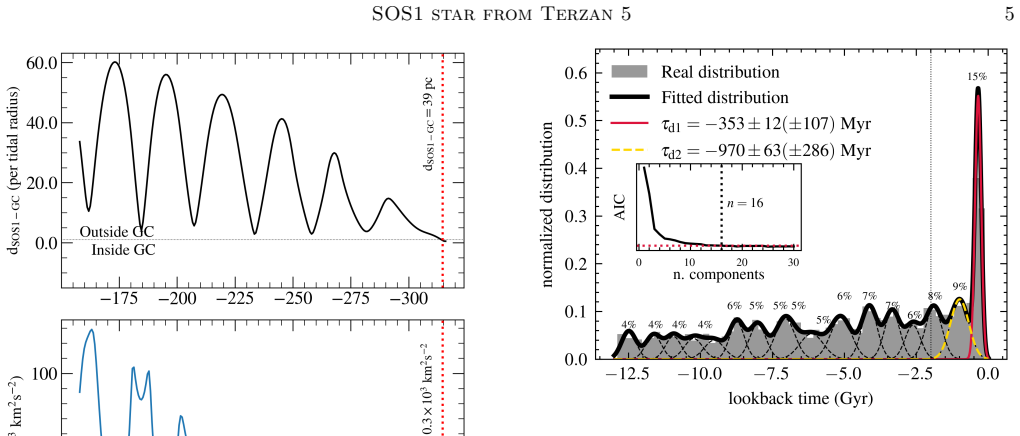
This star is moving on an orbit that follows the Milky Way's bar. The team integrated its orbit backward in a model of the Galaxy's gravitational field and counted close encounters with all cataloged globular clusters. For Terzan 5, a massive and chemically unusual cluster near the Galactic center, they found more than 900 encounters in the last two billion years where the star was inside the cluster's tidal radius and gravitationally bound. For every other surviving cluster, they found zero such encounters. The most recent cluster of dissociation times is near 350 million years ago.
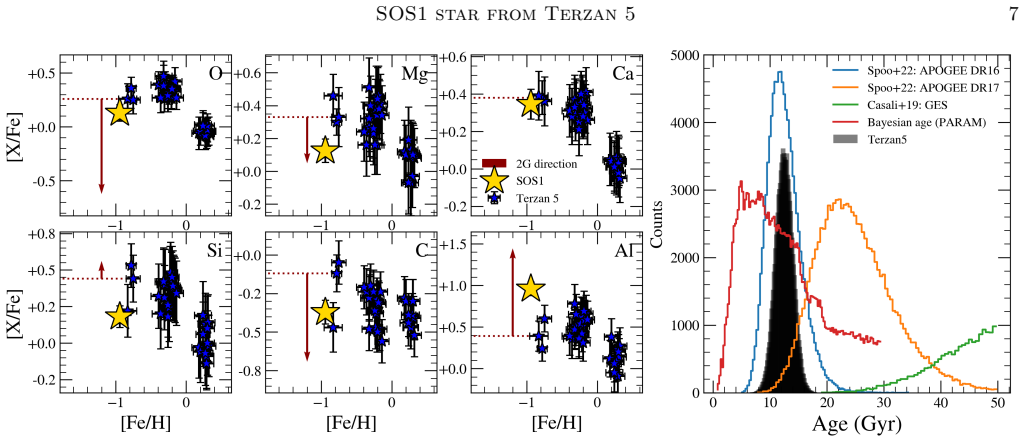
The chemical comparison is supportive but weaker. SOS1's iron content matches the most metal-poor population of Terzan 5, which is known from only three stars. The star's age, estimated from its carbon-to-nitrogen ratio after correcting for second-generation enrichment, is also consistent with Terzan 5's old age, although the correction itself assumes Terzan 5 was the parent. The authors caveat that a completely destroyed cluster cannot be excluded.
Extended reading notes
Core claim
The paper's central result is stated in Section 4: 'the dynamical results suggest that SOS1 was possibly gravitationally bound to Terzan 5 at -353 ± 12(±107) Myr ago.' If correct, SOS1 is a second-generation star originally belonging to Terzan 5's most metal-poor population, stripped by the Galactic bar, and this is the first chemodynamical tracing of a single non-stream field star back to a specific surviving globular cluster.
Load-bearing premise
The orbital traceback relies on a static, non-evolving Galactic potential (Sormani et al. 2022 approximation of Portail et al. 2017) with a fixed bar pattern speed, integrated 13 Gyr backward. The authors restrict trust to the last 2 Gyr and state that the boundedness criterion ignores dynamical friction and cluster evolution. If the bar potential or Terzan 5's orbit evolved significantly within the last roughly 1 Gyr, the more than 900 dissociation points in the 0 to -2 Gyr window could be artifacts. A second structural assumption is that the intact parent cluster must be among the observed Milky Way globular clusters, explicitly excluding a completely destroyed parent.
Signed reviews
Editorial analysis
A structured set of objections, weighed in public.
Referee Report
Summary. The paper presents SOS1, an APOGEE/Gaia red giant in the inner Galaxy with a bar-trapped orbit and an abundance pattern (N, Al, Na enhancements, C depletion, Ce enhancement) typical of second-generation globular-cluster stars. The authors integrate orbits backward 13 Gyr in a fixed Sormani et al. (2022) approximation of the Portail et al. (2017) barred potential, select Galactic globular clusters with Jacobi energies within 1 sigma of SOS1, and compare 500 Monte Carlo orbital realizations per object (2.5e5 pair combinations). They count 'dissociation points' where SOS1 lies within a cluster's tidal radius and is energetically bound. Terzan 5 yields 3794 dissociation points (936 within the past 2 Gyr), versus at most 15 for any other surviving cluster; a GMM fit to the dissociation times gives tau_d1 = -353 +/- 12( +/- 107) Myr. The authors conclude that SOS1 was tidally stripped from Terzan 5's most metal-poor population (popC) by the Galactic bar and is a fossil record of early enrichment.
Significance. If correct, this would be the first chemodynamical tracing of an individual field star (not in a stream) back to a specific surviving globular cluster, with implications for Terzan 5's status as a bulge fossil fragment and for bar-driven cluster disruption. The paper's strengths include the use of independent external datasets (Gaia DR3, APOGEE DR17, Baumgardt & Vasiliev 2021, Portail et al. 2017), two independent spectral checks of the N and Al abundances (reference-star comparison and MOOG synthesis), transparent Monte Carlo uncertainties, and a clear statement of the caveats of the fixed potential. The dynamical identification, however, hinges on an uncalibrated count of orbital coincidences, and the paper contains internal inconsistencies in the quoted abundances; these issues must be addressed before the central claim is accepted.
major comments (3)
- [Section 3.2, Table 2] The dissociation-point statistic has no null control. Terzan 5 is by far the largest and most massive cluster in the selected sample (rt = 51.26 pc, M = 1.09e6 Msun), while the other candidates have rt between 10.98 and 33.88 pc and masses of roughly 1e4 to 6e5 Msun; because a dissociation point only requires entering the tidal sphere and being energetically bound in a fixed cluster potential, the expected encounter rate scales steeply with tidal radius and mass. Furthermore, SOS1 and Terzan 5 are both on bar-trapped orbits (Pbar = 84% and 94%), so their 500-orbit Monte Carlo ensembles may pass through the same volume repeatedly for geometric reasons. The factor of >200 in raw counts relative to all other clusters therefore cannot be interpreted as a likelihood ratio or false-positive rate without running the identical pipeline on a control sample of non-member field stars with the same measurement uncertainties. Please add such a null control, or otherwise calibrate the expected dissociation count under the hypothesis that SOS1 is not a member of Terzan 5.
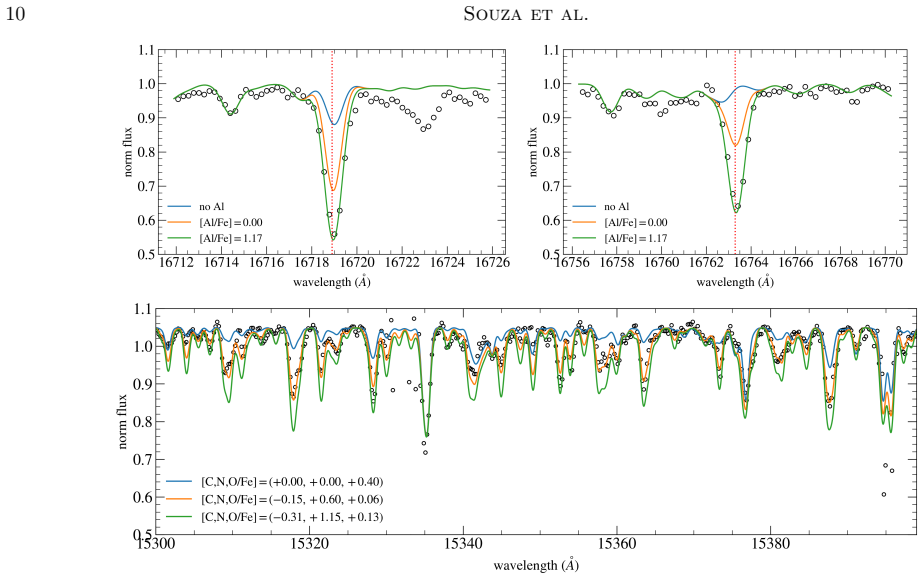
- [Table 1; Section 5] The paper quotes internally inconsistent abundances: [N/Fe] is +1.15 in Table 1 but +0.71 in the Conclusions, [Al/Fe] is +0.96 in Table 1 but +0.31 in the Conclusions, and [Ce/Fe] is +0.43 in Table 1 but +0.60 in the Conclusions. Section 3.1 also describes the star as having '[N/Fe] > 1.0, [Al/Fe] > 1.0', which is not satisfied by the Table 1 value [Al/Fe] = +0.96. These differences are large enough to alter the qualitative chemical argument: with [Al/Fe] = +0.31 the star is much less extreme relative to the field than with +0.96. Please reconcile the tables and text and re-state the chemical characterization using the final adopted values.
- [Section 4; Appendix E] The [C/N]-based age estimate is not an independent confirmation of the Terzan 5 link. The 2G abundance correction is obtained by interpolating the Milone et al. (2018) variations to Terzan 5's mass (Appendix E, Eq. E2), and the same assumed Terzan 5 mass is then used to argue that the corrected [C/N] gives an age compatible with Terzan 5. The age compatibility is therefore partly built into the correction. Please either derive the correction without assuming Terzan 5's properties or explicitly state that the age is only a consistency check after assuming membership, not an independent line of evidence.
minor comments (5)
- [Section 2] The text refers to 'Apendix A' rather than 'Appendix A'.
- [Appendix B] The reference star is introduced as STARB but later referred to as 'SARTB' in the figure caption text; please make the spelling consistent.
- [References] The entries 'Rodrigues et al. 2017a' and 'Rodrigues et al. 2017b' share identical titles, journal, volume, and pages; if they are the same paper, the citation should be consolidated.
- [Figure 2] Figure 2 is described as an interactive figure; in a printed or static PDF version, the red dotted dissociation-point markers may not be legible. Please ensure a static version conveys the same information.
- [Appendix A] The error on A_V is reported as 'sigma_Av = 0.351 fit + 0.564 EW meas mag' with no explicit quadrature formula, while Table 1 lists AV = 4.48 +/- 0.92; please clarify how the total error is propagated and which error budget is adopted.
Assumptions & free parameters
free parameters (2)
- GMM number of Gaussian components =
16
- 2G abundance correction for [C/N] =
interpolated value for Terzan 5's mass, not quoted numerically
assumptions (5)
- domain assumption A static, non-evolving Galactic potential with fixed bar pattern speed is adequate for backward orbital integration.
- domain assumption SOS1's parent cluster, if still intact, is among the 165 observed Milky Way globular clusters.
- domain assumption High N and Al abundances in a field star uniquely indicate a second-generation globular cluster star.
- domain assumption The Milone et al. (2018) 1G-to-2G abundance variation relations apply to Terzan 5's most metal-poor population and to SOS1.
- domain assumption The APOGEE DR17 abundances for SOS1, after the authors' spectral sanity checks, are accurate for the key light elements.
Cite this review
Pith. "Pith review of Tracing back a second-generation star stripped from Terzan 5 by the Galactic bar." pith.science (2026). https://pith.science/paper/2SBVGJPR
@misc{pith2026241108096,
  author       = {Pith},
  title        = {Pith review of: Tracing back a second-generation star stripped from Terzan 5 by the Galactic bar},
  year         = {2026},
  howpublished = {\url{https://pith.science/paper/2SBVGJPR}},
  note         = {Machine review of arXiv:2411.08096}
}
read the original abstract
The Galactic bulge hosts the Milky Way's oldest stars, possibly coming from disrupted globular clusters (GCs) or the bulge's primordial building blocks, making these stars witnesses to the Galaxy's early chemical enrichment. The Galactic bar currently dominates the bulge's region, altering the orbits of objects formed before its formation and complicating the trace of the field stars' original clusters. Here, we present the discovery of a fossil record of this evolution, SOS1 -- a star trapped in the bar, exhibiting significant enhancements in nitrogen, sodium, and aluminum, typical of second-generation GC stars. SOS1 also shows an s-process Ce enhancement, suggesting an old age and early enrichment by fast-rotating massive stars in the Galaxy's earliest phases. With the purpose of finding the SOS1's parent GC, we derive its precise chemodynamical properties by combining high-precision proper motions from Gaia with APOGEE detailed chemical abundances. Our analysis suggests that SOS1 was possibly stripped from the GC Terzan 5 by the Galactic bar's gravitational influence approximately 350 Myr ago. We also found chemical similarities suggesting that SOS1 belonged to the most metal-poor, ancient, and peripheral stellar population of Terzan 5. These results not only support the hypothesis that Terzan 5 is a remnant of a primordial building block of the Galactic bulge, but also suggest this cluster continues losing stars to the bar. Our method highlights how powerful the use of chemodynamical properties in the Gaia era is for tracing the Galaxy's evolutionary history.
Figures


Figures from the paper (4 more)


Reference graph
Works this paper leans on
-
[1]
, " * write output.state after.block = add.period write newline
ENTRY address archivePrefix author booktitle chapter doi edition editor eprint howpublished institution journal key month number organization pages publisher school series title misctitle type volume year version url label extra.label sort.label short.list INTEGERS output.state before.all mid.sentence after.sentence after.block FUNCTION init.state.consts ...
-
[2]
write newline
" write newline "" before.all 'output.state := FUNCTION format.url url empty "" new.block "" url * "" * if FUNCTION format.eprint eprint empty "" archivePrefix empty "" archivePrefix "arXiv" = new.block " " eprint * " " * new.block " " eprint * " " * if if if FUNCTION format.doi doi empty "" " " doi * " " * if FUNCTION format.pid doi empty eprint empty ur...
-
[3]
Ѐ 3gjڴiںuUV R!Ѐr͚5KO<6nRnz'7 @ ̾.eɒ h @ ; ! w 4C h ŋ +;;[Ǐ W -d ]V 2zwQ ;veTD Wdd H_U ڴiq_V۶m T?Y)))JLL3<S?**J>̻RSS=ꫯԩS' T &Od_ӧOu9u05mcX & WczRy<g Xxy6l6sakL< V6Dx =zTǎ TLۧ キ
thebibliography [1] 20pt to REFERENCES 6pt =0pt -12pt 10pt plus 3pt =0pt =0pt =1pt plus 1pt =0pt =0pt -12pt =13pt plus 1pt =20pt =13pt plus 1pt \@M =10000 =-1.0em =0pt =0pt 0pt =0pt =1.0em @enumiv\@empty 10000 10000 `\.\@m \@noitemerr \@latex@warning Empty `thebibliography' environment \@ifnextchar \@reference \@latexerr Missing key on reference command E...
2021
-
[4]
2022, , 259, 35, 10.3847/1538-4365/ac4414
Abdurro'uf , Accetta , K., Aerts , C., et al. 2022, , 259, 35, 10.3847/1538-4365/ac4414
-
[5]
Asplund , M., Grevesse , N., Sauval , A. J., & Scott , P. 2009, , 47, 481, 10.1146/annurev.astro.46.060407.145222
arXiv 2009
-
[6]
2018, , 56, 223, 10.1146/annurev-astro-081817-051826
Barbuy , B., Chiappini , C., & Gerhard , O. 2018, , 56, 223, 10.1146/annurev-astro-081817-051826
-
[7]
2018, , 478, 1520, 10.1093/mnras/sty1057
Baumgardt , H., & Hilker , M. 2018, , 478, 1520, 10.1093/mnras/sty1057
-
[8]
2021, , 505, 5957, 10.1093/mnras/stab1474
Baumgardt , H., & Vasiliev , E. 2021, , 505, 5957, 10.1093/mnras/stab1474
Show all 65 references
-
[9]
Bica , E., Ortolani , S., Barbuy , B., & Oliveira , R. A. P. 2024, , 687, A201, 10.1051/0004-6361/202346377
2024 doi
-
[10]
2017, , 469, 4718, 10.1093/mnras/stx1135
Bossini , D., Miglio , A., Salaris , M., et al. 2017, , 469, 4718, 10.1093/mnras/stx1135
2017 doi
-
[11]
W., Hunt , J
Bovy , J., Leung , H. W., Hunt , J. A. S., et al. 2019, , 490, 4740, 10.1093/mnras/stz2891
2019 doi
-
[12]
2009, , 508, 695, 10.1051/0004-6361/200913003
Carretta , E., Bragaglia , A., Gratton , R., D'Orazi , V., & Lucatello , S. 2009, , 508, 695, 10.1051/0004-6361/200913003
2009 doi
-
[13]
2019, , 629, A62, 10.1051/0004-6361/201935282
Casali , G., Magrini , L., Tognelli , E., et al. 2019, , 629, A62, 10.1051/0004-6361/201935282
2019 doi
-
[14]
2011, , 472, 454, 10.1038/nature10000
Chiappini , C., Frischknecht , U., Meynet , G., et al. 2011, , 472, 454, 10.1038/nature10000
2011 doi
-
[15]
P., & Giuli , R
Cox , J. P., & Giuli , R. T. 1968, Principles of stellar structure
1968
-
[16]
R., et al
Crociati , C., Valenti , E., Ferraro , F. R., et al. 2023, , 951, 17, 10.3847/1538-4357/acd382
2023 doi
-
[17]
P., Liddicott , D
Debattista , V. P., Liddicott , D. J., Gonzalez , O. A., et al. 2023, , 946, 118, 10.3847/1538-4357/acbb00
2023 doi
-
[18]
Elyajouri , M., Lallement , R., Monreal-Ibero , A., Capitanio , L., & Cox , N. L. J. 2017, , 600, A129, 10.1051/0004-6361/201630088
2017 doi
-
[19]
G., Zamora , O., Souto , D., et al
Fern \'a ndez-Trincado , J. G., Zamora , O., Souto , D., et al. 2019, , 627, A178, 10.1051/0004-6361/201834391
2019 doi
-
[20]
G., Beers , T
Fern \'a ndez-Trincado , J. G., Beers , T. C., Barbuy , B., et al. 2022, , 663, A126, 10.1051/0004-6361/202243195
2022 doi
-
[21]
R., Massari , D., Dalessandro , E., et al
Ferraro , F. R., Massari , D., Dalessandro , E., et al. 2016, , 828, 75, 10.3847/0004-637X/828/2/75
2016 doi
-
[22]
R., Dalessandro , E., Mucciarelli , A., et al
Ferraro , F. R., Dalessandro , E., Mucciarelli , A., et al. 2009, , 462, 483, 10.1038/nature08581
2009 doi
-
[23]
2016, , 456, 1803
Frischknecht , U., Hirschi , R., Pignatari , M., et al. 2016, , 456, 1803
2016
-
[24]
2018, , 616, A12, 10.1051/0004-6361/201832698
Gaia Collaboration , Helmi , A., van Leeuwen , F., et al. 2018, , 616, A12, 10.1051/0004-6361/201832698
2018 doi
-
[25]
E., Allende Prieto , C., Holtzman , J
Garc \' a P \'e rez , A. E., Allende Prieto , C., Holtzman , J. A., et al. 2016, , 151, 144, 10.3847/0004-6256/151/6/144
2016 doi
-
[26]
G., Carretta , E., & Bragaglia , A
Gratton , R. G., Carretta , E., & Bragaglia , A. 2012, , 20, 50, 10.1007/s00159-012-0050-3
2012 doi
-
[27]
2024, , 631, 285, 10.1038/s41586-024-07511-z
H \"a berle , M., Neumayer , N., Seth , A., et al. 2024, , 631, 285, 10.1038/s41586-024-07511-z
2024 doi
-
[28]
P., Mackereth , J
Horta , D., Schiavon , R. P., Mackereth , J. T., et al. 2021, , 500, 1385, 10.1093/mnras/staa2987
2021 doi
-
[29]
B., Sobeck, C., Haas, M., et al
Howell, S. B., Sobeck, C., Haas, M., et al. 2014, Publications of the Astronomical Society of the Pacific, 126, 398, 10.1086/676406
2014 doi
- [30]
- [31]
-
[32]
2014, Science, 345, 791, 10.1126/science.1253171
Kos , J., Zwitter , T., Wyse , R., et al. 2014, Science, 345, 791, 10.1126/science.1253171
2014 doi
-
[33]
C., Reyl \'e , C., & Nasello , G
Lagarde , N., Robin , A. C., Reyl \'e , C., & Nasello , G. 2017, , 601, A27, 10.1051/0004-6361/201630253
2017 doi
-
[34]
R., Dalessandro , E., et al
Lanzoni , B., Ferraro , F. R., Dalessandro , E., et al. 2010, , 717, 653, 10.1088/0004-637X/717/2/653
2010 doi
-
[35]
O., P \'e rez-Villegas , A., et al
Limberg , G., Souza , S. O., P \'e rez-Villegas , A., et al. 2022, , 935, 109, 10.3847/1538-4357/ac8159
2022 doi
-
[36]
2015, , 453, 1855, 10.1093/mnras/stv1731
Masseron , T., & Gilmore , G. 2015, , 453, 1855, 10.1093/mnras/stv1731
2015 doi
-
[37]
Merrow , A., Grand , R. J. J., Fragkoudi , F., & Martig , M. 2024, , 531, 1520, 10.1093/mnras/stae1250
2024 doi
-
[38]
A., et al
M \'e sz \'a ros , S., Masseron , T., Garc \' a-Hern \'a ndez , D. A., et al. 2020, , 492, 1641, 10.1093/mnras/stz3496
2020 doi
-
[39]
P., Marino , A
Milone , A. P., Marino , A. F., Di Criscienzo , M., et al. 2018, , 477, 2640, 10.1093/mnras/sty661
2018 doi
-
[40]
G., et al
Minniti , D., Matsunaga , N., Fern \'a ndez-Trincado , J. G., et al. 2024, , 683, A150, 10.1051/0004-6361/202348100
2024 doi
-
[41]
G., P \'e rez-Villegas , A., Chaves-Velasquez , L., & Schuster , W
Moreno , E., Fern \'a ndez-Trincado , J. G., P \'e rez-Villegas , A., Chaves-Velasquez , L., & Schuster , W. J. 2022, , 510, 5945, 10.1093/mnras/stab3724
2022 doi
-
[42]
2024, , 681, L8, 10.1051/0004-6361/202348365
Nepal , S., Chiappini , C., Guiglion , G., et al. 2024, , 681, L8, 10.1051/0004-6361/202348365
2024 doi
-
[43]
2020, , 28, 4, 10.1007/s00159-020-00125-0
Neumayer , N., Seth , A., & B \"o ker , T. 2020, , 28, 4, 10.1007/s00159-020-00125-0
2020 doi
-
[44]
M., et al
Origlia , L., Massari , D., Rich , R. M., et al. 2013, , 779, L5, 10.1088/2041-8205/779/1/L5
2013 doi
-
[45]
M., Ferraro , F
Origlia , L., Rich , R. M., Ferraro , F. R., et al. 2011, , 726, L20, 10.1088/2041-8205/726/2/L20
2011 doi
-
[46]
B., et al
Paxton , B., Schwab , J., Bauer , E. B., et al. 2018, , 234, 34, 10.3847/1538-4365/aaa5a8
2018 doi
-
[47]
O., et al
P \'e rez-Villegas , A., Barbuy , B., Kerber , L. O., et al. 2020, , 491, 3251, 10.1093/mnras/stz3162
2020 doi
-
[48]
2017, , 465, 1621, 10.1093/mnras/stw2819
Portail , M., Gerhard , O., Wegg , C., & Ness , M. 2017, , 465, 1621, 10.1093/mnras/stw2819
2017 doi
-
[49]
2015, , 450, L66, 10.1093/mnrasl/slv048
Portail , M., Wegg , C., & Gerhard , O. 2015, , 450, L66, 10.1093/mnrasl/slv048
2015 doi
-
[50]
Queiroz , A. B. A., Chiappini , C., Perez-Villegas , A., et al. 2021, , 656, A156, 10.1051/0004-6361/202039030
2021 doi
-
[51]
Queiroz , A. B. A., Anders , F., Chiappini , C., et al. 2023, , 673, A155, 10.1051/0004-6361/202245399
2023 doi
-
[52]
C., et al
Razera , R., Barbuy , B., Moura , T. C., et al. 2022, , 517, 4590, 10.1093/mnras/stac2136
2022 doi
- [54]
-
[55]
R., Origlia , L., et al
Romano , D., Ferraro , F. R., Origlia , L., et al. 2023, , 951, 85, 10.3847/1538-4357/acd8ba
2023 doi
-
[56]
M., & Cassisi , S
Salaris , M., Pietrinferni , A., Piersimoni , A. M., & Cassisi , S. 2015, , 583, A87, 10.1051/0004-6361/201526951
2015 doi
-
[57]
V., Cunha , K., Smith , V
Sales-Silva , J. V., Cunha , K., Smith , V. V., et al. 2024, , 965, 119, 10.3847/1538-4357/ad28c2
2024 doi
-
[58]
2012, MOOG: LTE line analysis and spectrum synthesis , Astrophysics Source Code Library, record ascl:1202.009
Sneden , C., Bean , J., Ivans , I., Lucatello , S., & Sobeck , J. 2012, MOOG: LTE line analysis and spectrum synthesis , Astrophysics Source Code Library, record ascl:1202.009. 1202.009
2012
-
[59]
C., Gerhard , O., Portail , M., Vasiliev , E., & Clarke , J
Sormani , M. C., Gerhard , O., Portail , M., Vasiliev , E., & Clarke , J. 2022, , 514, L1, 10.1093/mnrasl/slac046
2022 doi
-
[60]
O., Ernandes , H., Valentini , M., et al
Souza , S. O., Ernandes , H., Valentini , M., et al. 2023, , 671, A45, 10.1051/0004-6361/202245286
2023 doi
- [61]
-
[62]
M., et al
Spoo , T., Tayar , J., Frinchaboy , P. M., et al. 2022, , 163, 229, 10.3847/1538-3881/ac5d53
2022 doi
-
[63]
R., & Origlia , L
Valenti , E., Ferraro , F. R., & Origlia , L. 2007, , 133, 1287, 10.1086/511271
2007 doi
-
[64]
2019, , 482, 1525, 10.1093/mnras/sty2672
Vasiliev , E. 2019, , 482, 1525, 10.1093/mnras/sty2672
2019 doi
-
[65]
C., K ro g lu , F., Fragione , G., et al
Weatherford , N. C., K ro g lu , F., Fragione , G., et al. 2023, , 946, 104, 10.3847/1538-4357/acbcc1
2023 doi
-
[66]
M., Clarke , J
Wylie , S. M., Clarke , J. P., & Gerhard , O. E. 2022, , 659, A80, 10.1051/0004-6361/202142343
2022 doi
Reviewed August 12, 2026 · model on record in the stance chip above.
Discussion (0). Continue with ORCID to comment.