REVIEW 2 major objections 4 minor 1 cited by
Existence of a non-standard isoperimetric triple partition
T0 review · 2 major / 4 minor · reviewed 2026-08-06 · deepseek-v4-flash
Pith's one-line read An isoperimetric 3-partition of $\mathbb{R}^8$ exists that is not a lens: its blow-down is a singular minimal cone.
desk verdict A likely-correct resolution of a real open problem, with one load-bearing step that needs a missing free-boundary argument; the gap is probably fixable, so let it go to referees. read the letter →
The pith
A machine-rendered reading of the paper's core claim, the machinery that carries it, and where it could break.
The reading
What carries the argument
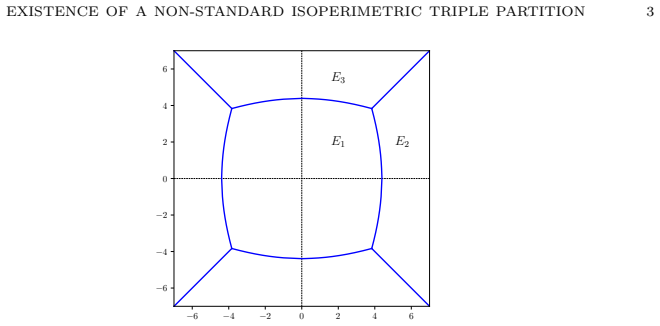
The load-bearing device is the defect functional of Definition 5.1: for a partition $E$ with unique blow-down $E_\infty$, the defect $\Delta^{\Pi}_{E}$ is the limiting excess perimeter per unit of $|E_1|^{(d-1)/d}$ inside the cone $\Pi$. The proof’s engine is the strict numerical comparison in Lemma 5.6: the lens partition’s defect is $\approx 7.29$ while the barrel partition—the Simons’ cone with a $B^4\times B^4$ block inserted—has defect $\approx 7.10$. A compactness and closure theorem (Theorem 3.6) transfers isoperimetric minimality to limits in half-spaces, a monotonicity formula gives blow-downs in cones (Corollary 4.4), and Proposition 5.10 asserts that the only possible half-space limits contribute at least the lens defect; the gap $\Delta_Q < \Delta_L$ then makes the contradiction go through.
What would settle it
Recompute the closed-form defects in Lemma 5.6: the argument requires the lens defect $\Delta_L \approx 7.29$ to be strictly larger than the barrel defect $\Delta_Q \approx 7.10$, and if the exact values instead satisfy $\Delta_L \le \Delta_Q$ the contradiction in Theorem 5.12 loses its force. A separate direct check would be to produce a half-space minimal interface meeting the boundary at a non-right angle, which would falsify the reflection step of Proposition 5.10.
Extended reading notes
Core claim
The central result is Theorem 5.12: there exists an isoperimetric 3-partition $E=(E_1,E_2,E_3)$ of $\mathbb{R}^8$ with $m(E)=(1,+\infty,+\infty)$ which is not a lens partition. Its blow-down partition $E_\infty=(\emptyset,E_1^\infty,E_2^\infty)$ is a singular minimal cone. The construction takes, for large radii $R_n$, the isoperimetric partition in the ball $\overline{B}_{R_n}$ that matches the Simons’ cone outside the ball and has $|E_1|=1$; by concentration compactness the rescaled partitions split into limits, each isoperimetric in a half-space or in $\mathbb{R}^8$. If every limit were a lens, summing their defects would give a lower bound $\Delta_L\approx 7.29$, but the barrel partition is a competitor whose defect is $\approx 7.10$, a contradiction. Hence one limit is not a lens; by known uniqueness results its blow-down must be a singular cone.
Load-bearing premise
The proof of Proposition 5.10 assumes that a partition that is locally perimeter-minimal on each side of a boundary plane, with a regular interface, can be reflected across that plane to give a globally stationary interface; the reflection is valid only if the interface meets the plane orthogonally, and that orthogonality is not proved.
Editorial extensions
If this is right
- For $N=3$, the lens is not the only isoperimetric partition in $\mathbb{R}^8$: uniqueness of isoperimetric triple partitions fails from dimension 8 onward.
- Because the blow-down is a singular minimal cone, the example ties the failure of lens uniqueness to the same dimension threshold where singular minimal cones such as the Simons’ cone first appear for locally minimal sets.
- The construction shows that half-space isoperimetric partitions can be non-standard when $d\geq 4$, a phenomenon isolated in Proposition 5.10 and the surrounding discussion.
- The method reduces the existence question to comparing two explicit constants, the barrel and lens defects, so the same scheme could in principle be repeated with other candidate cones once the half-space defect bound is available.
Reading between the lines
- If the reflection step in Proposition 5.10 can be repaired or replaced, the same defect comparison should produce non-lens isoperimetric 3-partitions in every dimension $d\geq 8$ where an analogous singular cone and barrel can be built.
- A natural next step is to identify the non-lens limit partition explicitly; the authors’ numerics suggest it is the constant-mean-curvature deformation of the barrel shown in Figure 1, so proving that profile is isoperimetric would make the construction explicit rather than a limit argument.
- The open question whether the blow-down is exactly the Simons’ cone could be settled by computing the density of the constructed blow-down and comparing it with the known density of the Simons’ cone.
- One might expect that, for all sufficiently large radii, the finite-ball minimizers themselves are already non-lens; the paper only proves that at least one limit is non-lens, and a uniform version of the defect gap would be needed to promote the conclusion to the finite-radius minimizers.
Editorial analysis
A structured set of objections, weighed in public.
Referee Report
Summary. The paper proves existence of an isoperimetric 3-partition of R^8 with one bounded region of volume 1 and two unbounded regions, which is not a lens partition and whose blow-down is a singular minimal cone. The strategy is to compare the "defect" of a lens partition (≈7.29) with that of a barrel partition built from the Simons cone (≈7.10), then take limits of isoperimetric partitions in large balls with Simons-cone boundary data. Concentration compactness produces limit partitions in R^8 or in half-spaces; if all such limits were lenses or lens-like half-space partitions, the total defect would be bounded below by that of a lens, contradicting the upper bound from the barrel partition. The proof relies on the authors' earlier framework for compactness and closure of isoperimetric partitions, and on several new results for half-space partitions.
Significance. If the main theorem is correct, it resolves a conjecture raised in the authors' earlier work and in [7], and provides the first non-standard isoperimetric 3-partition in Euclidean space, in analogy with the Simons-cone counterexamples for minimal sets. The explicit defect computations in Lemma 5.6 are a concrete strength: they are analytic, checkable, and give the numerical ordering that drives the argument. The paper also extends concentration-compactness and blow-down tools to partitions with half-space limits, which is of independent interest. However, the proof as written contains a load-bearing gap in the free-boundary stationarity assertion of Proposition 5.10.
major comments (2)
- [Proposition 5.10, paragraph 2] The assertion that the reflected set E = (F2∩Π) ∪ σ(F2∩Π) has stationary boundary varifold v(∂E\BR,1) in Rd\BR is not justified. Local minimality of F in Π controls variations supported in Π, and local minimality of the reflected copy controls variations in the complementary half-space, but neither controls variations supported in a ball centered on ∂Π that cross the boundary. Stationarity across ∂Π is a separate first-variation statement equivalent to the free-boundary condition that the interface meets ∂Π orthogonally; the proof never derives this condition from the J-isoperimetric property in Definition 2.2, and the regularity of ∂E on ∂Π does not by itself force it. Consequently the hypotheses of Theorem 4.1 are not verified, so the asymptotic expansion (49), the convergence (76), and the bound ∆^Π_F ≥ ∆L in (77) are unsupported. Since (77) is used to establish (81) in Theorem 5.12, the only route to the contradiction ∆L ≤ ∆Q, this gap is load-bearing for the main result.
- [Theorem 5.8] The proof applies the strong maximum principle of [21, Corollary 1] to ∂E∞, where E∞ is a locally minimal cone that may be singular at the origin (in R^8, Simons-type cones are singular). The quoted result is formulated for smooth area-minimizing hypersurfaces, and the manuscript does not justify its applicability at singular points of ∂E∞. This matters because Theorem 5.9 and, through it, the case analysis in Theorem 5.12 use Theorem 5.8 to identify blow-downs as half-planes. The authors should either state a maximum principle valid for minimal cones with singularities, or give a separate argument (for example, using tangent cones at regular points) that ∂E∞ must coincide with ∂Π.
minor comments (4)
- [Abstract and title] The abstract contains a grammatical error: "a isoperimetric" should be "an isoperimetric"; the title also has a spacing artifact in "P AR TITION".
- [Definition 5.4] In the definition of the Simons' cone partition, the set S3 is written as Rd \ S2, but since the ambient space is R^8 the notation should be R^8 \ S2 for consistency.
- [Lemma 5.6] The displayed formula for ∆L in the proof contains the garbled expression "4 8 s 4π3...", which appears to be a typographical artifact of the radical notation; the formula should be typeset as a single clean radical expression.
- [Theorem 5.12] In the statement of the theorem, the notation "E∞ = (∅, E1∞, E2∞)" is inconsistent with the convention used elsewhere for partitions, where regions are indexed by subscripts (E1, E2, E3); this should be clarified or aligned with the earlier notation.
Circularity Check
No circularity: the main contradiction is driven by analytically computed defect inequalities and external uniqueness/blow-down results, not by assumptions equivalent to the conclusion.
full rationale
The derivation chain in Theorem 5.12 is not circular. The proof assumes toward contradiction that every blow-up limit F_i is a lens or satisfies the half-space defect bound Δ^{Π_i}_{F_i} ≥ Δ_L (Eq. 81), then uses Lemma 5.7 to obtain limsup Δ_{E_n} ≥ Δ_L and the barrel competitor to obtain Δ_{E_n} ≤ Δ_Q, contradicting the strict analytic inequality Δ_L ≈ 7.29 > Δ_Q ≈ 7.10 computed directly in Lemma 5.6 from exact volumes and perimeters. No fitted parameter is renamed as a prediction: the defect values are computed analytically, not calibrated, and the contradiction is genuine. The compactness and closure machinery (Theorem 3.1, Theorem 3.6) is either proved in the paper or adapted with proofs from the authors' earlier published work; those cited results are parameter-free and do not assume the target partition. External inputs [7, 12, 10, 21] are uniqueness, flatness-expansion, and boundary-regularity theorems independent of the present construction. The one genuinely questionable inference is in Proposition 5.10, where the reflected set E = (F2∩Π) ∪ σ(F2∩Π) is claimed to have stationary varifold boundary across ∂Π from local minimality in each half-space plus boundary regularity; the required free-boundary orthogonality is not proved, and the subsequent use of Theorem 4.1, expansion (49), convergence (76), and the inequality Δ^{Π}_F ≥ Δ_L depends on it. That is a potential correctness gap, not circularity: it does not assume the conclusion Δ^{Π}_F ≥ Δ_L, does not rename a fitted quantity, and is not a self-citation chain. Therefore no circular step is identified.
Assumptions & free parameters
assumptions (6)
- standard math Standard compactness and semicontinuity results for Caccioppoli partitions, including the concentration compactness theorem (Theorem A.3).
- domain assumption Existence and closure of isoperimetric partitions with conical boundary data, built on the framework of [17].
- standard math Uniqueness of isoperimetric 3-partitions in R^d for d ≤ 7, proved by Bronsard and Novack in [7].
- standard math Strong maximum principle for minimal hypersurfaces from [21].
- standard math Boundary regularity and C^{1,α} regularity for locally minimizing currents from [10] and [3].
- standard math Asymptotic expansion of planelike stationary varifolds from [12] and [2].
Cite this review
Pith. "Pith review of Existence of a non-standard isoperimetric triple partition." pith.science (2026). https://pith.science/paper/2SG4DPIT
@misc{pith2026250714112,
  author       = {Pith},
  title        = {Pith review of: Existence of a non-standard isoperimetric triple partition},
  year         = {2026},
  howpublished = {\url{https://pith.science/paper/2SG4DPIT}},
  note         = {Machine review of arXiv:2507.14112}
}
abstract
We show existence of a isoperimetric $3$-partition of $\mathbb R^8$, with one set of finite volume and two of infinite volume, which is asymptotic to a singular minimal cone.
Figures


Forward citations
Cited by 1 Pith paper
-
Anisotropic isoperimetric double tilings of the plane
Under L1 perimeter the isoperimetric double-tiling profile is 2√x + 2√(1-x), uniquely realized by the Pythagorean tiling of two axis-aligned squares except at equal area.
Reference graph
Works this paper leans on
-
[7]
Lia Bronsard and Michael Novack, An infinite double bubble theorem, 2024, ArXiv:2401.08063
work page Pith review arXiv 2024
-
[17]
Matteo Novaga, Emanuele Paolini, and Vincenzo Maria Tortorelli, Locally isoperimetric par- titions, Trans. Amer. Math. Soc. 378 (2025), no. 4, 2517–2548
work page 2025
-
[1]
Stan Alama, Lia Bronsard, and Silas Vriend, The standard lens in R2 uniquely minimizes relative perimeter, Trans. Amer. Math. Soc. 12 (2025), 516–535
work page 2025
-
[2]
Allard, On the first variation of a varifold , Ann
W. Allard, On the first variation of a varifold , Ann. of Math. 95 (1972), 417–491
work page 1972
-
[3]
William K. Allard, On the first variation of a varifold: Boundary behavior , Annals of Math- ematics 101 (1975), no. 3, 418–446
work page 1975
-
[4]
E. Bombieri, E. De Giorgi, and E. Giusti, Minimal cones and the Bernstein problem , Inven- tiones math. 7 (1969), 243–268
work page 1969
-
[5]
Brakke, Minimal cones on hypercubes , J
Kenneth A. Brakke, Minimal cones on hypercubes , J. Geom. Anal. 1 (1991), no. 4, 329–338
work page 1991
-
[6]
Lia Bronsard, Robin Neumayer, Michael Novack, and Anna Skorobogatova, On the non- uniqueness of locally minimizing clusters via singular cones , 2025
work page 2025
Show all 22 references
-
[8]
Guido De Philippis and Emanuele Paolini, A short proof of the minimality of simons cone , Rend. Sem. Mat. Univ. Padova 121 (2009), 233–241
2009
-
[9]
Joel Foisy, Manuel Alfaro, Jeffrey Brock, Nickelous Hodges, and Jason Zimba, The standard double soap bubble in R2 uniquely minimizes perimeter , Pacific J. Math. 159 (1993), no. 1, 47–59
1993
-
[10]
3, 439–486
Robert Hardt and Leon Simon, Boundary regularity and embedded solutions for the oriented plateau problem, Annals of Mathematics 110 (1979), no. 3, 439–486
1979
-
[11]
Michael Hutchings, Frank Morgan, Manuel Ritor´ e, and Antonio Ros, Proof of the double bubble conjecture, Ann. of Math. (2) 155 (2002), no. 2, 459–489
2002
-
[12]
Francesco Maggi and Michael Novack, Isoperimetric residues and a mesoscale flatness crite- rion for hypersurfaces with bounded mean curvature , 2022
2022
-
[13]
Emanuel Milman and Joe Neeman, Plateau bubbles and the quintuple bubble theorem on Sn, 2023, ArXiv:2307.08164
2023 arXiv
-
[14]
Emanuel Milman and Joe Neeman, The structure of isoperimetric bubbles on Rn and Sn, Acta Mathematica 234 (2025), 71–188
2025
-
[15]
Emanuel Milman and Botong Xu, Standard bubbles (and other m¨ obius-flat partitions) on model spaces are stable , 2025
2025
-
[16]
Matteo Novaga, Emanuele Paolini, Eugene Stepanov, and Vincenzo Maria Tortorelli, Isoperi- metric clusters in homegeneous spaces via concentration compactness , J. Geom. Anal. 32 (2022), no. 11, Article n. 263
2022
-
[18]
Paolini and V
E. Paolini and V. M. Tortorelli, The quadruple planar bubble enclosing equal areas is symmet- ric, Calc. Var. Partial Differential Equations 59 (2020), no. 1, Paper No. 20, 9. MR 4048329
2020
-
[19]
3, 1303–1331, cvgmt preprint
Emanuele Paolini and Andrea Tamagnini, Minimal clusters of four planar regions with the same area, ESAIM: COCV 24 (2018), no. 3, 1303–1331, cvgmt preprint
2018
-
[20]
Reichardt, Proof of the double bubble conjecture in Rn, J
Ben W. Reichardt, Proof of the double bubble conjecture in Rn, J. Geom. Anal. 18 (2008), no. 1, 172–191. MR 2365672
2008
-
[21]
Leon Simon, A strict maximum principle for area minimizing hypersurfaces , Journal of Dif- ferential Geometry 26 (1987), 327–335
1987
-
[22]
Reine Angew
Wacharin Wichiramala, Proof of the planar triple bubble conjecture , J. Reine Angew. Math. 567 (2004), 1–49. MR 2038304 Universit`a di Pisa, Dipartimento di Matematica, Largo Bruno Pontecorvo 5, 56127 Pisa, Italy Email address : matteo.novaga@unipi.it Universit`a di Pisa, Dipa...
2004
Reviewed August 6, 2026 · model on record in the stance chip above.
Discussion (0). Continue with ORCID to comment.