REVIEW 5 major objections 5 minor 43 references
Antenna Positioning and Beamforming Optimization in MA Enabled Secure ISAC Systems: A Gradient-Based Meta Learning Approach
T0 review · 5 major / 5 minor · reviewed 2026-08-15 · deepseek-v4-flash
Pith's one-line read This paper claims that a gradient-based meta learning algorithm can maximize the secrecy rate of a movable-antenna integrated sensing and communication system by jointly learning antenna positions, transmit beamforming, and artificial…
desk verdict Competent combination of gradient-based meta-learning with softmax spacing mapping for MA-enabled secure ISAC; the performance claims need stronger statistics before the superiority result can be trusted. read the letter →
The pith
A machine-rendered reading of the paper's core claim, the machinery that carries it, and where it could break.
The reading
What carries the argument
The working mechanism is a per-variable meta-network update rule: for each optimization variable (antenna position parameters u, beamforming matrix W, and noise matrix N), a small multilayer perceptron receives the gradient of the loss with respect to that variable and outputs the update increment. Feasibility is enforced structurally: antenna positions come from a softmax over $M+1$ gap ratios followed by cumulative summation, so the panel bounds and minimum antenna spacing hold automatically; the noise covariance is parameterized as $N N^H$, guaranteeing positive semidefiniteness; and the sensing beampattern constraint is converted into a convex subproblem for a desired covariance $R_d$, with the mismatch $\|R_X - R_d\|_F^2$ entering the global loss as a penalty. The meta-learning loop updates the network parameters with Adam so that the learned update rule adapts to the current channel realization rather than to a fixed training distribution.
What would settle it
Run GML on a fixed channel and record, at each inner-loop iterate, the inner product $\nabla L(\beta_i)^T d_i$ between the loss gradient and the network-chosen step. If any non-terminal iterate has that inner product positive, or if $\|d_i\|$ exceeds any uniform $c_2\|\nabla L(\beta_i)\|$, then Assumption 2 fails for that run and Proposition 3's convergence proof does not apply, so the reported convergence would be an empirical observation rather than a guaranteed one. Alternatively, for a small system such as $M=3$, $K=2$, enumerate near-optimal antenna positions and beamformers on a fine grid and check whether GML's final secrecy rate falls below the best grid point; a persistent gap would indicate the method is not finding the true optimum.
Extended reading notes
Core claim
The central claim is that the formulated secrecy-rate maximization problem P0 is tractable by the proposed GML procedure and, under the tested conditions, yields the best secrecy-rate performance among the compared algorithms. Concretely, the paper claims that feeding the instantaneous gradient of the secrecy-rate loss into per-variable neural networks, and meta-updating those networks on the current scenario, lets the algorithm jointly position the movable antennas, design the beamforming matrix, and shape the artificial noise better than fixed-position arrays, random arrays, projected gradient ascent, plain meta learning, alternating convex approximations, or particle swarm search. It also claims that the softmax reparameterization of antenna positions preserves the feasible set in an optimization sense (Propositions 1 and 2), and that under a smoothness assumption plus a sufficient descent condition on the learned step, the inner loop converges to a first-order stationary point (Proposition 3).
Load-bearing premise
The convergence proof rests on the assumption that, at every inner-loop step, the neural network's update moves the loss downhill with a strength comparable to the gradient norm; the paper explicitly states that this is a sufficient condition rather than a property the trained network is known to guarantee.
Editorial extensions
If this is right
- If GML performs as reported, movable antennas give a measurable secrecy-rate gain over fixed or random arrays in secure ISAC, not only at nominal settings but also under channel estimation error and severe path loss.
- The reparameterization result means that optimizing over unconstrained gap variables can stand in for optimizing antenna positions: every interior placement is reachable, and every descent direction in position space is mirrored by a descent direction in the gap space.
- The convergence theorem gives a practical stopping rule: once the squared gradient norm sum is small, the inner loop is near a first-order stationary point of the penalized loss, so the reported secrecy rates correspond to stationary solutions rather than arbitrary iterates.
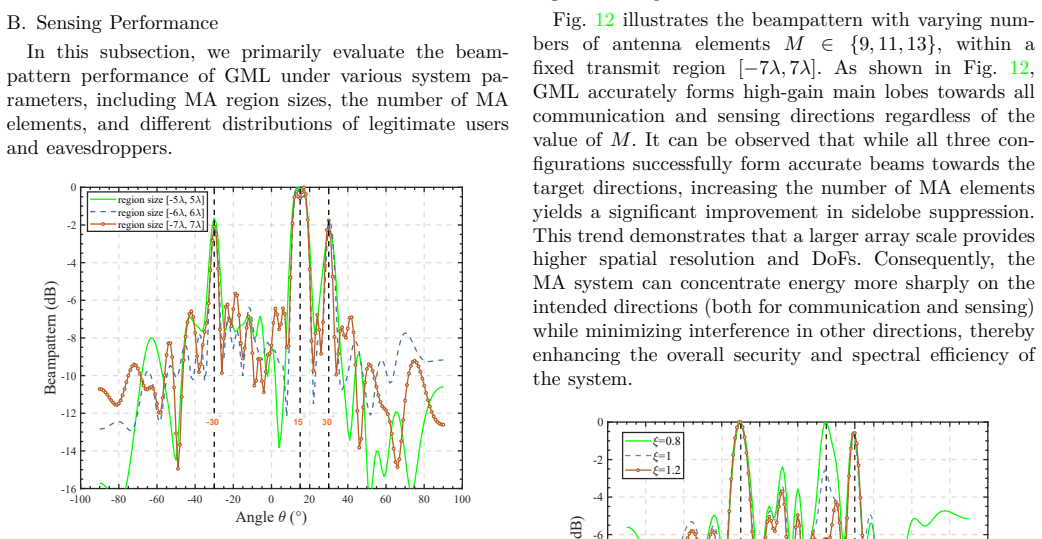
- GML can balance sensing and secrecy through the threshold $\xi$, because tightening $\xi$ reshapes the transmit covariance toward the desired sensing beampattern while GML still retains the highest secrecy rate among baselines.
- As a no-pre-training optimizer, GML can be applied to a new user or eavesdropper geometry or antenna-panel size without retraining on a dataset, as supported by the reported beampattern convergence across different user distributions.
Reading between the lines
- An implicit consequence is that the same gradient-in, step-out recipe could be applied to other constrained non-convex wireless designs, such as RIS phase shifts, fluid-antenna port selection, or power allocation, whenever a differentiable reparameterization of the feasible set exists; the paper does not test this, but nothing in the mechanism is ISAC-specific.
- The softmax gap-ratio mapping suggests a general way to handle order and spacing constraints: by allocating a one-dimensional panel's slack space through a simplex, the minimum-distance constraint is satisfied by construction, so the same construction could be reused for any sorted-placement problem.
- Because the convergence guarantee is conditional on Assumption 2, which the paper itself does not claim to verify globally, a natural testable extension is to monitor $\nabla L(\beta_i)^T d_i$ during training and measure what fraction of inner-loop updates actually satisfy the descent inequality, then relate that fraction to the observed convergence rate.
- Since the feasible region's boundary is never reached exactly by the softmax or $N N^H$ parameterization, deployment scenarios requiring antennas to sit at exact panel endpoints or exactly $d_{\min}$ apart would need a post-processing rounding step, which the paper does not address.
Signed reviews
Editorial analysis
A structured set of objections, weighed in public.
Referee Report
Summary. The paper proposes a gradient-based meta-learning (GML) algorithm for a movable-antenna (MA) enabled secure integrated sensing and communication (ISAC) system, jointly optimizing antenna positions, transmit beamforming, and artificial noise to maximize the secrecy rate under a transmit power budget and a sensing beampattern constraint. The method uses a softmax-based continuous parameterization of antenna positions, a convex subproblem to generate a desired beampattern covariance matrix, and three neural networks that map gradients of the secrecy rate to variable update steps in a three-loop alternating scheme. The theoretical part proves that the Jacobian of the position mapping has full row rank, uses that to argue equivalence between optimization in the unconstrained and position domains, and provides a conditional convergence theorem under a sufficient descent assumption on the learned updates. Numerical results compare GML with six baselines across transmit power, antenna count, channel estimation error, eavesdropper angle, and path loss, and also show beampattern evolution.
Significance. If the empirical claims hold, the paper would introduce a viable model-driven, pre-training-free solver for a challenging non-convex MA-ISAC secure beamforming problem, with a differentiable surrogate for the min-distance antenna constraint that may be useful beyond this specific setting. Strengths include the clean mathematical derivation of the Jacobian rank and the self-contained first-order convergence analysis under explicit assumptions, as well as the falsifiable prediction that GML outperforms five MA baselines and a fixed-antenna baseline over a range of system parameters. However, the central superiority claim rests on statistical evidence that is currently too thin to support the strong wording used in the paper, and the convergence theory is not fully aligned with the implemented algorithm.
major comments (5)
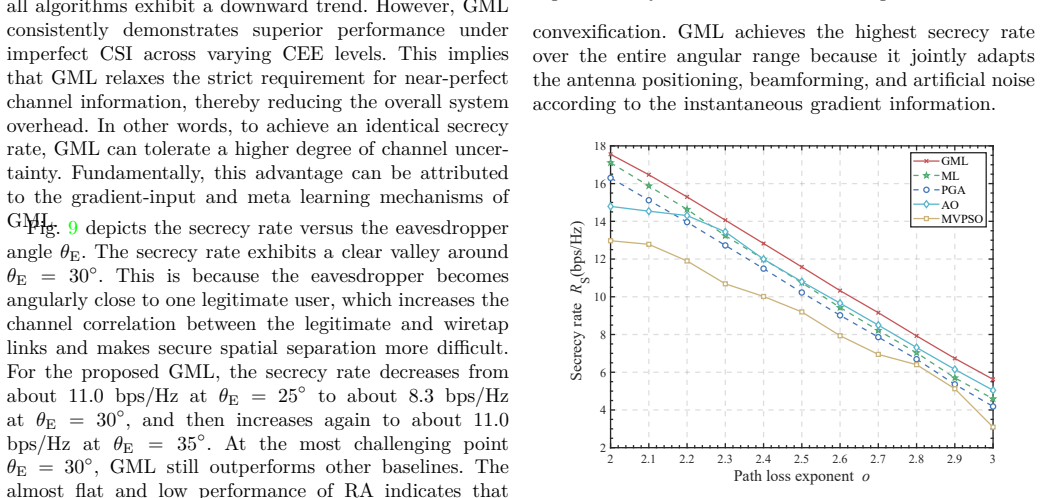
- [Section IV, Figs. 4-10, Table II] All simulation curves are averaged over Na = 10 independent channel realizations, and no error bars, confidence intervals, or significance tests are reported. At PT = 20 dBm, the claimed advantage over PGA and ML is only 4.83% and 6.67%, respectively; in a non-convex, randomly initialized learned-optimizer setting these margins can easily be within run-to-run variation. Ten realizations are insufficient to support the statement in Fig. 9 that GML 'achieves the highest secrecy rate over the entire angular range' or the repeated claim of 'significantly outperform[ing]' the baselines. Please report per-realization statistics, e.g., box plots or confidence bands, specify the number of random seeds for network initialization, and provide significance tests for the key comparisons.
- [Section III-C2, Eqs. (47)-(55), and Algorithm 1] The convergence proof of Proposition 3 analyzes a simultaneous recursion β_{i+1} = β_i + d_i with d_i = M_H(∇R_S(β_i)), where H is fixed, and imposes Assumption 2 on the descent of the full loss L(β) in Eq. (42). However, Algorithm 1 updates u, W, and N sequentially in three separate inner loops, the input to each network is the gradient of R_S (not of L), and the meta-parameters change across epochs. Thus the assumptions of Proposition 3 do not match the algorithm as implemented: the sufficient descent condition (49) is not verified for a network that takes ∇R_S as input, and convergence of the meta-parameter updates is only supported empirically by Fig. 3. The proof is internally consistent as a standalone statement, but it does not establish convergence of the proposed GML algorithm. Please either adapt the analysis to the alternating block structure, or explicitly state that Proposition 3 is a sufficient condition for a hypothetical fixed-update inner loop and not a convergence guarantee for Algorithm 1.
- [Section III-A2, Eqs. (24)-(26)] The sensing constraint (16e) is replaced by ||R_X - R_d||_F^2 ≤ ξ in Eq. (25), where R_d is obtained from the convex subproblem (24). No proof is given that satisfaction of (25) implies satisfaction of the original constraint (16e) for the chosen ξ and ε, and the relationship between ξ and ε is not characterized. The text at this point also incorrectly refers to (16d) instead of (16e), which obscures the fact that the minimum-distance constraint is unrelated to the sensing beampattern. Since the sensing quality constraint is one of the three primary constraints of P0, this missing link undermines the statement in Section IV-B that GML 'consistently achieves the goal of maximizing the system secrecy rate while ensuring sensing quality.' Please provide a quantitative relation between ξ and ε, or at least report the achieved MSEbp for the configurations in Figs. 11-15.
- [Section III-A1, Propositions 1-2 and paragraph after Eq. (21)] The softmax parameterization covers only the interior of the feasible position set; boundary configurations such as an antenna at the panel edge x_m = ±L or a tight active constraint |x_s - x_c| = d_min cannot be attained, only approached. The equivalence in (22) is stated 'for interior feasible points', and stationarity is characterized only for the interior. If the optimizer of P0 lies on the boundary, GML may be unable to represent it, so the claim of achieving the maximum secrecy rate is not justified for boundary optima. Please discuss whether the simulation settings produce interior optima, or provide a boundary-handling extension.
- [Section IV, baseline descriptions] The baselines are under-specified: ML, PGA, FPA, and RA reuse GML for W and N, while AO and MVPSO use CVX-based subproblems, but no convergence criteria, particle counts, trust-region parameters, or stopping tolerances are reported. Since PGA's performance depends on its step-size schedule and MVPSO on the particle budget, part of the observed gap could reflect implementation choices rather than algorithmic advantage. Please provide full implementation details for all baselines, ideally with code release, so that the comparisons are reproducible and fair.
minor comments (5)
- [Throughout] There are numerous typos and grammatical errors, including 'An movable antenna' in the abstract, 'efficiency', 'sufficient', 'parament', 'denots', and 'maximun'. These should be corrected and the manuscript should be carefully proofread.
- [Section III-A2] In the sentence 'which means (16d) can be transformed as follows', the constraint number should be (16e), not (16d).
- [Fig. 3] The figure shows 'std. band' for the meta-parameter variations, but the text does not describe how the standard deviation is computed or over how many realizations or seeds; please clarify.
- [Table II and Fig. 13] Table II lists the sensing threshold as ξ = 0.5, but Fig. 13 discusses ξ values of 0.8, 1.0, and 1.2; please clarify which ξ is used in each simulation and avoid the apparent inconsistency.
- [Section II-C1, Eq. (13)] The secrecy rate is defined with a [·]^+ operator, but the optimization and the loss function use R_S directly without the positive part; if R_S can be negative, this may produce misleading gradients. Please clarify how the [·]^+ is handled in the algorithm.
Circularity Check
No circularity: the GML solver optimizes the same objective it evaluates, the convergence theorem is explicitly conditional on a stated sufficient condition, and the self-citations are background only.
full rationale
The derivation chain is self-contained. The system model and secrecy-rate expression (Eqs. 3-13) are standard definitions, and the optimization problem P0 is formed from these models plus explicit constraints. The GML solver uses the gradient of the same objective, with explicit penalty terms for power and sensing constraints, as input to small MLPs; this is a numerical optimization procedure, not an inference from fitted data to a held-out quantity. The variable substitution via softmax (Eqs. 17-21) is an explicit, differentiable reparameterization, and Propositions 1-2 and Lemma 1 prove, for interior feasible points, that gradient descent in u induces descent in p using the full row rank of the Jacobian. Proposition 3 is conditional: it states that if Assumptions 1-2 hold (Eqs. 48-50), then the inner-loop loss decreases and gradients vanish. The paper explicitly labels Assumption 2 as a sufficient condition and does not claim it holds globally, so the theorem is an honest conditional result rather than a re-labeling of the desired conclusion. Self-citations [24] and [30] appear in the literature review as background for MA-ISAC capability and prior full-duplex work; neither is used as the proof of the present convergence or optimality claims. The numerical section compares GML against independent baselines (ML, PGA, FPA, RA, AO, MVPSO) on the same objective, so the central empirical claim is testable against external algorithms. No fitted parameter is renamed as a prediction, and no uniqueness theorem from the authors' prior work is invoked to force the choice of framework. Thus the paper exhibits no significant circularity.
Assumptions & free parameters
free parameters (5)
- Penalty weights λ1, λ2 =
not reported
- Learning rates αu, αW, αN =
3×10^-3, 1×10^-3, 3×10^-3
- Meta-network widths =
MN 100, BN 200, AN 100 hidden units
- Sensing threshold ξ =
0.5 in Table II; varied 0.8 to 1.2 in Fig. 13
- Inner/outer loop counts and update intervals =
Ni=1, No=1, Ne=2000; Rd every 100 epochs, W/N every 5 epochs
assumptions (6)
- standard math Rank-nullity theorem, chain rule, Cauchy-Schwarz inequality, smooth gradient descent lemma
- domain assumption Rician fading for user channels and pure LoS for eavesdropper (Eqs. 4-5)
- domain assumption The eavesdropper has perfect multiuser decoding or SIC capability (Eq. 12)
- ad hoc to paper The learned update step satisfies the descent and bounded-growth conditions in Assumption 2 (Eqs. 49-50)
- ad hoc to paper Softmax parameterization covers the feasible set only in the interior; boundary configurations are approached but not attained
- domain assumption Perfect CSI in main simulations; CEE modeled as zero-mean Gaussian later
Cite this review
Pith. "Pith review of Antenna Positioning and Beamforming Optimization in MA Enabled Secure ISAC Systems: A Gradient-Based Meta Learning Approach." pith.science (2026). https://pith.science/paper/2SW4EYAF
@misc{pith2026260812870,
  author       = {Pith},
  title        = {Pith review of: Antenna Positioning and Beamforming Optimization in MA Enabled Secure ISAC Systems: A Gradient-Based Meta Learning Approach},
  year         = {2026},
  howpublished = {\url{https://pith.science/paper/2SW4EYAF}},
  note         = {Machine review of arXiv:2608.12870}
}
read the original abstract
Integrated sensing and communications (ISAC) significantly improves spectral efficiency but introduces security risks regarding the interception of embedded communication signals. This paper proposes an movable antenna (MA)-enabled secure ISAC system that utilizes the spatial degrees of freedom of MA to mitigate these risks. Then, a problem is formulated to maximize the system secrecy rate by jointly optimizing antenna positioning, transmit beamforming, and artificial noise. However, the principal challenge arises from the non-convexity of the optimization problem and the strong coupling of the optimization variables. Generally, traditional optimization methods for this problem suffer from complex mathematical derivations, while existing deep learning approaches rely heavily on the training data distribution. To address these issues, we introduce a gradient-based meta learning (GML) algorithm, which works without pre-training and demonstrates favorable performance. Specifically, the algorithm establishes a neural network for each optimization variable, where the gradient of the objective function with respect to the variable serves as the input, and the output of the network determines the variable's update step. By handling the constraints and constructing penalty terms, the global loss function is used to guide the optimization process. Extensive numerical simulations confirm that the proposed algorithm achieves satisfactory performance in terms of both communication security and sensing capabilities.
Figures


Figures from the paper (11 more)





Reference graph
Works this paper leans on
-
[24]
Movable antennas enabled ISAC systems: Funda- mentals, opportunities, and future directions,
Z. Li, J. Ba, Z. Su, J. Huang, H. Peng, W. Chen, L. Du, and T. H. Luan, “Movable antennas enabled ISAC systems: Funda- mentals, opportunities, and future directions,” IEEE Wireless Commun., pp. 1–8, 2025, early Access
work page 2025
-
[30]
Z. Li, J. Ba, Z. Su, H. Peng, Y. Wang, W. Chen, and Q. Wu, “Joint discrete antenna positioning and beamforming optimiza- tion in movable antenna enabled full-duplex ISAC networks,” IEEE Trans. Wireless Commun., 2025, early Access
work page 2025
-
[1]
Integrated sensing and communications: Toward dual-functional wireless networks for 6G and beyond,
F. Liu, Y. Cui, C. Masouros, J. Xu, T. X. Han, Y. C. Eldar, and S. Buzzi, “Integrated sensing and communications: Toward dual-functional wireless networks for 6G and beyond,” IEEE J. Sel. Areas Commun., vol. 40, no. 6, pp. 1728–1767, Mar. 2022
work page 2022
-
[2]
Integrated sensing and communication signals toward 5G-A and 6G: A survey,
Z. Wei, H. Qu, Y. Wang, X. Yuan, H. Wu, Y. Du, K. Han, N. Zhang, and Z. Feng, “Integrated sensing and communication signals toward 5G-A and 6G: A survey,” IEEE Internet Things J., vol. 10, no. 13, pp. 11 068–11 092, Jan. 2023
work page 2023
-
[3]
The integrated sensing and communication revolution for 6G: Vision, techniques, and applications,
N. González-Prelcic, M. Furkan Keskin, O. Kaltiokallio, M. Valkama, D. Dardari, X. Shen, Y. Shen, M. Bayraktar, and H. Wymeersch, “The integrated sensing and communication revolution for 6G: Vision, techniques, and applications,” Proc. IEEE, vol. 112, no. 7, pp. 676–723, May 2024
work page 2024
-
[4]
A. Kaushik, R. Singh, S. Dayarathna, R. Senanayake, M. Di Renzo, M. Dajer, H. Ji, Y. Kim, V. Sciancalepore, A. Zappone, and W. Shin, “Toward integrated sensing and com- munications for 6G: Key enabling technologies, standardization, and challenges,” IEEE Commun. Stand. Mag., vol. 8, no. 2, pp. 52–59, May 2024
work page 2024
-
[5]
N. Su, F. Liu, and C. Masouros, “Secure radar-communication systems with malicious targets: Integrating radar, communi- cations and jamming functionalities,” IEEE Trans. Wireless Commun., vol. 20, no. 1, pp. 83–95, Jan. 2021
work page 2021
-
[6]
Secure integrated sensing and communication,
O. Günlü, M. R. Bloch, R. F. Schaefer, and A. Yener, “Secure integrated sensing and communication,” IEEE J. Sel. Areas Inf. Theory, vol. 4, pp. 40–53, May 2023
work page 2023
Show all 43 references
-
[7]
Artificial-noise-aided secure transmit beamforming for MU-MISO integrated sensing and communication systems,
Y. Liu, Z. Zhu, Q. Cui, and H. Duo, “Artificial-noise-aided secure transmit beamforming for MU-MISO integrated sensing and communication systems,” in Proc. IEEE Int. Conf. Com- mun. Workshops (ICC Workshops), Aug. 2024, pp. 1219–1224
2024
-
[8]
Beamforming for secure RSMA-aided ISAC systems,
Q. Dan, H. Lei, K.-H. Park, and G. Pan, “Beamforming for secure RSMA-aided ISAC systems,” IEEE Trans. Cogn. Commun. Netw., vol. 11, no. 5, pp. 2970–2983, July 2025
2025
-
[9]
Sensing-assisted eavesdropper estimation: An ISAC breakthrough in physical layer security,
N. Su, F. Liu, and C. Masouros, “Sensing-assisted eavesdropper estimation: An ISAC breakthrough in physical layer security,” IEEE Trans. Wireless Commun., vol. 23, no. 4, pp. 3162–3174, Aug. 2024
2024
-
[10]
Physical-layer security of the NOMA-assisted ISAC systems under near-field scenario,
L. Zhang, Y. Wang, H. Chen, and Y. Cao, “Physical-layer security of the NOMA-assisted ISAC systems under near-field scenario,” IEEE Internet Things J., vol. 12, no. 12, pp. 18 546– 18 553, Feb. 2025. 17
2025
-
[11]
Beamforming and computing capacity allocation for ISAC-assisted secure mobile edge computing,
C. Chen, J. Yao, M. Jin, and Q. Guo, “Beamforming and computing capacity allocation for ISAC-assisted secure mobile edge computing,” IEEE Wireless Commun. Lett., vol. 13, no. 12, pp. 3360–3364, Sep. 2024
2024
-
[12]
Sense and jam: ISAC-aided robust physical layer security,
M. H. Naim Shaikh, A. Celik, A. M. Eltawil, and G. Nau- ryzbayev, “Sense and jam: ISAC-aided robust physical layer security,” in Proc. Asilomar Conf. Signals Syst. Comput., Apr. 2024, pp. 653–657
2024
-
[13]
Secure beam- forming and radar association in CoMP-NOMA empowered integrated sensing and communication systems,
L. Guo, J. Jia, J. Chen, S. Yang, and X. Wang, “Secure beam- forming and radar association in CoMP-NOMA empowered integrated sensing and communication systems,” IEEE Trans. Inf. Forensics Security, vol. 19, pp. 10 246–10 257, Oct. 2024
2024
-
[14]
Movable antennas for wireless communication: Opportunities and challenges,
L. Zhu, W. Ma, and R. Zhang, “Movable antennas for wireless communication: Opportunities and challenges,” IEEE Commun. Mag., vol. 62, no. 6, pp. 114–120, Jun. 2024
2024
-
[15]
F AS for secure and covert communications,
J. Yao, L. Xin, T. Wu, M. Jin, K.-K. Wong, C. Yuen, and H. Shin, “F AS for secure and covert communications,” IEEE Internet Things J., vol. 12, no. 11, pp. 18 414–18 418, Jun. 2025
2025
-
[16]
Modeling and performance analysis for movable antenna enabled wireless communications,
L. Zhu, W. Ma, and R. Zhang, “Modeling and performance analysis for movable antenna enabled wireless communications,” IEEE Trans. Wireless Commun., vol. 23, no. 6, pp. 6234–6250, Jun. 2024
2024
-
[17]
A tutorial on six-dimensional movable antenna for 6G networks: Synergizing positionable and rotatable antennas,
X. Shao, W. Mei, C. You, Q. Wu, B. Zheng, C.-X. Wang, J. Li, R. Zhang, R. Schober, L. Zhu, W. Zhuang, and X. Shen, “A tutorial on six-dimensional movable antenna for 6G networks: Synergizing positionable and rotatable antennas,” IEEE Com- mun. Surveys & Tuts., 2025, early Access
2025
-
[18]
Movable- antenna position optimization: A graph-based approach,
W. Mei, X. Wei, B. Ning, Z. Chen, and R. Zhang, “Movable- antenna position optimization: A graph-based approach,” IEEE Wireless Commun. Lett., vol. 13, no. 7, pp. 1853–1857, July 2024
2024
-
[19]
Joint beamforming and antenna position optimization for movable antenna-assisted spectrum sharing,
X. Wei, W. Mei, D. Wang, B. Ning, and Z. Chen, “Joint beamforming and antenna position optimization for movable antenna-assisted spectrum sharing,” IEEE Wireless Commun. Lett., vol. 13, no. 9, pp. 2502–2506, Sep. 2024
2024
-
[20]
Joint beamforming and antenna movement design for moveable antenna systems based on statistical CSI,
X. Chen, B. Feng, Y. Wu, D. W. Kwan Ng, and R. Schober, “Joint beamforming and antenna movement design for moveable antenna systems based on statistical CSI,” in Proc. IEEE Global Commun. Conf. (GLOBECOM), Feb. 2023, pp. 4387–4392
2023
-
[21]
Movable antenna-enhanced multiuser communication: Jointly optimal discrete antenna positioning and beamforming,
Y. Wu, D. Xu, D. W. K. Ng, W. Gerstacker, and R. Schober, “Movable antenna-enhanced multiuser communication: Jointly optimal discrete antenna positioning and beamforming,” in Proc. IEEE Global Commun. Conf. (GLOBECOM), Feb. 2023, pp. 7508–7513
2023
-
[22]
Movable antenna for wireless communi- cations: Prototyping and experimental results,
Z. Dong, Z. Zhou, Z. Xiao, C. Zhang, X. Li, H. Min, Y. Zeng, S. Jin, and R. Zhang, “Movable antenna for wireless communi- cations: Prototyping and experimental results,” arXiv preprint arXiv:2408.08588, 2024
2024 arXiv
-
[23]
Movable antenna-enhanced wireless communi- cations: General architectures and implementation methods,
B. Ning, S. Yang, Y. Wu, P. Wang, W. Mei, C. Yuen, and E. Björnson, “Movable antenna-enhanced wireless communi- cations: General architectures and implementation methods,” IEEE Wireless Commun., vol. 32, no. 5, pp. 108–116, May 2025
2025
-
[25]
Movable antenna enabled ISAC beamforming design for low- altitude airborne vehicles,
Y. Xiu, S. Yang, W. Lyu, P. Lep Yeoh, Y. Li, and Y. Ai, “Movable antenna enabled ISAC beamforming design for low- altitude airborne vehicles,” IEEE Wireless Commun. Lett., vol. 14, no. 5, pp. 1311–1315, May 2025
2025
-
[26]
Movable-antenna array empowered ISAC systems for low-altitude economy,
Z. Kuang, W. Liu, C. Wang, Z. Jin, J. Ren, X. Zhang, and Y. Shen, “Movable-antenna array empowered ISAC systems for low-altitude economy,” in Proc. IEEE/CIC Int. Conf. Commun. China (ICCC Workshops), Oct. 2024, pp. 776–781
2024
-
[27]
NOMA-empowered integrated sensing and com- munication with movable antennas,
W. Lyu, X. Dong, R. Yang, K. Wang, Z. Zhang, C. Assi, and C. Yuen, “NOMA-empowered integrated sensing and com- munication with movable antennas,” IEEE Trans. Wireless Commun., vol. 25, pp. 8401–8416, 2026
2026
-
[28]
Movable antenna-assisted integrated sensing and communica- tion systems,
C. Jiang, C. Zhang, C. Huang, J. Ge, D. Niyato, and C. Yuen, “Movable antenna-assisted integrated sensing and communica- tion systems,” IEEE Trans. Wireless Commun., vol. 24, no. 8, pp. 6397–6412, Aug. 2025
2025
-
[29]
Toward intelligent antenna positioning: Leveraging DRL for F AS-aided ISAC systems,
S. Yang, J. Yao, J. Tang, T. Wu, M. Elkashlan, C. Yuen, M. Deb- bah, H. Shin, and M. Valenti, “Toward intelligent antenna positioning: Leveraging DRL for F AS-aided ISAC systems,” IEEE Internet Things J., vol. 12, no. 16, pp. 34 615–34 618, Aug. 2025
2025
-
[31]
MIMO capacity characterization for movable antenna systems,
W. Ma, L. Zhu, and R. Zhang, “MIMO capacity characterization for movable antenna systems,” IEEE Trans. Wireless Commun., vol. 23, no. 4, pp. 3392–3407, Apr. 2024
2024
-
[32]
Antenna position and beamforming optimization for movable antenna enabled ISAC: Optimal solutions and efficient algorithms,
L. Chen, M.-M. Zhao, M.-J. Zhao, and R. Zhang, “Antenna position and beamforming optimization for movable antenna enabled ISAC: Optimal solutions and efficient algorithms,” IEEE Trans. Signal Process., vol. 73, pp. 3812–3828, July 2025
2025
-
[33]
Cramér-Rao bound minimization for movable antenna-assisted multiuser integrated sensing and communications,
H. Qin, W. Chen, Q. Wu, Z. Zhang, Z. Li, and N. Cheng, “Cramér-Rao bound minimization for movable antenna-assisted multiuser integrated sensing and communications,” IEEE Wire- less Commun. Lett., vol. 13, no. 12, pp. 3404–3408, Dec. 2024
2024
-
[34]
Fluid antenna system liberating multiuser MIMO for ISAC via deep reinforcement learning,
C. Wang, G. Li, H. Zhang, K.-K. Wong, Z. Li, D. W. K. Ng, and C.-B. Chae, “Fluid antenna system liberating multiuser MIMO for ISAC via deep reinforcement learning,” IEEE Trans. Wireless Commun., vol. 23, no. 9, pp. 10 879–10 894, Sep. 2024
2024
-
[35]
Deep graph reinforcement learning for UA V-enabled multi-user secure communications,
X. Tang, K. Zhao, C. Shen, Q. Du, Y. Wang, D. Niyato, and Z. Han, “Deep graph reinforcement learning for UA V-enabled multi-user secure communications,” IEEE Trans. Mobile Com- put., vol. 24, no. 9, pp. 8780–8793, Apr. 2025
2025
-
[36]
Deep learning-based design of uplink integrated sensing and commu- nication,
Q. Qi, X. Chen, C. Zhong, C. Yuen, and Z. Zhang, “Deep learning-based design of uplink integrated sensing and commu- nication,” IEEE Trans. Wireless Commun., vol. 23, no. 9, pp. 10 639–10 652, 2024
2024
-
[37]
Metalearning-based alternating minimization algorithm for nonconvex optimization,
J.-Y. Xia, S. Li, J.-J. Huang, Z. Yang, I. M. Jaimoukha, and D. Gündüz, “Metalearning-based alternating minimization algorithm for nonconvex optimization,” IEEE Trans. Neural Netw. Learning Syst., vol. 34, no. 9, pp. 5366–5380, Sep. 2023
2023
-
[38]
Meta-learning based beamforming design for MISO downlink,
J. Xia and D. Gunduz, “Meta-learning based beamforming design for MISO downlink,” in Proc. IEEE Int. Symp. Inf. Theory (ISIT), 2021, pp. 2954–2959
2021
-
[39]
An iteratively weighted MMSE approach to distributed sum-utility maximiza- tion for a MIMO interfering broadcast channel,
Q. Shi, M. Razaviyayn, Z.-Q. Luo, and C. He, “An iteratively weighted MMSE approach to distributed sum-utility maximiza- tion for a MIMO interfering broadcast channel,” IEEE Trans. Signal Process., vol. 59, no. 9, pp. 4331–4340, Sep. 2011
2011
-
[40]
Robust beamforming for RIS-aided communications: Gradient-based manifold meta learning,
F. Zhu, X. Wang, C. Huang, Z. Yang, X. Chen, A. Al Hammadi, Z. Zhang, C. Yuen, and M. Debbah, “Robust beamforming for RIS-aided communications: Gradient-based manifold meta learning,” IEEE Trans. Wireless Commun., vol. 23, no. 11, pp. 15 945–15 956, Nov. 2024
2024
-
[41]
MU-MIMO communications with MIMO radar: From co-existence to joint transmission,
F. Liu, C. Masouros, A. Li, H. Sun, and L. Hanzo, “MU-MIMO communications with MIMO radar: From co-existence to joint transmission,” IEEE Trans. Wireless Commun., vol. 17, no. 4, pp. 2755–2770, Apr. 2018
2018
-
[42]
Secure wire- less communication via movable-antenna array,
G. Hu, Q. Wu, K. Xu, J. Si, and N. Al-Dhahir, “Secure wire- less communication via movable-antenna array,” IEEE Signal Process. Lett., vol. 31, pp. 516–520, Jan. 2024
2024
-
[43]
Movable antenna-aided secure full-duplex multi-user communications,
J. Ding, Z. Zhou, and B. Jiao, “Movable antenna-aided secure full-duplex multi-user communications,” IEEE Trans. Wireless Commun., vol. 24, no. 3, pp. 2389–2403, Mar. 2025
2025
Reviewed August 15, 2026 · model on record in the stance chip above.
Discussion (0). Continue with ORCID to comment.