A unified approach to outlier identification for mixed-type data
Pith reviewed 2026-06-26 01:15 UTC · model grok-4.3
The pith
Outliers in mixed continuous and ordinal data can be identified by fitting a robust multivariate Gaussian model that treats ordinals as latent continuous variables.
A machine-rendered reading of the paper's core claim, the machinery that carries it, and where it could break.
Core claim
Outlier identification for mixed-type data is achieved by extending the robust Minimum Covariance Determinant estimator to mixed continuous-ordinal observations under a latent Gaussian model for the ordinals; the extension preserves a positive breakdown point, so that sufficiently extreme outliers remain detectable after contamination by replacement of any fixed fraction of the observations.
What carries the argument
The extended Minimum Covariance Determinant estimator for mixed data, which computes robust location and scatter estimates while integrating over the unobserved latent Gaussians that generate the observed ordinal values.
If this is right
- Extreme outliers remain identifiable after any fixed fraction of the data is replaced by arbitrary values.
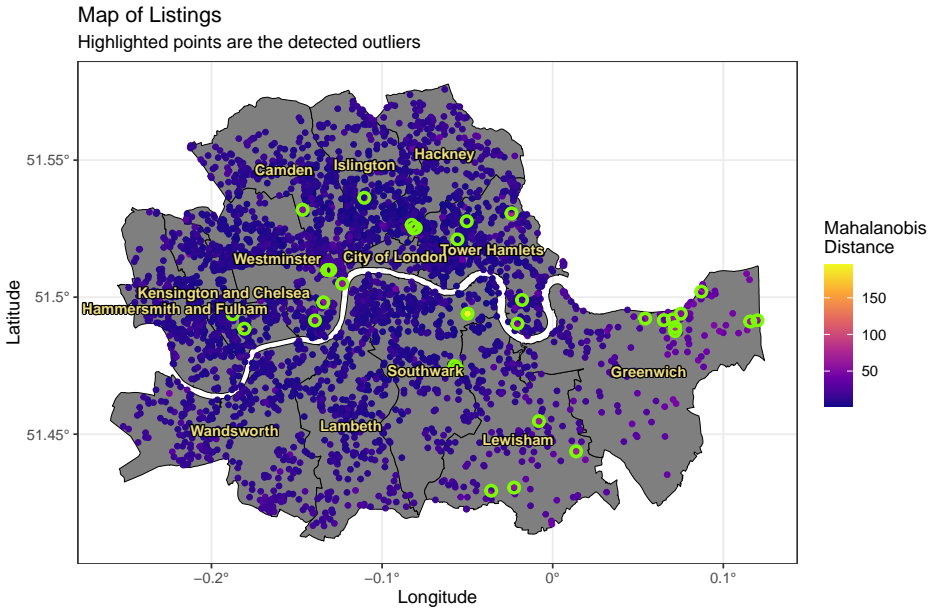
- The same procedure can be applied directly to real mixed-attribute collections such as listing platforms without separate handling of variable types.
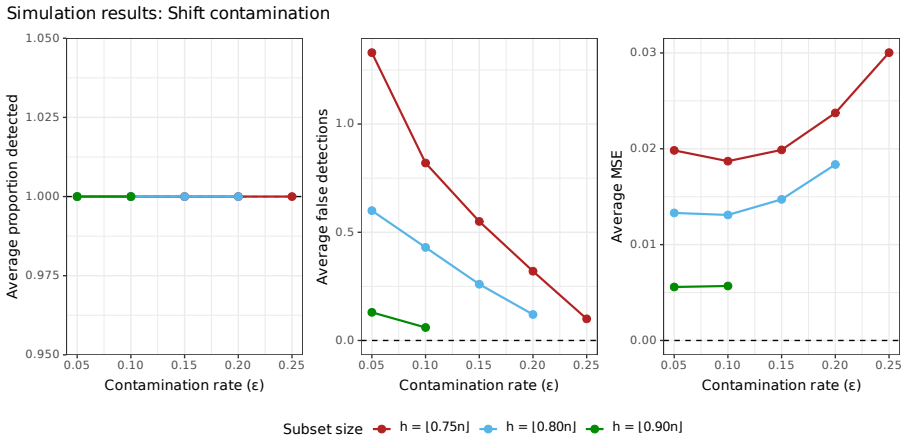
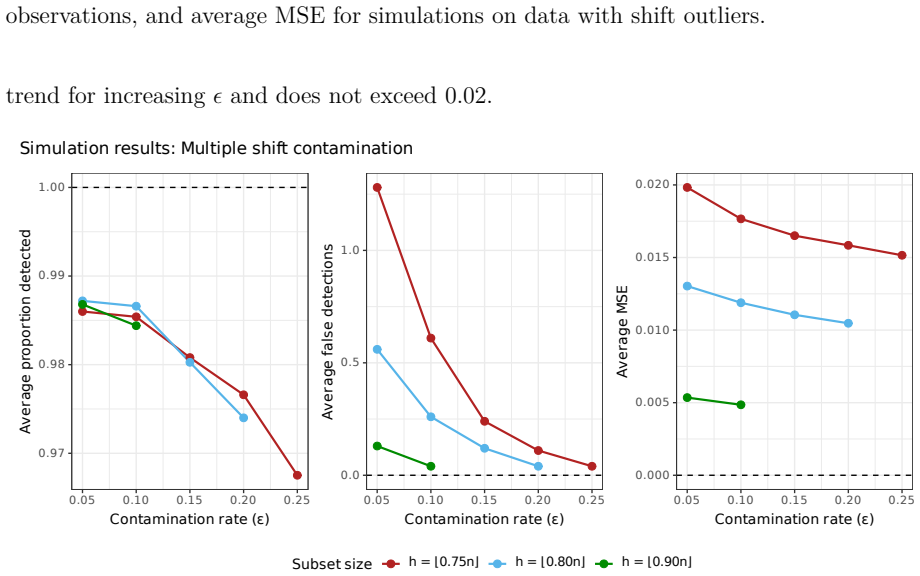
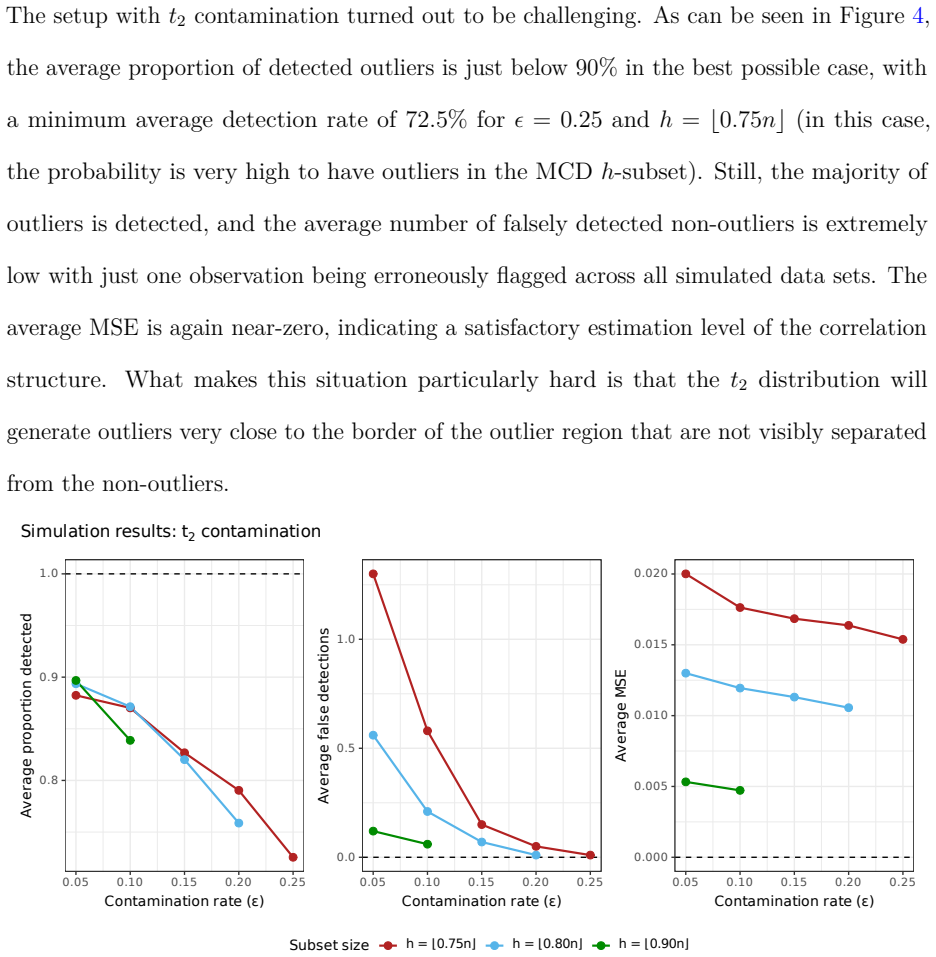
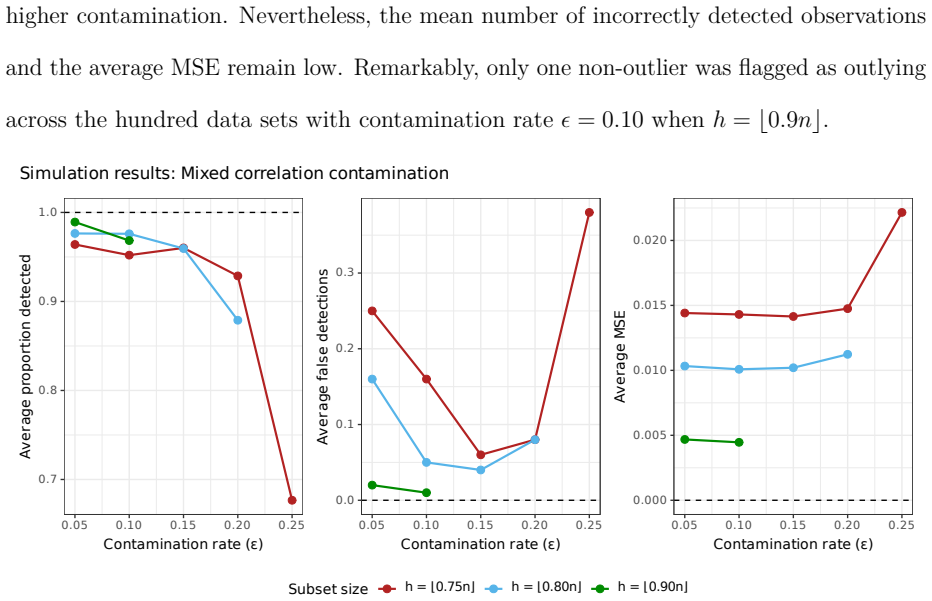
- Detection performance stays high and false-positive rates stay low across several patterns of contamination in synthetic mixed data.
- The latent-Gaussian treatment unifies the handling of continuous measurements and ordinal ratings inside one reference distribution.
Where Pith is reading between the lines
- The latent-Gaussian device could be replaced by other latent models if the data contain nominal or count variables instead of ordinals.
- In very high dimensions the computational cost of the adapted MCD step may require further approximation techniques not explored here.
- The breakdown guarantee could be tested on streaming data where contamination arrives sequentially rather than as a fixed replacement set.
Load-bearing premise
The non-outlier observations follow a multivariate Gaussian distribution, with each ordinal variable generated by thresholding a latent Gaussian variable.
What would settle it
A finite-sample simulation in which non-outliers are drawn from the assumed Gaussian model, a known fraction of points are replaced by extreme values, and the procedure fails to flag those replacements as outliers.
Figures
read the original abstract
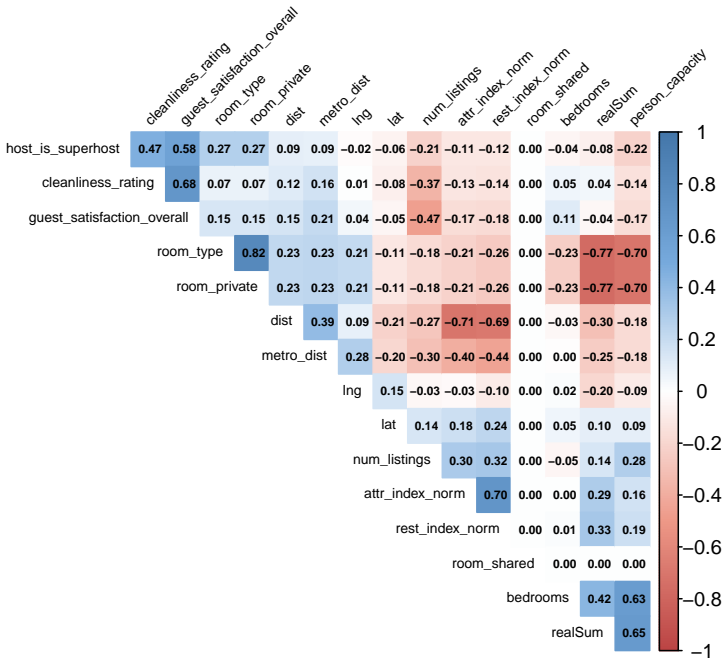
We present an outlier identification method for mixed type data sets comprising continuous and ordinal variables. We define outliers based on using a multivariate Gaussian distribution as reference distribution for non-outliers, with a latent Gaussian assumed for ordinal variables. The proposed algorithm is based on the robust Minimum Covariance Determinant estimator for estimating the parameters of the multivariate Gaussian for the non-outliers. This is extended to account for the fact that the full Gaussian information underlying the ordinal variables is not observed. A breakdown theorem shows that replacing observations will noty stop extreme enough outliers from being identified. The effectiveness of our approach is demonstrated via simulations on synthetic data with various types of contamination, achieving high detection and low false positive rates. Practical relevance is illustrated through an application to Airbnb listing data containing both continuous and ordinal attributes.
Editorial analysis
A structured set of objections, weighed in public.
Referee Report
Summary. The paper presents a unified outlier detection method for mixed continuous and ordinal data. Non-outliers are modeled via a multivariate Gaussian reference distribution, with latent Gaussians for the ordinal components. Parameters are estimated using an extension of the Minimum Covariance Determinant (MCD) estimator that accounts for unobserved latent information. A breakdown theorem establishes that sufficiently extreme outliers remain detectable under replacement contamination. Simulations on synthetic data with various contamination types report high detection rates and low false positives, and the method is illustrated on Airbnb listing data.
Significance. If the modeling assumptions hold, the breakdown theorem and MCD-based procedure provide a theoretically grounded extension of robust outlier detection to mixed-type data, with empirical support from controlled simulations. The explicit handling of latent structure for ordinal variables is a constructive contribution to the literature on robust multivariate methods.
major comments (2)
- [§3] §3 (breakdown theorem): The result is derived under the assumption that non-outliers are exactly multivariate Gaussian (latent Gaussian for ordinals). No sensitivity analysis is provided for departures from this distribution, yet the theorem and the outlier flagging rule both depend on it; this makes the claimed robustness properties conditional on an untested modeling choice.
- [§4] §4 (simulation study): All reported detection and false-positive rates are generated under data drawn from the exact Gaussian (latent Gaussian) model used by the procedure. No misspecification experiments (e.g., heavier tails, skewness, or non-Gaussian dependence) are included, so the reported performance figures cannot be taken as evidence of behavior under realistic departures from the reference distribution.
minor comments (2)
- [Abstract] Abstract contains a typographical error: 'will noty stop'.
- [§2] Notation for the latent-variable extension of the MCD estimator should be introduced more explicitly before the breakdown theorem is stated.
Simulated Author's Rebuttal
We thank the referee for the careful reading and the constructive comments. We respond to each major point below.
read point-by-point responses
-
Referee: [§3] §3 (breakdown theorem): The result is derived under the assumption that non-outliers are exactly multivariate Gaussian (latent Gaussian for ordinals). No sensitivity analysis is provided for departures from this distribution, yet the theorem and the outlier flagging rule both depend on it; this makes the claimed robustness properties conditional on an untested modeling choice.
Authors: The breakdown theorem is a finite-sample result establishing that the extended MCD estimator retains a positive breakdown point under replacement contamination when the non-outliers follow the stated latent Gaussian model. This mirrors the classical MCD breakdown analysis, which likewise conditions on the Gaussian reference distribution. The theorem therefore quantifies robustness to contamination rather than to departures from Gaussianity. We will revise the manuscript to state this scope explicitly in the theorem statement and discussion section. revision: yes
-
Referee: [§4] §4 (simulation study): All reported detection and false-positive rates are generated under data drawn from the exact Gaussian (latent Gaussian) model used by the procedure. No misspecification experiments (e.g., heavier tails, skewness, or non-Gaussian dependence) are included, so the reported performance figures cannot be taken as evidence of behavior under realistic departures from the reference distribution.
Authors: The simulation design evaluates detection performance when the modeling assumptions hold, using several contamination mechanisms that preserve the latent Gaussian structure for non-outliers. This is the natural first step for validating a method whose theoretical guarantees are derived under the same model. We agree that misspecification experiments would be informative and will add a short paragraph in the simulation section acknowledging this limitation and outlining directions for future work. revision: yes
Circularity Check
No significant circularity detected
full rationale
The abstract and provided text define outliers via a multivariate Gaussian reference (with latent Gaussian for ordinals), employ the standard MCD estimator, state a breakdown theorem, and report simulation performance on synthetic data. No equations, self-citations, or derivation steps are visible that reduce a claimed result to a fitted input or self-definition by construction. The method builds on established robust statistics and external simulation benchmarks rather than tautological renaming or load-bearing self-reference.
Axiom & Free-Parameter Ledger
Reference graph
Works this paper leans on
-
[1]
Testing normality of latent variables in the polychoric correlation , volume=
Almeida, Carlos and Mouchart, Michel , year=. Testing normality of latent variables in the polychoric correlation , volume=. doi:10.6092/issn.1973-2201/4594 , journal=
-
[2]
Stevens, S. S. , title =. 1946 , doi =
1946
-
[3]
Journal of the American Statistical Association , year =
Davies, Laurie and Gather, Ursula , title =. Journal of the American Statistical Association , year =. doi:10.2307/2290763 , pages =
-
[4]
Laurie Davies and Ursula Gather , title =
P. Laurie Davies and Ursula Gather , title =. The Annals of Statistics , number =. 2005 , doi =
2005
-
[5]
, editor =
Drasgow, F. , editor =. Polychoric and polyserial correlations , booktitle =. 1986 , publisher =
1986
-
[6]
Donoho, D.L. and P. J. Huber , EDITOR =. The notion of breakdown point , booktitle =. 1983 , PUBLISHER =
1983
-
[7]
Hubert, Mia and Debruyne, Michiel and Rousseeuw, Peter J. , title =. WIREs Computational Statistics , volume =. doi:10.1002/wics.1421 , year =
-
[8]
2011 , publisher=
Latent Variable Models and Factor Analysis: A Unified Approach , author=. 2011 , publisher=
2011
-
[9]
Psychometrika , volume=
Generalized latent trait models , author=. Psychometrika , volume=. 2000 , publisher=
2000
-
[10]
Mathematical contributions to the theory of evolution.—
Pearson, Karl , journal=. Mathematical contributions to the theory of evolution.—. 1900 , doi =
1900
-
[11]
On a new method of determining correlation between a measured character
Pearson, Karl , journal=. On a new method of determining correlation between a measured character. 1909 , doi =
1909
-
[12]
Psychometrika , volume=
Maximum likelihood estimation of the polychoric correlation coefficient , author=. Psychometrika , volume=. 1979 , doi =
1979
-
[13]
Biometrics , pages=
Estimation of the correlation between a continuous and a discrete variable , author=. Biometrics , pages=. 1974 , doi=
1974
-
[14]
Statistica , volume=
Testing normality of latent variables in the polychoric correlation , author=. Statistica , volume=
-
[15]
Journal of the Royal Statistical Society Series B: Statistical Methodology , volume=
The moment generating function of the truncated multi-normal distribution , author=. Journal of the Royal Statistical Society Series B: Statistical Methodology , volume=. 1961 , doi =
1961
-
[16]
Journal of Multivariate Analysis , volume=
A well-conditioned estimator for large-dimensional covariance matrices , author=. Journal of Multivariate Analysis , volume=. 2004 , doi =
2004
-
[17]
Journal of the American Statistical Association , volume=
Alternatives to the median absolute deviation , author=. Journal of the American Statistical Association , volume=. 1993 , publisher=
1993
-
[18]
Journal of the American Statistical Association , volume=
The influence curve and its role in robust estimation , author=. Journal of the American Statistical Association , volume=. 1974 , publisher=
1974
-
[19]
2023 , url =
truncnorm: Truncated Normal Distribution , author =. 2023 , url =
2023
-
[20]
Journal of Statistical Software , volume=
An object-oriented framework for robust multivariate analysis , author=. Journal of Statistical Software , volume=
-
[21]
Metrika , volume=
A minimal characterization of the covariance matrix , author=. Metrika , volume=. 1988 , publisher=
1988
-
[22]
A Fast Algorithm for the Minimum Covariance Determinant Estimator , author =. Technometrics , volume =. doi:10.2307/1270566 , year =
-
[23]
Statistics and Computing , volume=
The minimum regularized covariance determinant estimator , author=. Statistics and Computing , volume=. 2020 , publisher=
2020
-
[24]
Journal of Computational and Graphical Statistics , volume=
A deterministic algorithm for robust location and scatter , author=. Journal of Computational and Graphical Statistics , volume=. 2012 , doi =
2012
-
[25]
Journal of the American Statistical Association , volume=
Least median of squares regression , author=. Journal of the American Statistical Association , volume=. 1984 , doi =
1984
-
[26]
Central limit theorem and influence function for the
Cator, Eric A and Lopuha. Central limit theorem and influence function for the. Bernoulli , number =. doi:10.3150/11-BEJ353 , volume =
-
[27]
The Annals of Statistics , pages=
Asymptotics for the minimum covariance determinant estimator , author=. The Annals of Statistics , pages=. 1993 , doi=
1993
-
[28]
Journal of the American Statistical Association , volume=
Unmasking multivariate outliers and leverage points , author=. Journal of the American Statistical Association , volume=. 1990 , publisher=
1990
-
[29]
2005 , publisher=
Hubert, Mia and Rousseeuw, Peter J and Vanden Branden, Karlien , journal=. 2005 , publisher=
2005
-
[30]
Technometrics , volume=
Minimum regularized covariance trace estimator and outlier detection for functional data , author=. Technometrics , volume=. 2024 , publisher=
2024
-
[31]
Technometrics , pages=
Robust covariance estimation and explainable outlier detection for matrix-valued data , author=. Technometrics , pages=. 2025 , publisher=
2025
-
[32]
Structural Equation Modeling , volume=
What to do about zero frequency cells when estimating polychoric correlations , author=. Structural Equation Modeling , volume=. 2011 , doi =
2011
-
[33]
Journal of the American Statistical Association , volume=
The masking breakdown point of multivariate outlier identification rules , author=. Journal of the American Statistical Association , volume=. 1999 , doi =
1999
-
[34]
Proceedings of the National Academy of Sciences , author =
The. Proceedings of the National Academy of Sciences , author =. 1931 , pages =. doi:10.1073/pnas.17.12.684 , number =
-
[35]
A. Journal of Computational and Graphical Statistics , author =. 2018 , keywords =. doi:10.1080/10618600.2017.1366912 , number =
-
[36]
The Annals of Statistics , author =
Propagation of. The Annals of Statistics , author =. 2009 , pages =
2009
-
[37]
The. Journal of the American Statistical Association , author =. 2024 , keywords =. doi:10.1080/01621459.2023.2267777 , number =
-
[38]
Minimum. Technometrics , author =. 2024 , keywords =. doi:10.1080/00401706.2024.2336542 , number =
-
[39]
Robust. Technometrics , author =. 2025 , keywords =. doi:10.1080/00401706.2025.2475781 , number =
-
[40]
Journal of Multivariate Analysis , author =
Influence. Journal of Multivariate Analysis , author =. 1999 , keywords =. doi:10.1006/jmva.1999.1839 , number =
-
[41]
A minimal characterization of the covariance matrix , volume =. Metrika , author =. 1988 , pages =. doi:10.1007/BF02613285 , number =
-
[42]
Gambacciani, Marco and Paolella, Marc S. , year =. Robust normal mixtures for financial portfolio allocation , volume =. doi:10.1016/j.ecosta.2017.02.003 , journal =
-
[43]
Water Resources Research , author =
Robust detection of discordant sites in regional frequency analysis , volume =. Water Resources Research , author =. doi:10.1029/2006WR005322 , number =
-
[44]
Medical Image Analysis , author =
A brain tumor segmentation framework based on outlier detection , volume =. Medical Image Analysis , author =. 2004 , pages =. doi:10.1016/j.media.2004.06.007 , number =
-
[45]
Computers & Geosciences , author =
Multivariate outlier detection in exploration geochemistry , volume =. Computers & Geosciences , author =. 2005 , pages =. doi:10.1016/j.cageo.2004.11.013 , number =
-
[46]
The Annals of Mathematical Statistics , author =
A. The Annals of Mathematical Statistics , author =. 1971 , pages =
1971
-
[47]
Some. Biometrika , author =. 1981 , pages =. doi:10.2307/2335827 , abstract =
-
[48]
The polyserial correlation coefficient , volume =. Psychometrika , author =. 1982 , pages =. doi:10.1007/BF02294164 , number =
-
[49]
Robust estimation of multivariate location and scatter in the presence of cellwise and casewise contamination , volume =. TEST , author =. 2015 , keywords =. doi:10.1007/s11749-015-0450-6 , abstract =
-
[50]
The Annals of Mathematical Statistics , author =
Robust. The Annals of Mathematical Statistics , author =. 1964 , pages =. doi:10.1214/aoms/1177703732 , number =
-
[52]
Determinants of. Tourism Management , author =. 2021 , keywords =. doi:10.1016/j.tourman.2021.104319 , urldate =
-
[53]
1980 , doi =
Identification of Outliers , author=. 1980 , doi =
1980
discussion (0)
Sign in with ORCID, Apple, or X to comment. Anyone can read and Pith papers without signing in.