A Template-Driven Platform for Contextualised Researcher Profiles
Pith reviewed 2026-06-30 19:39 UTC · model grok-4.3
The pith
A template-driven platform lets researchers build profiles that reflect diverse outputs and roles beyond traditional publications.
A machine-rendered reading of the paper's core claim, the machinery that carries it, and where it could break.
Core claim
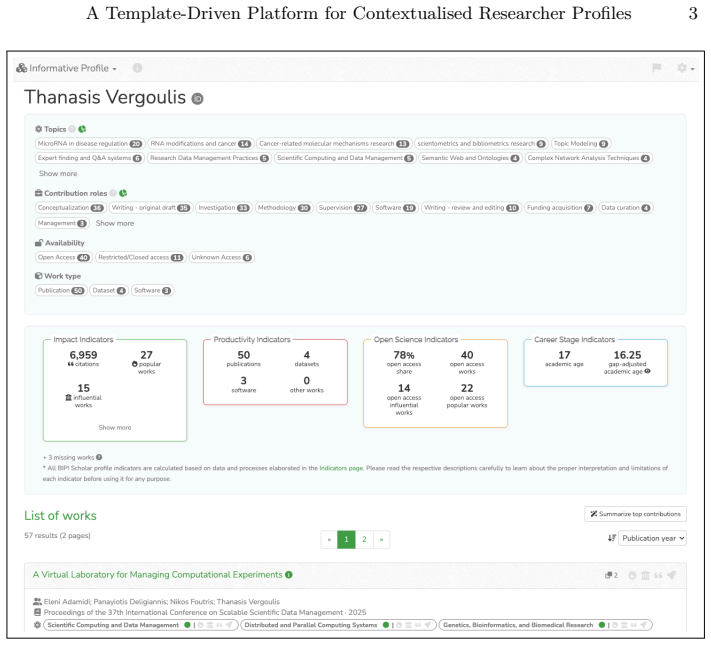
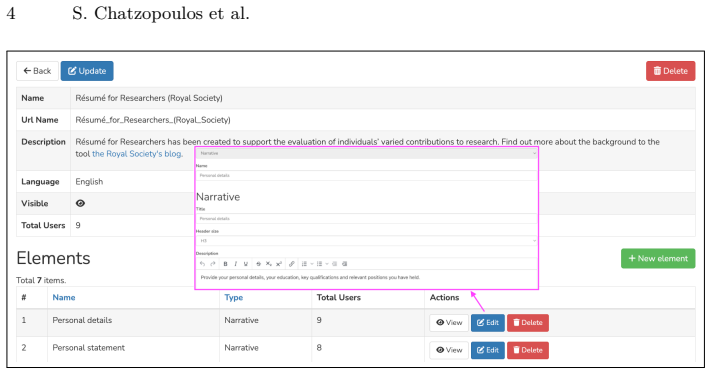
The paper claims that a template-driven platform supports flexible researcher profiling by allowing the creation of context-specific profiles through track-based, narrative-style, or hybrid templates, which in turn enable the representation of diverse outputs, contribution roles, and broader research activities that publication-centric systems overlook.
What carries the argument
The template-driven approach using track-based, narrative-style, or hybrid templates that organize and display research contributions for different contexts.
If this is right
- Researchers gain the ability to represent non-publication outputs and varied roles in profiles tailored to specific needs.
- Research assessment experts can design, deploy, and evaluate experimental templates for different evaluation purposes.
- Profiles become adaptable across presentation contexts rather than fixed to a single publication-centric format.
- Broader research activities receive structured representation that aligns with evolving assessment guidelines.
Where Pith is reading between the lines
- Such templates could reduce reliance on single metrics when researchers apply for positions or funding by making other contributions visible by default.
- The platform might encourage standardization of how impact or service roles are documented across institutions if templates are widely shared.
- Integration with data sources could allow partial automation of populating template sections from existing records.
Load-bearing premise
A template-driven platform will be adopted and will meaningfully improve upon the limitations of publication-focused profiling systems when used in practice.
What would settle it
A study showing that researchers and assessors continue to default to publication lists and standard metrics even when template-based profiles are available and promoted.
Figures
read the original abstract
Modern researchers engage in diverse activities, assume multiple contribution roles, and produce a variety of outputs beyond traditional publications. This broader view of research contributions is increasingly recognised by responsible research assessment initiatives. However, existing researcher profiling platforms remain largely focused on publications and publication-centric indicators, offering limited support for contextualised and multi-dimensional representations of research careers. This paper presents BIP! Scholar, a platform that supports flexible researcher profiling through a template-driven approach. Researchers can create profiles tailored to different presentation or assessment contexts using track-based, narrative-style, or hybrid templates which support the representation of diverse outputs, contribution roles, and broader research activities. The platform also supports research assessment experts who wish to design and evaluate experimental profile templates.
Editorial analysis
A structured set of objections, weighed in public.
Referee Report
Summary. The paper presents BIP! Scholar, a platform that supports flexible researcher profiling through a template-driven approach. Researchers can create profiles tailored to different presentation or assessment contexts using track-based, narrative-style, or hybrid templates which support the representation of diverse outputs, contribution roles, and broader research activities. The platform also supports research assessment experts who wish to design and evaluate experimental profile templates.
Significance. If the platform functions as described, the template-driven design offers a concrete architecture for moving beyond publication-centric profiles in alignment with responsible research assessment initiatives. The contribution lies in the system description itself, which is internally consistent, but the absence of any validation data means demonstrated significance remains limited to the proposed approach rather than proven outcomes.
major comments (1)
- [Abstract] Abstract: The claim that the platform enables 'contextualised and multi-dimensional representations of research careers' that address the 'limited support' in existing systems is presented without any supporting user studies, adoption metrics, comparative evaluations, or implementation details demonstrating effectiveness in practice.
Simulated Author's Rebuttal
We thank the referee for the feedback. We address the single major comment below. The manuscript is a system description of the BIP! Scholar platform design.
read point-by-point responses
-
Referee: [Abstract] Abstract: The claim that the platform enables 'contextualised and multi-dimensional representations of research careers' that address the 'limited support' in existing systems is presented without any supporting user studies, adoption metrics, comparative evaluations, or implementation details demonstrating effectiveness in practice.
Authors: We agree that the paper contains no user studies, adoption metrics, or comparative evaluations, as it is a system description focused on the platform architecture rather than an empirical evaluation. The abstract describes the supported capabilities of the template-driven design (track-based, narrative-style, and hybrid templates for diverse outputs, roles, and activities). To address the concern, we will revise the abstract to state that the platform offers mechanisms intended to support such representations, without implying demonstrated effectiveness or outcomes. This revision will be incorporated. revision: yes
Circularity Check
No circularity: descriptive platform paper with no derivations or fitted claims
full rationale
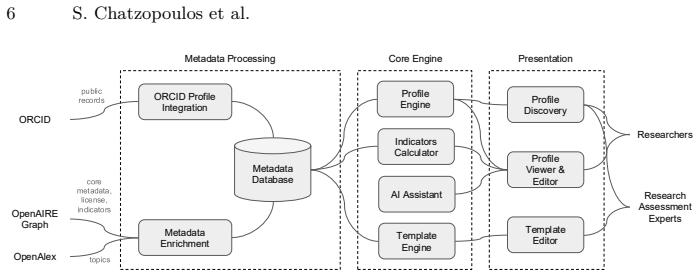
The manuscript is a system description of BIP! Scholar. It presents architecture, template types (track-based, narrative, hybrid), and intended use cases but contains no equations, no parameter fitting, no predictions derived from data, and no load-bearing self-citations or uniqueness theorems. The central claim is simply that the described templates support contextualised profiles; this is an assertion of design, not a reduction of any output to its own inputs. No steps meet any of the enumerated circularity patterns.
Axiom & Free-Parameter Ledger
Reference graph
Works this paper leans on
-
[1]
American Society for Cell Biology: San Francisco declaration on research assess- ment (DORA) (2012)
2012
-
[2]
Learned Publishing 28(2), 151–155 (2015)
Brand, A., Allen, L., Altman, M., Hlava, M., Scott, J.: Beyond authorship: attri- bution, contribution, collaboration, and credit. Learned Publishing 28(2), 151–155 (2015). https://doi.org/10.1087/20150211
-
[3]
https://coara.eu/ agreement/the-agreement-full-text/ (2022), accessed: 2025-04-24
CoARA: Agreement on Reforming Research Assessment. https://coara.eu/ agreement/the-agreement-full-text/ (2022), accessed: 2025-04-24
2022
-
[4]
Derrick, G.E., Hettrick, S., Baker, J., Karoune, E., Kerridge, S., Fletcher, G., Chue Hong, N., Ballantyne, L., Fransmann, J., Roche, T.: Shaping the future of research evaluation: Insights from the festival of hidden REF (Apr 2024)
2024
-
[5]
https://doi.org/https://doi.org/10.31222/osf.io/praxg_v1
Farrell, G., Alloza, E., Bouhraoua, A., Capella-Gutierrez, S., Goble, C., Hermjakob, H., Smith, A., Sufi, S., Vergoulis, T., Zoubiri, M., Quaglia, F., Tosatto, S.C.E.: Credit, recognition, and reward for non-traditional research artefacts in the life sciences (2026). https://doi.org/https://doi.org/10.31222/osf.io/praxg_v1
-
[6]
Learned publishing 25(4), 259–264 (2012)
Haak, L.L., Fenner, M., Paglione, L., Pentz, E., Ratner, H.: ORCID: a system to uniquely identify researchers. Learned publishing 25(4), 259–264 (2012)
2012
-
[7]
https://doi.org/10.5281/zenodo.7488618
Manghi, P., Atzori, C., Bardi, A., Baglioni, M., Schirrwagen, J., Dimitropoulos, H., La Bruzzo, S., Foufoulas, I., Mannocci, A., Horst, M., Czerniak, A., Iatropoulou, K., Kokogiannaki, A., De Bonis, M., Artini, M., Lempesis, A., Ioannidis, A., Manola, N., Principe, P., Vergoulis, T., Chatzopoulos, S., Pierrakos, D.: OpenAIRE Research Graph Dataset (Dec 20...
-
[8]
PLoS Biol
Moher, D., Bouter, L., Kleinert, S., Glasziou, P., Sham, M.H., Barbour, V., Coriat, A.M., Foeger, N., Dirnagl, U.: The hong kong principles for assessing researchers: Fostering research integrity. PLoS Biol. 18(7), e3000737 (Jul 2020)
2020
-
[9]
OpenAlex: A fully-open index of scholarly works, authors, venues, institutions, and concepts
Priem, J., Piwowar, H., Orr, R.: OpenAlex: A fully-open index of scholarly works, authors, venues, institutions, and concepts. arXiv preprint arXiv:2205.01833 (2022)
work page internal anchor Pith review Pith/arXiv arXiv 2022
-
[10]
In: Proceedings of the 22nd ACM/IEEE Joint Conference on Digital Libraries
Vergoulis, T., Chatzopoulos, S., Vichos, K., Kanellos, I., Mannocci, A., Manola, N., Manghi, P.: BIP! Scholar: a service to facilitate fair researcher assessment. In: Proceedings of the 22nd ACM/IEEE Joint Conference on Digital Libraries. pp. 1–5 (2022)
2022
-
[11]
In: Companion Proceedings of the Web Conference 2021
Vergoulis, T., Kanellos, I., Atzori, C., Mannocci, A., Chatzopoulos, S., Bruzzo, S.L., Manola, N., Manghi, P.: Bip! db: A dataset of impact measures for scientific publications. In: Companion Proceedings of the Web Conference 2021. pp. 456–460 (2021)
2021
discussion (0)
Sign in with ORCID, Apple, or X to comment. Anyone can read and Pith papers without signing in.