REVIEW 3 major objections 6 minor 34 references
Semantic Caching for Improving Web Affordability
T0 review · 3 major / 6 minor · reviewed 2026-08-06 · deepseek-v4-flash
Pith's one-line read The paper claims that a semantic image cache, which reuses stored images judged similar in meaning and context rather than byte-identical, can cut news-page data transfer by roughly 10% more than exact caching, and that language models…
desk verdict A credible feasibility study with a useful new dataset; the 10% savings headline is an upper bound from human-labeled simulation, not the measured LLM system. read the letter →
The pith
A machine-rendered reading of the paper's core claim, the machinery that carries it, and where it could break.
The reading
What carries the argument
The load-bearing object is the per-category replaceability matrix: an N by N table in which each entry scores, from 0 (not replaceable) to 4 (completely replaceable), whether one article's image can stand in for another's without unacceptable context loss. The mechanism works by having the server store a category label and image ID in each image's metadata; the client appends the IDs of same-category cached images plus a user-set threshold t to its request, and the server indexes the matrix and replies with a reuse_similar directive pointing at the cached image when the best matching score meets t. This turns a semantic judgment into a cheap server-side lookup, which is what makes the byte-savings estimate possible; the language-model evaluation is then a separate measurement of how faithfully models can generate those scores.
What would settle it
Re-run the Section 5.1 client-server simulation using language-model-predicted replaceability scores (for example GPT-4o's, which have NRMSE 0.17 against humans) instead of the human-annotated matrix, and compare the resulting byte savings with exact caching; a margin clearly below the reported roughly 10% would falsify the central claim.
Extended reading notes
Core claim
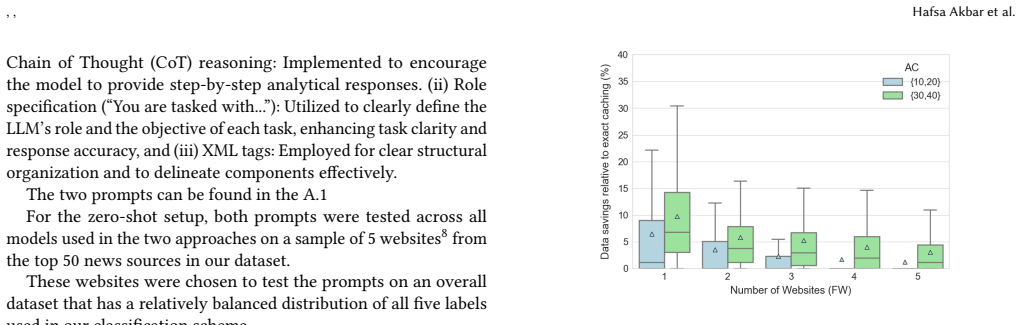
On its own terms, the central claim is that semantic image caching can be built on ordinary HTTP by attaching category metadata and a replaceability threshold to image requests, and that doing so yields measurably larger data savings than exact caching: on average up to about 9.8% greater byte savings in the proof-of-concept simulation, with up to roughly 30% for users who revisit very few sites, plus an estimated 6.4% reduction in total page weight at the most permissive threshold. To reach this, the paper constructs a 0 to 4 human-labeled replaceability scale for image pairs from 50 top news websites, aggregates those labels into per-category replaceability matrices, and measures how well commercial and open-source models reproduce the labels. The best-performing model, GPT-4o, reaches a normalized root mean square error of 0.1735 and a weighted kappa of 0.62, which the paper reads as substantial agreement with human judgments, while the open-source LLaMA 3.1 pipeline performs comparably at near-zero marginal cost.
Load-bearing premise
The headline byte-savings figures come from a simulation in which the server looks up a precomputed, human-annotated replaceability table on every request, so the real-world gains depend on language-model judgments matching those human labels closely enough to preserve the margin.
Editorial extensions
If this is right
- Data-constrained readers who stick to a few news sites gain the most: the simulation shows up to roughly 30% greater savings than exact caching when one site is frequently visited, falling to about 3% with five frequented sites.
- The user-selectable threshold t makes context-loss tolerance an explicit user choice, from aggressive replacement at t=1 with about 6.4% page-weight reduction to near-exact caching at t=4 with about 3.8%.
- Server-side effort stays low: the operator precomputes a per-category replaceability table and only indexes it at request time, while clients transmit short 16-bit image IDs to keep request overhead small.
- Because the open-source LLaVA-NeXT plus LLaMA 3.1 pipeline matches several commercial models closely at zero marginal cost, semantic caching could be offered without per-comparison API fees.
- Website operators keep control by flagging non-cacheable images through HTTP metadata or by opting out, so the mechanism does not have to force replacement on any publisher.
Reading between the lines
- Editorial extension: if LLM predictions were substituted for the human-annotated matrix in the byte-savings simulation, the reported margin over exact caching would likely shrink, because even the best model disagrees with humans on a meaningful share of pairs (NRMSE 0.17).
- Editorial extension: the same per-category replaceability design could be transferred to other repetitive visual domains such as product listings, sports recaps, or weather graphics, but each domain would need its own labeled replaceability matrix.
- Editorial extension: the privacy cost is two-sided, because a client that sends its cached-image IDs reveals part of its browsing history to every server it contacts; deployments would need to mask or rotate those IDs.
- Editorial extension: the paper's own limitation note implies that widening the pool beyond the ten most recent articles per category should increase cache hits, so a natural test is measuring how byte savings grow as the article window expands.
Editorial analysis
A structured set of objections, weighed in public.
Referee Report
Summary. The paper proposes semantic caching of images for news websites, where a client reuses a semantically similar cached image instead of downloading a new one, with an LLM assessing replaceability on a 0-4 scale. The authors collect 4,264 images from 50 news sites, obtain human annotations for 41,031 image pairs, fit a probabilistic byte-savings model (Eq. 1), and simulate client browsing to claim about 6.4% page-weight reduction and roughly 10% greater byte savings than exact caching (Section 5.1, Figure 5). They separately benchmark GPT-4o, Gemini 1.5 Pro, Claude 3.5, and a LLaVA-NeXT + LLaMA 3.1 pipeline on the same replaceability task, reporting GPT-4o as best (NRMSE 0.17347, weighted Kappa 0.62). The main caveat, which the paper itself does not address, is that the savings figures come from a simulation that indexes into human-annotated replaceability matrices, not from the LLM predictions evaluated in Section 4.
Significance. If the savings estimate holds, the paper introduces a concrete, timely mechanism for reducing data transfer in news browsing, with plausible benefits for data-constrained users. The strengths are real: a public dataset and code, a structured human-annotation protocol with inter-rater reliability checks, a careful prompt-design comparison, a cost analysis of commercial versus open models, and an honest discussion of semantic preservation and ethical concerns. The LLM evaluation is non-circular because model predictions are compared against independent human labels. However, the central contribution is not yet demonstrated end-to-end: the headline savings are an upper bound under perfect replaceability judgments, and the paper does not quantify how imperfect LLM predictions (NRMSE 0.17-0.21, Kappa 0.42-0.62) would change the realized savings. Because that gap sits exactly where the paper's novelty lies, the current evidence supports a feasibility study more than a measured system.
major comments (3)
- [§5.1, Figure 5, abstract] The 'approximately 10% greater byte savings compared to exact caching' claim is produced by a simulation in which the server indexes into a human-annotated replaceability matrix, not by the LLM-based system proposed in the paper. The LLM is evaluated separately (Section 4, Table 3) and achieves NRMSE 0.17347 and weighted Kappa 0.62 at best; Figure 7 shows systematic underestimation of replaceability for all models. Because underestimation would reduce cache hits and shrink the margin over exact caching, while overestimation would inflate savings without penalizing context loss, the headline figure is not a measured performance of the proposed system unless an LLM-in-the-loop simulation is run. Please either rerun the simulation with model-predicted labels (including error bars) or explicitly frame the reported savings as an upper bound under perfect replaceability knowledge.
- [§3.2, Eq. (1)] The byte-savings model depends on u_t (percentage of useful comparisons above threshold) estimated from the same dataset, N=164, and S=0.199 MB, yet the reported point estimates (6.4% and ~10%) are presented without confidence intervals or sensitivity analysis. The value of P=4.77 MB is said to come from 'a sample of 1,000 websites in our dataset,' which is inconsistent with the stated 50-website dataset; this needs clarification. Since every headline number flows through Eq. (1), the lack of uncertainty propagation and the apparent dataset inconsistency weaken confidence in the quantitative claims.
- [§5.1, Figure 5] The simulation protocol is underspecified: it is not stated how 'exact caching' is implemented (URL-match? content-hash?), how cache size is constrained, or what the distribution of image requests per article is. The paper reports that each FW-AC combination is simulated with 100 random samples, but no standard errors or confidence intervals are shown for the 9.8% average improvement or for the up-to-30% improvement at FW=1. Adding these quantities is necessary for the reader to judge whether the semantic advantage is robust rather than an artifact of sampling noise.
minor comments (6)
- [Abstract vs. Table 3] The abstract reports a weighted F1 score of 0.8374 for GPT-4o, but Table 3 lists 0.80728; please reconcile the discrepancy.
- [§4.1 / §4.2] The claim that LLaMA 3.1 performs 'comparably' to commercial models is overstated: its NRMSE is 0.21097, weighted F1 0.72934, and Kappa 0.42, compared with GPT-4o's 0.17347, 0.80728, and 0.62. Please soften the language or provide a statistical test of comparability.
- [§2.2] Inter-rater reliability was measured only for two pairs of raters covering a subset of websites (3,058 and 4,876 pairs); the remaining pairs were single-annotated. Please state this explicitly in the main text, since the ground-truth quality for the bulk of the data rests on this indirect check.
- [Appendix A.3] The mapping of specific subcategories to general categories is said to use cosine similarity, but the exact procedure (what vectors are compared, and at what threshold) is not described; this affects reproducibility.
- [§6, Limitations] The paper acknowledges that expanding the article pool would increase cache hits, but it does not quantify how the 6.4% / 10% figures would change with a larger time window; a short extrapolation would be useful.
- [§5.3 and Appendix A.5] The cost comparison treats LLaMA as $0, but deployment costs (inference hardware, engineering, latency) are not zero; a note on these omitted operational costs would make the cost analysis more balanced.
Circularity Check
No material circularity: the LLM replaceability scores are validated against independent human annotations, and the headline savings figure is an oracle-level simulation using those annotations, which is an external-validity gap rather than a circular reduction.
full rationale
The paper's central derivation chain is not circular. Ground-truth replaceability scores are produced by independent human annotators, with inter-rater Krippendorff's alpha values of 0.84 and 0.80 (Section 2.2), and the LLM evaluation (Sections 4 and 5.2) measures agreement of GPT-4o, Gemini, Claude, and LLaMA against that external ground truth using NRMSE, weighted F1, and weighted Cohen's Kappa. The LLMs are not trained on or fitted to the byte-savings target. The byte-savings model in Section 3.2 uses u_t, the measured percentage of useful comparisons above each threshold from the same dataset, but that is an input parameter estimated from the data, not a conclusion reused to justify the data. Section 5.1's simulation indexes into 'a replaceability matrix based on human annotations,' so the reported ~9.8%/10% savings over exact caching is an oracle-level estimate of an upper bound, not an end-to-end measurement with LLM predictions in the loop. That gap is a correctness and external-validity limitation, not a circularity: the savings figure is not equal to its input by construction, and the LLM accuracy claims stand independently against human labels. The self-citations to earlier web-affordability work (references 10, 27, and 33) appear only in motivation and related work and are not load-bearing for the central semantic-caching claims. The score is 2 rather than 0 only because of these minor, non-load-bearing self-citations; no circular step was found.
Assumptions & free parameters
free parameters (5)
- u_t: useful comparison fraction per threshold =
1.6% to 9.5% for t=1 to 4
- N: average comparisons per category =
164
- S: average image size =
0.199 MB (dataset), 0.9 MB (HTTP Archive)
- I: average images per article =
1.794
- P: average page weight =
4.77 MB
assumptions (4)
- domain assumption News images within the same category and website can replace each other without unacceptable context loss, as judged by human raters.
- ad hoc to paper Cached images are a uniformly random subset of the N images in a category.
- domain assumption Sixteen-bit hashes are collision-safe enough for category-unique image IDs.
- domain assumption The 50-site sample and category mapping represent general news browsing.
invented entities (1)
-
reuse_similar HTTP response directive
Cite this review
Pith. "Pith review of Semantic Caching for Improving Web Affordability." pith.science (2026). https://pith.science/paper/2TJUILPJ
@misc{pith2026250620420,
  author       = {Pith},
  title        = {Pith review of: Semantic Caching for Improving Web Affordability},
  year         = {2026},
  howpublished = {\url{https://pith.science/paper/2TJUILPJ}},
  note         = {Machine review of arXiv:2506.20420}
}
read the original abstract
The rapid growth of web content has led to increasingly large webpages, posing significant challenges for Internet affordability, especially in developing countries where data costs remain prohibitively high. We propose semantic caching using Large Language Models (LLMs) to improve web affordability by enabling reuse of semantically similar images within webpages. Analyzing 50 leading news and media websites, encompassing 4,264 images and over 40,000 image pairs, we demonstrate potential for significant data transfer reduction, with some website categories showing up to 37% of images as replaceable. Our proof-of-concept architecture shows users can achieve approximately 10% greater byte savings compared to exact caching. We evaluate both commercial and open-source multi-modal LLMs for assessing semantic replaceability. GPT-4o performs best with a low Normalized Root Mean Square Error of 0.1735 and a weighted F1 score of 0.8374, while the open-source LLaMA 3.1 model shows comparable performance, highlighting its viability for large-scale applications. This approach offers benefits for both users and website operators, substantially reducing data transmission. We discuss ethical concerns and practical challenges, including semantic preservation, user-driven cache configuration, privacy concerns, and potential resistance from website operators
Figures


Figures from the paper (5 more)



Reference graph
Works this paper leans on
-
[1]
[n. d.]. Web Page Test. https://webpagetest.org. Accessed: October 2024
work page 2024
-
[2]
Anthropic. 2024. Claude 3.5 Overview. https://www.anthropic.com/claude. Accessed: 2024-10-14
work page 2024
-
[3]
Fu Bang. 2023. GPTCache: An Open-Source Semantic Cache for LLM Applications Enabling Faster Answers and Cost Savings. InProceedings of the 3rd Workshop for Natural Language Processing Open Source Software (NLP-OSS 2023), Liling Tan, Dmitrijs Milajevs, Geeticka Chauhan, Jeremy Gwinnup, and Elijah Rippeth (Eds.). Association for Computational Linguistics, S...
-
[4]
Broadband Commission for Sustainable Development. 2023. The State of Broadband 2023: Accelerating Broadband for New Realities. https://www. broadbandcommission.org/publication/state-of-broadband-2023/
work page 2023
-
[5]
Tom B. Brown, Benjamin Mann, Nick Ryder, Melanie Subbiah, Jared Kaplan, Prafulla Dhariwal, Arvind Neelakantan, Pranav Shyam, Girish Sastry, Amanda Askell, Sandhini Agarwal, Ariel Herbert-Voss, Gretchen Krueger, Tom Henighan, Rewon Child, Aditya Ramesh, Daniel M. Ziegler, Jeffrey Wu, Clemens Winter, Christopher Hesse, Mark Chen, Eric Sigler, Mateusz Litwin...
2020
-
[6]
Jacob Cohen. 1960. A coefficient of agreement for nominal scales.Educational and Psychological Measurement20 (1960), 37–46
work page 1960
-
[7]
Franklin, Björn Þór Jónsson, Divesh Srivastava, and Michael Tan
Shaul Dar, Michael J. Franklin, Björn Þór Jónsson, Divesh Srivastava, and Michael Tan. 1996. Semantic Data Caching and Replacement. InProceedings of the 22th International Conference on Very Large Data Bases (VLDB ’96). Morgan Kaufmann Publishers Inc., San Francisco, CA, USA, 330–341
work page 1996
-
[8]
DeepMind. 2024. Gemini Pro. https://deepmind.google/technologies/gemini/pro. Accessed: 2024-10-14
work page 2024
Show all 34 references
-
[9]
Gaudette and N
L. Gaudette and N. Japkowicz. 2009. Evaluation Methods for Ordinal Classifi- cation. InCanadian AI 2009: Advances in Artificial Intelligence. Springer, Berlin, Heidelberg, 207–210. https://doi.org/10.1007/978-3-642-01818-3_25
2009 doi
-
[10]
Rumaisa Habib, Sarah Tanveer, Aimen Inam, Haseeb Ahmed, Ayesha Ali, Zartash Afzal Uzmi, Zafar Ayyub Qazi, and Ihsan Ayyub Qazi. 2023. A Frame- work for Improving Web Affordability and Inclusiveness. InProceedings of the ACM SIGCOMM 2023 Conference(New York, NY, USA)(ACM SIGCOM...
2023
-
[11]
Kaiming He, Xiangyu Zhang, Shaoqing Ren, and Jian Sun. 2016. Deep Residual Learning for Image Recognition. InProceedings of the IEEE Conference on Computer Vision and Pattern Recognition (CVPR). https://doi.org/10.1109/CVPR.2016.90 [Accessed: October 9, 2024]
2016 doi
-
[12]
HTTP Archive. 2024. State of the Web. https://httparchive.org/. [Accessed: October 8, 2024]
2024
-
[13]
Klaus Krippendorff. 2004. Answering the Call for a Standard Reliability Measure for Coding Data.Communication Methods and Measures1, 1 (2004), 77–89. https://doi.org/10.1080/19312450709336664
2004 doi
-
[14]
2004.Content Analysis: An Introduction to Its Methodology (2nd ed.)
Klaus Krippendorff. 2004.Content Analysis: An Introduction to Its Methodology (2nd ed.). Sage, Thousand Oaks, CA
2004
-
[15]
Dongwon Lee and Wesley W. Chu. 1999. Semantic caching via query match- ing for web sources. InInternational Conference on Information and Knowledge Management. https://api.semanticscholar.org/CorpusID:7024601
1999
-
[16]
Mosh Levy, Alon Jacoby, and Yoav Goldberg. 2024. Same Task, More Tokens: The Impact of Input Length on the Reasoning Performance of Large Language Models. arXiv:2402.14848 [cs.CL]
2024 arXiv
-
[17]
Feng Li, Renrui Zhang, Hao Zhang, Yuanhan Zhang, Bo Li, Wei Li, Zejun Ma, and Chunyuan Li. 2024. LLaVA-NeXT-Interleave: Tackling Multi-image, Video, and 3D in Large Multimodal Models.arXiv preprint arXiv:2407.07895(2024)
2024 arXiv
-
[18]
Jiaxing Li, Chi Xu, Feng Wang, Isaac M von Riedemann, Cong Zhang, and Jiangchuan Liu. 2024. SCALM: Towards Semantic Caching for Automated Chat Services with Large Language Models. arXiv:2406.00025 [cs.CL] https: //arxiv.org/abs/2406.00025
2024 arXiv
-
[19]
Haotian Liu, Chunyuan Li, Yuheng Li, Bo Li, Yuanhan Zhang, Sheng Shen, and Yong Jae Lee. 2024. LLaVA-NeXT: Improved reasoning, OCR, and world knowl- edge. https://llava-vl.github.io/blog/2024-01-30-llava-next/ [Accessed: October 9, 2024]
2024
-
[20]
Haotian Liu, Chunyuan Li, Qingyang Wu, and Yong Jae Lee. 2023. Visual In- struction Tuning. InAdvances in Neural Information Processing Systems, A. Oh, T. Naumann, A. Globerson, K. Saenko, M. Hardt, and S. Levine (Eds.), Vol. 36. Curran Associates, Inc., 34892–34916. https://p...
2023
-
[21]
Mary Louise McHugh. 2012. Interrater reliability: the kappa statistic.Biochemia medica22, 3 (2012), 276–282. https://doi.org/10.11613/BM.2012.031
2012 doi
-
[22]
2024.Introducing LLaMA 3.1: State-of-the-Art Open Source Lan- guage Model
Meta AI Team. 2024.Introducing LLaMA 3.1: State-of-the-Art Open Source Lan- guage Model. https://ai.meta.com/blog/meta-llama-3-1/ [Accessed: October 9, 2024]
2024
-
[23]
2018.UN Broadband Commission Adopts A4AI “1 for 2” Affordability Target
[n.d.]. 2018.UN Broadband Commission Adopts A4AI “1 for 2” Affordability Target. Retrieved 2022 from https://a4ai.org/news/un-broadband-commission-adopts- a4ai-1-for-2-affordability-target/
2018
-
[24]
2021.World Bank Digital Development
[n.d.]. 2021.World Bank Digital Development. Retrieved 2022 from https://www. worldbank.org/topic/digitaldevelopment
2021
-
[25]
OpenAI. 2023. GPT-4 Technical Report. https://openai.com/research/gpt-4. Accessed: 2024-10-14
2023
-
[26]
Gintas Palubinskas. 2016. Image similarity/distance measures: What is really behind MSE and SSIM?International Journal of Image and Data Fusion8, 1 (2016), 32–53. https://doi.org/10.1080/19479832.2016.1273259 [Accessed: October 9, 2024]
2016
-
[27]
Ihsan Ayyub Qazi, Zafar Ayyub Qazi, Ayesha Ali, Muhammad Abdullah, and Rumaisa Habib. 2021. Rethinking Web for Affordability and Inclusion. InProceed- ings of the 20th ACM Workshop on Hot Topics in Networks(Virtual Event, United Kingdom)(HotNets ’21). Association for Computing...
2021
-
[28]
Rijurekha Sen, Sohaib Ahmad, Amreesh Phokeer, Zaid Ahmed Farooq, Ih- san Ayyub Qazi, David Choffnes, and Krishna P. Gummadi. 2017. Inside the Walled Garden: Deconstructing Facebook’s Free Basics Program.SIGCOMM Comput. Commun. Rev.47, 5 (Oct. 2017), 12–24. https://doi.org/10.1...
2017 doi
-
[29]
Similarweb Ltd. [n. d.]. Traffic Insights for the Top Global Websites, August 2024. https://www.similarweb.com
2024
-
[30]
Karen Simonyan and Andrew Zisserman. 2015. Very Deep Convolutional Net- works for Large-Scale Image Recognition.arXiv preprint arXiv:1409.1556(2015). [Accessed: October 9, 2024]
2015 arXiv
-
[31]
Starke, Sebastian Øverhaug Larsen, and Christoph Trattner
A.D. Starke, Sebastian Øverhaug Larsen, and Christoph Trattner. 2021. Predicting Feature-based Similarity in the News Domain Using Human Judgments. InPro- ceedings of the 9th International Workshop on News Recommendation and Analytics (INRA 2021) co-located with 15th ACM Confe...
2021
-
[32]
2022.Percentage of mobile device website traffic worldwide from 1st quarter 2015 to 4th quarter 2021
Statista. 2022.Percentage of mobile device website traffic worldwide from 1st quarter 2015 to 4th quarter 2021. Retrieved 2022 from https://www.statista.com/statistics/ 277125/share-of-website-traffic-coming-from-mobile-devices/
2022
-
[33]
Ammar Tahir, Muhammad Tahir Munir, Shaiq Munir Malik, Zafar Ayyub Qazi, and Ihsan Ayyub Qazi. 2020. Deconstructing Google’s Web Light Service. In Proceedings of The Web Conference 2020(Taipei, Taiwan)(WWW ’20). Association for Computing Machinery, New York, NY, USA, 884–893. h...
2020
-
[34]
Wikipedia. 2024. Pooled Variance — Wikipedia, The Free Encyclopedia. https: //en.wikipedia.org/wiki/Pooled_variance. Accessed: 2024-10-14. 9 , , Hafsa Akbar et al. A APPENDIX A.1 Prompts Used for Image Replaceability Evaluation A.1.1 Base Prompt.You are tasked with evaluating ...
2024
Reviewed August 6, 2026 · model on record in the stance chip above.
Discussion (0). Continue with ORCID to comment.