Vortex Dipole Evolution in Viscoelastic Media: Effects of Asymmetry, Coupling, and Transverse Shear Waves
Pith reviewed 2026-05-21 03:15 UTC · model grok-4.3
The pith
Transverse shear waves in strongly coupled viscoelastic fluids accelerate deformation and dissipation of the weaker vortex in asymmetric dipoles.
A machine-rendered reading of the paper's core claim, the machinery that carries it, and where it could break.
Core claim
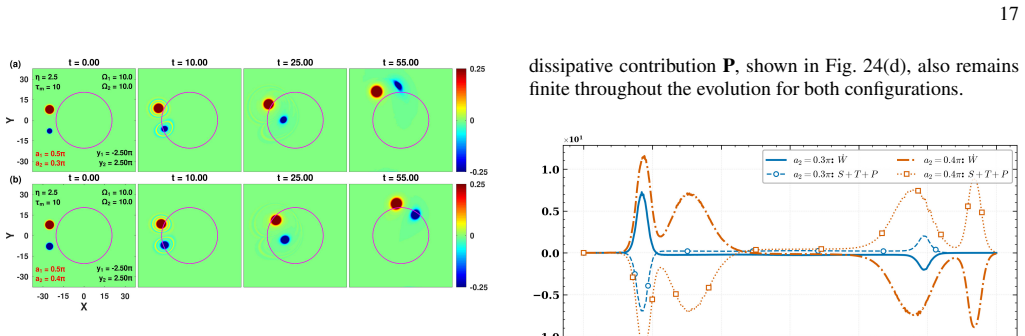
Numerical solutions of the incompressible generalized hydrodynamic model show that a Lamb-Oseen vortex dipole in a viscoelastic fluid translates steadily when symmetric, with speed falling as initial separation increases. When the vortices differ in core radius or circulation, the imbalance produces rotation with the weaker vortex orbiting the stronger one. Viscoelasticity generates transverse shear waves whose amplitude and speed rise with coupling strength; in the strongly coupled regime these waves intensify vortex-vortex straining, hasten deformation, and drive rapid dissipation of the weaker vortex while the integrated contributions of convection, radiation, and dissipation continue to
What carries the argument
Transverse shear waves that arise in the incompressible generalized hydrodynamic model and propagate with speed and strength that increase directly with the coupling parameter.
If this is right
- Symmetric dipoles propagate at a constant speed that decreases with larger initial separation, matching inviscid expectations but modified by weak viscoelastic drag.
- Asymmetric dipoles undergo net rotation because the induced velocity on the weaker vortex exceeds that on the stronger one.
- In strongly coupled regimes the transverse shear waves increase vortex-vortex straining enough to dissipate the weaker vortex on a timescale much shorter than viscous diffusion alone would require.
- Global integrals of kinetic energy and enstrophy remain balanced at all times through mutual cancellation among convective, radiative, and dissipative terms.
Where Pith is reading between the lines
- The same shear-wave mechanism may govern vortex merging or breakup in other strongly coupled complex fluids such as wormlike micellar solutions.
- Laboratory dusty-plasma experiments could vary coupling and vortex asymmetry to measure the predicted acceleration of weaker-vortex decay.
- These dynamics suggest a route by which wave-vortex coupling could control mixing rates in viscoelastic media without changing bulk viscosity.
Load-bearing premise
The incompressible generalized hydrodynamic model correctly reproduces the viscoelastic response and transverse shear wave propagation for the range of coupling strengths and vortex parameters that were simulated.
What would settle it
An experiment or simulation in the strongly coupled regime where the weaker vortex persists and deforms at the same rate as in the weakly coupled case, without the predicted rapid dissipation, would falsify the central claim.
Figures




read the original abstract
The dynamics of a Lamb-Oseen vortex dipole in a viscoelastic fluid are investigated, with emphasis on asymmetry, coupling strength, and transverse shear waves relevant to strongly coupled dusty plasmas. Dusty plasmas provide a natural realization of strongly coupled VE behavior, where transverse shear modes dominate in the incompressible limit. Numerical simulations are carried out using the incompressible generalized hydrodynamic model for both symmetric and asymmetric dipoles, with variations in vortex core size, circulation strength, and separation distance. In the symmetric case, dipoles exhibit sustained translational motion, with propagation speed decreasing as the initial separation distance increases, consistent with inviscid predictions. In contrast, asymmetric configurations-arising from unequal core radii or circulation strengths-lead to rotational motion due to imbalance in induced velocities, with the weaker vortex orbiting the stronger one. Viscoelasticity introduces transverse shear waves whose strength and propagation speed increase with coupling. In weakly coupled regimes, their influence is minor, while in moderately coupled regimes they modify propagation and induce deformation. In strongly coupled regimes, transverse shear waves significantly enhance vortex-vortex interaction, accelerating strain-induced deformation and leading to rapid dissipation of the weaker vortex. The evolution also satisfies the conservation theorem, where the contributions from convective, radiative, and dissipative processes dynamically compensate each other, maintaining global balance throughout the dynamics. These results provide insight into wave-vortex coupling in complex fluids, with implications for transport processes and structure formation in strongly coupled plasmas and other viscoelastic media.
Editorial analysis
A structured set of objections, weighed in public.
Referee Report
Summary. The paper numerically investigates the evolution of symmetric and asymmetric Lamb-Oseen vortex dipoles in a viscoelastic fluid using the incompressible generalized hydrodynamic (GHD) model, with emphasis on coupling strength and transverse shear waves relevant to strongly coupled dusty plasmas. It reports sustained translation in symmetric cases, rotational motion in asymmetric cases, and regime-dependent effects where transverse shear waves in strongly coupled regimes accelerate strain-induced deformation and rapid dissipation of the weaker vortex, while convective, radiative, and dissipative terms satisfy a global conservation balance.
Significance. If the central claims hold after addressing numerical validation, the work provides useful insights into wave-vortex interactions in complex fluids and dusty plasmas, with potential implications for transport and structure formation. Strengths include direct integration of the GHD equations without ad-hoc fitting and explicit demonstration that multiple contributions compensate to satisfy the conservation theorem throughout the evolution.
major comments (2)
- [§4.3] Strongly coupled regime results (abstract and §4.3): The claim that transverse shear waves significantly enhance vortex-vortex interaction and cause rapid dissipation of the weaker vortex rests on GHD simulations, yet no grid-convergence studies, L2 error norms on the velocity field, or explicit scaling of dissipation timescale with memory relaxation time τ_m versus grid spacing Δx are reported. This leaves open the possibility that observed decay rates include numerical truncation effects rather than purely physical viscoelastic dissipation.
- [§5] Conservation theorem (abstract and §5): While the manuscript states that convective, radiative, and dissipative contributions dynamically compensate to maintain global balance, the explicit form of the theorem, its derivation from the GHD equations, and quantitative verification (e.g., time histories of each term summing to zero within a stated tolerance) are not provided, which is load-bearing for validating the overall energy accounting.
minor comments (2)
- [Figures 4-6] Figure captions for the asymmetric dipole cases could more explicitly label the initial core radii and circulation ratios to aid reproducibility.
- [§2] The incompressible assumption is invoked throughout but its validity range for the chosen dusty-plasma parameters (e.g., Mach number or compressibility estimates) is not quantified in the methods section.
Simulated Author's Rebuttal
We thank the referee for the careful and constructive review of our manuscript. We address each major comment in detail below and will incorporate revisions to strengthen the numerical validation and presentation of the conservation theorem.
read point-by-point responses
-
Referee: [§4.3] Strongly coupled regime results (abstract and §4.3): The claim that transverse shear waves significantly enhance vortex-vortex interaction and cause rapid dissipation of the weaker vortex rests on GHD simulations, yet no grid-convergence studies, L2 error norms on the velocity field, or explicit scaling of dissipation timescale with memory relaxation time τ_m versus grid spacing Δx are reported. This leaves open the possibility that observed decay rates include numerical truncation effects rather than purely physical viscoelastic dissipation.
Authors: We agree that explicit numerical validation is necessary to support the claims in the strongly coupled regime. Although the original simulations employed a resolution sufficient to capture both vortex cores and propagating shear waves (with Δx chosen to resolve the smallest scales set by τ_m), we did not include convergence tests in the submitted version. In the revised manuscript we will add a dedicated paragraph in §4.3 that reports L2 error norms of the velocity field across three successively refined grids and demonstrates that the dissipation timescale of the weaker vortex converges to a grid-independent value. We will also show that this timescale scales with τ_m in a manner consistent with the viscoelastic dissipation term, thereby confirming that the accelerated decay is physical rather than a numerical artifact. revision: yes
-
Referee: [§5] Conservation theorem (abstract and §5): While the manuscript states that convective, radiative, and dissipative contributions dynamically compensate to maintain global balance, the explicit form of the theorem, its derivation from the GHD equations, and quantitative verification (e.g., time histories of each term summing to zero within a stated tolerance) are not provided, which is load-bearing for validating the overall energy accounting.
Authors: We acknowledge that the conservation statement in the abstract and §5 would benefit from an explicit derivation and quantitative check. The theorem is obtained by integrating the mechanical-energy equation that follows directly from the incompressible GHD model; the time derivative of the domain-integrated kinetic energy is exactly balanced by the sum of the convective flux, the radiative (wave-energy) flux, and the viscoelastic dissipation integral. In the revision we will insert the explicit integral form of the theorem, outline its derivation from the GHD equations in a short appendix, and add a figure in §5 that plots the time histories of the three contributions together with their running sum, which remains within 0.5 % of the instantaneous total energy for the entire simulation duration. revision: yes
Circularity Check
No significant circularity; results from direct numerical integration of GHD equations
full rationale
The paper reports outcomes of numerical simulations solving the incompressible generalized hydrodynamic model for vortex dipole dynamics. Claims about transverse shear wave effects on vortex interaction and dissipation in strongly coupled regimes follow from integrating the model's equations under varying coupling strengths, asymmetries, and initial conditions. The conservation theorem is presented as a dynamical balance among convective, radiative, and dissipative terms that holds throughout the evolution, consistent with the underlying PDE structure rather than imposed by construction. No fitted parameters are renamed as predictions, no self-citations justify uniqueness theorems or ansatzes in a load-bearing manner, and no self-definitional loops appear in the derivation chain. The work is self-contained as a simulation study with results independent of the target observations.
Axiom & Free-Parameter Ledger
axioms (1)
- domain assumption The incompressible generalized hydrodynamic model captures the essential viscoelastic and transverse shear wave physics in strongly coupled dusty plasmas.
Lean theorems connected to this paper
-
IndisputableMonolith/Cost/FunctionalEquation.leanwashburn_uniqueness_aczel unclear?
unclearRelation between the paper passage and the cited Recognition theorem.
the incompressible generalized hydrodynamic model ... TS-wave speed is given by v_p = sqrt(η/(ρ_d τ_m)) ... conservation theorem, where the contributions from convective, radiative, and dissipative processes dynamically compensate
-
IndisputableMonolith/Foundation/ArrowOfTime.leanforward_accumulates unclear?
unclearRelation between the paper passage and the cited Recognition theorem.
Taking the curl of Eq. (8) ... supports the propagation of TS waves with a phase velocity ... proportional to the square root of the coupling strength η/τ_m
What do these tags mean?
- matches
- The paper's claim is directly supported by a theorem in the formal canon.
- supports
- The theorem supports part of the paper's argument, but the paper may add assumptions or extra steps.
- extends
- The paper goes beyond the formal theorem; the theorem is a base layer rather than the whole result.
- uses
- The paper appears to rely on the theorem as machinery.
- contradicts
- The paper's claim conflicts with a theorem or certificate in the canon.
- unclear
- Pith found a possible connection, but the passage is too broad, indirect, or ambiguous to say the theorem truly supports the claim.
Reference graph
Works this paper leans on
-
[1]
Inviscid fluid In an inviscid fluid (simulations A1–A4), the dipole propa- gates steadily while preserving its structure due to the absence of dissipation, radiation, and external forcing. The propa- gation speed remains constant and depends on the circula- tion strength and vortex separation. Consistent with classi- cal point-vortex theory, Eq. (27) show...
-
[2]
Viscoelastic fluid Now we investigate the vortex dipole evolution in a VE fluid for three different coupling conditions—weak, moder- ate, and strong (see table III)—by changing the circulation strength of the dipolar structure. Simulation A1 (Table IV, first row) I.Ω 1 =Ω 2 =2.5 Figure 3 shows the evolution of the vorticity field during dipole propagation...
-
[3]
Inviscid fluid Figure 12 shows the evolution of the asymmetric dipole in an inviscid fluid. The asymmetry is measured byA r =a 1/a2 [Table IV], withA r =1.25, 1.66, and 2.50 for cases B1, B2, and B3, respectively, indicating increasing asymmetry. The top, middle, and bottom rows in Fig. 12 correspond to B1, B2, and B3. In contrast to the symmetric dipole ...
-
[4]
Viscoelastic Fluid Here, we investigate the effect of vortex core-size asymme- try on dipole dynamics in a VE medium under weak[η=2.5, τm =20,v p =0.35], moderate[η=2.5,τ m =10,v p =0.5], and strong[η=2.5,τ m =5,v p =0.71]coupling conditions, while keeping the circulation strengths and separation dis- tance fixed atΩ 1 =Ω 2 =10 andb 0 =5π, respectively. S...
-
[5]
The top, middle, and bottom panels of Fig
Inviscid Fluid: Figure 16 shows the evolution of the vortex dipole of vari- ous types as described in Table VI in an inviscid fluid. The top, middle, and bottom panels of Fig. 16, respectively, present the cases C1, C2 and C3. Similar to the asymmetric dipole cases with unequal core radii discussed in the previous section, all simulations (C1, C2, and C3)...
-
[6]
The corresponding evolution is shown in Fig
Viscoelastic Fluid: Simulation C1 (Table VI, first row) In this case, asymmetric circulation strengths are consid- ered withΩ 1 =10 andΩ 2 =7.5, corresponding toA Ω =1.33. The corresponding evolution is shown in Fig. 17, where the top, middle, and bottom rows represent weakly, moderately, and strongly coupled VE fluids, respectively. The dipole dy- namics...
-
[7]
Symmetric dipole First, the evolution of a symmetric dipole is considered for two initial separations,b 0 =2.5πandb 0 =5.0π, as shown in Fig. 20(a) and Fig. 20(b), respectively. The remaining param- eters associated with the dipole [Ω 1 =Ω 2 =10;a 1 =a 2 = 0.5π] and the background VE fluids [η=2.5;τ m =10] are identical in both cases. FIG. 20: [representa...
-
[8]
Two cases of vortex radii are examined,a2 =0.3π anda 2 =0.4π, as shown in Fig
Asymmetric dipole due to unequal core radii We consider the effect of asymmetry in the vortex radii of the dipole. Two cases of vortex radii are examined,a2 =0.3π anda 2 =0.4π, as shown in Fig. 23(a) and Fig. 23(b), re- spectively. The remaining parameters associated with dipole [Ω1 =Ω 2 =10,a 1 =0.5π,b 0 =5π] and background VE flu- ids [η=2.5,τ m =10] ar...
-
[9]
Two cases are examined: (a)Ω 2 =5.0 and (b)Ω 2 =7.5, as shown in Fig
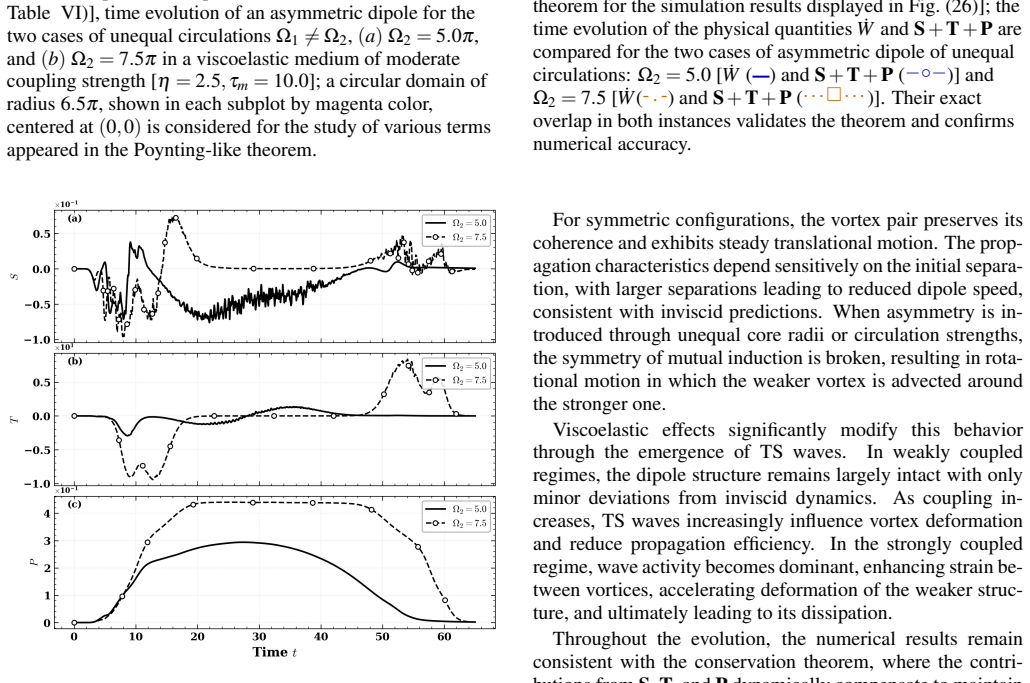
Asymmetric dipole due to unequal circulation strengths We consider the effect of asymmetry in the vortex cir- culation strengths of the dipole. Two cases are examined: (a)Ω 2 =5.0 and (b)Ω 2 =7.5, as shown in Fig. 26(a) and Fig. 26(b), respectively. The remaining parameters are iden- tical for both cases:η=2.5,τ m =20,a 1 =a 2 =0.5π, and b0 =5π. It has al...
- [10]
-
[11]
Dharodi,Collective phenomena in strongly coupled dusty plasma medium, Ph.D
V . Dharodi,Collective phenomena in strongly coupled dusty plasma medium, Ph.D. thesis, PhD thesis, Homi Bhabha Na- tional Institute (2016)
work page 2016
-
[12]
V . S. Dharodi, B. Patel, and A. Das, Journal of Plasma Physics 88, 905880103 (2022)
work page 2022
-
[13]
K. Fedorov and A. Ginsburg, inElsevier oceanography series, V ol. 50 (Elsevier, 1989) pp. 1–14
work page 1989
-
[14]
J. B. Weiss, inAGU Spring Meeting Abstracts, V ol. 2001 (2001) pp. U32A–06
work page 2001
-
[15]
E. Hopfinger and G. Van Heijst, Annual review of fluid mechan- ics25, 241 (1993)
work page 1993
-
[16]
G.-J. F. Van Heijst and J.-B. Flór, Nature340, 212 (1989)
work page 1989
-
[17]
J.-B. Flór and G. J. F. Van Heijst, Journal of Fluid Mechanics 279, 101 (1994)
work page 1994
- [18]
-
[19]
R. Trieling, J. Van Wesenbeeck, and G. Van Heijst, Physics of Fluids10, 144 (1998)
work page 1998
- [20]
-
[21]
W. J. Devenport, J. S. Zsoldos, and C. M. V ogel, Journal of Fluid Mechanics332, 71 (1997)
work page 1997
-
[22]
A. S. Chan, P. A. Dewey, A. Jameson, C. Liang, and A. J. Smits, Journal of Fluid Mechanics679, 343 (2011)
work page 2011
- [23]
-
[24]
C. F. Fontán and A. Verga, Physical Review E52, 6717 (1995)
work page 1995
-
[25]
S. K. Yadav, A. Das, and P. Kaw, Phys. Plasma15, 062308 (2008)
work page 2008
-
[26]
S. K. Yadav and A. Das, Phys. Plasma17, 052306 (2010)
work page 2010
-
[27]
T. W. Neely, E. C. Samson, A. S. Bradley, M. J. Davis, and B. P. Anderson, Phys. Rev. Lett.104, 160401 (2010)
work page 2010
-
[28]
G. K. Batchelor,An Introduction to Fluid Dynamics, Cam- bridge Mathematical Library (Cambridge University Press, 2000)
work page 2000
- [29]
- [30]
-
[31]
P. Bandyopadhyay, G. Prasad, A. Sen, and P. Kaw, inAIP Con- ference Proceedings, V ol. 1041 (2008)
work page 2008
-
[32]
V . Singh Dharodi, S. Kumar Tiwari, and A. Das, Physics of Plasmas21(2014)
work page 2014
- [33]
-
[34]
A. H. Nielsen and J. J. Rasmussen, Physics of Fluids9, 982 (1997)
work page 1997
-
[35]
M. Schmidt, M. Beckers, A. Nielsen, J. J. Rasmussen, and G. Van Heijst, Physics of Fluids10, 3099 (1998)
work page 1998
-
[36]
M. Beckers, H. Clercx, G. Van Heijst, and R. Verzicco, Physics of Fluids14, 704 (2002)
work page 2002
-
[37]
M. Choudhary, S. Mukherjee, and P. Bandyopadhyay, Physics of Plasmas24(2017)
work page 2017
-
[38]
M. Choudhary, R. Bergert, S. Mitic, and M. H. Thoma, Physics of Plasmas27(2020)
work page 2020
- [39]
-
[40]
O. V . Fuentes and G. Van Heijst, Journal of Fluid Mechanics 259, 79 (1994)
work page 1994
-
[41]
R. Bharuthram and P. Shukla, Planetary and space science40, 647 (1992)
work page 1992
- [42]
- [43]
- [44]
- [45]
-
[46]
A. Ijaz, A. M. Mirza, and M. Azeem, Journal of plasma physics 73, 591 (2007)
work page 2007
-
[47]
Laishram, Physica Scripta96, 045601 (2021)
M. Laishram, Physica Scripta96, 045601 (2021)
work page 2021
-
[48]
Swaters, Physics of Fluids31, 2745 (1988)
G. Swaters, Physics of Fluids31, 2745 (1988)
work page 1988
-
[49]
Y . Bailung, B. Chutia, T. Deka, A. Boruah, S. K. Sharma, S. Ku- mar, J. Chutia, Y . Nakamura, and H. Bailung, Physics of Plas- mas27(2020)
work page 2020
-
[50]
J. B. Flór and G. J. F. Van Heijst, Journal of Fluid Mechanics 279, 101–133 (1994)
work page 1994
- [51]
-
[52]
L. K. BRANDT and K. K. NOMURA, Journal of Fluid Me- chanics646, 233–253 (2010)
work page 2010
-
[53]
C. Josserand and M. Rossi, European Journal of Mechanics- B/Fluids26, 779 (2007)
work page 2007
-
[54]
V . S. Dharodi, Physical Review E102, 043216 (2020)
work page 2020
-
[55]
V . B. Rohit, V . Dharodi, and S. K. Yadav, Physics of Fluids37 (2025)
work page 2025
- [56]
-
[57]
Thomas Jr, Physics of plasmas6, 2672 (1999)
E. Thomas Jr, Physics of plasmas6, 2672 (1999)
work page 1999
- [58]
-
[59]
Z. Haralson and J. Goree, IEEE Transactions on Plasma Science 44, 549 (2015)
work page 2015
- [60]
- [61]
- [62]
- [64]
-
[65]
S. K. Tiwari, V . S. Dharodi, A. Das, B. G. Patel, and P. Kaw, Physics of Plasmas22(2015)
work page 2015
- [66]
- [67]
-
[68]
S. Vladimirov, P. Shevchenko, and N. Cramer, Physical Review E56, R74 (1997)
work page 1997
-
[69]
X. Wang, A. Bhattacharjee, and S. Hu, Physical review letters 86, 2569 (2001)
work page 2001
-
[70]
S. Nunomura, D. Samsonov, and J. Goree, Physical review let- ters84, 5141 (2000)
work page 2000
-
[71]
J. Pramanik, G. Prasad, A. Sen, and P. Kaw, Physical review letters88, 175001 (2002)
work page 2002
-
[72]
P. Schmidt, G. Zwicknagel, P.-G. Reinhard, and C. Toepffer, Physical Review E56, 7310 (1997)
work page 1997
- [73]
-
[74]
A. Das, V . Dharodi, and S. Tiwari, Journal of Plasma Physics 80, 855 (2014)
work page 2014
- [75]
-
[76]
P. K. Shukla and A. Mamun,Introduction to dusty plasma physics(CRC press, 2015)
work page 2015
-
[77]
N. Chaubey, J. Goree, S. J. Lanham, and M. J. Kushner, Physics of plasmas28(2021)
work page 2021
- [78]
-
[79]
N. Chaubey and J. Goree, Journal of Physics D: Applied Physics56, 375202 (2023)
work page 2023
-
[80]
V . S. Dharodi, S. K. Tiwari, and A. Das, Physics of Plasmas 21, 073705 (2014)
work page 2014
-
[81]
J. P. Boris, A. M. Landsberg, E. S. Oran, and J. H. Gardner, LCPFCT A flux-corrected transport algorithm for solving gen- eralized continuity equations(Technical Report NRL Memo- randum Report 93-7192, Naval Research Laboratory, 1993)
work page 1993
discussion (0)
Sign in with ORCID, Apple, or X to comment. Anyone can read and Pith papers without signing in.