REVIEW 4 major objections 6 minor 57 references
PRIMA Vista: far-infrared polarimetry to unveil small-scale magnetohydrodynamics in extragalactic observations
T0 review · 4 major / 6 minor · reviewed 2026-08-15 · deepseek-v4-flash
Pith's one-line read PRIMA will resolve magnetic fields in nearby galaxies to 20 pc
desk verdict Solid PRIMA forecast, but the abstract overstates resolution (10 pc vs 20 pc) and the 6° precision claim rests on a simulation the authors concede is not converged at those scales. read the letter →
The pith
A machine-rendered reading of the paper's core claim, the machinery that carries it, and where it could break.
The reading
What carries the argument
The load-bearing machinery is the synthetic far-infrared polarimetry pipeline: for each adaptive-mesh cell, a geometric dust-polarization model (Eqs. 1-3) converts gas density, metallicity with an ionization-dependent metal-to-dust ratio, and magnetic field geometry into Stokes $I$, $Q$, and $U$; line-of-sight integration gives face-on maps, and Gaussian smoothing to PRIMA's and SOFIA's beams turns them into mock observations. On top of that, the analysis stack defines the observables that carry the claims: the 100-pc turbulence fraction $f_{B,\mathrm{turb}}$, the alignment angle $\Delta\theta$ between magnetic field and density-gradient orientations, the polarization fraction $P$, the circular-standard-deviation dispersion $S$, and the spiral alignment parameter $\zeta = \cos(2\Delta\theta_{\mathrm{spiral}})$. Comparing each observable at simulation resolution, PRIMA resolution, and SOFIA resolution is what converts the simulations' ground truth into instrument-specific predictions.
What would settle it
Run the same galaxy formation models with peak resolution increased by a few dex (to about 1 pc) and recompute the median $\Delta\theta$ between mock-PRIMA and intrinsic field orientations and the 100-pc turbulence fractions; if $\Delta\theta$ moves above about $6^\circ$ or $f_{B,\mathrm{turb}}$ changes by more than a few percent, the central precision claim fails. Alternatively, a PRIMA observation of a local galaxy at 20-pc resolution whose $P$-$S$ slope matches SOFIA's $-0.52$ rather than the predicted $-0.27$ would show that the beam-depolarization reduction is not as strong as claimed.
Extended reading notes
Core claim
On the paper's own terms, the central discovery is a quantified resolution gap: magnetic-field information that SOFIA-era observations could only see as beam-averaged structure becomes individually resolvable with PRIMA's sensitivity. The paper claims that PRIMA will measure the plane-of-sky magnetic field orientation in local galaxies ($\lesssim 0.5$ Mpc) at about 20-pc resolution with median $\Delta\theta \sim 6^\circ$ fidelity relative to the intrinsic field, versus about $11^\circ$ for SOFIA at 300 pc, and about $8^\circ$ versus $19^\circ$ in the densest clumps. It also claims that the polarization fraction-angular dispersion relation, which looks steeply depolarized ($P \propto S^{-0.52}$) in SOFIA-like beams, is recovered at its intrinsic shallower slope ($\alpha \simeq -0.27$) by PRIMA, and that the magnetic alignment parameter $\zeta$ correlates with polarization fraction in dense regions only when small-scale structure is resolved. The underlying physical trends established in the simulations are that 100-pc magnetic turbulence increases with decreasing magnetization and that stronger magnetization weakens the alignment of magnetic fields with density structures.
Load-bearing premise
The paper's ground truth is a simulation whose magnetic-field structure at 10-20 pc scales is not proven converged; the authors note that convergence may require at least a few orders of magnitude higher resolution, so PRIMA's predicted about 6-degree precision against that ground truth could be optimistic for real galaxies.
Editorial extensions
If this is right
- PRIMA will recover the 100-pc magnetic turbulence fraction to within about 4% of simulation ground truth, whereas SOFIA-like observations deviate by up to about 35%, especially in dense spiral-arm gas.
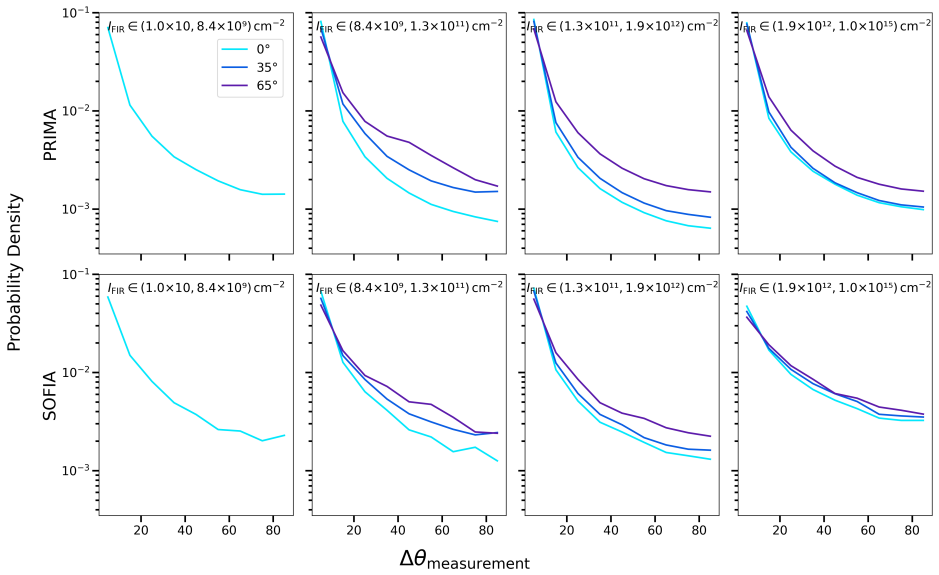
- PRIMA will nearly double the accuracy of magnetic-field orientation measurements: median $\Delta\theta \sim 6^\circ$ versus about $11^\circ$ for SOFIA, and about $8^\circ$ versus $19^\circ$ in the densest clumps.
- PRIMA will resolve polarized fraction and magnetic alignment down to about 20-pc scales for galaxies out to roughly 0.5 Mpc, sampling the turbulence coherence scale instead of averaging over it.
- PRIMA will reproduce the intrinsic polarization-dispersion relation ($\alpha = -0.27$) rather than SOFIA's beam-depolarized slope ($-0.52$), and will recover a positive $P$-$\zeta$ correlation in high-density regions that SOFIA flattens.
Reading between the lines
- An extension the authors leave implicit: if the simulated anti-correlation between 100-pc turbulence and magnetization is confirmed, observed turbulence fractions could become a statistical estimator of unresolved disk field strength.
- Because the ground truth is resolution-limited, PRIMA itself could be used to measure sub-beam field dispersion in real galaxies and check whether the simulated 10-pc structure is realistic.
- The inclination correction in Appendix B implies a practical strategy beyond the paper's face-on case: deprojecting observed alignment angles with $\theta_{\mathrm{int}} = \arctan(\tan\theta_{\mathrm{obs}} / \cos i)$ would let PRIMA recover small-scale alignment signals in inclined galaxies.
- A comparative test: galaxies with similar star formation but different mean field strengths, observed by PRIMA, would show whether the magnetization-alignment trend is universal or specific to these initial conditions.
Signed reviews
Editorial analysis
A structured set of objections, weighed in public.
Referee Report
Summary. The paper uses a suite of RAMSES cosmological MHD simulations of a face-on Milky Way-like galaxy with five initial magnetization strengths (MB10, MB11, MB12, MB20, MBinj) to generate synthetic far-infrared dust polarization maps via a geometric dust-alignment model. These maps are processed into SOFIA/HAWC+-like (300 pc) and PRIMA-like (20 pc at 0.5 Mpc) mock observations and compared with the simulation ground truth. The authors analyze the magnetic turbulence fraction at 100 pc scales, the alignment between magnetic fields and density structures, the angular separation between FIR-measured and intrinsic B-fields, the polarization fraction versus angular dispersion relation, and the magnetic alignment parameter ζ. The main claims are that magnetic turbulence increases with weaker magnetization, that PRIMA will recover intrinsic field orientations to roughly 6° precision and resolve observables at about 10 pc for galaxies up to 0.5 Mpc, that beam depolarization is significantly reduced with PRIMA, and that PRIMA will recover the polarization fraction–ζ correlation.
Significance. If the simulation ground truth is reliable, the qualitative trends—stronger magnetization suppressing small-scale magnetic turbulence and reducing alignment with density structures—are physically plausible and provide useful predictions for a proposed instrument. The paper's main strengths are its forward-modeling approach from independent MHD simulations, the use of externally calibrated dust parameters (p0=0.25, dust-to-metal ratio 0.4), and the explicit tests of inclination effects and of the magnetic-turbulence proxy in the appendices. The central limitation is the admitted non-convergence of the simulations at the 10–20 pc scales that the headline quantitative claims depend on; Section 2.2 states that convergence may require higher resolution by at least a few dex. The quantitative predictions (6° precision, 10 pc resolution) are therefore conditional on a numerical ground truth that has not been established, which is a load-bearing issue for the paper's most prominent claims.
major comments (4)
- [Abstract; §2.2; §3.3; Fig. 7] The headline claims that PRIMA will measure unresolved intrinsic magnetic field orientations to about 6° precision and resolve observables at about 10 pc rest on a simulation ground truth that the authors themselves state is not converged. Section 2.2 reads: 'convergence may still require higher resolution by at least a few dex [30, 31].' Because the intrinsic POS field used in Fig. 7 is a density-weighted column average of a field whose small-scale structure is not converged, the reported 6° median separation could reflect artificial smoothness introduced by the finite grid and numerical resistivity (Section 2.1) rather than astrophysical coherence. Please either provide a convergence study at higher resolution or explicitly temper the abstract and conclusions so that the 6° and 10 pc statements are presented as conditional on resolution convergence, not as robust predictions for real galaxies.
- [Abstract vs. §2.7 and §3.3] There is an internal inconsistency in the claimed spatial resolution. The abstract says PRIMA will resolve 'down to scales comparable to the resolution of our simulations (about 10 pc) for galaxies up to 0.5 Mpc away,' but Section 2.7 computes the PRIMA beam at 0.5 Mpc as 9.3 arcsec at 100 μm, giving about 20 pc, and Section 3.3 explicitly states 'down to scales of about 20 pc.' At 0.5 Mpc, 9.3 arcsec corresponds to roughly 20 pc, not 10 pc. The abstract overstates the resolution by a factor of two and should be corrected to state ~20 pc, with the ~10 pc figure reserved for the simulation cell size rather than the PRIMA beam.
- [§3.3; Fig. 7] The 'intrinsic magnetic field orientation' used as ground truth in Fig. 7 is the gas-density-weighted column-averaged POS field, not the full 3D magnetic field orientation. The 6° precision is therefore a statement about how well the mock pipeline recovers this column-averaged quantity under PRIMA-like smoothing, not a statement about recovery of the true local 3D field. This distinction should be stated explicitly whenever the 6° number is quoted, since the abstract's phrase 'unresolved intrinsic magnetic field orientations' risks overstating what is actually tested.
- [§4, conclusion item 2 vs. §3.1] The paper reports different values for SOFIA's deviation from ground truth in the turbulence fraction recovery. Section 3.1 states 'the SOFIA case has deviations of up to about 30 percent with respect to ground truth values,' while conclusion item 2 says SOFIA can recover with 'up to about 35 percent deviations.' Please reconcile these numbers or clarify whether they refer to different density ranges or different metrics, so that the conclusions are quantitatively consistent with the body of the paper.
minor comments (6)
- [Abstract] The abstract contains a typo: 'magnetic alignment paramater' should be 'parameter'.
- [§3.1] The paragraph introducing Fig. 4 repeats itself: 'In Fig. 4 we show the comparison...' is followed immediately by 'To further investigate the turbulence... we show a 2D histogram...'. Please remove the duplicated sentence and merge the two descriptions.
- [§2.9.2] When listing the dispersion radii, the sentence reads '10 pc, 13.6 arcsec (300 pc), and 9.3 arcsec (20 pc) for the simulation, SOFIA, and PRIMA.' Please explicitly state the assumed distances (simulation native resolution, 10 Mpc for SOFIA, 0.5 Mpc for PRIMA) in that sentence for consistency with Section 2.7.
- [Eq. (12)] Equation (12) appears to have a formatting issue: 'ζ = cos(2Δθ_spiral)' should probably read 'ζ = cos(2 Δθ_spiral)' or a closing parenthesis is missing; please check the typesetting.
- [Figure 1 caption] The caption states 'Colorscale values are displaced downwards by exactly 1 dex to reduce saturation.' This is unclear; please specify which quantity is displaced and why a one-dex offset is applied, or remove the sentence if it is not essential.
- [§2.10] The description of the 'quasi-asymmetrical binning' method is vague. The text says the highest and lowest bin edges are the maximum and minimum values, but it is not clear how many bins are used or how the low/high edges are set without making the bins pathologically wide. Please give the exact binning prescription.
Circularity Check
No circularity: the predictions are forward-modeled from independent MHD simulations with externally calibrated dust-polarization inputs; the simulation-resolution caveat is a correctness risk, not a circular step.
full rationale
The derivation chain is self-contained relative to its inputs. Mock Stokes maps (Eqs. 1-3) are produced by line-of-sight integration of the RAMSES MHD fields, with calibration constants p0,FIR = 0.25 and eta_D/M = 0.4 adopted from Planck and literature values, not fitted to the PRIMA or SOFIA quantities being predicted. The headline quantitative claims -- the approximately 6-degree Delta-theta separation between FIR-recovered and intrinsic field orientations (Section 3.3, Fig. 7) and the P-S relation slopes (Section 3.4, Fig. 8) -- are computed by comparing the mock FIR observables with the independent simulation ground truth, so they are genuine forward-modeled assessments rather than renamed fit parameters. The zeta estimator is adopted from the SALSA definition [13], but the P-zeta correlations are then measured from independently generated mock maps and compared with SALSA data, which provide external empirical confirmation; the overlap in authorship does not make the comparison circular. The admitted limitation in Section 2.2 ('convergence may still require higher resolution by at least a few dex [30, 31]') and the beam/distance arithmetic (9.3 arcsec at 0.5 Mpc gives 20 pc, not the 10 pc quoted in the abstract) are genuine threats to the correctness and precision of the predictions, but they do not make any predicted quantity equal to an input by construction: the simulated magnetic fields remain independent of the PRIMA mock-observation pipeline. No step in the paper reduces to its own input or to a load-bearing self-citation chain.
Assumptions & free parameters
free parameters (4)
- p0_FIR =
0.25
- eta_D/M =
0.4
- m_dust =
1.26e-14 g
- L_turb =
100 pc
assumptions (6)
- domain assumption Geometric dust polarization approximation (Eqs. 1-3) maps the local magnetic field to Stokes Q/U with fixed alignment efficiency p0.
- domain assumption Ideal MHD with zero physical resistivity; only numerical resistivity is present.
- domain assumption NUT galaxy initial conditions produce a representative Milky Way-like galaxy.
- domain assumption PRIMA will achieve the stated sensitivity of 5 microJy/arcsec^2 at 5 sigma and resolution of 9.3 arcsec at 100 micron.
- domain assumption Turbulence measured on 100 pc scale is converged at the 10 pc resolution of the simulations.
- domain assumption Temperature cut f_cut(T) selects the FIR-emitting cold phase.
Cite this review
Pith. "Pith review of PRIMA Vista: far-infrared polarimetry to unveil small-scale magnetohydrodynamics in extragalactic observations." pith.science (2026). https://pith.science/paper/2U77DO6A
@misc{pith2026250902533,
  author       = {Pith},
  title        = {Pith review of: PRIMA Vista: far-infrared polarimetry to unveil small-scale magnetohydrodynamics in extragalactic observations},
  year         = {2026},
  howpublished = {\url{https://pith.science/paper/2U77DO6A}},
  note         = {Machine review of arXiv:2509.02533}
}
read the original abstract
Magnetic fields are a fundamental part of the interstellar medium (ISM) and remain a challenge for building a comprehensive understanding of galactic properties. Their study requires far-infrared polarimetric observations, which provide an unrivaled probe of the dynamics, magnetization, and structure of the coldest and densest interstellar gas and dust at small scales in galaxies, where mass and star formation reside. We use high-resolution magnetohydrodynamical simulations of a face-on Milky Way-like galaxy and show that the alignment of magnetic fields with ISM structures and the turbulence at 100 pc scales decrease with increasing magnetization. We make predictions for extragalactic observations by the proposed PRobefarInfrared Mission for Astrophysics (PRIMA) telescope, comparing them with Stratospheric Observatory For Infrared Astronomy (SOFIA) observations similar to those of the Survey of extragALactic magnetiSm with SOFIA (SALSA). PRIMA will be able to better measure magnetic alignment trends inaccessible by SOFIA. We find that PRIMA will better sample magnetic turbulence, especially in dense environments, and will be able to measure the unresolved intrinsic magnetic field orientations to approximately 6 deg precision. PRIMA will also be capable of resolving observables such as the polarized fraction or the magnetic alignment down to scales comparable to the resolution of our simulations (about 10 pc) for galaxies up to 0.5 Mpc away. The polarization-dispersion relation shows that PRIMA observations will suffer from significantly reduced beam depolarization. Furthermore, PRIMA will recover the correlation between increasing the magnetic alignment parameter and local polarization fraction. Overall, observations of local galaxies with PRIMA will better characterize interstellar magnetism and constrain ISM and galaxy models, advancing our understanding of magnetism in the universe.
Figures


Figures from the paper (11 more)



Reference graph
Works this paper leans on
-
[1]
O. Iffrig and P. Hennebelle, “Structure distribution and turbulence in self-consistently supernova-driven ISM of multiphase magnetized galactic discs,”A&A 604, A70 (2017)
work page 2017
-
[2]
The impact of magnetic fields on thermal instability,
S. Ji, O. P. Oh, and M. McCourt, “The impact of magnetic fields on thermal instability,” MNRAS 476, 852–867 (2018)
work page 2018
-
[3]
The supernova-regulated ISM - VI. Magnetic effects on the structure of the interstellar medium,
C. C. Evirgen, F. A. Gent, A. Shukurov, et al., “The supernova-regulated ISM - VI. Magnetic effects on the structure of the interstellar medium,” MNRAS 488, 5065–5074 (2019)
work page 2019
-
[4]
C. Federrath and R. S. Klessen, “The star formation rate of turbulent magnetized clouds: Comparing theory, simulations, and observations,” ApJ 761, 156 (2012)
work page 2012
-
[5]
Global dynamics of the interstellar medium in magnetized disc galaxies,
B. K ¨ortgen, R. Banerjee, R. E. Pudritz, et al., “Global dynamics of the interstellar medium in magnetized disc galaxies,” MNRAS 489, 5004–5021 (2019). 26
work page 2019
-
[6]
How primordial magnetic fields shrink galaxies,
S. Martin-Alvarez, A. Slyz, J. Devriendt, et al. , “How primordial magnetic fields shrink galaxies,” MNRAS 495, 4475–4495 (2020)
work page 2020
-
[7]
Spiral-arm instability – II. Magnetic destabilization,
S. Inoue and N. Yoshida, “Spiral-arm instability – II. Magnetic destabilization,”MNRAS 485, 3024–3041 (2019)
work page 2019
-
[8]
Orion A’s complete 3D magnetic field morphol- ogy,
M. Tahani, J. Glover, W. Lupypciw, et al., “Orion A’s complete 3D magnetic field morphol- ogy,” A&A 660, L7 (2022)
work page 2022
Show all 57 references
-
[9]
Theory of Star Formation,
C. F. McKee and E. C. Ostriker, “Theory of Star Formation,” ARA&A 45, 565–687 (2007)
2007
-
[10]
Extragalactic Magnetism with SOFIA (SALSA Legacy Program). VII. A Tomographic View of Far-infrared and Radio Polarimetric Observations through MHD Simulations of Galaxies,
S. Martin-Alvarez, E. Lopez-Rodriguez, T. Dacunha, et al., “Extragalactic Magnetism with SOFIA (SALSA Legacy Program). VII. A Tomographic View of Far-infrared and Radio Polarimetric Observations through MHD Simulations of Galaxies,” ApJ 966, 43 (2024)
2024
-
[11]
The Fallibility of Equipartition Magnetic Field Strengths from Synchrotron Emission Using Synthetically Observed Galaxies,
T. Dacunha, S. Martin-Alvarez, S. E. Clark, et al., “The Fallibility of Equipartition Magnetic Field Strengths from Synchrotron Emission Using Synthetically Observed Galaxies,” ApJ 980, 197 (2025)
2025
-
[12]
Extragalactic Magnetism with SOFIA (SALSA Legacy Program). IV. Program Overview and First Results on the Polarization Fraction*,
E. Lopez-Rodriguez, S. A. Mao, R. Beck, et al. , “Extragalactic Magnetism with SOFIA (SALSA Legacy Program). IV. Program Overview and First Results on the Polarization Fraction*,” ApJ 936, 92 (2022)
2022
-
[13]
Extragalactic Magnetism with SOFIA (SALSA Legacy Program). V. First Results on the Magnetic Field Orientation of Galaxies,
A. S. Borlaff, E. Lopez-Rodriguez, R. Beck, et al., “Extragalactic Magnetism with SOFIA (SALSA Legacy Program). V. First Results on the Magnetic Field Orientation of Galaxies,” ApJ 952, 4 (2023)
2023
-
[14]
The spatial energy spectrum of magnetic fields in our galaxy,
J. L. Han, K. Ferriere, and R. N. Manchester, “The spatial energy spectrum of magnetic fields in our galaxy,”ApJ 610, 820 (2004)
2004
-
[15]
Supernova feedback in a local vertically stratified medium: interstellar turbulence and galactic winds,
D. Martizzi, D. Fielding, C.-A. Faucher-Gigu `ere, et al. , “Supernova feedback in a local vertically stratified medium: interstellar turbulence and galactic winds,” MNRAS 459, 2311– 2326 (2016)
2016
-
[16]
A three-phase amplification of the cosmic magnetic field in galaxies,
S. Martin-Alvarez, J. Devriendt, A. Slyz, et al., “A three-phase amplification of the cosmic magnetic field in galaxies,” MNRAS 479, 3343–3365 (2018)
2018
-
[17]
Dissipative magnetic structures and scales in small-scale dynamos,
A. Brandenburg, I. Rogachevskii, and J. Schober, “Dissipative magnetic structures and scales in small-scale dynamos,” MNRAS 518, 6367–6375 (2022)
2022
-
[18]
Polarised emission from aligned dust grains in nearby galaxies: Predictions from the Auriga simulations,
B. Vandenbroucke, M. Baes, P. Camps, et al., “Polarised emission from aligned dust grains in nearby galaxies: Predictions from the Auriga simulations,” A&A 653, A34 (2021)
2021
-
[19]
Submillimetre observations of the two-component magnetic field in M82,
K. Pattle, W. Gear, M. Redman, et al., “Submillimetre observations of the two-component magnetic field in M82,” MNRAS 505, 684–688 (2021)
2021
-
[20]
Polarized dust emission in Arp220: magnetic fields in the core of an ultraluminous infrared Galaxy,
D. L. Clements, Q. Zhang, K. Pattle, et al., “Polarized dust emission in Arp220: magnetic fields in the core of an ultraluminous infrared Galaxy,” MNRAS 537, L67–L71 (2025). 27
2025
-
[21]
PRIMA General Observer Science Book,
A. Moullet, T. Kataria, D. Lis,et al., “PRIMA General Observer Science Book,”arXiv e-prints , arXiv:2310.20572 (2023)
2023
-
[22]
Modelling Local Bubble analogs: synthetic dust polarization maps,
E. Maconi, J. D. Soler, S. Reissl, et al., “Modelling Local Bubble analogs: synthetic dust polarization maps,” MNRAS 523, 5995–6010 (2023)
2023
-
[23]
Synthetic observations of dust emission and polarisation of Galactic cold clumps,
M. Juvela, P. Padoan, I. Ristorcelli, et al. , “Synthetic observations of dust emission and polarisation of Galactic cold clumps,” A&A 629, A63 (2019)
2019
-
[24]
Unraveling the origin of magnetic fields in galaxies,
S. Martin-Alvarez, H. Katz, D. Sijacki, et al., “Unraveling the origin of magnetic fields in galaxies,” MNRAS 504, 2517–2534 (2021)
2021
-
[25]
Kinematic dynamos using constrained transport with high order Godunov schemes and adaptive mesh refinement,
R. Teyssier, S. Fromang, and E. Dormy, “Kinematic dynamos using constrained transport with high order Godunov schemes and adaptive mesh refinement,”Journal of Computational Physics 218, 44–67 (2006)
2006
-
[26]
A high order Godunov scheme with constrained transport and adaptive mesh refinement for astrophysical magnetohydrodynamics,
S. Fromang, P. Hennebelle, and R. Teyssier, “A high order Godunov scheme with constrained transport and adaptive mesh refinement for astrophysical magnetohydrodynamics,”A&A 457, 371–384 (2006)
2006
-
[27]
The div (B) = 0 Constraint in Shock-Capturing Magnetohydrodynamics Codes,
G. T ´oth, “The div (B) = 0 Constraint in Shock-Capturing Magnetohydrodynamics Codes,” Journal of Computational Physics 161, 605–652 (2000)
2000
-
[28]
The impact of supernova-driven winds on stream-fed protogalaxies,
L. C. Powell, A. Slyz, and J. Devriendt, “The impact of supernova-driven winds on stream-fed protogalaxies,” MNRAS 414, 3671–3689 (2011)
2011
-
[29]
Towards convergence of turbulent dynamo amplification in cosmological simulations of galaxies,
S. Martin-Alvarez, J. Devriendt, A. Slyz, et al., “Towards convergence of turbulent dynamo amplification in cosmological simulations of galaxies,” MNRAS 513, 3326–3344 (2022)
2022
-
[30]
The driving of turbulence in simulations of molecular cloud formation and evolution,
B. K ¨ortgen, C. Federrath, and R. Banerjee, “The driving of turbulence in simulations of molecular cloud formation and evolution,”MNRAS 472, 2496–2503 (2017)
2017
-
[31]
The Small-scale Dynamo in a Multiphase Supernova-driven Medium,
F. A. Gent, M.-M. Mac Low, M. J. Korpi-Lagg, et al. , “The Small-scale Dynamo in a Multiphase Supernova-driven Medium,” ApJ 943, 176 (2023)
2023
-
[32]
Observational constraints on energetic particle diffusion in young supernovae remnants: Amplified magnetic field and maximum energy,
E. Parizot, A. Marcowith, J. Ballet, et al., “Observational constraints on energetic particle diffusion in young supernovae remnants: Amplified magnetic field and maximum energy,” Astronomy and Astrophysics 453(2), 387–395 (2006)
2006
-
[33]
Planck 2015 results. XIX. Constraints on primordial magnetic fields,
Planck Collaboration, “Planck 2015 results. XIX. Constraints on primordial magnetic fields,” A&A 594, A19 (2015)
2015
-
[34]
Introducing SPHINX-MHD: the impact of primordial magnetic fields on the first galaxies, reionization, and the global 21-cm signal,
H. Katz, S. Martin-Alvarez, J. Rosdahl, et al., “Introducing SPHINX-MHD: the impact of primordial magnetic fields on the first galaxies, reionization, and the global 21-cm signal,” MNRAS 507, 1254–1282 (2021)
2021
-
[35]
Dwarf galaxies as a probe of a primordially magnetized Universe,
M. Sanati, S. Martin-Alvarez, J. Schober, et al., “Dwarf galaxies as a probe of a primordially magnetized Universe,” A&A 690, A59 (2024). 28
2024
-
[36]
Infrared extinction and polarization due to partially aligned spheroidal grains : models for the dust toward the BN object.,
H. M. Lee and B. T. Draine, “Infrared extinction and polarization due to partially aligned spheroidal grains : models for the dust toward the BN object.,” ApJ 290, 211–228 (1985)
1985
-
[37]
Polarized Submillimeter Emission from Filamentary Molecular Clouds,
J. D. Fiege and R. E. Pudritz, “Polarized Submillimeter Emission from Filamentary Molecular Clouds,” ApJ 544, 830–837 (2000)
2000
-
[38]
Planck intermediate results. XX. Comparison of polarized thermal emission from Galactic dust with simulations of MHD turbulence,
Planck Collaboration, P. A. R. Ade, N. Aghanim, et al., “Planck intermediate results. XX. Comparison of polarized thermal emission from Galactic dust with simulations of MHD turbulence,” A&A 576, A105 (2015)
2015
-
[39]
Change of Magnetic Field-gas Alignment at the Gravity-driven Alfv´enic Transition in Molecular Clouds: Implications for Dust Polarization Observations,
C.-Y. Chen, P. K. King, and Z.-Y. Li, “Change of Magnetic Field-gas Alignment at the Gravity-driven Alfv´enic Transition in Molecular Clouds: Implications for Dust Polarization Observations,” ApJ 829, 84 (2016)
2016
-
[40]
Modelling dust polarization observations of molecular clouds through MHD simulations,
P. K. King, L. M. Fissel, C.-Y. Chen, et al., “Modelling dust polarization observations of molecular clouds through MHD simulations,” MNRAS 474, 5122–5142 (2018)
2018
-
[41]
ALMA Polarimetry Mea- sures Magnetically Aligned Dust Grains in the Torus of NGC 1068,
E. Lopez-Rodriguez, A. Alonso-Herrero, S. Garc´ıa-Burillo, et al., “ALMA Polarimetry Mea- sures Magnetically Aligned Dust Grains in the Torus of NGC 1068,”ApJ 893, 33 (2020)
2020
-
[42]
Planck 2018 results. XII. Galactic astrophysics using polarized dust emission,
Planck Collaboration, N. Aghanim, Y. Akrami, et al., “Planck 2018 results. XII. Galactic astrophysics using polarized dust emission,” A&A 641, A12 (2020)
2020
-
[43]
The Evolution of the Elemental Abundances in the Gas and Dust Phases of the Galaxy,
E. Dwek, “The Evolution of the Elemental Abundances in the Gas and Dust Phases of the Galaxy,” ApJ 501, 643–665 (1998)
1998
-
[44]
Dust Masses, PAH Abundances, and Starlight Intensities in the SINGS Galaxy Sample,
B. T. Draine, D. A. Dale, G. Bendo, et al., “Dust Masses, PAH Abundances, and Starlight Intensities in the SINGS Galaxy Sample,” ApJ 663, 866–894 (2007)
2007
-
[45]
Interstellar Dust Models Consistent with Extinction, Emission, and Abundance Constraints,
V. Zubko, E. Dwek, and R. G. Arendt, “Interstellar Dust Models Consistent with Extinction, Emission, and Abundance Constraints,” The Astrophysical Journal Supplement Series 152, 211–249 (2004)
2004
-
[46]
Ly𝛼 radiative transfer with dust: Escape fractions from simulated high-redshift galaxies,
P. Laursen, J. Sommer-Larsen, and A. C. Andersen, “Ly𝛼 radiative transfer with dust: Escape fractions from simulated high-redshift galaxies,” ApJ 704, 1640–1656 (2009)
2009
-
[47]
Galaxies with grains: unraveling dust evolution and extinction curves with hydrodynamical simulations,
Y. Dubois, F. Rodr ´ıguez Montero, C. Guerra, et al., “Galaxies with grains: unraveling dust evolution and extinction curves with hydrodynamical simulations,”A&A 687, A240 (2024)
2024
-
[48]
HAWC+, the Far-Infrared Camera and Polarimeter for SOFIA,
D. A. Harper, M. C. Runyan, C. D. Dowell, et al., “HAWC+, the Far-Infrared Camera and Polarimeter for SOFIA,” Journal of Astronomical Instrumentation 7, 1840008–1025 (2018)
2018
-
[49]
Extragalactic Magnetism with SOFIA (SALSA Legacy Program). III. First Data Release and On-the-fly Polarization Mapping Char- acterization*,
E. Lopez-Rodriguez, M. Clarke, S. Shenoy, et al., “Extragalactic Magnetism with SOFIA (SALSA Legacy Program). III. First Data Release and On-the-fly Polarization Mapping Char- acterization*,” ApJ 936, 65 (2022)
2022
-
[50]
PACS and SPIRE photometer maps of M 33: First results of the HERschel M 33 Extended Survey (HERM33ES),
C. Kramer, C. Buchbender, E. M. Xilouris, et al., “PACS and SPIRE photometer maps of M 33: First results of the HERschel M 33 Extended Survey (HERM33ES),” A&A 518, L67 (2010). 29
2010
-
[51]
The Outer Scale of Turbulence in the Magnetoionized Galactic Interstellar Medium,
M. Haverkorn, J. C. Brown, B. M. Gaensler, et al., “The Outer Scale of Turbulence in the Magnetoionized Galactic Interstellar Medium,” ApJ 680, 362–370 (2008)
2008
-
[52]
Stellar population synthesis at the resolution of 2003,
G. Bruzual and S. Charlot, “Stellar population synthesis at the resolution of 2003,” MNRAS 344, 1000–1028 (2003)
2003
-
[53]
Planck intermediate results. XXXII. The relative orientation between the magnetic field and structures traced by interstellar dust,
Planck Collaboration, R. Adam, P. A. R. Ade, et al., “Planck intermediate results. XXXII. The relative orientation between the magnetic field and structures traced by interstellar dust,” A&A 586, A135 (2016)
2016
-
[54]
The Pandora project – I. The impact of radiation, magnetic fields, and cosmic rays on the baryonic and dark matter properties of dwarf galaxies,
S. Martin-Alvarez, D. Sijacki, M. G. Haehnelt, et al., “The Pandora project – I. The impact of radiation, magnetic fields, and cosmic rays on the baryonic and dark matter properties of dwarf galaxies,” MNRAS 525, 3806–3830 (2023)
2023
-
[55]
Planck intermediate results. XIX. An overview of the polarized thermal emission from Galactic dust,
Planck Collaboration, P. A. R. Ade, N. Aghanim, et al., “Planck intermediate results. XIX. An overview of the polarized thermal emission from Galactic dust,” A&A 576, A104 (2015)
2015
-
[56]
Efficient Three-dimensional NLTE Dust Radiative Transfer with SKIRT,
M. Baes, J. Verstappen, I. De Looze,et al., “Efficient Three-dimensional NLTE Dust Radiative Transfer with SKIRT,”ApJS 196, 22 (2011)
2011
-
[57]
Introducing the illustris project: Simulating the coevolution of dark and visible matter in the universe,
M. Vogelsberger, S. Genel, V. Springel, et al., “Introducing the illustris project: Simulating the coevolution of dark and visible matter in the universe,”MNRAS 444, 1518–1547 (2014). List of Figures 1 Observational Comparison of the Polarized Intensity Signal-to-Noise Between...
2014
Reviewed August 15, 2026 · model on record in the stance chip above.
Discussion (0). Continue with ORCID to comment.