EP260321a/SN 2026gzf: The Faintest Shock Breakout Associated with a Broad-Lined Supernova
Pith reviewed 2026-06-27 15:28 UTC · model grok-4.3
The pith
EP260321a marks shock breakout from a choked mildly relativistic outflow in a broad-lined Type Ic supernova.
A machine-rendered reading of the paper's core claim, the machinery that carries it, and where it could break.
Core claim
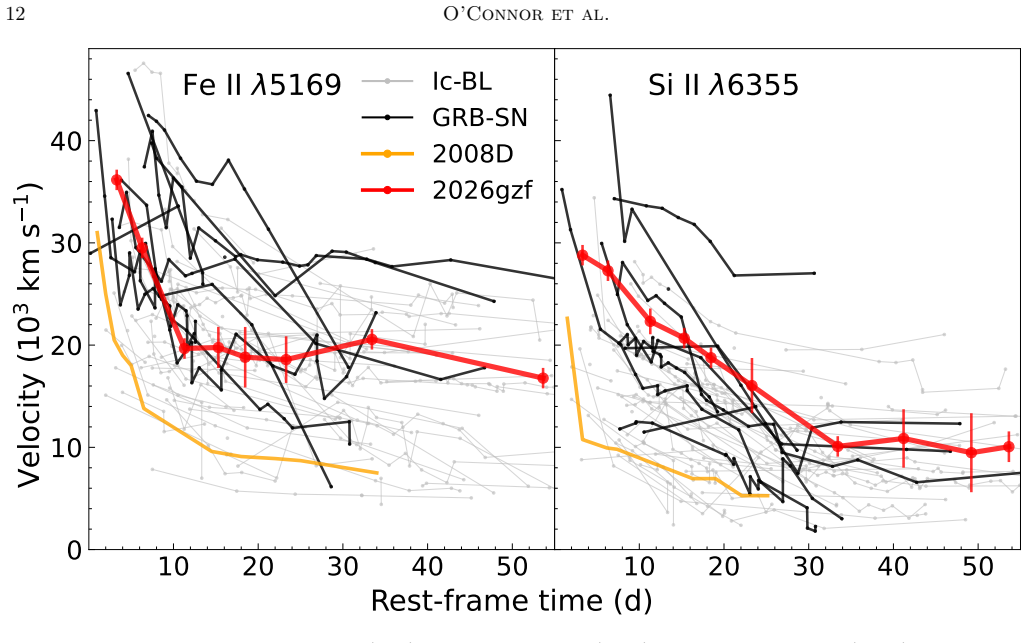
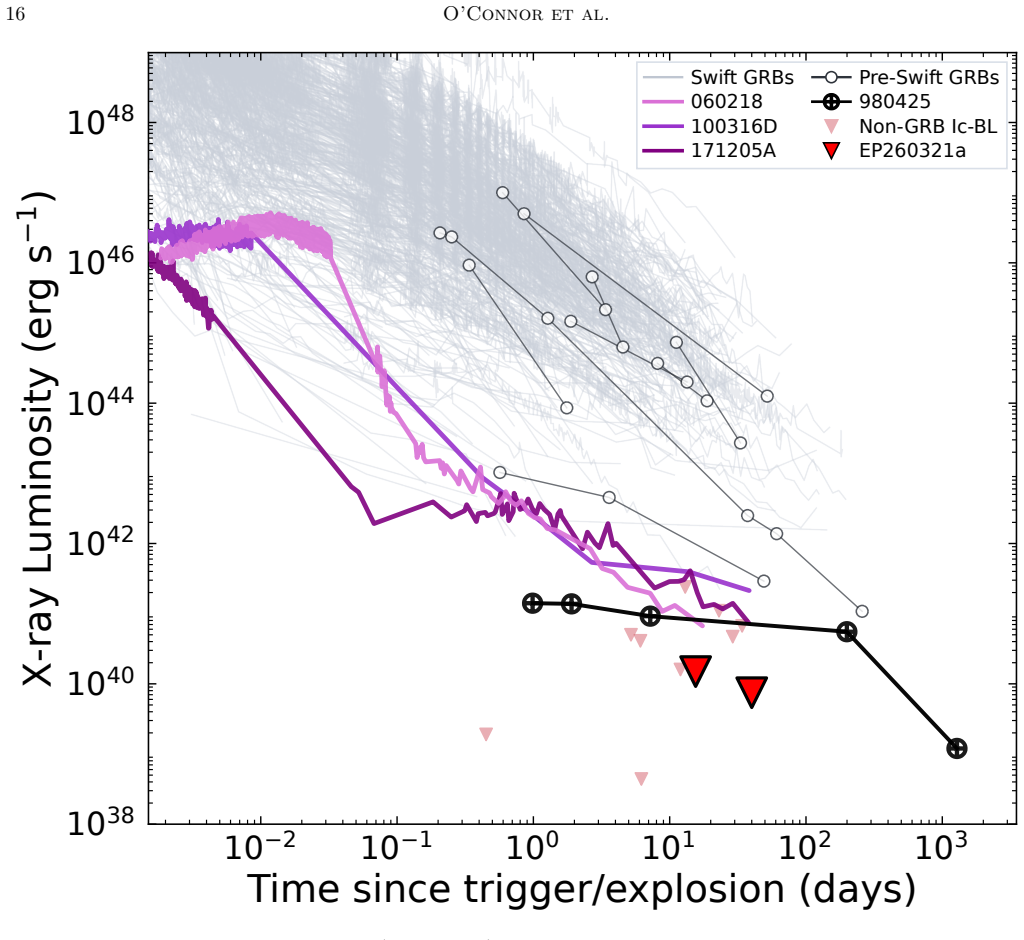
EP260321a originated from a mildly relativistic, weak outflow that was choked by the progenitor star of SN 2026gzf. The thermal X-ray emission with kT of 160 eV and luminosity 2.2 times 10 to the 44 erg per second is the shock breakout signature, while the lack of an X-ray afterglow excludes standard gamma-ray burst models for typical stellar-wind densities. The supernova itself shows spectral evolution, light-curve shape, and expansion velocities typical of energetic broad-lined Type Ic events linked to gamma-ray bursts, yet the explosion must have had Lorentz factor below 30 and kinetic energy below 10 to the 49 erg. This choked-outflow scenario accounts for the low X-ray output and missin
What carries the argument
the shock breakout produced by a mildly relativistic weak outflow choked inside the progenitor star
If this is right
- The supernova properties match those of gamma-ray burst associated events, yet no successful jet was launched.
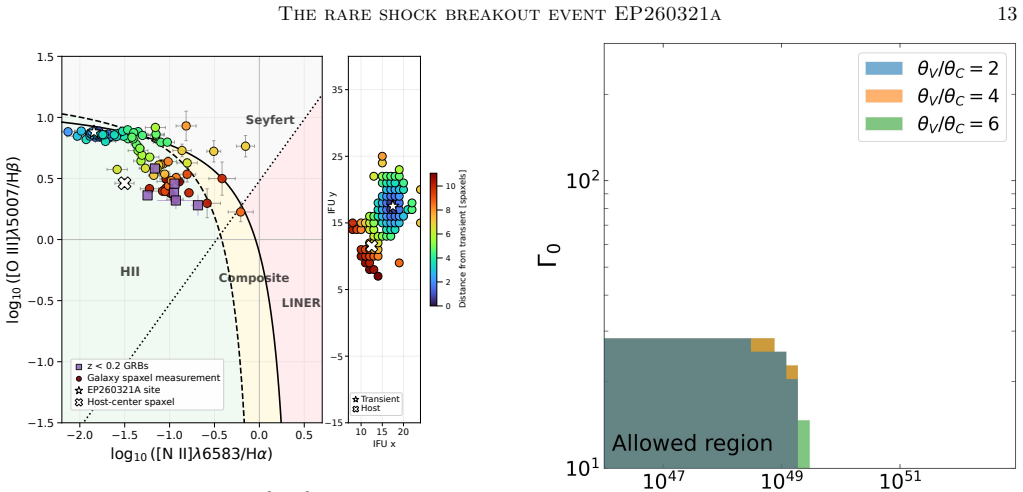
- The required outflow parameters are a Lorentz factor below 30 and kinetic energy below 10 to the 49 erg for stellar wind density parameter above 1.
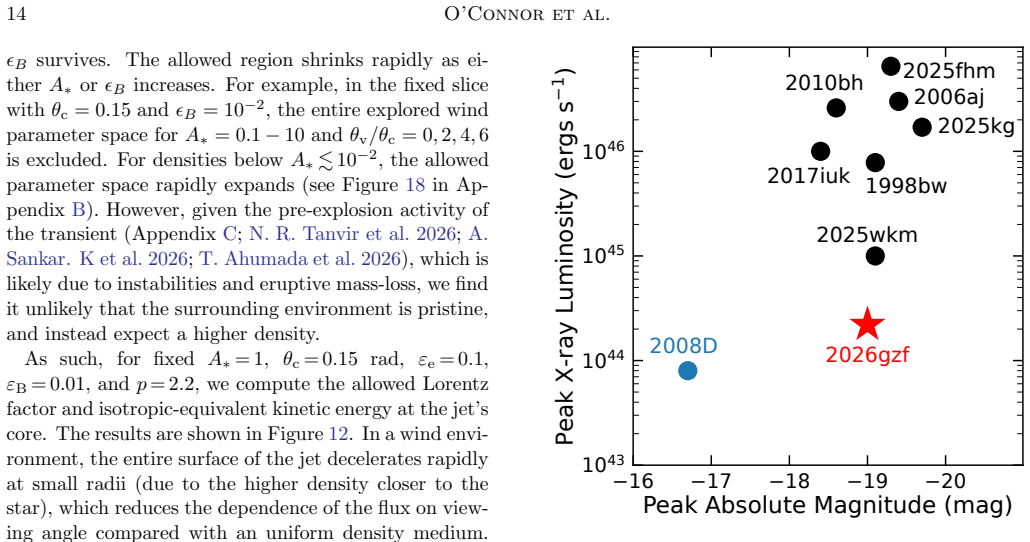
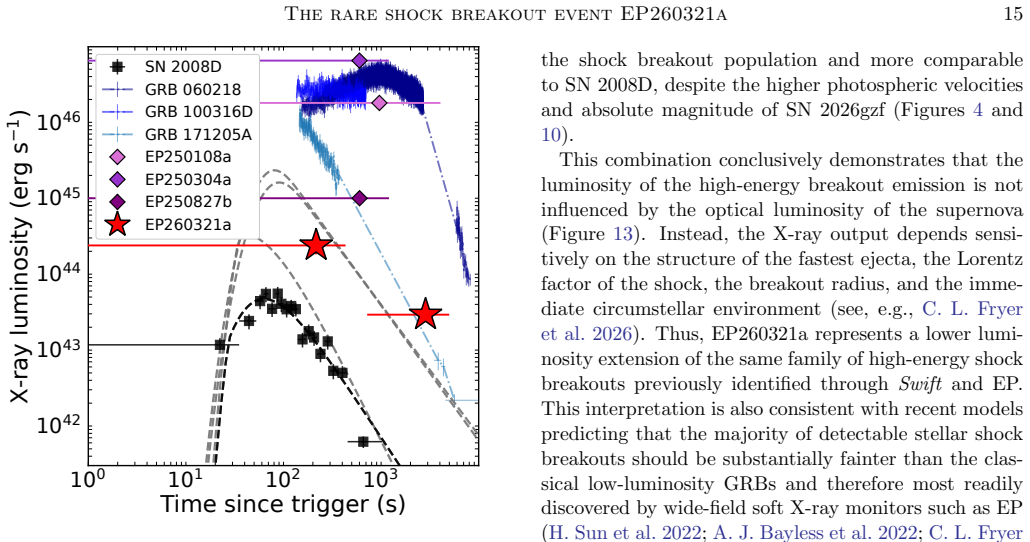
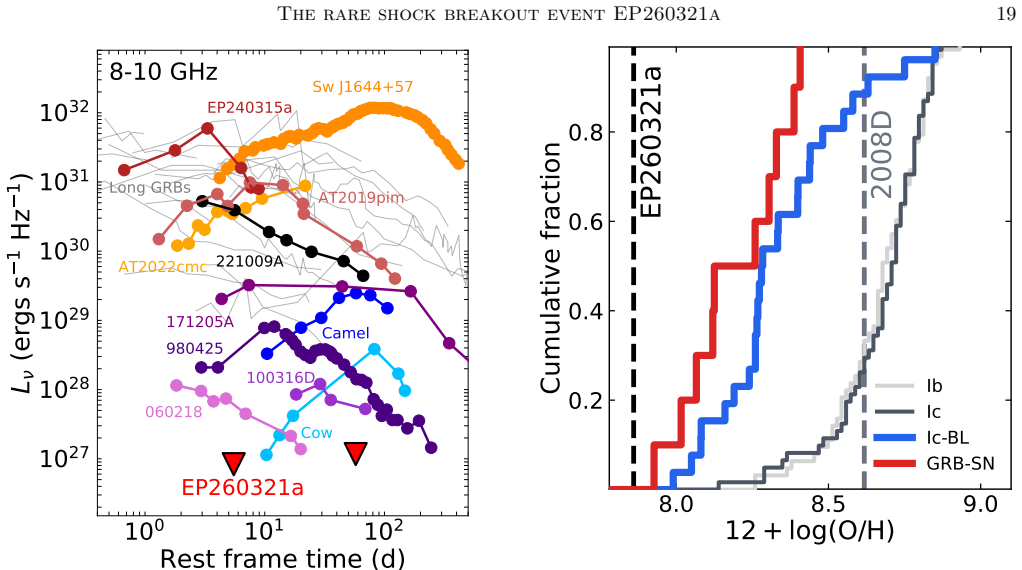
- EP260321a bridges the gap between SN 2008D and low-luminosity gamma-ray bursts.
- Stripped stars that undergo terminal collapse exhibit greater diversity in their explosion parameters than previously assumed.
Where Pith is reading between the lines
- Many energetic broad-lined supernovae may launch similar weak outflows that remain undetected because they produce even fainter X-ray signals.
- Targeted follow-up of future Einstein Probe or similar fast X-ray transients could identify additional examples of this intermediate population.
- The diversity in jet success may require revisions to models of how relativistic outflows form during core collapse.
Load-bearing premise
The observed thermal X-ray spectrum and luminosity are produced by shock breakout from the stellar surface rather than by other emission processes.
What would settle it
Detection of prompt gamma-ray emission or an X-ray afterglow consistent with a successful relativistic jet at the observed distance and density would contradict the choked-outflow model.
Figures
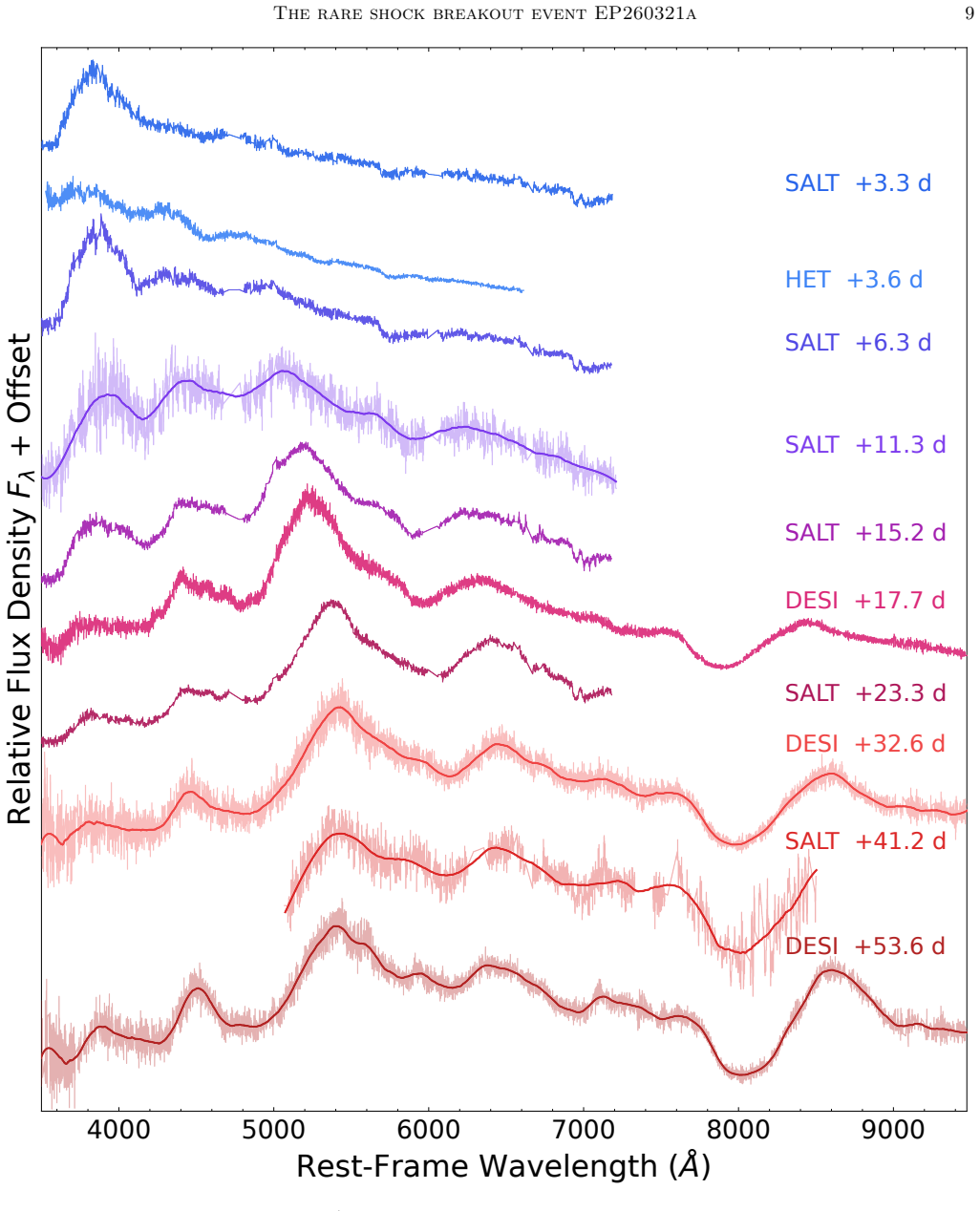
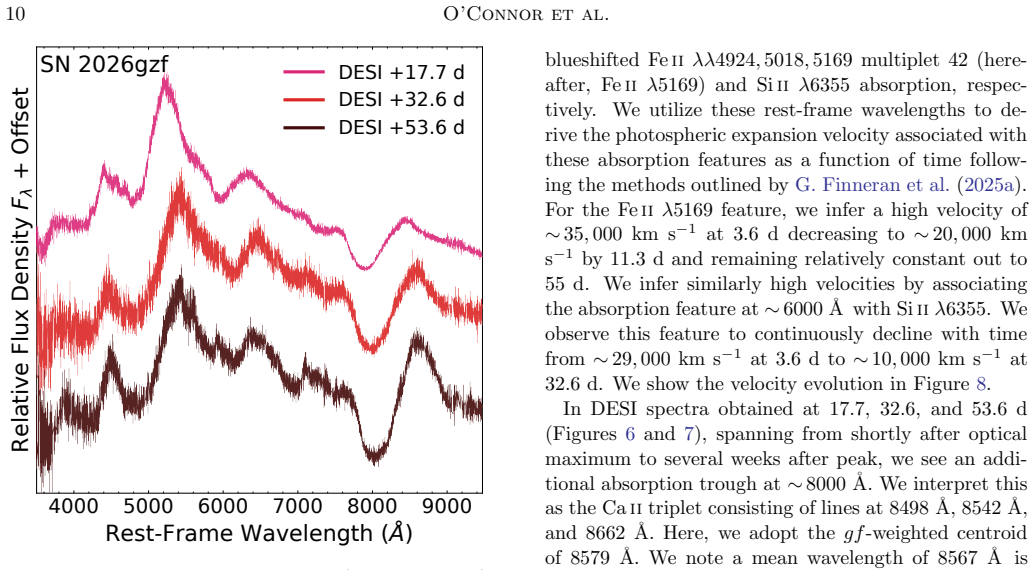
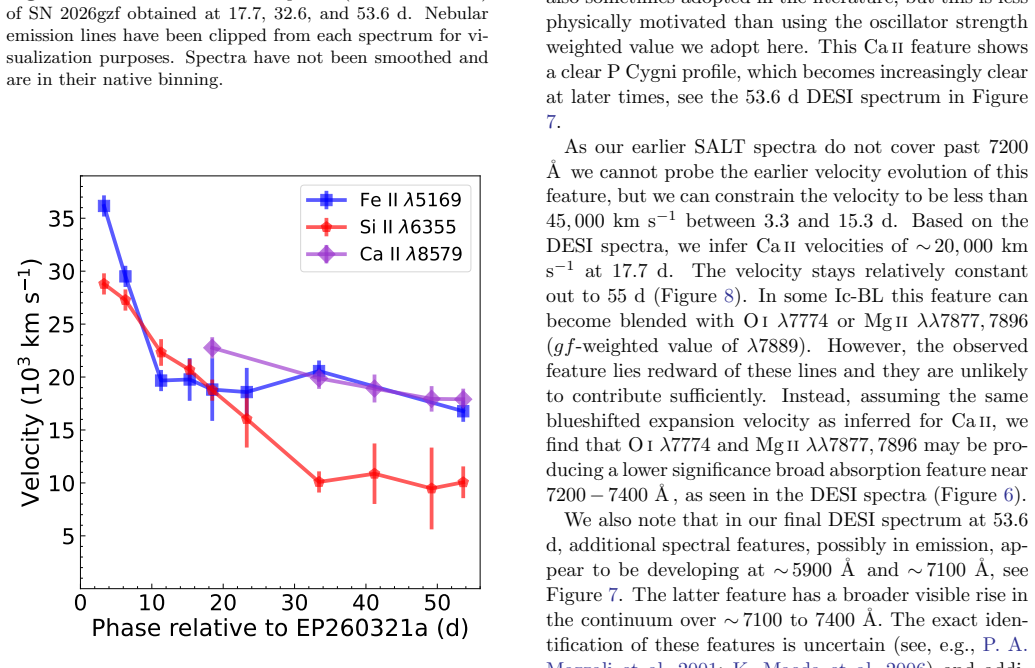
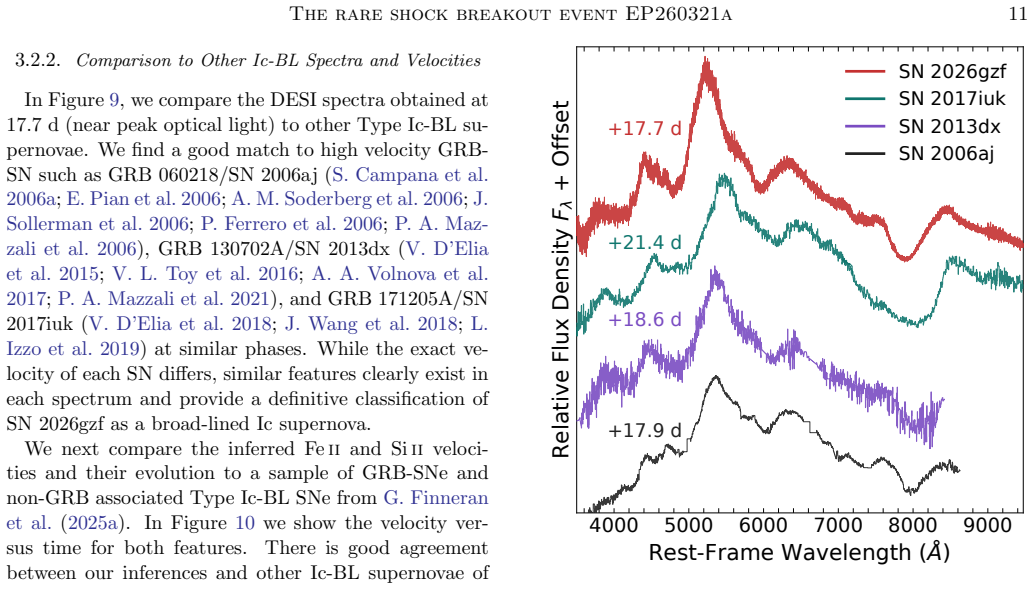
read the original abstract
The explosion of a star is first marked by the shock wave breaking out of the stellar surface, producing a burst of ultraviolet and X-ray radiation. These events are observationally rare, despite likely accompanying the majority of supernovae. Here, we report on our multi-wavelength observing campaign of the closest Einstein Probe fast X-ray transient EP260321a at $z=0.0344$. The thermal ($kT=160$ eV) X-ray emission with peak luminosity $2.2\times10^{44}$ erg s$^{-1}$ points to a shock breakout origin. We demonstrate that EP260321a is accompanied by a broad-lined Type Ic supernova, SN 2026gzf. The supernova properties, including its spectral evolution, lightcurve evolution, and expansion velocities, are all typical of the energetic stripped-envelope supernovae associated with gamma-ray bursts. However, deep X-ray upper limits obtained with the \textit{Chandra X-ray Observatory} do not detect an X-ray afterglow, and instead exclude the afterglow of known gamma-ray bursts or fast X-ray transients. If the stellar explosion launched a successful relativistic jet, we require that it had both a low Lorentz factor $\Gamma_0$\,$<$\,$30$ and a kinetic energy $E_\textrm{kin}$\,$<$\,$10^{49}$ erg for a stellar wind density of $A_*$\,$\gtrsim$\,$1$. We propose that EP260321a originated from a mildly relativistic, weak outflow that was choked by the progenitor star. This scenario is capable of naturally explaining its low X-ray luminosity and lack of prompt gamma-ray emission. EP260321a bridges the gap between SN 2008D and low-luminosity GRBs, suggesting a greater diversity in the physical parameters of stripped stars as they undergo terminal collapse.
Editorial analysis
A structured set of objections, weighed in public.
Referee Report
Summary. The manuscript reports multi-wavelength observations of the Einstein Probe fast X-ray transient EP260321a at z=0.0344, identifying a thermal X-ray component (kT=160 eV, peak luminosity 2.2×10^44 erg s^{-1}) as shock breakout and associating the event with broad-lined Type Ic supernova SN 2026gzf. Chandra non-detections are used to exclude standard GRB afterglows, implying that any successful relativistic jet must satisfy Γ0 < 30 and E_kin < 10^49 erg (for A* ≳ 1); the authors propose instead a mildly relativistic choked outflow that naturally accounts for the low X-ray luminosity and absent prompt gamma rays.
Significance. If the central interpretation holds, the event supplies an important observational bridge between shock-breakout events such as SN 2008D and low-luminosity GRBs, illustrating greater diversity in the terminal collapse of stripped stars. The multi-wavelength campaign, direct reporting of the thermal spectrum and luminosity, and application of standard afterglow modeling to derive jet-parameter upper limits constitute clear strengths.
major comments (1)
- [jet afterglow limits / discussion of Chandra constraints] The Chandra non-detection is stated to exclude afterglows from jets with Γ0 ≳ 30 and E_kin ≳ 10^49 erg only under the assumption A* ≳ 1 (abstract and the section deriving the jet limits). No independent measurement or modeling of the wind density parameter A* is presented from the SN 2026gzf light curve, spectra, or radio data. If the actual density is lower, standard GRB afterglow models remain compatible with the non-detection, removing the necessity of the choked-outflow scenario.
minor comments (2)
- [Abstract] The abstract and main text should explicitly flag that the choked-outflow preference is conditional on A* ≳ 1 and discuss the observational consequences if this assumption does not hold.
- Figure captions and axis labels for the X-ray light curve and spectral fits should be expanded to include all fitted parameters and the exact energy range used for the thermal component.
Simulated Author's Rebuttal
We thank the referee for the careful and constructive review. We address the single major comment below regarding the Chandra constraints and the A* assumption.
read point-by-point responses
-
Referee: The Chandra non-detection is stated to exclude afterglows from jets with Γ0 ≳ 30 and E_kin ≳ 10^49 erg only under the assumption A* ≳ 1 (abstract and the section deriving the jet limits). No independent measurement or modeling of the wind density parameter A* is presented from the SN 2026gzf light curve, spectra, or radio data. If the actual density is lower, standard GRB afterglow models remain compatible with the non-detection, removing the necessity of the choked-outflow scenario.
Authors: We agree that A* is an assumption rather than a quantity directly measured from SN 2026gzf light curves, spectra, or radio data. The manuscript already qualifies the derived limits with the phrase 'for a stellar wind density of A* ≳ 1'. We will revise the abstract and the jet-limits section to state this condition more prominently and to add a short discussion of literature values for A* in broad-lined Type Ic SN progenitors (typically A* ~ 0.1–10 for Wolf-Rayet winds). Under the standard assumption A* ≳ 1 the Chandra limits still exclude ordinary GRB afterglows, supporting the choked-outflow interpretation as a natural explanation for the low X-ray luminosity and absent gamma rays. If future observations constrain a lower A*, the jet-parameter bounds would relax, but the overall multi-wavelength properties would remain consistent with a weak, choked outflow. revision: yes
Circularity Check
No significant circularity; claims rest on observations and external models
full rationale
The paper reports direct multi-wavelength observations (thermal X-ray spectrum and luminosity, SN spectral/lightcurve properties, Chandra non-detection) and applies external afterglow models to derive conditional limits on jet parameters given A* ≳1. No derivation step reduces by construction to a fitted parameter from the same dataset, no self-citation is load-bearing for the central claim, and the density assumption is stated explicitly rather than derived internally. This matches the default expectation of a non-circular observational classification plus upper-limit argument.
Axiom & Free-Parameter Ledger
axioms (2)
- domain assumption The observed X-ray spectrum is thermal and arises from shock breakout at the stellar surface.
- domain assumption Standard GRB afterglow models apply to any relativistic jet launched by this progenitor.
invented entities (1)
-
mildly relativistic choked outflow
no independent evidence
Forward citations
Cited by 1 Pith paper
-
Pinning Down the Geometry of the Type Ic Broad-Line Supernova 2026gzf
Spectropolarimetry of SN 2026gzf indicates mostly spherical ejecta with axisymmetric Ca distribution viewed at ~40° from symmetry axis.
Reference graph
Works this paper leans on
-
[1]
On the Impact of Relativistic Gravity on the Rate of Tidal Disruption Events. , keywords =. doi:10.3847/1538-4357/ac85b3 , archivePrefix =. 2207.14301 , primaryClass =
-
[2]
GRB Coordinates Network , year = 2026, month = mar, volume =
EP260321a: ZTF and Rubin detections of the candidate optical counterpart to EP260321a. GRB Coordinates Network , year = 2026, month = mar, volume =
2026
-
[3]
The Supernova Impostor Impostor SN 1961V: Spitzer Shows That Zwicky Was Right (Again). , keywords =. doi:10.1088/0004-637X/737/2/76 , archivePrefix =. 1010.3704 , primaryClass =
-
[4]
Searching for electromagnetic emission in an AGN from the gravitational wave binary black hole merger candidate S230922g. , keywords =. doi:10.1103/PhysRevD.110.123029 , archivePrefix =. 2407.10698 , primaryClass =
-
[5]
Kilonova Constraints for the LIGO/Virgo/KAGRA Neutron Star Merger Candidate S250206dm: GW-MMADS Observations. , keywords =. doi:10.3847/2041-8213/adfd49 , archivePrefix =. 2506.22626 , primaryClass =
-
[6]
Astronomy and Computing , keywords =
The GRBSN webtool: An open-source repository for gamma-ray burst-supernova associations. Astronomy and Computing , keywords =. doi:10.1016/j.ascom.2025.100954 , archivePrefix =. 2411.08866 , primaryClass =
-
[7]
A GPU-Accelerated Transient Detection Pipeline for DECam Time-Domain Surveys. arXiv e-prints , keywords =. doi:10.48550/arXiv.2603.08593 , archivePrefix =. 2603.08593 , primaryClass =
-
[8]
SN 2009ip after a decade: the luminous blue variable progenitor is now gone. , keywords =. doi:10.1093/mnras/stac1669 , archivePrefix =. 2205.02896 , primaryClass =
-
[9]
A new and unusual LBV-like outburst from a Wolf-Rayet star in the outskirts of M33. , keywords =. doi:10.1093/mnras/staa061 , archivePrefix =. 2001.02725 , primaryClass =
-
[10]
SN 2009ip and SN 2010mc: core-collapse Type IIn supernovae arising from blue supergiants. , keywords =. doi:10.1093/mnras/stt2269 , archivePrefix =. 1308.0112 , primaryClass =
-
[11]
Discovery of Precursor Luminous Blue Variable Outbursts in Two Recent Optical Transients: The Fitfully Variable Missing Links UGC 2773-OT and SN 2009ip. , keywords =. doi:10.1088/0004-6256/139/4/1451 , archivePrefix =. 0909.4792 , primaryClass =
-
[12]
Luminous blue variable eruptions and related transients: diversity of progenitors and outburst properties. , keywords =. doi:10.1111/j.1365-2966.2011.18763.x , archivePrefix =. 1010.3718 , primaryClass =
-
[13]
Bellm, Eric C. and Kulkarni, Shrinivas R. and Graham, Matthew J. and Dekany, Richard and Smith, Roger M. and Riddle, Reed and Masci, Frank J. and Helou, George and Prince, Thomas A. and Adams, Scott M. and Barbarino, C. and Barlow, Tom and Bauer, James and Beck, Ron and Belicki, Justin and Biswas, Rahul and Blagorodnova, Nadejda and Bodewits, Dennis and B...
-
[14]
Masci, Frank J. and Laher, Russ R. and Rusholme, Ben and Shupe, David L. and Groom, Steven and Surace, Jason and Jackson, Edward and Monkewitz, Serge and Beck, Ron and Flynn, David and Terek, Scott and Landry, Walter and Hacopians, Eugean and Desai, Vandana and Howell, Justin and Brooke, Tim and Imel, David and Wachter, Stefanie and Ye, Quan-Zhi and Lin, ...
-
[15]
Bellm, Eric C. and Kulkarni, Shrinivas R. and Barlow, Tom and Feindt, Ulrich and Graham, Matthew J. and Goobar, Ariel and Kupfer, Thomas and Ngeow, Chow-Choong and Nugent, Peter and Ofek, Eran and Prince, Thomas A. and Riddle, Reed and Walters, Richard and Ye, Quan-Zhi , month = apr, year =. The. Publications of the Astronomical Society of the Pacific , p...
-
[16]
Graham, Matthew J. and Kulkarni, S. R. and Bellm, Eric C. and Adams, Scott M. and Barbarino, Cristina and Blagorodnova, Nadejda and Bodewits, Dennis and Bolin, Bryce and Brady, Patrick R. and Cenko, S. Bradley and Chang, Chan-Kao and Coughlin, Michael W. and De, Kishalay and Eadie, Gwendolyn and Farnham, Tony L. and Feindt, Ulrich and Franckowiak, Anna an...
-
[17]
Dekany, Richard and Smith, Roger M. and Riddle, Reed and Feeney, Michael and Porter, Michael and Hale, David and Zolkower, Jeffry and Belicki, Justin and Kaye, Stephen and Henning, John and Walters, Richard and Cromer, John and Delacroix, Alex and Rodriguez, Hector and Reiley, Daniel J. and Mao, Peter and Hover, David and Murphy, Patrick and Burruss, Rick...
-
[18]
BOOM and Babamul: a real-time, multi-survey, optical alert broker system operating at scale. arXiv e-prints , keywords =. doi:10.48550/arXiv.2511.00164 , archivePrefix =. 2511.00164 , primaryClass =
-
[19]
I - Analytic solutions for the early part of the light curve
Type I supernovae. I - Analytic solutions for the early part of the light curve. , keywords =. doi:10.1086/159681 , adsurl =
-
[20]
An Intermediate-mass Black Hole Lurking in A Galactic Halo Caught Alive during Outburst. arXiv e-prints , keywords =. doi:10.48550/arXiv.2501.09580 , archivePrefix =. 2501.09580 , primaryClass =
-
[21]
Transient MeV radiation from a relativistic tidal disruption candidate. arXiv e-prints , keywords =. doi:10.48550/arXiv.2507.18694 , archivePrefix =. 2507.18694 , primaryClass =
-
[22]
GRB Coordinates Network , year = 2025, month = jul, volume =
GRBs 250702B/C/D/E / EP250702a: Swift XRT localization. GRB Coordinates Network , year = 2025, month = jul, volume =
2025
-
[23]
Planck 2018 results. VI. Cosmological parameters. , keywords =. doi:10.1051/0004-6361/201833910 , archivePrefix =. 1807.06209 , primaryClass =
-
[24]
, title =
Submitted. , title =
-
[25]
, title =
In preparation. , title =
-
[26]
CASA, the Common Astronomy Software Applications for Radio Astronomy. , keywords =. doi:10.1088/1538-3873/ac9642 , archivePrefix =. 2210.02276 , primaryClass =
-
[27]
Expanded Sample of Small Magellanic Cloud Ultraviolet Dust Extinction Curves: Correlations between the 2175 A Bump, q _ PAH , Ultraviolet Extinction Shape, and N(H I)/A(V). , keywords =. doi:10.3847/1538-4357/ad4be1 , archivePrefix =. 2405.12792 , primaryClass =
-
[28]
Radio observations of the ultra-long GRB 220627A reveal a hot cocoon supporting the blue supergiant progenitor scenario. arXiv e-prints , keywords =. doi:10.48550/arXiv.2502.13435 , archivePrefix =. 2502.13435 , primaryClass =
-
[29]
On characterizing the variability properties of X-ray light curves from active galaxies. , keywords =. doi:10.1046/j.1365-2966.2003.07042.x , archivePrefix =. astro-ph/0307420 , primaryClass =
-
[30]
Long-term X-ray variability of Swift J1644+57. , keywords =. doi:10.1111/j.1365-2966.2012.20739.x , archivePrefix =. 1201.5210 , primaryClass =
-
[31]
Effective absorbing column density in the gamma-ray burst afterglow X-ray spectra. , keywords =. doi:10.1093/mnras/stu831 , archivePrefix =. 1405.4114 , primaryClass =
-
[32]
GRB Coordinates Network , year = 2025, month = jul, volume =
EP250702a/GRB 250702B, C, D, E: EP-FXT follow-up observation. GRB Coordinates Network , year = 2025, month = jul, volume =
2025
-
[33]
Spitzer Space Telescope Observations of Magnetic Cataclysmic Variables: Possibilities for the Presence of Dust in Polars. , keywords =. doi:10.1086/512797 , archivePrefix =. astro-ph/0701307 , primaryClass =
-
[34]
Studies in Astronomical Time Series Analysis. VI. Bayesian Block Representations. , keywords =. doi:10.1088/0004-637X/764/2/167 , archivePrefix =. 1207.5578 , primaryClass =
-
[35]
SN IA light curves and radioactive decay. , keywords =. doi:10.48550/arXiv.astro-ph/9707016 , archivePrefix =. astro-ph/9707016 , primaryClass =
-
[36]
Analytical Light Curve Models of Superluminous Supernovae: ^ 2 -minimization of Parameter Fits. , keywords =. doi:10.1088/0004-637X/773/1/76 , archivePrefix =. 1306.3447 , primaryClass =
-
[37]
The Hydrogen-poor Superluminous Supernovae from the Zwicky Transient Facility Phase I Survey. II. Light-curve Modeling and Characterization of Undulations. , keywords =. doi:10.3847/1538-4357/aca162 , archivePrefix =. 2202.02060 , primaryClass =
-
[38]
Winds from massive stars: implications for the afterglows of -ray bursts. , keywords =. doi:10.1046/j.1365-8711.2001.04762.x , archivePrefix =. astro-ph/0012396 , primaryClass =
-
[39]
Expanding Relativistic Shells and Gamma-Ray Burst Temporal Structure. , keywords =. doi:10.1086/178210 , archivePrefix =. astro-ph/9607163 , primaryClass =
-
[40]
The Diversity of Gamma-Ray Burst Afterglows and the Surroundings of Massive Stars. , keywords =. doi:10.1086/382867 , archivePrefix =. astro-ph/0311326 , primaryClass =
-
[41]
Are gamma-ray bursts optically thick?. , keywords =. doi:10.1086/184741 , adsurl =
-
[42]
, year = 1994, month = oct, volume =
A model of gamma-ray bursts. , year = 1994, month = oct, volume =. doi:10.1093/mnras/270.3.480 , adsurl =
-
[43]
Constraints on gamma-ray burst and supernova progenitors through circumstellar absorption lines. , keywords =. doi:10.1051/0004-6361:20053520 , archivePrefix =. astro-ph/0507659 , primaryClass =
-
[44]
The afterglow of GRB 021004: Surfing on density waves. , keywords =. doi:10.1051/0004-6361:20021618 , archivePrefix =. astro-ph/0210333 , primaryClass =
-
[45]
GRB 221009A afterglow from a shallow angular structured jet. , keywords =. doi:10.1093/mnrasl/slad075 , archivePrefix =. 2304.14331 , primaryClass =
-
[46]
Theory and Diagnostics of Hot Star Mass Loss. , keywords =. doi:10.1146/annurev-astro-052920-094949 , archivePrefix =. 2109.08164 , primaryClass =
-
[47]
The circumstellar environment of Wolf-Rayet stars and gamma-ray burst afterglows. , keywords =. doi:10.1111/j.1365-2966.2005.09938.x , archivePrefix =. astro-ph/0509749 , primaryClass =
-
[48]
ASASSN-15lh: A highly super-luminous supernova. Science , keywords =. doi:10.1126/science.aac9613 , archivePrefix =. 1507.03010 , primaryClass =
-
[49]
iPTF 16asu: A Luminous, Rapidly Evolving, and High-velocity Supernova. , keywords =. doi:10.3847/1538-4357/aa99de , archivePrefix =. 1706.05018 , primaryClass =
-
[50]
A Luminous, Fast Rising UV-transient Discovered by ROTSE: A Tidal Disruption Event?. , keywords =. doi:10.1088/0004-637X/798/1/12 , archivePrefix =. 1410.6014 , primaryClass =
-
[51]
The Swift Gamma-Ray Burst Mission. , keywords =. doi:10.1086/422091 , archivePrefix =. astro-ph/0405233 , primaryClass =
-
[52]
GRB Coordinates Network , year = 2024, month = apr, volume =
EP240408a: Swift follow-up observation. GRB Coordinates Network , year = 2024, month = apr, volume =
2024
-
[53]
Luminous Supernovae: Unveiling a Population between Superluminous and Normal Core-collapse Supernovae. , keywords =. doi:10.3847/1538-4357/ac9842 , archivePrefix =. 2204.08486 , primaryClass =
-
[54]
The Type I superluminous supernova catalogue I: light-curve properties, models, and catalogue description. , keywords =. doi:10.1093/mnras/stae2270 , archivePrefix =. 2407.07946 , primaryClass =
-
[55]
Jets in Hydrogen-poor Superluminous Supernovae: Constraints from a Comprehensive Analysis of Radio Observations. , keywords =. doi:10.3847/1538-4357/aab36e , archivePrefix =. 1711.03428 , primaryClass =
-
[56]
A Radio Source Coincident with the Superluminous Supernova PTF10hgi: Evidence for a Central Engine and an Analog of the Repeating FRB 121102?. , keywords =. doi:10.3847/2041-8213/ab18a5 , archivePrefix =. 1901.10479 , primaryClass =
-
[57]
MOSFiT: Modular Open Source Fitter for Transients. , keywords =. doi:10.3847/1538-4365/aab761 , archivePrefix =. 1710.02145 , primaryClass =
-
[58]
The diversity of transients from magnetar birth in core collapse supernovae. , keywords =. doi:10.1093/mnras/stv2224 , archivePrefix =. 1508.02712 , primaryClass =
-
[59]
The NOIRLab Mirror , year = 2021, month = jan, volume =
NOIRLab Astro Data Archive. The NOIRLab Mirror , year = 2021, month = jan, volume =
2021
-
[60]
The Properties of NI CO Fe Decay. , keywords =. doi:10.1086/192008 , adsurl =
-
[61]
An extremely energetic supernova from a very massive star in a dense medium. Nature Astronomy , keywords =. doi:10.1038/s41550-020-1066-7 , archivePrefix =. 2004.05840 , primaryClass =
-
[62]
The Magnetar Model for Type I Superluminous Supernovae. I. Bayesian Analysis of the Full Multicolor Light-curve Sample with MOSFiT. , keywords =. doi:10.3847/1538-4357/aa9334 , archivePrefix =. 1706.00825 , primaryClass =
-
[63]
A Mildly Relativistic Outflow from the Energetic, Fast-rising Blue Optical Transient CSS161010 in a Dwarf Galaxy. , keywords =. doi:10.3847/2041-8213/ab8cc7 , archivePrefix =. 2003.10503 , primaryClass =
-
[64]
SN 2023zaw: the low-energy explosion of an ultra-stripped star. arXiv e-prints , keywords =. doi:10.48550/arXiv.2405.13596 , archivePrefix =. 2405.13596 , primaryClass =
-
[65]
Hydrodynamic Timescales and Temporal Structure of Gamma-Ray Bursts. , keywords =. doi:10.1086/309835 , archivePrefix =. astro-ph/9508081 , primaryClass =
-
[66]
Astrophysics: refreshed shocks from a -ray burst. , keywords =. doi:10.1038/426138a , archivePrefix =. astro-ph/0304563 , primaryClass =
-
[67]
Some Observational Consequences of Gamma-Ray Burst Shock Models. , keywords =. doi:10.1086/308537 , archivePrefix =. astro-ph/9906002 , primaryClass =
-
[68]
Variability in GRB afterglows and GRB 021004. , keywords =. doi:10.1016/S1384-1076(03)00044-7 , archivePrefix =. astro-ph/0210631 , primaryClass =
-
[69]
Hydrodynamics of Relativistic Blast Waves in a Density-Jump Medium and Their Emission Signature. , keywords =. doi:10.1086/339418 , archivePrefix =. astro-ph/0111454 , primaryClass =
-
[70]
SN 2023zaw: An Ultrastripped, Nickel-poor Supernova from a Low-mass Progenitor. , keywords =. doi:10.3847/2041-8213/ad527a , archivePrefix =. 2403.08165 , primaryClass =
-
[71]
Supernova PTF 09UJ: A Possible Shock Breakout from a Dense Circumstellar Wind. , keywords =. doi:10.1088/0004-637X/724/2/1396 , archivePrefix =. 1009.5378 , primaryClass =
-
[72]
Investigating the properties of stripped-envelope supernovae; what are the implications for their progenitors?. , keywords =. doi:10.1093/mnras/sty3399 , archivePrefix =. 1812.03716 , primaryClass =
-
[73]
, year = 1995, month = feb, volume =
Konus-W Gamma-Ray Burst Experiment for the GGS Wind Spacecraft. , year = 1995, month = feb, volume =. doi:10.1007/BF00751332 , adsurl =
-
[74]
Experimental Astronomy , keywords =
On-ground calibration of low gain response for Gamma-Ray Detectors onboard the GECAM satellite. Experimental Astronomy , keywords =. doi:10.1007/s10686-023-09892-x , adsurl =
-
[75]
arXiv e-prints , keywords =
The Soft X-ray Aspect of Gamma-ray Bursts in the Einstein Probe Era. arXiv e-prints , keywords =
-
[76]
Photospheric Prompt Emission from Long Gamma Ray Burst Simulations. III. X-Ray Spectropolarimetry. , keywords =. doi:10.3847/1538-4357/ad6dd8 , archivePrefix =. 2407.01831 , primaryClass =
-
[77]
The Observed Offset Distribution of Gamma-Ray Bursts from Their Host Galaxies: A Robust Clue to the Nature of the Progenitors. , keywords =. doi:10.1086/338893 , archivePrefix =. astro-ph/0010176 , primaryClass =
-
[78]
pysynphot: Synthetic photometry software package
-
[79]
Journal of Astrophysics and Astronomy , keywords =
The Cadmium Zinc Telluride Imager on AstroSat. Journal of Astrophysics and Astronomy , keywords =. doi:10.1007/s12036-017-9447-8 , archivePrefix =. 1608.03408 , primaryClass =
-
[80]
AT2018cow: A Luminous Millimeter Transient. , keywords =. doi:10.3847/1538-4357/aaf473 , archivePrefix =. 1810.10880 , primaryClass =
discussion (0)
Sign in with ORCID, Apple, or X to comment. Anyone can read and Pith papers without signing in.