REVIEW 2 minor 53 references
Full-Domain Coupler: A Wireless Native Neural Backbone for Channel Representation and Deduction
T0 review · 0 major / 2 minor · reviewed 2026-06-26 · grok-4.3
Pith's one-line read Coupler decomposes CSI representation into domain-specific layers then couples them via dimension-staggered cascades.
desk verdict Coupler introduces a domain-decomposed neural backbone for CSI that is worth refereeing to verify the claimed efficiency gains. read the letter →
The pith
A machine-rendered reading of the paper's core claim, the machinery that carries it, and where it could break.
The reading
What carries the argument
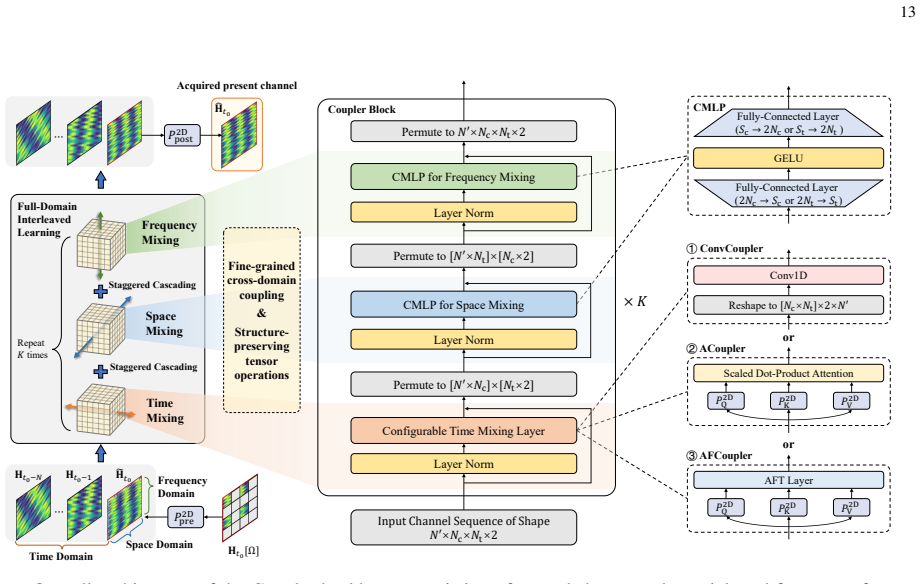
The dimension-staggered cascade that interleaves features from domain-specific learners (CMLPs for space and frequency, plus convolution/attention/gating for time).
What would settle it
An experiment in which a conventional network without per-domain layer decomposition matches or exceeds Coupler on both accuracy and parameter count for the same channel deduction tasks would falsify the claimed advantage.
Extended reading notes
Core claim
Coupler leverages the physical insights of channel tensors to decompose representation learning into individual domains on a layer-by-layer basis, and then couples the learned domain-specific features through a dimension-staggered cascade. This full-domain interleaved learning architecture enables superior parameter efficiency and fine-grained multi-domain feature fusion.
Load-bearing premise
The physical insights of channel tensors permit effective decomposition of representation learning into individual domains on a layer-by-layer basis.
Editorial extensions
If this is right
- Produces multiple lightweight schemes by pairing CMLPs with optional temporal mechanisms for diverse channel tasks.
- Delivers measurable gains on channel estimation, interpolation, prediction, and feedback.
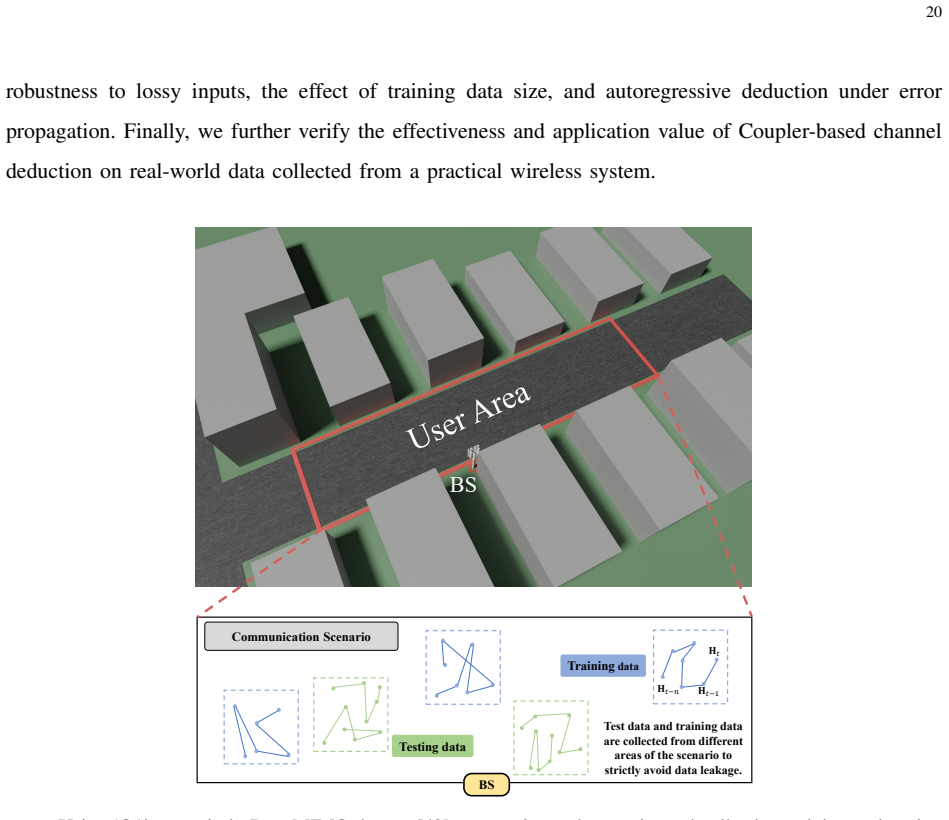
- Retains performance when tested on real-world measured CSI data.
- Offers a candidate basic architecture for larger wireless foundation models.
Reading between the lines
- The same layer-wise domain split might apply to other tensor-structured signals that have separable physical dimensions.
- If the cascade coupling proves stable, it could reduce the need for heavy attention mechanisms in wireless models.
Signed reviews
Editorial analysis
A structured set of objections, weighed in public.
Referee Report
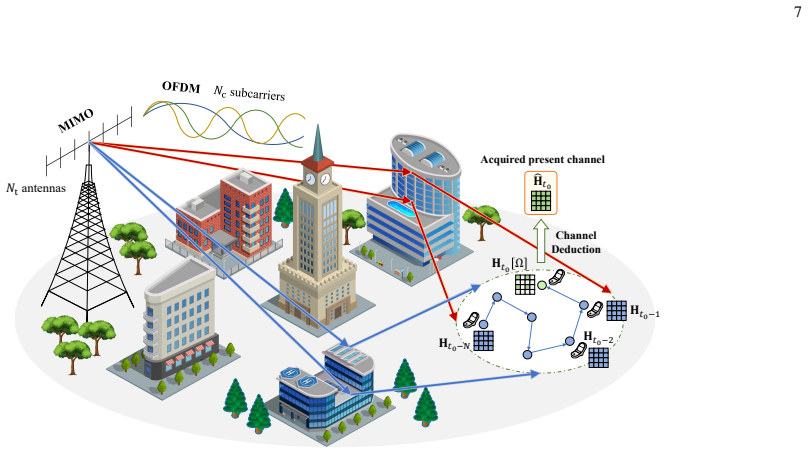
Summary. The paper proposes Coupler, a wireless-native neural backbone for CSI representation learning. It decomposes representation learning into individual physical domains (space, frequency, time) on a layer-by-layer basis based on channel tensor insights, then couples the domain-specific features via a dimension-staggered cascade. The architecture employs complex-domain MLPs for spatial/frequency domains and optional mechanisms (convolution, attention, or gating) for temporal dependencies, yielding lightweight schemes evaluated on the general channel deduction task (estimation, interpolation, prediction, feedback) with reported gains in parameter efficiency, multi-domain fusion, and performance on both simulated and real measured data.
Significance. If the central claims hold, the work supplies a dedicated architecture that directly addresses structural redundancy in general-purpose networks for wireless data, offering a potential foundational component for wireless foundation models. Strengths include the explicit grounding in channel tensor structure, the resulting parameter efficiency, the flexibility across temporal mechanisms, and the inclusion of real-world measured data validation.
minor comments (2)
- [Abstract] The abstract states that the architecture 'enables superior parameter efficiency' but does not quantify the parameter counts or FLOPs relative to the stitched general-purpose baselines; adding these numbers in §4 or Table 1 would strengthen the efficiency claim.
- Notation for the dimension-staggered cascade and the exact layer-by-layer decomposition is introduced in the abstract without a forward reference to the corresponding diagram or equations; a brief pointer would improve readability.
Simulated Author's Rebuttal
We thank the referee for the positive and accurate summary of our work, the recognition of its significance as a potential foundational architecture, and the recommendation for minor revision. No specific major comments or requested changes were listed in the report.
Circularity Check
No significant circularity detected
full rationale
The paper proposes Coupler as a new neural backbone architecture explicitly motivated by physical properties of channel tensors, with domain decomposition and staggered coupling presented as design choices rather than derived predictions. No equations or claims in the abstract reduce a result to a fitted parameter or self-citation by construction; the architecture is described as enabling efficiency and fusion, with evaluation on channel deduction tasks treated as external validation. The derivation chain remains self-contained against the stated physical insights without load-bearing self-referential steps.
Assumptions & free parameters
assumptions (1)
- domain assumption Channel tensors possess physical insights that permit layer-by-layer domain decomposition
invented entities (1)
-
Coupler neural backbone
Cite this review
Pith. "Pith review of Full-Domain Coupler: A Wireless Native Neural Backbone for Channel Representation and Deduction." pith.science (2026). https://pith.science/paper/2UKQXIBP
@misc{pith2026260622038,
  author       = {Pith},
  title        = {Pith review of: Full-Domain Coupler: A Wireless Native Neural Backbone for Channel Representation and Deduction},
  year         = {2026},
  howpublished = {\url{https://pith.science/paper/2UKQXIBP}},
  note         = {Machine review of arXiv:2606.22038}
}
read the original abstract
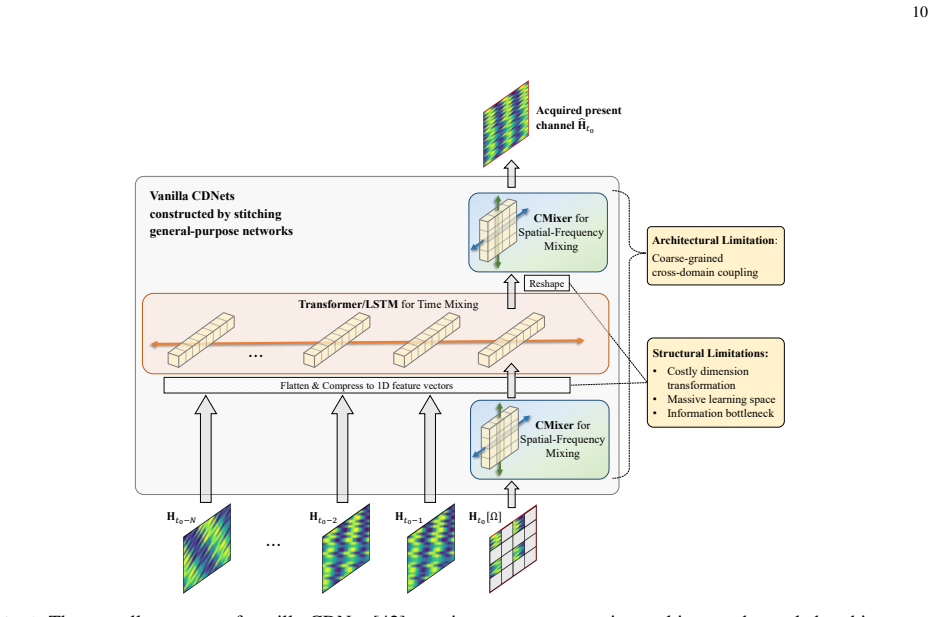
Data representation is a fundamental issue in deep learning. However, as wireless data scales and deeply couples across many physical domains such as time, space, and frequency, existing wireless artificial intelligence (AI) technologies lack dedicated representation solutions. Instead, they mainly rely on stitching general-purpose networks, a tool-driven paradigm that inevitably results in structural redundancy and bottlenecks in information flow. To fill this gap, this paper proposes Coupler, a wireless native-AI neural backbone designed for representation learning of channel state information (CSI)--the pivotal data in wireless systems. Leveraging the revealed physical insights of channel tensors, Coupler decomposes representation learning into individual domains on a layer-by-layer basis, and then couples the learned domain-specific features through a dimension-staggered cascade. This full-domain interleaved learning architecture enables superior parameter efficiency and fine-grained multi-domain feature fusion. Based on this backbone, we use the complex-domain multilayer perceptrons (CMLPs) as spatial and frequency domain learners, while employing three optional mechanisms--convolution, attention, or gating--to capture temporal dependencies. This results in a series of efficient channel learning schemes with diverse functionalities and extreme lightweights, showcasing the compactness, versatility and flexibility of Coupler. We evaluate these schemes on channel deduction, a general representation task encompassing channel estimation, interpolation, prediction, and feedback. Extensive experimental evaluations validate their significant performance gains and robust applicability even for real-world measured data, demonstrating the potential of Coupler as a promising basic architecture in the design of wireless foundation models.
Figures
Figures from the paper (11 more)
Reference graph
Works this paper leans on
-
[1]
Parameter-efficient channel deduction based on full-domain interleaved learning,
Z. Xing, Z. Chen, Z. Zhanget al., “Parameter-efficient channel deduction based on full-domain interleaved learning,” in IEEE International Symposium on Personal, Indoor and Mobile Radio Communications (PIMRC), 2026 (accepted)
2026
-
[2]
Framework and overall objectives of the future development of IMT for 2030 and beyond,
International Telecommunication Union, “Framework and overall objectives of the future development of IMT for 2030 and beyond,” ITU-R, Tech. Rep. Recommendation M.2160-0, Nov 2023
-
[3]
ComAI: The convergence of communication and artificial intelligence,
P. Zhang, K. Niu, X. Wanget al., “ComAI: The convergence of communication and artificial intelligence,”IEEE Commun. Surveys Tuts., vol. 28, pp. 2163–2197, 2026
2026
-
[4]
Toward wisdom-evolutionary and primitive-concise 6G: A new paradigm of semantic communication networks,
P. Zhang, W. Xu, H. Gaoet al., “Toward wisdom-evolutionary and primitive-concise 6G: A new paradigm of semantic communication networks,”Engineering, vol. 8, pp. 60–73, 2022
2022
-
[5]
Big AI models for 6G wireless networks: Opportunities, challenges, and research directions,
Z. Chen, Z. Zhang, and Z. Yang, “Big AI models for 6G wireless networks: Opportunities, challenges, and research directions,”IEEE Wireless Commun., vol. 31, no. 5, pp. 164–172, 2024
2024
-
[6]
Toward a 6G AI-native air interface,
J. Hoydis, F. A. Aoudia, A. Valcarceet al., “Toward a 6G AI-native air interface,”IEEE Commun. Mag., vol. 59, no. 5, pp. 76–81, 2021
2021
-
[7]
Way to build native AI-driven 6G air interface: Principles, roadmap, and outlook,
P. Zhang, K. Niu, Y . Liuet al., “Way to build native AI-driven 6G air interface: Principles, roadmap, and outlook,”IEEE Trans. Netw. Sci. Eng., vol. 13, pp. 3551–3565, 2026
2026
-
[8]
A task-driven design approach for 6G AI-native architecture,
X. Wang, L. Lu, Q. Liet al., “A task-driven design approach for 6G AI-native architecture,”Engineering, vol. 56, pp. 87–103, 2026
2026
Show all 53 references
-
[9]
Situation-aware resource allocation for multi-dimensional intelligent multiple access: A proactive deep learning framework,
Y . Liu, X. Wang, J. Meiet al., “Situation-aware resource allocation for multi-dimensional intelligent multiple access: A proactive deep learning framework,”IEEE J. Sel. Areas Commun., vol. 39, no. 1, pp. 116–130, 2020
2020
-
[10]
Intelligent beam management based on deep reinforcement learning in high-speed railway scenarios,
Y . Qiao, Y . Niu, X. Zhanget al., “Intelligent beam management based on deep reinforcement learning in high-speed railway scenarios,”IEEE Trans. V eh. Technol., vol. 73, no. 3, pp. 3917–3931, 2023
2023
-
[11]
The Agentic-AI core: An AI-empowered, mission-oriented core network for next-generation mobile telecommunications,
X. Li, W. Shi, H. Zhanget al., “The Agentic-AI core: An AI-empowered, mission-oriented core network for next-generation mobile telecommunications,”Engineering, vol. 56, pp. 104–119, 2026
2026
-
[12]
Towards wireless native big AI model: the mission and approach differ from large language model,
Z. Chen, Z. Zhang, C. Liuet al., “Towards wireless native big AI model: the mission and approach differ from large language model,”Sci. China Inf. Sci., vol. 68, no. 7, p. 170303, 2025
2025
-
[13]
Wireless environmental information theory: A new paradigm toward 6G online and proactive environment intelligence communication,
J. Zhang, L. Yu, S. Liuet al., “Wireless environmental information theory: A new paradigm toward 6G online and proactive environment intelligence communication,”Engineering, vol. 56, pp. 186–200, 2026. June 23, 2026 DRAFT 34
2026
-
[14]
Acquisition of channel state information for mmwave massive MIMO: Traditional and machine learning-based approaches,
C. Qi, P. Dong, W. Maet al., “Acquisition of channel state information for mmwave massive MIMO: Traditional and machine learning-based approaches,”Sci. China Inf. Sci., vol. 64, no. 8, p. 181301, 2021
2021
-
[15]
Overview of deep learning-based CSI feedback in massive MIMO systems,
J. Guo, C.-K. Wen, S. Jinet al., “Overview of deep learning-based CSI feedback in massive MIMO systems,”IEEE Trans. Commun., vol. 70, no. 12, pp. 8017–8045, 2022
2022
-
[16]
From data-driven learning to physics-inspired inferring: A novel mobile MIMO channel prediction scheme based on neural ODE,
Z. Xiao, Z. Zhang, Z. Chenet al., “From data-driven learning to physics-inspired inferring: A novel mobile MIMO channel prediction scheme based on neural ODE,”IEEE Trans. Wireless Commun., vol. 23, no. 7, pp. 7186–7199, 2023
2023
-
[17]
A hybrid inference architecture incorporating neural network with belief propagation for AI receivers,
Y . Yang, Z. Zhang, Z. Chenet al., “A hybrid inference architecture incorporating neural network with belief propagation for AI receivers,”IEEE Trans. Wireless Commun., vol. 24, no. 8, pp. 6365–6381, 2025
2025
-
[18]
Multi-sources fusion learning for multi-points NLOS localization in OFDM system,
B. Wang, Z. Shuai, C. Huanget al., “Multi-sources fusion learning for multi-points NLOS localization in OFDM system,” IEEE J. Sel. Topics Signal Process., vol. 18, no. 7, pp. 1339–1350, 2024
2024
-
[19]
Analogical learning for cross-scenario generalization: Framework and application to intelligent localization,
Z. Chen, Z. Zhang, Z. Xinget al., “Analogical learning for cross-scenario generalization: Framework and application to intelligent localization,”arXiv preprint arXiv:2504.08811, 2025
2025
-
[20]
Multi-view wireless sensing via conditional generative learning: Framework and model design,
Z. Xing, Z. Zhang, Z. Chenet al., “Multi-view wireless sensing via conditional generative learning: Framework and model design,”IEEE Trans. Wireless Commun., vol. 25, pp. 12 691–12 708, 2026
2026
-
[21]
Deep learning-based channel estimation,
M. Soltani, V . Pourahmadi, A. Mirzaeiet al., “Deep learning-based channel estimation,”IEEE Commun. Lett., vol. 23, no. 4, pp. 652–655, 2019
2019
-
[22]
Deep residual learning meets OFDM channel estimation,
L. Li, H. Chen, H.-H. Changet al., “Deep residual learning meets OFDM channel estimation,”IEEE Wireless Commun. Lett., vol. 9, no. 5, pp. 615–618, May 2020
2020
-
[23]
Deep learning based channel estimation algorithm for fast time-varying MIMO-OFDM systems,
Y . Liao, Y . Hua, and Y . Cai, “Deep learning based channel estimation algorithm for fast time-varying MIMO-OFDM systems,”IEEE Commun. Lett., vol. 24, no. 3, pp. 572–576, Mar. 2020
2020
-
[24]
Deep learning for TDD and FDD massive MIMO: Mapping channels in space and frequency,
M. Alrabeiah and A. Alkhateeb, “Deep learning for TDD and FDD massive MIMO: Mapping channels in space and frequency,” inAsilomar Conference on Signals, Systems, and Computers (Asilomar), 2019, pp. 1465–1470
2019
-
[25]
Channel mapping based on interleaved learning with complex-domain MLP-mixer,
Z. Chen, Z. Zhang, Z. Yanget al., “Channel mapping based on interleaved learning with complex-domain MLP-mixer,” IEEE Wireless Commun. Lett., vol. 13, no. 5, pp. 1369–1373, 2024
2024
-
[26]
Deep learning based channel extrapolation for large-scale antenna systems: Opportunities, challenges and solutions,
S. Zhang, Y . Liu, F. Gaoet al., “Deep learning based channel extrapolation for large-scale antenna systems: Opportunities, challenges and solutions,”IEEE Wireless Commun., vol. 28, no. 6, pp. 160–167, 2021
2021
-
[27]
Deep learning for massive MIMO CSI feedback,
C.-K. Wen, W.-T. Shih, and S. Jin, “Deep learning for massive MIMO CSI feedback,”IEEE Wireless Commun. Lett., vol. 7, no. 5, pp. 748–751, 2018
2018
-
[28]
Convolutional neural network-based multiple-rate compressive sensing for massive MIMO CSI feedback: Design, simulation, and analysis,
J. Guo, C.-K. Wen, S. Jinet al., “Convolutional neural network-based multiple-rate compressive sensing for massive MIMO CSI feedback: Design, simulation, and analysis,”IEEE Trans. Wireless Commun., vol. 19, no. 4, pp. 2827–2840, Apr. 2020
2020
-
[29]
SALDR: Joint self-attention learning and dense refine for massive MIMO CSI feedback with multiple compression ratio,
X. Song, J. Wang, J. Wanget al., “SALDR: Joint self-attention learning and dense refine for massive MIMO CSI feedback with multiple compression ratio,”IEEE Wireless Commun. Lett., vol. 10, no. 9, pp. 1899–1903, Sep. 2021
1903
-
[30]
A lightweight deep network for efficient CSI feedback in massive MIMO systems,
Y . Sun, W. Xu, L. Lianget al., “A lightweight deep network for efficient CSI feedback in massive MIMO systems,”IEEE Wireless Commun. Lett., vol. 10, no. 8, pp. 1840–1844, Jun. 2021
2021
-
[31]
Viewing channel as sequence rather than image: A 2-D Seq2Seq approach for efficient MIMO-OFDM CSI feedback,
Z. Chen, Z. Zhang, Z. Xiaoet al., “Viewing channel as sequence rather than image: A 2-D Seq2Seq approach for efficient MIMO-OFDM CSI feedback,”IEEE Trans. Wireless Commun., vol. 22, no. 11, pp. 7393–7407, Nov. 2023
2023
-
[32]
Deep learning for fading channel prediction,
W. Jiang and H. D. Schotten, “Deep learning for fading channel prediction,”IEEE Open J. Commun. Soc., vol. 1, pp. 320–332, Mar. 2020
2020
-
[33]
Channel state information prediction for 5G wireless communications: A deep learning approach,
C. Luo, J. Ji, Q. Wanget al., “Channel state information prediction for 5G wireless communications: A deep learning approach,”IEEE Trans. Netw. Sci. Eng., vol. 7, no. 1, pp. 227–236, Jan.-Mar. 2020. June 23, 2026 DRAFT 35
2020
-
[34]
Accurate channel prediction based on Transformer: Making mobility negligible,
H. Jiang, M. Cui, D. W. K. Nget al., “Accurate channel prediction based on Transformer: Making mobility negligible,” IEEE J. Sel. Areas Commun., vol. 40, no. 9, pp. 2717–2732, 2022
2022
-
[35]
Mobile MIMO channel prediction with ODE-RNN: A physics-inspired adaptive approach,
Z. Xiao, Z. Zhang, Z. Chenet al., “Mobile MIMO channel prediction with ODE-RNN: A physics-inspired adaptive approach,” inIEEE Annual International Symposium on Personal, Indoor and Mobile Radio Communications (PIMRC), 2022, pp. 1301–1307
2022
-
[36]
C-GRBFnet: A physics-inspired generative deep neural network for channel representation and prediction,
Z. Xiao, Z. Zhang, C. Huanget al., “C-GRBFnet: A physics-inspired generative deep neural network for channel representation and prediction,”IEEE J. Sel. Areas Commun., vol. 40, no. 8, pp. 2282–2299, Aug. 2022
2022
-
[37]
CSI-based positioning in massive MIMO systems using convolutional neural networks,
S. Bast, A. Guevara, and S. Pollin, “CSI-based positioning in massive MIMO systems using convolutional neural networks,” inIEEE V ehicular Technology Conference (VTC-Spring), 2020, pp. 1–5
2020
-
[38]
Machine-learning assisted outdoor localization via sector-based fog massive MIMO,
H. Pirzadeh, C. Wang, and H. Papadopoulos, “Machine-learning assisted outdoor localization via sector-based fog massive MIMO,” inIEEE International Conference on Communications (ICC), 2019, pp. 1–6
2019
-
[39]
Deep learning-based multi-user positioning in wireless FDMA cellular networks,
Z. Chen, Z. Zhang, Z. Xiaoet al., “Deep learning-based multi-user positioning in wireless FDMA cellular networks,” IEEE J. Sel. Areas Commun., vol. 41, no. 12, pp. 3848–3862, 2023
2023
-
[40]
Attention-aided outdoor localization in commercial 5G NR systems,
G. Tian, D. Pjani ´c, X. Caiet al., “Attention-aided outdoor localization in commercial 5G NR systems,”IEEE Trans. Mach. Learn. Commun. Netw., vol. 2, pp. 1678–1692, 2024
2024
-
[41]
Synergizing global pattern learning and time order characterization in mobile channel prediction: An RWKV-based approach,
Z. Wang, Z. Chen, R. Liet al., “Synergizing global pattern learning and time order characterization in mobile channel prediction: An RWKV-based approach,” 2026. [Online]. Available: https://arxiv.org/abs/2606.16170
2026
-
[42]
Channel deduction: A new learning framework to acquire channel from outdated samples and coarse estimate,
Z. Chen, Z. Zhang, Z. Yanget al., “Channel deduction: A new learning framework to acquire channel from outdated samples and coarse estimate,”IEEE J. Sel. Areas Commun., vol. 43, no. 3, pp. 944–958, 2025
2025
-
[43]
Spatial channel deduction: Acquiring channel from approximate position and coarse estimate,
Z. Chen, Z. Zhang, Z. Xinget al., “Spatial channel deduction: Acquiring channel from approximate position and coarse estimate,” in2025 IEEE 36th International Symposium on Personal, Indoor and Mobile Radio Communications (PIMRC). Istanbul, Turkiye: IEEE, 2025, pp. 1–6
2025
-
[44]
Multi-input multi-output fading channel tracking and equalization using Kalman estimation,
C. Komninakis, C. Fragouli, A. H. Sayedet al., “Multi-input multi-output fading channel tracking and equalization using Kalman estimation,”IEEE Trans. Signal Process., vol. 50, no. 5, pp. 1065–1076, 2002
2002
-
[45]
Deep learning-based CSI feedback approach for time-varying massive MIMO channels,
T. Wang, C.-K. Wen, S. Jinet al., “Deep learning-based CSI feedback approach for time-varying massive MIMO channels,” IEEE Wireless Commun. Lett., vol. 8, no. 2, pp. 416–419, 2018
2018
-
[46]
Geometry-aided channel deduction: A robust channel acquisition framework utilizing coarse scenario prompt,
H. Ruan, Z. Zhang, Z. Chenet al., “Geometry-aided channel deduction: A robust channel acquisition framework utilizing coarse scenario prompt,”arXiv preprint arXiv:2605.07425, 2026
2026 arXiv
-
[47]
Attention is all you need,
A. Vaswani, N. Shazeer, N. Parmaret al., “Attention is all you need,”Advances in neural information processing systems, vol. 30, 2017
2017
-
[48]
An Attention free Transformer,
S. Zhai, W. Talbott, N. Srivastavaet al., “An Attention free Transformer,”arXiv preprint arXiv:2105.14103, 2021
2021
-
[49]
DeepMIMO: A generic deep learning dataset for millimeter wave and massive MIMO applications,
A. Alkhateeb, “DeepMIMO: A generic deep learning dataset for millimeter wave and massive MIMO applications,” in Proceedings of the Information Theory and Applications Workshop (ITA), San Diego, CA, USA, 2019, pp. 1–8
2019
-
[50]
Convolutional LSTM network: A machine learning approach for precipitation nowcasting,
X. Shi, Z. Chen, H. Wanget al., “Convolutional LSTM network: A machine learning approach for precipitation nowcasting,” Advances in neural information processing systems, vol. 28, 2015
2015
-
[51]
Adam: A method for stochastic optimization,
D. Kingma and J. Ba, “Adam: A method for stochastic optimization,”arXiv preprint arXiv:1412.6980, 2014
2014 arXiv
-
[52]
A distributed massive MIMO channel sounder for “big CSI data
F. Euchner, M. Gauger, S. Dörneret al., “A distributed massive MIMO channel sounder for “big CSI data”-driven machine learning,” in25th International ITG Workshop on Smart Antennas (WSA), French Riviera, France, 2021, pp. 1–6
2021
-
[53]
Channel estimation for OFDM systems based on comb-type pilot arrangement in frequency selective fading channels,
M. H. Hsieh and C. Wei, “Channel estimation for OFDM systems based on comb-type pilot arrangement in frequency selective fading channels,”IEEE Trans. Consum. Electron., vol. 44, no. 1, pp. 217–225, 1998. June 23, 2026 DRAFT
1998
Reviewed June 26, 2026 · model on record in the stance chip above.
Discussion (0). Continue with ORCID to comment.