Optimization of Tessellation-based Statistics: Void Statistics
Pith reviewed 2026-06-26 12:08 UTC · model grok-4.3
The pith
A subsampling and averaging scheme stabilizes tessellation-based void statistics and boosts their signal-to-noise ratios along with cosmological constraints.
A machine-rendered reading of the paper's core claim, the machinery that carries it, and where it could break.
Core claim
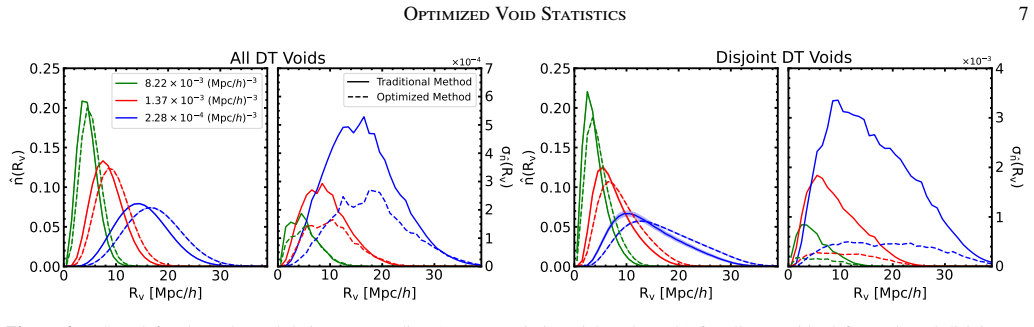
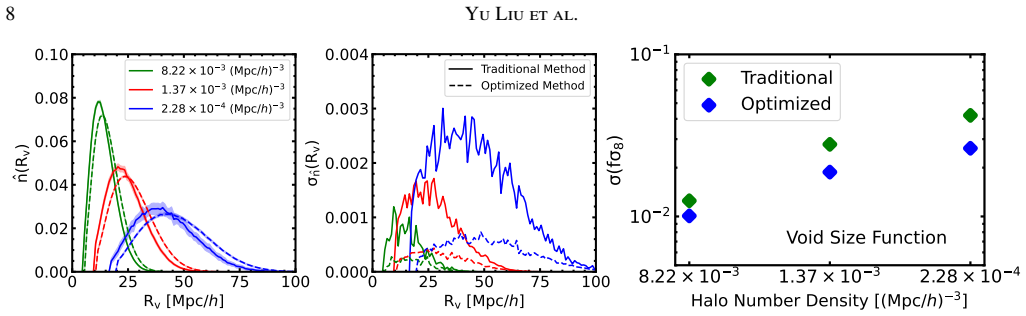
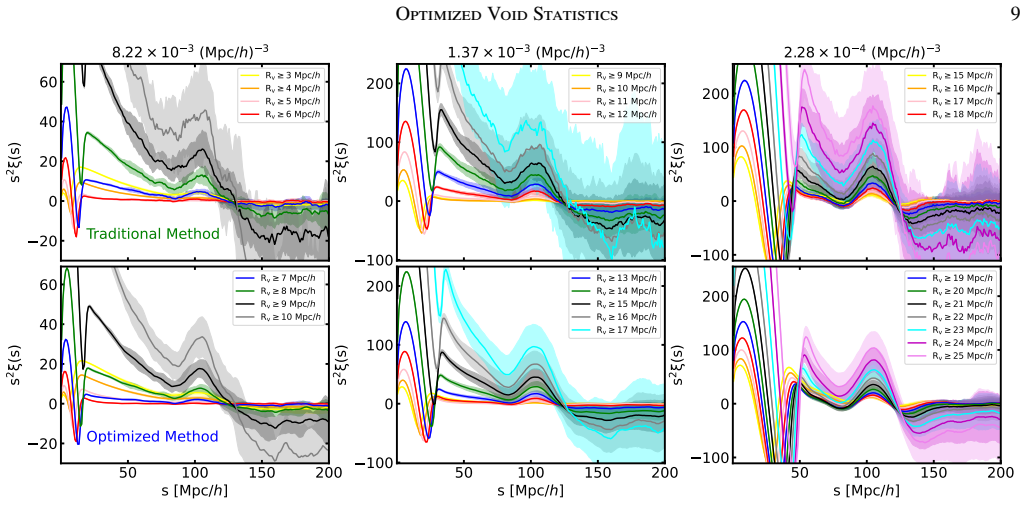
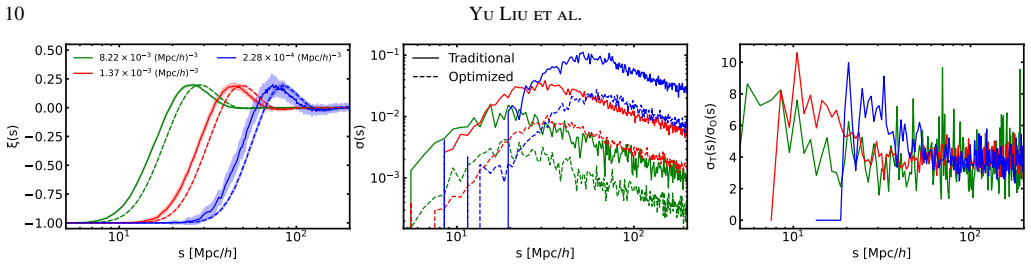
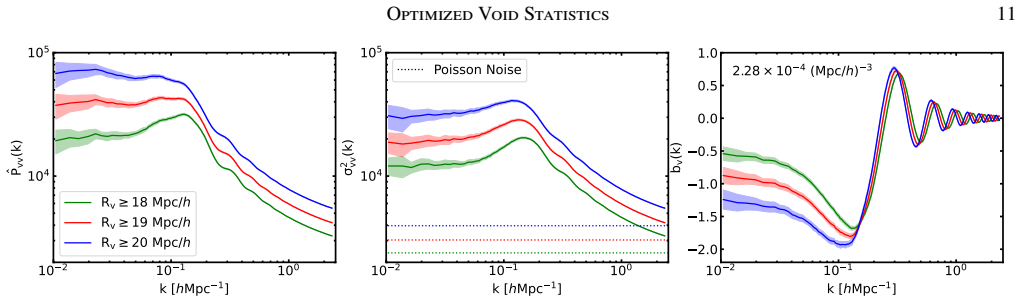
The statistical uncertainties in void statistics can be predominantly attributed to tessellation instabilities, and a subsampling-averaging procedure can substantially eliminate these scatters, dramatically boosting the signal-to-noise ratios of void BAOs and significantly improving the constraining power of void statistics on cosmological parameters.
What carries the argument
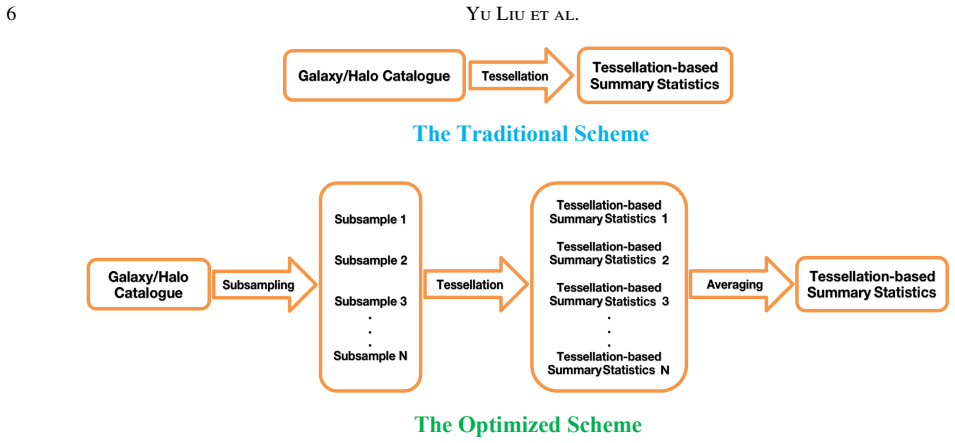
The subsampling and averaging procedure, which computes the statistics on multiple random subsamples of the catalog and averages the results to suppress rearrangements caused by small density or position perturbations.
If this is right
- The method applies directly to the void size function, void two-point correlation function, and void power spectrum for both Delaunay-based and Voronoi-based voids.
- Signal-to-noise ratios of void baryon acoustic oscillations increase substantially.
- Constraints on cosmological parameters from void statistics become significantly tighter.
- The procedure is simple enough to serve as a general framework for other tessellation-based measurements.
Where Pith is reading between the lines
- The same instabilities likely appear in other tessellation-derived quantities such as density field estimates or cluster finders, suggesting the averaging step could be tested there as well.
- In future wide-field surveys the computational cost of multiple subsamples may be offset by the gain in information per object, allowing smaller effective error bars without larger volumes.
- Optimal subsample fraction and number of realizations could be calibrated on mocks to further minimize residual scatter.
Load-bearing premise
The dominant source of statistical uncertainty in these void statistics is tessellation instability rather than sample variance or survey systematics.
What would settle it
Applying the subsampling-averaging method to simulated void catalogs with known inputs and finding no reduction in the variance of the measured statistics compared with the standard single-tessellation approach.
Figures
read the original abstract
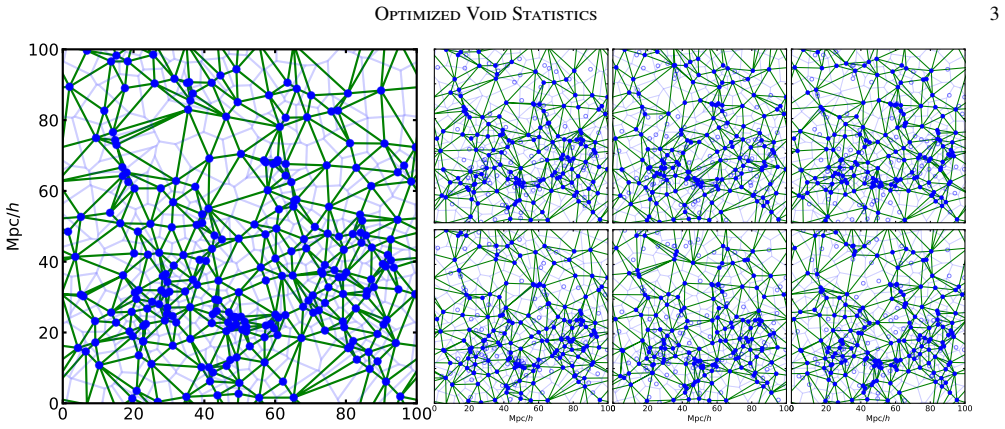
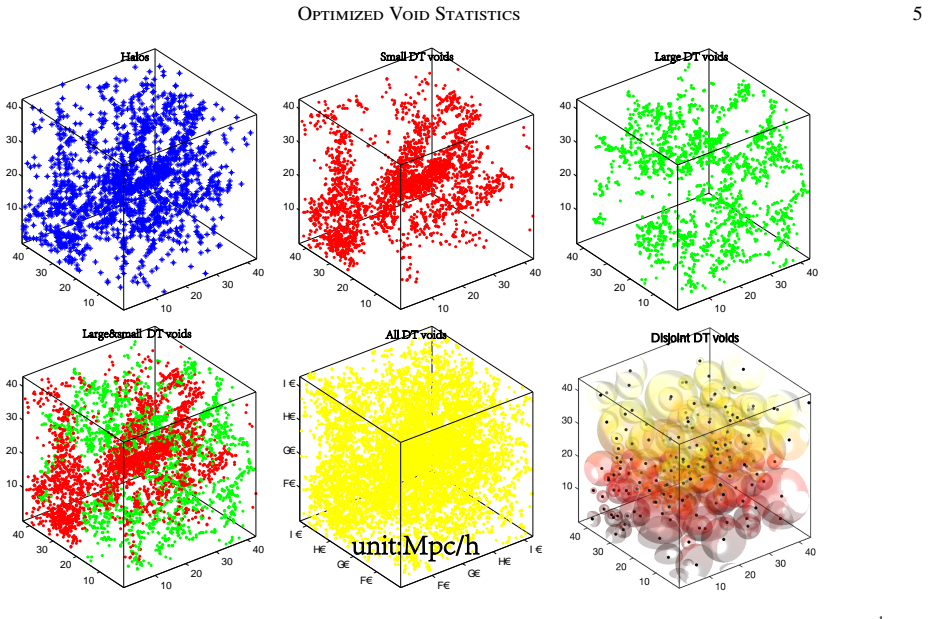
Tessellation methods are extensively employed in the analyses of cosmic large-scale structure (LSS). However, these techniques are highly sensitive to perturbations in both densities and positions of points, often leading to substantial rearrangements of tessellation configurations. As a result, considerable additional statistical errors are introduced in various tessellation-based statistics, thereby weakening their cosmological constraints. In this work, we identify this issue and propose an efficacious measurement scheme through subsampling and averaging to enhance the stabilities of tessellation-based statistics. As a case study, we apply the new scheme to measure multiple primary void statistics [i.e., void size function (VSF), void two-point correlation function (VTCF), and void power spectrum (VPS)] in two distinct classes of voids, based on Delaunay and Voronoi tessellations, respectively. We notice that the statistical uncertainties in void statistics can be predominantly attributed to tessellation instabilities. Through rigorous testing, we demonstrate that the proposed method can substantially eliminate these scatters to deeply mine the statistical power of void statistics. Specifically, we find that our method can dramatically boost the signal-to-noise ratios (SNRs) of void Baryon Acoustic Oscillations (BAOs) and significantly improve the constraining power of void statistics on cosmological parameters. These findings showcase enormous application potentials of our new method in maximizing extraction of cosmological information from galaxy surveys. Importantly, our method is simple yet highly potent with broad applicability, hopefully evolving into a standard framework for measuring tessellation-based statistics in the future.
Editorial analysis
A structured set of objections, weighed in public.
Referee Report
Summary. The paper identifies instabilities in Delaunay and Voronoi tessellations as the dominant source of scatter in void statistics (VSF, VTCF, VPS) and proposes a subsampling-plus-averaging procedure to stabilize the measurements. It claims that this procedure substantially reduces the scatter, dramatically increases the SNR of void BAOs, and improves cosmological-parameter constraints from these statistics.
Significance. If the error-source attribution and the reported SNR gains are robustly demonstrated, the method could meaningfully increase the cosmological return from void analyses in upcoming surveys. The manuscript supplies no variance decomposition or controlled isolation of tessellation instabilities versus sample variance, shot noise, or survey systematics, so the claimed gains remain unverified.
major comments (2)
- [Abstract and §3] Abstract and §3 (results on error attribution): the assertion that 'statistical uncertainties in void statistics can be predominantly attributed to tessellation instabilities' is not supported by any variance decomposition (e.g., comparison of jackknife covariance with covariance obtained from controlled tessellation perturbations, or from multiple realizations with fixed tessellation). Without this test the SNR improvements for void BAOs cannot be shown to arise from the proposed scheme rather than from other sources.
- [§4] §4 (SNR and parameter constraints): the reported 'dramatic' SNR boosts and improved cosmological constraints are presented without a baseline comparison that isolates the contribution of the subsampling-averaging step from changes in effective volume, number of voids, or post-processing choices. A controlled ablation (with vs. without the averaging step on identical catalogs) is required to substantiate the central claim.
minor comments (2)
- [§2] Notation for the two void classes (Delaunay-based vs. Voronoi-based) is introduced without an explicit definition or reference to the precise void-finding algorithm used.
- [Figures] Figure captions and axis labels should explicitly state the number of subsamples and the averaging procedure so that the method can be reproduced from the plots alone.
Simulated Author's Rebuttal
We thank the referee for the constructive comments. We address the concerns on error attribution and controlled comparisons below, and will incorporate additional tests in the revised manuscript to strengthen the presentation.
read point-by-point responses
-
Referee: [Abstract and §3] the assertion that 'statistical uncertainties in void statistics can be predominantly attributed to tessellation instabilities' is not supported by any variance decomposition (e.g., comparison of jackknife covariance with covariance obtained from controlled tessellation perturbations, or from multiple realizations with fixed tessellation). Without this test the SNR improvements for void BAOs cannot be shown to arise from the proposed scheme rather than from other sources.
Authors: We acknowledge that an explicit variance decomposition isolating tessellation instabilities from sample variance or shot noise was not included. Our existing tests compare scatter across multiple realizations and show substantial reduction only when the subsampling-averaging is applied, which we attribute to stabilization of tessellation configurations. To directly address the referee's point, we will add a controlled test in the revised §3: we will generate perturbed point sets with fixed underlying density field and compare covariances from jackknife versus these controlled perturbations. This will quantify the tessellation contribution. revision: yes
-
Referee: [§4] the reported 'dramatic' SNR boosts and improved cosmological constraints are presented without a baseline comparison that isolates the contribution of the subsampling-averaging step from changes in effective volume, number of voids, or post-processing choices. A controlled ablation (with vs. without the averaging step on identical catalogs) is required to substantiate the central claim.
Authors: We agree that isolating the effect of the subsampling-averaging procedure requires a controlled ablation on identical catalogs. In the revised §4 we will add direct side-by-side comparisons of VSF, VTCF, and VPS (including BAO SNR and cosmological constraints) computed with and without the averaging step, holding the input catalogs, effective volume, and void selection fixed. This will demonstrate that the reported gains arise specifically from the proposed scheme. revision: yes
Circularity Check
No circularity: method and claims are empirically tested without self-referential reduction
full rationale
The paper identifies tessellation instabilities as a source of scatter in void statistics (VSF, VTCF, VPS), proposes a subsampling-averaging scheme, and reports SNR gains from tests on simulated or survey data. No equations appear in the abstract or described chain that equate a fitted quantity to a prediction by construction. No self-citations are invoked to establish uniqueness theorems or to smuggle ansatzes. The attribution of dominant error to instabilities is framed as an empirical observation rather than a definitional or fitted tautology, and the reported improvements are presented as outcomes of controlled tests, rendering the central claims externally falsifiable rather than internally forced.
Axiom & Free-Parameter Ledger
axioms (1)
- domain assumption Tessellation methods are highly sensitive to perturbations in densities and positions of points, leading to substantial rearrangements.
Reference graph
Works this paper leans on
-
[1]
2012, MNRAS, 427, 61
Abel, T., Hahn, O., & Kaehler, R. 2012, MNRAS, 427, 61
2012
-
[2]
2019, PhRvD, 100, 123513
Achitouv, I. 2019, PhRvD, 100, 123513
2019
-
[3]
2006, arXiv e-prints, astro
Albrecht, A., Bernstein, G., Cahn, R., et al. 2006, arXiv e-prints, astro
2006
-
[4]
Alonso, R., Ojeda, J., Hitschfeld, N., Hervías, C., & Campusano, L. E. 2018, Astronomy and Computing, 22, 48
2018
-
[5]
Aragon-Calvo, M. A. 2021, MNRAS, 503, 557 Aragón-Calvo, M. A., Jones, B. J. T., van de Weygaert, R., & van der Hulst, J. M. 2007, A&A, 474, 315 Aragón-Calvo, M. A., Platen, E., van de Weygaert, R., & Szalay, A. S. 2010, ApJ, 723, 364
2021
-
[6]
2022, MNRAS, 513, 186
Aubert, M., Cousinou, M.-C., Escoffier, S., et al. 2022, MNRAS, 513, 186
2022
-
[7]
2018, PhRvD, 98, 023511
Baker, T., Clampitt, J., Jain, B., & Trodden, M. 2018, PhRvD, 98, 023511
2018
-
[8]
2021, PhRvD, 103, 083530
Baldauf, T., Codis, S., Desjacques, V., & Pichon, C. 2021, PhRvD, 103, 083530
2021
-
[9]
2015, JCAP, 2015, 007
Baldauf, T., Mercolli, L., Mirbabayi, M., & Pajer, E. 2015, JCAP, 2015, 007
2015
-
[10]
E., Hamaus, N., & Desjacques, V
Baldauf, T., Seljak, U., Smith, R. E., Hamaus, N., & Desjacques, V. 2013, PhRvD, 88, 083507 Bayer,A. E.,Villaescusa-Navarro, F.,Massara, E.,et al.2021,ApJ, 919, 24
2013
-
[11]
2024, MNRAS, 529, 4325
Bermejo, R., Wilding, G., van de Weygaert, R., et al. 2024, MNRAS, 529, 4325
2024
-
[12]
2002, PhR, 367, 1
Bernardeau, F., Colombi, S., Gaztañaga, E., & Scoccimarro, R. 2002, PhR, 367, 1
2002
-
[13]
1996, MNRAS, 279, 693
Bernardeau, F., & van de Weygaert, R. 1996, MNRAS, 279, 693
1996
-
[14]
2025, arXiv e-prints, arXiv:2503.07923 Beyond-2pt Collaboration, :, Krause, E., et al
Besuner, R., Dey, A., Drlica-Wagner, A., et al. 2025, arXiv e-prints, arXiv:2503.07923 Beyond-2pt Collaboration, :, Krause, E., et al. 2024, arXiv e-prints, arXiv:2405.02252
arXiv 2025
-
[15]
Biswas, R., Alizadeh, E., & Wandelt, B. D. 2010, PhRvD, 82, 023002
2010
-
[16]
2013, International Journal of Computational Geometry & Applications, 23, 303
BOISSONNAT, J.-D., DYER, R., & GHOSH, A. 2013, International Journal of Computational Geometry & Applications, 23, 303
2013
-
[17]
2014, International Journal of Computational Geometry & Applications, 24, 125
BOISSONNAT, J.-D., DYER, R., & GHOSH, A. 2014, International Journal of Computational Geometry & Applications, 24, 125
2014
-
[18]
2022, A&A, 661, A146 Bos,E.G
Bonnaire, T., Aghanim, N., Kuruvilla, J., & Decelle, A. 2022, A&A, 661, A146 Bos,E.G. P.,vandeWeygaert,R., Dolag,K.,&Pettorino,V.2012, MNRAS, 426, 440
2022
-
[19]
2025, arXiv e-prints, arXiv:2503.22532
Cai, Y.-C., & Neyrinck, M. 2025, arXiv e-prints, arXiv:2503.22532
Pith/arXiv arXiv 2025
-
[20]
2017, MNRAS, 466, 3364
Cai, Y.-C., Neyrinck, M., Mao, Q., et al. 2017, MNRAS, 466, 3364
2017
-
[21]
C., Szapudi, I., Cole, S., & Frenk, C
Cai, Y.-C., Neyrinck, M. C., Szapudi, I., Cole, S., & Frenk, C. S. 2014, ApJ, 786, 110
2014
-
[22]
2015, MNRAS, 451, 1036
Cai, Y.-C., Padilla, N., & Li, B. 2015, MNRAS, 451, 1036
2015
-
[23]
A., & Padilla, N
Cai, Y.-C., Taylor, A., Peacock, J. A., & Padilla, N. 2016, MNRAS, 462, 2465
2016
-
[24]
2025, Science China Physics, Mechanics, and Astronomy, 68, 280403
Cai, Z., Huang, S., Liu, Y., Zhao, C., & Huang, L. 2025, Science China Physics, Mechanics, and Astronomy, 68, 280403
2025
-
[25]
2018, MNRAS, 476, 3195
Cautun, M., Paillas, E., Cai, Y.-C., et al. 2018, MNRAS, 476, 3195
2018
-
[26]
Cautun, M., van de Weygaert, R., & Jones, B. J. T. 2013, MNRAS, 429, 1286
2013
-
[27]
C., & Hamaus, N
Chan, K. C., & Hamaus, N. 2021, PhRvD, 103, 043502
2021
-
[28]
C., Hamaus, N., & Desjacques, V
Chan, K. C., Hamaus, N., & Desjacques, V. 2014, PhRvD, 90, 103521
2014
-
[29]
C., Li, Y., Biagetti, M., & Hamaus, N
Chan, K. C., Li, Y., Biagetti, M., & Hamaus, N. 2020, ApJ, 889, 89
2020
-
[30]
2020, MNRAS, 499, 5902
Cheng, S., Ting, Y.-S., Ménard, B., & Bruna, J. 2020, MNRAS, 499, 5902
2020
-
[31]
S., Soares-Santos, M., Tait, T
Chou, A. S., Soares-Santos, M., Tait, T. M. P., et al. 2022, arXiv e-prints, arXiv:2211.09978
arXiv 2022
-
[32]
2017, PhRvD, 95, 063528 Colberg,J.M.,Pearce,F.,Foster,C.,etal.2008,MNRAS,387,933
Chuang, C.-H., Kitaura, F.-S., Liang, Y., et al. 2017, PhRvD, 95, 063528 Colberg,J.M.,Pearce,F.,Foster,C.,etal.2008,MNRAS,387,933
2017
-
[33]
2021, MNRAS, 504, 5021
Contarini, S., Marulli, F., Moscardini, L., et al. 2021, MNRAS, 504, 5021
2021
-
[34]
2023, ApJ, 953, 46
Contarini, S., Pisani, A., Hamaus, N., et al. 2023, ApJ, 953, 46
2023
-
[35]
2019, MNRAS, 488, 3526
Contarini, S., Ronconi, T., Marulli, F., et al. 2019, MNRAS, 488, 3526
2019
-
[36]
2026, arXiv e-prints, arXiv:2601.14362
Contarini, S., Verza, G., & Pisani, A. 2026, arXiv e-prints, arXiv:2601.14362
arXiv 2026
-
[37]
2022, A&A, 667, A162
Contarini, S., Verza, G., Pisani, A., et al. 2022, A&A, 667, A162
2022
-
[38]
M., Paz, D
Correa, C. M., Paz, D. J., Padilla, N. D., et al. 2022, MNRAS, 509, 1871
2022
-
[39]
M., Paz, D
Correa, C. M., Paz, D. J., Sánchez, A. G., et al. 2021, MNRAS, 500, 911
2021
-
[40]
2024, MNRAS, 531, 3336
Cuesta-Lazaro, C., Paillas, E., Yuan, S., et al. 2024, MNRAS, 531, 3336
2024
-
[41]
S., Schlegel, D
Dawson, K. S., Schlegel, D. J., Ahn, C. P., et al. 2013, AJ, 145, 10 de Berg, M., van Kreveld, M., Overmars, M., & Schwarzkopf, O. 1997, Computational geometry: algorithms and applications (Berlin, Heidelberg: Springer-Verlag) de Jong, R. S., Agertz, O., Berbel, A. A., et al. 2019, The Messenger, 175, 3
2013
-
[42]
1934, Bulletin de l’Académie des Sciences de l’URSS
Delaunay, B. 1934, Bulletin de l’Académie des Sciences de l’URSS. Classe des sciences mathématiques et na, 1934, 793 DESI Collaboration, Aghamousa, A., Aguilar, J., et al. 2016, arXiv e-prints, arXiv:1611.00036
Pith/arXiv arXiv 1934
-
[43]
2025, arXiv e-prints, arXiv:2506.16408
Dhawalikar, S., Paranjape, A., & Alam, S. 2025, arXiv e-prints, arXiv:2506.16408
arXiv 2025
-
[44]
2003, Modern Cosmology
Dodelson, S. 2003, Modern Cosmology
2003
-
[45]
2021, MNRAS, 500, 3838 Doré, O., Bock, J., Ashby, M., et al
Dong, F., Yu, Y., Zhang, J., Yang, X., & Zhang, P. 2021, MNRAS, 500, 3838 Doré, O., Bock, J., Ashby, M., et al. 2014, arXiv e-prints, arXiv:1412.4872
Pith/arXiv arXiv 2021
-
[46]
2022, The Journal of Open Source Software, 7, 4033
Douglass, K., Veyrat, D., O’Neill, S., et al. 2022, The Journal of Open Source Software, 7, 4033
2022
-
[47]
A., Veyrat, D., & BenZvi, S
Douglass, K. A., Veyrat, D., & BenZvi, S. 2023, ApJS, 265, 7
2023
-
[48]
1979, The Annals of Statistics, 7, 1
Efron, B. 1979, The Annals of Statistics, 7, 1
1979
-
[49]
J., Seo, H.-J., & White, M
Eisenstein, D. J., Seo, H.-J., & White, M. 2007, ApJ, 664, 660 Eisenstein,D.J.,Weinberg,D.H.,Agol,E.,etal.2011,AJ,142,72
2007
-
[50]
Endo, T., Tashiro, H., & Nishizawa, A. J. 2020, MNRAS, 499, 587 Euclid Collaboration, Mellier, Y., Abdurro’uf, et al. 2024, arXiv e-prints, arXiv:2405.13491
arXiv 2020
-
[51]
2018, MNRAS, 475, 3262
Falck, B., Koyama, K., Zhao, G.-B., & Cautun, M. 2018, MNRAS, 475, 3262
2018
-
[52]
2025, MNRAS, 536, 807
Feldbrugge, J. 2025, MNRAS, 536, 807
2025
-
[53]
2016, MNRAS, 463, 2273 Fernández-García, E., Betancort-Rijo, J
Feng, Y., Chu, M.-Y., Seljak, U., & McDonald, P. 2016, MNRAS, 463, 2273 Fernández-García, E., Betancort-Rijo, J. E., Prada, F., et al. 2025, A&A, 695, A19
2016
-
[54]
S., Paillas, E., Percival, W
Fraser, T. S., Paillas, E., Percival, W. J., et al. 2025, JCAP, 2025, 001
2025
-
[55]
2021, ApJ, 923, 217 18Yu Liu et al
Gebhardt, K., Mentuch Cooper, E., Ciardullo, R., et al. 2021, ApJ, 923, 217 18Yu Liu et al
2021
-
[56]
Ghafour, P., Tavasoli, S., & Shojaei, M. R. 2025, arXiv e-prints, arXiv:2501.16431
arXiv 2025
-
[57]
Ginzburg, D., Desjacques, V., & Chan, K. C. 2017, PhRvD, 96, 083528
2017
-
[58]
A., & de Serio, V
Goberna, M. A., & de Serio, V. N. V. 2011, TOP, 20, 411
2011
-
[59]
2019, ApJ, 883, 203
Gong, Y., Liu, X., Cao, Y., et al. 2019, ApJ, 883, 203
2019
-
[60]
2023, Astronomy and Computing, 44, 100713
Guidotti, V., Alonso, R., Bravo, M., et al. 2023, Astronomy and Computing, 44, 100713
2023
-
[61]
2017, JCAP, 2017, 014
Hamaus, N., Cousinou, M.-C., Pisani, A., et al. 2017, JCAP, 2017, 014
2017
-
[62]
2020, JCAP, 2020, 023
Hamaus, N., Pisani, A., Choi, J.-A., et al. 2020, JCAP, 2020, 023
2020
-
[63]
M., et al
Hamaus, N., Pisani, A., Sutter, P. M., et al. 2016, PhRvL, 117, 091302
2016
-
[64]
E., & Baldauf, T
Hamaus, N., Seljak, U., Desjacques, V., Smith, R. E., & Baldauf, T. 2010, PhRvD, 82, 043515
2010
-
[65]
M., Lavaux, G., & Wandelt, B
Hamaus, N., Sutter, P. M., Lavaux, G., & Wandelt, B. D. 2014a, JCAP, 2014, 013
2014
-
[66]
Hamaus, N., Sutter, P. M., & Wandelt, B. D. 2014b, arXiv e-prints, arXiv:1409.7621
-
[67]
2022, A&A, 658, A20
Hamaus, N., Aubert, M., Pisani, A., et al. 2022, A&A, 658, A20
2022
-
[68]
2018, AJ, 156, 160
Hand, N., Feng, Y., Beutler, F., et al. 2018, AJ, 156, 160
2018
-
[69]
J., Aubert, M., Pisani, A., et al
Hawken, A. J., Aubert, M., Pisani, A., et al. 2020, JCAP, 2020, 012
2020
-
[70]
2013, ApJS, 208, 19 Ilić, S., Langer, M., & Douspis, M
Hinshaw, G., Larson, D., Komatsu, E., et al. 2013, ApJS, 208, 19 Ilić, S., Langer, M., & Douspis, M. 2013, A&A, 556, A51 Ivezić, Ž., Kahn, S. M., Tyson, J. A., et al. 2019, ApJ, 873, 111
2013
-
[71]
2013, MNRAS, 434, 2167
Jennings, E., Li, Y., & Hu, W. 2013, MNRAS, 434, 2167
2013
-
[72]
Jing, Y. P. 2005, ApJ, 620, 559
2005
-
[73]
2008, Riemannian geometry and geometric analysis, Vol
Jost, J., & Jost, J. 2008, Riemannian geometry and geometric analysis, Vol. 42005 (Springer)
2008
-
[74]
2016b, MNRAS, 456, 4156 Kovács, A
Kitaura, F.-S., Rodríguez-Torres, S., Chuang, C.-H., et al. 2016b, MNRAS, 456, 4156 Kovács, A. 2018, MNRAS, 475, 1777
2018
-
[75]
D., Pisani, A., Carbone, C., et al
Kreisch, C. D., Pisani, A., Carbone, C., et al. 2019, MNRAS, 488, 4413
2019
-
[76]
D., Pisani, A., Villaescusa-Navarro, F., et al
Kreisch, C. D., Pisani, A., Villaescusa-Navarro, F., et al. 2022, ApJ, 935, 100
2022
-
[77]
2012, MNRAS, 421, 3481
Li, B., Zhao, G.-B., & Koyama, K. 2012, MNRAS, 421, 3481
2012
-
[78]
2016, MNRAS, 459, 4020
Liang, Y., Zhao, C., Chuang, C.-H., Kitaura, F.-S., & Tao, C. 2016, MNRAS, 459, 4020
2016
-
[79]
2021, ApJS, 254, 4
Liu, Y., Yu, Y., & Li, B. 2021, ApJS, 254, 4
2021
-
[80]
2020, PhRvD, 101, 063515
Liu, Y., Yu, Y., Yu, H.-R., & Zhang, P. 2020, PhRvD, 101, 063515
2020
discussion (0)
Sign in with ORCID, Apple, or X to comment. Anyone can read and Pith papers without signing in.