REVIEW 2 major objections 6 minor 216 references
Integrated Radio Sensing Capabilities for 6G Networks: AI/ML Perspective
T0 review · 2 major / 6 minor · reviewed 2026-08-06 · deepseek-v4-flash
Pith's one-line read The paper claims that no prior review treats radio sensing of physical objects and electromagnetic emitter analysis together, and it provides a unified AI/ML tutorial that maps machine-learning solutions onto every major sensing task.
desk verdict A well-organized tutorial on AI/ML for 6G radio sensing, with an overstated novelty claim that should be toned down before publication. read the letter →
The pith
A machine-rendered reading of the paper's core claim, the machinery that carries it, and where it could break.
The reading
What carries the argument
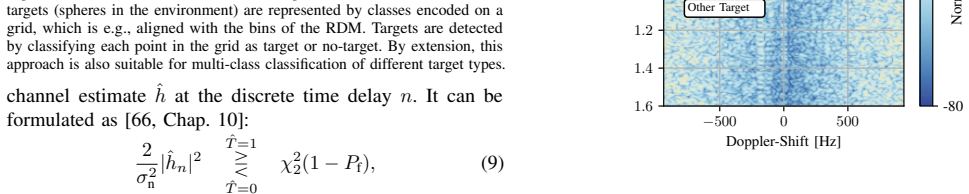
The load-bearing device is the taxonomy: radio sensing is divided into physical perception of objects (radar and channel measurements, using the network's own transmitter) versus passive electromagnetic emitter analysis (spectrum sensing, signal classification, non-cooperative transmitter localization). Carrying the tutorial is a generalized learning-based framework in which every sensing task becomes a neural-network problem — target detection as multi-class classification on a grid aligned with range-Doppler bins, spectrum sensing as binary hypothesis testing on the power spectral density, signal classification as a softmax over waveform or modulation classes applied to IQ samples or spectrograms, and channel charting as contrastive dimensionality reduction of channel state information. This uniform formulation is what lets the survey hold the radar and spectrum threads together under one AI/ML lens.
What would settle it
A systematic literature search with explicit inclusion criteria across the major engineering databases up to 2024, looking for survey or tutorial articles that treat both radar-based object sensing and passive spectrum or emitter analysis from a machine-learning perspective, would settle the central claim: finding one such peer-reviewed survey erases the stated gap, while finding none supports it.
Extended reading notes
Core claim
The paper's central claim is that prior surveys on wireless sensing each stay inside a single capability — radar-centric ISAC, cognitive-radio spectrum sensing, or localization — and that none has formulated the importance of AI-empowered radio sensing as one coherent whole. Following the categorization in [11], the paper splits radio sensing into radar sensing of the physical world, channel measurements of propagation, and electromagnetic analysis of the spectrum, then groups the first two as physical perception (the network illuminates the scene with its own transmitter) and the third as passive emitter analysis that answers who and where transmits. Within that frame it formulates each problem — object detection, positioning, orientation, shape, tracking, environmental sensing, spectrum occupancy, waveform and modulation classification, transmitter localization — and shows how machine learning recasts each as a classification or regression task on representations such as the range-Doppler matrix, power spectral density, IQ samples, or spectrograms. The contribution is the tutorial synthesis itself, together with a vision of a multi-modal multi-task network in which radar, spectrum sensing, and signal classification feed a digital twin of the environment.
Load-bearing premise
The novelty claim stated in Section I.B — that no prior review treats physical-object sensing and electromagnetic emitter analysis together — is supported only by the paper's own comparison table rather than by a systematic search, so the survey's organizing premise weakens if earlier ISAC reviews are read as already covering both categories.
Editorial extensions
If this is right
- Adopting the unified view makes 6G sensing a single multi-modal stack that feeds a digital twin of the radio environment, rather than separate radar, spectrum, and localization communities.
- Across the surveyed tasks, learning-based methods become the default where model-based tools break down: CNNs on range-Doppler maps match or beat CFAR detectors under clutter and hardware mismatch, and learning-augmented estimators approach the Cramér–Rao bound at lower runtime.
- Joint multi-task networks can classify a transmitter's waveform and estimate its position from the same IQ samples at small extra computational cost, and the same architecture extends to flag spectrum occupancy.
- Channel charting provides self-supervised, label-free positioning that survives severe non-line-of-sight conditions, supporting beamforming and resource allocation from relative positions alone.
- A distributed architecture using federated learning for privacy and reinforcement learning for real-time adaptation is the paper's proposed route to a self-sustaining 6G network.
Reading between the lines
- The physical-perception versus emitter-analysis split is testable as an organizing principle: a bibliometric clustering of integrated-sensing publications by which half they address would show whether the literature really separates along that line.
- The authors note that ML has not yet been shown to benefit the fusion of multiple ISAC nodes; a demonstration on a real multi-node testbed would be the natural next experiment.
- The paper declares the RadioML 2018.01A benchmark outdated for 2025-era signals; a successor dataset combining radar waveforms, ISAC signals, and shared-band coexistence is an implicit but urgent prerequisite for progress.
- If the gap claim holds, future work will treat this survey as the reference that split radio sensing into its two halves; if it does not, the taxonomy may still survive as a useful teaching device, just not a novel one.
Editorial analysis
A structured set of objections, weighed in public.
Referee Report
Summary. This manuscript is a tutorial-style survey of AI/ML methods for radio sensing in 6G ISAC networks. It proposes a taxonomy that separates physical perception of objects (radar sensing, channel-based spatial awareness) from electromagnetic emitter analysis (spectrum sensing, signal classification, non-cooperative transmitter localization, channel charting), and it reviews ML-based techniques for both branches. The paper also discusses multi-task learning, channel charting, implementation aspects, and a vision of an AI-powered multi-functional sensing network. The central novelty claim is that no existing review considers physical-object sensing and EM sensing together with a clear formulation of AI-empowered radio sensing.
Significance. If the gap claim were established, the paper would fill a genuine niche: most prior ISAC surveys concentrate on radar/communications signal processing, while cognitive-radio surveys focus on spectrum sensing; a unified tutorial with an explicit ML angle, datasets, and implementation discussion would be a useful entry point. The manuscript contains careful problem formulations (e.g., Eqs. (8), (9), (17), (21)), structured comparison tables (Tables I–III), and practical discussions of hardware, federated learning, and testbeds, which are strengths. However, the uniqueness claim is not demonstrated and appears internally inconsistent with Table I; the tutorial value is real but the advertised contribution needs to be reframed and supported.
major comments (2)
- [I.B, Table I] The paper's central claim—'To the best of our knowledge, no reviews consider sensing of physical objects and EM sensing together'—is unsupported and appears contradicted by the paper's own Table I. In that table, entries [31] and [35] are marked as covering both the 'Physical perception of objects' block and the 'Emitter analysis' columns (spectrum sensing, signal classification, transmitter localization). No search protocol, inclusion/exclusion criteria, or coverage-judgment methodology is provided, so the negative claim cannot be verified. Because this claim is the stated rationale for the paper, it is load-bearing. I recommend either softening the claim to a scoped statement ('no prior review that we found treats both categories at tutorial depth with an explicit AI/ML emphasis') or adding a reproducible literature-search methodology.
- [III.G] The statement that 'distributed sensing for the fusion of different ISAC nodes has not been demonstrated to benefit from ML methods in the current literature' is another strong negative claim made without a systematic search. Since the surrounding discussion cites [130] and [131] on ML-based fusion and distributed learning, the basis for this negative conclusion is unclear. Please either remove the claim, narrow it to 'the papers we reviewed,' or support it with a short tabulation.
minor comments (6)
- [III.C.1, Eq. (10)] Equation (10) writes the channel model as h_i(t,τ)=α(t)δ(t−τ_{i,0}(t))e^{−j2πf_c τ_{i,0}(t)}; the delta argument should be in the delay variable, δ(τ−τ_{i,0}(t)), otherwise the delay dependence of h_i is lost.
- [III.B, Eq. (9)] In the Neyman-Pearson detector expression, the right-hand side should be the inverse chi-square quantile, e.g., χ²₂^{-1}(1−P_f), rather than χ²₂(1−P_f).
- [IV.D] The text says the loss terms are 'defined by (4) and (5)', but (4) is the MSE loss and (5) is the cross-entropy loss; the order should be reversed or clarified.
- [Fig. 2] Fig. 2 lists a Section I.D 'List of Acronyms' that does not appear in the manuscript; either add such a section or remove it from the organization diagram.
- [Table I] The table's legend uses '✓' and '✓✓✓' for coverage but the entries combine these with diamond symbols (e.g., '✓✓✓♢'); separating the coverage axis from the AI-focus axis, or adding a note explaining the combined marks, would make the comparison easier to read.
- [Fig. 9 caption] The caption contains a malformed license string: '/creative-commons /creative-commons-byCC-BY 4.0 International license'; please correct the attribution.
Circularity Check
No significant circularity: the survey is a tutorial-style literature review, not a derivation, and its self-citations are transparent rather than load-bearing.
full rationale
This paper is a tutorial-style survey of AI/ML techniques for radio sensing in 6G, not a first-principles derivation. It contains no fitted parameters presented as predictions, no uniqueness theorems imported from the authors' prior work, and no equation-level equivalence between inputs and outputs. The paper does cite its own prior works, including [11] for the taxonomy of radio sensing and [59], [61], [91], [101], [196], [197], and [201] for illustrative systems and datasets. These citations are transparent and used as examples or organizing frames, not as the sole justification for the paper's central claims. The main novelty assertion in Section I.B, that 'no reviews consider sensing of physical objects and EM sensing together,' is an external literature-gap claim that is not backed by a reproducible systematic search and appears to be in tension with the paper's own Table I, where prior survey [31] is marked as covering both physical perception and emitter analysis. However, that is a completeness and correctness concern, not a circularity one: the claim is not derived from the paper's own definitions or equations. Since the survey's value rests on the assembled external literature and tutorial content, no central result reduces to its own input by construction, and the paper should not receive a circularity score above the 0-2 'no significant circularity' range. I assign 0 because no circular step can be exhibited.
Assumptions & free parameters
assumptions (1)
- domain assumption The radio sensing taxonomy (physical perception vs. electromagnetic analysis) is a meaningful and exhaustive partition of the literature and of 6G sensing tasks.
Cite this review
Pith. "Pith review of Integrated Radio Sensing Capabilities for 6G Networks: AI/ML Perspective." pith.science (2026). https://pith.science/paper/2VHUNEW6
@misc{pith2026250714856,
  author       = {Pith},
  title        = {Pith review of: Integrated Radio Sensing Capabilities for 6G Networks: AI/ML Perspective},
  year         = {2026},
  howpublished = {\url{https://pith.science/paper/2VHUNEW6}},
  note         = {Machine review of arXiv:2507.14856}
}
read the original abstract
The sixth-generation wireless communications (6G) is often labeled as "connected intelligence". Radio sensing, aligned with machine learning (ML) and artificial intelligence (AI), promises, among other benefits, breakthroughs in the system's ability to perceive the environment and effectively utilize this awareness. This article offers a tutorial-style survey of AI and ML approaches to enhance the sensing capabilities of next-generation wireless networks. To this end, while staying in the framework of integrated sensing and communication (ISAC), we expand the term "sensing" from radar, via spectrum sensing, to miscellaneous applications of radio sensing like non-cooperative transmitter localization. We formulate the problems, explain the state-of-the-art approaches, and detail AI-based techniques to tackle various objectives in the context of wireless sensing. We discuss the advantages, enablers, and challenges of integrating various sensing capabilities into an envisioned AI-powered multimodal multi-task network. In addition to the tutorial-style core of this work based on direct authors' involvement in 6G research problems, we review the related literature, and provide both a good start for those entering this field of research, and a topical overview for a general reader with a background in wireless communications
Figures


Figures from the paper (15 more)




Reference graph
Works this paper leans on
-
[31]
The integrated sensing and communication revolution for 6G: Vision, techniques, and applications,
N. Gonz´alez-Prelcic et al., “The integrated sensing and communication revolution for 6G: Vision, techniques, and applications,” Proc. IEEE, vol. 112, no. 7, pp. 676–723, 2024
2024
-
[35]
A survey on integrated sensing, communication, and computation,
D. Wen, Y . Zhou, X. Li, Y . Shi, K. Huang, and K. B. Letaief, “A survey on integrated sensing, communication, and computation,” IEEE Commun. Surv. Tutor., pp. 1–1, 2024
2024
-
[130]
Integrated sensing-communication-computation for over-the-air edge AI inference,
Z. Zhuang, D. Wen, Y . Shi, G. Zhu, S. Wu, and D. Niyato, “Integrated sensing-communication-computation for over-the-air edge AI inference,” 2023
2023
-
[131]
A survey on machine learning for data fusion,
T. Meng, X. Jing, Z. Yan, and W. Pedrycz, “A survey on machine learning for data fusion,” Information Fusion, vol. 57, pp. 115–129,
-
[1]
Deep learning,
Y . LeCun, J. Bengio, and G. Hinton, “Deep learning,” Nature, vol. 521, no. 7553, pp. 235–244, 2015
2015
-
[2]
You only look once: Unified, real-time object detection,
J. Redmon, S. Divvala, R. Girshick, and A. Farhadi, “You only look once: Unified, real-time object detection,” in Proc. IEEE Conf. on Computer Vision and Pattern Recognition (CVPR) , 2016, pp. 779–788
2016
-
[3]
Deep neural networks for acoustic modeling in speech recognition: The shared views of four research groups,
G. Hinton et al. , “Deep neural networks for acoustic modeling in speech recognition: The shared views of four research groups,” IEEE Signal Process. Mag. , vol. 29, no. 6, pp. 82–97, 2012
2012
-
[4]
Cognitive radio: An integrated agent architecture for software defined radio,
J. Mitola, “Cognitive radio: An integrated agent architecture for software defined radio,” PhD dissertation, 2000
2000
Show all 216 references
-
[5]
Cognitive radio: brain-empowered wireless communica- tions,
S. Haykin, “Cognitive radio: brain-empowered wireless communica- tions,” IEEE J. Sel. Areas Commun. , vol. 23, no. 2, pp. 201–220, 2005
2005
-
[6]
An introduction to deep learning for the physical layer,
T. O’Shea and J. Hoydis, “An introduction to deep learning for the physical layer,” IEEE Trans. Cogn. Commun. Netw. , vol. 3, no. 4, pp. 563–575, 2017
2017
-
[7]
Deep learning based communication over the air,
S. D ¨orner, S. Cammerer, J. Hoydis, and S. ten Brink, “Deep learning based communication over the air,” IEEE J. Sel. Topics Signal Process., vol. 12, no. 1, pp. 132–143, 2018
2018
-
[8]
Massive MIMO is a reality—what is next?: Five promising research directions for antenna arrays,
E. Bj ¨ornson, L. Sanguinetti, H. Wymeersch, J. Hoydis, and T. L. Marzetta, “Massive MIMO is a reality—what is next?: Five promising research directions for antenna arrays,” Digit. Signal Process. , vol. 94, pp. 3–20, 2019
2019
-
[9]
The roadmap to 6G: AI empowered wireless networks,
K. B. Letaief, W. Chen, Y . Shi, J. Zhang, and Y .-J. A. Zhang, “The roadmap to 6G: AI empowered wireless networks,” IEEE Commun. Mag., vol. 57, no. 8, pp. 84–90, 2019
2019
-
[10]
Study on enhancement for data collection for NR and EN-DC,
3GPP TR 37.817, “Study on enhancement for data collection for NR and EN-DC,” V17.0.0, 2022
2022
-
[11]
On integrated cooperative radio sensing for spatial electromagnetic analysis in 6G,
V . Shatov, M. L¨ubke, Y . Su, and N. Franchi, “On integrated cooperative radio sensing for spatial electromagnetic analysis in 6G,” in Proc. IEEE Future Networks World Forum (FNWF) , 2023, pp. 1–8
2023
-
[12]
Embracing AI in 5G-advanced toward 6G: A joint 3GPP and O-RAN perspective,
X. Lin, L. Kundu, C. Dick, and S. Velayutham, “Embracing AI in 5G-advanced toward 6G: A joint 3GPP and O-RAN perspective,” IEEE Commun. Stand. Mag. , vol. 7, no. 4, pp. 76–83, 2023
2023
-
[13]
Artificial intelligence in 3GPP 5G-Advanced: A survey,
X. Lin, “Artificial intelligence in 3GPP 5G-Advanced: A survey,” IEEE ComSoc Technology News, 2023
2023
-
[14]
Feasibility study on integrated sensing and communication,
3GPP, “Feasibility study on integrated sensing and communication,” Tech. Rep. 22.837 (Version 19.3.0) , 2024
2024
-
[15]
AI-enhanced integrated sensing and communications: Advancements, challenges, and prospects,
N. Wu et al., “AI-enhanced integrated sensing and communications: Advancements, challenges, and prospects,” IEEE Commun. Mag. , vol. 62, no. 9, pp. 144–150, 2024
2024
-
[16]
Integrated sensing and communication driven digital twin for intelligent machine network,
Z. Wei et al., “Integrated sensing and communication driven digital twin for intelligent machine network,” IEEE Internet Things Mag. , vol. 7, no. 4, pp. 60–67, 2024
2024
-
[17]
(2024) 6G explained
Nokia. (2024) 6G explained. [Online]. Available: https://www.nokia. com/about-us/newsroom/articles/6g-explained/
2024
-
[18]
(2024) White paper: Co-creating a cyber-physical world
Ericsson. (2024) White paper: Co-creating a cyber-physical world. [Online]. Available: https://www.ericsson.com/en/reports-and-papers/ white-papers/co-creating-a-cyber-physical-world
2024
-
[19]
T. Wen, M. Jianglei, Z. Peiying, and C. Yan. (2024) Co-creating a cyber-physical world. [Online]. Available: https://www.huawei.com/en/ huaweitech/publication/202401/ai-bridge-to-6g#
2024
-
[20]
Obiodu, K
E. Obiodu, K. Chowdhury, L. Kundu, and X. Lin. (2024) Boosting AI-driven innovation in 6G with the AI-RAN Alliance, 3GPP, and O-RAN. [Online]. Available: https://developer.nvidia.com/blog/ boosting-ai-driven-innovation-in-6g-with-the-ai-ran-alliance-3gpp \ -and-o-ran/
2024
-
[21]
Sionna research kit: A GPU-accelerated research platform for AI-RAN,
S. Cammerer et al. , “Sionna research kit: A GPU-accelerated research platform for AI-RAN,” 2025. [Online]. Available: https: //arxiv.org/abs/2505.15848
2025 arXiv
-
[22]
A survey of artificial intelligence for cognitive radios,
A. He et al., “A survey of artificial intelligence for cognitive radios,” IEEE Trans. Veh. Technol., vol. 59, no. 4, pp. 1578–1592, 2010
2010
-
[23]
A survey on machine- learning techniques in cognitive radios,
M. Bkassiny, Y . Li, and S. K. Jayaweera, “A survey on machine- learning techniques in cognitive radios,” IEEE Commun. Surv. Tutor., vol. 15, no. 3, pp. 1136–1159, 2013
2013
-
[24]
Convergent communication, sensing and localiza- tion in 6G systems: An overview of technologies, opportunities and challenges,
C. De Lima et al., “Convergent communication, sensing and localiza- tion in 6G systems: An overview of technologies, opportunities and challenges,” IEEE Access, vol. 9, pp. 26 902–26 925, 2021
2021
-
[25]
Integrated sensing and communications: Toward dual- functional wireless networks for 6G and beyond,
F. Liu et al., “Integrated sensing and communications: Toward dual- functional wireless networks for 6G and beyond,” IEEE J. Sel. Areas Commun., vol. 40, no. 6, pp. 1728–1767, 2022
2022
-
[26]
Integrated sensing and communication for 6G: Ten key machine learning roles,
U. Demirhan and A. Alkhateeb, “Integrated sensing and communication for 6G: Ten key machine learning roles,” IEEE Commun. Mag., vol. 61, no. 5, pp. 113–119, May 2023
2023
-
[27]
Joint radar and communications: Architectures, use cases, aspects of radio access, signal processing, and hardware,
V . Shatovet al., “Joint radar and communications: Architectures, use cases, aspects of radio access, signal processing, and hardware,” IEEE Access, vol. 12, pp. 47 888–47 914, 2024
2024
-
[28]
A survey on machine learning enhanced integrated sensing and communication systems: Architectures, algorithms, and applications,
M. Ade Krisna Respati and B. M. Lee, “A survey on machine learning enhanced integrated sensing and communication systems: Architectures, algorithms, and applications,” IEEE Access , vol. 12, pp. 170 946– 170 964, 2024. IEEE XXXXX, VOL. XX, NO. XX, MM 2025 27
2024
-
[29]
Advances in machine learning-driven cognitive radio for wireless networks: A survey,
N. A. Khalek, D. H. Tashman, and W. Hamouda, “Advances in machine learning-driven cognitive radio for wireless networks: A survey,” IEEE Commun. Surv. Tutor., vol. 26, no. 2, pp. 1201–1237, 2024
2024
-
[30]
From 5G to 6G networks: A survey on AI-based jamming and interference detection and mitigation,
P. Lohan, B. Kantarci, M. Amine Ferrag, N. Tihanyi, and Y . Shi, “From 5G to 6G networks: A survey on AI-based jamming and interference detection and mitigation,” IEEE Open J. Commun. Soc. , vol. 5, pp. 3920–3974, 2024
2024
-
[32]
Integrated sensing and communications: Recent advances and ten open challenges,
S. Lu et al., “Integrated sensing and communications: Recent advances and ten open challenges,” IEEE Internet Things J. , vol. 11, no. 11, pp. 19 094–19 120, 2024
2024
-
[33]
Deep neural networks for spectrum sensing: A review,
S. N. Syed et al. , “Deep neural networks for spectrum sensing: A review,” IEEE Access, vol. 11, pp. 89 591–89 615, 2023
2023
-
[34]
Machine learning for spectrum sharing: A survey,
F. R. V . Guimar˜aes, J. M. B. da Silva Jr., C. Casimiro Cavalcante, G. Fodor, M. Bengtsson, and C. Fischione, “Machine learning for spectrum sharing: A survey,” Foundations and Trends in Networking , vol. 14, no. 1–2, p. 1–159, 2024
2024
-
[36]
Toward distributed and intelligent integrated sensing and communications for 6G networks,
E. C. Strinati et al. , “Toward distributed and intelligent integrated sensing and communications for 6G networks,” IEEE Wirel. Commun., vol. 32, no. 1, pp. 60–67, 2025
2025
-
[37]
Distributed intelligent integrated sensing and communications: The 6G-DISAC approach,
——, “Distributed intelligent integrated sensing and communications: The 6G-DISAC approach,” in Proc. Joint European Conf. on Netw. and Commun. & 6G Summit (EuCNC/6G Summit) , 2024, pp. 392–397
2024
-
[38]
G. L. Stuber, Principles of Mobile Communication , 4th ed. Springer Nature, 2017
2017
-
[39]
Goldsmith, Wireless Communications
A. Goldsmith, Wireless Communications. Cambridge University Press, 2005
2005
-
[40]
Rappaport, Wireless communications: Principles and practice , 2nd ed., ser
T. Rappaport, Wireless communications: Principles and practice , 2nd ed., ser. Prentice Hall communications engineering and emerging technologies series. Prentice Hall, 2002
2002
-
[41]
A survey of reinforcement learning algorithms for dynamically varying environments,
S. Padakandla, “A survey of reinforcement learning algorithms for dynamically varying environments,” ACM Comput. Surv. , vol. 54, no. 6, Jul. 2021. [Online]. Available: https://doi.org/10.1145/3459991
2021 doi
-
[42]
LeCun and Y
Y . LeCun and Y . Bengio,Convolutional networks for images, speech, and time series. Cambridge, MA, USA: MIT Press, 1998, p. 255–258
1998
-
[43]
Attention is all you need,
A. Vaswani et al. , “Attention is all you need,” in Proc. of the 31st Adv. Neural Inf. Process. (NeurIPS) . Curran Associates Inc., 2017, p. 6000–6010
2017
-
[44]
Study on channel model for frequencies from 0.5 to 100 GHz (3GPP TR 38.901 version 16.1.0 Release 16),
ETSI 3rd Generation Partnership Project (3GPP), “Study on channel model for frequencies from 0.5 to 100 GHz (3GPP TR 38.901 version 16.1.0 Release 16),” ETSI, Tech. Rep., 2020
2020
-
[45]
QuaDRiGa: a MIMO channel model for land mobile satellite,
F. Burkhardt, S. Jaeckel, E. Eberlein, and R. Prieto-Cerdeira, “QuaDRiGa: a MIMO channel model for land mobile satellite,” in Proc. 8th European Conf. on Antennas and Propag. (EuCAP 2014) . IEEE, 2014, pp. 1274–1278
2014
-
[46]
Sionna RT: Differentiable ray tracing for radio propagation modeling,
J. Hoydis et al. , “Sionna RT: Differentiable ray tracing for radio propagation modeling,” in Proc. IEEE Globecom Workshops (GC Wkshps), 2023, pp. 317–321
2023
-
[47]
Wireless InSite,
Remcom, “Wireless InSite,” http://www.remcom.com/wireless-insite
-
[48]
DeepMIMO: A generic deep learning dataset for millimeter wave and massive MIMO applications,
A. Alkhateeb, “DeepMIMO: A generic deep learning dataset for millimeter wave and massive MIMO applications,” in Proc. Information Theory and Applications Workshop (ITA) , San Diego, CA, Feb 2019, pp. 1–8
2019
-
[49]
NIST NextG Channel Model Alliance,
National Institute of Standards and Technology (NIST), “NIST NextG Channel Model Alliance,” 2025, accessed: 2025-02-13. [Online]. Available: https://nextg.nist.gov/
2025
-
[50]
On the complex backpropagation algorithm,
N. Benvenuto and F. Piazza, “On the complex backpropagation algorithm,” IEEE Trans. Signal Process. , vol. 40, no. 4, pp. 967–969, 1992
1992
-
[51]
Model-based deep learning,
N. Shlezinger, J. Whang, Y . C. Eldar, and A. G. Dimakis, “Model-based deep learning,” Proc. IEEE, vol. 111, no. 5, pp. 465–499, 2023
2023
-
[52]
ISAC- NET: Model-driven deep learning for integrated passive sensing and communication,
W. Jiang, D. Ma, Z. Wei, Z. Feng, P. Zhang, and J. Peng, “ISAC- NET: Model-driven deep learning for integrated passive sensing and communication,” IEEE Trans. Commun., vol. 72, no. 8, pp. 4692–4707, 2024
2024
-
[53]
Training spiking neural networks using lessons from deep learning,
J. K. Eshraghian et al., “Training spiking neural networks using lessons from deep learning,” IEEE Proc., vol. 111, no. 9, pp. 1016–1054, Sep. 2023
2023
-
[54]
Neuromorphic integrated sensing and communications,
J. Chen, N. Skatchkovsky, and O. Simeone, “Neuromorphic integrated sensing and communications,” IEEE Wirel. Commun. Lett. , vol. 12, no. 3, pp. 476–480, 2023
2023
-
[55]
Cooperative passive coherent location: A promising 5g service to support road safety,
R. S. Thoma et al., “Cooperative passive coherent location: A promising 5g service to support road safety,” IEEE Communications Magazine , vol. 57, no. 9, pp. 86–92, 2019
2019
-
[56]
On the fundamental tradeoff of integrated sensing and communications under gaussian channels,
Y . Xiong, F. Liu, Y . Cui, W. Yuan, T. X. Han, and G. Caire, “On the fundamental tradeoff of integrated sensing and communications under gaussian channels,” IEEE Trans. Inf. Theory , vol. 69, no. 9, pp. 5723–5751, 2023
2023
-
[57]
Deep reinforcement learning-based resource allocation for integrated sensing, communi- cation, and computation in vehicular network,
L. Yang, Y . Wei, Z. Feng, Q. Zhang, and Z. Han, “Deep reinforcement learning-based resource allocation for integrated sensing, communi- cation, and computation in vehicular network,” IEEE Trans. Wirel. Commun., vol. 23, no. 12, pp. 18 608–18 622, Dec. 2024
2024
-
[58]
Optimal resource allocation for integrated sensing and communications in internet of vehicles: A deep reinforcement learning approach,
C. Liu, M. Xia, J. Zhao, H. Li, and Y . Gong, “Optimal resource allocation for integrated sensing and communications in internet of vehicles: A deep reinforcement learning approach,” IEEE Trans. Veh. Technol., vol. 74, no. 2, pp. 3028–3038, Feb. 2025
2025
-
[59]
Loss design for single-carrier joint communication and neural network-based sensing,
C. Muth, B. Geiger, D. G. Gaviria, and L. Schmalen, “Loss design for single-carrier joint communication and neural network-based sensing,” in Proc. 27th Int. Workshop on Smart Antennas (WSA) , 2024, pp. 131–137
2024
-
[60]
End-to-end learning for integrated sensing and communication,
J. M. Mateos-Ramos et al., “End-to-end learning for integrated sensing and communication,” in Proc. IEEE Int. Conf. Commun. (ICC) , 2022
2022
-
[61]
Autoencoder-based joint communication and sensing of multiple targets,
C. Muth and L. Schmalen, “Autoencoder-based joint communication and sensing of multiple targets,” in Proc. 26th Int. ITG Workshop on Smart Antennas and 13th Conf. on Systems, Communications, and Coding (WSA & SCC) , 2023, pp. 1–6
2023
-
[62]
A deep-NN beamforming approach for dual function radar-communication THz UA V,
G. Fontanesi et al. , “A deep-NN beamforming approach for dual function radar-communication THz UA V,” IEEE Trans. Veh. Technol., vol. 74, no. 1, pp. 746–760, 2025
2025
-
[63]
Joint communications and sensing hybrid beamforming design via deep unfolding,
N. T. Nguyen, L. V . Nguyen, N. Shlezinger, Y . C. Eldar, A. L. Swindlehurst, and M. Juntti, “Joint communications and sensing hybrid beamforming design via deep unfolding,” 2023
2023
-
[64]
Constellation design for integrated sensing and communication with random waveforms,
X. Yang, R. Zhang, D. Zhai, F. Liu, R. Du, and T. X. Han, “Constellation design for integrated sensing and communication with random waveforms,” IEEE Trans. Wirel. Commun., vol. 23, no. 11, pp. 17 415–17 428, 2024
2024
-
[65]
Joint optimization of geometric and probabilistic constellation shaping for OFDM-ISAC systems,
B. Geiger, F. Liu, S. Lu, A. Rode, and L. Schmalen, “Joint optimization of geometric and probabilistic constellation shaping for OFDM-ISAC systems,” in Proc. IEEE 5th Int. Symp. on Joint Commun. & Sensing (JC&S), 2025, pp. 1–6
2025
-
[66]
H. L. van Trees, Optimum Array Processing: Part IV of Detection, Estimation, and Modulation Theory . Wiley, 2002
2002
-
[67]
End-to-end learning of waveform generation and detection for radar systems,
W. Jiang, A. M. Haimovich, and O. Simeone, “End-to-end learning of waveform generation and detection for radar systems,” in Proc. 53rd Asilomar Conference on Signals, Systems, and Computers , Pacific Grove, CA, USA, 2019, pp. 1672–1676
2019
-
[68]
Vehicle detection with automotive radar using deep learning on range-azimuth-doppler tensors,
B. Major et al., “Vehicle detection with automotive radar using deep learning on range-azimuth-doppler tensors,” in Proc. IEEE/CVF Int. Conf. on Computer Vision Workshop (ICCVW) , 2019, pp. 924–932
2019
-
[69]
Debrisense: Terahertz-based integrated sens- ing and communications (isac) for debris detection and classification in the internet of space (ios),
H. Dong and O. B. Akan, “Debrisense: Terahertz-based integrated sens- ing and communications (isac) for debris detection and classification in the internet of space (ios),” 2024
2024
-
[70]
Benchmarking cfar and cnn-based peak detection algorithms in isac under hardware impairments,
P. Tosi, S. Schieler, M. Henninger, S. Semper, and S. Mandelli, “Benchmarking cfar and cnn-based peak detection algorithms in isac under hardware impairments,” 2025. [Online]. Available: https://arxiv.org/abs/2505.10969
2025 arXiv
-
[71]
Wireless propagation parameter estimation with convolutional neural networks,
S. Schieler, S. Semper, and R. Thom¨a, “Wireless propagation parameter estimation with convolutional neural networks,” International Journal of Microwave and Wireless Technologies , p. 1–8, 2025
2025
-
[72]
Measurement testbed for radar and emitter localiza- tion of uav at 3.75 ghz,
J. Beuster et al., “Measurement testbed for radar and emitter localiza- tion of uav at 3.75 ghz,” in 2023 17th European Conf. on Antennas and Propag. (EuCAP) , 2023, pp. 1–5
2023
-
[73]
You only look once: Unified, real-time object detection,
J. Redmon, S. Divvala, R. Girshick, and A. Farhadi, “You only look once: Unified, real-time object detection,” 2016. [Online]. Available: https://arxiv.org/abs/1506.02640
2016 arXiv
-
[74]
Wireless propagation parameter estimation with convolutional neural networks (under review),
S. Schieler, S. Semper, and R. Thom¨a, “Wireless propagation parameter estimation with convolutional neural networks (under review),” pp. 1–5, 2025
2025
-
[75]
Richter, Estimation of radio channel parameters: models and algorithms
A. Richter, Estimation of radio channel parameters: models and algorithms. Ilmenau: ISLE, 2005
2005
-
[76]
Distributed computing and model-based estimation for integrated communications and sensing: A roadmap,
S. Semper, J. Naviliat, J. Gedschold, M. D ¨obereiner, S. Schieler, and R. S. Thom ¨a, “Distributed computing and model-based estimation for integrated communications and sensing: A roadmap,” IEEE Open J. Commun. Soc., vol. 5, pp. 6279–6290, 2024
2024
-
[77]
Detection and estimation in sensor arrays using weighted subspace fitting,
M. Viberg, B. Ottersten, and T. Kailath, “Detection and estimation in sensor arrays using weighted subspace fitting,” IEEE Trans. Signal Process., vol. 39, no. 11, pp. 2436–2449, 1991. IEEE XXXXX, VOL. XX, NO. XX, MM 2025 28
1991
-
[78]
Maximum likelihood methods for direction- of-arrival estimation,
P. Stoica and K. Sharman, “Maximum likelihood methods for direction- of-arrival estimation,” IEEE Trans. Acoustics, Speech, and Signal Process., vol. 38, no. 7, pp. 1132–1143, 1990
1990
-
[79]
Genetic algorithms for maximum likelihood parameter estimation,
K. Sharman and G. McClurkin, “Genetic algorithms for maximum likelihood parameter estimation,” in Proc. Int. Conf. on Acoustics, Speech, and Signal Process. , 1989, pp. 2716–2719 vol.4
1989
-
[80]
Deep learning-based DOA estimation,
S. Zheng et al., “Deep learning-based DOA estimation,” IEEE Trans. Cogn. Commun. Netw., vol. 10, no. 3, pp. 819–835, 2024
2024
-
[81]
A deep learning based super resolution DoA estimator with single snapshot MIMO radar data,
Y . Ma, Y . Zeng, and S. Sun, “A deep learning based super resolution DoA estimator with single snapshot MIMO radar data,” IEEE Trans. Veh. Technol., vol. 71, no. 4, pp. 4142–4155, 2022
2022
-
[82]
Sdoa-net: An efficient deep-learning-based DOA estimation network for imperfect array,
P. Chen, Z. Chen, L. Liu, Y . Chen, and X. Wang, “Sdoa-net: An efficient deep-learning-based DOA estimation network for imperfect array,” IEEE Trans. Instrum. Meas. , vol. 73, pp. 1–12, 2024
2024
-
[83]
Two-dimensional DOA estimation via deep ensemble learning,
W. Zhu, M. Zhang, P. Li, and C. Wu, “Two-dimensional DOA estimation via deep ensemble learning,” IEEE Access , vol. 8, pp. 124 544–124 552, 2020
2020
-
[84]
Robust DoA estimation using denoising autoencoder and deep neural networks,
D. Chen, S. Shi, X. Gu, and B. Shim, “Robust DoA estimation using denoising autoencoder and deep neural networks,” IEEE Access, vol. 10, pp. 52 551–52 564, 2022
2022
-
[85]
Deep learning-based multipath DoAs estimation method for mmwave massive MIMO systems in low SNR,
J. Yu and Y . Wang, “Deep learning-based multipath DoAs estimation method for mmwave massive MIMO systems in low SNR,” IEEE Transactions Veh. Technol., vol. 72, no. 6, pp. 7480–7490, 2023
2023
-
[86]
Subspacenet: Deep learning-aided subspace methods for DoA estimation,
D. H. Shmuel, J. P. Merkofer, G. Revach, R. J. G. v. Sloun, and N. Shlezinger, “Subspacenet: Deep learning-aided subspace methods for DoA estimation,” IEEE Trans. Veh. Technol., pp. 1–15, 2024
2024
-
[87]
DA-MUSIC: Data-driven DoA estimation via deep augmented MUSIC algorithm,
J. P. Merkofer, G. Revach, N. Shlezinger, T. Routtenberg, and R. J. G. van Sloun, “DA-MUSIC: Data-driven DoA estimation via deep augmented MUSIC algorithm,” IEEE Trans. Veh. Technol., vol. 73, no. 2, pp. 2771–2785, 2024
2024
-
[88]
Physically parameterized differentiable music for doa estimation with uncalibrated arrays,
B. Chatelier et al., “Physically parameterized differentiable music for doa estimation with uncalibrated arrays,” IEEE Int. Conf. on Commun. , 2025
2025
-
[89]
A machine learning approach to DoA estimation and model order selection for antenna arrays with subarray sampling,
A. Barthelme and W. Utschick, “A machine learning approach to DoA estimation and model order selection for antenna arrays with subarray sampling,” IEEE Trans. Signal Process., vol. 69, pp. 3075–3087, 2021
2021
-
[90]
Grid-free harmonic retrieval and model order selection using convolutional neural networks,
S. Schieler, S. Semper, R. Faramarzahangari, M. D ¨obereiner, C. Schnei- der, and R. Thom ¨a, “Grid-free harmonic retrieval and model order selection using convolutional neural networks,” in Proc. 18th European Conf. on Antennas and Propag. (EuCAP) , 2024, pp. 1–5
2024
-
[91]
Measurement- based evaluation of cnn-based detection and estimation for ISAC systems,
S. Schieler, S. Semper, C. Schneider, and R. Thom ¨a, “Measurement- based evaluation of cnn-based detection and estimation for ISAC systems,” in Proc. IEEE Int. Radar Conf. , 2025, pp. 1–5
2025
-
[92]
Radar target classification of commercial aircraft,
A. Zyweck and R. Bogner, “Radar target classification of commercial aircraft,” IEEE Trans. Aerosp. Electron. Syst. , vol. 32, no. 2, pp. 598– 606, 1996
1996
-
[93]
Pedestrian classification with 24 GHz chirp sequence radar,
P. Sorowka and H. Rohling, “Pedestrian classification with 24 GHz chirp sequence radar,” in Proc. 16th Int. Radar Symp. (IRS) , 2015, pp. 167–173
2015
-
[94]
Target classification by mmwave FMCW radars using machine learning on range-angle images,
S. Gupta, P. K. Rai, A. Kumar, P. K. Yalavarthy, and L. R. Cenkera- maddi, “Target classification by mmwave FMCW radars using machine learning on range-angle images,” IEEE Sens. J. , vol. 21, no. 18, pp. 19 993–20 001, 2021
2021
-
[95]
Deepreflecs: Deep learning for automotive object classification with radar reflections,
M. Ulrich, C. Gl ¨aser, and F. Timm, “Deepreflecs: Deep learning for automotive object classification with radar reflections,” in Proc. IEEE Radar Conf. (RadarConf21) , 2021, pp. 1–6
2021
-
[96]
Deep learning-based object classification on automotive radar spectra,
K. Patel, K. Rambach, T. Visentin, D. Rusev, M. Pfeiffer, and B. Yang, “Deep learning-based object classification on automotive radar spectra,” in Proc. IEEE Radar Conf. (RadarConf) , 2019, pp. 1–6
2019
-
[97]
Model-based end-to-end learning for multi-target integrated sensing and communication under hardware impairments,
J. M. Mateos-Ramos, C. H ¨ager, M. F. Keskin, L. L. Magoarou, and H. Wymeersch, “Model-based end-to-end learning for multi-target integrated sensing and communication under hardware impairments,” IEEE Trans. Wirel. Commun. , pp. 2574–2589, 2025
2025
-
[98]
Semi-supervised end-to-end learning for integrated sensing and communications,
J. M. Mateos-Ramos, B. Chatelier, C. H ¨ager, M. F. Keskin, L. Le Magoarou, and H. Wymeersch, “Semi-supervised end-to-end learning for integrated sensing and communications,” in Proc. IEEE Int. Conf. on Machine Learning for Commun. and Netw. (ICMLCN) , 2024, pp. 132–138
2024
-
[99]
Radnet: A radar detection network for target detection using 3D range-angle-doppler tensor,
K. Hu, X. Hu, L. Qi, G. Lu, Y . Zhong, and Y . Han, “Radnet: A radar detection network for target detection using 3D range-angle-doppler tensor,” in Proc. IEEE 19th Int. Conf. on Automation Science and Engineering (CASE), 2023, pp. 1–6
2023
-
[100]
Squeezenet-based range, angle, and doppler estimation for automotive MIMO radar systems,
Z. Benyahia, M. Hefnawi, M. Aboulfatah, E. Abdelmounim, and T. Gadi, “Squeezenet-based range, angle, and doppler estimation for automotive MIMO radar systems,” in Proc. Int. Conf. on Intelligent Systems and Computer Vision (ISCV) , 2022, pp. 1–5
2022
-
[101]
4d joint harmonic retrieval and model order estimation with convolutional neural networks,
S. Schieler, S. Semper, R. Faramarzahangari, C. Schneider, and R. S. Thomae, “4d joint harmonic retrieval and model order estimation with convolutional neural networks,” in Proc. 5th International Conference on Advances in Signal Processing and Artificial Intelligence (ASPAI’ ...
2023
-
[102]
Grid-free harmonic retrieval and model order selection using deep convolutional neural networks,
S. Schieler, S. Semper, R. Faramarzahangari, M. D ¨obereiner, C. Schnei- der, and R. Thom ¨a, “Grid-free harmonic retrieval and model order selection using deep convolutional neural networks,” 2022
2022
-
[103]
Trajectory PHD and CPHD filters,
´A. F. Garc´ıa-Fern´andez and L. Svensson, “Trajectory PHD and CPHD filters,” IEEE Trans. Signal Process. , vol. 67, no. 22, pp. 5702–5714, 2019
2019
-
[104]
A multi-scan labeled random finite set model for multi-object state estimation,
B.-N. V o and B.-T. V o, “A multi-scan labeled random finite set model for multi-object state estimation,” IEEE Trans. Signal Process., vol. 67, no. 19, pp. 4948–4963, 2019
2019
-
[105]
Multi-scan implementation of the trajectory poisson multi- bernoulli mixture filter,
Y . Xia, K. Granstr¨om, L. Svensson, ´A. F. Garc´ıa-Fern´andez, and J. L. Williams, “Multi-scan implementation of the trajectory poisson multi- bernoulli mixture filter,” Journal of Advances in Information Fusion , vol. 14, no. 2, pp. 213–235, 2019
2019
-
[106]
Mahler, Statistical multisource-multitarget information fusion
R. Mahler, Statistical multisource-multitarget information fusion . Artech, 2007
2007
-
[107]
Learning-based predictive beamforming for integrated sensing and communication in vehicular networks,
C. Liu et al., “Learning-based predictive beamforming for integrated sensing and communication in vehicular networks,” IEEE J. Sel. Areas Commun., vol. 40, no. 8, pp. 2317–2334, 2022
2022
-
[108]
Deep learning for ISAC-enabled end-to- end predictive beamforming in vehicular networks,
Z. Wang and V . W. Wong, “Deep learning for ISAC-enabled end-to- end predictive beamforming in vehicular networks,” in Proc. IEEE Int. Conf. on Commun. , 2023, pp. 5713–5718
2023
-
[109]
Radar aided 6G beam prediction: Deep learning algorithms and real-world demonstration,
U. Demirhan and A. Alkhateeb, “Radar aided 6G beam prediction: Deep learning algorithms and real-world demonstration,” in Proc. IEEE Wirel. Commun. and Netw. Conf. (WCNC) , 2022, pp. 2655–2660
2022
-
[110]
Deep learning for model-based multiobject tracking,
J. Pinto, G. Hess, W. Ljungbergh, Y . Xia, H. Wymeersch, and L. Svensson, “Deep learning for model-based multiobject tracking,” IEEE Trans. Aerosp. Electron. Syst. , vol. 59, no. 6, pp. 7363–7379, 2023
2023
-
[111]
Gruber, An approach to target tracking
M. Gruber, An approach to target tracking . MIT Lincoln Laboratory, 1967
1967
-
[112]
New extension of the kalman filter to nonlinear systems,
S. J. Julier and J. K. Uhlmann, “New extension of the kalman filter to nonlinear systems,” in Signal processing, sensor fusion, and target recognition VI, vol. 3068. Spie, 1997, pp. 182–193
1997
-
[113]
Novel approach to nonlinear/non-gaussian bayesian state estimation,
N. J. Gordon, D. J. Salmond, and A. F. Smith, “Novel approach to nonlinear/non-gaussian bayesian state estimation,” in IEE proceedings F (radar and signal processing) , vol. 140, no. 2. IET, 1993, pp. 107–113
1993
-
[114]
KalmanNet: Neural network aided kalman filtering for partially known dynamics,
G. Revach, N. Shlezinger, X. Ni, A. L. Escoriza, R. J. G. van Sloun, and Y . C. Eldar, “KalmanNet: Neural network aided kalman filtering for partially known dynamics,” IEEE Trans. Signal Process. , vol. 70, pp. 1532–1547, 2022
2022
-
[115]
Adaptive kalmannet: Data-driven Kalman filter with fast adaptation,
X. Ni, G. Revach, and N. Shlezinger, “Adaptive kalmannet: Data-driven Kalman filter with fast adaptation,” in Proc. IEEE Int. Conf. Acoust. Speech Signal Process. (ICASSP) , 2024, pp. 5970–5974
2024
-
[116]
Uncertainty quantification in deep learning based kalman filters,
Y . Dahan, G. Revach, J. Dunik, and N. Shlezinger, “Uncertainty quantification in deep learning based kalman filters,” in Proc. IEEE Int. Conf. Acoust. Speech Signal Process. (ICASSP) , 2024, pp. 13 121– 13 125
2024
-
[117]
Learning flock: Enhancing sets of particles for multi˜ sub-state particle filtering with neural augmentation,
I. Nuri and N. Shlezinger, “Learning flock: Enhancing sets of particles for multi˜ sub-state particle filtering with neural augmentation,” arXiv preprint arXiv:2408.11348, 2024
2024 arXiv
-
[118]
Gesture recognition: A survey,
S. Mitra and T. Acharya, “Gesture recognition: A survey,” IEEE Transactions on Systems, Man, and Cybernetics, Part C (Applications and Reviews), vol. 37, no. 3, pp. 311–324, 2007
2007
-
[119]
Deep learning for fall detection: Three-dimensional CNN combined with LSTM on video kinematic data,
N. Lu, Y . Wu, L. Feng, and J. Song, “Deep learning for fall detection: Three-dimensional CNN combined with LSTM on video kinematic data,” IEEE J. Biomed. Health Inform. , vol. 23, no. 1, pp. 314–323, 2019
2019
-
[120]
Wearable sensors for human activity monitoring: A review,
S. C. Mukhopadhyay, “Wearable sensors for human activity monitoring: A review,” IEEE Sens. J. , vol. 15, no. 3, pp. 1321–1330, 2015
2015
-
[121]
A resource-efficient cross-domain sensing method for device-free gesture recognition with federated transfer learning,
W. Qi, R. Zhang, J. Zhou, H. Zhang, Y . Xie, and X. Jing, “A resource-efficient cross-domain sensing method for device-free gesture recognition with federated transfer learning,” IEEE Trans. Green Commun. Netw, vol. 7, no. 1, pp. 393–400, 2023
2023
-
[122]
A three-dimensional deep learning framework for human behavior analysis using range-doppler time points,
H. Du, T. Jin, Y . Song, Y . Dai, and M. Li, “A three-dimensional deep learning framework for human behavior analysis using range-doppler time points,” IEEE Geosci. Remote Sens. Lett. , vol. 17, no. 4, pp. 611–615, 2020
2020
-
[123]
Gesture recognition with mmwave Wi-Fi access points: Lessons learned,
N. N. Bhat, R. Berkvens, and J. Famaey, “Gesture recognition with mmwave Wi-Fi access points: Lessons learned,” in Proc. IEEE 24th IEEE XXXXX, VOL. XX, NO. XX, MM 2025 29 Int. Symp. on a World of Wireless, Mobile and Multimedia Networks (WoWMoM), 2023, pp. 127–136
2025
-
[124]
Angle-insensitive human motion and posture recognition based on 4D imaging radar and deep learning classifiers,
Y . Zhao, A. Yarovoy, and F. Fioranelli, “Angle-insensitive human motion and posture recognition based on 4D imaging radar and deep learning classifiers,” IEEE Sens. J. , vol. 22, no. 12, pp. 12 173–12 182, 2022
2022
-
[125]
Learning radio environments by differentiable ray tracing,
J. Hoydis et al., “Learning radio environments by differentiable ray tracing,” IEEE Trans. on Machine Learning in Commun. and Netw. , vol. 2, pp. 1527–1539, 2024
2024
-
[126]
Fusion of rain radar images and wind forecasts in a deep learning model applied to rain nowcasting,
V . Bouget, D. B´er´eziat, J. Brajard, A. Charantonis, and A. Filoche, “Fusion of rain radar images and wind forecasts in a deep learning model applied to rain nowcasting,” Remote Sensing, vol. 13, no. 2, p. 246, 2021
2021
-
[127]
Deep learning for rain fade prediction in satellite communications,
A. Ferdowsi and D. Whitefield, “Deep learning for rain fade prediction in satellite communications,” in Proc. IEEE Globecom Workshops (GC Wkshps), 2021, pp. 1–6
2021
-
[128]
Signal processing and machine learning techniques for terahertz sensing: An overview,
S. Helal, H. Sarieddeen, H. Dahrouj, T. Y . Al-Naffouri, and M.- S. Alouini, “Signal processing and machine learning techniques for terahertz sensing: An overview,” IEEE Signal Process. Mag. , vol. 39, no. 5, pp. 42–62, sep 2022
2022
-
[129]
Distributed ISAC systems – multisensor radio access and coordination,
R. Thom ¨a and T. Dallmann, “Distributed ISAC systems – multisensor radio access and coordination,” in Proc. 20th European Radar Conf. (EuRAD), 2023, pp. 351–354
2023
-
[132]
Wideband spectrum sensing in cognitive radio networks,
Z. Quan, S. Cui, A. H. Sayed, and H. V . Poor, “Wideband spectrum sensing in cognitive radio networks,” in IEEE Int. Conf. Commun. , 2008, pp. 901–906
2008
-
[133]
An overview of cognitive radar: Past, present, and future,
S. Z. Gurbuz, H. D. Griffiths, A. Charlish, M. Rangaswamy, M. S. Greco, and K. Bell, “An overview of cognitive radar: Past, present, and future,” IEEE Aerosp. Electron. Syst. Mag. , vol. 34, no. 12, pp. 6–18, 2019
2019
-
[134]
Adaptive listen-before-talk (LBT) scheme for LTE and Wi-Fi systems coexisting in unlicensed band,
C. K. Kim, C. S. Yang, and C. G. Kang, “Adaptive listen-before-talk (LBT) scheme for LTE and Wi-Fi systems coexisting in unlicensed band,” in Proc. 13th IEEE Annual Consumer Commun. & Netw. Conf. (CCNC), 2016, pp. 589–594
2016
-
[135]
A view on radar and communication systems coexistence and dual functionality in the era of spectrum sensing,
A. Martone and M. Amin, “A view on radar and communication systems coexistence and dual functionality in the era of spectrum sensing,” Digit. Signal Process. , vol. 119, 12 2021
2021
-
[136]
Channel sensing algorithm based on neural networks for cognitive wireless mesh networks,
X.-L. Zhu, Y .-A. Liu, W.-W. Weng, and D.-M. Yuan, “Channel sensing algorithm based on neural networks for cognitive wireless mesh networks,” in Proc. 4th Int. Conf. on Wirel. Commun., Netw. and Mobile Comput., 2008, pp. 1–4
2008
-
[137]
Spectrum sensing based on deep learning classification for cognitive radios,
S. Zheng, S. Chen, P. Qi, H. Zhou, and X. Yang, “Spectrum sensing based on deep learning classification for cognitive radios,” in China Commun., 2020, pp. 138–148
2020
-
[138]
Eigenvalue-based spectrum sensing algo- rithms for cognitive radio,
Y . Zeng and Y .-C. Liang, “Eigenvalue-based spectrum sensing algo- rithms for cognitive radio,” IEEE Trans. Commun. , vol. 57, no. 6, pp. 1784–1793, 2009
2009
-
[139]
Deepsweep: Parallel and scalable spectrum sensing via convolutional neural networks,
C. P. Robinson, D. Uvaydov, S. D’Oro, and T. Melodia, “Deepsweep: Parallel and scalable spectrum sensing via convolutional neural networks,” in Proc. IEEE Int. Conf. on Machine Learning for Commun. and Netw. (ICMLCN) , 2024, pp. 505–510
2024
-
[140]
Spectrum transformer: An attention-based wideband spectrum detector,
W. Zhang, Y . Wang, X. Chen, Z. Cai, and Z. Tian, “Spectrum transformer: An attention-based wideband spectrum detector,” Trans. Wirel. Commun., vol. 23, no. 9, pp. 12 343–12 353, 2024
2024
-
[141]
Deepsense: Fast wideband spectrum sensing through real-time in-the-loop deep learning,
D. Uvaydov, S. D’Oro, F. Restuccia, and T. Melodia, “Deepsense: Fast wideband spectrum sensing through real-time in-the-loop deep learning,” in Proc. IEEE Conf. on Computer Commun. (INFOCOM) , 2021, pp. 1–10
2021
-
[142]
Generative adversarial learning for spectrum sensing,
K. Davaslioglu and Y . E. Sagduyu, “Generative adversarial learning for spectrum sensing,” in Proc. IEEE Int. Conf. on Commun. (ICC) , 2018, pp. 1–6
2018
-
[143]
Spectrum sensing based on spectrogram-aware CNN for cognitive radio network,
L. Cai, K. Cao, Y . Wu, and Y . Zhou, “Spectrum sensing based on spectrogram-aware CNN for cognitive radio network,” IEEE Wirel. Commun. Lett., vol. 11, no. 10, pp. 2135–2139, 2022
2022
-
[144]
Cooperative localization in wireless networks,
H. Wymeersch, J. Lien, and M. Z. Win, “Cooperative localization in wireless networks,” Proc. IEEE, vol. 97, no. 2, pp. 427–450, 2009
2009
-
[145]
Cooperative spectrum sensing optimization in cognitive radio networks,
W. Zhang, R. K. Mallik, and K. B. Letaief, “Cooperative spectrum sensing optimization in cognitive radio networks,” in Proc. IEEE Int. Conf. on Commun. (ICC) , 2008, pp. 3411–3415
2008
-
[146]
Hierarchical cooperative LSTM-based spectrum sensing,
D. Janu, K. Singh, S. Kumar, and S. Mandia, “Hierarchical cooperative LSTM-based spectrum sensing,” IEEE Commun. Lett. , vol. 27, no. 3, pp. 866–870, 2023
2023
-
[147]
Intelligent spectrum sensing: An unsupervised learning approach based on dimensionality reduction,
N. A. Khalek and W. Hamouda, “Intelligent spectrum sensing: An unsupervised learning approach based on dimensionality reduction,” in Proc. IEEE Int. Conf. on Commun. (ICC) , 2022, pp. 171–176
2022
-
[148]
Collaborative learning based spectrum sensing under partial observations,
W. Zhang, Y . Wang, X. Chen, L. Liu, and Z. Tian, “Collaborative learning based spectrum sensing under partial observations,” IEEE Trans. Cogn. Commun. Netw. , pp. 1–1, 2024
2024
-
[149]
Automatic modulation recognition using time domain parameters,
J. Aisbett, “Automatic modulation recognition using time domain parameters,” Signal Processing, vol. 13, no. 3, pp. 323–328, 1987
1987
-
[150]
Automatic classification of communication signals using higher order statistics,
J. Reichert, “Automatic classification of communication signals using higher order statistics,” in Proc. IEEE Int. Conf. Acoust. Speech Signal Process. (ICASSP, vol. 5, 1992, pp. 221–224 vol.5
1992
-
[151]
Survey of automatic modulation classification techniques: Classical approaches and new trends,
O. Dobre, A. Abdi, and W. Su, “Survey of automatic modulation classification techniques: Classical approaches and new trends,” Com- munications, IET, vol. 1, pp. 137 – 156, 2007
2007
-
[152]
Deep neural network-based automatic modulation classification technique,
B. Kim, J. Kim, H. Chae, D. Yoon, and J. W. Choi, “Deep neural network-based automatic modulation classification technique,” in Proc. Int. Conf. ICT Converg. (ICTC) , 2016, pp. 579–582
2016
-
[153]
On a measure of divergence between two sta- tistical populations defined by their probability distributions,
A. K. Bhattacharyya, “On a measure of divergence between two sta- tistical populations defined by their probability distributions,” Bulettin of the Calcutta Mathematical Society , no. 35, pp. 99–109, 1943
1943
-
[154]
Novel feature selection method using Bhattacharyya distance for neural networks based automatic modulation classification,
M. H. Shah and X. Dang, “Novel feature selection method using Bhattacharyya distance for neural networks based automatic modulation classification,” IEEE Signal Process. Lett. , vol. 27, pp. 106–110, 2020
2020
-
[155]
A new approach to signal classification using spectral correlation and neural networks,
A. Fehske, J. Gaeddert, and J. Reed, “A new approach to signal classification using spectral correlation and neural networks,” in Proc. 1st IEEE Int. Symp. on New Frontiers in Dynamic Spectrum Access Netw., 2005, pp. 144–150
2005
-
[156]
Hierarchical digital modulation classification using cumulants,
A. Swami and B. Sadler, “Hierarchical digital modulation classification using cumulants,” IEEE Trans. Commun. , vol. 48, no. 3, pp. 416–429, 2000
2000
-
[157]
Phasma: An automatic modulation classification system based on random forest,
K. Triantafyllakis, M. Surligas, G. Vardakis, and S. Papadakis, “Phasma: An automatic modulation classification system based on random forest,” in Proc. IEEE Int. Symp. Dyn. Spectr. Access Netw. (DySPAN) , 2017, pp. 1–3
2017
-
[158]
Study of modulation recognition based on HOCs and SVM,
H. Gang, L. Jiandong, and L. Donghua, “Study of modulation recognition based on HOCs and SVM,” in Proc. IEEE Veh. Technol. Conf. (VTC-Spring), vol. 2, 2004, pp. 898–902 V ol.2
2004
-
[159]
Supervised learning of wireless signal waveforms in the era of radar- communications convergence,
V . Shatov, A. Vagollari, Y . Su, W. Gerstacker, N. Franchi, and M. L¨ubke, “Supervised learning of wireless signal waveforms in the era of radar- communications convergence,” Under Review, 2025
2025
-
[160]
CNN- based automatic modulation classification for beyond 5G communica- tions,
A. P. Hermawan, R. R. Ginanjar, D.-S. Kim, and J.-M. Lee, “CNN- based automatic modulation classification for beyond 5G communica- tions,” IEEE Commun. Lett. , vol. 24, no. 5, pp. 1038–1041, 2020
2020
-
[161]
Deep learning for RF signal classification in unknown and dynamic spectrum environments,
Y . Shi, K. Davaslioglu, Y . E. Sagduyu, W. C. Headley, M. Fowler, and G. Green, “Deep learning for RF signal classification in unknown and dynamic spectrum environments,” in Proc. IEEE Int. Symp. on Dynamic Spectrum Access Netw. (DySPAN) , 2019, pp. 1–10
2019
-
[162]
CNN-based automatic modulation classifica- tion under phase imperfections,
T. K. Oikonomou et al., “CNN-based automatic modulation classifica- tion under phase imperfections,” IEEE Wirel. Commun. Lett. , vol. 13, no. 5, pp. 1508–1512, 2024
2024
-
[163]
Automatic modulation classification for OFDM systems using bi-stream and attention-based CNN-LSTM model,
A. Kumar, M. S. Chaudhari, and S. Majhi, “Automatic modulation classification for OFDM systems using bi-stream and attention-based CNN-LSTM model,” IEEE Commun. Lett. , pp. 1–5, 2024
2024
-
[164]
Data and knowledge dual-driven automatic modulation classification for 6G wireless communications,
R. Ding, F. Zhou, Q. Wu, C. Dong, Z. Han, and O. A. Dobre, “Data and knowledge dual-driven automatic modulation classification for 6G wireless communications,” IEEE Trans. Wirel. Commun., vol. 23, no. 5, pp. 4228–4242, 2024
2024
-
[165]
Linear and quadratic time- frequency signal representations,
F. Hlawatsch and G. Boudreaux-Bartels, “Linear and quadratic time- frequency signal representations,” IEEE Sig. Process. Mag. , vol. 9, no. 2, pp. 21–67, 1992
1992
-
[166]
An end-to-end deep learning framework for wideband signal recognition,
A. Vagollari, M. Hirschbeck, and W. Gerstacker, “An end-to-end deep learning framework for wideband signal recognition,” IEEE Access, vol. 11, pp. 52 899–52 922, 2023
2023
-
[167]
Performance analysis of convolutional neural networks with different window functions for automatic modulation classification,
H.-K. Le, V .-P. Hoang, V .-S. Doan, M.-T. Hoang, and N. P. Dao, “Performance analysis of convolutional neural networks with different window functions for automatic modulation classification,” in Proc. Int. Conf. ICT Converg. (ICTC) , 2022, pp. 153–157
2022
-
[168]
Signal detection and classification in shared spectrum: A deep learning approach,
W. Zhang, M. Feng, M. Krunz, and A. Hossein Yazdani Abyaneh, “Signal detection and classification in shared spectrum: A deep learning approach,” in Proc. IEEE Conf. on Comput. Commun. , 2021, pp. 1–10
2021
-
[169]
A defensive strategy against beam training attack in 5G mmwave networks for manufacturing,
S. Dinh-Van, T. M. Hoang, B. B. Cebecioglu, D. S. Fowler, Y . K. Mo, and M. D. Higgins, “A defensive strategy against beam training attack in 5G mmwave networks for manufacturing,” IEEE Trans. Inf. Forensics Secur., vol. 18, pp. 2204–2217, 2023. IEEE XXXXX, VOL. XX, NO. XX, MM 2025 30
2023
-
[170]
Advancing spectrum anomaly detection through digital twins,
A. Schosser, F. Burmeister, P. Schulz, M. D. Khursheed, S. Ma, and G. Fettweis, “Advancing spectrum anomaly detection through digital twins,” IEEE Commun. Mag. , pp. 1–7, 2024
2024
-
[171]
Distributed automatic modulation classification with multiple sensors,
J. L. Xu, W. Su, and M. Zhou, “Distributed automatic modulation classification with multiple sensors,” IEEE Sens. J. , vol. 10, no. 11, pp. 1779–1785, 2010
2010
-
[172]
Hybrid maximum likelihood modulation classification using multiple radios,
O. Ozdemir, R. Li, and P. K. Varshney, “Hybrid maximum likelihood modulation classification using multiple radios,” IEEE Commun. Lett. , vol. 17, no. 10, pp. 1889–1892, 2013
2013
-
[173]
Cooperative modu- lation classification for multipath fading channels via expectation- maximization,
J. Zhang, D. Cabric, F. Wang, and Z. Zhong, “Cooperative modu- lation classification for multipath fading channels via expectation- maximization,” IEEE Trans. Wirel. Commun. , vol. 16, no. 10, pp. 6698–6711, 2017
2017
-
[174]
Deep learning models for wireless signal classification with distributed low-cost spectrum sensors,
S. Rajendran, W. Meert, D. Giustiniano, V . Lenders, and S. Pollin, “Deep learning models for wireless signal classification with distributed low-cost spectrum sensors,” IEEE Trans. Cogn. Commun. Netw., vol. 4, no. 3, pp. 433–445, 2018
2018
-
[175]
Deep learning-based cooperative automatic modulation classification method for MIMO systems,
Y . Wang, J. Wang, W. Zhang, J. Yang, and G. Gui, “Deep learning-based cooperative automatic modulation classification method for MIMO systems,” IEEE Trans. Veh. Technol., vol. 69, no. 4, pp. 4575–4579, 2020
2020
-
[176]
Distributed learning for automatic modulation classification in edge devices,
Y . Wang et al. , “Distributed learning for automatic modulation classification in edge devices,” IEEE Wirel. Commun. Lett. , vol. 9, no. 12, pp. 2177–2181, 2020
2020
-
[177]
Toward collaborative and channel-robust automatic modulation classification for OFDM signals,
Y . Chen, J. He, W. Jiang, Y . Zhang, S. Huang, and Z. Feng, “Toward collaborative and channel-robust automatic modulation classification for OFDM signals,” IEEE Wirel. Commun. Lett. , vol. 13, no. 11, pp. 3187–3191, 2024
2024
-
[178]
Attention enhanced multi-agent reinforcement learning for cooperative spectrum sensing in cognitive radio networks,
A. Gao et al., “Attention enhanced multi-agent reinforcement learning for cooperative spectrum sensing in cognitive radio networks,” IEEE Trans. Veh. Technol., vol. 73, no. 7, pp. 10 464–10 477, 2024
2024
-
[179]
Multi-band sub-GHz technology recognition on NVIDIA’s Jetson Nano,
J. Fontaine, A. Shahid, R. Elsas, A. Seferagic, I. Moerman, and E. De Poorter, “Multi-band sub-GHz technology recognition on NVIDIA’s Jetson Nano,” in Proc. IEEE 92nd Veh. Technol. Conf. (VTC2020-Fall), 2020, pp. 1–7
2020
-
[180]
Joint detection and classification of RF signals using deep learning,
A. Vagollari, V . Schram, W. Wicke, M. Hirschbeck, and W. Gerstacker, “Joint detection and classification of RF signals using deep learning,” in Proc. IEEE 93rd Veh. Technol. Conf. (VTC2021-Spring) , 2021, pp. 1–7
2021
-
[181]
Waveform classification in radar- communications coexistence scenarios,
G. Kong, M. Jung, and V . Koivunen, “Waveform classification in radar- communications coexistence scenarios,” in Proc. 2020 IEEE Global Commun. Conf. (GLOBECOM) , 2020, pp. 1–6
2020
-
[182]
Wavenet: Towards waveform classification in integrated radar- communication systems with improved accuracy and reduced com- plexity,
T. Huynh-The, V .-P. Hoang, J.-W. Kim, M.-T. Le, and M. Zeng, “Wavenet: Towards waveform classification in integrated radar- communication systems with improved accuracy and reduced com- plexity,” IEEE Internet Things J. , vol. 11, no. 14, pp. 25 111–25 123, 2024
2024
-
[183]
Convolutional radio modulation recognition networks,
T. J. O’Shea, J. Corgan, and T. C. Clancy, “Convolutional radio modulation recognition networks,” in Proc. Int. Conf. Eng. Appl. Neural Netw. Springer, 2016, pp. 213–226
2016
-
[184]
Over-the-air deep learning based radio signal classification,
T. J. O’Shea, T. Roy, and T. C. Clancy, “Over-the-air deep learning based radio signal classification,” IEEE J. Sel. Top. Signal Process. , vol. 12, no. 1, pp. 168–179, 2018
2018
-
[185]
RML22: Realistic dataset generation for wireless modulation classification,
V . Sathyanarayanan, P. Gerstoft, and A. E. Gamal, “RML22: Realistic dataset generation for wireless modulation classification,” IEEE Wirel. Commun., vol. 22, no. 11, pp. 7663–7675, 2023
2023
-
[186]
A wideband signal recognition dataset,
N. West, T. O’Shea, and T. Roy, “A wideband signal recognition dataset,” in Proc. IEEE Workshop Signal Process. Adv. Wirel. Commun. (SPAWC), 2021, pp. 6–10
2021
-
[187]
Spectrogram Data Set for Deep- Learning-Based RF Frame Detection,
J. Wicht, U. Wetzker, and V . Jain, “Spectrogram Data Set for Deep- Learning-Based RF Frame Detection,” Data, vol. 7, no. 12, 2022
2022
-
[188]
Detection of co-existing RF signals in CBRS using ML: Dataset and API-based collection testbed,
C. Tassie et al., “Detection of co-existing RF signals in CBRS using ML: Dataset and API-based collection testbed,” IEEE Commun. Mag. , vol. 61, no. 9, pp. 82–88, 2023
2023
-
[189]
DeepMTL: Deep learning based multiple transmitter localization,
C. Zhan, M. Ghaderibaneh, P. Sahu, and H. Gupta, “DeepMTL: Deep learning based multiple transmitter localization,” in Proc. IEEE 22nd Int. Symp. on a World of Wireless, Mobile and Multimedia Networks (WoWMoM), 2021, pp. 41–50
2021
-
[190]
DeepTxFinder: Multiple transmitter localization by deep learning in crowdsourced spectrum sensing,
A. Zubow, S. Bayhan, P. Gawłowicz, and F. Dressler, “DeepTxFinder: Multiple transmitter localization by deep learning in crowdsourced spectrum sensing,” in Proc. 29th Int. Conf. on Computer Communica- tions and Networks (ICCCN) , 2020, pp. 1–8
2020
-
[191]
Machine learning based indoor localization using Wi-Fi RSSI fingerprints: An overview,
N. Singh, S. Choe, and R. Punmiya, “Machine learning based indoor localization using Wi-Fi RSSI fingerprints: An overview,” IEEE Access, vol. 9, pp. 127 150–127 174, 2021
2021
-
[192]
Experimental performance of blind position estimation using deep learning,
I. Bizon, Z. Li, A. Nimr, M. Chafii, and G. P. Fettweis, “Experimental performance of blind position estimation using deep learning,” in Proc. IEEE Global Commun. Conf. (GLOBECOM) , 2022, pp. 4553–4557
2022
-
[193]
Indoor positioning using correlation based signal analysis and convolutional neural networks,
I. Bizon, A. Nimr, G. Fettweis, and M. Chafii, “Indoor positioning using correlation based signal analysis and convolutional neural networks,” in Proc. 19th Int. Symp. on Wirel. Commun. Syst. (ISWCS) , 2024, pp. 1–6
2024
-
[194]
A survey on multi-task learning,
Y . Zhang and Q. Yang, “A survey on multi-task learning,” IEEE Trans. Knowl. Data Eng. , vol. 34, no. 12, pp. 5586–5609, 2022
2022
-
[195]
Spectrum sensing with deep clustering: Label-free radio access technology recognition,
L. Milosheski, M. Mohor ˇciˇc, and C. Fortuna, “Spectrum sensing with deep clustering: Label-free radio access technology recognition,” IEEE Open J. Commun. Soc. , vol. 5, pp. 4746–4763, 2024
2024
-
[196]
LSTM-DNN-based joint wireless signal waveform classification and blind transmitter localization,
V . Shatov, N. Shanin, B. Perner, Y . Su, N. Franchi, and M. L ¨ubke, “LSTM-DNN-based joint wireless signal waveform classification and blind transmitter localization,” in Proc. Int. Symp. on Wirel. Commun. Systems (ISWCS), 2024
2024
-
[197]
Dual-task supervised learning for distributed spectrum monitoring applications,
V . Shatov, N. Shanin, T. Veihelmann, B. Perner, N. Franchi, and M. L ¨ubke, “Dual-task supervised learning for distributed spectrum monitoring applications,” in Proc. Joint European Conf. on Netw. and Commun. & 6G Summit (EuCNC/6G Summit) , 2025
2025
-
[198]
A comparison of loss weighting strategies for multi task learning in deep neural networks,
T. Gong et al., “A comparison of loss weighting strategies for multi task learning in deep neural networks,” IEEE Access, vol. 7, pp. 141 627– 141 632, 2019
2019
-
[199]
Channel charting: Locating users within the radio environment using channel state information,
C. Studer, S. Medjkouh, E. G ¨on¨ultas, T. Goldstein, and O. Tirkkonen, “Channel charting: Locating users within the radio environment using channel state information,” IEEE Access, 2018
2018
-
[200]
Angle-delay profile-based and timestamp-aided dissimilarity metrics for channel charting,
P. Stephan, F. Euchner, and S. ten Brink, “Angle-delay profile-based and timestamp-aided dissimilarity metrics for channel charting,” IEEE Trans. Commun., vol. 72, no. 9, pp. 5611–5625, 2024
2024
-
[201]
Uncertainty-aware dimension- ality reduction for channel charting with geodesic loss,
F. Euchner, P. Stephan, and S. ten Brink, “Uncertainty-aware dimension- ality reduction for channel charting with geodesic loss,” in Asilomar Conf. on Signals, Systems, and Computers , 2024
2024
-
[202]
A Distributed Massive MIMO Channel Sounder for
F. Euchner, M. Gauger, S. D ¨orner, and S. ten Brink, “A Distributed Massive MIMO Channel Sounder for ”Big CSI Data”-driven Machine Learning,” in Proc. 25th Int. ITG Workshop on Smart Antennas (WSA) , 2021
2021
-
[203]
Intelligent multi-modal sensing-communication integration: Synesthesia of machines,
X. Cheng et al. , “Intelligent multi-modal sensing-communication integration: Synesthesia of machines,” IEEE Commun. Surv. Tutor. , vol. 26, no. 1, pp. 258–301, 2024
2024
-
[204]
UniT: Multimodal multitask learning with a unified transformer,
R. Hu and A. Singh, “UniT: Multimodal multitask learning with a unified transformer,” in IEEE/CVF Int. Conf. on Computer Vision (ICCV), 2021, pp. 1419–1429
2021
-
[205]
A vision of 6G wireless systems: Applications, trends, technologies, and open research problems,
W. Saad, M. Bennis, and M. Chen, “A vision of 6G wireless systems: Applications, trends, technologies, and open research problems,” IEEE Netw., vol. 34, no. 3, pp. 134–142, 2020
2020
-
[206]
Hybrid sensing and commu- nications receiver front-end for mobile communications applications,
A. Schuster, T. Reissland, and R. Weigel, “Hybrid sensing and commu- nications receiver front-end for mobile communications applications,” in Proc. IEEE MTT-S Latin America Microw. Conf. (LAMC) , 2023
2023
-
[207]
A universal metasurface antenna to manipulate all fundamental characteristics of electromagnetic waves,
G.-B. Wu et al., “A universal metasurface antenna to manipulate all fundamental characteristics of electromagnetic waves,” Nat. Commun., no. 14, 2023
2023
-
[208]
60 GHz programmable dynamic metasurface antenna (DMA) for next-generation communication, sensing, and imaging applications: From concept to prototype,
A. Jabbar et al., “60 GHz programmable dynamic metasurface antenna (DMA) for next-generation communication, sensing, and imaging applications: From concept to prototype,” IEEE Open J. Antennas Propag., vol. 5, no. 3, pp. 705–726, 2024
2024
-
[209]
Holographic MIMO surfaces for 6G wireless networks: Opportunities, challenges, and trends,
C. Huang et al. , “Holographic MIMO surfaces for 6G wireless networks: Opportunities, challenges, and trends,” IEEE Wirel. Commun., vol. 27, no. 5, pp. 118–125, 2020
2020
-
[210]
Flexible and scalable broadband massive MIMO testbed for joint communication and sensing applications,
B. Nuss et al., “Flexible and scalable broadband massive MIMO testbed for joint communication and sensing applications,” in Proc. European Wireless, 2024, pp. 1–6
2024
-
[211]
Accelerating innovation in 6G research: Real- time capable SDR system architecture for rapid prototyping,
M. Engelhardt et al., “Accelerating innovation in 6G research: Real- time capable SDR system architecture for rapid prototyping,” IEEE Access, vol. 12, pp. 118 718–118 732, 2024
2024
-
[212]
Multiple access techniques for intelligent and multifunctional 6G: Tutorial, survey, and outlook,
B. Clerckx et al. , “Multiple access techniques for intelligent and multifunctional 6G: Tutorial, survey, and outlook,” Proc. IEEE, pp. 1–48, 2024
2024
-
[213]
Aloha and Q-learning based medium access control for wireless sensor networks,
Y . Chu, P. D. Mitchell, and D. Grace, “Aloha and Q-learning based medium access control for wireless sensor networks,” in Int. Symp. Wirel. Commun. Syst. (ISWCS) , 2012, pp. 511–515
2012
-
[214]
Device scheduling in over-the-air federated learning via matching pursuit,
A. Bereyhi, A. Vagollari, S. Asaad, R. R. M ¨uller, W. Gerstacker, and H. V . Poor, “Device scheduling in over-the-air federated learning via matching pursuit,” IEEE Trans. Signal Process., vol. 71, pp. 2188–2203, 2023
2023
-
[215]
Optimizing federated learning on non-iid data with reinforcement learning,
H. Wang, Z. Kaplan, D. Niu, and B. Li, “Optimizing federated learning on non-iid data with reinforcement learning,” in IEEE Conf. on Comput. Commun. (INFOCOM), 2020, pp. 1698–1707
2020
-
[2020]
Available: https://www.sciencedirect.com/science/ article/pii/S1566253519303902
[Online]. Available: https://www.sciencedirect.com/science/ article/pii/S1566253519303902
Reviewed August 6, 2026 · model on record in the stance chip above.
Discussion (0). Sign in to comment.