Zonal asymmetries control the response of atmospheric blocking to Arctic warming in an aquaplanet experiment
Pith reviewed 2026-06-26 12:36 UTC · model grok-4.3
The pith
Zonal asymmetries cause an upstream shift in atmospheric blocking under Arctic warming by crossing a carrying capacity threshold.
A machine-rendered reading of the paper's core claim, the machinery that carries it, and where it could break.
Core claim
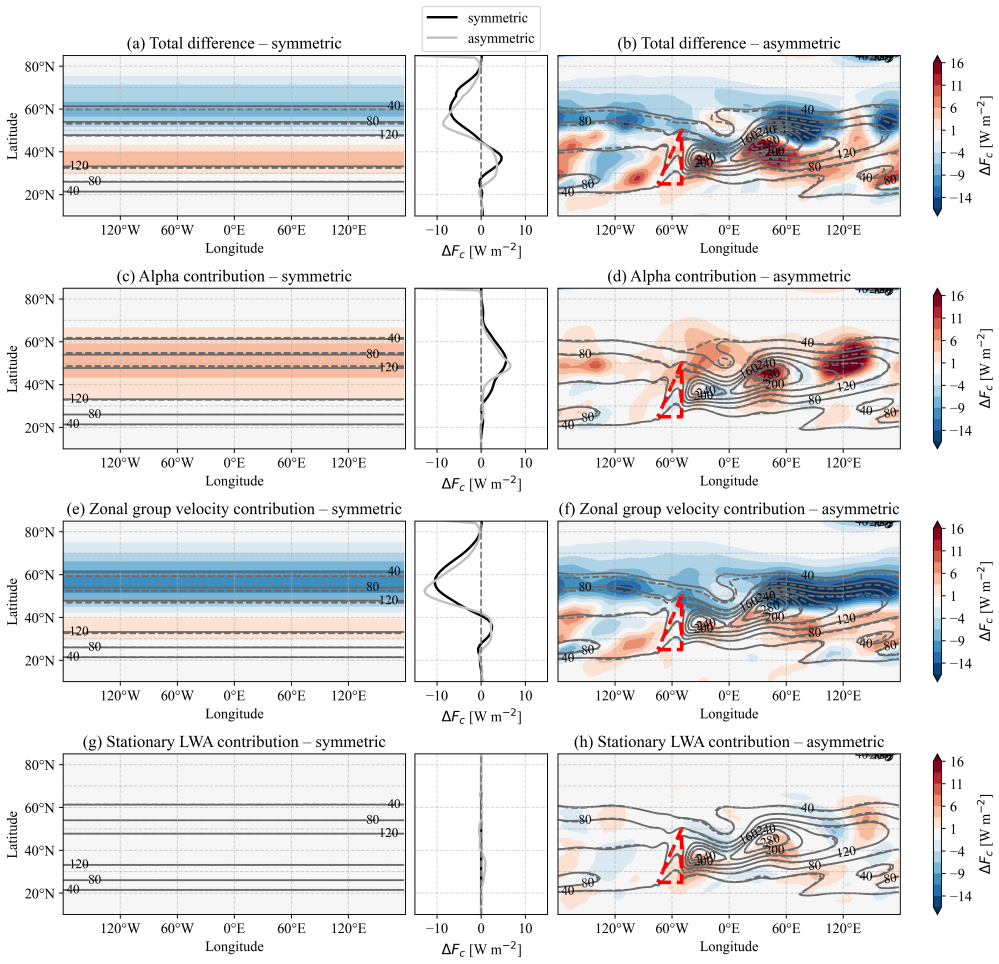
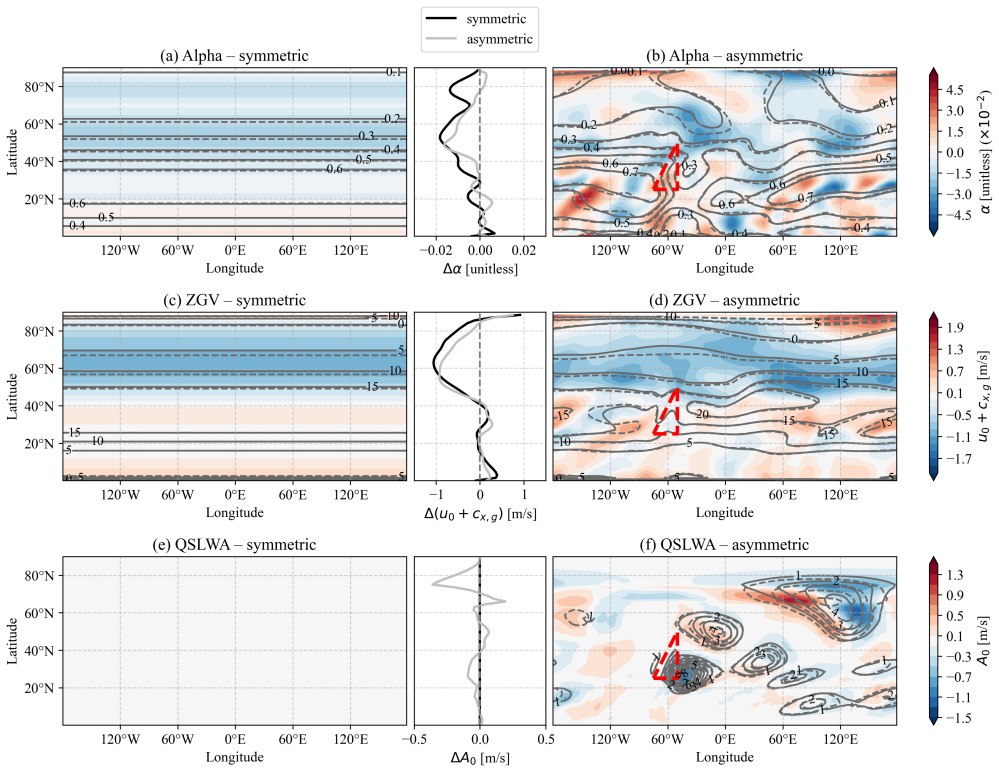
Imposing polar heating in aquaplanet runs increases atmospheric blocking in both configurations by weakening zonal winds, which lowers the Doppler-shifted Rossby wave group velocity and therefore the carrying capacity of the midlatitude flow. In the zonally symmetric setup the increase is uniform across latitudes. In the zonally asymmetric setup that includes a localized storm track, the identical reduction in carrying capacity instead displaces the blocking frequency maximum upstream of the storm-track exit because blocking onset occurs only once wave activity exceeds a threshold.
What carries the argument
Traffic Jam theory carrying capacity of the midlatitude flow, which sets the threshold for blocking onset when Rossby wave activity exceeds the flow's ability to propagate it downstream.
If this is right
- Weakening of zonal winds from Arctic warming reduces carrying capacity and raises blocking frequency in any configuration.
- The same capacity reduction produces an upstream shift of blocking only when zonal asymmetries are present.
- Mean circulation characteristics determine the spatial pattern of the blocking response to polar heating.
- The threshold nature of blocking onset converts a uniform capacity change into a localized frequency shift.
Where Pith is reading between the lines
- The upstream-shift mechanism may operate in models that include realistic land-sea contrasts and could alter projected changes in blocking over continents.
- Similar capacity-threshold diagnostics could be applied to other midlatitude phenomena that depend on wave propagation speed.
- If the threshold is confirmed, targeted changes to mean zonal wind could be used to test whether blocking frequency can be shifted without altering overall wave activity.
Load-bearing premise
The carrying capacity diagnosis and its threshold behavior from the Traffic Jam theory correctly explain why the upstream shift of blocking occurs only in the asymmetric configuration.
What would settle it
An asymmetric aquaplanet run with polar heating in which the blocking maximum does not shift upstream even though zonal winds weaken and carrying capacity falls.
Figures
read the original abstract
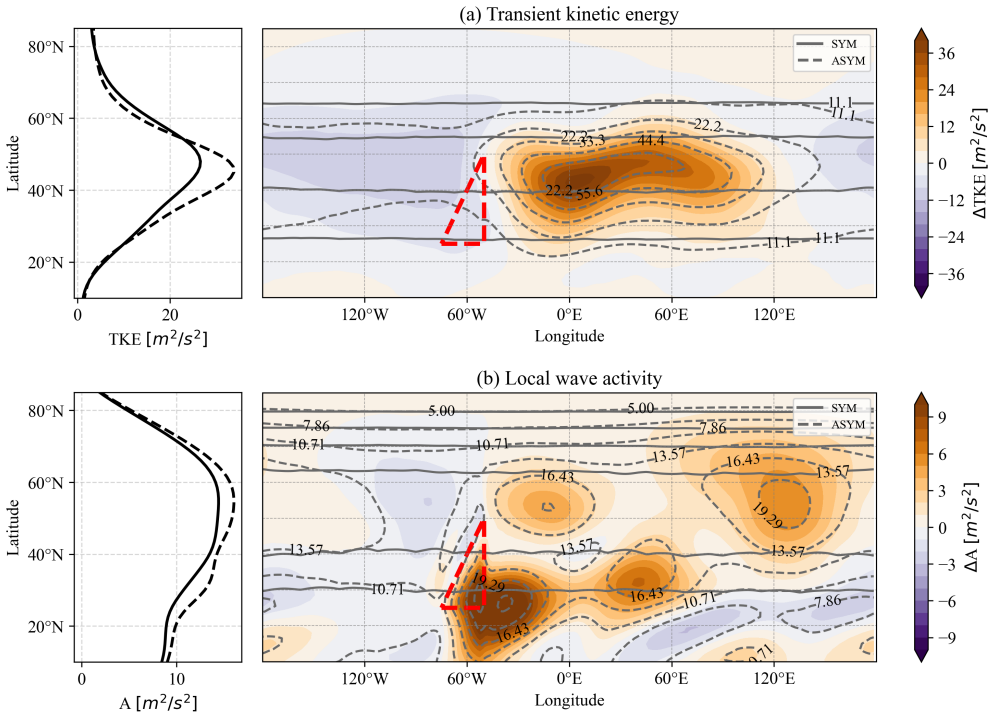
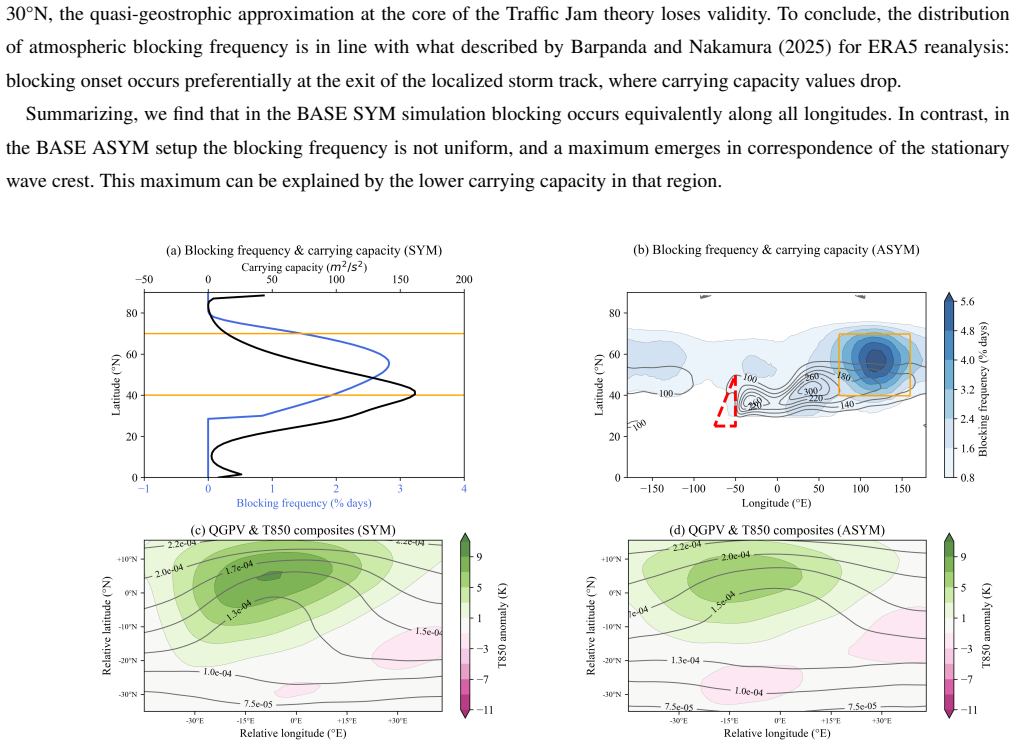
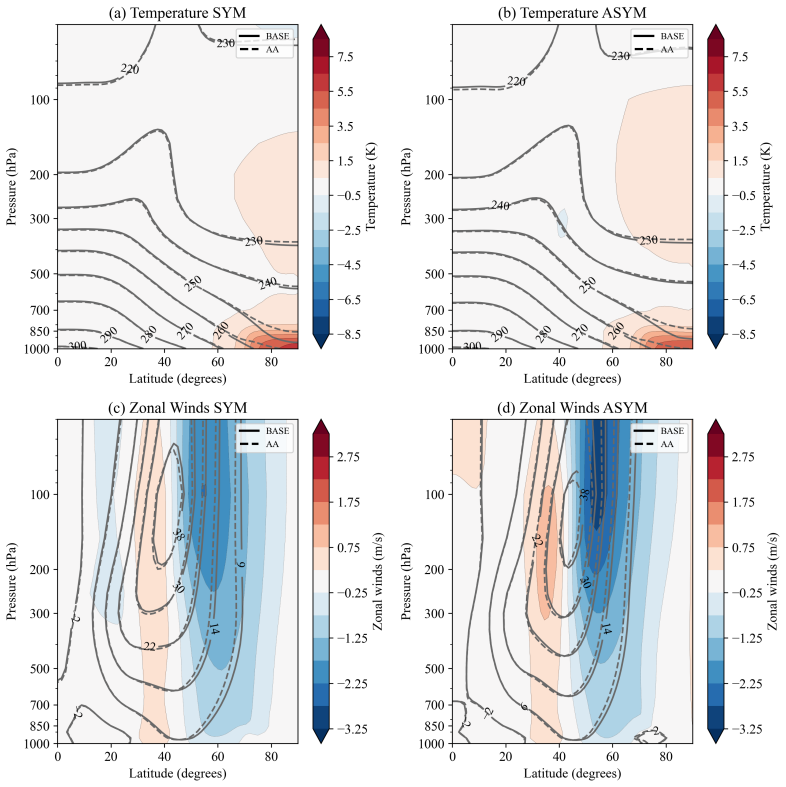
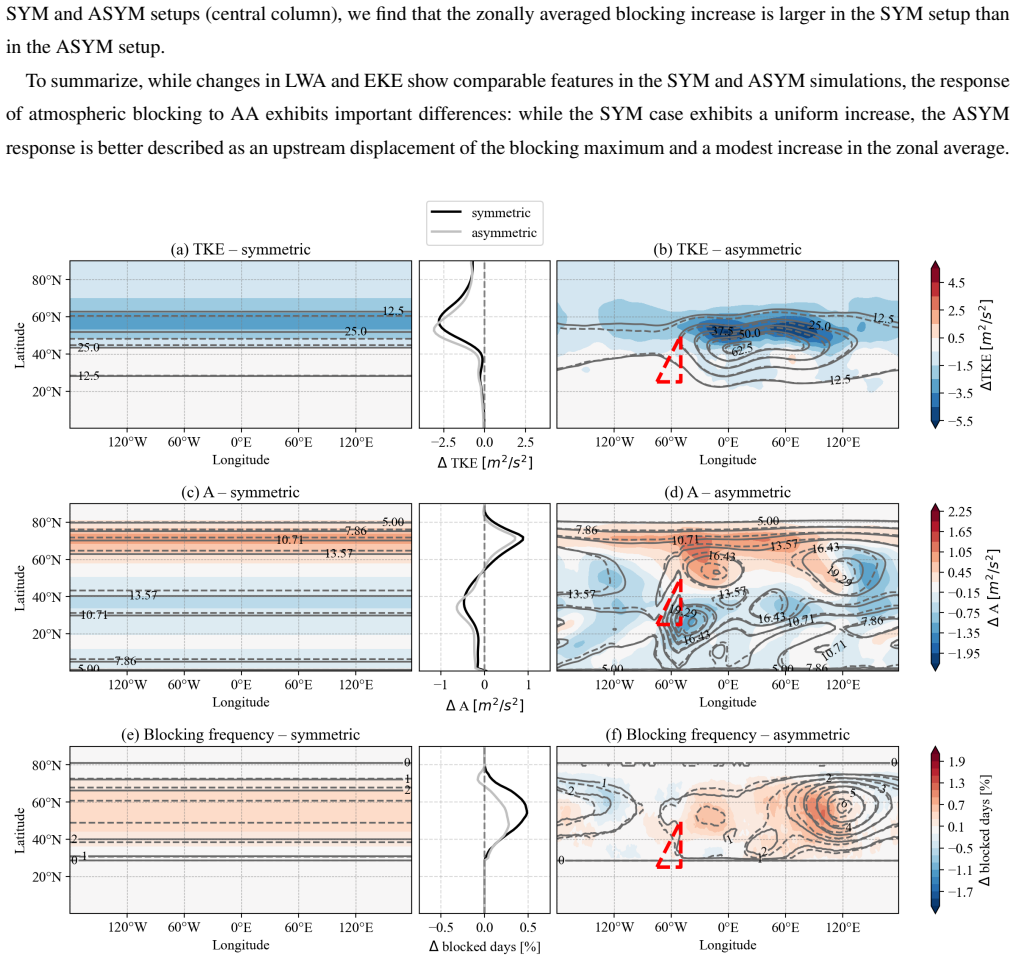
In recent years a weak but robust response of mean midlatitude circulation to Arctic amplification (AA) has emerged from modeling experiments. However, open questions remain about the mechanisms linking such circulation differences to weather extremes in the midlatitudes. In this study we investigate such mechanisms and the importance of zonal asymmetries in shaping the atmospheric blocking response to AA. We perform idealized aquaplanet simulations in two configurations: a zonally symmetric setup and a zonally asymmetric experiment featuring a localized midlatitude storm track. For each configuration, we examine the response to AA by imposing an anomalous surface heating in the polar region. In the zonally symmetric configuration atmospheric blocking increases uniformly with AA from mid to high latitudes. In the asymmetric configuration, the response is more complex; instead of a zonally uniform response, we observe an upstream displacement of the blocking maximum, which sits at the exit of the localized storm track. We interpret these changes through the lens of the Traffic Jam theory by diagnosing the carrying capacity of the midlatitude flow. In both configurations, the zonally averaged increase in blocking is primarily driven by a weakening of the zonal winds, which reduces the Doppler-shifted Rossby wave group velocity and, in turn, decreases the flow carrying capacity. While the reduction in carrying capacity has similar characteristics in the two configurations, in the asymmetric case it leads to an upstream shift of blocking frequency as a direct consequence of the threshold behavior of blocking onset that lies at the core of the Traffic Jam theory. This mechanism, which has received limited attention so far, highlights the importance of mean circulation characteristics in shaping the blocking response to external forcing such as Arctic warming.
Editorial analysis
A structured set of objections, weighed in public.
Referee Report
Summary. The manuscript uses idealized aquaplanet simulations to compare the atmospheric blocking response to polar surface heating in a zonally symmetric configuration versus an asymmetric configuration with a localized midlatitude storm track. It reports a uniform increase in blocking frequency across mid-to-high latitudes in the symmetric case, but an upstream displacement of the blocking maximum (at the storm-track exit) in the asymmetric case. Both responses are attributed to a reduction in the midlatitude flow's carrying capacity arising from weakened zonal winds that lower the Doppler-shifted Rossby-wave group velocity; the asymmetric-case shift is interpreted as a direct consequence of the threshold behavior for blocking onset in the Traffic Jam theory.
Significance. If the mechanistic link holds, the work isolates the role of zonal asymmetries in shaping blocking changes under Arctic amplification and supplies a theory-based explanation that could be tested in more comprehensive models. The controlled experimental contrast and explicit diagnosis of carrying capacity from an external theory are strengths that allow a clear attribution of the differing responses.
major comments (1)
- [Results and interpretation of asymmetric configuration] The central interpretive claim (abstract and results on the asymmetric configuration) that the upstream shift arises 'as a direct consequence of the threshold behavior of blocking onset' is not supported by an explicit demonstration that the carrying-capacity threshold is evaluated locally within the storm-track region rather than on the zonal mean. The provided diagnostics are described only as zonally averaged reductions, leaving the predicted direction and location of the displacement unverified by the theory's onset criterion.
minor comments (2)
- [Methods] The methods section omits key numerical details (horizontal/vertical resolution, integration length, ensemble size) required to evaluate the statistical robustness of the reported blocking-frequency changes.
- [Results figures and text] Blocking-frequency responses are presented without error bars or significance testing, which would strengthen the contrast between the uniform and upstream-shifted responses.
Simulated Author's Rebuttal
We thank the referee for their constructive review and for identifying an important point regarding the interpretation of the asymmetric configuration. We address the major comment below and commit to revisions that will strengthen the link to the Traffic Jam theory.
read point-by-point responses
-
Referee: [Results and interpretation of asymmetric configuration] The central interpretive claim (abstract and results on the asymmetric configuration) that the upstream shift arises 'as a direct consequence of the threshold behavior of blocking onset' is not supported by an explicit demonstration that the carrying-capacity threshold is evaluated locally within the storm-track region rather than on the zonal mean. The provided diagnostics are described only as zonally averaged reductions, leaving the predicted direction and location of the displacement unverified by the theory's onset criterion.
Authors: We agree that the manuscript would benefit from an explicit local demonstration. Our current analysis diagnoses carrying capacity from the zonally averaged zonal wind reduction, which is reduced in both configurations. In the asymmetric experiment, the localized storm track creates zonal variations in the background flow; the theory's threshold for blocking onset is therefore crossed first in the region immediately upstream of the original blocking maximum once the carrying capacity drops below the local wave activity. To make this explicit, the revised manuscript will add maps of the local carrying capacity (computed from the Doppler-shifted group velocity at each longitude) together with the spatial field of wave activity relative to the local threshold. These diagnostics will directly verify that the threshold is first exceeded upstream of the storm-track exit, confirming the predicted displacement. revision: yes
Circularity Check
No significant circularity; results from direct simulation outputs interpreted via external theory
full rationale
The paper reports outcomes from aquaplanet simulations (symmetric and asymmetric configurations) with imposed polar heating, then diagnoses zonally-averaged carrying capacity from zonal wind changes. The upstream blocking shift in the asymmetric case is interpreted as following from the threshold behavior of the Traffic Jam theory. No equations, fitted parameters, or self-citations in the provided text reduce any claimed result to an input by construction, nor does any step equate a prediction to its own fit or definition. The derivation chain remains self-contained against the external benchmarks of the simulations and cited theory.
Axiom & Free-Parameter Ledger
free parameters (1)
- anomalous surface heating magnitude
axioms (2)
- domain assumption The aquaplanet model equations and boundary conditions isolate the effects of zonal asymmetry without land or orography.
- domain assumption The Traffic Jam theory's carrying capacity and threshold onset apply directly to the diagnosed blocking changes in these simulations.
Reference graph
Works this paper leans on
-
[1]
Barnes, E. A.: Revisiting the evidence linking Arctic amplification to extreme weather in midlatitudes, Geophysical research letters, 40, 4734–4739, https://doi.org/https://doi.org/10.1002/grl.50880,
-
[2]
Barpanda, P. and Nakamura, N.: Local wave-activity analysis of atmospheric blocks in the Northern Hemisphere winter, Journal of Climate, https://doi.org/https://doi.org/10.1175/JCLI-D-24-0232.1,
-
[3]
Blackport, R. and Screen, J. A.: Insignificant effect of Arctic amplification on the amplitude of midlatitude atmospheric waves, Science Advances, 6, eaay2880, https://doi.org/10.1126/sciadv.aay2880,
-
[4]
Blackport, R., Sigmond, M., and Screen, J. A.: Models and observations agree on fewer and milder midlatitude cold extremes even over recent decades of rapid Arctic warming, Science Advances, 10, eadp1346, https://doi.org/DOI: 10.1126/sciadv.adp1346,
-
[5]
Butler, A. H., Thompson, D. W., and Heikes, R.: The steady-state atmospheric circulation response to climate change–like thermal forcings in a simple general circulation model, Journal of Climate, 23, 3474–3496, https://doi.org/https://doi.org/10.1175/2010JCLI3228.1,
-
[6]
Caballero, R. and Merlis, T. M.: Polar Feedbacks in Clear-Sky Radiative–Advective Equilibrium from an Airmass Transformation Perspective, Journal of Climate, 38, 3399–3416, https://doi.org/https://doi.org/10.1175/JCLI-D-24-0031.1,
-
[7]
Cattiaux, J., Peings, Y ., Saint-Martin, D., Trou-Kechout, N., and Vavrus, S. J.: Sinuosity of midlatitude atmospheric flow in a warming world, Geophysical Research Letters, 43, 8259–8268, https://doi.org/https://doi.org/10.1002/2016GL070309,
-
[8]
Charney, J. G. and Drazin, P. G.: Propagation of planetary-scale disturbances from the lower into the upper atmosphere, Journal of Geophysical Research, 66, 83–109, https://doi.org/https://doi.org/10.1029/JZ066i001p00083,
-
[9]
Cohen, J., Zhang, X., Francis, J., Jung, T., Kwok, R., Overland, J., Ballinger, T. J., Bhatt, U. S., Chen, H.-W., Coumou, D., Feldstein, S., Gu, H., Handorf, D., Henderson, G., Ionita, M., Kretschmer, M., Laliberte, F., Lee, S.-K., Linderholm, H. W., Maslowski, W., Peings, Y ., Pfeiffer, K., Rigor, I., Semmler, T., Stroeve, J., Taylor, P. C., Vavrus, S., ...
-
[10]
Davini, P., Cagnazzo, C., Gualdi, S., and Navarra, A.: Bidimensional diagnostics, variability, and trends of Northern Hemisphere blocking, Journal of Climate, 25, 6496–6509, https://doi.org/https://doi.org/10.1175/JCLI-D-12-00032.1,
-
[11]
Dole, R. M. and Gordon, N. D.: Persistent anomalies of the extratropical Northern Hemisphere wintertime circulation: Geographical distribution and regional persistence characteristics, Monthly Weather Review, 111, 1567–1586, https://doi.org/https://doi.org/10.1175/1520-0493(1983)111<1567:PAOTEN>2.0.CO;2,
-
[12]
Eyring, V ., Bony, S., Meehl, G. A., Senior, C. A., Stevens, B., Stouffer, R. J., and Taylor, K. E.: Overview of the Coupled Model Intercomparison Project Phase 6 (CMIP6) experimental design and organization, Geoscientific Model Development, 9, 1937–1958, https://doi.org/https://doi.org/10.5194/gmd-9-1937-2016,
-
[13]
Feldl, N., Anderson, B. T., and Bordoni, S.: Atmospheric eddies mediate lapse rate feedback and Arctic amplification, Journal of Climate, 30, 9213–9224, https://doi.org/https://doi.org/10.1175/JCLI-D-16-0706.1,
-
[14]
Filippucci, M., Maddison, J., and Bordoni, S.: Tracking summer Greenland blocking: the upstream pathway shapes historical extremes and future change, International Journal of Climatology, https://doi.org/https://doi.org/10.1002/joc.70472,
-
[15]
30 Francis, J. A. and Vavrus, S. J.: Evidence linking Arctic amplification to extreme weather in mid-latitudes, Geophysical research letters, 39, https://doi.org/https://doi.org/10.1029/2012GL051000,
-
[16]
Francis, J. A. and Vavrus, S. J.: Evidence for a wavier jet stream in response to rapid Arctic warming, Environmental Research Letters, 10, 014 005, https://doi.org/10.1088/1748-9326/10/1/014005,
-
[17]
Frierson, D. M.: The dynamics of idealized convection schemes and their effect on the zonally averaged tropical circulation, Journal of the atmospheric sciences, 64, 1959–1976, https://doi.org/https://doi.org/10.1175/JAS3935.1,
-
[18]
Geen, R., Thomson, S. I., Screen, J. A., Blackport, R., Lewis, N. T., Mudhar, R., Seviour, W. J., and Vallis, G. K.: An explanation for the metric dependence of the midlatitude jet-waviness change in response to polar warming, Geophysical Research Letters, 50, e2023GL105 132, https://doi.org/https://doi.org/10.1029/2023GL105132,
-
[19]
Hassanzadeh, P., Kuang, Z., and Farrell, B. F.: Responses of midlatitude blocks and wave amplitude to changes in the meridional temperature gradient in an idealized dry GCM, Geophysical Research Letters, 41, 5223–5232, https://doi.org/https://doi.org/10.1002/2014GL060764,
-
[20]
Hay, S., Screen, J. A., and Catto, J. L.: Steady but model dependent Arctic amplification of the forced temperature response in 21st century CMIP6 projections, Environmental Research: Climate, 3, 031 003, https://doi.org/10.1088/2752-5295/ad4201,
-
[21]
L., Hewitt, H., Eunice Lo, Y ., Screen, J
Hay, S., Blockley, E., Catto, J. L., Hewitt, H., Eunice Lo, Y ., Screen, J. A., Smith, D., and Yu, H.: The impact of Arctic sea-ice loss on winter weather in the British Isles, Quarterly Journal of the Royal Meteorological Society, p. e70012, https://doi.org/https://doi.org/10.1002/qj.70012,
-
[22]
Held, I. M., Ting, M., and Wang, H.: Northern winter stationary waves: Theory and modeling, Journal of climate, 15, 2125–2144, https://doi.org/https://doi.org/10.1175/1520-0442(2002)015<2125:NWSWTA>2.0.CO;2,
-
[23]
Hu, Y ., Yang, D., and Yang, J.: Blocking systems over an aqua planet, Geophysical Research Letters, 35, https://doi.org/https://doi.org/10.1029/2008GL035351,
-
[24]
Huang, C. S. and Nakamura, N.: Local finite-amplitude wave activity as a diagnostic of anomalous weather events, Journal of the Atmospheric Sciences, 73, 211–229, https://doi.org/https://doi.org/10.1175/JAS-D-15-0194.1,
-
[25]
Huang, C. S., Polster, C., and Nakamura, N.: Falwa: Python Package to Implement Finite-Amplitude Local Wave Activity Diagnostics on Climate Data, Geoscience Data Journal, 12, e70 006, https://doi.org/https://doi.org/10.1002/gdj3.70006,
-
[26]
IPCC: Climate Change 2023: Synthesis Report. Contribution of Working Groups I, II and III to the Sixth Assessment Report of the Intergovernmental Panel on Climate Change, IPCC, Geneva, Switzerland, https://doi.org/10.59327/IPCC/AR6-9789291691647,
-
[27]
Jiménez-Esteve, B. and Domeisen, D. I.: The role of atmospheric dynamics and large-scale topography in driving heatwaves, Quarterly Journal of the Royal Meteorological Society, 148, 2344–2367, https://doi.org/https://doi.org/10.1002/qj.4306,
-
[28]
Kaspi, Y . and Schneider, T.: The role of stationary eddies in shaping midlatitude storm tracks, Journal of the atmospheric sciences, 70, 2596–2613, https://doi.org/https://doi.org/10.1175/JAS-D-12-082.1,
-
[29]
Lewis, N. T., England, M. R., Screen, J. A., Geen, R., Mudhar, R., Seviour, W. J., and Thomson, S. I.: Assessing the Spurious Impacts of Ice- Constraining Methods on the Climate Response to Sea Ice Loss Using an Idealized Aquaplanet GCM, Journal of Climate, 37, 6729–6750, https://doi.org/https://doi.org/10.1175/JCLI-D-24-0153.1, 2024a. Lewis, N. T., Sevio...
-
[30]
Mudhar, R., Seviour, W. J., Screen, J. A., Geen, R., Lewis, N. T., and Thomson, S. I.: Exploring mechanisms for model- dependency of the stratospheric response to Arctic warming, Journal of Geophysical Research: Atmospheres, 129, e2023JD040 416, https://doi.org/https://doi.org/10.1029/2023JD040416,
-
[31]
Nakamura, N.: Large-Scale Eddy-Mean Flow Interaction in the Earth’s Extratropical Atmosphere, Annual Review of Fluid Mechanics, 56, 349–377, https://doi.org/https://doi.org/10.1146/annurev-fluid-121021-035602,
-
[32]
Nakamura, N. and Huang, C. S.: Atmospheric blocking as a traffic jam in the jet stream, Science, 361, 42–47, https://doi.org/10.1126/science.aat0721,
-
[33]
Nakamura, N. and Zhu, D.: Finite-amplitude wave activity and diffusive flux of potential vorticity in eddy–mean flow interaction, Journal of the atmospheric sciences, 67, 2701–2716, https://doi.org/https://doi.org/10.1175/2010JAS3432.1,
-
[34]
Narinesingh, V ., Booth, J. F., Clark, S. K., and Ming, Y .: Atmospheric blocking: The impact of topography in an idealized general circulation model, Weather and Climate Dynamics Discussions, 2020, 1–39, https://doi.org/https://doi.org/10.5194/wcd-1-293-2020,
-
[35]
Previdi, M., Smith, K. L., and Polvani, L. M.: Arctic amplification of climate change: a review of underlying mechanisms, Environmental Research Letters, 16, 093 003, https://doi.org/10.1088/1748-9326/ac1c29,
-
[36]
Riboldi, J., Lott, F., d’Andrea, F., and Rivière, G.: On the linkage between Rossby wave phase speed, atmospheric blocking, and Arctic amplification, Geophysical Research Letters, 47, e2020GL087 796, https://doi.org/https://doi.org/10.1029/2020GL087796,
-
[37]
Richards, P. I.: Shock waves on the highway, Operations research, 4, 42–51, https://doi.org/https://doi.org/10.1287/opre.4.1.42,
-
[38]
Riebold, J., Richling, A., Ulbrich, U., Rust, H., Semmler, T., and Handorf, D.: On the linkage between future Arctic sea ice retreat, Euro-Atlantic circulation regimes and temperature extremes over Europe, Weather and Climate Dynamics, 4, 663–682, https://doi.org/https://doi.org/10.5194/wcd-4-663-2023,
-
[39]
Ronalds, B. and Barnes, E. A.: A role for barotropic Eddy–Mean flow feedbacks in the zonal wind response to sea ice loss and arctic amplification, Journal of Climate, 32, 7469–7481, https://doi.org/https://doi.org/10.1175/JCLI-D-19-0157.1,
-
[40]
Scaife, A. A., Woollings, T., Knight, J., Martin, G., and Hinton, T.: Atmospheric blocking and mean biases in climate models, Journal of Climate, 23, 6143–6152, https://doi.org/https://doi.org/10.1175/2010JCLI3728.1,
-
[41]
Scherrer, S. C., Croci-Maspoli, M., Schwierz, C., and Appenzeller, C.: Two-dimensional indices of atmospheric blocking and their statistical relationship with winter climate patterns in the Euro-Atlantic region, International journal of climatology, 26, 233–250, https://doi.org/10.1002/joc.1250,
-
[42]
Schneider, T., Bischoff, T., and Płotka, H.: Physics of changes in synoptic midlatitude temperature variability, Journal of Climate, 28, 2312– 2331, https://doi.org/https://doi.org/10.1175/JCLI-D-14-00632.1,
-
[43]
32 Screen, J. A. and Simmonds, I.: The central role of diminishing sea ice in recent Arctic temperature amplification, Nature, 464, 1334–1337, https://doi.org/https://doi.org/10.1038/nature09051,
-
[44]
Screen, J. A. and Simmonds, I.: Exploring links between Arctic amplification and mid-latitude weather, Geophysical Research Letters, 40, 959–964, https://doi.org/https://doi.org/10.1002/grl.50174,
-
[45]
Screen, J. A., Deser, C., and Sun, L.: Reduced risk of North American cold extremes due to continued Arctic sea ice loss, Bulletin of the American Meteorological Society, 96, 1489–1503, https://doi.org/https://doi.org/10.1175/BAMS-D-14-00185.1,
-
[46]
Screen, J. A., Smith, D., et al.: Net equatorward shift of the jet streams when the contribution from sea-ice loss is constrained by observed eddy feedback, Geophysical Research Letters, 49, e2022GL100 523, https://doi.org/10.1029/2022GL100523,
-
[47]
A., Audette, A., Blackport, R., Deser, C., England, M., Feldl, N., Gervais, M., Hay, S., Kushner, P
Screen, J. A., Audette, A., Blackport, R., Deser, C., England, M., Feldl, N., Gervais, M., Hay, S., Kushner, P. J., Liang, Y .-C., et al.: Causes and consequences of Arctic amplification elucidated by coordinated multimodel experiments, Communications Earth & Environment, https://doi.org/https://doi.org/10.1038/s43247-025-03052-z,
-
[48]
Shaw, T., Baldwin, M., Barnes, E. A., Caballero, R., Garfinkel, C., Hwang, Y .-T., Li, C., O’gorman, P., Rivière, G., Simpson, I., et al.: Storm track processes and the opposing influences of climate change, Nature Geoscience, 9, 656–664, https://doi.org/https://doi.org/10.1038/ngeo2783,
-
[49]
Shaw, T. A. and Smith, Z.: The midlatitude response to polar sea ice loss: Idealized slab-ocean aquaplanet experiments with thermodynamic sea ice, Journal of Climate, 35, 2633–2649, https://doi.org/https://doi.org/10.1175/JCLI-D-21-0508.1,
-
[50]
Smith, D. M., Screen, J. A., Deser, C., Cohen, J., Fyfe, J. C., García-Serrano, J., Jung, T., Kattsov, V ., Matei, D., Msadek, R., et al.: The Polar Amplification Model Intercomparison Project (PAMIP) contribution to CMIP6: investigating the causes and consequences of polar amplification, Geoscientific Model Development, 12, 1139–1164, https://doi.org/htt...
-
[51]
Smith, D. M., Eade, R., Andrews, M., Ayres, H., Clark, A., Chripko, S., Deser, C., Dunstone, N., García-Serrano, J., Gastineau, G., et al.: Robust but weak winter atmospheric circulation response to future Arctic sea ice loss, Nature communications, 13, 727, https://doi.org/https://doi.org/10.1038/s41467-022-28283-y,
-
[52]
Sousa, P. M., Trigo, R. M., Barriopedro, D., Soares, P. M., and Santos, J. A.: European temperature responses to blocking and ridge regional patterns, Climate Dynamics, 50, 457–477, https://doi.org/https://doi.org/10.1007/s00382-017-3620-2,
-
[53]
Streffing, J., Semmler, T., Zampieri, L., and Jung, T.: Response of Northern Hemisphere weather and climate to Arctic sea ice decline: Resolution independence in Polar Amplification Model Intercomparison Project (PAMIP) simulations, Journal of Climate, 34, 8445– 8457, https://doi.org/https://doi.org/10.1175/JCLI-D-19-1005.1,
-
[54]
Tibaldi, S. and Molteni, F.: On the operational predictability of blocking, Tellus A, 42, 343–365, https://doi.org/https://doi.org/10.1034/j.1600-0870.1990.t01-2-00003.x,
-
[55]
K., Colyer, G., Geen, R., et al
Vallis, G. K., Colyer, G., Geen, R., Gerber, E., Jucker, M., Maher, P., Paterson, A., Pietschnig, M., Penn, J., and Thomson, S. I.: Isca, v1. 0: A framework for the global modelling of the atmospheres of Earth and other planets at varying levels of complexity, Geoscientific Model Development, 11, 843–859, https://doi.org/https://doi.org/10.5194/gmd-11-843-2018,
-
[56]
Woollings, T., Barriopedro, D., Methven, J., Son, S.-W., Martius, O., Harvey, B., Sillmann, J., Lupo, A. R., and Seneviratne, S.: Blocking and its response to climate change, Current climate change reports, 4, 287–300, https://doi.org/https://doi.org/10.1007/s40641-018-0108-z,
-
[57]
33 Wu, Y . and Smith, K. L.: Response of Northern Hemisphere midlatitude circulation to Arctic amplification in a simple atmospheric general circulation model, Journal of Climate, 29, 2041–2058, https://doi.org/https://doi.org/10.1175/JCLI-D-15-0602.1,
-
[58]
Yan, X., Wang, L., Gerber, E. P., Castañeda, V ., and Ho, K. Y .: Traffic bottlenecks: Predicting atmospheric blocking with a diminishing flow capacity, Geophysical Research Letters, 51, e2024GL111 035, https://doi.org/https://doi.org/10.1029/2024GL111035,
-
[59]
Yuval, J. and Kaspi, Y .: Eddy activity response to global warming–like temperature changes, Journal of Climate, 33, 1381–1404, https://doi.org/https://doi.org/10.1175/JCLI-D-19-0190.1,
-
[60]
Zhuo, W., Yao, Y ., Luo, D., Huang, F., Luo, B., and Zhong, L.: The response of atmospheric blocking and East Asian cold extremes to future Arctic Sea ice loss, Atmospheric Research, 304, 107 355, https://doi.org/https://doi.org/10.1016/j.atmosres.2024.107355,
discussion (0)
Sign in with ORCID, Apple, or X to comment. Anyone can read and Pith papers without signing in.