REVIEW 3 major objections 4 minor 85 references
Time-varying wind-turbine wakes at high Reynolds numbers
T0 review · 3 major / 4 minor · reviewed 2026-08-07 · deepseek-v4-flash
Pith's one-line read Slow disturbances in wind-turbine wakes travel as traveling waves carried at the local wake velocity, not the free-stream wind speed, and the wake is quasi-steady only after a Lagrangian map removes that advection.
desk verdict New high-Re data show slow turbine forcing produces wake-velocity advected traveling waves, but the key advection-speed test is partly built into the Lagrangian transform; still worth refereeing. read the letter →
The pith
A machine-rendered reading of the paper's core claim, the machinery that carries it, and where it could break.
The reading
What carries the argument
The load-bearing object is the Lagrangian wake-following transformation. Starting from the measured phase-averaged field $U(x,t)$ at the first measured station $x/D=1.44$, the authors advance fluid parcels by forward-Euler integration $x_{k+1}=x_k+U(x_k,t_k)\Delta t$ and $t_{k+1}=t_k+\Delta t$, mapping every measurement into coordinates of the initial phase $t_0/T$ at which it left the near wake. This transformation carries the argument because the test of the paper's thesis is whether the curved traveling-wave streaks in Eulerian coordinates collapse onto horizontal lines in these Lagrangian coordinates; the collapsed contours are then compared with a quasi-steady reference solution interpolated from steady-flow measurements. On the theory side, a triple-decomposed, phase-averaged momentum equation reduced under quasi-parallel, zero-pressure-gradient assumptions gives an advection-diffusion equation for the perturbation $\tilde u_x$, which is the stated reason disturbances should ride at the local wake velocity and accelerate downstream.
What would settle it
Measure the phase speed of the perturbation independently of the transformation, for instance with phase-locked anemometry or particle image velocimetry at two closely spaced stations in the intermediate wake and with additional measurements upstream of $x/D=1.44$; if the observed disturbance speed departs from the local phase-averaged wake velocity $U(x,t)$ because of near-wake pressure gradients or radial averaging, the Lagrangian collapse will break down and the quasi-steady recovery will fail. A quantitative version would compute the normalized root-mean-square difference between the Lagrangian-transformed unsteady contours and the quasi-steady reference and check whether it exceeds the measured phase-averaging uncertainty.
Extended reading notes
Core claim
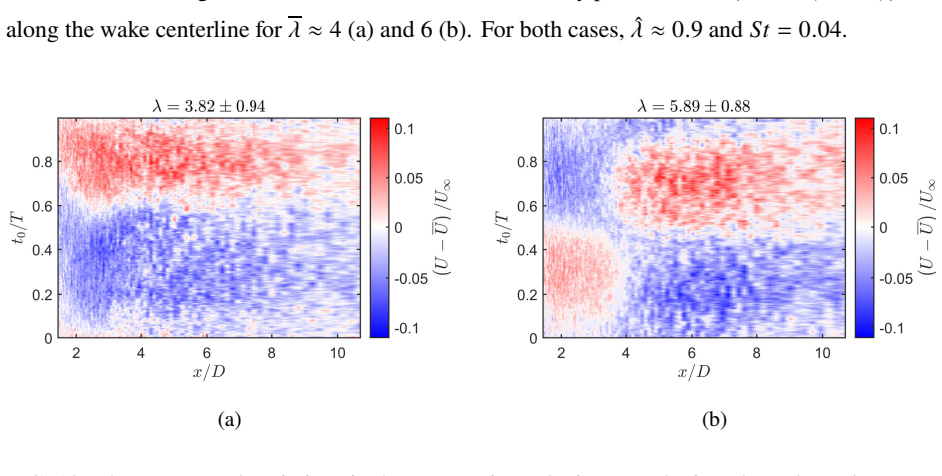
At Reynolds number $Re_D = 4\times10^6$ and a forcing Strouhal number $St = 0.04$, slow enough to be called quasi-steady, the phase-averaged velocity perturbations in the turbine wake form red and blue streaks in the $(x/D, t/T)$ plane along curved trajectories. The curvature is the signature of nonlinear advection: disturbances start slowly in the near wake and accelerate as the wake recovers, so a single free-stream advection speed cannot describe them. The paper's discovery is that working in characteristic coordinates built from the local phase-averaged wake velocity $U(x,t)$ flattens those streaks onto horizontal lines of constant phase of origin, and the resulting profiles of velocity and velocity variance coincide with the quasi-steady solution interpolated from steady-flow data. In the authors' words, wake evolution can be modeled as quasi-steady only after the effects of advection by the wake velocity are taken into account. A second finding is that the phase relationship between thrust and tip-speed ratio determines whether the traveling waves pass through the intermediate wake unchanged or invert sign at the tip-vortex breakdown location, giving slow controllers a lever over wake structure.
Load-bearing premise
The central claim assumes that disturbances are carried at the local measured wake speed, and the Lagrangian map is built from that same measured speed, so the tight collapse onto characteristics is partly a consequence of the method rather than independent evidence.
Editorial extensions
If this is right
- Quasi-steady wake models that update the wake profile from rotor state alone will misplace the wake in time whenever inflow or turbine operation varies; advection lags at the wake velocity must be added.
- Dynamic wake models that advect wake elements should adopt the local wake velocity as the advection speed, since the Lagrangian collapse reproduces the quasi-steady solution with that speed and not with the free-stream speed.
- At practical scale, $St=0.04$ corresponds to a roughly 250-second period for a 100-meter turbine in a 10 m/s wind, and a disturbance takes at least 300 seconds to cross four turbines spaced 10 diameters apart, so turbines in a row will see different phases of the same disturbance.
- Operating on either side of the thrust-curve peak reverses the phase of thrust relative to tip-speed ratio, and the wake responds differently: waves pass through unchanged near $\lambda\approx4$ and invert sign near $\lambda\approx5$ and 6 at the tip-vortex breakdown location.
- Time-varying control of thrust and tip-speed ratio can shape wake structure even at forcing frequencies traditionally regarded as quasi-steady.
Reading between the lines
- Beyond the paper, the same Lagrangian collapse could be applied to lateral wake motion: if yaw-induced or meandering disturbances also ride at the local wake velocity, the time delay of wake steering across a farm depends on wake speed rather than wind speed.
- The paper's conjecture that pressure-gradient communication makes disturbances appear to start downstream of the rotor plane would be directly testable by extending phase-locked measurements upstream of $x/D=1.44$; that measurement would also settle whether the Lagrangian origin should be at the rotor plane.
- Quantifying the mismatch between Lagrangian-transformed unsteady contours and the quasi-steady reference with a normalized error metric would turn the visual agreement into a controller-ready error bound.
Editorial analysis
A structured set of objections, weighed in public.
Referee Report
Summary. The paper reports wind-tunnel experiments at Reynolds number Re_D=4×10^6 in the Princeton High Reynolds number Test Facility, in which a model wind turbine is forced with sinusoidal generator-torque oscillations at Strouhal number St=0.04. Phase-averaged streamwise velocity measurements along the wake centerline and at several radial stations show perturbation streaks that curve in the (x/D, t/T) plane, which the authors interpret as traveling waves advected nonlinearly at the local wake velocity. A Lagrangian transformation using the measured phase-averaged velocity as the advection speed collapses the streaks onto horizontal characteristics, and the transformed profiles are compared with quasi-steady reconstructions interpolated from steady-flow measurements. Additional cases at mean tip-speed ratios λ≈4, 5, and 6, and variations of forcing frequency and amplitude, are used to support the conclusions that wake advection must be included in quasi-steady wake models and that time-varying thrust/tip-speed-ratio relationships can shape the wake even at slow forcing.
Significance. If the central claim is correct, the paper provides a rare high-Reynolds-number experimental confirmation that time-varying disturbances in wind-turbine wakes are advected at wake-velocity scales rather than free-stream scales, with direct implications for dynamic wake models and wind-farm control. The experimental strengths are substantial: the pressurized-tunnel facility reaches near-utility-scale Reynolds numbers, forces are measured and reported with uncertainty quantification, phase-averaged velocity statistics are synchronized to the forcing waveform, and the appendices extend the results over forcing frequency and amplitude. The comparison to quasi-steady reference solutions is a useful falsifiable design. However, the empirical evidence for the wake-velocity advection speed is weakened by the fact that the same measured velocity field is used both to construct the Lagrangian coordinates and to demonstrate the collapse, so an independent, quantitative phase-lag test is needed to separate the claim from the analysis method.
major comments (3)
- [§IV B, Figs. 6-8] The Lagrangian transformation is constructed by forward-Euler integration using the measured phase-averaged streamwise velocity U(x,t) itself as the advection speed. Because the same field is used to define the characteristics and to display the collapsed contours, the flattening of the streaks onto horizontal lines is partly a consequence of the method rather than an independent measurement of the disturbance advection speed. To support the claim that disturbances propagate at the wake velocity rather than the free-stream velocity, the authors should provide a test that does not use the same measured field for both coordinate construction and verification. A direct phase-lag analysis of the velocity-perturbation extrema between two or more streamwise stations, compared quantitatively against predictions using U_infinity, the time-averaged wake velocity, and a constant fraction of U_infinity, would be appropriate; the partial phase-lag analysis in §IV C for the variance peaks is a step in this direction but is not applied to the main traveling-wave claim.
- [§IV B, Figs. 7 and 8] The statement that the Lagrangian-transformed time-varying data 'closely correspond' to the quasi-steady reference solutions is supported only visually. The authors should quantify the agreement (for example, RMS deviation or correlation coefficient as a function of x/D) and, crucially, compare this agreement against the agreement obtained when the transformation uses alternative advection speeds such as U_infinity or a constant fraction of U_infinity. Without such a metric, it is not possible to assess whether the wake-velocity advection hypothesis is actually favored over simpler alternatives, especially since the transformation is nonlinear and can partially accommodate a range of advection speeds.
- [§IV B, paragraph beginning 'It is important to note that...'] The authors explicitly acknowledge that data are not available for x/D < 1.44 and that pressure-gradient effects in this region may communicate thrust information nearly instantaneously downstream. This is a load-bearing limitation because the Lagrangian characteristics are initialized at x/D = 1.44, and any uncertainty in the initial phase and position of the disturbances propagates into the claimed collapse. The conjecture about pressure-driven near-wake communication is plausible, but the central advection claim would be strengthened by either measuring the near wake or by showing that the collapse and the match to the quasi-steady reference are insensitive to the chosen initialization location x/D and to the initial phase assignment.
minor comments (4)
- [§IV C, Eq. (12)] The fitted linear velocity profile is written as U/U_infinity ≈ 0.18 + 0.2 x/(3D), but the notation is ambiguous: it should specify the range of validity and clarify whether x/(3D) means x divided by (3D) or (x/3)/D. The subsequent integration and phase-lag estimate would also benefit from an error estimate propagated from the fit.
- [§IV B and Fig. 6(b)] The quasi-steady reference solution is constructed by linear interpolation of steady-flow data with no advection, so it is unsurprising that its propagation characteristics differ from the time-varying data. The text could state more explicitly that this comparison is designed to isolate the role of advection rather than to test the validity of quasi-steadiness per se.
- [Appendix A] For the St = 0.02 case, only 20 forcing periods were included in the phase average, compared with at least 30 for the other cases. The authors should state the expected effect on statistical convergence of the phase-averaged velocities in this appendix.
- [§III B] The use of the '±' symbol to denote oscillation amplitude rather than uncertainty is unconventional and may confuse readers. It is explained in the main text, but the figure captions (for example, Fig. 5) could state this explicitly to avoid misinterpretation.
Circularity Check
Lagrangian collapse is partly built into the method; wake-velocity advection is not independently tested against alternative speeds.
-
self definitional
[§IV B, Lagrangian transformation (Figs. 6c, 7, 8)]
"This is done for each phase-averaged streamwise dataset by forward-Euler integration over the velocity fields. ... x_{k+1} = x_k + U(x_k, t_k) Δt ... This process effectively flattens the characteristic curves from Fig. 6a onto horizontal lines ... Furthermore, it demonstrates that advection occurs at the wake velocity and not the free-stream velocity, as a spatially varying advection velocity is required to account for the curved trajectories in the original phase-averaged data."
The characteristic coordinate t0 is constructed by integrating the measured phase-averaged velocity U(x,t) itself. Plotting the same field in those coordinates and observing horizontal contours is therefore partly a consequence of the coordinate definition, not an independent measurement that disturbances propagate at the wake velocity. The claim that advection occurs at the wake velocity rather than U∞ is not tested against alternative advection speeds, and the independent check against the quasi-steady reference solution is presented only visually, without a quantitative metric.
full rationale
The paper's central claim has two parts: (i) disturbances travel as waves advected at the wake velocity, and (ii) quasi-steady wake behavior is recovered after a Lagrangian transformation. Part (i) is supported by a standard advection-diffusion equation derived in §II and by the Lagrangian collapse in §IV. The derivation is self-contained; citations to Wei et al. [19] are corroborating rather than load-bearing. However, the experimental demonstration in §IV B is partially circular: the characteristic coordinate t0 is computed by integrating the same measured phase-averaged velocity U(x,t) that is then asserted to be the wave advection speed. Horizontal contours in U(x,t0) are therefore partly a consequence of the coordinate choice, not an independent measurement of the phase speed. Alternative advection speeds are not quantitatively compared, and the quasi-steady reference match is visual only. Part (ii) has independent content because the reference solution is built from separate steady-flow data, but the comparison lacks a quantitative metric. Overall: one partially self-definitional step in the central evidence; no load-bearing self-citation; score 4.
Assumptions & free parameters
free parameters (1)
- Fitted linear wake velocity profile =
U/U∞ ≈ 0.18 + 0.2x/(3D) for 1.5 ≤ x/D ≤ 3.5
assumptions (5)
- domain assumption Boussinesq eddy-viscosity closure for phase-averaged Reynolds stresses (Eqs. 5-8)
- domain assumption Neglect of pressure gradient, radial homogeneity, and quasi-parallel flow in the theoretical model
- domain assumption The turbine forcing is quasi-steady: the phase-averaged thrust coefficient matches the steady-flow thrust curve at each phase
- domain assumption Disturbances are advected at the local phase-averaged streamwise velocity, and the Lagrangian transformation defined by forward-Euler integration of this field recovers the true characteristics
- domain assumption The tip-vortex breakdown location is inferred from the sharp rise in streamwise-velocity variance along the wake centerline
Cite this review
Pith. "Pith review of Time-varying wind-turbine wakes at high Reynolds numbers." pith.science (2026). https://pith.science/paper/2W6RW7H3
@misc{pith2026250522788,
  author       = {Pith},
  title        = {Pith review of: Time-varying wind-turbine wakes at high Reynolds numbers},
  year         = {2026},
  howpublished = {\url{https://pith.science/paper/2W6RW7H3}},
  note         = {Machine review of arXiv:2505.22788}
}
abstract
Wind turbines operating in the atmospheric boundary layer are constantly exposed to time-varying flow conditions. These disturbances often occur on similar time scales to wind-turbine controllers, which may interfere with wind-farm control strategies that operate under steady-flow assumptions. This study aims to investigate the significance of such time variations on wind-turbine wake dynamics, focusing on slow time scales representative of quasi-steady processes in large wind farms. Experiments are conducted at near utility-scale Reynolds numbers ($Re_D=4\times10^6$) in a pressurized-air wind tunnel, with a wind turbine forced in periodic rotation-rate oscillations by means of a time-varying generator torque at low Strouhal numbers ($St=0.04$). Flow measurements in the wake of the turbine demonstrate that disturbances propagate through the wake as traveling waves, which are advected nonlinearly at the velocity of the wake rather than that of the free stream. The wake behavior can be described in a quasi-steady manner, but only after wake advection is accounted for by a Lagrangian transformation. Even in the quasi-steady regime, the spatiotemporal evolution of the wake can be controlled by independently varying the turbine thrust and tip-speed ratio. The results suggest that wake advection is important to consider for wind-farm modeling and control, and that time-varying control may allow wind-turbine wake interactions to be tuned even in nominally quasi-steady conditions for optimal wind-farm performance.
Figures


Figures from the paper (14 more)




Reference graph
Works this paper leans on
-
[1]
R. J. Barthelmie, K. Hansen, S. T. Frandsen, O. Rathmann, J. G. Schepers, W . Schlez, J. Phillips, K. Ra- dos, A. Zervos, E. S. Politis, and P. K. Chaviaropoulos. Modelling and measuring flow and wind turbine wakes in large wind farms offshore. Wind Energy, 12(5):431–444, July 2009. ISSN 1095-4244, 1099-
2009
-
[2]
R. J. Barthelmie, S. C. Pryor, S. T. Frandsen, K. S. Hansen , J. G. Schepers, K. Rados, W . Schlez, 27 A. Neubert, L. E. Jensen, and S. Neckelmann. Quantifying the Impact of Wind Turbine Wakes on Power Output at Offshore Wind Farms. Journal of Atmospheric and Oceanic Technology , 27(8): 1302–1317, August 2010. ISSN 1520-0426, 0739-0572. doi:10 .1175/2010JT...
-
[3]
Michael F. Howland, Sanjiva K. Lele, and John O. Dabiri. W ind farm power optimiza- tion through wake steering. Proceedings of the National Academy of Sciences , 116(29): 14495–14500, July 2019. ISSN 0027-8424, 1091-6490. doi:10 .1073/pnas.1903680116. URL https://pnas.org/doi/full/10.1073/pnas.1903680116
-
[4]
Sara C. Pryor, Rebecca J. Barthelmie, and Tristan J. Shep herd. Wind power production from very large offshore wind farms. Joule, 5(10):2663– 2686, October 2021. ISSN 25424351. doi:10.1016/j.joule.2 021.09.002. URL https://linkinghub.elsevier.com/retrieve/pii/S254243512100430X
-
[5]
Power spectrum of horizontal wind sp eed in the frequency range from 0.0007 to 900 cycles per hour
Isaac van der Hoven. Power spectrum of horizontal wind sp eed in the frequency range from 0.0007 to 900 cycles per hour. Journal of the Atmospheric Sciences , 14(2):160–164, April
-
[6]
Roland B. Stull. An Introduction to Boundary Layer Meteorology . Springer Netherlands, Dor- drecht, 1988. ISBN 978-90-277-2769-5 978-94-009-3027-8. doi:10.1007/978-94-009-3027-8. URL http://link.springer.com/10.1007/978-94-009-3027-8
-
[7]
Field measurements of wake mean- dering at a utility-scale wind turbine with nacelle-mounte d Doppler lidars
Peter Brugger, Corey Markfort, and Fernando Port ´e-Agel. Field measurements of wake mean- dering at a utility-scale wind turbine with nacelle-mounte d Doppler lidars. Wind Energy Sci- ence, 7(1):185–199, February 2022. ISSN 2366-7451. doi:10.519 4/wes-7-185-2022. URL https://wes.copernicus.org/articles/7/185/2022/
2022
-
[8]
B Foloppe, W Munters, S Buckingham, L Vandevelde, and J Va n Beeck. De- velopment of a dynamic wake model accounting for wake advect ion delays and mesoscale wind transients. Journal of Physics: Conference Series , 2265(2):022055, May 2022. ISSN 1742-6588, 1742-6596. doi:10.1088/1742-65 96/2265/2/022055. URL https://iopscience.iop.org/article/10.1088/1742...
Show all 85 references
-
[9]
Starke, Charles Meneveau, Jennifer R
Genevieve M. Starke, Charles Meneveau, Jennifer R. King , and Dennice F. Gayme. A dynamic model of wind turbine yaw for active farm control. Wind Energy , 27(11): 1302–1318, November 2024. ISSN 1095-4244, 1099-1824. doi: 10.1002/we.2884. URL 28 https://onlinelibrary.wiley.com/...
2024 doi
-
[10]
Bottasso, Ola Carlson, An- drew Clifton, Johney Green, Peter Green, Hannele Holttinen , Daniel Laird, Ville Lehtom ¨aki, Julie K
Paul Veers, Katherine Dykes, Eric Lantz, Stephan Barth , Carlo L. Bottasso, Ola Carlson, An- drew Clifton, Johney Green, Peter Green, Hannele Holttinen , Daniel Laird, Ville Lehtom ¨aki, Julie K. Lundquist, James Manwell, Melinda Marquis, Charle s Meneveau, Patrick Moriarty, X...
2019
-
[11]
Shaw, Larry K
William J. Shaw, Larry K. Berg, Mithu Debnath, Georgios Deskos, Caroline Draxl, Viren- dra P. Ghate, Charlotte B. Hasager, Rao Kotamarthi, Jeffrey D . Mirocha, Paytsar Muradyan, William J. Pringle, David D. Turner, and James M. Wilczak. Sc ientific challenges to char- acterizing...
2022
-
[12]
Berg, Sue E
Branko Kosovi ´c, Sukanta Basu, Jacob Berg, Larry K. Berg, Sue E. Haupt, Xiao li G. Lars ´en, Joachim Peinke, Richard J. A. M. Stevens, Paul Veers, and Simon Watso n. Impact of atmospheric turbulence on performance and loads of wind turbines: knowledge gaps an d research chall...
2026
-
[13]
A Review on the Mea ndering of Wind Turbine Wakes
Xiaolei Y ang and Fotis Sotiropoulos. A Review on the Mea ndering of Wind Turbine Wakes. Energies, 12(24):4725, December 2019. ISSN 1996-1073. doi:10.3390 /en12244725. URL https://www.mdpi.com/1996-1073/12/24/4725
2019
-
[14]
Dynamic wake modulatio n induced by utility-scale wind turbine operation
Aliza Abraham and Jiarong Hong. Dynamic wake modulatio n induced by utility-scale wind turbine operation. Applied Energy , 257:114003, Jan- uary 2020. ISSN 03062619. doi:10.1016/j.apenergy.2019.1 14003. URL https://linkinghub.elsevier.com/retrieve/pii/S0306261919316903
2020 doi
-
[15]
The low-amplitude case had no significant thrust variati on as a function of time relative 25 (a) (b) FIG
For both cases, /u1D706 ≈ 5 and /u1D446/u1D461= 0.04. The low-amplitude case had no significant thrust variati on as a function of time relative 25 (a) (b) FIG. 15: Phase-averaged tip-speed ratio (a) and thrust coeffi cient (b) for three tip-speed ratio amplitudes. For all cases,...
-
[17]
The dynamic coupling between the pulse wake mixing strategy and floating wind turbines
Daniel van den Berg, Delphine De Tavernier, and Jan-Wil lem van Wingerden. The dynamic coupling between the pulse wake mixing strategy and floating wind turbines. Wind Energy Science, 8(5):849–864, May 2023. ISSN 2366-7451. doi:10.5194/wes -8-849-2023. URL https://wes.copernicu...
2023 doi
-
[18]
Mart ´ınez-Tossas, and Jiarong Hong
Aliza Abraham, Luis A. Mart ´ınez-Tossas, and Jiarong Hong. Mechanisms of dynamic near-wake modulation of a utility-scale wind turbine. Journal of Fluid Mechanics , 926: A29, November 2021. ISSN 0022-1120, 1469-7645. doi:10.101 7/jfm.2021.737. URL https://www.cambridge.org/cor...
2021
-
[19]
Wei, Adnan El Makdah, JiaCheng Hu, Frieder Kaiser, David E
Nathaniel J. Wei, Adnan El Makdah, JiaCheng Hu, Frieder Kaiser, David E. Rival, and John O. Dabiri. Wake dynamics of wind turbines in unsteady streamwise flow co nditions. Journal of Fluid Mechan- ics, 1000:A66, December 2024. ISSN 0022-1120, 1469-7645. doi: 10.1017/jfm.2024.99...
2024 doi
-
[20]
Wake development in float- ing wind turbines: new insights and an open dataset from wind tunnel experiments
Alessandro Fontanella, Alberto Fusetti, Stefano Cion i, Francesco Papi, Sara Muggiasca, Giacomo Persico, Vincenzo Dossena, Alessandro Bianchini, and Marc o Belloli. Wake development in float- ing wind turbines: new insights and an open dataset from wind tunnel experiments. Wind...
2025
-
[21]
Enhanced recovery caused by nonlinear dynamics in the wake of a floating offshore wind turb ine
Thomas Messmer, Michael H ¨olling, and Joachim Peinke. Enhanced recovery caused by nonlinear dynamics in the wake of a floating offshore wind turb ine. Journal of Fluid Me- chanics, 984:A66, April 2024. ISSN 0022-1120, 1469-7645. doi:10.1 017/jfm.2024.175. URL https://www.cambri...
2024
-
[22]
Wind farm flow control : prospects and challenges
Johan Meyers, Carlo Bottasso, Katherine Dykes, Paul Fl eming, Pieter Gebraad, Gregor Giebel, Tuhfe G¨oc ¸men, and Jan-Willem van Wingerden. Wind farm flow control : prospects and challenges. Wind Energy Science, 7(6):2271–2306, November 2022. ISSN 2366-7451. doi:10.5 194/wes-7-...
2022
-
[23]
Ac- celerated Wind-Turbine Wake Recovery Through Actuation of the Tip-Vortex Instability
Kenneth Brown, Daniel Houck, David Maniaci, Carsten We stergaard, and Christopher Kelley. Ac- celerated Wind-Turbine Wake Recovery Through Actuation of the Tip-Vortex Instability. AIAA Jour- 30 nal, 60(5):3298–3310, May 2022. ISSN 0001-1452, 1533-385X. do i:10.2514/1.J060772. ...
2022 doi
-
[24]
The role of motion-excited coherent structures in improved wake recovery of a floating wind turbine
Thomas Messmer, Joachim Peinke, Alessandro Croce, and Michael H¨olling. The role of motion-excited coherent structures in improved wake recovery of a floating wind turbine. Journal of Fluid Mechanics, 1018:A23, September 2025. ISSN 0022-1120, 1469-7645. doi: 10.1017/jfm.2025.10...
2025
-
[25]
Munters and J
W . Munters and J. Meyers. An optimal control framework f or dynamic induction control of wind farms and their interaction with the atmospheric bound ary layer. Philosophical Trans- actions of the Royal Society A: Mathematical, Physical and E ngineering Sciences , 375(2091): 2...
2017
-
[27]
Goit and Johan Meyers
Jay P. Goit and Johan Meyers. Optimal control of energy e xtraction in wind-farm boundary layers. Journal of Fluid Mechanics , 768:5–50, April
-
[28]
Experimental analysis of the effect of dynamic induction control on a wind turbine wake
Daan van der Hoek, Joeri Frederik, Ming Huang, Fulvio Sc arano, Carlos Simao Ferreira, and Jan- Willem van Wingerden. Experimental analysis of the effect of dynamic induction control on a wind turbine wake. Wind Energy Science, 7(3):1305–1320, June 2022. ISSN 2366-7451. doi:10....
2022
-
[29]
Frederik, Bart M
Joeri A. Frederik, Bart M. Doekemeijer, Sebastiaan P. M ulders, and Jan-Willem van Wingerden. The helix approach: Using dynamic individual pitch control to e nhance wake mixing in wind farms. Wind Energy, 23(8):1739–1751, August 2020. ISSN 1095-4244, 1099-1824 . doi:10.1002/we...
2020 doi
-
[30]
Maximizing wind farm power output with the helix approach: Experimen- tal validation and wake analysis using tomographic particl e image velocimetry
Daan van der Hoek, Bert van den Abbeele, Carlos Simao Fer reira, and Jan-Willem van Wingerden. Maximizing wind farm power output with the helix approach: Experimen- tal validation and wake analysis using tomographic particl e image velocimetry. Wind En- 31 ergy, 27(5):463–482,...
2024 doi
-
[31]
El Makdah, Kai Zhang, and David E
Adnan M. El Makdah, Kai Zhang, and David E. Rival. The sca ling of ro- tor inertia under dynamic inflow conditions. Journal of Fluids and Structures , 106: 103357, October 2021. ISSN 08899746. doi:10.1016/j.jfluid structs.2021.103357. URL https://linkinghub.elsevier.com/retrieve...
2021
-
[32]
Periodic dyn amic induction control of wind farms: proving the potential in simulations and wind tunnel experiments
Joeri Alexis Frederik, Robin Weber, Stefano Cacciola, Filippo Campagnolo, Alessandro Croce, Carlo Bottasso, and Jan-Willem van Wingerden. Periodic dyn amic induction control of wind farms: proving the potential in simulations and wind tunnel experiments. Wind Energy Sci- ence,...
2020
-
[33]
Wei and John O
Nathaniel J. Wei and John O. Dabiri. Power-generation e nhancements and upstream flow properties of turbines in unsteady inflow conditions. Journal of Fluid Mechan- ics, 966:A30, July 2023. ISSN 0022-1120, 1469-7645. doi:10.10 17/jfm.2023.454. URL https://www.cambridge.org/core/...
2023
-
[34]
A Control-Orien ted Dynamic Model for Wakes in Wind Plants
Pieter M O Gebraad and J W Van Wingerden. A Control-Orien ted Dynamic Model for Wakes in Wind Plants. Journal of Physics: Conference Series , 524: 012186, June 2014. ISSN 1742-6596. doi:10.1088/1742-6596 /524/1/012186. URL https://iopscience.iop.org/article/10.1088/1742-659 6/...
2014 doi
-
[35]
P. M. O. Gebraad, F. W . Teeuwisse, J. W . Van Wingerden, P. A. Fleming, S. D. Ruben, J. R. Marden, and L. Y . Pao. Wind plant power optimization through yaw control using a parametric model for wake effects-a CFD simulation study: Wind plant optimization by y aw control using ...
2016 doi
-
[36]
Jonkman, Jennifer Annoni, Greg Hayman, Bonnie Jonkman, and Avi Purkayastha
Jason M. Jonkman, Jennifer Annoni, Greg Hayman, Bonnie Jonkman, and Avi Purkayastha. De- velopment of FAST.Farm: A New Multi-Physics Engineering To ol for Wind-Farm Design and Analysis. In 35th Wind Energy Symposium , Grapevine, Texas, January 2017. American Insti- tute of Aer...
2017 doi
-
[37]
Wei and John O
Nathaniel J. Wei and John O. Dabiri. Phase-averaged dyn amics of a periodically surging wind turbine. Journal of Renewable and Sustainable Energy , 14(1):013305, January 2022. doi:10.1063/5.0076029. URL https://aip.scitation.org/doi/full/10.1063/5.0076029. Publisher: American ...
2022 doi
-
[38]
The re vised FLORIDyn model: im- plementation of heterogeneous flow and the Gaussian wake
Marcus Becker, Bastian Ritter, Bart Doekemeijer, Daan Van Der Hoek, Ulrich Konig- orski, Dries Allaerts, and Jan-Willem Van Wingerden. The re vised FLORIDyn model: im- plementation of heterogeneous flow and the Gaussian wake. Wind Energy Science , 7 (6):2163–2179, November 2022...
2022
-
[39]
Kheirabadi and Ryozo Nagamune
Ali C. Kheirabadi and Ryozo Nagamune. A low-fidelity dyn amic wind farm model for simulating time-varying wind conditions and floating platf orm motion. Ocean Engineering , 234:109313, August 2021. ISSN 00298018. doi:10.1016/j.oc eaneng.2021.109313. URL https://linkinghub.elsevi...
2021
-
[40]
A novel dynamic wak e model for prediction of wind speed and power production considering wake propagation ve locity and deflection
Yun-Peng Song and Takeshi Ishihara. A novel dynamic wak e model for prediction of wind speed and power production considering wake propagation ve locity and deflection. Applied En- ergy, 400:126526, December 2025. ISSN 03062619. doi:10.1016/j .apenergy.2025.126526. URL https://...
2025
-
[41]
Y aw Op- timisation for Wind Farm Production Maximisation Based on a Dynamic Wake Model
Zhiwen Deng, Chang Xu, Zhihong Huo, Xingxing Han, and Fe ifei Xue. Y aw Op- timisation for Wind Farm Production Maximisation Based on a Dynamic Wake Model. Energies, 16(9):3932, May 2023. ISSN 1996-1073. doi:10.3390/en160 93932. URL https://www.mdpi.com/1996-1073/16/9/3932
2023 doi
-
[42]
FAST.Farm user’s guide and theory manual
Jason Mark Jonkman and Kelsey Shaler. FAST.Farm user’s guide and theory manual. Technical Report NREL/TP-5000-78785, National Renewable Energy Lab oratory, Golden, CO, USA, 2021. URL https://www.nrel.gov/docs/fy21osti/78485.pdf. 32
2021
-
[43]
Larsen, Helge Aa
Gunner C. Larsen, Helge Aa. Madsen, Kenneth Thomsen, an d Torben J. Larsen. Wake meandering: a pragmatic approach. Wind Energy, 11(4):377–395, July 2008. ISSN 1095-4244, 1099-1824. doi : 10.1002/we.267. URL https://onlinelibrary.wiley.com/doi/10.1002/we.267
2008 doi
-
[44]
H. Aa. Madsen, G. C. Larsen, T. J. Larsen, N. Troldborg, a nd R. Mikkelsen. Cal- ibration and Validation of the Dynamic Wake Meandering Mode l for Implementa- tion in an Aeroelastic Code. Journal of Solar Energy Engineering , 132(4):041014, November 2010. ISSN 0199-6231, 1528-...
2010 doi
-
[45]
Resolvent-based motion-t o-wake modelling of wind turbine wakes under dynamic rotor motion
Zhaobin Li and Xiaolei Y ang. Resolvent-based motion-t o-wake modelling of wind turbine wakes under dynamic rotor motion. Journal of Fluid Mechanics , 980:A48, February 2024. ISSN 0022-1120, 1469-7645. doi:10.1017/jf m.2023.1097. URL 33 https://www.cambridge.org/core/product/i...
2024
-
[46]
Self-consistent model for active con- trol of wind turbine wakes
Zhaobin Li and Xiaolei Y ang. Self-consistent model for active con- trol of wind turbine wakes. Journal of Fluid Mechanics , 1013:A36, June
-
[47]
Derek Micheletto, Jens H. M. Fransson, and Antonio Sega lini. Experimental Study of the Transient Behavior of a Wind Turbine Wake Following Y aw Actuation.Energies, 16(13):5147, July 2023. ISSN 1996-1073. doi:10.3390/en16135147. URL https://www.mdpi.com/1996-1073/16/13/5147
2023 doi
-
[49]
Wind tunnel experiments on wind turbine wakes in yaw: effects of inflow turbulence and shear
Jan Bartl, Franz M¨ uhle, Jannik Schottler, Lars Sætran , Joachim Peinke, Muyiwa Adaramola, and Michael H ¨olling. Wind tunnel experiments on wind turbine wakes in yaw: effects of inflow turbulence and shear. Wind Energy Science, 3(1):329–343, June 2018. ISSN 2366-7451. doi:10.5...
2018 doi
-
[50]
Chamorro, R.E.A Arndt, and F
Leonardo P. Chamorro, R.E.A Arndt, and F. Sotiropoulos . Reynolds number dependence of turbulence statistics in the wake of wind turbines.Wind Energy, 15(5):733–742, July 2012. ISSN 1095-4244, 1099-
2012
-
[51]
Miller, Janik Kiefer, Carsten Westergaard, Mar tin O
Mark A. Miller, Janik Kiefer, Carsten Westergaard, Mar tin O. L. Hansen, and Marcus Hult- mark. Horizontal axis wind turbine testing at high Reynolds numbers. Physical Review Fluids , 4(11):110504, November 2019. ISSN 2469-990X. doi:10.1103 /PhysRevFluids.4.110504. URL https:/...
2019 doi
-
[52]
Duckworth and R.J
A. Duckworth and R.J. Barthelmie. Investigation and Va lidation of Wind Turbine Wake Models. Wind Engineering , 32(5):459–475, October 2008. ISSN 0309-524X, 2048-402X. doi:10.1260/030952408786411 912. URL http://journals.sagepub.com/doi/10.1260/030952408786411912
2008 doi
-
[53]
Adaramola
Per- ˚ Age Krogstad and Muyiwa S. Adaramola. Performance and near w ake measurements of a model horizontal axis wind turbine. Wind Energy, 15(5):743–756, July 2012. ISSN 1095-4244, 1099-1824. doi:10.1002/we.502. URL https://onlinelibrary.wiley.com/doi/10.1002/we.502
2012 doi
-
[54]
Volumetric Lidar Scanning of Wind Turbine Wakes under Convective and Neutral Atmospheric Stability Regime s
Giacomo Valerio Iungo and Fernando Port ´e-Agel. Volumetric Lidar Scanning of Wind Turbine Wakes under Convective and Neutral Atmospheric Stability Regime s. Journal of Atmospheric and Oceanic Technology, 31(10):2035–2048, October 2014. ISSN 0739-0572, 1520-04 26. doi:10.1175/...
2014 doi
-
[55]
Aitken, Robert M
Matthew L. Aitken, Robert M. Banta, Y elena L. Pichugina , and Julie K. Lundquist. Quantifying Wind Turbine Wake Characteristics from Scanning Remote Sensor Data. Journal of Atmospheric and Oceanic Technology, 31(4):765–787, April 2014. ISSN 0739-0572, 1520-0426. do i:10.1175/...
2014 doi
-
[56]
URL https://wes.copernicus.org/articles/3/329/2018/
2018
-
[57]
Chamorro, Mi chele Guala, Kevin Howard, Sean Riley, James Tucker, and Fotis Sotiropoulos
Jiarong Hong, Mostafa Toloui, Leonardo P. Chamorro, Mi chele Guala, Kevin Howard, Sean Riley, James Tucker, and Fotis Sotiropoulos. Natural snowfall rev eals large-scale flow structures in the wake of a 2.5-MW wind turbine. Nature Communications, 5:4216, June 2014. ISSN 2041-17...
2014 doi
-
[58]
URL https://onlinelibrary.wiley.com/doi/10.1002/we.501
doi:10.1002/we.501. URL https://onlinelibrary.wiley.com/doi/10.1002/we.501
-
[59]
Piqu ´e, M
A. Piqu ´e, M. A. Miller, and M. Hultmark. Dominant flow features in the wake of a wind turbine at high Reynolds numbers. Journal of Renewable and Sustainable En- ergy, 14(3):033304, May 2022. ISSN 1941-7012. doi:10.1063/5.0 086746. URL https://pubs.aip.org/jrse/article/14/3/03...
2022 doi
-
[60]
Miller, and Marcus Hultmark
Alexander Piqu ´e, Mark A. Miller, and Marcus Hultmark. Laboratory investig ation of the near and intermediate wake of a wind turbine at very high Reynolds numbers. Experiments in Flu- ids, 63(6):106, June 2022. ISSN 0723-4864, 1432-1114. doi:10. 1007/s00348-022-03455-0. URL h...
2022 doi
-
[61]
Field Measurements of Wind Turbine Wakes with Lidars
Giacomo Valerio Iungo, Yu-Ting Wu, and Fernando Port ´e-Agel. Field Measurements of Wind Turbine Wakes with Lidars. Journal of Atmospheric and Oceanic Technology , 30(2):274– 287, February 2013. ISSN 0739-0572, 1520-0426. doi:10.117 5/JTECH-D-12-00051.1. URL http://journals.am...
2013 doi
-
[62]
Stevens and Charles Meneveau
Richard J.A.M. Stevens and Charles Meneveau. Flow Stru cture and Turbu- lence in Wind Farms. Annual Review of Fluid Mechanics , 49(1):311–339, Jan- uary 2017. ISSN 0066-4189. doi:10.1146/annurev-fluid-010 816-060206. URL https://www.annualreviews.org/content/journals/10.1146/an...
2017 doi
-
[63]
Wind-Turbi ne and Wind-Farm Flows: A Review
Fernando Port ´e-Agel, Majid Bastankhah, and Sina Shamsoddin. Wind-Turbi ne and Wind-Farm Flows: A Review. Boundary-Layer Meteorology , 174(1):1–59, January 2020. ISSN 1573-1472. doi:10.1007/s10546-019-00473-0. URL https://doi.org/10.1007/s10546-019-00473-0
2020 doi
-
[64]
The sp ectral signature of wind tur- bine wake meandering: A wind tunnel and field-scale study
Michael Heisel, Jiarong Hong, and Michele Guala. The sp ectral signature of wind tur- bine wake meandering: A wind tunnel and field-scale study. Wind Energy , 21(9): 715–731, September 2018. ISSN 1095-4244, 1099-1824. doi:1 0.1002/we.2189. URL https://onlinelibrary.wiley.com/do...
2018 doi
-
[65]
Sheila E. Widnall. The stability of a helical vortex fila ment. Journal of Fluid Mechanics , 54(4): 641–663, August 1972. ISSN 0022-1120, 1469-7645. doi:10.1 017/S0022112072000928. URL https://www.cambridge.org/core/product/identifier/S0022112072000928/type/journal_article
1972
-
[67]
Mikkelsen, Phili pp Schlatter, Stefan Ivanell, Jens N
Sasan Sarmast, Reza Dadfar, Robert F. Mikkelsen, Phili pp Schlatter, Stefan Ivanell, Jens N. Sørensen, and Dan S. Henningson. Mutual inductance i nstability of the tip vortices behind a wind turbine. Journal of Fluid Mechanics , 755:705–731, September 2014. ISSN 0022-1120, 146...
2014 doi
-
[68]
Sørensen, Robert F
Jens N. Sørensen, Robert F. Mikkelsen, Dan S. Henningso n, Stefan Ivanell, Sasan Sarmast, and Søren J. Andersen. Simulation of wind turbine wakes using th e actuator line technique. Philosoph- ical Transactions of the Royal Society A: Mathematical, Phy sical and Engineering Sc...
2015
-
[69]
Miller, and Marcus Hultmark
Alexander Piqu ´e, Mark A. Miller, and Marcus Hultmark. Understanding the ef - fects of rotation on the wake of a wind turbine at high Reynold s number. Flow, 5:E44, December 2025. ISSN 2633-4259. doi:10.1017/flo.202 5.10037. URL 35 https://www.cambridge.org/core/journals/flow/...
2025
-
[70]
Vermeer, J.N
L.J. Vermeer, J.N. Sørensen, and A. Crespo. Wind turbin e wake aerodynamics. Progress in Aerospace Sciences, 39(6-7):467–510, August 2003. ISSN 03760421. doi:10.101 6/S0376-0421(03)00078-2. URL https://linkinghub.elsevier.com/retrieve/pii/S0376042103000782
2003
-
[71]
Aubrun, S
S. Aubrun, S. Loyer, P.E. Hancock, and P. Hayden. Wind turbine wake properties: Comparison between a non-rotating simplified wind turbine model and a rotating model. Journal of Wind Engineering and In- dustrial Aerodynamics, 120:1–8, September 2013. ISSN 01676105. doi:10.1016/j...
2013 doi
-
[72]
Uberoi and Peter Freymuth
Mahinder S. Uberoi and Peter Freymuth. Turbulent Energ y Balance and Spectra of the Axisymmetric Wake. The Physics of Fluids , 13(9):2205– 2210, September 1970. ISSN 0031-9171. doi:10.1063/1.1693 225. URL https://pubs.aip.org/pfl/article/13/9/2205/833929/Turbulent-Energy-Balan...
1970 doi
-
[74]
V . L. Okulov and J. N. Sørensen. Stability of helical tipvortices in a rotor far wake.Journal of Fluid Me- chanics, 576:1–25, April 2007. ISSN 1469-7645, 0022-1120. doi:10.1017/S0022112006004228. URL https://www.cambridge.org/core/journals/journal-of- fluid-mechanics/article/...
2007 doi
-
[75]
J. B. de Vaal, M. O. L. Hansen, and T. Moan. Validation of a vortex ring wake model suited for aeroelastic simulations of floating wind turbines. Journal of Physics: Conference Series , 555(1):012025, December 2014. ISSN 1742-6596. doi:10.108 8/1742-6596/555/1/012025. URL https...
2014 doi
-
[76]
Limacher, Liuyang Ding, Alexander Piqu ´e, Alexander J
Eric J. Limacher, Liuyang Ding, Alexander Piqu ´e, Alexander J. Smits, and Marcus Hultmark. On the relationship between turbine thrust and near-wake ve locity and vorticity. Journal of Fluid Mechanics, 949:A24, October 2022. ISSN 0022-1120, 1469-7645. doi:10 .1017/jfm.2022.722...
2022
-
[77]
L. E. M. Lignarolo, D. Ragni, F. Scarano, C. J. Sim ˜ao Ferreira, and G. J. W . Van Bussel. Tip-vortex instability and turbulent mixing in wind-turbi ne wakes. Journal of Fluid Mechan- 36 ics, 781:467–493, October 2015. ISSN 0022-1120, 1469-7645. do i:10.1017/jfm.2015.470. URL...
2015 doi
-
[78]
Bempedelis and K
N. Bempedelis and K. Steiros. Analytical all-inductio n state model for wind turbine wakes. Physical Review Fluids , 7(3):034605, March 2022. doi:10.1103/PhysRevFluids.7. 034605. URL https://link.aps.org/doi/10.1103/PhysRevFluids.7.034605. Publisher: American Phys- ical Society
2022 doi
-
[79]
Bahaj, A.F
A.S. Bahaj, A.F. Molland, J.R. Chaplin, and W .M.J. Batt en. Power and thrust measurements of marine current turbines under various hydrodynamic flow condition s in a cavitation tunnel and a towing tank. Renewable Energy, 32(3):407–426, March 2007. ISSN 09601481. doi:10.1016/j ...
2007 doi
-
[80]
Kurelek, Alexander Piqu ´e, and Marcus Hultmark
John W . Kurelek, Alexander Piqu ´e, and Marcus Hultmark. Performance of the porous disk wind turbine model at a high Reynolds number: Sol idity distribution and length scales effects. Journal of Wind Engineering and Industrial Aerodynam- ics, 237:105377, June 2023. ISSN 016761...
2023
-
[81]
Y . Fan, G. Arwatz, T. W . Van Buren, D. E. Hoffman, and M. Hul tmark. Nanoscale sensing devices for turbulence measurements. Experiments in Fluids , 56(7): 138, July 2015. ISSN 0723-4864, 1432-1114. doi:10.1007/s0 0348-015-2000-0. URL http://link.springer.com/10.1007/s00348-015-2000-0
2015 doi
-
[82]
Henrik Alfredsson
Antonio Segalini and P. Henrik Alfredsson. A simplified vortex model of propeller and wind-turbine wakes. Journal of Fluid Mechanics , 725:91–116, June 2013. ISSN 0022-1120, 1469-7645. doi:10.1017/jfm.20 13.182. URL https://www.cambridge.org/core/journals/journal-of- fluid-mech...
2013 doi
-
[85]
Rotea, and Stefano Leonardi
Giacomo Valerio Iungo, Vignesh Santhanagopalan, Umbe rto Ciri, Francesco Viola, Lu Zhan, Mario A. Rotea, and Stefano Leonardi. Parabolic RANS solver for low- computational-cost simulations of wind turbine wakes. Wind Energy , 21(3):184–197, March 2018. ISSN 1095-4244, 1099-182...
2018 doi
-
[88]
Sean C. C. Bailey, Gary J. Kunkel, Marcus Hultmark, Marg it Vallikivi, Jeffrey P. Hill, Karl A. Meyer, Candice Tsay, Craig B. Arnold, and Alexander J. Smits . Turbulence measurements using a nanoscale thermal anemometry probe. Journal of Fluid Mechanics , 663:160–179, November ...
2010 doi
-
[90]
Mano Grunwald and Claudia E. Brunner. Effect of inflow con ditions on tip vortex breakdown in a high Reynolds number wind turbine wake. Physical Review Fluids , 11(1):014608, January 2026. doi:10.1103/5phx-7dhk. URL https://link.aps.org/doi/10.1103/5phx-7dhk. 38
2026 doi
-
[1824]
URL https://onlinelibrary.wiley.com/doi/10.1002/we.348
doi:10.1002/we.348. URL https://onlinelibrary.wiley.com/doi/10.1002/we.348
-
[1957]
doi:10.1175/1520-0469(1957)014¡0 160:PSOHWS¿2.0.CO;2
ISSN 1520-0469. doi:10.1175/1520-0469(1957)014¡0 160:PSOHWS¿2.0.CO;2. URL https://journals.ametsoc.org/view/journals/atsc/14/2/1520-0469_1957_014_0160_psohws_2_0_co_2
1957 doi
-
[2015]
doi:10.1017/jfm.2015.7 0
ISSN 0022-1120, 1469-7645. doi:10.1017/jfm.2015.7 0. URL https://www.cambridge.org/core/product/identifier/S0022112015000701/type/journal_article
2015 doi
-
[2018]
URL https://wes.copernicus.org/articles/3/409/2018/
2018
-
[2025]
doi:10.1017/jfm.2025.1 0263
ISSN 0022-1120, 1469-7645. doi:10.1017/jfm.2025.1 0263. URL https://www.cambridge.org/core/product/identifier/S0022112025102632/type/journal_article
2025 doi
Reviewed August 7, 2026 · model on record in the stance chip above.
Discussion (0). Sign in to comment.