REVIEW 3 major objections 6 minor 81 references
Consistent radial velocities of classical Cepheids from the cross-correlation technique
T0 review · 3 major / 6 minor · reviewed 2026-08-14 · deepseek-v4-flash
Pith's one-line read Cepheid radial velocities shift with every cross-correlation choice, and centroid velocities from deep, broad-line templates are the most consistent.
desk verdict A methodologically solid, large-sample study confirming that Cepheid RVs are strongly method-dependent; the practical recommendation to favor centroid RVs is under-supported by a missing scatter analysis. read the letter →
The pith
A machine-rendered reading of the paper's core claim, the machinery that carries it, and where it could break.
The reading
What carries the argument
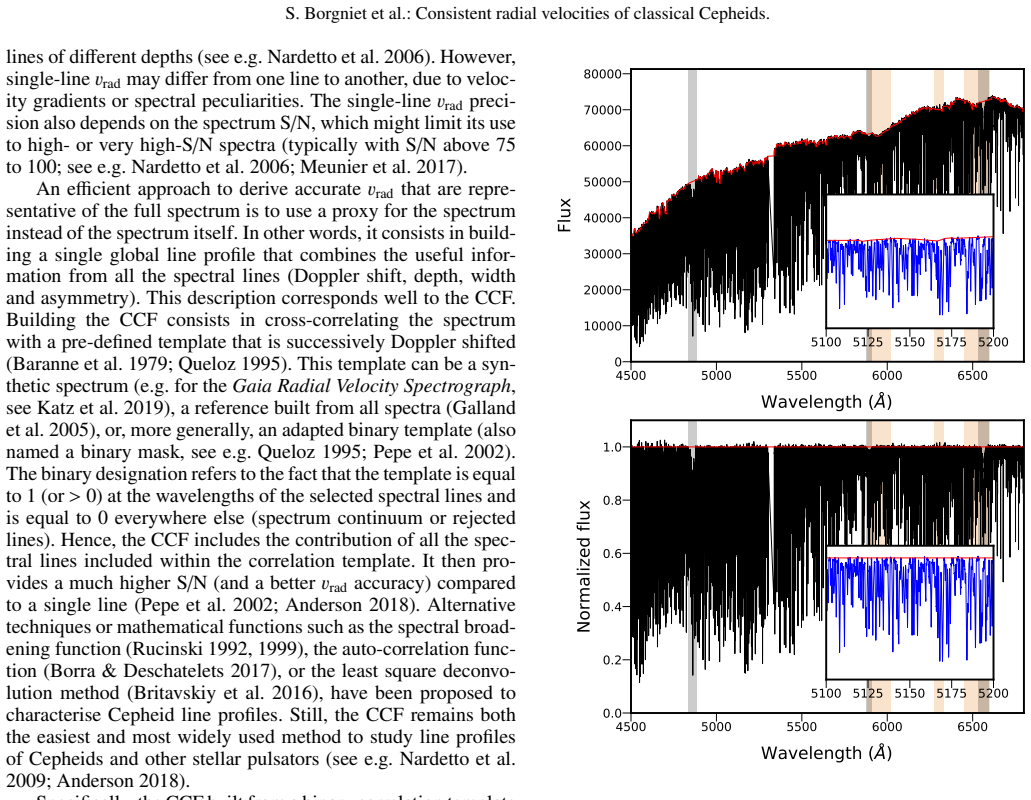
The load-bearing object is the cross-correlation function (CCF), a single average line profile obtained by sliding a binary correlation template across the spectrum. The templates are built from a synthetic PHOENIX Cepheid spectrum with Teff = 5250 K, log g = 1, and solar metallicity, by selecting un-blended lines in three depth bins (weak, medium, deep), plus an all-line depth-weighted template on the green range and medium-depth templates on blue and red ranges. The CCF is characterized by depth, width, equivalent width, bisector inverse span (BIS) for asymmetry, a quality factor Q, and a signal-to-noise proxy; velocities are then extracted three ways: centroid, Gaussian, and biGaussian fits. This machinery isolates the effect of each choice because only one ingredient changes at a time across otherwise identical spectra.
What would settle it
Rebuild the weak, medium, and deep templates from synthetic spectra at the hot and cool ends of the sample, for example Teff near 6000 K and 4500 K, and re-derive the depth-dependent v_rad offsets on the same spectra. If the offsets change sign or disappear for the extreme stars, the single-reference template, not a physical velocity gradient, produced the reported trend; a check of whether the selected unblended lines are actually unblended in observed spectra of the hottest and coolest Cepheids would settle the same question directly.
Extended reading notes
Core claim
The central discovery is that the Cepheid radial velocity is not a single number but a function of the measurement recipe. Cross-correlating the same spectra with six tailored templates, weak, medium, and deep lines on a green range, an all-line depth-weighted template, and medium templates on blue and red ranges, and then extracting velocities by centroid, Gaussian, and biGaussian fits, the paper finds significant offsets and amplitude changes in every comparison. Gaussian velocities run about 1% larger than centroid velocities, biGaussian velocities about 3-4% larger, and the differences grow for shallower lines and shorter periods. Deeper lines produce less asymmetric CCFs and more robust velocities; wider template lines reduce wing noise and asymmetry at the cost of a shallower core. The paper concludes that consistent Cepheid v_rad time series should favor centroid velocities and templates made of stronger, broader lines, and that any Baade-Wesselink study should specify these choices because each implies a different projection factor and distance.
Load-bearing premise
The single synthetic spectrum used to choose template lines is assumed to represent all 64 Cepheids; if real spectra of hotter or cooler stars differ, the depth-dependent velocity differences could be an artifact of that template choice.
Editorial extensions
If this is right
- Published Cepheid v_rad values are method-dependent: the same star can show different pulsation amplitudes, and hence different projection factors and Baade-Wesselink distances, depending on template and estimator.
- Centroid v_rad should be favored for distance work: despite slightly smaller amplitudes, their scatter is significantly smaller than Gaussian or biGaussian v_rad.
- Templates built from deeper and broader lines are more robust: they reduce CCF asymmetry and yield more consistent v_rad time series.
- Any v_rad publication for Cepheids should report the wavelength range, template line selection, line width, and v_rad estimator, because each materially changes the result.
- The published catalogue of templates, CCFs, observables, and v_rad time series enables homogeneous studies of Cepheid binarity, period-luminosity relations, and p-factor calibration.
Reading between the lines
- Beyond the paper: the same line-selection logic could be applied to other pulsating stars, such as RR Lyrae, whose data-reduction templates are similarly built from dwarf spectra and may carry the same method-dependent bias.
- Beyond the paper: building the weak, medium, and deep templates from synthetic spectra spanning the sample's full effective-temperature range would directly test whether the depth-dependent v_rad offsets persist or are partly an artifact of the single 5250 K reference spectrum.
- Beyond the paper: the released CCFs could be used to check whether centroid-v_rad based p-factors actually reduce the scatter of Baade-Wesselink distances across the 64-star sample, a test the paper does not run.
- Beyond the paper: the observed decrease in v_rad amplitude from blue to red wavelengths, if confirmed on more targets, could be used as a spectroscopic probe of the Cepheid atmospheric velocity gradient rather than treated as noise.
Signed reviews
Editorial analysis
A structured set of objections, weighed in public.
Referee Report
Summary. The paper presents a large homogeneous spectroscopic survey of 64 Classical Milky Way Cepheids, based on 3919 high-resolution spectra from seven echelle spectrographs. The authors standardise all spectra through a single processing chain, cross-correlate them with six tailored binary correlation templates that select unblended lines of different depths on three wavelength ranges, and derive from each CCF a set of line-profile observables plus three radial-velocity measurements: centroid (RVcc-c), Gaussian (RVcc-g), and biGaussian (RVcc-2g). They then compare the resulting v_rad time series as functions of the v_rad computation method, template wavelength range, template line width, and template line depth. The central claimed result, stated in the Abstract and in Section 5, is that each of these steps significantly impacts the derived v_rad, and that centroid v_rad, which show slightly smaller amplitudes but 'significantly smaller scatter' than Gaussian or biGaussian v_rad, should be favoured, together with stronger lines and somewhat broader template lines, to obtain more consistent Cepheid v_rad for Baade-Wesselink distance determinations.
Significance. If the claims hold, the paper makes a useful contribution: it provides a large, consistently processed catalogue of Cepheid CCFs and v_rad time series, demonstrates quantitatively that v_rad depends on template depth, width, wavelength range, and measurement method, and validates the s1d-based pipeline against the HARPS-North DRS with Pearson correlation coefficients between 0.99 and 1 (Appendix B.4). The decision to compute linear regressions over all measurements rather than comparing only extrema is a methodological improvement over earlier studies. The recommendation that authors specify their template and v_rad method is well motivated. However, the paper's most actionable claim, that centroid v_rad should be favoured because of significantly smaller scatter, is not quantitatively supported in the present text; this is a load-bearing gap that requires additional analysis.
major comments (3)
- [Abstract, §4.3, §5] The central recommendation, stated in the Abstract and reiterated in Section 5, is that centroid v_rad (RVcc-c) should be favoured because they exhibit 'significantly smaller scatter' than Gaussian or biGaussian v_rad. No quantitative scatter comparison is presented anywhere in the manuscript. Section 4.3 reports only linear-regression slopes (RVcc-g ~1.01, RVcc-2g ~1.03-1.04 relative to RVcc-c) and dispersions of those slopes across targets (Fig. 9). No per-target RMS residual, scatter around a common phased pulsation curve, or statistical test is given for the three methods. This is load-bearing: the practical recommendation rests on this claim. In addition, RVcc-c is a first-moment integral over the CCF core, so a smaller scatter could partly reflect the smoothing effect of the integration window rather than a genuine improvement in consistency. The authors should provide a direct scatter comparison (e.g., RMS of residuals around a spline fit to the phased v_rad curve for each method and target) and a statistical test (e.g., paired F-test or Wilcoxon signed-rank test on per-target scatter).
- [§3.5 vs Abstract and §5] Section 3.5 states: 'We did not try to definitively assess which method is to be preferred.' This is in direct tension with the Abstract and Section 5, which explicitly recommend centroid v_rad over Gaussian and biGaussian v_rad. This internal inconsistency suggests that the scatter-based recommendation may not have been fully analysed or validated. The authors should either remove the disclaimer in §3.5 or qualify the conclusions to match the available evidence, which currently supports method-dependence but not a definitive ranking of the three methods.
- [§3.3 and §4.6] The template line selection is based on a single synthetic PHOENIX Cepheid spectrum (Teff = 5250 K, log g = 1, solar metallicity), while the sample spans spectral types F8-G5 and periods from roughly 2 to 68 days. The manuscript does not quantify how template mismatch would affect the selection of 'un-blended' lines for stars with different Teff/log g, and hence how it would affect the depth-dependent comparisons in Section 4.6. If the reference spectrum is not representative, the weak/medium/deep template comparisons could partly reflect template mismatch (blended or absent lines in real spectra) rather than cleanly probing line-formation depth. The authors should test the robustness of their line selection and of the Section 4.6 conclusions by repeating the selection with one or two additional PHOENIX models spanning the sample's parameter range (e.g., Teff = 6000 K, log g = 2; Teff = 5000 K, log g = 1) and verifying that the trends in CCF quality, asymmetry, and v_rad persist.
minor comments (6)
- [§4.1] In the last full paragraph of Section 4.1, 'which we will show latter' should read 'which we will show later'.
- [Appendix B.3] The uncertainty formula for RVcc-c, epsilon_cc-c = W/SNRCCF, is described in the text as 'arbitrary'. Consequently, the comparison of uncertainty magnitudes among RVcc-c, RVcc-g, and RVcc-2g in Fig. B.1 is not informative for ranking the methods and should be explicitly labelled as such in the main text.
- [§4.5.2] The comparison with the G2 HARPS DRS template is performed only for δ Cep (103 HARPS-North spectra); this should be stated explicitly in the main text rather than only in the caption of Fig. 12.
- [Fig. 9] The left panel of Fig. 9 would benefit from a direct statement in the text or the caption of the median and 1σ dispersion of the slope distributions for RVcc-g vs RVcc-c and RVcc-2g vs RVcc-c, since these values are quoted in the text.
- [Table 2] For the last row (G2/HARPS template), the values N_l = 1725 and sigma_l = 0.08 Å are valid over the green range only; this should be stated explicitly in the table caption or column header to avoid ambiguity.
- [§4.4] In the discussion of the red versus blue v_rad comparison, the sentence 'Such studies would need to be extended to infrared (IR) wavelengths in order to be confirmed' is vague; the authors could indicate which specific infrared wavelengths or instruments would be relevant.
Circularity Check
No circularity: the method-dependence claim is grounded in new measured comparisons and an external DRS benchmark.
full rationale
The paper's central claim is that template wavelength range, line depth/width, and vrad method affect measured Cepheid vrad. This is established by cross-correlating observed spectra with six templates deliberately differing in these properties and by regressing the resulting vrad time series against each other; the regression slopes and zero-points are descriptive measurements, not fits to a pre-chosen conclusion. The templates are constructed from an external PHOENIX synthetic spectrum, and the pipeline is validated against the HARPS-North DRS in Appendix B.4 with Pearson coefficients of 0.99-1, providing an independent benchmark. Citations to Anderson 2016 and Nardetto et al. 2006 are used for interpretation and agreement, but the supporting slopes, dispersions, zero-points, BIS, and quality proxies come from the new catalogue, so self-citation is not load-bearing. Two caveats are noted but are not circularity: the abstract's 'significantly smaller scatter' for centroid vrad is not quantified in the text, and the single Teff=5250 K synthetic template may not represent the full sample; these are support and assumption concerns, not input-output equivalences.
Assumptions & free parameters
free parameters (5)
- PHOENIX template atmosphere parameters =
Teff = 5250 K, log g = 1, solar metallicity
- Line-depth selection windows =
weak [0.25-0.45], medium [0.45-0.65], deep [0.65-0.95] (relative depth)
- Template line widths =
0.35-0.51 A (90% continuum width of PHOENIX lines)
- Wavelength ranges =
green 4500-6800 A, blue 3900-4980 A, red 5700-8800 A
- S/N and Q thresholds =
S/N = 30; Q = 4
assumptions (5)
- domain assumption The cross-correlation function computed from a binary template is a valid proxy for the spectrum mean line profile.
- ad hoc to paper The adopted PHOENIX synthetic spectrum (Teff = 5250 K, log g = 1, solar metallicity) is representative enough of the 64 Cepheids for selecting unblended lines.
- domain assumption The linear regression slope is a valid statistic to compare v_rad time series, treating the relationship between methods as linear with a zero-point offset.
- standard math Gaussian and biGaussian fits converge and the covariance-matrix 1-sigma uncertainties are representative.
- domain assumption Spectrograph-to-spectrograph v_rad offsets are negligible compared to the Cepheid variability (of order 100 m/s or below).
Cite this review
Pith. "Pith review of Consistent radial velocities of classical Cepheids from the cross-correlation technique." pith.science (2026). https://pith.science/paper/2WOV2GXV
@misc{pith2026190802059,
  author       = {Pith},
  title        = {Pith review of: Consistent radial velocities of classical Cepheids from the cross-correlation technique},
  year         = {2026},
  howpublished = {\url{https://pith.science/paper/2WOV2GXV}},
  note         = {Machine review of arXiv:1908.02059}
}
abstract
Accurate radial velocities ($v_{\rm rad}$) of Cepheids are mandatory within the context of distance measurements via the Baade-Wesselink technique. The most common $v_{\rm rad}$ derivation method consists in cross-correlating the observed spectrum with a binary template and measuring a velocity on the resulting profile. Yet for Cepheids, the spectral lines selected within the template as well as the way of fitting the cross-correlation function (CCF) have a significant impact on the measured $v_{\rm rad}$. We detail the steps to compute consistent Cepheid CCFs and $v_{\rm rad}$, and we characterise the impact of Cepheid spectral properties and $v_{\rm rad}$ computation method on the resulting line profiles. We collected more than 3900 high-resolution spectra from seven different spectrographs of 64 classical Cepheids. These spectra were standardised through a single process on pre-defined wavelength ranges. We built six correlation templates selecting un-blended lines of different depths from a synthetic Cepheid spectrum, on three different wavelength ranges from 390 to 800 nm. Each spectrum was cross-correlated with these templates to build the corresponding CCFs. We derived a set of line profile observables as well as three different $v_{\rm rad}$ measurements from each CCF. This study confirms that both the template wavelength range, its mean line depth and width, and the $v_{\rm rad}$ computation method significantly impact the $v_{\rm rad}$. Deriving more robust Cepheid $v_{\rm rad}$ time series require to minimise the asymmetry of the line profile and its impact on the $v_{\rm rad}$. Centroid $v_{\rm rad}$, that exhibit slightly smaller amplitudes but significantly smaller scatter than Gaussian or biGaussian $v_{\rm rad}$, should thus be favoured. Stronger lines are also less asymmetric and lead to more robust $v_{\rm rad}$ than weaker lines.
Figures


Figures from the paper (12 more)


Reference graph
Works this paper leans on
-
[1]
Anderson , R. I. 2014, , 566, L10
2014
-
[2]
Anderson , R. I. 2016, , 463, 1707
work page 2016
-
[3]
Anderson , R. I. 2018, in The RR Lyrae 2017 Conference. Revival of the Classical Pulsators: from Galactic Structure to Stellar Interior Diagnostics, ed. R. Smolec , K. Kinemuchi , & R. I. Anderson , Vol. 6, 193--200
work page 2018
-
[4]
Anderson , R. I. 2019, , 623, A146
work page 2019
-
[5]
Anderson , R. I., Casertano , S., Riess , A. G., et al. 2016, , 226, 18
work page 2016
-
[6]
I., Sahlmann , J., Holl , B., et al
Anderson , R. I., Sahlmann , J., Holl , B., et al. 2015, , 804, 144
work page 2015
-
[7]
P., Tollerud , E
Astropy Collaboration , Robitaille , T. P., Tollerud , E. J., et al. 2013, , 558, A33
2013
-
[8]
1926, Astronomische Nachrichten, 228, 359
Baade , W. 1926, Astronomische Nachrichten, 228, 359
work page 1926
Show all 81 references
-
[9]
Baranne , A., Mayor , M., & Poncet , J. L. 1979, Vistas in Astronomy, 23, 279
1979
-
[10]
1996, , 119, 373
Baranne , A., Queloz , D., Mayor , M., et al. 1996, , 119, 373
1996
-
[11]
Borra , E. F. & Deschatelets , D. 2017, , 470, 4732
2017
-
[12]
& Sophie Team
Bouchy , F. & Sophie Team . 2006, in Tenth Anniversary of 51 Peg-b: Status of and prospects for hot Jupiter studies, ed. L. Arnold , F. Bouchy , & C. Moutou , 319--325
2006
-
[13]
2017, , 129, 034002
Brahm , R., Jord \'a n , A., & Espinoza , N. 2017, , 129, 034002
2017
-
[14]
2016, Commmunications of the Konkoly Observatory Hungary, 105, 105
Britavskiy , N., Pancino , E., Tsymbal , V., et al. 2016, Commmunications of the Konkoly Observatory Hungary, 105, 105
2016
-
[15]
2018, , 474, 3344
Britavskiy , N., Pancino , E., Tsymbal , V., Romano , D., & Fossati , L. 2018, , 474, 3344
2018
-
[16]
1982, , 109, 258
Burki , G., Mayor , M., & Benz , W. 1982, , 109, 258
1982
-
[17]
2012, in , Vol
Cosentino , R., Lovis , C., Pepe , F., et al. 2012, in , Vol. 8446, Ground-based and Airborne Instrumentation for Astronomy IV, 84461V
2012
-
[18]
2018, , 616, A5
Cropper , M., Katz , D., Sartoretti , P., et al. 2018, , 616, A5
2018
-
[19]
2000, in , Vol
Dekker , H., D'Odorico , S., Kaufer , A., Delabre , B., & Kotzlowski , H. 2000, in , Vol. 4008, Optical and IR Telescope Instrumentation and Detectors, ed. M. Iye & A. F. Moorwood , 534--545
2000
-
[20]
R., Berdnikov , L., Lauer , J., et al
Evans , N. R., Berdnikov , L., Lauer , J., et al. 2015, , 150, 13
2015
-
[21]
Freedman , W. L. & Madore , B. F. 2010, , 48, 673
2010
-
[22]
Gaia Collaboration , Brown , A. G. A., Vallenari , A., et al. 2018, , 616, A1
2018
-
[23]
2005, , 444, L21
Galland , F., Lagrange , A.-M., Udry , S., et al. 2005, , 444, L21
2005
-
[24]
2019, , 622, A164
Gallenne , A., Kervella , P., Borgniet , S., et al. 2019, , 622, A164
2019
-
[25]
R., et al
Gallenne , A., Kervella , P., Evans , N. R., et al. 2018, , 867, 121
2018
-
[26]
2012, , 541, A87
Gallenne , A., Kervella , P., M \'e rand , A., et al. 2012, , 541, A87
2012
-
[27]
2017, , 608, A18
Gallenne , A., Kervella , P., M \'e rand , A., et al. 2017, , 608, A18
2017
-
[28]
2015, , 579, A68
Gallenne , A., M \'e rand , A., Kervella , P., et al. 2015, , 579, A68
2015
-
[29]
D., M \'e rand , A., et al
Gallenne , A., Monnier , J. D., M \'e rand , A., et al. 2013, , 552, A21
2013
-
[30]
A., Samus' , N
Gorynya , N. A., Samus' , N. N., Sachkov , M. E., et al. 1998, Astronomy Letters, 24, 815
1998
-
[31]
Groenewegen , M. A. T. 2013, , 550, A70
2013
-
[32]
H., Allard , F., Ferguson , J., Baron , E., & Alexander , D
Hauschildt , P. H., Allard , F., Ferguson , J., Baron , E., & Alexander , D. R. 1999, , 525, 871
1999
-
[33]
Hauschildt , P. H. & Baron , E. 1999, Journal of Computational and Applied Mathematics, 109, 41
1999
-
[34]
Hauschildt , P. H. & Baron , E. 2010, , 509, A36
2010
-
[35]
& Bell , R
Hindsley , R. & Bell , R. A. 1986, , 98, 881
1986
-
[36]
Hunter, J. D. 2007, Computing In Science & Engineering, 9, 90
2007
-
[37]
2001--, SciPy : Open source scientific tools for Python , online guide
Jones, E., Oliphant, T., Peterson, P., et al. 2001--, SciPy : Open source scientific tools for Python , online guide
2001
-
[38]
2019, , 622, A205
Katz , D., Sartoretti , P., Cropper , M., et al. 2019, , 622, A205
2019
-
[39]
& Pasquini , L
Kaufer , A. & Pasquini , L. 1998, in , Vol. 3355, Optical Astronomical Instrumentation, ed. S. D'Odorico , 844--854
1998
-
[40]
2019, , 623, A116
Kervella , P., Gallenne , A., Remage Evans , N., et al. 2019, , 623, A116
2019
-
[41]
2004, , 416, 941
Kervella , P., Nardetto , N., Bersier , D., Mourard , D., & Coud \'e du Foresto , V. 2004, , 416, 941
2004
-
[42]
V., Andrievsky , S
Kovtyukh , V. V., Andrievsky , S. M., Belik , S. I., & Luck , R. E. 2005, , 129, 433
2005
-
[43]
Kovtyukh , V. V. & Gorlova , N. I. 2000, , 358, 587
2000
-
[44]
Leavitt , H. S. & Pickering , E. C. 1912, Harvard College Observatory Circular, 173, 1
1912
-
[45]
& Dravins , D
Lindegren , L. & Dravins , D. 2003, , 401, 1185
2003
-
[46]
Lindemann , F. A. 1918, , 78, 639
1918
-
[47]
Luck , R. E. 2018, , 156, 171
2018
-
[48]
2017, , 469, 3965
Malavolta , L., Lovis , C., Pepe , F., Sneden , C., & Udry , S. 2017, , 469, 3965
2017
-
[49]
2015, , 584, A80
M \'e rand , A., Kervella , P., Breitfelder , J., et al. 2015, , 584, A80
2015
-
[50]
M., Mbemba Kabuiku , L., et al
Meunier , N., Lagrange , A. M., Mbemba Kabuiku , L., et al. 2017, , 597, A52
2017
-
[51]
A., Monai , S., et al
Molaro , P., Levshakov , S. A., Monai , S., et al. 2008, , 481, 559
2008
-
[52]
2018, arXiv e-print:1801.04158, habilitation Thesis
Nardetto , N. 2018, arXiv e-print:1801.04158, habilitation Thesis
2018 arXiv
-
[53]
2009, , 502, 951
Nardetto , N., Gieren , W., Kervella , P., et al. 2009, , 502, 951
2009
-
[54]
2006, , 453, 309
Nardetto , N., Mourard , D., Kervella , P., et al. 2006, , 453, 309
2006
-
[55]
2007, , 471, 661
Nardetto , N., Mourard , D., Mathias , P., Fokin , A., & Gillet , D. 2007, , 471, 661
2007
-
[56]
2018, , 616, A92
Nardetto , N., Poretti , E., Gallenne , A., et al. 2018, , 616, A92
2018
-
[57]
2017, , 597, A73
Nardetto , N., Poretti , E., Rainer , M., et al. 2017, , 597, A73
2017
-
[58]
Nardetto , N., Stoekl , A., Bersier , D., & Barnes , T. G. 2008, , 489, 1255
2008
-
[59]
2018, High-Precision Spectrographs for Exoplanet Research: CORAVEL, ELODIE, CORALIE, SOPHIE and HARPS , 190
Pepe , F., Bouchy , F., Mayor , M., & Udry , S. 2018, High-Precision Spectrographs for Exoplanet Research: CORAVEL, ELODIE, CORALIE, SOPHIE and HARPS , 190
2018
-
[60]
2002, The Messenger, 110, 9
Pepe , F., Mayor , M., Rupprecht , G., et al. 2002, The Messenger, 110, 9
2002
-
[61]
1995, in IAU Symposium, Vol
Queloz , D. 1995, in IAU Symposium, Vol. 167, New Developments in Array Technology and Applications, ed. A. G. D. Philip , K. Janes , & A. R. Upgren , 221
1995
-
[62]
W., Sivan , J
Queloz , D., Henry , G. W., Sivan , J. P., et al. 2001 a , , 379, 279
2001
-
[63]
2001 b , The Messenger, 105, 1
Queloz , D., Mayor , M., Udry , S., et al. 2001 b , The Messenger, 105, 1
2001
-
[64]
2011, , 526, A69
Raskin , G., van Winckel , H., Hensberge , H., et al. 2011, , 526, A69
2011
-
[65]
2018, in American Astronomical Society Meeting Abstracts, Vol
Riess , A. 2018, in American Astronomical Society Meeting Abstracts, Vol. 231, American Astronomical Society Meeting Abstracts 231, 117.01
2018
-
[66]
G., Macri , L., Casertano , S., et al
Riess , A. G., Macri , L., Casertano , S., et al. 2011, , 730, 119
2011
-
[67]
G., Macri , L
Riess , A. G., Macri , L. M., Hoffmann , S. L., et al. 2016, , 826, 56
2016
-
[68]
1995, Python Reference Manual (Tech
Rossum , G. 1995, Python Reference Manual (Tech. rep. Centrum voor Wiskunde en Informatica (CWI), Amsterdam, The Netherlands)
1995
-
[69]
1999, in Astronomical Society of the Pacific Conference Series, Vol
Rucinski , S. 1999, in Astronomical Society of the Pacific Conference Series, Vol. 185, IAU Colloq. 170: Precise Stellar Radial Velocities, ed. J. B. Hearnshaw & C. D. Scarfe , 82
1999
-
[70]
Rucinski , S. M. 1992, , 104, 1968
1992
-
[71]
N., Sasselov , D
Sabbey , C. N., Sasselov , D. D., Fieldus , M. S., et al. 1995, , 446, 250
1995
-
[72]
2018, , 616, A6
Sartoretti , P., Katz , D., Cropper , M., et al. 2018, , 616, A6
2018
-
[73]
2011, , 535, A54
S \'e gransan , D., Mayor , M., Udry , S., et al. 2011, , 535, A54
2011
-
[74]
2015, , 576, A77
Smette , A., Sana , H., Noll , S., et al. 2015, , 576, A77
2015
-
[75]
2013, , 552, A64
Soubiran , C., Jasniewicz , G., Chemin , L., et al. 2013, , 552, A64
2013
-
[76]
G., Alapini , A., Israelian , G., & Santos , N
Sousa , S. G., Alapini , A., Israelian , G., & Santos , N. C. 2010, , 512, A13
2010
-
[77]
2011, VizieR Online Data Catalog, 353
Storm , J., Gieren , W., Fouque , P., et al. 2011, VizieR Online Data Catalog, 353
2011
-
[78]
C., & Varoquaux , G
van der Walt , S., Colbert , S. C., & Varoquaux , G. 2011, Computing in Science and Engineering, 13, 22
2011
-
[79]
2007, Astronomy & Astrophysics, 474, 653
van Leeuwen , F. 2007, Astronomy & Astrophysics, 474, 653
2007
-
[80]
2017, , 606, A140
Vasilyev , V., Ludwig , H.-G., Freytag , B., Lemasle , B., & Marconi , M. 2017, , 606, A140
2017
-
[81]
Wesselink , A. J. 1946, , 10, 91
1946
Reviewed August 14, 2026 · model on record in the stance chip above.
Discussion (0). Continue with ORCID to comment.