Multi-Condition Guided Diffusion Model for Controllable Elastic Parameter Synthesis
Pith reviewed 2026-06-27 22:51 UTC · model grok-4.3
The pith
A diffusion model trained on well-log statistics generates elastic parameters that respect multiple seismic and geological conditions simultaneously.
A machine-rendered reading of the paper's core claim, the machinery that carries it, and where it could break.
Core claim
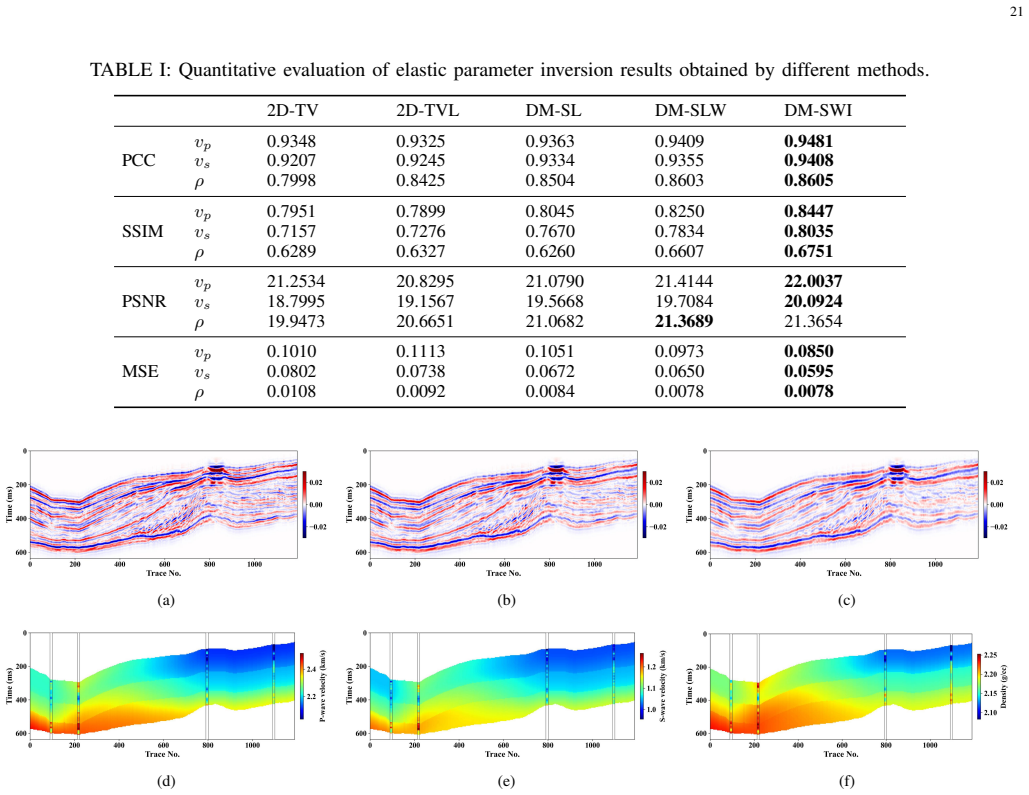
A unified multi-condition guided diffusion framework, using iterative latent variable refinement for implicit model-domain constraints, Adapter-based conditioning for implicit structural constraints, and diffusion posterior sampling (DPS)-projection guidance for explicit conditioning-operator constraints, produces elastic-parameter realizations that remain consistent with any combination of supplied conditions; when seismic data supply the explicit condition the same model performs inversion and improves accuracy on Vp, Vs and density relative to baseline methods.
What carries the argument
Multi-condition guided diffusion model that combines iterative latent refinement, adapter modules, and DPS-projection guidance to enforce implicit and explicit constraints during sampling.
If this is right
- Elastic-parameter volumes can be sampled that satisfy arbitrary combinations of implicit model rules, structural patterns and explicit operator constraints.
- The identical trained model can be repurposed for seismic inversion simply by supplying seismic records as the explicit conditioning input.
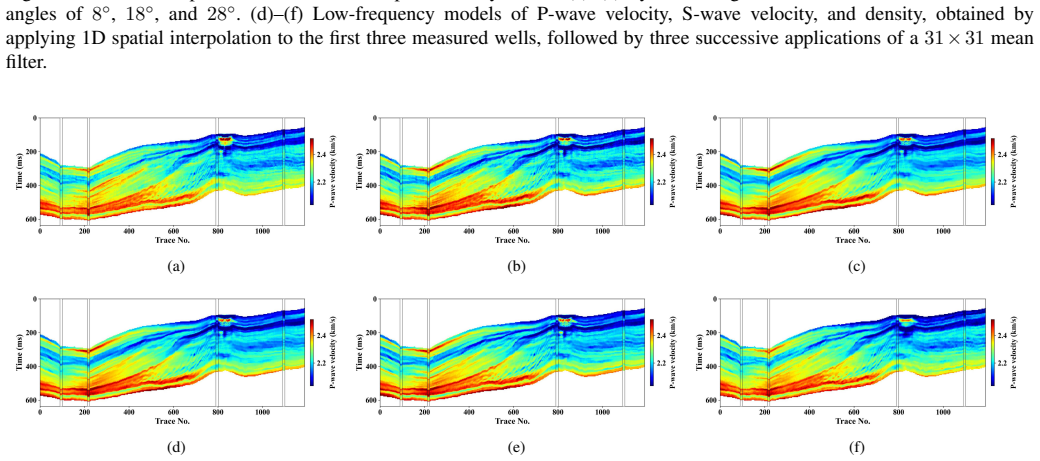
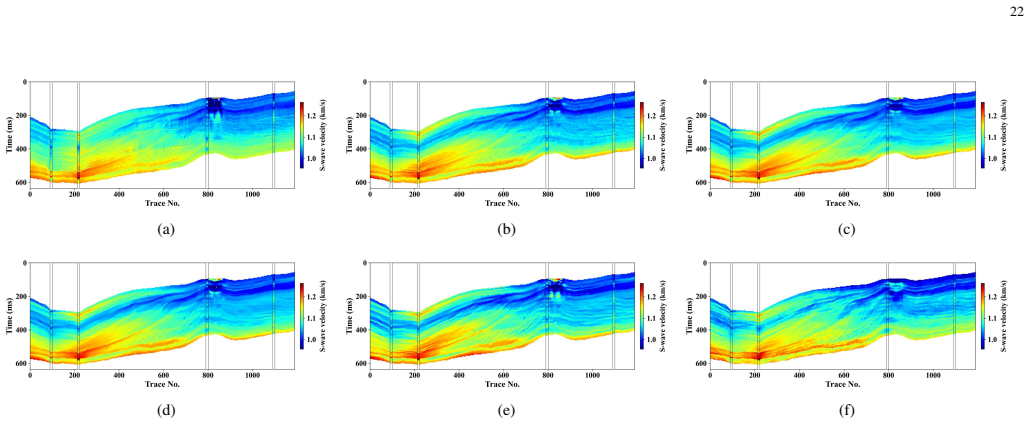
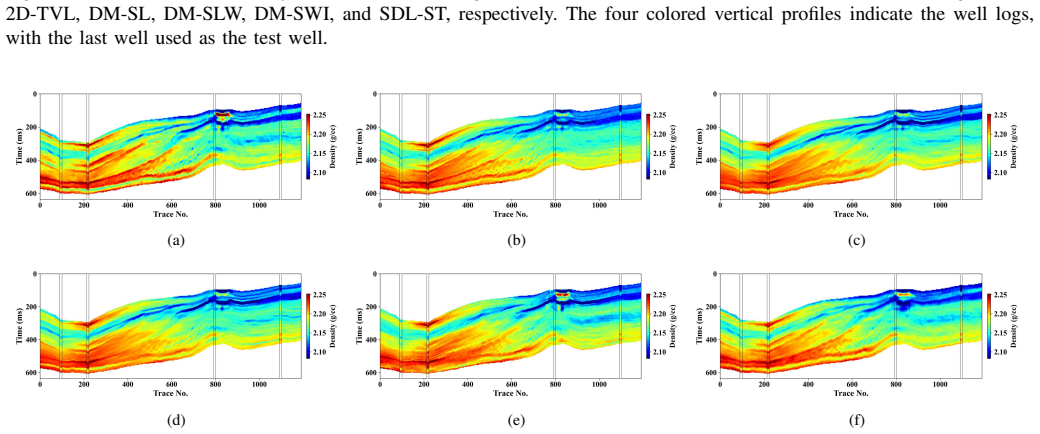
- Prediction accuracy for P-wave velocity, S-wave velocity and density exceeds that of standard baseline inversion methods on the same data.
- The generated volumes can be added to small labeled sets to improve the training of separate deep-learning inversion networks.
Where Pith is reading between the lines
- The same conditioning machinery could be applied to other geophysical inverse problems that require joint satisfaction of multiple data types.
- Because the diffusion process is iterative, one could stop sampling early to trade accuracy for speed in time-critical interpretation workflows.
- If the projection guidance is replaced by a differentiable forward operator, the method could be extended to joint inversion of multiple physical fields.
Load-bearing premise
The synthetic training sets built from well-log statistics and target-area geology must faithfully capture the statistics and physical relationships of the real subsurface that will be inverted.
What would settle it
On a held-out real seismic survey, the inversion errors for Vp, Vs and density remain equal to or larger than those of the baseline methods when the diffusion model is conditioned on the same seismic data.
Figures
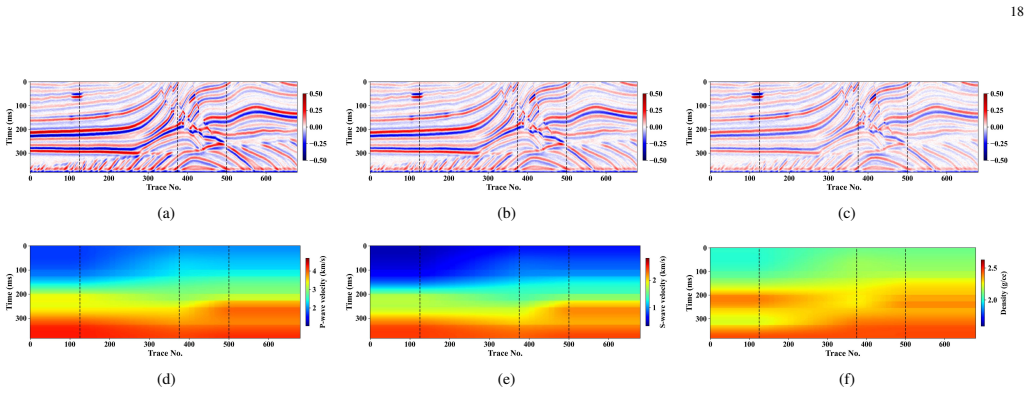
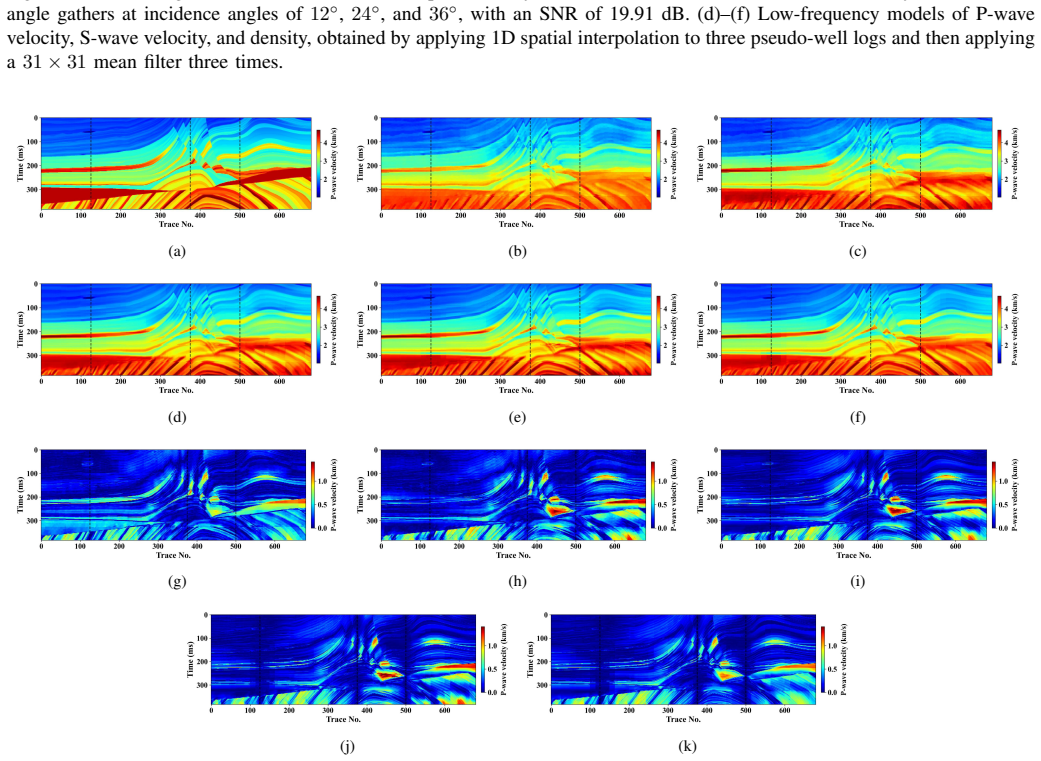
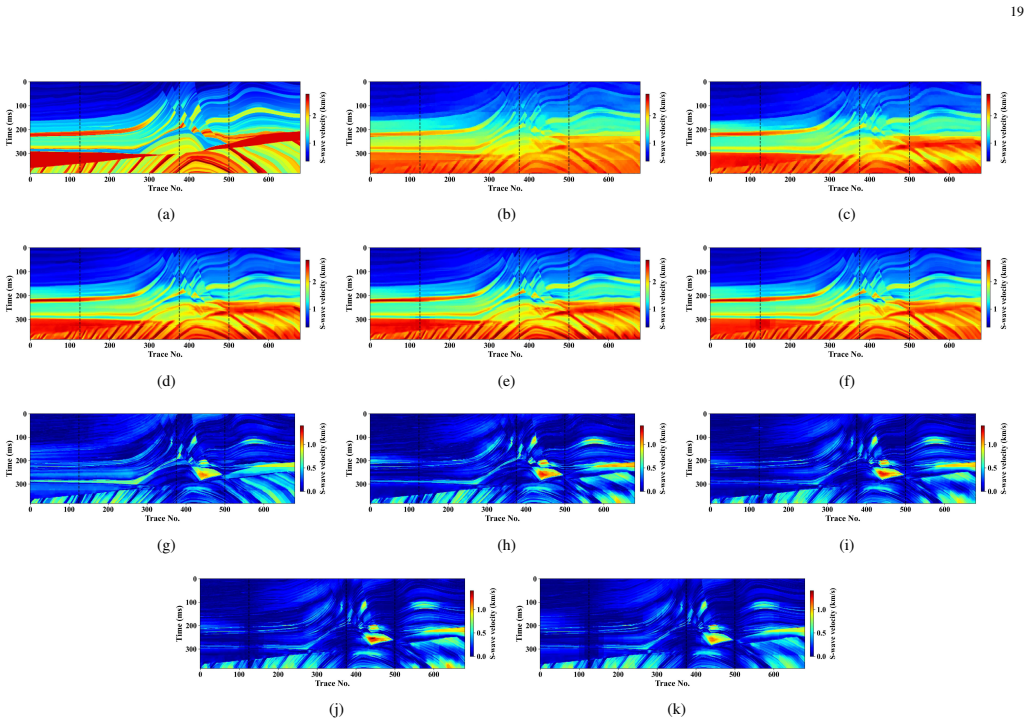
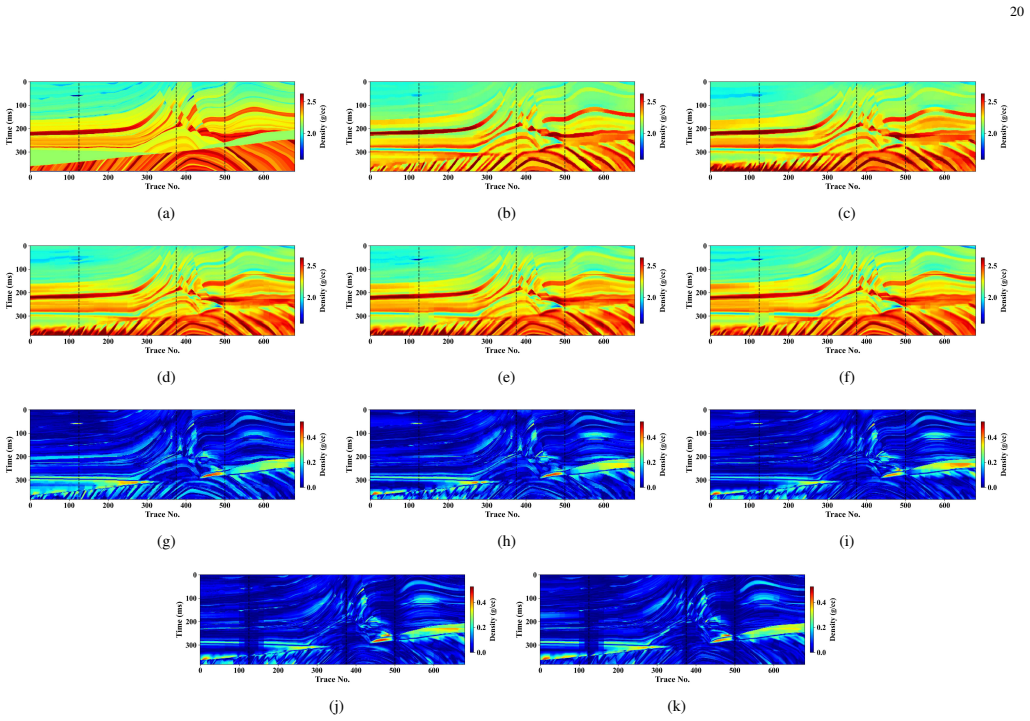
read the original abstract
Prestack elastic parameter inversion is important for reservoir characterization and quantitative seismic interpretation. Most existing deep-learning-based methods have achieved promising results, but they generally require sufficient labeled training data and have limited flexibility in integrating multi-source conditioning information. To address this issue, we propose a multi-condition guided diffusion model for controllable elastic parameter synthesis. Elastic parameter training datasets are first constructed based on well log statistics and geological characteristics of the target area and are used to train the diffusion model. A unified multi-condition guided diffusion framework is then developed to incorporate both implicit and explicit conditioning information. Specifically, iterative latent variable refinement, Adapter-based conditioning, and a diffusion posterior sampling (DPS)-projection guidance strategy are introduced for implicit model-domain constraints, implicit structural constraints, and explicit conditioning-operator constraints, respectively. Synthetic examples demonstrate that the proposed method can generate elastic parameter samples that are consistent with the prescribed conditions under both single-condition and multi-condition guidance. When seismic data are used as conditioning information, the framework can be further adapted to seismic elastic parameter inversion. Experiments show that the proposed method improves the prediction of representative elastic parameters, including P-wave velocity, S-wave velocity, and density, compared with baseline methods. The synthesized samples can also support downstream deep-learning-based inversion under limited labeled data, achieving competitive performance.
Editorial analysis
A structured set of objections, weighed in public.
Referee Report
Summary. The paper proposes a multi-condition guided diffusion model for controllable synthesis of elastic parameters (Vp, Vs, density). Training data are constructed from well-log statistics and target-area geology; the model incorporates iterative latent refinement for model-domain constraints, Adapter conditioning for structural constraints, and DPS-projection for explicit operator constraints. The framework is adapted to seismic inversion and is claimed to improve predictions over baselines while also supporting downstream tasks under limited labels.
Significance. If the performance gains and physical consistency hold under rigorous validation, the method could provide a flexible alternative to supervised inversion networks by enabling controllable multi-source conditioning without requiring large labeled seismic-elastic pairs.
major comments (3)
- [Dataset construction and Experiments] The central performance claim (improved prediction of Vp, Vs, and density when seismic data serve as conditioning) rests on the fidelity of the synthetic training distribution; however, no quantitative comparison of the constructed dataset statistics against held-out real well logs from the same geological setting is reported.
- [Guidance mechanisms and Experiments] No quantitative audit of physical admissibility (e.g., fraction of samples violating plausible Vp/Vs ratios or Gardner-type density-velocity relations) is provided for the generated ensembles under the three guidance mechanisms, leaving open whether the reported accuracy gains reflect genuine inversion improvement or artifacts of the synthetic pipeline.
- [Experiments] The abstract and experimental description assert improvements over baseline methods but supply no numerical metrics, error bars, dataset sizes, cross-validation details, or ablation results that would allow evaluation of the magnitude or statistical significance of the gains.
minor comments (2)
- [Method] Notation for the three conditioning strategies (iterative latent refinement, Adapter, DPS-projection) should be introduced with explicit equations or pseudocode to clarify how they interact during sampling.
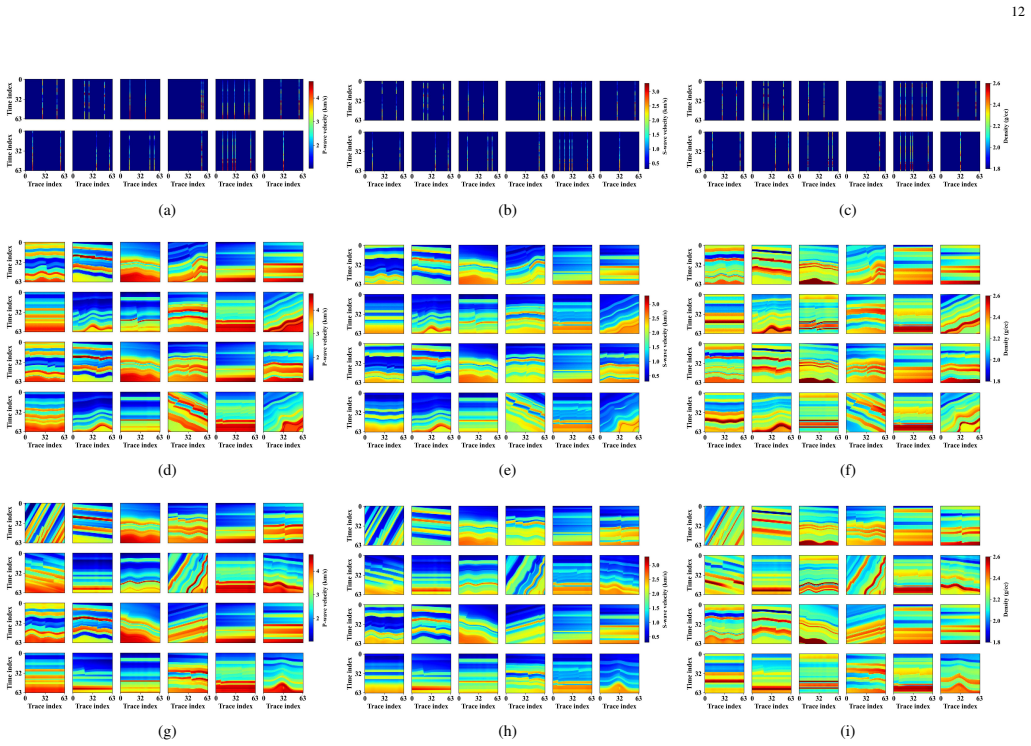
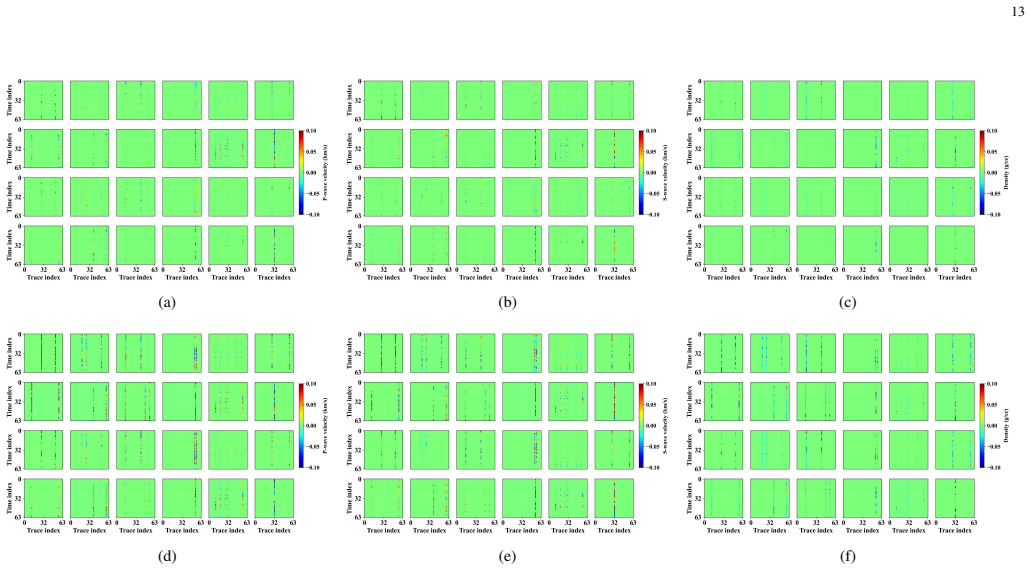
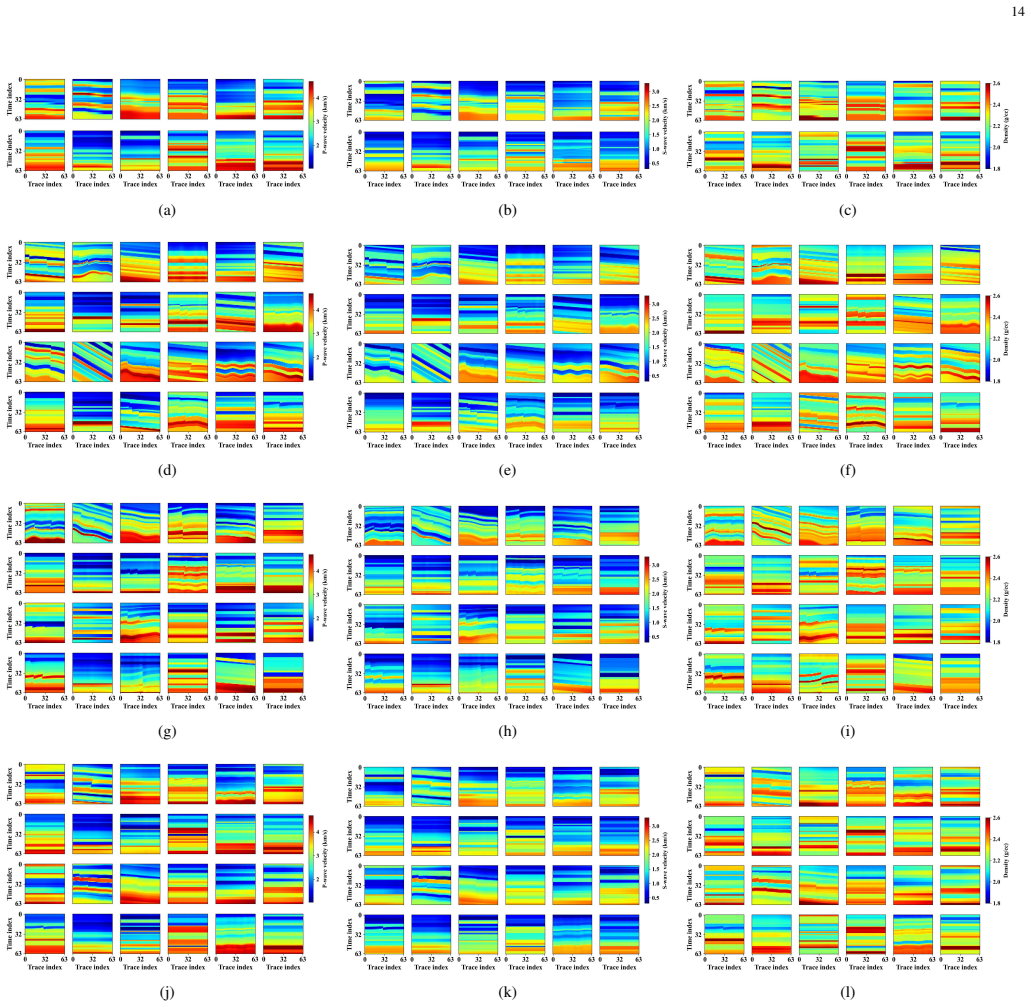
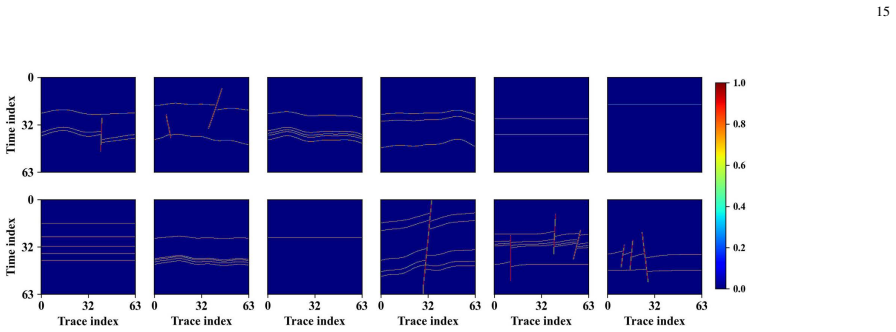
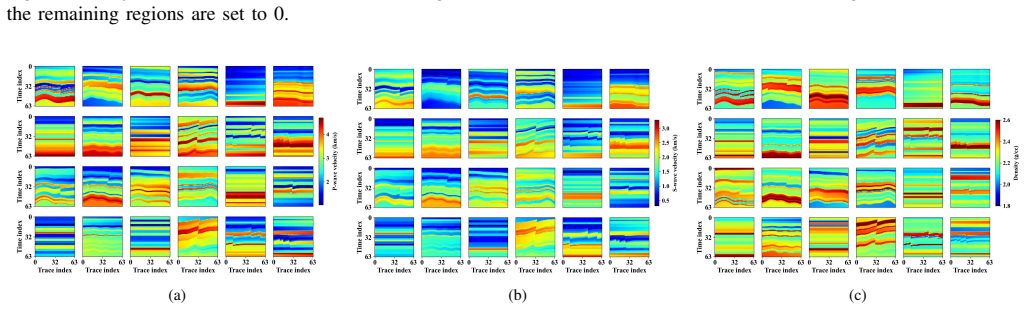
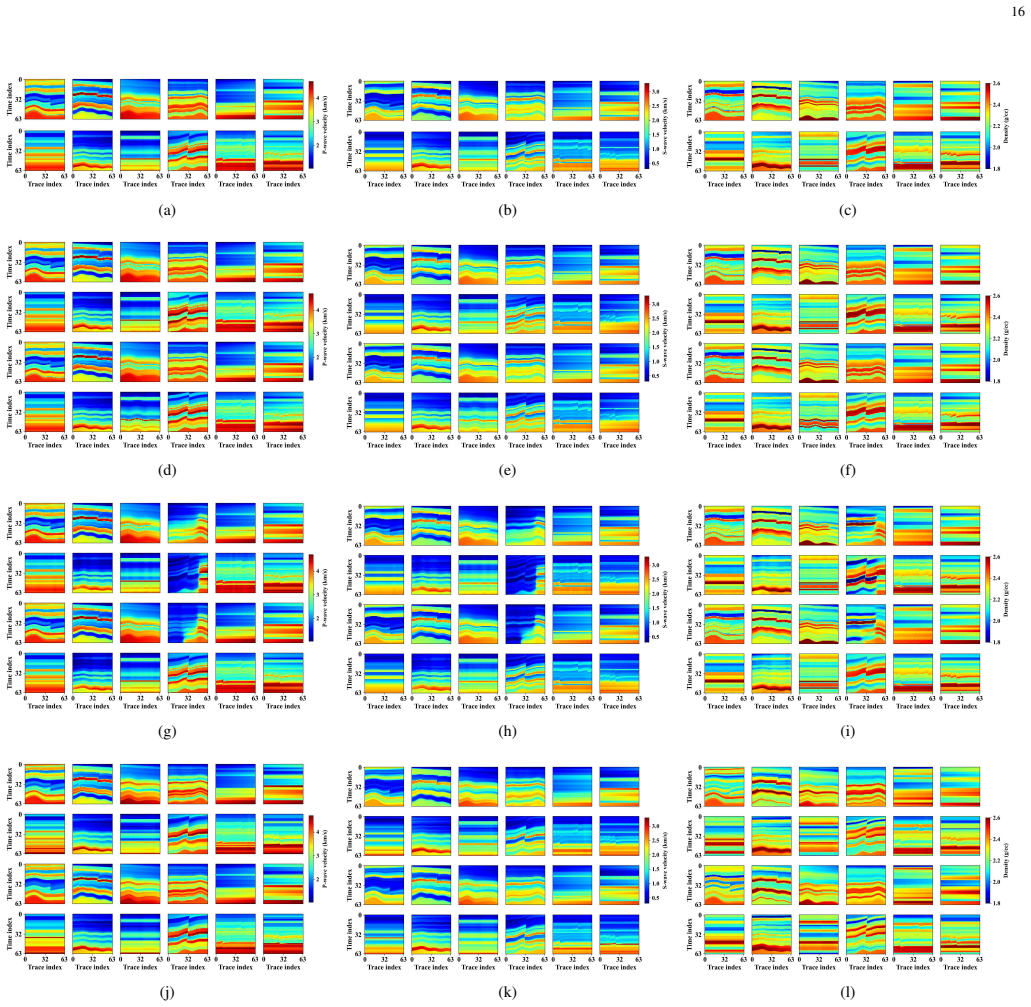
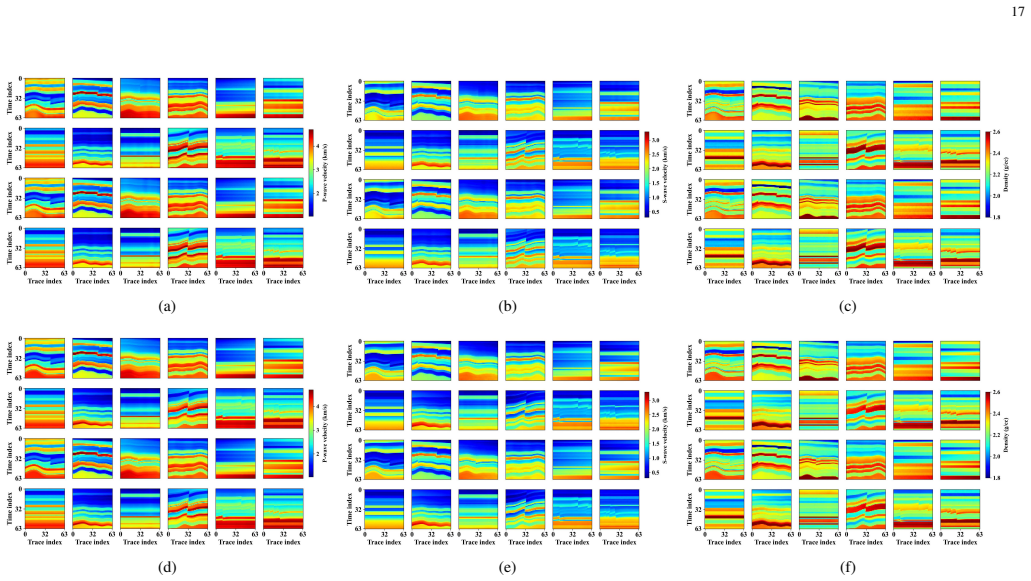
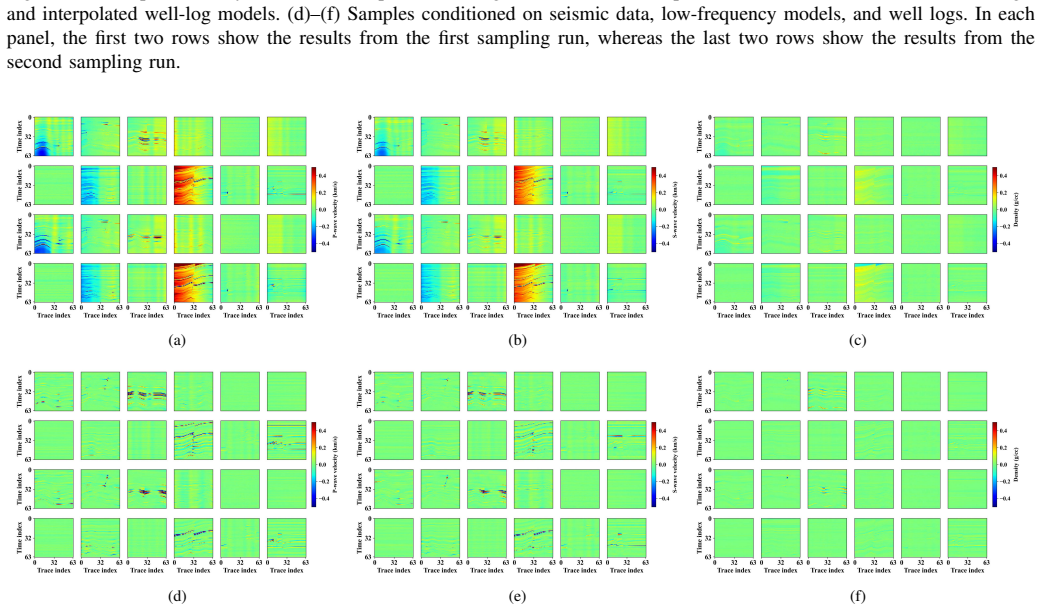
- [Figures] Figure captions for synthetic examples should state the exact conditioning values used and whether the displayed samples are single realizations or ensemble statistics.
Simulated Author's Rebuttal
We thank the referee for the constructive feedback on our manuscript. We address each major comment below and will incorporate revisions to strengthen the validation and reporting of results.
read point-by-point responses
-
Referee: [Dataset construction and Experiments] The central performance claim (improved prediction of Vp, Vs, and density when seismic data serve as conditioning) rests on the fidelity of the synthetic training distribution; however, no quantitative comparison of the constructed dataset statistics against held-out real well logs from the same geological setting is reported.
Authors: We acknowledge this limitation in the current manuscript. While the dataset construction is described as based on well-log statistics and target-area geology, a direct quantitative comparison to held-out real logs (e.g., via Kolmogorov-Smirnov tests or moment matching on Vp, Vs, density distributions) is indeed absent. In the revised manuscript, we will add this analysis using available real well logs from the geological setting to quantify fidelity and support the performance claims. revision: yes
-
Referee: [Guidance mechanisms and Experiments] No quantitative audit of physical admissibility (e.g., fraction of samples violating plausible Vp/Vs ratios or Gardner-type density-velocity relations) is provided for the generated ensembles under the three guidance mechanisms, leaving open whether the reported accuracy gains reflect genuine inversion improvement or artifacts of the synthetic pipeline.
Authors: We agree that an explicit audit of physical consistency would address potential concerns about artifacts. The guidance mechanisms are intended to promote admissibility, but no such fractions or violation rates were reported. In revision, we will include a quantitative table reporting the percentage of samples satisfying Vp/Vs ratios (e.g., 1.4-2.8) and Gardner relations (within 5% tolerance) across guided ensembles, unguided baselines, and different conditioning strengths to demonstrate the improvements arise from valid physics. revision: yes
-
Referee: [Experiments] The abstract and experimental description assert improvements over baseline methods but supply no numerical metrics, error bars, dataset sizes, cross-validation details, or ablation results that would allow evaluation of the magnitude or statistical significance of the gains.
Authors: The original submission relies primarily on figures for comparisons without accompanying tabulated metrics or statistical details in the text. We will revise the Experiments section to include a results table with MAE/RMSE values and standard deviations for Vp, Vs, and density predictions, dataset sizes (training/validation splits), cross-validation procedure (e.g., k-fold details), and ablation results isolating each guidance component (iterative refinement, Adapter, DPS-projection). This will enable rigorous assessment of the gains' magnitude and significance. revision: yes
Circularity Check
No significant circularity detected; derivation remains self-contained
full rationale
The manuscript describes construction of synthetic elastic-parameter datasets from well-log statistics, training of a multi-condition diffusion model, and experimental evaluation of generation and inversion performance on synthetic test cases. No equation, procedure, or claim is shown to reduce by construction to its own inputs (e.g., no fitted parameter is relabeled as an independent prediction, no uniqueness theorem is imported from prior self-work, and no ansatz is smuggled via self-citation). The reported improvements are presented as comparative results against baselines within the same synthetic regime; this constitutes a standard empirical evaluation rather than a definitional loop. The paper is therefore scored as having no load-bearing circular steps.
Axiom & Free-Parameter Ledger
Reference graph
Works this paper leans on
-
[1]
Avseth, T
P. Avseth, T. Mukerji, and G. Mavko, Quantitative seismic interpretation: Applying rock physics tools to reduce interpretation risk. Cambridge university press, 2010
2010
-
[2]
Bayesian linearized A VO inversion,
A. Buland and H. Omre, “Bayesian linearized A VO inversion,” Geophysics, vol. 68, no. 1, pp. 185–198, 2003
2003
-
[3]
Three-parameter prestack seismic inversion based onL 1−2 minimiza- tion,
L. Wang, H. Zhou, Y . Wang, B. Yu, Y . Zhang, W. Liu, and Y . Chen, “Three-parameter prestack seismic inversion based onL 1−2 minimiza- tion,” Geophysics, vol. 84, no. 5, pp. R753–R766, 2019
2019
-
[4]
The slope-attribute-regularized high-resolution prestack seismic inversion,
G. Huang, X. Chen, J. Li, O. M. Saad, S. Fomel, C. Luo, H. Wang, and Y . Chen, “The slope-attribute-regularized high-resolution prestack seismic inversion,” Surveys in Geophysics, no. 3, pp. 625–671, 2021
2021
-
[5]
An improved stochastic inversion method for 3D elastic impedance under the prior constraints of random medium parameters,
Y . Lin, G. Zhang, B. Wang, M. Huang, S. Chen, and C. Zhao, “An improved stochastic inversion method for 3D elastic impedance under the prior constraints of random medium parameters,” Geoenergy Science and Engineering, vol. 233, p. 212421, 2024
2024
-
[6]
Petrophysical properties prediction from prestack seismic data using convolutional neural networks,
V . Das and T. Mukerji, “Petrophysical properties prediction from prestack seismic data using convolutional neural networks,” Geophysics, vol. 85, no. 5, pp. N41–N55, 2020
2020
-
[7]
Multi-parameter pre-stack seismic inversion based on deep learning with sparse reflection coefficient constraints,
D. Cao, Y . Su, and R. Cui, “Multi-parameter pre-stack seismic inversion based on deep learning with sparse reflection coefficient constraints,” Journal of Petroleum Science and Engineering, vol. 209, p. 109836, 2022
2022
-
[8]
OpenFWI: Large-scale multi-structural benchmark datasets for full waveform inversion,
C. Deng, S. Feng, H. Wang, X. Zhang, P. Jin, Y . Feng, Q. Zeng, Y . Chen, and Y . Lin, “OpenFWI: Large-scale multi-structural benchmark datasets for full waveform inversion,” Advances in Neural Information Processing Systems, vol. 35, pp. 6007–6020, 2022
2022
-
[9]
Synthetic seismic data for training deep learning networks,
T. P. Merrifield, D. P. Griffith, S. A. Zamanian, S. Gesbert, S. Sen, J. D. L. T. Guzman, R. D. Potter, and H. Kuehl, “Synthetic seismic data for training deep learning networks,” Interpretation, vol. 10, no. 3, pp. SE31–SE39, 2022
2022
-
[10]
Prestack and post- stack inversion using a physics-guided convolutional neural network,
R. Biswas, M. K. Sen, V . Das, and T. Mukerji, “Prestack and post- stack inversion using a physics-guided convolutional neural network,” Interpretation, vol. 7, no. 3, pp. SE161–SE174, 2019
2019
-
[11]
A VO inversion based on closed-loop multitask conditional wasserstein generative adversarial net- work,
Z. Wang, S. Wang, C. Zhou, and W. Cheng, “A VO inversion based on closed-loop multitask conditional wasserstein generative adversarial net- work,” IEEE Transactions on Geoscience and Remote Sensing, vol. 61, pp. 1–13, 2023
2023
-
[12]
Deep learning for multidimensional seismic impedance inversion,
X. Wu, S. Yan, Z. Bi, S. Zhang, and H. Si, “Deep learning for multidimensional seismic impedance inversion,” Geophysics, vol. 86, no. 5, pp. R735–R745, 2021
2021
-
[13]
Multidi- mensional petrophysical seismic inversion based on knowledge-driven semi-supervised deep learning,
H. Chen, B. Wu, M. D. Sacchi, Z. Wang, and J. Gao, “Multidi- mensional petrophysical seismic inversion based on knowledge-driven semi-supervised deep learning,” IEEE Transactions on Geoscience and Remote Sensing, vol. 62, pp. 1–15, 2024
2024
-
[14]
Iterative gradient corrected semi-supervised seismic impedance inversion via swin trans- former,
Q. Pang, H. Chen, J. Gao, Z. Wang, and P. Yang, “Iterative gradient corrected semi-supervised seismic impedance inversion via swin trans- former,” IEEE Transactions on Geoscience and Remote Sensing, 2025
2025
-
[15]
Intelligent prestack multitrace seismic inversion constrained by probabilistic geologic infor- mation,
M. Li, H. Cao, Z. Yang, Y . Yu, Q. Ge, and S. Yuan, “Intelligent prestack multitrace seismic inversion constrained by probabilistic geologic infor- mation,” Geophysics, vol. 90, no. 2, pp. IM15–IM34, 2025
2025
-
[16]
Porosity prediction based on improved structural modeling deep learn- ing method guided by petrophysical information,
B.-C. Tao, H.-L. Zhou, W.-Y . Wu, G. Zhang, B. Liu, and X.-Y . Liu, “Porosity prediction based on improved structural modeling deep learn- ing method guided by petrophysical information,” Petroleum Science, vol. 22, no. 6, pp. 2325–2338, 2025
2025
-
[17]
Applications of supervised deep learning for seismic interpretation and inversion,
Y . Zheng, Q. Zhang, A. Yusifov, and Y . Shi, “Applications of supervised deep learning for seismic interpretation and inversion,” The Leading Edge, vol. 38, no. 7, pp. 526–533, 2019
2019
-
[18]
Deep learning seismic inversion based on prestack waveform datasets,
J. Zhang, H. Sun, G. Zhang, and X. Zhao, “Deep learning seismic inversion based on prestack waveform datasets,” IEEE Transactions on Geoscience and Remote Sensing, vol. 60, pp. 1–11, 2022
2022
-
[19]
An unsupervised deep-learning method for porosity estimation based on poststack seismic data,
R. Feng, T. Mejer Hansen, D. Grana, and N. Balling, “An unsupervised deep-learning method for porosity estimation based on poststack seismic data,” Geophysics, vol. 85, no. 6, pp. M97–M105, 2020
2020
-
[20]
Seismic acoustic impedance inversion via optimization-inspired semisupervised deep learning,
H. Chen, J. Gao, W. Zhang, and P. Yang, “Seismic acoustic impedance inversion via optimization-inspired semisupervised deep learning,” IEEE Transactions on Geoscience and Remote Sensing, vol. 60, pp. 1–11, 2021
2021
-
[21]
Joint physics and model-guided pre-stack seismic inversion using double dual neural network,
J. Zhang, H. Sun, X.-G. Huang, L. Han, and Y .-S. Li, “Joint physics and model-guided pre-stack seismic inversion using double dual neural network,” Petroleum Science, 2025
2025
-
[22]
A Survey on Diffusion Models for Inverse Problems
G. Daras, H. Chung, C.-H. Lai, Y . Mitsufuji, J. C. Ye, P. Milanfar, A. G. Dimakis, and M. Delbracio, “A survey on diffusion models for inverse problems,” arXiv preprint arXiv:2410.00083, 2024
work page internal anchor Pith review Pith/arXiv arXiv 2024
-
[23]
Controllable seismic velocity synthesis using generative diffusion models,
F. Wang, X. Huang, and T. Alkhalifah, “Controllable seismic velocity synthesis using generative diffusion models,” Journal of Geophysical Research: Machine Learning and Computation, vol. 1, no. 3, p. e2024JH000153, 2024
2024
-
[24]
Stochastic solutions for simultaneous seismic data denoising and reconstruction via score-based generative models,
C. Meng, J. Gao, Y . Tian, H. Chen, W. Zhang, and R. Luo, “Stochastic solutions for simultaneous seismic data denoising and reconstruction via score-based generative models,” IEEE Transactions on Geoscience and Remote Sensing, vol. 62, pp. 1–15, 2024
2024
-
[25]
Unsupervised seismic acoustic impedance inversion based on generative diffusion model,
H. Chen, J. Chen, M. D. Sacchi, J. Gao, and P. Yang, “Unsupervised seismic acoustic impedance inversion based on generative diffusion model,” Geophysics, vol. 90, no. 4, pp. M109–M121, 2025
2025
-
[26]
Unsupervised seismic acoustic impedance inversion based on conditional latent diffusion model,
H. Chen, J. Chen, C. Meng, L. Zhao, and J. Gao, “Unsupervised seismic acoustic impedance inversion based on conditional latent diffusion model,” in 86th EAGE Annual Conference & Exhibition, 2025, pp. 1–5
2025
-
[27]
DiffusionVel: Multi-information in- tegrated velocity inversion using generative diffusion model,
H. Zhang, Y . Li, and J. Huang, “DiffusionVel: Multi-information in- tegrated velocity inversion using generative diffusion model,” in 86th EAGE Annual Conference & Exhibition, vol. 2025, no. 1, 2025, pp. 1–5
2025
-
[28]
Wavenumber-aware diffusion sam- pling to regularize multiparameter elastic full waveform inversion,
M. H. Taufik and T. Alkhalifah, “Wavenumber-aware diffusion sam- pling to regularize multiparameter elastic full waveform inversion,” Geophysical Journal International, vol. 240, no. 2, pp. 1215–1233, 2025
2025
-
[29]
CA-DiffSeg: Cross- attention guided diffusion model for seismic facies segmentation,
L. Zhou, J. Gao, J. Yang, H. Chen, and C. Meng, “CA-DiffSeg: Cross- attention guided diffusion model for seismic facies segmentation,” IEEE Transactions on Geoscience and Remote Sensing, vol. 64, pp. 1–15, 2026
2026
-
[30]
Scaling the subsurface: Deep generative synthesis of 3D seismic properties,
Q. Pang, H. Chen, J. Gao, and X. Sun, “Scaling the subsurface: Deep generative synthesis of 3D seismic properties,” in 87th EAGE Annual Conference & Exhibition, 2026, pp. 1–5
2026
-
[31]
GeoVolDiff: Taming 3D Geological Volumes with Latent Diffusion
Q. Pang, H. Chen, and J. Gao, “GeoV olDiff: Taming 3D geological volumes with latent diffusion,” 2026. [Online]. Available: https: //arxiv.org/abs/2606.03572
work page internal anchor Pith review Pith/arXiv arXiv 2026
-
[32]
Diffusion posterior sampling for general noisy inverse problems,
H. Chung, J. Kim, M. T. Mccann, M. L. Klasky, and J. C. Ye, “Diffusion posterior sampling for general noisy inverse problems,” in International Conference on Learning Representations, 2023
2023
-
[33]
Score-based generative modeling through stochastic differen- tial equations,
Y . Song, J. Sohl-Dickstein, D. P. Kingma, A. Kumar, S. Ermon, and B. Poole, “Score-based generative modeling through stochastic differen- tial equations,” inInternational Conference on Learning Representations, 2021
2021
-
[34]
ILVR: Conditioning method for denoising diffusion probabilistic models,
J. Choi, S. Kim, Y . Jeong, Y . Gwon, and S. Yoon, “ILVR: Conditioning method for denoising diffusion probabilistic models,” in Proceedings of the IEEE/CVF International Conference on Computer Vision, 2021, pp. 14 367–14 376
2021
-
[35]
T2i- adapter: Learning adapters to dig out more controllable ability for text- 24 to-image diffusion models,
C. Mou, X. Wang, L. Xie, Y . Wu, J. Zhang, Z. Qi, and Y . Shan, “T2i- adapter: Learning adapters to dig out more controllable ability for text- 24 to-image diffusion models,” in Proceedings of the AAAI conference on artificial intelligence, vol. 38, no. 5, 2024, pp. 4296–4304
2024
-
[36]
High- resolution image synthesis with latent diffusion models,
R. Rombach, A. Blattmann, D. Lorenz, P. Esser, and B. Ommer, “High- resolution image synthesis with latent diffusion models,” in Proceedings of the IEEE/CVF conference on computer vision and pattern recognition, 2022, pp. 10 684–10 695
2022
-
[37]
Deep data consistency: a fast and robust diffusion model-based solver for inverse problems,
H. Chen, Z. Hao, and L. Xiao, “Deep data consistency: a fast and robust diffusion model-based solver for inverse problems,” Neural Networks, p. 108334, 2025
2025
-
[38]
Improving diffusion models for inverse problems using manifold constraints,
H. Chung, B. Sim, D. Ryu, and J. C. Ye, “Improving diffusion models for inverse problems using manifold constraints,” Advances in Neural Information Processing Systems, vol. 35, pp. 25 683–25 696, 2022
2022
-
[39]
Adam: A Method for Stochastic Optimization
K. D. B. J. Adam et al., “A method for stochastic optimization,” arXiv preprint arXiv:1412.6980, vol. 1412, no. 6, 2014
work page internal anchor Pith review Pith/arXiv arXiv 2014
-
[40]
Improved denoising diffusion probabilis- tic models,
A. Q. Nichol and P. Dhariwal, “Improved denoising diffusion probabilis- tic models,” in International conference on machine learning. PMLR, 2021, pp. 8162–8171
2021
-
[41]
Building realistic structure models to train convolutional neural networks for seismic structural interpretation,
X. Wu, Z. Geng, Y . Shi, N. Pham, S. Fomel, and G. Caumon, “Building realistic structure models to train convolutional neural networks for seismic structural interpretation,” Geophysics, vol. 85, no. 4, pp. W A27– W A39, 2020
2020
discussion (0)
Sign in with ORCID, Apple, or X to comment. Anyone can read and Pith papers without signing in.