MusE GAs FLOw and Wind (MEGAFLOW) XIV: Background-Galaxy Absorption Reveals Kiloparsec-Scale Structure in the Cool Circumgalactic Medium
Pith reviewed 2026-06-27 12:39 UTC · model grok-4.3
The pith
MgII clouds in the cool CGM show a coherence length of 2-7 kpc from differences in stacked absorption against galaxies versus quasars.
A machine-rendered reading of the paper's core claim, the machinery that carries it, and where it could break.
Core claim
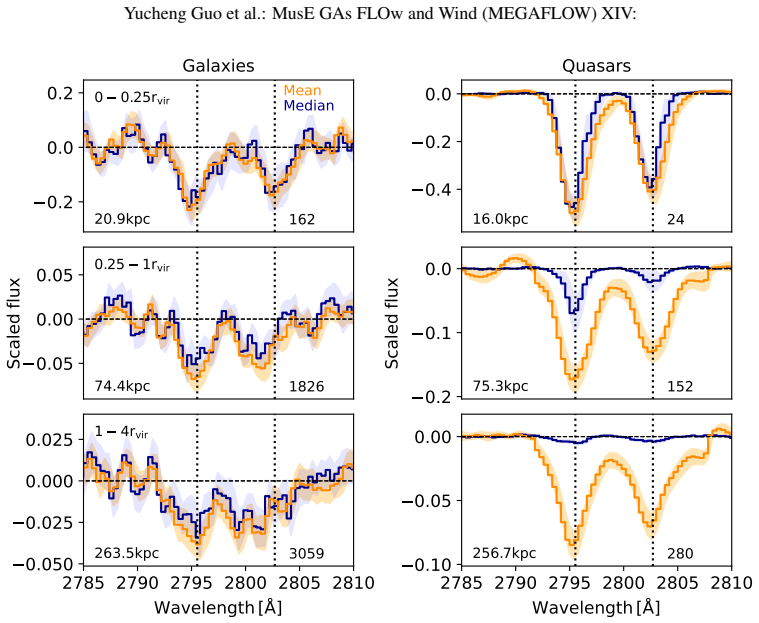
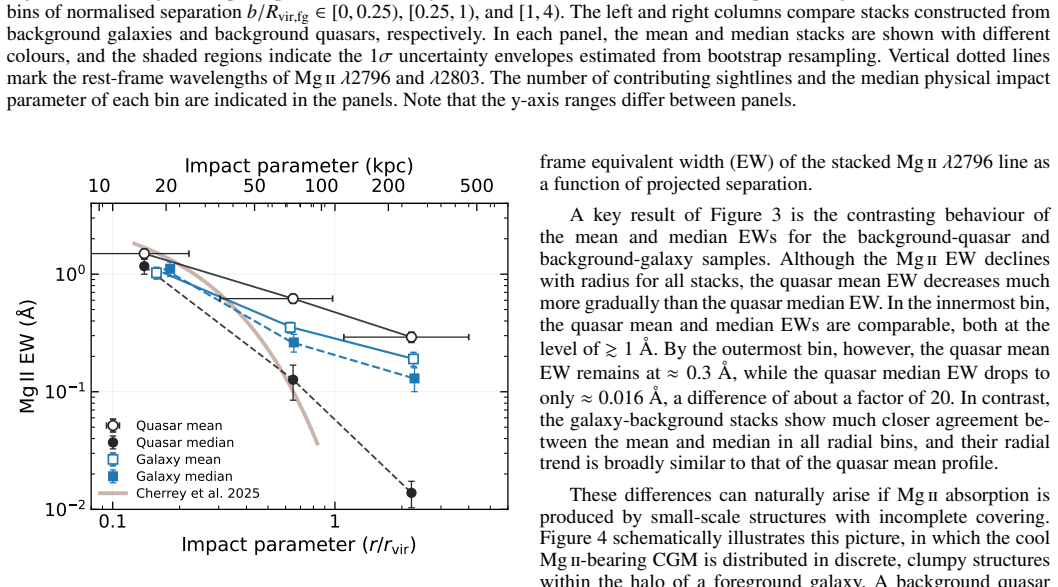
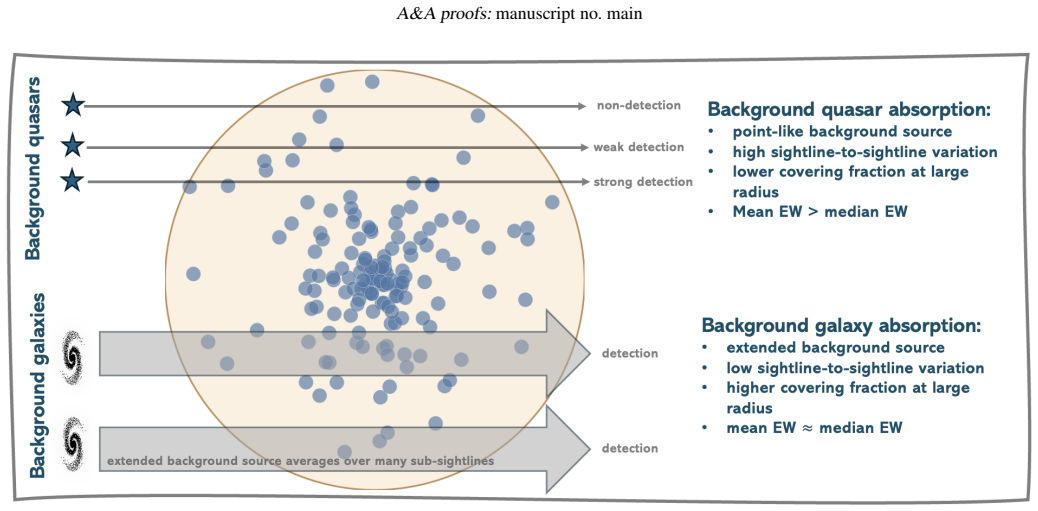
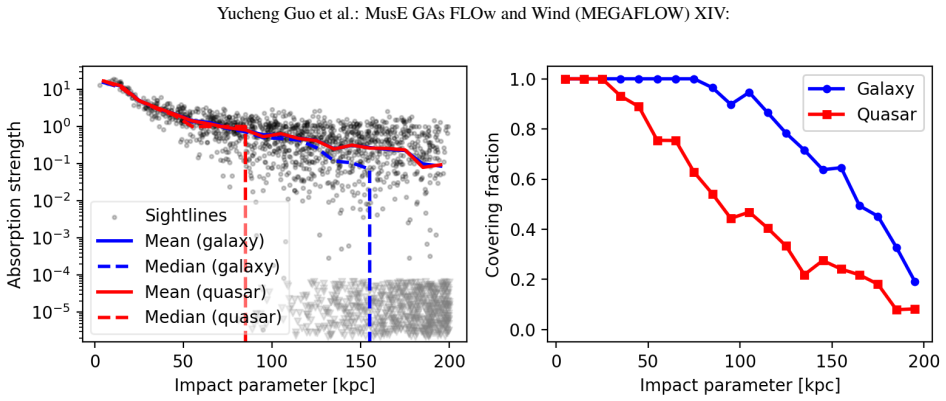
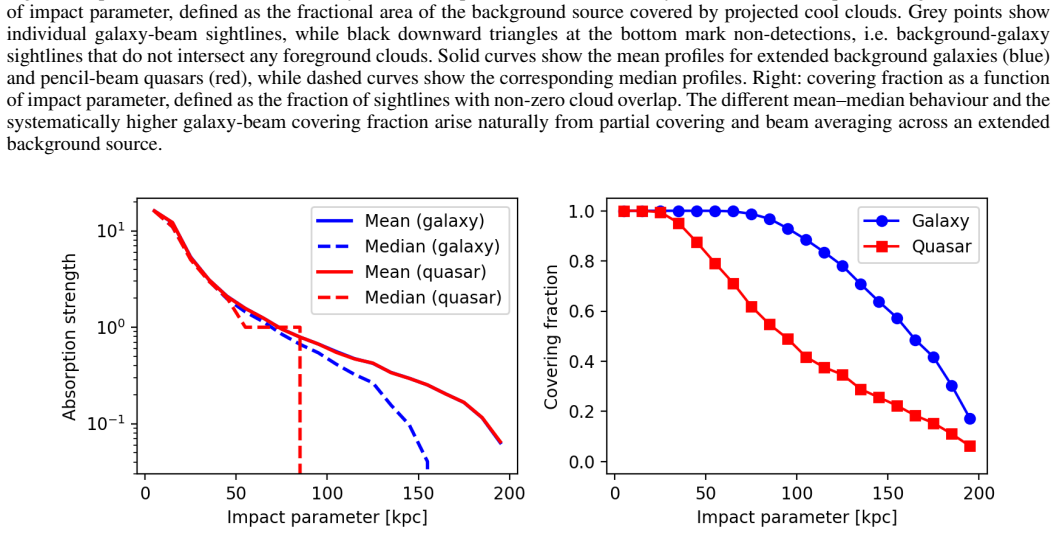
Stacked MgII absorption against background galaxies yields consistent mean and median equivalent-width profiles, while the same stacks against background quasars show median profiles that fall below the mean, with the offset growing at larger impact parameters. A similar pattern appears when splitting the galaxy sample by size. These differences arise because the quasars and smaller galaxies are smaller than the coherence scale of the absorbing clouds, so they sample only partial covering fractions on average; the larger galaxies average over multiple clouds and recover the full mean absorption.
What carries the argument
The mean-minus-median difference in stacked MgII equivalent-width profiles, produced by partial covering when background-source size is smaller than the foreground cloud coherence scale.
If this is right
- The cool CGM is composed of discrete clouds rather than a volume-filling smooth medium at the probed impact parameters.
- Absorption-line stacking analyses must include the angular size of the background source when converting equivalent widths to covering fractions.
- The coherence scale sets a minimum size for structures that can survive in the CGM, directly affecting how outflow and accretion models populate the halo with cool gas.
- The method supplies a purely geometric constraint that can be repeated with other ions or at higher redshift without assuming specific cloud velocities or ionization conditions.
Where Pith is reading between the lines
- If the 2-7 kpc scale matches the expected size of galactic fountain clouds or recycled wind material, it would link the observed coherence directly to outflow recycling cycles.
- Simulations that resolve CGM structure below 1 kpc could be tested by checking whether they reproduce the same mean-median divergence when mock observations are performed with realistic source sizes.
- Extending the analysis to background galaxies at different redshifts or with different stellar masses would reveal whether cloud size scales with halo properties.
Load-bearing premise
The differences between mean and median EW profiles are caused only by the finite coherence scale of the clouds combined with source size, rather than velocity structure, ionization gradients, or stacking selection effects.
What would settle it
High-resolution integral-field spectroscopy of a single background galaxy that shows uniform MgII absorption across its entire disk on scales of several kpc would falsify the claimed coherence length.
Figures
read the original abstract
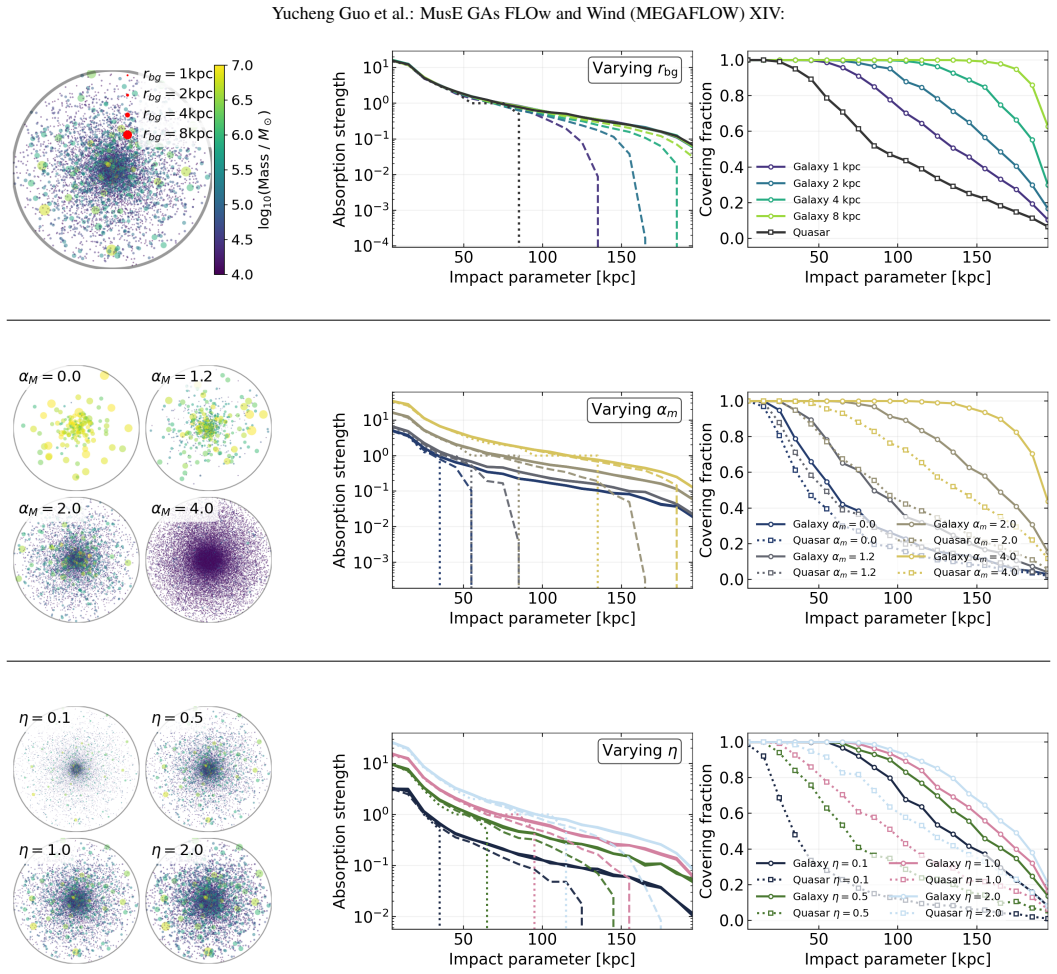
The properties of the cool ($T\sim10^4$~K) gas in the circumgalactic medium (CGM) are closely linked to the physical mechanisms that create and maintain this multiphase medium. The cool CGM is thought to consist of discrete clouds, whose characteristic size is unknown. Here we present a geometric and direct approach to constrain the coherence scale of these cool structures using stacked MgII absorption lines measured against extended background galaxies and effectively point-like background quasars, whose sizes are a few kpc and $\lesssim$ 0.01 pc, respectively. When the background-source size is smaller than the coherence scale of the foreground clouds, incomplete covering lowers the detection fraction and causes the median stacked absorption to differ from the mean. For stacked MgII absorption against background galaxies, the mean and median equivalent width (EW) profiles are broadly consistent. For stacked MgII absorption against background quasars, by contrast, the median and mean EW profiles differ significantly, and more so as the impact parameter increases beyond 100 kpc. Furthermore, we find a tentative trend that the median and mean EW profiles are broadly consistent for large background galaxies (median half-light radius $\approx 6.6$ kpc), but differ for small background galaxies ($\approx 1.5$ kpc). This indicates that MgII clouds have a coherence length of $\sim$2-7~kpc. Using a toy model in which the CGM is populated with discrete cool clouds, we show that the observed differences arise naturally from the combination of partial covering and beam averaging. Our results provide a new geometry-based measure of the small-scale structure of cool CGM gas.
Editorial analysis
A structured set of objections, weighed in public.
Referee Report
Summary. The paper claims that differences in mean versus median stacked MgII equivalent width profiles—consistent for large background galaxies but discrepant for quasars and small galaxies—indicate that cool CGM clouds have a coherence length of ∼2-7 kpc. This geometric inference is supported by a toy model in which discrete clouds produce partial covering when the background source size is smaller than the cloud scale, with the discrepancy increasing at impact parameters >100 kpc.
Significance. If the central claim holds after addressing sample-matching concerns, the work supplies a novel, direct geometric constraint on the small-scale structure of the cool CGM that is independent of fitted parameters and complements kinematic or ionization studies. The comparison to independently measured source sizes and the explicit toy model are strengths that make the result potentially falsifiable with future data.
major comments (1)
- [Abstract] Abstract, final paragraph: The claim that the observed mean-median EW discrepancy arises exclusively from partial covering due to finite coherence length (yielding the 2-7 kpc range) requires that the small-galaxy (median half-light radius ≈1.5 kpc) and large-galaxy (≈6.6 kpc) subsamples are matched in redshift distribution, mean impact parameter, and intrinsic CGM properties. Without explicit tests for these matches, velocity structure, ionization gradients, or selection effects in the stacking could produce the same offset, undermining the coherence-length interpretation.
minor comments (2)
- [Abstract] The abstract states the 2-7 kpc range but provides no error bars, derivation details, or sensitivity tests to the exact source-size values used.
- Additional details on the stacking procedure (weighting, error estimation, and handling of non-detections) would improve reproducibility of the mean-median comparison.
Simulated Author's Rebuttal
We thank the referee for their thoughtful and constructive report. The major comment raises an important point about sample matching that we address directly below. We have revised the manuscript to incorporate explicit tests and expanded discussion as described.
read point-by-point responses
-
Referee: [Abstract] Abstract, final paragraph: The claim that the observed mean-median EW discrepancy arises exclusively from partial covering due to finite coherence length (yielding the 2-7 kpc range) requires that the small-galaxy (median half-light radius ≈1.5 kpc) and large-galaxy (≈6.6 kpc) subsamples are matched in redshift distribution, mean impact parameter, and intrinsic CGM properties. Without explicit tests for these matches, velocity structure, ionization gradients, or selection effects in the stacking could produce the same offset, undermining the coherence-length interpretation.
Authors: We agree that demonstrating the small- and large-galaxy subsamples are well-matched is essential for the robustness of the coherence-length inference. In the revised manuscript we have added a new figure and accompanying text in Section 4.2 that explicitly compares the redshift and impact-parameter distributions of the two subsamples; Kolmogorov-Smirnov tests yield p > 0.2, indicating consistency. Both subsamples are drawn from the identical parent MEGAFLOW galaxy catalog with the sole distinction being the half-light radius cut, and the stacking procedure is identical. While velocity structure and ionization gradients could in principle contribute, the toy model in Section 5 shows that the mean-median offset arises naturally from partial covering once source size is varied, and the same model reproduces the quasar-galaxy contrast without invoking differences in CGM properties. We have also added a brief discussion of possible selection biases and why they are unlikely to mimic the observed size-dependent trend. revision: yes
Circularity Check
No circularity: coherence length inferred from independent source-size comparisons
full rationale
The paper's central inference—that MgII clouds have a coherence length of ∼2-7 kpc—follows directly from comparing observed mean vs. median EW profiles across background sources whose physical sizes (quasars ≲0.01 pc; galaxies with measured half-light radii 1.5 kpc and 6.6 kpc) are determined independently of the absorption data. The toy model is used only to illustrate that partial covering plus beam averaging reproduces the pattern; it does not fit parameters to the target coherence length or redefine inputs. No self-definitional equations, fitted-input predictions, or load-bearing self-citations appear in the derivation chain. The result is therefore self-contained against external size measurements.
Axiom & Free-Parameter Ledger
axioms (1)
- domain assumption Background galaxies have half-light radii of ~1.5 kpc and ~6.6 kpc; quasars are effectively point sources (<0.01 pc).
Reference graph
Works this paper leans on
-
[1]
2023, A&A, 680, A112
Afruni, A., Lopez, S., Anshul, P., et al. 2023, A&A, 680, A112
2023
-
[2]
1993, ARA&A, 31, 473
Antonucci, R. 1993, ARA&A, 31, 473
1993
-
[3]
K., Prochaska, J
Armillotta, L., Fraternali, F., Werk, J. K., Prochaska, J. X., & Marinacci, F. 2017, MNRAS, 470, 114
2017
-
[4]
2021, MNRAS, 505, 6195
Augustin, R., Péroux, C., Hamanowicz, A., et al. 2021, MNRAS, 505, 6195
2021
-
[5]
S., et al
Augustin, R., Tumlinson, J., Peeples, M. S., et al. 2025, ApJ, 993, 52
2025
-
[6]
2010, in Society of Photo-Optical In- strumentation Engineers (SPIE) Conference Series, V ol
Bacon, R., Accardo, M., Adjali, L., et al. 2010, in Society of Photo-Optical In- strumentation Engineers (SPIE) Conference Series, V ol. 7735, Ground-based and Airborne Instrumentation for Astronomy III, ed. I. S. McLean, S. K. Ram- say, & H. Takami, 773508
2010
-
[7]
2021, A&A, 647, A107
Bacon, R., Mary, D., Garel, T., et al. 2021, A&A, 647, A107
2021
-
[8]
Bahcall, J. N. & Spitzer, Jr., L. 1969, ApJ, 156, L63
1969
-
[9]
H., Hearin, A
Behroozi, P., Wechsler, R. H., Hearin, A. P., & Conroy, C. 2019, MNRAS, 488, 3143
2019
-
[10]
S., Sharma, P., Dutta, A., & Nath, B
Bisht, M. S., Sharma, P., Dutta, A., & Nath, B. B. 2025, MNRAS, 542, 1573
2025
-
[11]
J., Knobel, C., et al
Bordoloi, R., Lilly, S. J., Knobel, C., et al. 2011, ApJ, 743, 10
2011
-
[12]
2015, ApJ, 813, 46 Bouché, N., Hohensee, W., Vargas, R., et al
Borthakur, S., Heckman, T., Tumlinson, J., et al. 2015, ApJ, 813, 46 Bouché, N., Hohensee, W., Vargas, R., et al. 2012, MNRAS, 426, 801 Bouché, N. F., Wendt, M., Zabl, J., et al. 2025, A&A, 694, A67
2015
-
[13]
2003, PASP, 115, 763
Chabrier, G. 2003, PASP, 115, 763
2003
-
[14]
2023, ApJ, 955, L25
Chen, H.-W., Qu, Z., Rauch, M., et al. 2023, ApJ, 955, L25
2023
-
[15]
L., et al
Chen, H.-W., Wild, V ., Tinker, J. L., et al. 2010, ApJ, 724, L176
2010
-
[16]
F., Zabl, J., et al
Cherrey, M., Bouché, N. F., Zabl, J., et al. 2024, MNRAS, 528, 481
2024
-
[17]
F., Zabl, J., et al
Cherrey, M., Bouché, N. F., Zabl, J., et al. 2025, A&A, 694, A117
2025
-
[18]
W., Mellon, R
Churchill, C. W., Mellon, R. R., Charlton, J. C., & V ogt, S. S. 2003, ApJ, 593, 203
2003
-
[19]
L., Songaila, A., Kim, T.-S., & Hu, E
Cowie, L. L., Songaila, A., Kim, T.-S., & Hu, E. M. 1995, AJ, 109, 1522
1995
-
[20]
D., Keeney, B
Davis, J. D., Keeney, B. A., Danforth, C. W., & Stocke, J. T. 2015, ApJ, 810, 92
2015
-
[21]
2000, in Society of Photo-Optical Instrumentation Engineers (SPIE) Conference Se- ries, V ol
Dekker, H., D’Odorico, S., Kaufer, A., Delabre, B., & Kotzlowski, H. 2000, in Society of Photo-Optical Instrumentation Engineers (SPIE) Conference Se- ries, V ol. 4008, Optical and IR Telescope Instrumentation and Detectors, ed. M. Iye & A. F. Moorwood, 534–545
2000
-
[22]
& Bally, J
Devine, D. & Bally, J. 1999, ApJ, 510, 197
1999
-
[23]
2024, MNRAS, 528, 1895
Dutta, R., Acebron, A., Fumagalli, M., et al. 2024, MNRAS, 528, 1895
2024
-
[24]
L., Ibata, R., Pettini, M., et al
Ellison, S. L., Ibata, R., Pettini, M., et al. 2004, A&A, 414, 79
2004
-
[25]
& Werk, J
Faerman, Y . & Werk, J. K. 2023, ApJ, 956, 92 Faucher-Giguère, C.-A. & Oh, S. P. 2023, ARA&A, 61, 131
2023
-
[26]
B., Ostriker, E
Fielding, D. B., Ostriker, E. C., Bryan, G. L., & Jermyn, A. S. 2020, ApJ, 894, L24
2020
-
[27]
B., Bolatto, A
Fisher, D. B., Bolatto, A. D., Chisholm, J., et al. 2025, MNRAS, 538, 3068
2025
-
[28]
F., Contini, T., et al
Freundlich, J., Bouché, N. F., Contini, T., et al. 2021, MNRAS, 501, 1900
2021
-
[29]
G., Baldry, I
Gilbank, D. G., Baldry, I. K., Balogh, M. L., Glazebrook, K., & Bower, R. G. 2010, MNRAS, 405, 2594
2010
-
[30]
G., Baldry, I
Gilbank, D. G., Baldry, I. K., Balogh, M. L., Glazebrook, K., & Bower, R. G. 2011, MNRAS, 412, 2111
2011
-
[31]
2022, arXiv e-prints, arXiv:2206.14908
Greene, J., Bezanson, R., Ouchi, M., Silverman, J., & the PFS Galaxy Evolution Working Group. 2022, arXiv e-prints, arXiv:2206.14908
arXiv 2022
-
[32]
Gronke, M. & Oh, S. P. 2018, MNRAS, 480, L111
2018
-
[33]
Gronke, M. & Oh, S. P. 2020, MNRAS, 494, L27
2020
-
[34]
F., et al
Guo, Y ., Bacon, R., Bouché, N. F., et al. 2023, Nature, 624, 53
2023
-
[35]
2017, ApJ, 836, 243
Gupta, A., Mathur, S., & Krongold, Y . 2017, ApJ, 836, 243
2017
-
[36]
M., Dahlem, M., Lehnert, M
Heckman, T. M., Dahlem, M., Lehnert, M. D., et al. 1995, ApJ, 448, 98
1995
-
[37]
H., Martin, C
Ho, S. H., Martin, C. L., & Schaye, J. 2020, ApJ, 904, 76
2020
-
[38]
B., Rubin, K
Hummels, C. B., Rubin, K. H. R., Schneider, E. E., & Fielding, D. B. 2024, ApJ, 972, 148
2024
-
[39]
P., & Masterson, P
Ji, S., Oh, S. P., & Masterson, P. 2019, MNRAS, 487, 737
2019
-
[40]
L., Wu, X., & Pen, U.-L
Jow, D. L., Wu, X., & Pen, U.-L. 2024, Proceedings of the National Academy of Science, 121, e2406783121
2024
-
[41]
& Shelton, R
Kwak, K. & Shelton, R. L. 2010, ApJ, 719, 523
2010
-
[42]
& Fukugita, M
Lan, T.-W. & Fukugita, M. 2017, ApJ, 850, 156
2017
-
[43]
Lan, T.-W. & Mo, H. 2018, ApJ, 866, 36
2018
-
[44]
Lan, T.-W. & Mo, H. 2019, MNRAS, 486, 608
2019
-
[45]
F., et al
Langan, I., Zabl, J., Bouché, N. F., et al. 2023, MNRAS, 521, 546
2023
-
[46]
D., Heckman, T
Lehnert, M. D., Heckman, T. M., & Weaver, K. A. 1999, ApJ, 523, 575
1999
-
[47]
2024, A&A, 691, A356
Lopez, S., Afruni, A., Zamora, D., et al. 2024, A&A, 691, A356
2024
-
[48]
A., Thompson, T
Lopez, S., Lopez, L. A., Thompson, T. A., Leroy, A. K., & Bolatto, A. D. 2025, ApJ, 989, 100
2025
-
[49]
Mainieri, V ., Anderson, R. I., Brinchmann, J., et al. 2024, arXiv e-prints, arXiv:2403.05398
arXiv 2024
-
[50]
2020, The Messenger, 180, 24
Maiolino, R., Cirasuolo, M., Afonso, J., et al. 2020, The Messenger, 180, 24
2020
-
[51]
Maller, A. H. & Bullock, J. S. 2004, MNRAS, 355, 694
2004
-
[52]
W., Kacprzak, G
Marra, R., Churchill, C. W., Kacprzak, G. G., et al. 2024, MNRAS, 527, 10522
2024
-
[53]
P., O’Leary, R., & Madigan, A.-M
McCourt, M., Oh, S. P., O’Leary, R., & Madigan, A.-M. 2018, MNRAS, 473, 5407
2018
-
[54]
2024, MNRAS, 527, 3858
Mishra, S., Muzahid, S., Dutta, S., Srianand, R., & Charlton, J. 2024, MNRAS, 527, 3858
2024
-
[55]
Mo, H. J. & Miralda-Escude, J. 1996, ApJ, 469, 589
1996
-
[56]
W., Kochanek, C
Morgan, C. W., Kochanek, C. S., Morgan, N. D., & Falco, E. E. 2010, ApJ, 712, 1129
2010
-
[57]
2020, MNRAS, 498, 2391
Nelson, D., Sharma, P., Pillepich, A., et al. 2020, MNRAS, 498, 2391
2020
-
[58]
M., Churchill, C
Nielsen, N. M., Churchill, C. W., & Kacprzak, G. G. 2013, ApJ, 776, 115
2013
-
[59]
D., Schaye, J., Crain, R
Oppenheimer, B. D., Schaye, J., Crain, R. A., Werk, J. K., & Richings, A. J. 2018, MNRAS, 481, 835
2018
-
[60]
S., Corlies, L., Tumlinson, J., et al
Peeples, M. S., Corlies, L., Tumlinson, J., et al. 2019, ApJ, 873, 129 Péroux, C., Rahmani, H., Arrigoni Battaia, F., & Augustin, R. 2018, MNRAS, 479, L50
2019
-
[61]
2026, arXiv e-prints, arXiv:2602.11280
Pessa, I., Wisotzki, L., Urrutia, T., et al. 2026, arXiv e-prints, arXiv:2602.11280
Pith/arXiv arXiv 2026
-
[62]
2024, A&A, 691, A5
Pessa, I., Wisotzki, L., Urrutia, T., et al. 2024, A&A, 691, A5
2024
-
[63]
2000, A&A, 359, 457 Planck Collaboration, Ade, P
Petitjean, P., Aracil, B., Srianand, R., & Ibata, R. 2000, A&A, 359, 457 Planck Collaboration, Ade, P. A. R., Aghanim, N., et al. 2016, A&A, 594, A13
2000
-
[64]
& Nelson, D
Ramesh, R. & Nelson, D. 2024, MNRAS, 528, 3320
2024
-
[65]
Rauch, M., Sargent, W. L. W., & Barlow, T. A. 1999, ApJ, 515, 500
1999
-
[66]
Rauch, M., Sargent, W. L. W., Barlow, T. A., & Simcoe, R. A. 2002, ApJ, 576, 45
2002
-
[67]
2026, A&A, 707, A359
Santo, E., Fumagalli, M., Chang, S.-J., et al. 2026, A&A, 707, A359
2026
-
[68]
2003, ApJ, 596, 768
Schaye, J., Aguirre, A., Kim, T.-S., et al. 2003, ApJ, 596, 768
2003
-
[69]
F., & Kim, T.-S
Schaye, J., Carswell, R. F., & Kim, T.-S. 2007, MNRAS, 379, 1169
2007
-
[70]
2016, ApJ, 833, 39
Schroetter, I., Bouché, N., Wendt, M., et al. 2016, ApJ, 833, 39
2016
-
[71]
F., Zabl, J., et al
Schroetter, I., Bouché, N. F., Zabl, J., et al. 2019, MNRAS, 490, 4368
2019
-
[72]
F., Zabl, J., et al
Schroetter, I., Bouché, N. F., Zabl, J., et al. 2021, MNRAS, 506, 1355
2021
-
[73]
F., Zabl, J., et al
Schroetter, I., Bouché, N. F., Zabl, J., et al. 2024, A&A, 687, A39
2024
-
[74]
M., et al
Shaban, A., Bordoloi, R., O’Meara, J. M., et al. 2025, ApJ, 986, 190
2025
-
[75]
Shakura, N. I. & Sunyaev, R. A. 1973, A&A, 24, 337
1973
-
[76]
J., & Quataert, E
Sharma, P., McCourt, M., Parrish, I. J., & Quataert, E. 2012, MNRAS, 427, 1219
2012
-
[77]
T., Lilly, S
Soto, K. T., Lilly, S. J., Bacon, R., Richard, J., & Conseil, S. 2016, MNRAS, 458, 3210
2016
-
[78]
& Fielding, D
Tan, B. & Fielding, D. B. 2024, MNRAS, 527, 9683
2024
-
[79]
S., & Werk, J
Tumlinson, J., Peeples, M. S., & Werk, J. K. 2017, ARA&A, 55, 389 van de V oort, F., Springel, V ., Mandelker, N., van den Bosch, F. C., & Pakmor, R. 2019, MNRAS, 482, L85 V oit, G. M., Bryan, G. L., O’Shea, B. W., & Donahue, M. 2015, ApJ, 808, L30
2017
-
[80]
M., Palsa, R., Streicher, O., et al
Weilbacher, P. M., Palsa, R., Streicher, O., et al. 2020, A&A, 641, A28
2020
discussion (0)
Sign in with ORCID, Apple, or X to comment. Anyone can read and Pith papers without signing in.