Stacked autoencoders based machine learning for noise reduction and signal reconstruction in geophysical data
Pith reviewed 2026-05-25 01:28 UTC · model grok-4.3
The pith
Stacked autoencoders reconstruct clean geophysical signals from noisy inputs by learning a lower-dimensional hidden representation.
A machine-rendered reading of the paper's core claim, the machinery that carries it, and where it could break.
Core claim
Autoencoders project input data nonlinearly onto a lower-dimensional hidden space in which important features are highlighted; even when the input is noisy, the network can be trained so that the reconstruction step recovers the clean signal component. The stacked variant uses local pretraining on basic single-hidden-layer autoencoders to set initial weights before full-network training, and this procedure reduces noise across all examined mathematical and geophysical cases.
What carries the argument
Stacked autoencoder with two-step training, in which single-hidden-layer autoencoders first learn local weights that initialize the deeper network before joint optimization of the full model.
If this is right
- The same two-step stacked training produces usable denoised versions of both synthetic and field geophysical datasets.
- Feature highlighting in the hidden space improves downstream interpretation of the reconstructed signals.
- The method operates without an explicit parametric model of the noise distribution.
Where Pith is reading between the lines
- The approach may transfer to other measurement domains where signals share consistent low-dimensional structure across examples.
- Performance could degrade if the training set lacks sufficient variety in signal patterns relative to the noise.
- Extending the architecture depth or adding regularization terms might further separate signal from noise on larger datasets.
Load-bearing premise
The lower-dimensional representation learned from noisy data encodes the clean geophysical signal rather than a blend of signal and noise patterns.
What would settle it
Running the trained stacked autoencoder on held-out noisy geophysical traces yields outputs whose noise level is not lower than the input or whose signal features deviate from known clean reference traces.
Figures


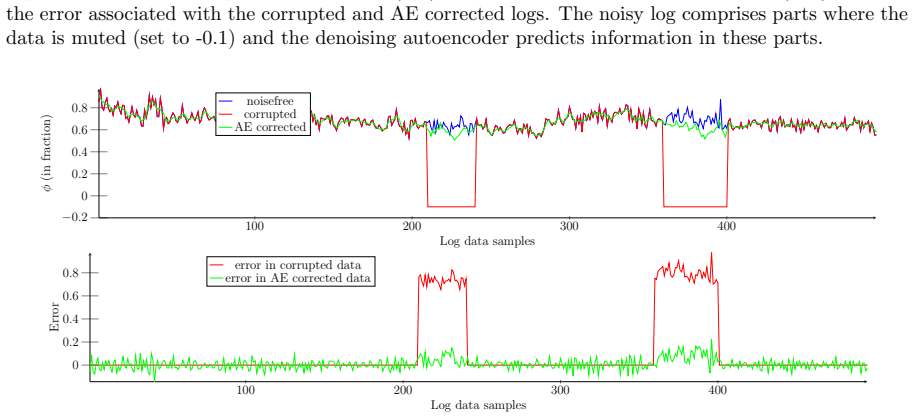

read the original abstract
Autoencoders are neural network formulations where the input and output of the network are identical and the goal is to identify the hidden representation in the provided datasets. Generally, autoencoders project the data nonlinearly onto a lower dimensional hidden space, where the important features get highlighted and interpretation of the data becomes easier. Recent studies have shown that even in the presence of noise in the input data, autoencoders can be trained to reconstruct the noisefree component of the data from the reduced-dimensional hidden space. In this paper, we explore the application of autoencoders within the scope of denoising geophysical datasets using a data-driven methodology. The autoencoder formulation is discussed, and a stacked variant of deep autoencoders is proposed. The proposed method involves locally training the weights first using basic autoencoders, each comprising a single hidden layer. Using these initialized weights as starting points in the optimization model, the full autoencoder network is then trained in the second step. The applicability of denoising autoencoders has been demonstrated on a basic mathematical example and several geophysical examples. For all the cases, autoencoders are found to significantly reduce the noise in the input data.
Editorial analysis
A structured set of objections, weighed in public.
Referee Report
Summary. The paper proposes a two-stage stacked autoencoder architecture (local pre-training of single-hidden-layer autoencoders followed by end-to-end fine-tuning) for denoising geophysical signals. It applies the method to a synthetic mathematical example and several geophysical datasets, asserting that the approach significantly reduces noise in the input data for all examined cases.
Significance. If the central claim were supported by objective metrics and independent validation, the work would offer a practical data-driven alternative for noise suppression in geophysical signal processing. The two-stage training is a standard initialization technique, but its utility here depends on demonstrating genuine signal recovery rather than generic compression.
major comments (3)
- [Abstract] Abstract: the assertion that autoencoders 'significantly reduce the noise' for all cases supplies no quantitative metrics (SNR improvement, MSE, or similar), error bars, or baseline comparisons, leaving the central empirical claim unsupported.
- [Geophysical examples] Geophysical examples section: without ground-truth clean signals, visual inspection cannot confirm that the hidden representation isolates the geophysical signal rather than performing dimensionality-reduction smoothing; any sufficiently compressive autoencoder could yield comparable visual results.
- [Method and results] Method and results: training and evaluation are performed on the identical noisy observations, so reported reconstruction quality is a fitted quantity whose value depends on architecture and optimization choices rather than an independent test of signal recovery.
minor comments (2)
- [Method] The description of the two-stage training procedure would benefit from an explicit diagram or pseudocode to clarify the local pre-training versus global fine-tuning steps.
- [Autoencoder formulation] Notation for encoder/decoder weights and hidden-layer dimensions is introduced without a consolidated table, making it harder to reproduce the exact architectures used.
Simulated Author's Rebuttal
We thank the referee for the constructive feedback on our manuscript. We address each major comment below, indicating where revisions will be incorporated to strengthen the presentation of our results.
read point-by-point responses
-
Referee: [Abstract] Abstract: the assertion that autoencoders 'significantly reduce the noise' for all cases supplies no quantitative metrics (SNR improvement, MSE, or similar), error bars, or baseline comparisons, leaving the central empirical claim unsupported.
Authors: The abstract condenses the visual evidence from the figures. We agree that quantitative support would improve clarity. In revision we will insert SNR and MSE values (with the synthetic mathematical example, where a clean reference is available) and will explicitly qualify the real-data cases as relying on visual assessment. revision: yes
-
Referee: [Geophysical examples] Geophysical examples section: without ground-truth clean signals, visual inspection cannot confirm that the hidden representation isolates the geophysical signal rather than performing dimensionality-reduction smoothing; any sufficiently compressive autoencoder could yield comparable visual results.
Authors: Ground-truth clean signals are unavailable for the field geophysical datasets, a common constraint in the domain. The two-stage training procedure is intended to encourage recovery of structured signal components rather than generic smoothing. We will add side-by-side comparisons against standard denoising baselines (e.g., wavelet thresholding) to provide additional evidence that the learned representation offers advantages beyond simple compression. revision: yes
-
Referee: [Method and results] Method and results: training and evaluation are performed on the identical noisy observations, so reported reconstruction quality is a fitted quantity whose value depends on architecture and optimization choices rather than an independent test of signal recovery.
Authors: Autoencoder denoising is unsupervised by design; the network is trained to reconstruct its noisy input through a bottleneck. For the synthetic example an independent clean reference exists and will be used for explicit error quantification. We will revise the text to state this distinction clearly and, where data volume permits, introduce a hold-out subset for the synthetic case to illustrate generalization. revision: partial
Circularity Check
No circularity; empirical demonstration on provided examples is self-contained
full rationale
The paper describes a data-driven application of stacked autoencoders trained end-to-end on the input geophysical datasets themselves to produce reconstructions. No first-principles derivation, uniqueness theorem, or parameter-free prediction is claimed that reduces by construction to the training inputs. Results are presented as empirical demonstrations on a mathematical example and geophysical cases, which constitutes standard supervised evaluation rather than a circular reduction. No self-citations or ansatzes are invoked as load-bearing steps in the provided text.
Axiom & Free-Parameter Ledger
free parameters (2)
- network depth and hidden-layer widths
- learning rate, batch size, and number of epochs
axioms (1)
- domain assumption A neural network with a bottleneck layer can separate repeatable signal structure from uncorrelated noise when trained on many examples.
Reference graph
Works this paper leans on
-
[1]
URL https://www.tensorflow.org/, software available from tensorflow.org
Abadi M, Agarwal A, Barham P, Brevdo E, Chen Z, Citro C, Corrado GS, Davis A, Dean J, Devin M, Ghemawat S, Goodfellow I, Harp A, Irving G, Isard M, Jia Y, Jozefowicz R, Kaiser L, Kudlur M, Levenberg J, Man´ e D, Monga R, Moore S, Murray D, Olah C, Schuster M, Shlens J, Steiner B, Sutskever I, Talwar K, Tucker P, Vanhoucke V, Vasudevan V, Vi´ egas F, Vinya...
2015
-
[2]
Geophysics 68:1202–1210
Abdelrehman EM, El-Araby TM, Hassaneen AG, Hafez MA (2003) New methods for shape and depth determinations from SP data. Geophysics 68:1202–1210
2003
-
[3]
Cogni- tive Sci 9:147–169
Ackley DH, Hinton GE, Sejnowski TJ (1985) A learning algorithm for boltzmann machines. Cogni- tive Sci 9:147–169
1985
-
[4]
Neural Networks 2:53–58
Baldi P, Hornik K (1989) Neural networks and principal component analysis: Learning from exam- ples without local minima. Neural Networks 2:53–58
1989
-
[5]
J Manage Inform Syst 10:11–32
Bansal A, Kauffman RJ, Weitz RR (1993) Comparing the modeling performance of regression and neural networks as data quality varies: a business value approach. J Manage Inform Syst 10:11–32
1993
-
[6]
Comput Math Appl 64:3580–3593 18
Beenamol M, Prabavathy S, Mohanalin J (2012) Wavelet based seismic signal de-noising using shannon and tsallis entropy. Comput Math Appl 64:3580–3593 18
2012
-
[7]
Foundations and Trends in Machine Learning 2(1):1–127
Bengio Y (2009) Learning deep architectures for AI. Foundations and Trends in Machine Learning 2(1):1–127
work page 2009
-
[8]
In: 78th EAGE Conf
Bhowmick D, Shankar U, Maiti S (2016) Revisiting supervised learning in the context of predicting gas hydrate saturation. In: 78th EAGE Conf. Exhib., pp 1–4
2016
-
[9]
Deep Autoassociative Neural Networks for Noise Reduction in Seismic data
Bhowmick D, Gupta DK, Maiti S, Shankar U (2018) Deep autoassociative neural networks for noise reduction in seismic data. CoRR abs/1805.00291
work page internal anchor Pith review Pith/arXiv arXiv 2018
-
[10]
Burger CH, Schuler CJ, Harmeling S (2012) Image denoising with multi-layer perceptrons, part 1: comparison with existing algorithms and with bounds. CoRR 1211.1544
work page internal anchor Pith review Pith/arXiv arXiv 2012
-
[11]
MIT Press, Cambridge, MA
Chapelle O, Scholkopf B, Zien A (2006) Semi-supervised learning. MIT Press, Cambridge, MA
2006
- [12]
-
[13]
Collins JM, Clark MR (1993) An application of the theory of neural computation to the prediction of workplace behavior: an illustration and assessment of network analysis. Pers Psychol 46(3):503–522
work page 1993
- [14]
-
[15]
Crisci C, Ghattas B, Perera G (2012) A review of supervised machine learning algorithms and their applications to ecological data. Ecol Model 240:113–122
work page 2012
-
[16]
Doumas A, Mavroudakis K, Gritzalis D, Katsikas S (1995) Design of a neural network for recognition and classification of computer viruses. Comput Sec 14(5):435–448
work page 1995
-
[17]
Feng F, Wu Y, Nie G, Ni R (2012) The effect of artificial neural network model combined with six tumor markers in auxillary diagnosis of lung cancer. J Med Syst 36:2973–2980
work page 2012
- [18]
-
[19]
Gupta DK, Gupta JP, Arora Y, Shankar U (2013) Recursive ant colony optimization: a new tech- nique for the estimation of function parameters from geophysical field data. Near Surf Geophys 11:325–339
work page 2013
-
[20]
Hutchinson J, Lo AW, Poggio T (1994) A non-parametric approach to pricing and hedging derivative securities via learning networks. J Finance 11:325–339
work page 1994
-
[21]
Jain V, Sebastian S (2009) Natural image denoising with convolutional networks. In: Koller D, Schuurmans D, Bengio Y, Bottou L (eds) Advances in Neural Information Processing Systems 21, Curran Associates, Inc., pp 769–776
work page 2009
-
[22]
Jardani A, Revil A, Santos FAM, Fauchard C, Dupont JP (2007) Detection of preferential infiltration pathways in sinkholes using joint inversion of self-potential and EM-34 conductivity data. Geophy Prospec 55(5):749–760
work page 2007
-
[23]
Jenson HL (1992) Using neural networks for credit scoring. Manag Finance 18(6):15–26
work page 1992
-
[24]
Comput Meth Prog Bio 132:93– 103
Jones DE, Ghandehari H, Facelli JC (2016) A review of the applications of data mining and machine learning for the prediction of biomedical properties of nanoparticles. Comput Meth Prog Bio 132:93– 103
work page 2016
-
[25]
Mech Syst Signal Pr 107:241–265
Khan S, Yairi T (2018) A review on the application of deep learning in system health management. Mech Syst Signal Pr 107:241–265
work page 2018
-
[26]
Comput Struct Biotechnol J 13:8–17
Kourou K, Exarchos TP, Exarchos KP, Karamouzis MV, Fotiadis DI (2015) Machine learning ap- plications in cancer prognosis and prediction. Comput Struct Biotechnol J 13:8–17
work page 2015
-
[27]
Computers Chem Engng 16(4):313–328 19
Kramer MA (1992) Autoassociative neural networks. Computers Chem Engng 16(4):313–328 19
work page 1992
- [28]
-
[29]
Li J, Zhang Y, Qi R, Liu QH (2017) Wavelet-based higher order correlative stacking for seismic data denoising in the curvelet domain. IEEE J Sel Top Appl
work page 2017
-
[30]
Maiti S, Tiwari RK, K¨ umpel HJ (2007) Neural network modelling and classification of lithofacies using well log data: A case study from ktb borehole site. Geophy J Int 169(2):733–746
work page 2007
-
[31]
Cambridge University Press, Cambridge
Mavko G, Mukerji T, Dvorkin J (2009) The Rock Physics Handbook: Tools for Seismic Analysis of Porous Media. Cambridge University Press, Cambridge
work page 2009
-
[32]
McCormack MD, Zaucha DE, Dushek DW (1993) First-break refraction event picking and seismic data trace editing using neural networks. Geophysics 58:67–78
work page 1993
-
[33]
Meiser P (1962) A method of quantitative interpretation of self-potential measurements. Geophys Prosp 10:203–218
work page 1962
-
[34]
Murat ME, Rudman AJ (1992) Automated first arrival picking: A neural network approach. Geo- phys Prosp 40:587–604
work page 1992
-
[35]
Nikolopoulos C, Fellrath P (1994) A hybrid expert system for investment advising. Expert Syst 11(4):245–250
work page 1994
-
[36]
Ojha U, Garg A (2016) Denoising high resolution multispectral images using deep learning approach. In: 15th Int. Conf. Machine Learning and Appl., IEEE, pp 1–5
work page 2016
-
[37]
IEEE T Image Process 11(5):545–557
Pizurica A, Philips W, Lemahieu I, Acheroy M (2002) A joint inter- and intrascale statistical model for bayesian wavelet based image denoising. IEEE T Image Process 11(5):545–557
work page 2002
-
[38]
IEEE T Image Process 12(11):1338–1351
Portilla J, Strela V, Wainright MJ, Simoncelli EP (2003) Image denoising using scale mixtures of gaussians in the wavelet domain. IEEE T Image Process 12(11):1338–1351
work page 2003
-
[39]
Poulton MM, Sternberg BK, Glass CE (1992) Location of subsurface targets in geophysical data using neural networks. Geophysics 57:1534–1544
work page 1992
-
[40]
Proctor RA (1991) An expert system to aid in staff selection: a neural network approach. Int J Manpower 12(8):18–21
work page 1991
- [41]
- [42]
-
[43]
Rogers J (1995) Neural network user authentication. AI Expert 10:29–33
work page 1995
-
[44]
Ronzato M, Poultney CS, Chopra S, LeCun Y (2007) Efficient learning of sparse representations with an energy-based model. In: Platt JC, Koller D, Singer Y, Roweis S (eds) Advances in Neural Information Processing Systems 19 (NIPS06), MIT Press, pp 1137–1144
work page 2007
-
[45]
Rose K, Boswell R, Collett T (2011) Mount elbert gas hydrate stratigraphic test well, alaska north slope: Coring operations, core sedimentology, and lithostratigraphy. Mar Pet Geo 28(2):311 – 331
work page 2011
-
[46]
R¨ oth G, Tarantola A (1994) Neural networks and inversion of seismic data. J Geophys R 99:6753– 6768
work page 1994
-
[47]
Int J Comput Vision 82(2):205–229
Roth S, Black MJ (2009) Fields of experts. Int J Comput Vision 82(2):205–229
work page 2009
-
[48]
Physica D 60:259–268
Rudin LI, Osher S, Fatemi E (1992) Nonlinear total variation based noise removal algorithms. Physica D 60:259–268
1992
-
[49]
Ruggiero Jr MA (1994) Training neural networks for intermarket analysis. Futures 23(9):42–44 20
work page 1994
-
[50]
Decis Sci 23:899–196
Salchenberger LM, Cinar EM, Lash NA (1992) Neural networks: a new tool for predicting thrift failures. Decis Sci 23:899–196
1992
-
[51]
Santos FAM (2010) Inversion of self-potential of idealized bodies’ anomalies using particle swarm optimization. Comput Geosci 36:1185–1190
work page 2010
-
[52]
Earth Planets Space 54:655–662
Santos FAM, Almeida EP, Castro R, Nolasco M, Mendes-Victor L (2002) A hydrogeological inves- tigation using em34 and sp surveys. Earth Planets Space 54:655–662
2002
-
[53]
In: Proc
Schuler CJ, Burger HC, Harmeling S, Scholkopf B (2013) A machine learning approach for non-blind image deconvolution. In: Proc. IEEE Conf. Comp. Vision Patt. Recog. (CVPR), pp 1067–1074
2013
-
[54]
J Petrol Sci Eng 106:62–70
Shankar U, Gupta DK, Bhowmick D, Sain K (2013) Gas hydrate and free gas saturations using rock physics modelling at site nghp-01-05 and 07 in the krishnagodavari basin, eastern indian margin. J Petrol Sci Eng 106:62–70
2013
-
[55]
IEEE Trans Softw Eng 18(7):590–600
Stafylopatis A, Likas A (1992) Pictorial information retrieval using the random neural network. IEEE Trans Softw Eng 18(7):590–600
work page 1992
-
[56]
Sundararajan N, Rao PS, Sunitha V (1998) An analytical method to interpret self-potential anoma- lies caused by 2d inclined sheets. Geophysics 63:1551–1555
work page 1998
- [57]
-
[58]
Expert Syst Appl 36(10):11994–12000
Tsai C, Hsu Y, Lin C, Lin W (2009) Intrusion detection by machine learning: A review. Expert Syst Appl 36(10):11994–12000
work page 2009
-
[59]
Geophys J Int 189(3):1183–1202
Valentine AP, Trampert J (2012) Data space reduction, quality assessment and searching of seismo- grams: autoencoder networks for waveformdata. Geophys J Int 189(3):1183–1202
work page 2012
-
[60]
Geophys Res Lett 40(12):3048–3054
Valentine AP, Kalnins LM, Trampert J (2013) Discovery and analysis of topographic features using learning algorithms: A seamount case study. Geophys Res Lett 40(12):3048–3054
work page 2013
-
[61]
J Mach Learn Res 11:3371–3408
Vincent P, Larochelle H, Lajoie I, Bengio Y, Manzagol PA (2010) Stacked denoising autoencoders: Learning useful representations in a deep network with a local denoising criterion. J Mach Learn Res 11:3371–3408
2010
-
[62]
ECMI Series, Teubner-Verlag, Stuttgart, Germany
Weickert J (1998) Anisotropic diffusion in image processing. ECMI Series, Teubner-Verlag, Stuttgart, Germany
work page 1998
- [63]
-
[64]
Xiong Y, Zuo R (2016) Recognition of geochemical anomalies using a deep autoencoder network. Comput Geosci 86:75–82
work page 2016
-
[65]
Zhang Y, Paulson KV (1997) Magnetotelluric inversion using regularized hopfield neural networks. Geophys Prosp 45:725–743
work page 1997
-
[66]
Zlotnini J, Nishida Y (2003) Review on morphological insights of self-potential anomalies on volca- noes. Surveys Geophy 24:291–338 21
work page 2003
discussion (0)
Sign in with ORCID, Apple, or X to comment. Anyone can read and Pith papers without signing in.