REVIEW 3 major objections 5 minor 47 references
Let the Dynamics Flow: Stable Flow Matching Dynamical Systems
T0 review · 3 major / 5 minor · reviewed 2026-07-12 · grok-4.5
Pith's one-line read Flow matching can learn multimodal robot motions that stay stable by design, not just by hope.
desk verdict Coherent soft/hard flow-matching DS with Lyapunov/LaSalle constraints and Lie-group extensions; multimodal gains are real, discrete-time transfer is the honest soft spot. read the letter →
The pith
A machine-rendered reading of the paper's core claim, the machinery that carries it, and where it could break.
The reading
What carries the argument
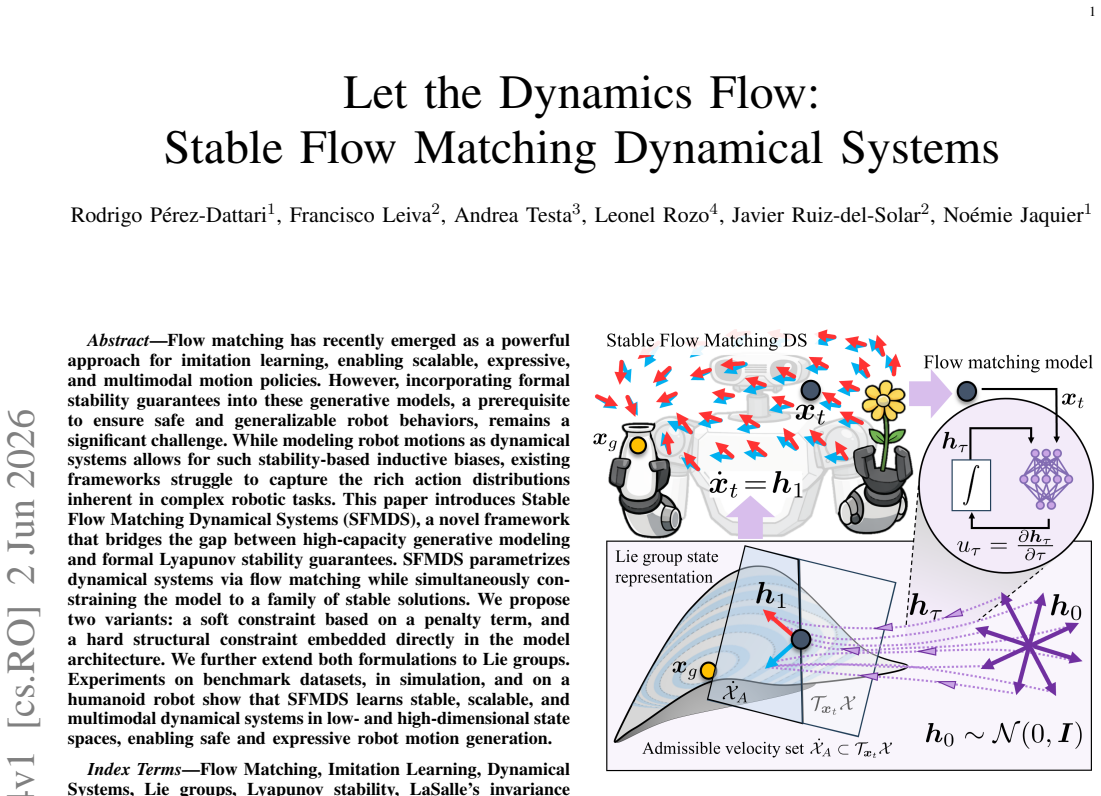
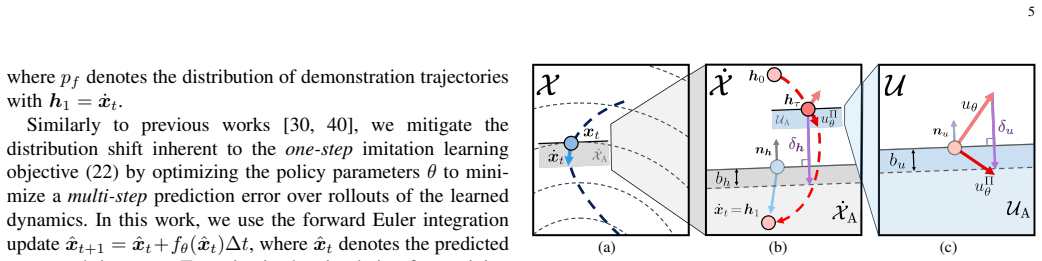
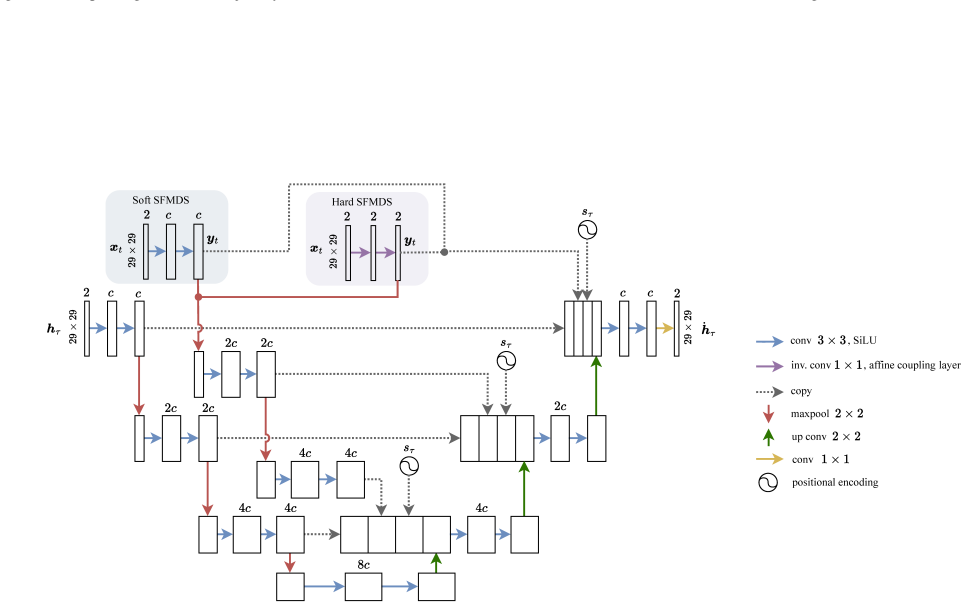
Stable Flow Matching Dynamical Systems (SFMDS): a state-conditioned flow-matching vector field whose auxiliary flow is forced, by LaSalle half-space or ball constraints (soft penalty or hard projection through a latent map), to land in the set of velocities that keep the system positively invariant and/or decrease a latent Lyapunov function.
What would settle it
Train hard SFMDS on a multimodal dataset or the humanoid insertion task, roll out many trajectories from a dense grid of out-of-distribution starts with the same discrete integrator used at deployment, and measure whether a non-negligible fraction fails to reach the goal or escapes the intended workspace.
Extended reading notes
Core claim
Dynamical systems can be parametrized by flow matching and simultaneously constrained—softly via a hinge penalty or hard via projection—to admissible velocity sets derived from positive invariance and latent Lyapunov decrease, including on Lie groups, so that the learned policies remain scalable and multimodal yet asymptotically stable.
Load-bearing premise
Stability is proved for continuous trajectories obtained by freezing or tracking a single noise sample, so the same guarantees need not hold automatically after discrete Euler integration or when the latent map’s Jacobian is sharp.
Editorial analysis
A structured set of objections, weighed in public.
Referee Report
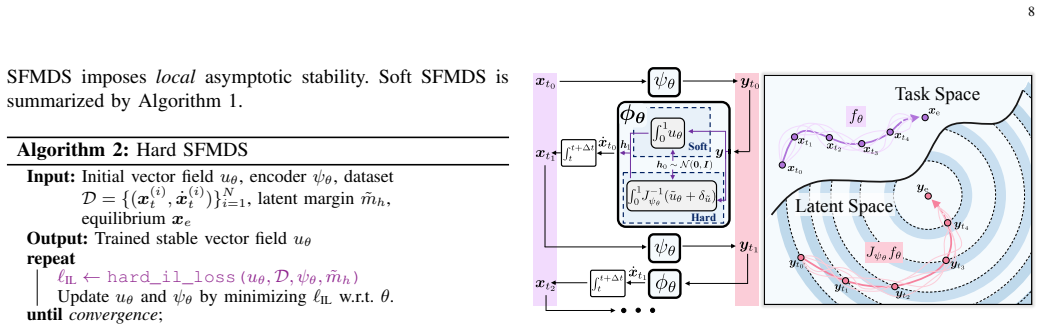
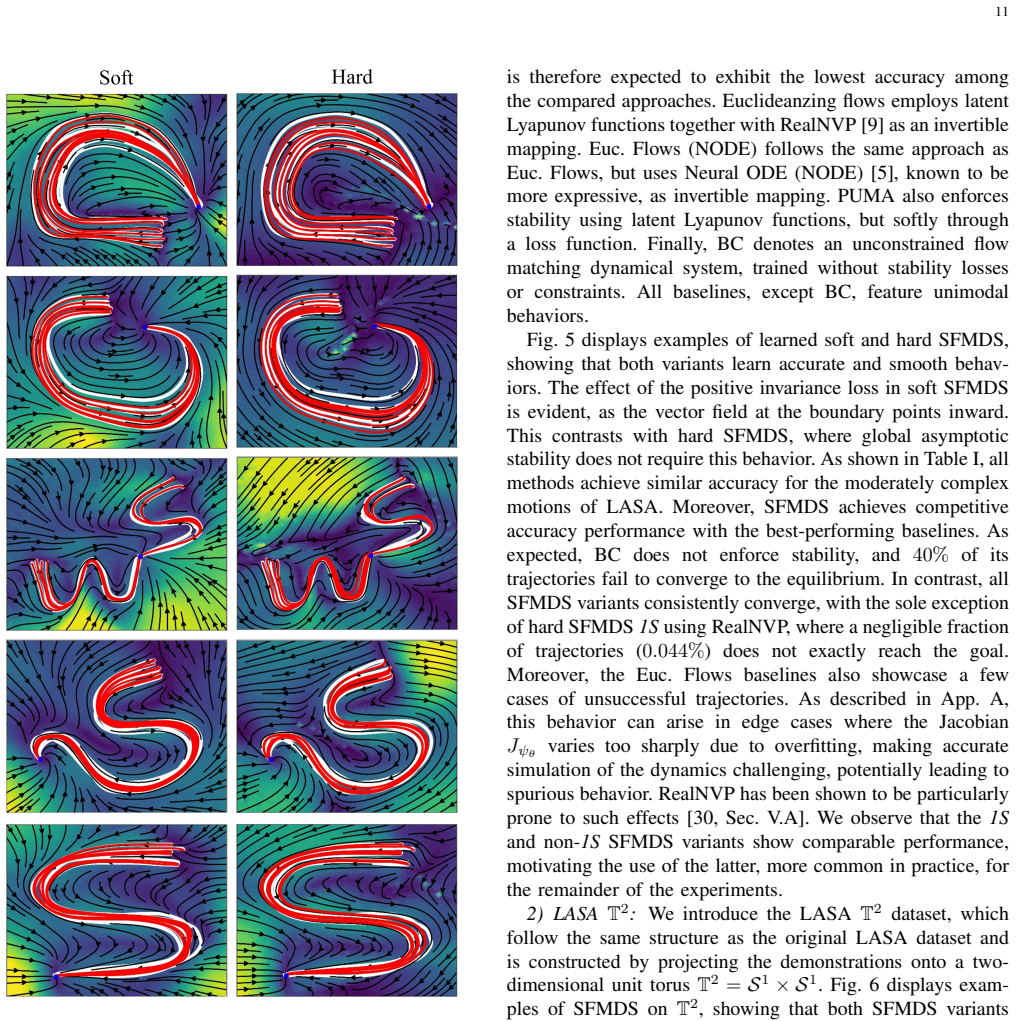
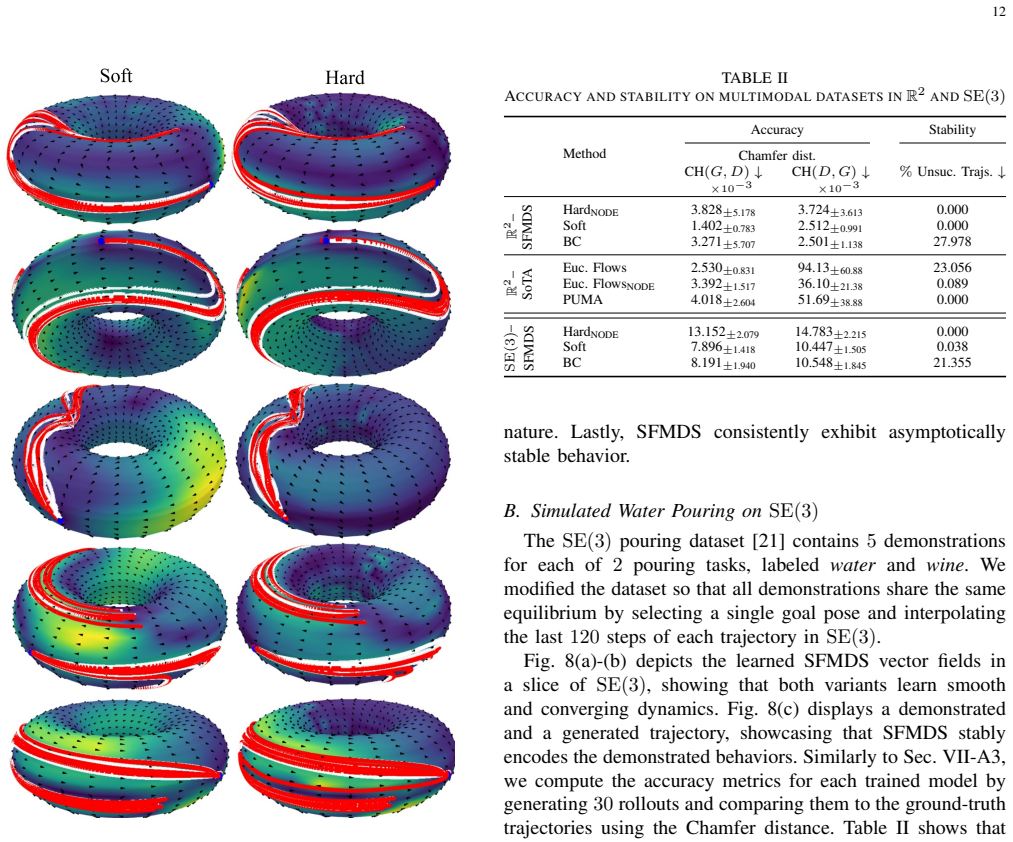
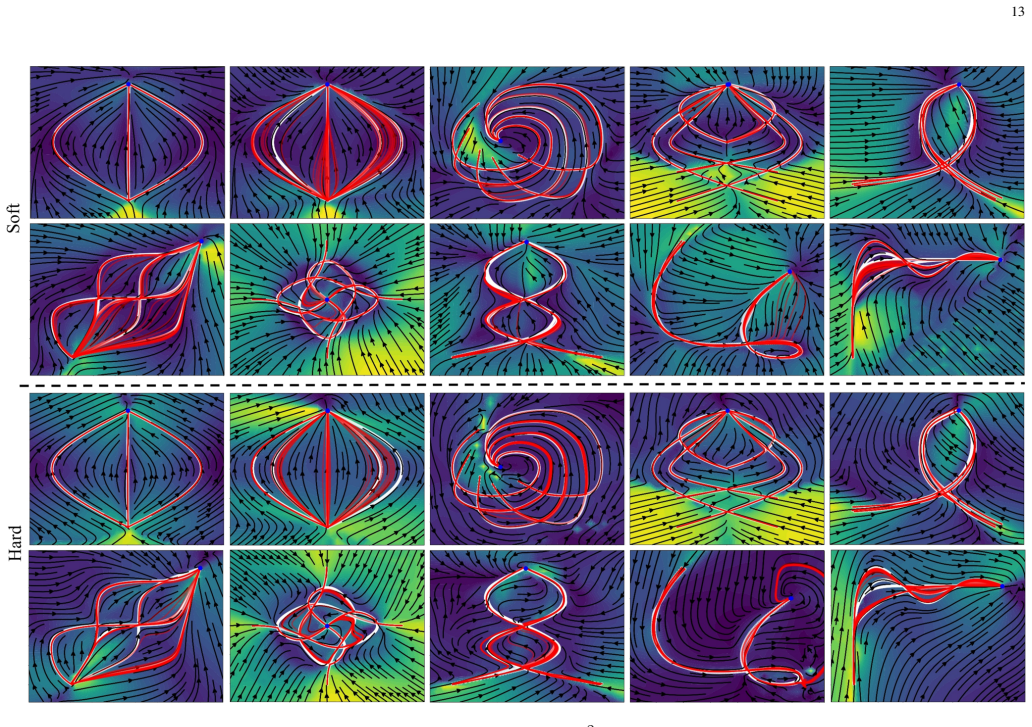
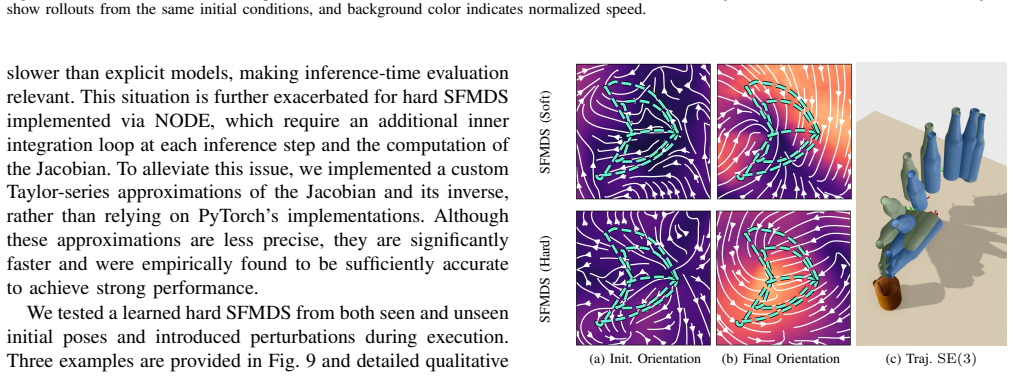
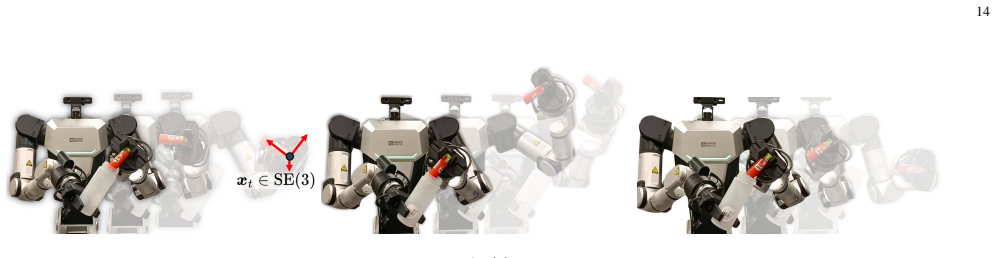
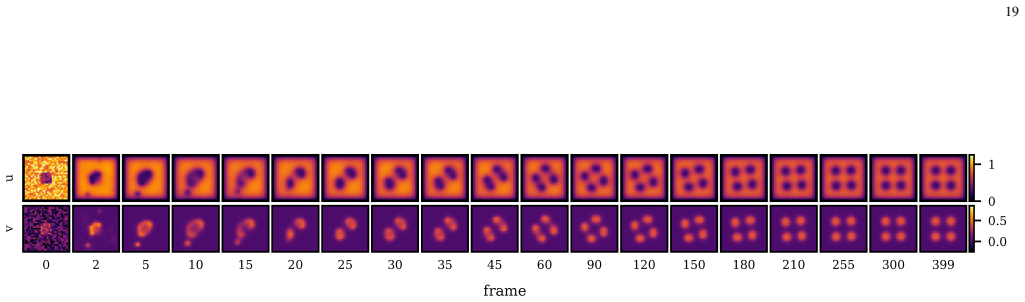
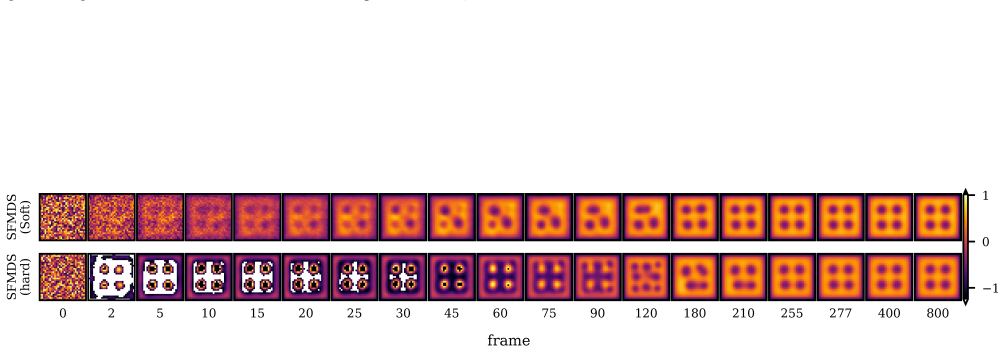
Summary. The paper introduces Stable Flow Matching Dynamical Systems (SFMDS), which model robot motion policies as dynamical systems whose velocities are generated by a state-conditioned flow-matching process, while restricting those velocities to admissible sets derived from positive invariance and/or Lyapunov (LaSalle) conditions. Two variants are proposed: soft SFMDS (hinge penalties on the flow vector field) and hard SFMDS (structural projection through an invertible latent map ψ_θ). Both are extended to Lie groups (T², SE(3)) via first-cover restrictions on the Lie algebra. Training combines multi-step imitation losses with the stability constraints (Algorithms 1–2). Experiments cover LASA, a new LASA-T² benchmark, a new multimodal R² set, SE(3) pouring, a real humanoid insertion task, and a 1682-dimensional Gray–Scott system, with comparisons to CLF-DM, Euclideanizing flows, PUMA, LieImFlow, and unconstrained BC. Soft/hard SFMDS match or beat unimodal baselines and substantially improve multimodal coverage while reporting near-zero unsuccessful trajectories under OOD initial conditions.
Significance. If the constructions hold as stated, the work is a meaningful bridge between high-capacity generative imitation (flow matching) and classical stable dynamical-system policies. The multimodal gains (Table II) are particularly valuable: competing latent-Lyapunov methods remain effectively unimodal and fail to cover intersecting modes, whereas SFMDS captures them while retaining asymptotic stability. The Lie-group extension, new T² and multimodal R² benchmarks, real-robot SE(3) insertion, and 1682-D reaction–diffusion experiment strengthen the contribution beyond a pure methods paper. Public code and video support reproducibility. The free parameters (loss weights, margins, architectures) are standard for this literature; the main novelty is the admissible-set formulation of flow matching rather than a parameter-free derivation.
major comments (3)
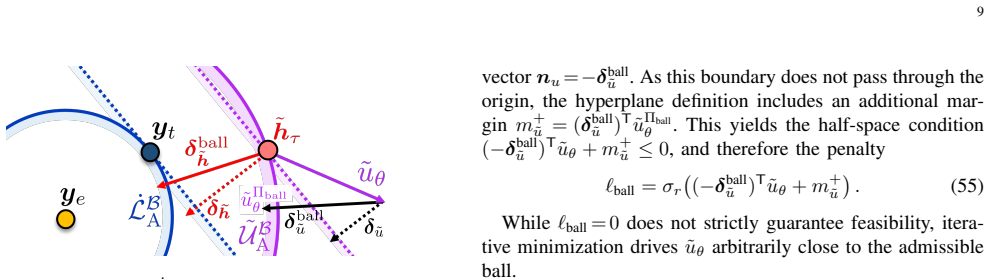
- [Sec. V-B–V-C; App. A; Tables I–III] Sec. V-B (Conditions 1–2) and Sec. V-C: The formal asymptotic-stability argument is developed for continuous-time sampled trajectories obtained by fixing or tracking a single ω, then adapted to discrete forward-Euler maps via admissible balls (48)–(56). The abstract and introduction nevertheless advertise “formal stability guarantees” for robot motion generation without clearly scoping that the deployed controller is always the discrete Euler map (and, on the humanoid, a Cartesian impedance loop). App. A and residual failures in Tables I–III (e.g., 0.044% hard RealNVP on LASA, <0.03% hard NODE on SE(3), 2.3% soft on GSRD) show that discretization and sharp Jacobians of ψ_θ can still escape the admissible set. The manuscript should state a precise discrete-time theorem (what is guaranteed for the implemented map under stated step-size/margin conditions) and quantify the measure of the res
- [Abstract; Sec. I; Sec. V-B; Algorithm 1] Sec. V-B and Algorithm 1: Soft SFMDS is only locally asymptotically stable by construction (positive-invariance loss over a closed region plus latent hinge). Hard SFMDS claims global asymptotic stability only when ψ_θ is a diffeomorphism and continuous-time idealization holds. The abstract and contribution list do not distinguish these scopes; readers can reasonably infer global formal guarantees for both variants. Please qualify soft vs. hard claims consistently in the abstract, Sec. I, and conclusions, and report the positively invariant region used for soft SFMDS in each experiment.
- [Sec. VII-A3; Table II; Sec. VII-C; Table IV] Sec. VII-A3 and Table II: Hard SFMDS with RealNVP failed to learn the multimodal R² behaviors robustly, so all subsequent hard experiments use only NODE. This architectural sensitivity is load-bearing for the claim that hard structural constraints preserve expressivity: if the invertible map must be a carefully tuned NODE (with extra inner integration and Jacobian cost; Table IV ~13 Hz), the practical “hard” guarantee is narrower than the general construction suggests. Please report RealNVP multimodal numbers (even if poor), discuss when the hard projection becomes too restrictive, and clarify whether global stability is retained under the Taylor Jacobian approximations used on the real robot.
minor comments (5)
- [Sec. III-B1; Remark 1] Notation: u_θ is overloaded for the full augmented field and for the learnable ḣ component after Remark 1; a consistent superscript or rename would help.
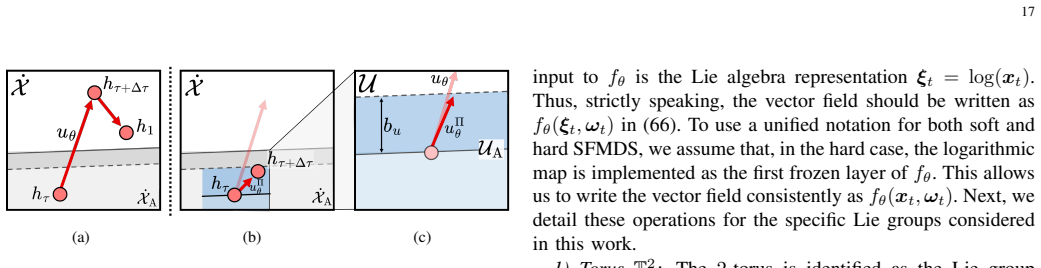
- [Fig. 4; Sec. V-C] Fig. 4 caption and surrounding text: the overlap of X, Ẋ, and U is dense; a short legend mapping dotted/solid and blue/purple sets to equations (40)–(52) would improve readability.
- [Algorithm 1; free parameters] Loss weights λ_IL, λ_PI, λ_AS (and γ) and margins m̃_h, m_h are free parameters; a brief sensitivity or default schedule in the appendix would aid reproduction.
- [Throughout] Typos/style: “Euclideanzing” vs “Euclideanizing”; “must must be taken” (Sec. VI-B); “assesstrajectory” spacing artifacts in Sec. VII; arXiv header “arXiv:2606.03834v1” is fine for review but check final DOI/venue formatting.
- [Sec. I Related work] Related work: briefly position against concurrent stable diffusion/flow policy certificates (e.g., S2Diff is cited but the imitation vs. cost-optimization distinction could be one sentence sharper).
Circularity Check
No significant circularity: admissible sets and constraints are derived from standard Lyapunov/LaSalle conditions, enforced by construction on the flow-matching field, and evaluated empirically against independent accuracy and OOD stability metrics.
full rationale
The paper's core derivation (Secs. III–V) defines flow-matching dynamical systems f_θ via the conditional FM objective (Eqs. 19–24), then independently constructs admissible velocity sets ˙X_A from positive-invariance half-spaces (Eq. 36) or latent Lyapunov decrease conditions (Eqs. 40–41, Conditions 1–2). Soft penalties (Eqs. 34, 44) and hard projections (Eqs. 35, 45–46) are applied to u_θ so that h_1 lands in those sets by τ=1 (via LaSalle, Sec. IV). Training minimizes the sum of imitation losses plus these independent stability terms; success is measured by separate held-out metrics (RMSE/DTWD/FD/Chamfer on demos, % unsuccessful OOD trajectories) against external baselines (CLF-DM, Euc. Flows, PUMA, LieImFlow, BC). Self-citations (e.g., to PUMA [31], Euclideanizing flows [33], stable autonomous FM [36]) supply related methods or baselines but are not load-bearing uniqueness theorems or fitted inputs renamed as predictions. Discrete-time edge cases (App. A) are acknowledged as implementation limitations, not circular reductions. The construction is self-contained and falsifiable outside the training losses.
Assumptions & free parameters
free parameters (4)
- Loss weights λ_IL, λ_PI, λ_AS (and γ for discrete ball term)
- Latent/task margins m̃_h, m_h, m_u and λ_h, λ_s (ϵ_s, α)
- Network architectures and latent dimension for ψ_θ / u_θ
- Integration step sizes Δt, Δτ and single-step flow approximation
assumptions (6)
- standard math LaSalle’s invariance principle: if H decreases along the flow outside S and is constant on S, trajectories approach S.
- standard math Lyapunov asymptotic stability: positive-definite V with V̇<0 implies asymptotic stability of the equilibrium.
- domain assumption Conditional flow matching regression yields the same gradients as matching the marginal probability path.
- ad hoc to paper Stability of trajectories obtained by sampling a single ω_0 (or tracking ω) is an adequate certificate for the generative dynamical system used at deployment.
- domain assumption For hard SFMDS, ψ_θ is a diffeomorphism (invertible Jacobian) so latent half-space/ball constraints map back to task space without losing Cond. 1.
- domain assumption Restricting Lie-algebra maps to the first cover (e.g., ∥ξ^r∥<π) preserves bijectivity of log/exp for stability on T² and SE(3).
invented entities (2)
-
Stable Flow Matching Dynamical Systems (SFMDS)
-
Admissible velocity / u-space half-spaces and discrete balls Ẋ_A, U_A, ḊL_A, Ũ^B_A
Cite this review
Pith. "Pith review of Let the Dynamics Flow: Stable Flow Matching Dynamical Systems." pith.science (2026). https://pith.science/paper/2XQSFE6L
@misc{pith2026260603834,
  author       = {Pith},
  title        = {Pith review of: Let the Dynamics Flow: Stable Flow Matching Dynamical Systems},
  year         = {2026},
  howpublished = {\url{https://pith.science/paper/2XQSFE6L}},
  note         = {Machine review of arXiv:2606.03834}
}
read the original abstract
Flow matching has recently emerged as a powerful approach for imitation learning, enabling scalable, expressive, and multimodal motion policies. However, when modeling these policies as dynamical systems, incorporating formal stability guarantees into these generative models is a prerequisite to ensure safe and generalizable robot behaviors, which remains a significant challenge. This paper introduces Stable Flow Matching Dynamical Systems (SFMDS), a novel framework that bridges the gap between highly expressive generative modeling and formal stability guarantees. SFMDS parametrizes dynamical systems via flow matching while constraining the model to satisfy positive invariance and/or Lyapunov stability conditions. We propose two variants: a soft constraint based on a penalty term, and a hard structural constraint embedded directly into the model architecture. We further extend both formulations to Lie groups to robustly handle orientation trajectories. Experiments on benchmark datasets, in simulation, and on a humanoid robot show that SFMDS learns stable, scalable, and multimodal dynamical systems in low- and high-dimensional state spaces, enabling safe and expressive robot motion generation. SFMDS matches or outperforms state-of-the-art methods on unimodal datasets, while substantially improving performance on multimodal datasets, where competing approaches fail to capture multi-modal behaviors. Accompanying source code and video are available at: https://let-the-dynamics-flow.github.io/SFMDS/.
Figures
Figures from the paper (11 more)
Reference graph
Works this paper leans on
-
[1]
Parametric correspondence and cham- fer matching: Two new techniques for image matching
Harry G Barrow, Jay M Tenenbaum, Robert C Bolles, and Helen C Wolf. Parametric correspondence and cham- fer matching: Two new techniques for image matching. Technical report, 1977
1977
-
[2]
Learning for adaptive and reactive robot control: a dynamical systems approach
Aude Billard, Sina Mirrazavi, and Nadia Figueroa. Learning for adaptive and reactive robot control: a dynamical systems approach. Mit Press, 2022
2022
-
[3]
Cambridge university press, 2004
Stephen Boyd and Lieven Vandenberghe.Convex opti- mization. Cambridge university press, 2004
2004
-
[4]
Riemannian flow matching policy for robot motion learning
Max Braun, No ´emie Jaquier, Leonel Rozo, and Tamim Asfour. Riemannian flow matching policy for robot motion learning. InIEEE/RSJ Intl. Conf. on Intelligent Robots and Systems (IROS), pages 5144–5151, 2024
2024
-
[5]
Neural ordinary differential equations.Advances in neural information processing systems, 31, 2018
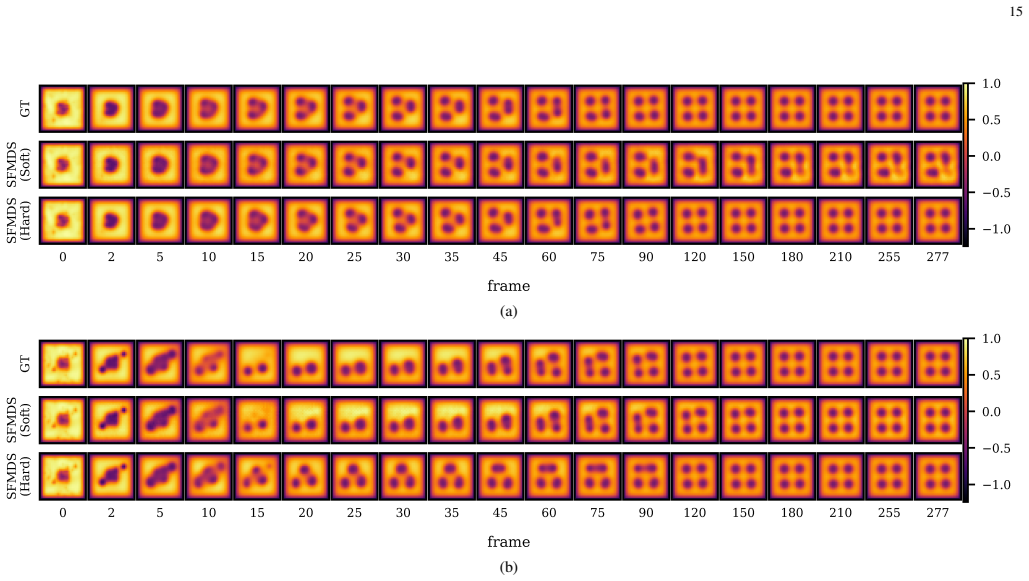
Ricky TQ Chen, Yulia Rubanova, Jesse Bettencourt, and David K Duvenaud. Neural ordinary differential equations.Advances in neural information processing systems, 31, 2018. 15 (a) (b) Fig. 10. Ground-truth (GT) and generated trajectories via Soft and Hard SFMDS associated with two different demonstrations ((a) and (b), respectively)
2018
-
[6]
Safe and stable control via Lyapunov-guided diffusion models
Xiaoyuan Cheng, Xiaohang Tang, and Yiming Yang. Safe and stable control via Lyapunov-guided diffusion models. InNeural Information Processing Systems (NeurIPS), 2025
2025
-
[7]
Learn- ing robotic manipulation policies from point clouds with conditional flow matching
Eugenio Chisari, Nick Heppert, Max Argus, Tim Welschehold, Thomas Brox, and Abhinav Valada. Learn- ing robotic manipulation policies from point clouds with conditional flow matching. InConference on Robot Learning (CoRL), 2024
2024
-
[8]
Fast and robust visuomotor riemannian flow matching policy.IEEE Transactions on Robotics, 41: 5327–5343, 2025
Haoran Ding, No ´emie Jaquier, Jan Peters, and Leonel Rozo. Fast and robust visuomotor riemannian flow matching policy.IEEE Transactions on Robotics, 41: 5327–5343, 2025
2025
Show all 47 references
-
[9]
Density estimation using real nvp
Laurent Dinh, Jascha Sohl-Dickstein, and Samy Bengio. Density estimation using real nvp. InInternational Conference on Learning Representations, 2017
2017
-
[10]
Fast and stable learning of dynamical systems based on extreme learning machine.IEEE Transactions on Systems, Man, and Cybernetics: Systems, 49(6):1175–1185, 2017
Jianghua Duan, Yongsheng Ou, Jianbing Hu, Zhiyang Wang, Shaokun Jin, and Chao Xu. Fast and stable learning of dynamical systems based on extreme learning machine.IEEE Transactions on Systems, Man, and Cybernetics: Systems, 49(6):1175–1185, 2017
2017
-
[11]
Computing discrete Fr´echet distance
Thomas Eiter and Heikki Mannila. Computing discrete Fr´echet distance. Technical Report CD-TR 94/64, Tech- nische Universitat Wien, 1994
1994
-
[12]
Action- Flow: Equivariant, accurate, and efficient policies with spatially symmetric flow matching
Niklas Funk, Julen Urain, Joao Carvalho, Vignesh Prasad, Georgia Chalvatzaki, and Jan Peters. Action- Flow: Equivariant, accurate, and efficient policies with spatially symmetric flow matching. 2024
2024
-
[13]
Mohammad Khansari-Zadeh and Aude Billard
S. Mohammad Khansari-Zadeh and Aude Billard. Learn- ing stable nonlinear dynamical systems with gaussian mixture models.IEEE Transactions on Robotics, 27(5): 943–957, 2011
2011
-
[14]
Mohammad Khansari-Zadeh and Aude Billard
S. Mohammad Khansari-Zadeh and Aude Billard. Learn- ing control lyapunov function to ensure stability of dy- namical system-based robot reaching motions.Robotics and Autonomous Systems, 62(6):752–765, 2014
2014
-
[15]
Glow: Generative flow with invertible 1x1 convolutions.Advances in neural information processing systems, 31, 2018
Durk P Kingma and Prafulla Dhariwal. Glow: Generative flow with invertible 1x1 convolutions.Advances in neural information processing systems, 31, 2018
2018
-
[16]
Normalizing flows: An introduction and review of current methods.IEEE Transactions on Pattern Analysis and Machine Intelligence, 43(11):3964–3979, 2020
Ivan Kobyzev, Simon JD Prince, and Marcus A Brubaker. Normalizing flows: An introduction and review of current methods.IEEE Transactions on Pattern Analysis and Machine Intelligence, 43(11):3964–3979, 2020
2020
-
[17]
Learning stable deep dynamics models.Advances in neural information processing systems, 32, 2019
J Zico Kolter and Gaurav Manek. Learning stable deep dynamics models.Advances in neural information processing systems, 32, 2019
2019
-
[18]
An invariance principle in the theory of stability
Joseph P La Salle. An invariance principle in the theory of stability. Technical report, 1966
1966
-
[19]
J. M. Lee.Introduction to smooth manifolds. Springer, 2013
2013
-
[20]
Smooth manifolds
John M Lee. Smooth manifolds. InIntroduction to smooth manifolds, pages 1–29. Springer, 2003
2003
-
[21]
Mmp++: Motion manifold primitives with parametric curve models.IEEE Transactions on Robotics, 2024
Yonghyeon Lee. Mmp++: Motion manifold primitives with parametric curve models.IEEE Transactions on Robotics, 2024
2024
-
[22]
Neural learning of vector fields for encoding stable dynamical systems.Neurocomputing, 141:3–14, 2014
Andre Lemme, Klaus Neumann, Ren ´e Felix Reinhart, and Jochen J Steil. Neural learning of vector fields for encoding stable dynamical systems.Neurocomputing, 141:3–14, 2014
2014
-
[23]
Yaron Lipman, Ricky T. Q. Chen, Heli Ben-Hamu, Maximilian Nickel, and Matthew Le. Flow matching for generative modeling. InIntl. Conf. on Learning Representations (ICLR), 2023
2023
-
[24]
Flow straight and fast: Learning to generate and transfer data with rectified flow
Xingchao Liu, Chengyue Gong, et al. Flow straight and fast: Learning to generate and transfer data with rectified flow. InIntl. Conf. on Learning Representations (ICLR), 16 2023
2023
-
[25]
Neural contractive dynamical systems
Hadi Beik Mohammadi, Søren Hauberg, Georgios Ar- vanitidis, Nadia Figueroa, Gerhard Neumann, and Leonel Rozo. Neural contractive dynamical systems. InThe Twelfth International Conference on Learning Represen- tations, 2023
2023
-
[26]
Dynamic time warping.Information retrieval for music and motion, pages 69–84, 2007
Meinard M ¨uller. Dynamic time warping.Information retrieval for music and motion, pages 69–84, 2007
2007
-
[27]
Springer Science & Business Media, 2013
Bernt Oksendal.Stochastic differential equations: an introduction with applications. Springer Science & Business Media, 2013
2013
-
[28]
Normalizing flows for probabilistic modeling and inference.Journal of Machine Learning Research, 22(57):1–64, 2021
George Papamakarios, Eric Nalisnick, Danilo Jimenez Rezende, Shakir Mohamed, and Balaji Lakshmi- narayanan. Normalizing flows for probabilistic modeling and inference.Journal of Machine Learning Research, 22(57):1–64, 2021
2021
-
[29]
Complex patterns in a simple system
John E Pearson. Complex patterns in a simple system. Science, 261(5118):189–192, 1993
1993
-
[30]
Stable motion primitives via imitation and contrastive learning.IEEE Transactions on Robotics, 39(5):3909–3928, 2023
Rodrigo P ´erez-Dattari and Jens Kober. Stable motion primitives via imitation and contrastive learning.IEEE Transactions on Robotics, 39(5):3909–3928, 2023
2023
-
[31]
Puma: Deep metric imitation learning for stable motion primitives.Advanced Intelligent Systems, 6(11): 2400144, 2024
Rodrigo P ´erez-Dattari, Cosimo Della Santina, and Jens Kober. Puma: Deep metric imitation learning for stable motion primitives.Advanced Intelligent Systems, 6(11): 2400144, 2024
2024
-
[32]
Fast diffeomorphic matching to learn globally asymptotically stable nonlinear dynamical systems.Systems & Control Letters, 96:51–59, 2016
Nicolas Perrin and Philipp Schlehuber-Caissier. Fast diffeomorphic matching to learn globally asymptotically stable nonlinear dynamical systems.Systems & Control Letters, 96:51–59, 2016
2016
-
[33]
Euclideaniz- ing flows: Diffeomorphic reduction for learning stable dynamical systems
Muhammad Asif Rana, Anqi Li, Dieter Fox, Byron Boots, Fabio Ramos, and Nathan Ratliff. Euclideaniz- ing flows: Diffeomorphic reduction for learning stable dynamical systems. InConference on Learning for Dynamics and Control (L4DC), pages 630–639, 2020
2020
-
[34]
U-net: Convolutional networks for biomedical image segmentation
Olaf Ronneberger, Philipp Fischer, and Thomas Brox. U-net: Convolutional networks for biomedical image segmentation. InInternational Conference on Medical image computing and computer-assisted intervention, pages 234–241. Springer, 2015
2015
-
[35]
A micro lie theory for state estimation in robotics.arXiv preprint arXiv:1812.01537, 2018
Joan Sola, Jeremie Deray, and Dinesh Atchuthan. A micro lie theory for state estimation in robotics.arXiv preprint arXiv:1812.01537, 2018
2018 arXiv
-
[36]
Stable autonomous flow matching.arXiv preprint arXiv:2402.05774, 2024
Christopher Iliffe Sprague, Arne Elofsson, and Hossein Azizpour. Stable autonomous flow matching.arXiv preprint arXiv:2402.05774, 2024
2024 arXiv
-
[37]
Imitationflow: Learning deep stable stochastic dynamic systems by normalizing flows
Julen Urain, Michele Ginesi, Davide Tateo, and Jan Peters. Imitationflow: Learning deep stable stochastic dynamic systems by normalizing flows. InIEEE/RSJ Intl. Conf. on Intelligent Robots and Systems (IROS), pages 5231–5237, 2020
2020
-
[38]
Learning stable vector fields on lie groups.IEEE Robotics and Automation Letters, 7(4):12569–12576, 2022
Julen Urain, Davide Tateo, and Jan Peters. Learning stable vector fields on lie groups.IEEE Robotics and Automation Letters, 7(4):12569–12576, 2022
2022
-
[39]
Attention is all you need.Advances in neural information processing systems, 30, 2017
Ashish Vaswani, Noam Shazeer, Niki Parmar, Jakob Uszkoreit, Llion Jones, Aidan N Gomez, Łukasz Kaiser, and Illia Polosukhin. Attention is all you need.Advances in neural information processing systems, 30, 2017
2017
-
[40]
Neural geometric fabrics: Efficiently learning high-dimensional policies from demonstration
Mandy Xie, Ankur Handa, Stephen Tyree, Dieter Fox, Harish Ravichandar, Nathan D Ratliff, and Karl Van Wyk. Neural geometric fabrics: Efficiently learning high-dimensional policies from demonstration. InCon- ference on Robot Learning, pages 1355–1367. PMLR, 2023
2023
-
[41]
Mani- Flow: A general robot manipulation policy via consis- tency flow training.arXiv preprint arXiv:2509.01819, 2025
Ge Yan, Jiyue Zhu, Yuquan Deng, Shiqi Yang, Ri-Zhao Qiu, Xuxin Cheng, Marius Memmel, Ranjay Krishna, Ankit Goyal, Xiaolong Wang, and Dieter Fox. Mani- Flow: A general robot manipulation policy via consis- tency flow training.arXiv preprint arXiv:2509.01819, 2025
2025 arXiv
-
[42]
Learning riemannian stable dynamical systems via diffeomorphisms
Jiechao Zhang, Hadi Beik-Mohammadi, and Leonel Rozo. Learning riemannian stable dynamical systems via diffeomorphisms. InConference on Robot Learning (CoRL), 2022
2022
-
[43]
Dif- feomorphic transforms for generalised imitation learning
Weiming Zhi, Tin Lai, Lionel Ott, and Fabio Ramos. Dif- feomorphic transforms for generalised imitation learning. InL4DC, Proceedings of Machine Learning Research, pages 508–519. PMLR, 2022. APPENDIXA EDGECASES FORHARD-CONSTRAINEDMETHODS As discussed in Secs. V-C and VII-A, a ...
2022
-
[44]
However, the same approach can be employed in the case when ˙XA(xt;θ)is a ball
Escaping ˙XA:Next, we consider the case when ˙XA(xt;θ)is a half-space. However, the same approach can be employed in the case when ˙XA(xt;θ)is a ball. When hτ ∈ ˙XA(xt;θ), the ReLU-based projection in (29) leaves the vector fieldu θ unconstrained. In such cases, ifu θ induces ...
-
[45]
In this case, the latent dynamics may remain stable, while the corresponding deformation induced byJ −1 ψθ changes too abruptly in task space
Overfitting ofψ θ:In cases where the transformation ψθ varies too sharply, for instance, due to overfitting, the discretized dynamics may violate the stability conditions even when the admissible set is defined as a ball in the latent space. In this case, the latent dynamics m...
-
[46]
SinceS 1 is isomorphic to the set of unit complex numbers{e iθ |θ∈R} ⊂C, elements on the torus can be written asx t = (eiθ1,t , eiθ2,t)∈T 2 ⊂C 2 [20, Ch
TorusT 2:The2-torus is identified as the Lie group T2 =S 1 × S1. SinceS 1 is isomorphic to the set of unit complex numbers{e iθ |θ∈R} ⊂C, elements on the torus can be written asx t = (eiθ1,t , eiθ2,t)∈T 2 ⊂C 2 [20, Ch. 7]. Its Lie algebra ist 2 ∼= R2, whose elements can be wri...
-
[47]
patternλ
Special Euclidean groupSE(3):Each element ofSE(3) is a pose xt = Rt pt 0 1 ∈SE(3), whereR t ∈SO(3)andp t ∈R 3 denote the rotation and translation components, respectively. A Lie algebra element is written as ξt = [ωt]× vt 0⊤ 0 ∈se(3).(70) The exponential map is defined as [35]...
Reviewed July 12, 2026 · model on record in the stance chip above.
Discussion (0). Sign in to comment.