REVIEW 4 major objections 5 minor 36 references
Electric transport as a probe to unveil microscopic aspects of oxygen-depleted YBCO
T0 review · 4 major / 5 minor · reviewed 2026-08-10 · deepseek-v4-flash
Pith's one-line read Oxygen vacancies in YBCO act as carrier traps whose depth grows with oxygen loss, and the same vacancy states appear as the mid-infrared ionization peak in optical conductivity.
desk verdict Transport side is solid but thin; the optical EI comparison is too fragile to carry the paper's central claim. read the letter →
The pith
A machine-rendered reading of the paper's core claim, the machinery that carries it, and where it could break.
The reading
What carries the argument
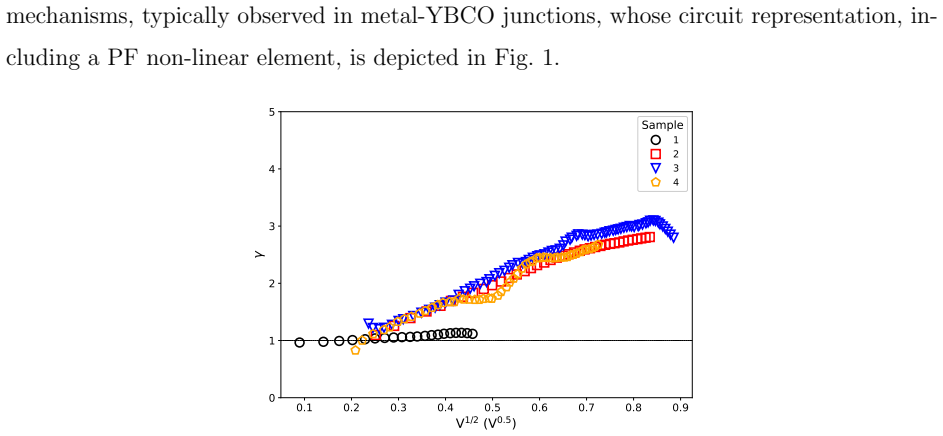
The central object is the Poole-Frenkel (PF) trap energy $\phi_T$, the depth of the Coulombic well from which carriers are thermally emitted under an applied field. It enters through the equivalent-circuit model of the metal-YBCO interface: a nonlinear PF element in parallel with an ohmic resistor $R_p$, all in series with a bulk resistance $R_s$. The fitting identity is $I_{PF}=A V_{PF}\exp(C\sqrt{V_{PF}})$, with $A\propto \exp(-\phi_T/k_B T)$ and $C\propto (q^3/\pi\epsilon'\epsilon_0 d)^{1/2}/k_B T$, which converts measured current-voltage curves at several temperatures into the trap energy and a geometric-dielectric factor. The extracted $\phi_T(\delta)$ is then compared with optical ionization energies $E_I(\delta)$ digitized from published conductivity spectra.
What would settle it
On a single YBCO film, measure both the Poole-Frenkel trap energy $\phi_T$ from current-voltage curves at a platinum contact and the mid-infrared optical conductivity peak on the same film, then change the oxygen deficiency $\delta$ by controlled annealing and repeat. If $\phi_T$ and $E_I$ do not track each other point by point as $\delta$ varies, the claimed identification fails.
Extended reading notes
Core claim
The central claim is that oxygen vacancies in oxygen-depleted YBCO create Coulombic potential wells that trap carriers, that the depth of these wells $\phi_T$ increases monotonically with oxygen deficiency $\delta$ across the studied range $0.12 \le \delta \le 0.56$, and that this electrical trap energy tracks the ionization energy $E_I(\delta)$ extracted from the mid-infrared optical conductivity peak attributed to impurity bands. The paper treats the agreement between $\phi_T(\delta)$ and $E_I(\delta)$ as evidence that the Poole-Frenkel traps and the optically detected impurity states are the same oxygen-vacancy defects, thereby reinforcing the earlier optical interpretation and validating transport as a probe of vacancy-related electronic structure.
Load-bearing premise
The load-bearing premise is that the trap energy measured electrically at the platinum-YBCO contact is the same oxygen-vacancy impurity state whose ionization produces the mid-infrared optical conductivity peak; if the two states are different, the agreement between the electrical and optical energy scales is coincidental and the main conclusion does not follow.
Editorial extensions
If this is right
- The monotonic $\phi_T(\delta)$ relation can serve as a calibration for estimating local oxygen deficiency from electrical measurements at a metal-YBCO contact, including the interfacial region.
- The strong correlation with optical $E_I(\delta)$ means the same oxygen-vacancy impurity states govern both nonlinear dc transport and mid-infrared absorption, unifying two experimental windows onto the same electronic structure.
- Deeper trap wells at higher $\delta$ explain the orders-of-magnitude increase in interface resistance with deoxygenation, because fewer carriers escape from the wells at a given field and temperature.
- In resistive-switching devices, oxygen-vacancy concentration becomes a direct control knob for the trap barrier and thus for switching voltage and retention behavior.
Reading between the lines
- Extending the paper's identification, the same $\phi_T(\delta)$ calibration could serve as a transport-only probe of oxygen-vacancy energetics in other oxide memristive interfaces where oxygen vacancies dominate conduction.
- The non-monotonic prefactor $A_{PF}(\delta)$ is left unresolved; separating mobility, donor density, and geometric-area contributions with controlled film thicknesses would test whether the sharp rise at $\delta=0.56$ marks a percolation or metal-insulator crossover.
- If oxygen vacancies are the traps, voltage-pulse-driven vacancy migration should locally change $\phi_T$; measuring $\phi_T$ before and after controlled resistive-switching pulses on the same interface would connect the trap picture to switching kinetics.
- A stronger test of the correspondence would be to measure $\phi_T(\delta)$ and the mid-infrared peak on the same physical sample after sequential oxygen anneals, removing the sample-to-sample scatter that comes from comparing different datasets.
Signed reviews
Editorial analysis
A structured set of objections, weighed in public.
Referee Report
Summary. The paper reports current-voltage measurements across Pt/YBa2Cu3O7-δ interfaces for four thin-film samples with oxygen deficiency δ between 0.12 and 0.56. The IV curves are fit to an equivalent circuit containing a Poole-Frenkel (PF) element, from which the trap energy φ_T and pre-factor A_PF are extracted as functions of temperature and δ. The main empirical claim is that φ_T increases with δ, and this trend is compared with ionization energies EI derived from published optical conductivity measurements on oxygen-depleted YBCO. The authors conclude that the correlation supports the identification of oxygen vacancies as the source of both the PF traps and the optical impurity-band ionization feature.
Significance. If the φ_T(δ) trend is robust, the paper provides an electrical transport route to estimating oxygen content in YBCO interfaces and connects a transport-derived trap energy with an independently measured optical energy scale. The strength of the work is that the central comparison is not circular: the electrical trap energies and the optical ionization energies come from different experiments. The detailed supplementary material describing the digitization of the optical data and the XRD-based δ calibration is a useful transparency step. However, the significance is limited by the small number of samples (four), the absence of error bars on the extracted parameters, and the reliance on digitized literature data for the optical comparison without quantitative correlation analysis.
major comments (4)
- [§III, Fig. 11 and §VI.C] The claimed 'strong correlation' between φ_T(δ) and EI(δ) is not quantitatively established. No error bars are reported for φ_T or for the digitized optical peak energies, no correlation statistic is computed, and the Orenstein points show a 2.6-fold internal scatter (EI=0.22 eV at δ≈0.55 versus 0.58 eV at δ≈0.61). Because this comparison is the basis for the paper's main conclusion, the authors should propagate the digitization and fitting uncertainties, report a correlation measure, and show how the correlation changes under plausible variations of the δ conversion.
- [§VI.C, Figure S4] The Tc-to-δ conversion used to place the Orenstein et al. data on the δ axis relies on a mean curve digitized from Cava et al. and Jorgensen et al. with an onset-Tc criterion, whereas the present samples' Tc values are determined at 50% of the susceptibility transition. The mismatch of criteria and the absence of uncertainty in the digitized mean curve directly affect the δ assignments of the optical points. Without a sensitivity analysis or a more directly measured δ for those optical samples, the degree of agreement with φ_T(δ) is not robust.
- [§III, Eq. (4), Fig. 9] The internal consistency of the Poole-Frenkel model is not established: only S2 shows the predicted C ∝ 1/T dependence, while for S1, S3, and S4 the deviations are attributed to a temperature-dependent ε' without any independent dielectric measurement. Since C is part of the PF functional form used to fit the IV curves, the extracted φ_T values may be sensitive to this unexplained behavior. The authors should quantify the impact of the C(T) anomaly on φ_T or provide independent evidence for ε'(T).
- [§III, Fig. 11] The identification of the interface PF trap energy with the bulk oxygen-vacancy ionization energy is assumed rather than demonstrated. The chemical inertness of Pt does not exclude interface-specific electronic states or band-bending effects that could produce a trap energy of different physical origin. The paper should either provide same-sample evidence (e.g., optical or spectroscopic measurements on the same films) or explicitly test this assumption, since the conclusion that the correlation reinforces the oxygen-vacancy/impurity-band picture depends on it.
minor comments (5)
- [§VI.C] The phrase 'the one studied in ref[xx]' contains an unresolved citation placeholder; please insert the intended reference.
- [§I] The word 'non-recting' should be 'non-rectifying'.
- [§III, after Eq. (5)] The word 'arbitrarilly' should be 'arbitrarily'.
- [Fig. 11 inset] The vertical axis is labeled 'A_PF (S)' but the text calls it A_PF; please define the units (Siemens) and state explicitly why no error bars are shown.
- [§VI.C] The Thomas et al. point is for δ=0.9 (YBa2Cu3O6.1), a strongly underdoped sample; please comment on whether the PF transport model is expected to apply at that extreme doping when comparing with the present interface measurements.
Circularity Check
No significant circularity: the φ_T(δ) trend is fit from new transport data and compared with independently published optical EI(δ); the self-cited PF circuit model is not equivalent to the correlation claim.
full rationale
The paper's central claim is that the Poole-Frenkel trap energy φ_T extracted from Pt/YBCO IV fits increases with oxygen deficiency δ, and that this trend correlates with the ionization energy EI(δ) obtained from optical conductivity (Orenstein et al., Thomas et al.). No equation in the paper defines φ_T in terms of EI or vice versa; the optical points are external published data, digitized and mapped to δ through a separately published Tc–δ relation. The extraction of φ_T does use an equivalent-circuit/Poole-Frenkel model adopted from the authors' prior work (refs. 14, 29), but that is a modeling ansatz with standard PF equations (refs. 30, 31), not a result whose truth is equivalent to the present conclusion. The comparison is a correlation of independently measured quantities, so the claim is not forced by construction. The manuscript's own limitation flags—a missing 'ref[xx]' in SI C and the absence of error bars or correlation statistics in Fig. 11—are correctness or presentation risks, not circularity. Even if the identification of the optical peak with the oxygen-vacancy ionization energy is wrong, the failure would be an invalid assumption, not a circular derivation. Hence no circular step is present.
Assumptions & free parameters
free parameters (6)
- φ_T per sample =
approximately 0.1 to 0.9 eV (estimated from Fig. 11)
- A_PF per sample =
approximately 0.1 to 100 S (inset of Fig. 11)
- C parameter per IV curve =
1 to 8 V^-0.5 (Fig. 9)
- R_p and R_s per IV curve =
R_p: 10^2 to 10^5 Ω; R_s: 0 to 500 Ω (Fig. 10)
- δ calibration polynomial =
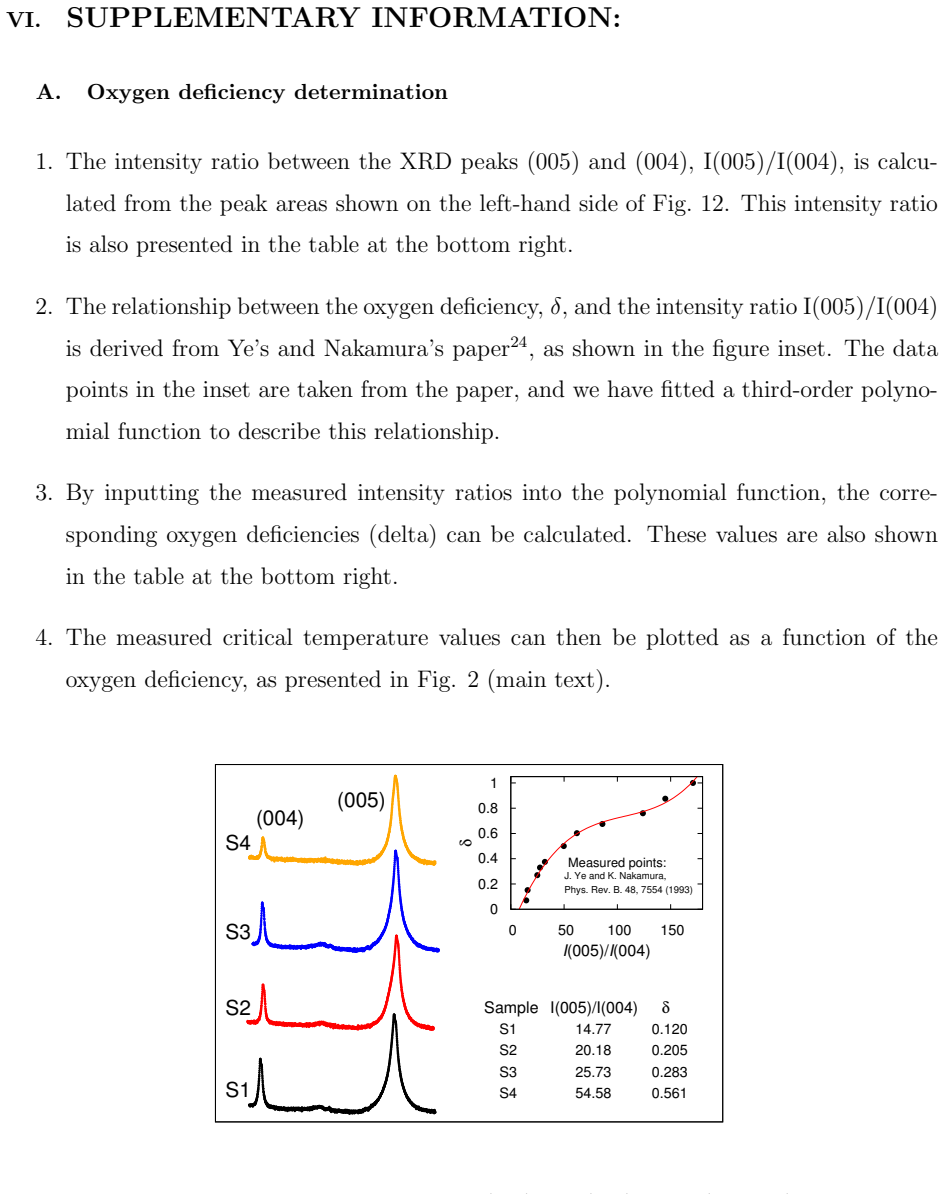
third-order polynomial fit to I(005)/I(004) vs δ from ref. 24
- δ(Tc) interpolated curve =
mean curve from digitized Cava et al. and Jorgensen et al. data (Fig. S4)
assumptions (5)
- domain assumption The Poole-Frenkel model (Eqs. 1-4) with an Arrhenius prefactor describes the interface conduction.
- domain assumption The equivalent circuit of Fig. 1 (PF element in parallel with R_p, in series with R_s) represents the Pt/YBCO interface.
- ad hoc to paper The traps probed by PF emission at the interface arise from bulk oxygen vacancies in YBCO, not from Pt-induced interface states.
- domain assumption The mid-infrared optical absorption peak in oxygen-deficient YBCO is the ionization energy EI of oxygen-vacancy impurity states, and this same energy equals the PF trap energy.
- ad hoc to paper The parameter C follows C ∝ 1/T (Eq. 4) with temperature-independent ε' and d; when it does not (S1, S3, S4), the deviation is attributed to temperature-dependent ε' without independent measurement.
Cite this review
Pith. "Pith review of Electric transport as a probe to unveil microscopic aspects of oxygen-depleted YBCO." pith.science (2026). https://pith.science/paper/2XQYAU7J
@misc{pith2026250116278,
  author       = {Pith},
  title        = {Pith review of: Electric transport as a probe to unveil microscopic aspects of oxygen-depleted YBCO},
  year         = {2026},
  howpublished = {\url{https://pith.science/paper/2XQYAU7J}},
  note         = {Machine review of arXiv:2501.16278}
}
abstract
We report on the characterization of Pt-YBa$_2$Cu$_3$O$_{7-\delta}$ interfaces, focusing on how oxygen vacancies content ($\delta$) affects electrical transport mechanisms. Our study examines four Pt-YBa$_2$Cu$_3$O$_{7-\delta}$ samples with varying $\delta$ (0.12 $\leq \delta \leq$ 0.56) using voltage-current measurements across a temperature range. We successfully model the electrical behavior using a Poole-Frenkel conduction framework, revealing that oxygen vacancies create potential wells that trap carriers, directly influencing conduction. We observe that the energy of these traps increases as $\delta$ rises, in agreement with a peak previously detected in optical conductivity measurements. This result supports earlier interpretations, strengthening the proposed connection between oxygen vacancies and the ionization energy associated with impurity bands in YBa$_2$Cu$_3$O$_{7-\delta}$.
Figures


Figures from the paper (12 more)






Reference graph
Works this paper leans on
-
[1]
J. L. Tallon, Ybco 1, in: A. B. David A. Cardwell, David C. Larbalestier (Ed.), Handbook of Superconductivity, Taylor and Francis Group, Boca Raton, 2023, pp. 2--40, chapter C1
work page 2023
-
[2]
J. D. Jorgensen, B. W. Veal, A. P. Paulikas, L. J. Nowicki, G. W. Crabtree, H. Claus, W. K. Kwok, https://link.aps.org/doi/10.1103/PhysRevB.41.1863 Structural properties of oxygen-deficient YBa _2 Cu _3 O _ 7- , Phys. Rev. B 41 (1990) 1863--1877. https://doi.org/10.1103/PhysRevB.41.1863 doi:10.1103/PhysRevB.41.1863 . ://link.aps.org/doi/10.1103/PhysRevB.41.1863
-
[3]
M. J. Rozenberg, M. J. S\'anchez, R. Weht, C. Acha, F. Gomez-Marlasca, P. Levy, Mechanism for bipolar resistive switching in transition-metal oxides, Phys. Rev. B 81 (2010) 115101
work page 2010
-
[4]
A. Schulman, M. J. Rozenberg, C. Acha, Anomalous time relaxation of the nonvolatile resistive state in bipolar resistive-switching oxide-based memories, Phys. Rev. B 86 (2012) 104426
work page 2012
-
[5]
T. Plecenik, M. Tomasek, M. Belogolovskii, M. Truchl, M. Gregor, J. Noskovic, M. Zahoran, T. Roch, I. Boylo, M. Spankova, S. Chromik, P. Kus, A. Plecenik, Effect of crystallographic anisotropy on the resistance switching phenomenon in perovskites, J. Appl. Phys. 111 (2012) 056106
work page 2012
-
[6]
C. Acha, M. J. Rozenberg, Non-volatile resistive switching in the dielectric superconductor YBa _2 Cu _3 O _ 7- , J. Phys.: Condens. Matter 21 (2009) 045702
work page 2009
-
[7]
C. Acha, Electric pulse-induced resistive switching in ceramic YBa_2Cu_3O_ 7- / Au interfaces, Physica B 404 (2009) 2746
work page 2009
-
[8]
A. Plecenik, M. Tomasek, T. Plecenik, M. Truchly, J. Noskovic, M. Zahoran, T. Rocha, M. Belogolovskii, M. Spankova, S. Chromik, P. Kus, Studies of resistance switching effects in metal/ YBa _2 Cu _3 O _ 7-x interface junctions, Appl. Surface Science 256 (2010) 5684
work page 2010
Show all 36 references
-
[9]
Acha, Dynamical behaviour of the resistive switching in ceramic YBCO /metal interfaces, J.Phys.D: Appl.Phys
C. Acha, Dynamical behaviour of the resistive switching in ceramic YBCO /metal interfaces, J.Phys.D: Appl.Phys. 44 (2011) 345301
2011
-
[10]
Schulman, C
A. Schulman, C. Acha, Cyclic electric field stress on bipolar resistive switching devices, J. Appl. Phys. 114 (2013) 243706
2013
-
[11]
Schulman, C
A. Schulman, C. Acha, MRS Proceedings 1337 (2011) q10--07
2011
-
[12]
Palau, A
A. Palau, A. Fernandez-Rodriguez, J. C. Gonzalez-Rosillo, X. Granados, M. Coll, B. Bozzo, R. Ortega-Hernandez, J. Su \ n \'e , N. Mestres, X. Obradors, T. Puig, Electrochemical tuning of metal insulator transition and non-volatile resistive switching in superconducting films, ...
2018
-
[13]
Alcal \`a , A
J. Alcal \`a , A. Fern \'a ndez-Rodr \' i guez, T. G \"u nkel, A. Barrera, M. Cabero, J. Gazquez, L. Balcells, N. Mestres, A. Palau, Tuning the superconducting performance of YBa _2 Cu _3 O _ 7- films through field-induced oxygen doping, Scientific Reports 14 (2024) 1939. http...
2024 doi
-
[14]
Schulman, L
A. Schulman, L. F. Lanosa, C. Acha, Poole-frenkel effect and variable-range hopping conduction in metal/ YBCO resistive switching devices, Journal of Applied Physics 118 (2015) 044511
2015
-
[15]
Wa\'skiewicz, J
J. Wa\'skiewicz, J. Golebiowski, Resistive memory physical mechanism in a thin-film Ag/YBa _2 Cu _3 O _ 7-x /Ag structure, Przeglad Elektrotechniczny 91 (2015) 313--317
2015
-
[16]
Truchly, T
M. Truchly, T. Plecenik, E. Zhitlukhina, M. Belogolovskii, M. Dvoranova, P. Kus, A. Plecenik, Inverse polarity of the resistive switching effect and strong inhomogeneity in nanoscale ybco-metal contacts, Journal of Applied Physics 120 (18) (2016) 185302. https://doi.org/10.106...
2016 doi
-
[17]
J. Wa\'skiewicz, Measurement of the thickness of the oxygen-depleted layer in the Ag/YBa _2 Cu _3 O _ 7-x /Ag structures of the electro-resistance memory, Przeglad Elektrotechniczny 94 (2018) 99--103
2018
-
[18]
N. A. Tulina, A. N. Rossolenko, I. M. Shmytko, A. A. Ivanov, V. V. Sirotkin, I. Y. Borisenko, V. A. Tulin, Properties of percolation channels in planar memristive structures based on epitaxial films of a YBa _2 Cu _3 O _ 7- high temperature superconductor, Superconductor Scien...
2018 doi
-
[19]
S. M. Sze, K. K. Ng, Physics of Semiconductor Devices, John Wiley & Sons, 2007
2007
-
[20]
Matsushita, T
A. Matsushita, T. Oguchi, K. Kimura, T. Matsumoto, T. Hatano, K. Ogawa, S. Takayanagi, Jap. J. Appl. Phys. 26 (1987) L1953
1987
-
[21]
Palonen, H
H. Palonen, H. Huhtinen, M. Shakhov, P. Paturi, Electron mass anisotropy of BaZrO3 doped YBCO thin films in pulsed magnetic fields up to 30 T , Superconductor Science and Technology 26 (2013) 045003. https://doi.org/10.1088/0953-2048/26/4/045003 doi:10.1088/0953-2048/26/4/045003
2013 doi
-
[22]
a rvi, C. Haalisto, E. M \
M. M. Aye, E. Rivasto, M. Khan, H. Rijckaert, E. Saloj \"a rvi, C. Haalisto, E. M \"a kil \"a , H. Palonen, H. Huhtinen, I. Van Driessche, P. Paturi, Control of the nanosized defect network in superconducting thin films by target grain size, Scientific Reports 11 (03 2021). ht...
2021 doi
-
[23]
M. Khan, E. Rivasto, H. Rijckaert, Y. Zhao, M. Liedke, M. Butterling, A. Wagner, I. Van Driessche, H. Huhtinen, P. Paturi, Strongly enhanced growth of high-temperature superconducting films on an advanced metallic template, Crystal Growth & Design 22 (03 2022). https://doi.org...
2022 doi
-
[24]
J. Ye, K. Nakamura, Quantitative structure analyses of YBa _2 Cu _3 O _ 7- thin films: Determination of oxygen content from x-ray-diffraction patterns, Phys. Rev. B 48 (1993) 7554--7564. https://doi.org/10.1103/PhysRevB.48.7554 doi:10.1103/PhysRevB.48.7554
1993 doi
-
[25]
Acha, Graphical analysis of current-voltage characteristics in memristive interfaces, Journal of Applied Physics 121 (13) (2017) 134502
C. Acha, Graphical analysis of current-voltage characteristics in memristive interfaces, Journal of Applied Physics 121 (13) (2017) 134502
2017
-
[26]
C. Acha, A. Schulman, M. Boudard, K. Daoudi, T. Tsuchiya, Transport mechanism through metal-cobaltite interfaces, Applied Physics Letters 109 (2016) 011603
2016
-
[27]
W. R. Acevedo, C. Acha, M. J. S\'anchez, P. Levy, D. Rubi, Origin of multistate resistive switching in Ti/manganite/SiO _x /Si heterostructures, Applied Physics Letters 110 (2017) 053501
2017
-
[28]
Ghenzi, M
N. Ghenzi, M. Barella, D. Rubi, C. Acha, Adaptive threshold in TiO _2 -based synapses, Journal of Physics D: Applied Physics 52 (12) (2019) 125401. https://doi.org/10.1088/1361-6463/aafdf3 doi:10.1088/1361-6463/aafdf3
2019 doi
-
[29]
L. F. Lanosa, H. Huhtinen, P. Paturi, C. Acha, Electrical conduction mechanisms of metal / high- T _c superconductor ( YBCO ) interfaces, Journal of Physics: Condensed Matter 32 (17) (2020) 175001
2020
-
[30]
R. M. Hill, Poole-frenkel conduction in amorphous solids, The Philosophical Magazine: A Journal of Theoretical Experimental and Applied Physics 23 (181) (1971) 59--86. https://doi.org/10.1080/14786437108216365 doi:10.1080/14786437108216365
1971 doi
-
[31]
Vollmann, Poole-Frenkel conduction in insulators of large impurity densities, Physica Status Solidi (a) 22 (1) (1974) 195--203
W. Vollmann, Poole-Frenkel conduction in insulators of large impurity densities, Physica Status Solidi (a) 22 (1) (1974) 195--203. https://doi.org/10.1002/pssa.2210220122 doi:10.1002/pssa.2210220122
1974 doi
-
[32]
Orenstein, G
J. Orenstein, G. A. Thomas, A. J. Millis, S. L. Cooper, D. H. Rapkine, T. Timusk, L. F. Schneemeyer, J. V. Waszczak, Frequency- and temperature-dependent conductivity in YBa _2 Cu _3 O _ 7- crystals, Phys. Rev. B 42 (1990) 6342--6362. https://doi.org/10.1103/PhysRevB.42.6342 d...
1990 doi
-
[33]
G. A. Thomas, D. H. Rapkine, S. L. Cooper, S.-W. Cheong, A. S. Cooper, L. F. Schneemeyer, J. V. Waszczak, Optical excitations of a few charges in cuprates, Phys. Rev. B 45 (1992) 2474--2479. https://doi.org/10.1103/PhysRevB.45.2474 doi:10.1103/PhysRevB.45.2474
1992 doi
-
[34]
S. L. Cooper, D. Reznik, A. Kotz, M. A. Karlow, R. Liu, M. V. Klein, W. C. Lee, J. Giapintzakis, D. M. Ginsberg, B. W. Veal, A. P. Paulikas, Optical studies of the a-, b-, and c-axis charge dynamics in YBa _2 Cu _3 O _ 6+x , Phys. Rev. B 47 (1993) 8233--8248. https://doi.org/1...
1993 doi
-
[35]
N. F. Mott, Metal-insulator transitions, Taylor & Francis, 1990
1990
-
[36]
R. Cava, A. Hewat, E. Hewat, B. Batlogg, M. Marezio, K. Rabe, J. Krajewski, W. P. Jr., L. R. Jr., Physica C: Superconductivity 165 (1990) 419
1990
Reviewed August 10, 2026 · model on record in the stance chip above.
Discussion (0). Continue with ORCID to comment.