REVIEW 4 major objections 3 minor 103 references
AMICO-WL: an optimal filtering algorithm for galaxy cluster detections with weak lensing
T0 review · 4 major / 3 minor · reviewed 2026-08-10 · deepseek-v4-flash
Pith's one-line read The paper introduces AMICO-WL, an optimal matched-filter cluster detector for weak-lensing data, and shows that cutting foreground galaxies at redshift 0.2 doubles completeness at 70% purity on Euclid-like mock data.
desk verdict A solid, honestly reported matched-filter weak-lensing cluster finder with a clever simulation-side matching tool; the headline completeness gain is real but conditional on exact redshifts and a single mock realization. read the letter →
The pith
A machine-rendered reading of the paper's core claim, the machinery that carries it, and where it could break.
The reading
What carries the argument
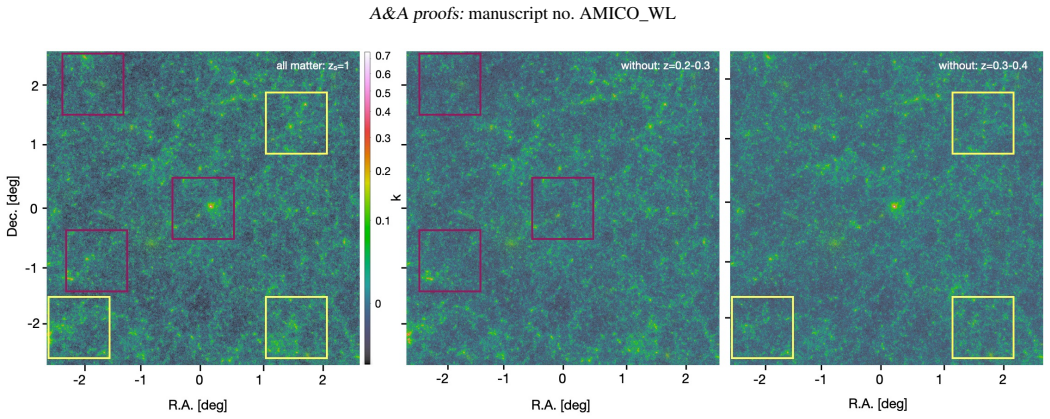
The load-bearing object is the linear optimal matched filter $\Psi$, defined in Fourier space as $\hat{\Psi}(k)\propto \hat{\tau}(k)/P_N(k)$, where $\hat{\tau}$ is the Fourier transform of the assumed Navarro-Frenk-White tangential-shear profile and $P_N=P_\epsilon+P_\gamma$ is the noise power spectrum combining shape noise and the cosmic-shear power spectrum from non-linear structure growth. The filter is applied to the tangential ellipticities of galaxies to build an amplitude map, and detections are peaks in the signal-to-noise map. Around that core the paper adds a foreground-removal redshift cut with re-optimised filter parameters, a signal-to-noise threshold calibrated by comparing positive and negative E-mode peaks so that the desired sample purity can be set in advance, and an iterative cleaning step that subtracts the filtered shear model of each detection before searching for the next peak. Performance is assessed with a lens-plane 'blinking' matching procedure that removes one $\Delta z=0.1$ matter slice at a time, giving each detection a redshift anchor.
What would settle it
Re-run the FR02 and COMPLETE configurations on a mock that assigns photometric-redshift scatter $\sigma_z/(1+z)\simeq 0.05$ to the galaxy redshifts before applying the $z_{\min}=0.2$ cut; if the FR02 completeness advantage over COMPLETE at 70% purity does not remain significant, the headline gain does not transfer to real survey data.
Extended reading notes
Core claim
On the paper's own terms, the discovery is that a simple pre-processing step—cutting every galaxy whose true redshift lies below $z_{\min}$ out of the shear catalogue and re-optimising the filter for the truncated catalogue—transforms a weak-lensing cluster finder into one whose completeness at fixed purity roughly doubles, from 6.5% to 13.0% at 70% purity, while reducing spurious detections. The paper attributes the gain to removing the noise contribution of galaxies in the foreground of the target haloes, whose shapes dilute the tangential-shear signal and add variance to the maps. The paper also introduces a 'blinking' redshift-plane matching procedure that assigns redshift information to weak-lensing detections, shows that matched detections peak at lens redshifts $0.3<z<0.4$ where lensing efficiency is maximum, and classifies the remaining spurious detections into noise fluctuations, chains of low-mass haloes aligned along the line of sight, and structures missed by the reference halo mass cut.
Load-bearing premise
The load-bearing premise is that every galaxy in the input catalogue has an exact, error-free redshift, so the $z_{\min}$ cut cleanly separates foreground from background; the paper states that no photometric-redshift uncertainty is included.
Editorial extensions
If this is right
- At a fixed sample purity of 70%, applying the $z_{\min}=0.2$ foreground cut raises completeness from 6.5% to 13.0% compared with using the full galaxy catalogue.
- The foreground cut also lowers the number of spurious detections: in the paper's taxonomy, non-vanished spurious detections fall from 17 to 6 and non-matched spurious detections from 65 to 42 in the FR02 run.
- At the more conservative 80% purity level the completeness of the four configurations converges, because only the high signal-to-noise peaks from the most massive, best-lensed haloes survive.
- The lens-plane blinking matching shows that detections concentrate at lens redshifts $0.3<z<0.4$, consistent with lensing geometry, and it supplies a redshift estimate that ordinary positional matching cannot give.
Reading between the lines
- A testable extension would rerun the same four configurations on a mock with photometric-redshift scatter $\sigma_z/(1+z)\simeq 0.05$; the completeness gap between FR02 and COMPLETE at fixed purity is likely to shrink once the sharp $z_{\min}=0.2$ boundary is blurred.
- Because the mock neglects source clustering, the shape-noise term $P_\epsilon$ used in the filter and the negative-peak purity calibration may underestimate correlated-noise contamination on real data; adding clustering would quantify this.
- The purity estimator compares positive and negative E-mode peaks and assumes they share the same noise and large-scale-structure statistics; on real data, shear systematics that break E/B symmetry would require external calibration of this estimator.
- The foreground-removal idea could be made redshift-dependent, with a cut threshold matched to each lens plane, which the paper notes as a possible development; this could push the 70%-purity completeness beyond the reported 13%.
Editorial analysis
A structured set of objections, weighed in public.
Referee Report
Summary. The paper introduces AMICO-WL, a weak-lensing extension of the AMICO optimal matched filter code for galaxy cluster detection. The algorithm constructs E-mode and B-mode amplitude maps from galaxy ellipticities, derives SNR thresholds through a comparison of positive and negative E-mode peak statistics, and includes a cleaning procedure to handle blended detections. The method is tested on a 25 deg^2 Euclid-like mock built from the DUSTGRAIN-pathfinder simulation, using four configurations: COMPLETE and three foreground-removed runs (FR02, FR04, FR06) based on redshift cuts at z_min = 0.2, 0.4, 0.6. Detections are matched to haloes with M200 > 5e13 h^-1 Msun using a new 'blinking' procedure that removes individual redshift slices to infer the redshift of the lensing signal. The headline result is that, at ~70% purity, the FR02 run achieves 13.0% completeness versus 6.5% for the COMPLETE run, with a concurrent reduction in spurious detections.
Significance. If the headline result is robust, AMICO-WL provides a practical, well-tested weak-lensing cluster finder for Euclid, building on the established AMICO infrastructure and adding a principled SNR-threshold calibration and a novel matching technique for simulation validation. The paper is transparent about its mock assumptions and includes a careful spurious-detection taxonomy. Strengths include the use of the standard optimal filter formalism, the B-mode consistency check, the support for the matching procedure provided by the positional scatter distribution in Fig. 12, and the detailed analysis of the origin of false positives. The main risk is that the quantitative performance claims are derived under idealized assumptions—exact redshifts and no source clustering—that may not transfer to real Euclid data, and the absence of any uncertainty estimates makes it difficult to judge the significance of the reported factor-of-two gain.
major comments (4)
- [Sect. 3 and Sect. 4.2] The headline result (6.5% to 13.0% completeness at ~70% purity) rests on the FR02 configuration, which applies a hard redshift cut at z_min = 0.2 using the true redshifts of the mock galaxies. The manuscript states in Sect. 3 that 'we do not consider any photometric redshift uncertainty in our analysis.' Real Euclid photo-z errors, with typical scatter around sigma_z ~ 0.05(1+z), will scatter galaxies across this boundary, blurring the foreground/background separation, modifying the effective source density entering Eq. (26), and changing the LSS noise contribution in Eq. (28). This is a load-bearing simplification for the quantitative headline, and the paper should either include a photo-z error model or explicitly frame the factor-of-two gain as an idealized proof of concept rather than a Euclid-ready performance prediction.
- [Sect. 3 and Sect. 5.2] The mock galaxies are 'randomly distribute[d] in the map, neglecting source clustering.' The filter noise model (Eqs. 24-25) and the purity calibration based on positive/negative E-mode peak statistics (Eq. 29) assume uncorrelated shape noise and Gaussian LSS statistics. Source clustering introduces correlations in the noise field and in the peak counts, which can bias the SNR thresholds and the purity estimates. Since the paper claims the thresholding method sets a desired sample purity, a quantitative test of the sensitivity to source clustering (e.g., a clustered or log-normal source catalogue) is needed to support the validity of the purity calibration for survey-like data.
- [Table 2 and Sect. 6.2] The completeness and purity values are quoted without uncertainties, and all numbers come from a single 25 deg^2 mock field. In the '~70% PUR' rows of Table 2, the measured purity is not reported, only the SNR threshold, number of detections, and completeness. Because the Eq. (29) calibration is imperfect (the TOTAL row shows predicted 70% purity yielding measured purities of 61%, 71%, 64%, and 61% for COMPLETE, FR02, FR04, and FR06, respectively), the reader cannot verify that the headline 6.5% versus 13.0% comparison is actually at matched measured purity. The authors should report the measured purity in every row and provide error estimates, such as jackknife over subfields or field-to-field variance, for the completeness and purity values that support the central claim.
- [Sect. 5.2, Eq. (29)] The purity calibration of Eq. (29) assumes that negative E-mode peaks follow the same noise statistics as positive peaks except for the absence of cluster signals. The measured purities in the TOTAL row of Table 2 deviate from the predicted 70% by up to 9 percentage points for the COMPLETE, FR04, and FR06 runs, showing that the calibration is not accurate across configurations. This discrepancy indicates that the symmetry between positive and negative peaks is not fully realized in the simulations, and it directly affects the reliability of the SNR thresholds used to define the operating points. The calibration should be validated per configuration, or the paper should base its purity-matched comparison entirely on the measured purity rather than the predicted value.
minor comments (3)
- [Sect. 2.2, Eq. (20)] The notation 'averageb' appears to be a typo for 'average b', and the sentence defining the bias term is confusing; please clarify that b is the bias of the estimator and that the constraint in Eq. (20) is imposed to make it zero.
- [Table 1] The parameter 'white noise N_epsilon' is not defined in the table caption; please specify whether it corresponds to the power spectrum P_epsilon of Eq. (24) or to its square root, and give its units.
- [Sect. 7] There are typographical issues in phrases such as 'lineofsight' appearing in the text; please correct these to 'line-of-sight' throughout.
Circularity Check
No circularity: the headline completeness and purity numbers are measured against an external halo catalogue, and the purity estimator of Eq. (29) is falsifiable (it fails for COMPLETE).
full rationale
The derivation chain is self-contained with respect to the paper's headline claims. The matched filter is derived in Eqs. (18)-(22) inside the paper, so the citations to Maturi et al. (2005, 2007) are provenance for a standard optimal-filter construction rather than an unverified premise. The purity control of Eq. (29) is an estimator based on the symmetry of positive and negative E-mode noise peaks, and it is not self-fulfilling because it is independently checked: for the COMPLETE run, the predicted 70% purity threshold yields a measured purity of only 61% (Table 2), so the estimator is falsifiable and does not reduce to its own definition. Completeness and purity in Sect. 6 are measured by cross-matching detections to the simulation halo catalogue through the lens-plane 'blinking' procedure, which is an external ground truth independent of the filter template. The foreground-removal gain (6.5% to 13.0% at roughly 70% purity) is an empirical comparison of measured completeness at calibrated thresholds, not a fitted parameter renamed as a prediction. The acknowledged simplifications, exact redshifts and neglected source clustering (Sect. 3), limit transferability to Euclid but do not make any equation reduce to its input. Self-citations are present, for the AMICO code and for the matched filter, but they are not load-bearing: the AMICO code was externally validated in the Euclid Cluster Finder Challenge, and the filter construction is reproduced in this paper. I therefore find no circular step.
Assumptions & free parameters
free parameters (7)
- Template halo mass M_l =
1e15 h^-1 M_sun (all runs)
- Template lens redshift z_l =
0.4 (COMPLETE), 0.2 (FR02), 0.4 (FR04), 0.6 (FR06)
- Template source redshift z_s =
0.93, 0.98, 1.06, 1.18
- Foreground removal redshift cuts z_min =
0.2, 0.4, 0.6
- Blinking matching radii =
0.6 arcmin (vanished matching), 3 arcmin (halo matching)
- Target sample purity for thresholding =
70% (also 80%)
- Lens plane slice thickness =
Delta z = 0.1
assumptions (6)
- domain assumption The weak lensing signal of a cluster is well described by an NFW shear profile with the adopted concentration.
- domain assumption Negative E-mode peaks are generated only by noise and LSS underdensities, never by clusters.
- domain assumption Background source redshifts are known exactly; no photometric redshift uncertainty.
- domain assumption Source galaxies are unclustered; they are randomly distributed in the map.
- domain assumption Each halo's lensing signal is localized to a single Delta z = 0.1 lens plane, so removing that plane makes a true detection vanish.
- domain assumption Born approximation and multi-plane ray tracing through 27 lens planes accurately reproduce weak lensing in the light-cone.
Cite this review
Pith. "Pith review of AMICO-WL: an optimal filtering algorithm for galaxy cluster detections with weak lensing." pith.science (2026). https://pith.science/paper/2XXYJU66
@misc{pith2026250116420,
  author       = {Pith},
  title        = {Pith review of: AMICO-WL: an optimal filtering algorithm for galaxy cluster detections with weak lensing},
  year         = {2026},
  howpublished = {\url{https://pith.science/paper/2XXYJU66}},
  note         = {Machine review of arXiv:2501.16420}
}
abstract
The detection of galaxy clusters, the most massive bounded structures in the universe, is crucial for cosmological analysis. Weak lensing signals allow us to track the distribution of all (dark and baryonic) matter regardless of its observable electromagnetic properties. Upcoming wide-field surveys like Euclid and LSST-Rubin will provide enhanced shape measurements of billions of background galaxies, presenting an unparalleled opportunity to detect galaxy clusters on a vast cosmic scale. The immense data volume generated by these surveys will require efficient and accurate analysis techniques. In this work, we introduce AMICO-WL, an extension of the optimal filtering algorithm implemented in AMICO, a well-tested code developed for optical cluster detection. AMICO-WL implements a specific linear optimal matched filter for weak lensing data in the AMICO infrastructure, using parallelisation and adding an efficient signal-to-noise ratio thresholding approach to set a desired sample purity and a cleaning procedure to deal with blended detections. The algorithm has been tested on a 25 deg$^2$ field of Euclid-like mock galaxy catalogue with the simulated shear signal produced using DUSTGRAIN-$pathfinder$ past-light-cones. We implemented a foreground removal procedure based on different cuts of low redshift galaxies from the input catalogue. To evaluate the performance of the method, we used an efficient matching procedure based on the 'blinking' of the simulation's individual redshift lensing planes. Cross-matching the AMICO-WL detections with the dark matter halo sample in the simulation having $M_{200} > 5 \times 10^{13}$ $M_{\odot}/h$ and considering a purity level of $\sim70\%$, the application of the foreground removal doubles the completeness from $6.5\%$ to $13.0\%$ and at the same time produces a significant decrease of spurious detections.
Figures


Figures from the paper (11 more)


Reference graph
Works this paper leans on
-
[1]
2011, Astronomy & Astro- physics, 536, A9
Aghanim, N., Arnaud, M., Ashdown, M., et al. 2011, Astronomy & Astro- physics, 536, A9
2011
-
[2]
2020, Journal of Cosmology and As- troparticle Physics, 2020, 047
Aiola, S., Calabrese, E., Maurin, L., et al. 2020, Journal of Cosmology and As- troparticle Physics, 2020, 047
2020
-
[3]
W., Evrard, A
Allen, S. W., Evrard, A. E., & Mantz, A. B. 2011, ARA&A, 49, 409
2011
-
[4]
& Bergé, J
Andreon, S. & Bergé, J. 2012, A&A, 547, A117
2012
-
[5]
2009, Astronomy & Astro- physics, 507, 147
Andreon, S., Maughan, B., Trinchieri, G., & Kurk, J. 2009, Astronomy & Astro- physics, 507, 147
2009
-
[6]
& Moretti, A
Andreon, S. & Moretti, A. 2011, Astronomy & Astrophysics, 536, A37
2011
-
[7]
2024, Astronomy & Astrophysics, 686, A284
Andreon, S., Trinchieri, G., & Moretti, A. 2024, Astronomy & Astrophysics, 686, A284
2024
-
[8]
& Schneider, P
Bartelmann, M. & Schneider, P. 2001, Physics Reports, 340, 291
2001
Show all 103 references
-
[9]
2011, Monthly Notices of the Royal Astronomical Society, 413, 1145
Bellagamba, F., Maturi, M., Hamana, T., et al. 2011, Monthly Notices of the Royal Astronomical Society, 413, 1145
2011
-
[10]
2018, Monthly Notices of the Royal Astronomical Society, 473, 5221
Bellagamba, F., Roncarelli, M., Maturi, M., & Moscardini, L. 2018, Monthly Notices of the Royal Astronomical Society, 473, 5221
2018
-
[11]
& Arnouts, S
Bertin, E. & Arnouts, S. 1996, Astronomy and astrophysics supplement series, 117, 393
1996
-
[12]
2020, The Astrophysical Journal Sup- plement Series, 247, 25
Bleem, L., Bocquet, S., Stalder, B., et al. 2020, The Astrophysical Journal Sup- plement Series, 247, 25
2020
-
[13]
2015, The Astrophysical Journal Sup- plement Series, 216, 27 Böhringer, H., Schuecker, P., Guzzo, L., et al
Bleem, L., Stalder, B., De Haan, T., et al. 2015, The Astrophysical Journal Sup- plement Series, 216, 27 Böhringer, H., Schuecker, P., Guzzo, L., et al. 2001, Astronomy & Astrophysics, 369, 826
2015
-
[14]
2012, MNRAS, 427, 3134
Boldrin, M., Giocoli, C., Meneghetti, M., & Moscardini, L. 2012, MNRAS, 427, 3134
2012
-
[15]
2016, MNRAS, 457, 2738
Boldrin, M., Giocoli, C., Meneghetti, M., et al. 2016, MNRAS, 457, 2738
2016
-
[16]
2022, Astronomy & Astro- physics, 667, A52 4 https://www.lsst.org/
Castignani, G., Radovich, M., Combes, F., et al. 2022, Astronomy & Astro- physics, 667, A52 4 https://www.lsst.org/
2022
-
[17]
2023, Astronomy and Astro- physics, 672, A139
Castignani, G., Radovich, M., Combes, F., et al. 2023, Astronomy and Astro- physics, 672, A139
2023
-
[18]
2018, MNRAS, 478, 1305
Castro, T., Quartin, M., Giocoli, C., Borgani, S., & Dolag, K. 2018, MNRAS, 478, 1305
2018
-
[19]
2019, Monthly Notices of the Royal Astronomical Society, 488, 4779
Costanzi, M., Rozo, E., Simet, M., et al. 2019, Monthly Notices of the Royal Astronomical Society, 488, 4779
2019
-
[20]
S., & White, S
Davis, M., Efstathiou, G., Frenk, C. S., & White, S. D. 1985, Astrophysical Jour- nal, Part 1 (ISSN 0004-637X), vol. 292, May 15, 1985, p. 371-394. Research supported by the Science and Engineering Research Council of England and NASA., 292, 371 De Jong, J. T., Kleijn, G. A. V...
1985
-
[21]
& Hartlap, J
Dietrich, J. & Hartlap, J. 2010, Monthly Notices of the Royal Astronomical So- ciety, 402, 1049
2010
-
[22]
2009, MNRAS, 399, 497
Dolag, K., Borgani, S., Murante, G., & Springel, V . 2009, MNRAS, 399, 497
2009
-
[23]
1980, Astrophysical Journal, Part 1, vol
Dressler, A. 1980, Astrophysical Journal, Part 1, vol. 236, Mar. 1, 1980, p. 351- 365., 236, 351
1980
-
[24]
2011, Astronomy & Astrophysics, 526, A79
Eckert, D., Molendi, S., & Paltani, S. 2011, Astronomy & Astrophysics, 526, A79
2011
-
[25]
R., Brodwin, M., Gonzalez, A
Eisenhardt, P. R., Brodwin, M., Gonzalez, A. H., et al. 2008, The Astrophysical Journal, 684, 905 Euclid Collaboration: Adam, R., Vannier, M., et al. 2019, A&A, 627, A23 Euclid Collaboration: Giocoli, C., Meneghetti, M., et al. 2024, A&A, 681, A67 Euclid Collaboration: Scarame...
2008
-
[26]
2010, The Astrophysical Journal, 719, 1408
Fan, Z., Shan, H., & Liu, J. 2010, The Astrophysical Journal, 719, 1408
2010
-
[27]
2011, PhD thesis, UCL (University College London)
Farrens, S. 2011, PhD thesis, UCL (University College London)
2011
-
[28]
& Soucail, G
Gavazzi, R. & Soucail, G. 2007, Astronomy & Astrophysics, 462, 459
2007
-
[29]
R., Leauthaud, A., Bundy, K., et al
George, M. R., Leauthaud, A., Bundy, K., et al. 2011, The Astrophysical Journal, 742, 125
2011
-
[30]
2024, arXiv preprint arXiv:2402.08458
Ghirardini, V ., Bulbul, E., Artis, E., et al. 2024, arXiv preprint arXiv:2402.08458
2024 arXiv
-
[31]
G., Gladders, M., Yee, H., & Hsieh, B
Gilbank, D. G., Gladders, M., Yee, H., & Hsieh, B. 2011, The Astronomical Journal, 141, 94
2011
-
[32]
2021, Astronomy & Astrophysics, 653, A19
Giocoli, C., Marulli, F., Moscardini, L., et al. 2021, Astronomy & Astrophysics, 653, A19
2021
-
[33]
B., Baldi, M., et al
Giocoli, C., Metcalf, R. B., Baldi, M., et al. 2015, MNRAS, 452, 2757
2015
-
[34]
Giocoli, C., Moscardini, L., Baldi, M., Meneghetti, M., & Metcalf, R. B. 2018b, MNRAS[arXiv:1801.01886]
-
[35]
2012, Monthly Notices of the Royal Astronomical Society, 425, 2287
Hamana, T., Oguri, M., Shirasaki, M., & Sato, M. 2012, Monthly Notices of the Royal Astronomical Society, 425, 2287
2012
-
[36]
2020, Publications of the Astronomical Society of Japan, 72, 78
Hamana, T., Shirasaki, M., & Lin, Y .-T. 2020, Publications of the Astronomical Society of Japan, 72, 78
2020
-
[37]
2004, Monthly Notices of the Royal Astronomical Society, 350, 893
Hamana, T., Takada, M., & Yoshida, N. 2004, Monthly Notices of the Royal Astronomical Society, 350, 893
2004
-
[38]
A., et al
Hasselfield, M., Hilton, M., Marriage, T. A., et al. 2013, Journal of Cosmology and Astroparticle Physics, 2013, 008
2013
-
[39]
Hennawi, J. F. & Spergel, D. N. 2005, The Astrophysical Journal, 624, 59
2005
-
[40]
2005, Astronomy & Astro- physics, 442, 43
Hetterscheidt, M., Erben, T., Schneider, P., et al. 2005, Astronomy & Astro- physics, 442, 43
2005
-
[41]
2020, MNRAS, 493, 305
Hilbert, S., Barreira, A., Fabbian, G., et al. 2020, MNRAS, 493, 305
2020
-
[42]
2022, Monthly Notices of the Royal Astronomical Society, 511, 1484
Ingoglia, L., Covone, G., Sereno, M., et al. 2022, Monthly Notices of the Royal Astronomical Society, 511, 1484
2022
-
[43]
2004, Monthly Notices of the Royal Astro- nomical Society, 352, 338
Jarvis, M., Bernstein, G., & Jain, B. 2004, Monthly Notices of the Royal Astro- nomical Society, 352, 338
2004
-
[44]
1999, The Astrophysical Journal, 517, 78
Kepner, J., Fan, X., Bahcall, N., et al. 1999, The Astrophysical Journal, 517, 78
1999
-
[45]
P., McKay, T
Koester, B. P., McKay, T. A., Annis, J., et al. 2007, The Astrophysical Journal, 660, 239
2007
-
[46]
2021, Astronomy & Astro- physics, 652, A12
Koulouridis, E., Clerc, N., Sadibekova, T., et al. 2021, Astronomy & Astro- physics, 652, A12
2021
-
[47]
2017, Astron- omy & Astrophysics, 604, A54
Kuchner, U., Ziegler, B., Verdugo, M., Bamford, S., & Häußler, B. 2017, Astron- omy & Astrophysics, 604, A54
2017
-
[48]
2011, arXiv preprint arXiv:1110.3193
Laureijs, R., Amiaux, J., Arduini, S., et al. 2011, arXiv preprint arXiv:1110.3193
2011 arXiv
-
[49]
2007, The Astrophysical Journal Supplement Series, 172, 219
Leauthaud, A., Massey, R., Kneib, J.-P., et al. 2007, The Astrophysical Journal Supplement Series, 172, 219
2007
-
[50]
2000, Astrophys
Lewis, A., Challinor, A., & Lasenby, A. 2000, Astrophys. J., 538, 473
2000
-
[51]
2016, Astronomy & Astrophysics, 593, A88
Lin, C.-A., Kilbinger, M., & Pires, S. 2016, Astronomy & Astrophysics, 593, A88
2016
-
[52]
2018, Astronomy & Astro- physics, 620, A1
Marulli, F., Veropalumbo, A., Sereno, M., et al. 2018, Astronomy & Astro- physics, 620, A1
2018
-
[53]
2019, Monthly Notices of the Royal Astronomical Society, 485, 498
Maturi, M., Bellagamba, F., Radovich, M., et al. 2019, Monthly Notices of the Royal Astronomical Society, 485, 498
2019
-
[54]
2023, Astronomy & Astrophysics, 678, A145 Article number, page 16 of 17 Trobbiani et al.: AMICO-WL, detecting clusters via weak gravitational lensing
Maturi, M., Finoguenov, A., Lopes, P., et al. 2023, Astronomy & Astrophysics, 678, A145 Article number, page 16 of 17 Trobbiani et al.: AMICO-WL, detecting clusters via weak gravitational lensing
2023
-
[55]
2005, Astronomy & Astrophysics, 442, 851
Maturi, M., Meneghetti, M., Bartelmann, M., Dolag, K., & Moscardini, L. 2005, Astronomy & Astrophysics, 442, 851
2005
-
[56]
2007, Astronomy & Astrophysics, 462, 473
Maturi, M., Schirmer, M., Meneghetti, M., Bartelmann, M., & Moscardini, L. 2007, Astronomy & Astrophysics, 462, 473
2007
-
[57]
2024, arXiv preprint arXiv:2405.13491
Mellier, Y ., Barroso, J., Achúcarro, A., et al. 2024, arXiv preprint arXiv:2405.13491
2024
-
[58]
S., et al
Miyazaki, S., Hamana, T., Ellis, R. S., et al. 2007, The Astrophysical Journal, 669, 714
2007
-
[59]
2002, The Astrophysical Journal, 580, L97
Miyazaki, S., Hamana, T., Shimasaku, K., et al. 2002, The Astrophysical Journal, 580, L97
2002
-
[60]
2018, Publications of the Astronom- ical Society of Japan, 70, S27
Miyazaki, S., Oguri, M., Hamana, T., et al. 2018, Publications of the Astronom- ical Society of Japan, 70, S27
2018
-
[61]
Navarro, J. F. 1996, in Symposium-international astronomical union, V ol. 171, Cambridge University Press, 255–258
1996
-
[62]
F., Hayashi, E., Power, C., et al
Navarro, J. F., Hayashi, E., Power, C., et al. 2004, Monthly Notices of the Royal Astronomical Society, 349, 1039
2004
-
[63]
2021, Publications of the Astronomical Society of Japan, 73, 817
Oguri, M., Miyazaki, S., Li, X., et al. 2021, Publications of the Astronomical Society of Japan, 73, 817
2021
-
[64]
2016, Astronomy & Astrophysics, 592, A2
Pacaud, F., Clerc, N., Giles, P., et al. 2016, Astronomy & Astrophysics, 592, A2
2016
-
[65]
2007, Astronomy & Astrophysics, 471, 731
Pace, F., Maturi, M., Meneghetti, M., et al. 2007, Astronomy & Astrophysics, 471, 731
2007
-
[66]
2011, As- tronomy & Astrophysics, 534, A109
Piffaretti, R., Arnaud, M., Pratt, G., Pointecouteau, E., & Melin, J.-B. 2011, As- tronomy & Astrophysics, 534, A109
2011
-
[67]
2020, Astronomy & Astrophysics, 638, A141 Planck Collaboration, Adam, R., Ade, P
Pires, S., Vandenbussche, V ., Kansal, V ., et al. 2020, Astronomy & Astrophysics, 638, A141 Planck Collaboration, Adam, R., Ade, P. A. R., et al. 2015, ArXiv e-prints: 1502.01582 [arXiv:1502.01582] Planck Collaboration, Ade, P. A. R., Aghanim, N., et al. 2011, A&A, 536, A1
2020 arXiv
-
[68]
2021, Astronomy & Astrophysics, 645, A9 Pyne III, E
Puddu, E., Radovich, M., Sereno, M., et al. 2021, Astronomy & Astrophysics, 645, A9 Pyne III, E. W. 1995, Null geodesics in perturbed spacetimes (Harvard Univer- sity)
2021
-
[69]
2020, Monthly Notices of the Royal Astronomical Society, 498, 4303
Radovich, M., Tortora, C., Bellagamba, F., et al. 2020, Monthly Notices of the Royal Astronomical Society, 498, 4303
2020
-
[70]
2001, Astronomy & Astro- physics, 368, 776
Ramella, M., Boschin, W., Fadda, D., & Nonino, M. 2001, Astronomy & Astro- physics, 368, 776
2001
-
[71]
2014, The Astrophysical Jour- nal, 797, 109
Rettura, A., Martinez-Manso, J., Stern, D., et al. 2014, The Astrophysical Jour- nal, 797, 109
2014
-
[72]
2024, Astronomy & Astro- physics, 682, A72
Romanello, M., Marulli, F., Moscardini, L., et al. 2024, Astronomy & Astro- physics, 682, A72
2024
-
[73]
2007, MNRAS, 378, 1259
Roncarelli, M., Moscardini, L., Borgani, S., & Dolag, K. 2007, MNRAS, 378, 1259
2007
-
[74]
2002, Annual Review of Astronomy and Astrophysics, 40, 539
Rosati, P., Borgani, S., & Norman, C. 2002, Annual Review of Astronomy and Astrophysics, 40, 539
2002
-
[75]
H., Rykoff, E
Rozo, E., Wechsler, R. H., Rykoff, E. S., et al. 2010, ApJ, 708, 645
2010
-
[76]
2014, The Astrophysical Journal, 785, 104
Rykoff, E., Rozo, E., Busha, M., et al. 2014, The Astrophysical Journal, 785, 104
2014
-
[77]
2024, Astronomy & Astrophysics, 688, A187
Sadibekova, T., Arnaud, M., Pratt, G., Tarrío, P., & Melin, J.-B. 2024, Astronomy & Astrophysics, 688, A187
2024
-
[78]
2018, Astronomy & Astro- physics, 613, A67
Sarron, F., Martinet, N., Durret, F., & Adami, C. 2018, Astronomy & Astro- physics, 613, A67
2018
-
[79]
2011, The Astrophysical Journal, 743, 90
Schaffer, K., Crawford, T., Aird, K., et al. 2011, The Astrophysical Journal, 743, 90
2011
-
[80]
2007, Astronomy & Astrophysics, 462, 875
Schirmer, M., Erben, T., Hetterscheidt, M., & Schneider, P. 2007, Astronomy & Astrophysics, 462, 875
2007
-
[81]
2004, As- tronomy & Astrophysics, 420, 75
Schirmer, M., Erben, T., Schneider, P., Wolf, C., & Meisenheimer, K. 2004, As- tronomy & Astrophysics, 420, 75
2004
-
[82]
1996, Monthly Notices of the Royal Astronomical Society, 283, 837
Schneider, P. 1996, Monthly Notices of the Royal Astronomical Society, 283, 837
1996
-
[83]
E., et al
Schneider, P., Ehlers, J., Falco, E. E., et al. 1992, Gravitational Lenses, 157
1992
-
[84]
1998, Monthly Notices of the Royal Astronomical Society, 296, 873
Schneider, P., Van Waerbeke, L., Jain, B., & Kruse, G. 1998, Monthly Notices of the Royal Astronomical Society, 296, 873
1998
-
[85]
2002, Astronomy & Astrophysics, 396, 1
Schneider, P., van Waerbeke, L., Kilbinger, M., & Mellier, Y . 2002, Astronomy & Astrophysics, 396, 1
2002
-
[86]
2015, Monthly Notices of the Royal Astronomical Society, 454, 1432
Schrabback, T., Hilbert, S., Hoekstra, H., et al. 2015, Monthly Notices of the Royal Astronomical Society, 454, 1432
2015
-
[87]
F., et al
Schrabback, T., Schirmer, M., van Der Burg, R. F., et al. 2018, Astronomy & Astrophysics, 610, A85
2018
-
[88]
2024, Astronomy & Astrophysics, 686, A196
Seppi, R., Comparat, J., Ghirardini, V ., et al. 2024, Astronomy & Astrophysics, 686, A196
2024
-
[89]
2012, The Astrophysical Journal, 748, 56
Shan, H., Kneib, J.-P., Tao, C., et al. 2012, The Astrophysical Journal, 748, 56
2012
-
[90]
2018, Monthly Notices of the Royal Astronomical Society, 474, 1116
Shan, H., Liu, X., Hildebrandt, H., et al. 2018, Monthly Notices of the Royal Astronomical Society, 474, 1116
2018
-
[91]
E., Peacock, J
Smith, R. E., Peacock, J. A., Jenkins, A., et al. 2003, MNRAS, 341, 1311
2003
-
[92]
Springel, V ., White, S. D. M., Tormen, G., & Kau ffmann, G. 2001, MNRAS, 328, 726
2001
-
[93]
2012, ApJ, 761, 152
Takahashi, R., Sato, M., Nishimichi, T., Taruya, A., & Oguri, M. 2012, ApJ, 761, 152
2012
-
[94]
& Fan, Z
Tang, J. & Fan, Z. 2005, The Astrophysical Journal, 635, 60
2005
-
[95]
A., Metcalf, R
Tessore, N., Winther, H. A., Metcalf, R. B., Ferreira, P. G., & Giocoli, C. 2015, J. Cosmology Astropart. Phys., 10, 036
2015
-
[96]
2021, Physical review letters, 126, 141301
To, C., Krause, E., Rozo, E., et al. 2021, Physical review letters, 126, 141301
2021
-
[97]
2024, Astronomy & Astrophysics, 687, A56
Toni, G., Maturi, M., Finoguenov, A., Moscardini, L., & Castignani, G. 2024, Astronomy & Astrophysics, 687, A56
2024
-
[98]
2020, The Astronomy and Astrophysics Review, 28, 1
Umetsu, K. 2020, The Astronomy and Astrophysics Review, 28, 1
2020
-
[99]
2014, Monthly Notices of the Royal Astronomical Society, 442, 3275
Veropalumbo, A., Marulli, F., Moscardini, L., Moresco, M., & Cimatti, A. 2014, Monthly Notices of the Royal Astronomical Society, 442, 3275
2014
-
[100]
2009, The Astrophysical Journal, 692, 1060
Vikhlinin, A., Kravtsov, A., Burenin, R., et al. 2009, The Astrophysical Journal, 692, 1060
2009
-
[101]
2023, Monthly Notices of the Royal Astronomical Society, 519, 2630
Werner, S., Cypriano, E., Gonzalez, A., et al. 2023, Monthly Notices of the Royal Astronomical Society, 519, 2630
2023
-
[102]
2002, The Astrophysical Journal, 575, 640
White, M., van Waerbeke, L., & Mackey, J. 2002, The Astrophysical Journal, 575, 640
2002
-
[103]
2006, The Astrophysical Journal, 643, 128 Article number, page 17 of 17
Wittman, D., Dell’Antonio, I., Hughes, J., et al. 2006, The Astrophysical Journal, 643, 128 Article number, page 17 of 17
2006
Reviewed August 10, 2026 · model on record in the stance chip above.
Discussion (0). Continue with ORCID to comment.