RoofNet: A Global Multimodal Dataset for Roof Material Identification from Earth Observation
Pith reviewed 2026-05-19 12:50 UTC · model grok-4.3
The pith
RoofNet supplies over 51,500 satellite images labeled with 14 roof materials from 184 diverse global locations.
A machine-rendered reading of the paper's core claim, the machinery that carries it, and where it could break.
Core claim
The central claim is that RoofNet constitutes the largest and most geographically diverse multimodal dataset for roof material classification, with more than 51,500 samples drawn from 184 sites around the world, each combining Earth Observation imagery and curated annotations for 14 roofing types, created to support vision-language modeling and improve the accuracy of global building exposure data.
What carries the argument
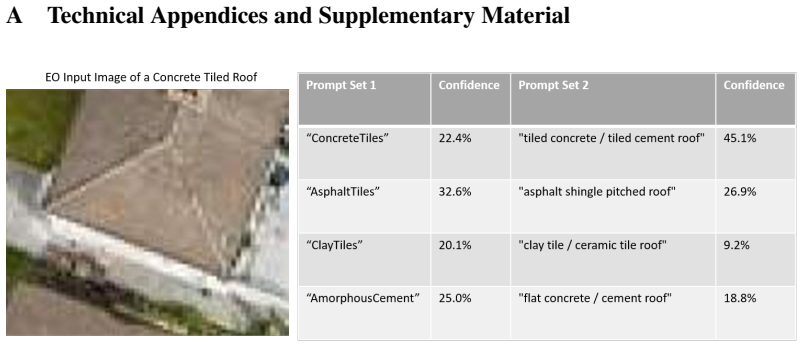
The key mechanism is the process of geographic sampling from climatically and architecturally distinct regions, expert annotation of 6,000 images, application of geographic- and material-aware prompt tuning to a vision-language model, and subsequent rule-based and human-in-the-loop verification to generate labels and additional metadata for the full set of tiles.
If this is right
- Improved modeling of building vulnerability to natural hazards becomes possible with better roof material data.
- Vision-language models can be trained more effectively on global roof classification tasks.
- Global exposure datasets gain higher fidelity through the inclusion of this labeled imagery and metadata.
- Additional attributes like roof shape, area, solar panel presence, and mixed materials are available for each sample.
Where Pith is reading between the lines
- Such a dataset could allow researchers to track roof material changes over time by comparing images from different years.
- Integration into disaster simulation tools might refine estimates of economic losses from future events.
- Similar approaches could be applied to classify other building components, such as foundations or walls, using satellite data.
Load-bearing premise
The selection of 184 sites from climatically and architecturally distinct regions creates a representative sample of global roof materials, and the combination of expert annotations with rule-based and human verification produces accurate labels free from major bias.
What would settle it
Ground surveys or independent high-resolution inspections in several of the sampled sites that reveal a substantially different distribution of the 14 roof material types than what the dataset reports.
Figures



read the original abstract
Building-level exposure data are critical to natural hazard risk modeling, yet most global inventories describe where buildings are located rather than what they are made of. Roof material is a critical but poorly documented attribute for assessing vulnerability to wildfires, wind hazards, urban heat, floods, and earthquakes. To address this gap, we introduce RoofNet, a global dataset that maps 49,662 georeferenced building instances from 101 countries to 14 key roofing material classes using Earth observation (EO) imagery (redistributed where permitted) and associated geospatial metadata. RoofNet contributes (1) climatographically and architecturally diverse coverage of roof material labels, (2) a scalable annotation pipeline combining SME-guided manual labeling with vision-language model (VLM)-assisted classification, rule-based validation, and human-in-the-loop verification, and (3) a resource for evaluating subtle, geographically variable material-level identification in EO imagery and its implications for material-aware hazard risk modeling. Evaluation on a manually labeled hold-out set shows that zero-shot Remote Contrastive Language-Image Pre-Training (RemoteCLIP) struggles with roof material classification, while fine-tuning with RoofNet improves top-1 accuracy from 4.9% to 47.7%. We use RoofNet in an illustrative hazard case study to demonstrate how material-aware exposure data can change vulnerability estimates relative to material-naive inventories. RoofNet provides a missing material layer for global building attribute mapping and scalable hazard risk assessment.
Editorial analysis
A structured set of objections, weighed in public.
Referee Report
Summary. The manuscript introduces RoofNet as the largest and most geographically diverse multimodal dataset for roof material classification, comprising over 51,500 samples from 184 sites that pair high-resolution Earth Observation imagery with curated text annotations for 14 roofing types. It describes sampling EO tiles from climatically and architecturally distinct regions, expert annotation of a 6,000-image subset, fine-tuning a vision-language model via geographic- and material-aware prompt tuning, and subsequent application with rule-based and human-in-the-loop verification. The work also provides rich metadata including roof shape, footprint area, solar panel presence, and mixed-material indicators. The abstract explicitly states that the dataset used in earlier experiments has been removed due to licensing constraints on imagery sources, with updated experiments using compliant data stated to be in progress.
Significance. If a fully compliant and accessible version of the dataset were released with verified results, RoofNet would offer a substantial contribution to global building exposure datasets for natural hazard modeling. Its scale, geographic diversity across 184 sites, and multimodal design supporting vision-language models could improve fidelity in vulnerability assessments for earthquakes, floods, wildfires, and hurricanes, while the additional metadata would enable more granular analyses.
major comments (2)
- [Abstract] Abstract: The explicit statement that 'The dataset used in earlier experiments has been removed due to licensing constraints related to imagery sources' and that 'Results based on this dataset should be interpreted with caution' with 'Updated experiments using compliant data are in progress' directly undermines the central claim of introducing a usable RoofNet dataset. The core contribution is the paired EO imagery and labels, which are currently unavailable, preventing any verification or use of the claimed scale, diversity, or utility.
- [Abstract] Abstract: The premise that sampling from climatically and architecturally distinct regions yields a representative global distribution of roof materials, combined with expert annotations and rule-based verification producing accurate labels without significant bias, is load-bearing for the dataset's claimed value but receives only high-level description without quantitative validation or bias assessment.
minor comments (1)
- [Abstract] Abstract: The description of the VLM fine-tuning and prompt tuning process would benefit from explicit details on the number of classes, prompt templates, or performance metrics to clarify how class separability was enhanced.
Simulated Author's Rebuttal
We thank the referee for their constructive review and for highlighting important issues regarding dataset availability and validation. We address each major comment below, indicating revisions where appropriate.
read point-by-point responses
-
Referee: [Abstract] Abstract: The explicit statement that 'The dataset used in earlier experiments has been removed due to licensing constraints related to imagery sources' and that 'Results based on this dataset should be interpreted with caution' with 'Updated experiments using compliant data are in progress' directly undermines the central claim of introducing a usable RoofNet dataset. The core contribution is the paired EO imagery and labels, which are currently unavailable, preventing any verification or use of the claimed scale, diversity, or utility.
Authors: We agree that the cautionary language in the abstract regarding the removed dataset creates uncertainty about immediate usability and verifiability. This change was necessitated by licensing restrictions discovered after initial experiments. In the revised manuscript we have updated the abstract to state that a fully compliant version of RoofNet, constructed from alternative licensed imagery sources, is now the primary contribution, with the original non-compliant data removed entirely. We have added a dedicated paragraph in the methods section describing the new data sources, acquisition process, and preliminary scale achieved with the compliant imagery. We also include a clear statement that the full dataset and updated results will be released upon completion of verification. This revision directly addresses the concern by shifting emphasis to the compliant resource while acknowledging the transitional status. revision: partial
-
Referee: [Abstract] Abstract: The premise that sampling from climatically and architecturally distinct regions yields a representative global distribution of roof materials, combined with expert annotations and rule-based verification producing accurate labels without significant bias, is load-bearing for the dataset's claimed value but receives only high-level description without quantitative validation or bias assessment.
Authors: We accept that the original manuscript relied on high-level descriptions of the sampling strategy and verification pipeline without sufficient quantitative support. To strengthen this foundation we have added a new subsection on dataset representativeness that includes: (1) a breakdown of roof-material class frequencies stratified by the 184 sites and major Köppen climate zones, (2) inter-annotator agreement statistics (Cohen’s kappa) from the 6,000-image expert subset, and (3) a preliminary bias analysis comparing observed material distributions against publicly available national building statistics for a subset of countries. These additions provide measurable evidence for the sampling and annotation approach and will be expanded with the compliant dataset release. revision: yes
Circularity Check
No circularity: dataset introduction paper with no derivation or fitted predictions
full rationale
This is a data-collection paper whose central contribution is the creation and description of RoofNet (51,500+ samples, 184 sites, 14 roof classes, VLM fine-tuning plus rule-based verification). The abstract and provided text contain no equations, no parameter fitting presented as out-of-sample prediction, no uniqueness theorems, and no self-citations that bear the load of any claimed result. Sampling from climatically distinct regions and expert annotation are procedural choices, not self-referential definitions or reductions of outputs to inputs. The licensing-removal note affects reproducibility but does not create any circular step in a derivation chain. The work is therefore self-contained as an empirical resource rather than a mathematical or predictive model.
Axiom & Free-Parameter Ledger
axioms (1)
- domain assumption High-resolution Earth observation imagery combined with expert text annotations can reliably identify roof material types across diverse global regions.
Lean theorems connected to this paper
-
IndisputableMonolith/Cost/FunctionalEquation.leanwashburn_uniqueness_aczel unclear?
unclearRelation between the paper passage and the cited Recognition theorem.
We sample EO tiles from climatically and architecturally distinct regions... A subset of 6,000 images was annotated... fine-tune a VLM... rule-based and human-in-the-loop verification.
-
IndisputableMonolith/Foundation/AbsoluteFloorClosure.leanabsolute_floor_iff_bare_distinguishability unclear?
unclearRelation between the paper passage and the cited Recognition theorem.
The dataset used in earlier experiments has been removed due to licensing constraints...
What do these tags mean?
- matches
- The paper's claim is directly supported by a theorem in the formal canon.
- supports
- The theorem supports part of the paper's argument, but the paper may add assumptions or extra steps.
- extends
- The paper goes beyond the formal theorem; the theorem is a base layer rather than the whole result.
- uses
- The paper appears to rely on the theorem as machinery.
- contradicts
- The paper's claim conflicts with a theorem or certificate in the canon.
- unclear
- Pith found a possible connection, but the passage is too broad, indirect, or ambiguous to say the theorem truly supports the claim.
discussion (0)
Sign in with ORCID, Apple, or X to comment. Anyone can read and Pith papers without signing in.