REVIEW 3 major objections 3 minor 33 references
EnVisionVR: A Scene Interpretation Tool for Visual Accessibility in Virtual Reality
T0 review · 3 major / 3 minor · reviewed 2026-08-09 · deepseek-v4-flash
Pith's one-line read EnVisionVR significantly improved blind and low-vision users' ability to locate virtual objects, with task success rising from 50% to 91.7% in a 12-user study.
desk verdict Useful proof-of-concept with honest limitations, but the headline significance claim rests on a McNemar test that doesn't survive the exact small-sample correction. read the letter →
The pith
A machine-rendered reading of the paper's core claim, the machinery that carries it, and where it could break.
The reading
What carries the argument
The load-bearing mechanism is the pre-baked anchor-point scene description pipeline. Before runtime, the developer places a set of anchor positions in the scene, and a script captures eight screenshots at each anchor with orientations of $0^\circ, 45^\circ, \ldots, 315^\circ$; a vision-language model converts those screenshots into short first-person descriptions that are stored locally. During runtime, the user's current camera position and orientation are matched to the closest anchor, and the stored description is spoken via text-to-speech, turning expensive VLM inference into a lookup with a measured latency of tens of milliseconds ($M=19.8$, $SD=19.5$). Around this, the main-objects function selects nearby objects by a runtime importance value (preset importance scaled inversely by distance, with recently announced objects down-weighted), and the object-localization function maps controller-to-object distance onto beep frequency, periodic spoken distance/direction, and contact vibration. This combination of a high-level static-scene interpretation layer and low-level multimodal object guidance is what carries the paper's claim.
What would settle it
Move a salient object such as the radio in the test scene to a new location after EnVisionVR's descriptions have been generated, then have a participant ask 'Where am I?' and 'Where is the radio?'; if the system reads out the original description and guides the user to the old location, the pre-baked assumption is falsified in exactly the class of dynamic scenes the paper excludes.
Extended reading notes
Core claim
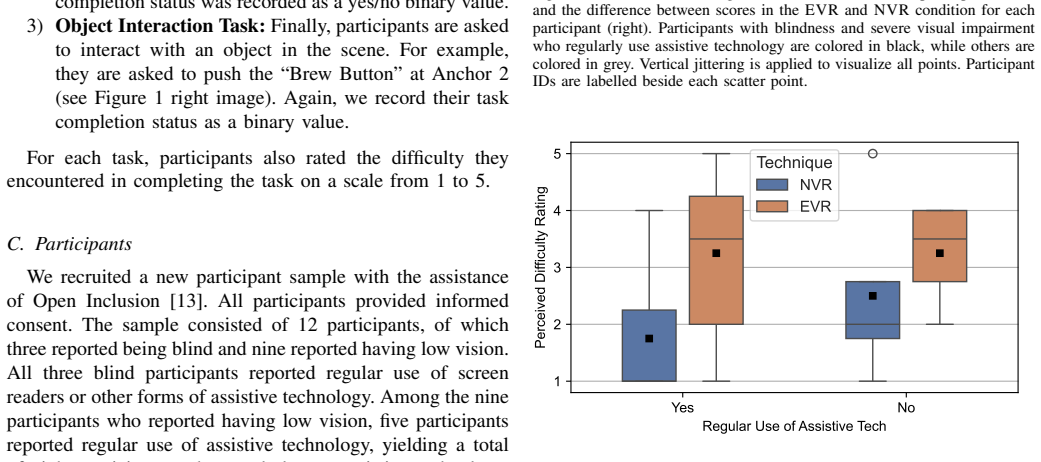
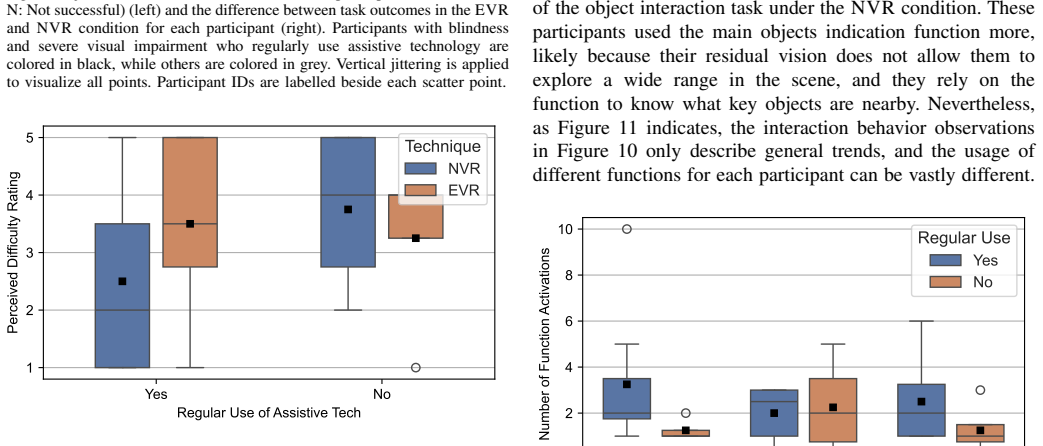
EnVisionVR is an integrated set of three speech-activated functions for virtual reality. 'Where am I?' reads a short first-person description of the current field of view, produced by a vision-language model from screenshots taken before runtime at developer-defined camera anchor points in eight orientations. 'What is near me?' announces three nearby key objects with spatial tones indicating their positions, where object selection is governed by a runtime importance value proportional to a preset importance and inversely proportional to distance. 'Where is the <object>?' emits a beep whose frequency rises as the controller nears the target, gives periodic direction-and-distance guidance such as 'one meter ahead,' and vibrates the controller on contact. In an evaluation with 12 blind and low-vision participants completing scene-understanding, object-localization, and object-interaction tasks in a VR escape-room scene, the paper reports that EnVisionVR significantly improved object-localization success from 50% to 91.7% ($\chi^2=5.0$, $p<.05$), significantly reduced perceived difficulty on that task, and was preferred by 11 of 12 participants, with the scene-understanding and object-interaction results interpreted as supporting the approach.
Load-bearing premise
The tool's scene descriptions are generated in advance from screenshots at a small set of developer-chosen anchor points, so the system assumes those descriptions still match what the user sees from arbitrary positions and orientations, an assumption the paper notes breaks if the scene changes during runtime.
Editorial extensions
If this is right
- Developers can retrofit existing VR titles with a meaningful accessibility layer by placing a small set of anchor points and pre-generating VLM descriptions, without remapping controllers or redesigning interactions.
- Because the description lookup is nearly instantaneous compared with cloud-based AI description services, latency itself emerges as a usability feature, not just a technical detail.
- Participants who regularly use assistive technology activated the scene-description and object-localization functions more often, so the tool's benefit is likely concentrated among users with the least usable residual vision.
- The three-function split provides a reusable template: a high-level scene orientation function, a nearby-object announcement function, and a fine-grained localization function, each with redundant audio and haptic feedback.
Reading between the lines
- A dynamic-scene test the paper does not run would delimit the method: if objects move after descriptions are pre-baked, the anchor-matching lookup should be expected to produce outdated guidance, marking the boundary at which on-demand VLM calls become necessary.
- The observed mismatch in object names across functions (a bookholder announced as a computer) suggests an architectural fix the paper leaves implicit: a shared canonical object registry would let the description, nearby-object, and localization functions all refer to the same entity.
- The assistive-technology subgroup's significant object-interaction gain points to a stratification hypothesis the paper does not develop: users with the least residual vision may be the primary beneficiaries, and a study powered for vision-severity subgroups could test that directly.
Editorial analysis
A structured set of objections, weighed in public.
Referee Report
Summary. EnVisionVR is a VR accessibility system that combines a Vision Language Model (GPT-4o), voice input, and multimodal feedback (speech, spatial audio, haptics) to help Blind and Low Vision (BLV) users interpret and interact with virtual scenes. The paper reports a formative usability study with nine BLV participants that identified the lack of screen-reader-like and scene-description features as a key barrier. It then presents a proof-of-concept system with three functions: scene description ("Where am I?"), main objects indication ("What is near me?"), and object localization ("Where is the <object>?"). The evaluation is a within-subjects study with 12 BLV participants comparing EnVisionVR against a no-accessibility-features baseline across three tasks: scene understanding, object localization, and object interaction. The paper reports a significant improvement in object localization task success and perceived difficulty, and the abstract and conclusion claim that the system effectively supports scene understanding and object interaction.
Significance. If the central statistical claims held, this would be a useful contribution to VR accessibility, particularly because the system is designed as a lightweight retrofit and demonstrates a low-latency approach to VLM-powered scene descriptions. The formative study adds descriptive evidence about BLV users' barriers in consumer VR, and the design implications in Section VII are practical. The evaluation is a direct empirical comparison with no fitted parameters, so there is no circularity concern of the kind that arises in model-tuning papers. However, the quantitative support is weaker than the paper presents: the only significant task-success result is based on a small-sample McNemar test whose asymptotic approximation is not robust, and the scene understanding and object interaction results are not significant in the full sample. The contribution is best assessed as a promising proof-of-concept with credible qualitative evidence, but the current claims exceed the statistical results.
major comments (3)
- [Section VI-B] The headline claim that EnVisionVR significantly improved object localization is not robust. For the paired outcome table with 5 discordant pairs all in one direction (b=5, c=0), the McNemar chi-square statistic is (|5-0|)^2/(5+0)=5.0, but the exact two-sided conditional binomial test gives p=2*(1/2)^5=0.0625, and the continuity-corrected McNemar statistic is (|5-0|-1)^2/5=3.2, p approximately 0.073. With n=12, the asymptotic chi-square approximation is anti-conservative, and the standard small-sample correction does not reach significance at alpha=0.05. Since this is the only inferential result supporting the abstract's central claim of significantly improved ability to locate objects, the paper should either use the exact test and clearly state whether a one-sided hypothesis was pre-specified, or soften the claim to a descriptive improvement in task success alongside the significant perceived-difficulty result.
- [Abstract and Section IX] The abstract says the evaluation demonstrated that EnVisionVR significantly improved object localization, "effectively supporting scene understanding and object interaction," and Section IX says the results "demonstrate the effectiveness of EnVisionVR in assisting scene understanding, object localization ... and object interaction." The full-sample data do not support these secondary claims: the scene understanding Friedman test gave p=1.0 (Section VI-A), and the object interaction McNemar test gave p=.102 (Section VI-C). The conclusions should be restricted to the localization and perceived-difficulty findings, with the other outcomes reported as non-significant trends or qualitative observations.
- [Section IV-A and footnote 6] The description of the Scene Description Function as "real-time" is stronger than what is implemented. Descriptions are generated offline by GPT-4o at developer-defined anchor points and retrieved by nearest-neighbor matching during runtime; footnote 6 correctly notes that the descriptions become inaccurate when the scene changes at runtime. The evaluation encountered exactly this limitation (Section VI-E3: a bookholder described as a computer, and P9 receiving a conflicting location report). This means the system's central scene-interpretation claim is currently limited to static scenes, and the manuscript should state this limitation in the abstract and discussion, not only in a footnote.
minor comments (3)
- [Section VI-A] The Friedman test reporting for two-level conditions would be clearer with exact p-values and test statistics reported to three decimals, and with a brief note on how the ordinal 1-5 scale was treated in the analysis.
- [Section II-A] The related work section would benefit from a brief comparison with more recent VLM-based accessibility systems for 3D content beyond the 2024 papers cited, to support the claim of novelty.
- [Section III-B] The barrier frequency percentages would be easier to interpret if the counts for each barrier category were reported in a table alongside the percentages, since the current text lists only a few n values.
Circularity Check
No significant circularity: the system evaluation is an empirical comparison with independently generated scene descriptions and no fitted parameters.
full rationale
EnVisionVR's central claims are supported by a user study comparing an accessibility-equipped condition (EVR) with a no-accessibility baseline (NVR), not by a derivation whose output is contained in its input. The VLM scene descriptions are generated offline from developer-defined anchor screenshots (Section IV-A) and are not tuned to task outcomes; the object localization function uses distance-based beeping and speech cues computed from the scene state, with no parameter fitted to participant performance. The formative study informs design goals but does not define the success metrics, and the evaluation tasks (scene understanding, object localization, object interaction) are external behavioral measures with clear ground truth. The only self-citation of potential note, the reference to Dudley et al. [9] in the design implications (Section VII, point 5), is used to align with previously published design principles and is not load-bearing for the paper's quantitative claims. The statistical concern raised about the McNemar test (exact two-sided p = 0.0625 with five discordant pairs) is a question of statistical inference validity, not of circularity, and therefore does not affect the circularity score. The paper is self-contained as an empirical HCI contribution with no reduction of predicted results to inputs by construction.
Assumptions & free parameters
free parameters (2)
- Camera anchor points =
4 anchors in test scene, 8 orientations each
- Runtime importance value formula constants =
not specified
assumptions (3)
- domain assumption Pre-baked VLM scene descriptions at anchor points are representative of user viewpoints
- domain assumption Spatial audio and haptic cues effectively convey object direction and distance to BLV users
- domain assumption GPT-4o-generated descriptions are consistent in object naming with the object localization function
Cite this review
Pith. "Pith review of EnVisionVR: A Scene Interpretation Tool for Visual Accessibility in Virtual Reality." pith.science (2026). https://pith.science/paper/2Y75PJPO
@misc{pith2026250203564,
  author       = {Pith},
  title        = {Pith review of: EnVisionVR: A Scene Interpretation Tool for Visual Accessibility in Virtual Reality},
  year         = {2026},
  howpublished = {\url{https://pith.science/paper/2Y75PJPO}},
  note         = {Machine review of arXiv:2502.03564}
}
read the original abstract
Effective visual accessibility in Virtual Reality (VR) is crucial for Blind and Low Vision (BLV) users. However, designing visual accessibility systems is challenging due to the complexity of 3D VR environments and the need for techniques that can be easily retrofitted into existing applications. While prior work has studied how to enhance or translate visual information, the advancement of Vision Language Models (VLMs) provides an exciting opportunity to advance the scene interpretation capability of current systems. This paper presents EnVisionVR, an accessibility tool for VR scene interpretation. Through a formative study of usability barriers, we confirmed the lack of visual accessibility features as a key barrier for BLV users of VR content and applications. In response, we designed and developed EnVisionVR, a novel visual accessibility system leveraging a VLM, voice input and multimodal feedback for scene interpretation and virtual object interaction in VR. An evaluation with 12 BLV users demonstrated that EnVisionVR significantly improved their ability to locate virtual objects, effectively supporting scene understanding and object interaction.
Figures


Figures from the paper (7 more)




Reference graph
Works this paper leans on
-
[1]
Pietro Bongini, Federico Becattini, and Alberto Del Bimbo. Is GPT-3 All You Need for Visual Question Answering in Cultural Heritage? In Computer Vision– ECCV 2022 Workshops: Tel Aviv, Israel, October 23–27, 2022, Proceedings, Part I , pages 268–281. Springer, 2023
work page 2022
-
[2]
More than meets the eye: A survey of screen-reader browsing strategies
Yevgen Borodin, Jeffrey P Bigham, Glenn Dausch, and IV Ramakrishnan. More than meets the eye: A survey of screen-reader browsing strategies. In Proceedings of the 2010 International Cross Disciplinary Conference on Web Accessibility (W4A), pages 1–10, 2010
work page 2010
-
[3]
Uni- fying Vision-and-Language Tasks via Text Generation
Jaemin Cho, Jie Lei, Hao Tan, and Mohit Bansal. Uni- fying Vision-and-Language Tasks via Text Generation. In Marina Meila and Tong Zhang, editors, Proceedings of the 38th International Conference on Machine Learn- ing, volume 139 of Proceedings of Machine Learning Research, pages 1931–1942. PMLR, 18–24 Jul 2021
work page 1931
-
[4]
The next generation of virtual reality: recommen- dations for accessible and ergonomic design
Brendan A Ciccone, Shannon KT Bailey, and Joanna E Lewis. The next generation of virtual reality: recommen- dations for accessible and ergonomic design. Ergonomics in Design, 31(2):24–27, 2023
work page 2023
-
[5]
Inclusive AR/VR: accessibility barriers for immersive technologies
Chris Creed, Maadh Al-Kalbani, Arthur Theil, Sayan Sarcar, and Ian Williams. Inclusive AR/VR: accessibility barriers for immersive technologies. Universal Access in the Information Society , 23(1):59–73, 2024
work page 2024
-
[6]
Khang Dang, Hamdi Korreshi, Yasir Iqbal, and Sooyeon Lee. Opportunities for Accessible Virtual Reality Design for Immersive Musical Performances for Blind and Low- Vision People. In Proceedings of the 2023 ACM Sympo- sium on Spatial User Interaction , pages 1–21, 2023
work page 2023
-
[7]
LLMR: Real-time prompting of interactive worlds using large language models
Fernanda De La Torre, Cathy Mengying Fang, Han Huang, Andrzej Banburski-Fahey, Judith Amores Fer- nandez, and Jaron Lanier. LLMR: Real-time prompting of interactive worlds using large language models. In Proceedings of the CHI Conference on Human Factors in Computing Systems , pages 1–22, 2024
work page 2024
-
[8]
Nicoletta Di Blas, Paolo Paolini, Marco Speroni, et al. “Usable Accessibility” to the Web for Blind Users. In Proceedings of 8th ERCIM Workshop: User Interfaces for All, Vienna , 2004
work page 2004
Show all 33 references
-
[9]
Inclusive Immersion: a review of efforts to improve accessibility in virtual reality, augmented reality and the metaverse
John Dudley, Lulu Yin, Vanja Garaj, and Per Ola Kris- tensson. Inclusive Immersion: a review of efforts to improve accessibility in virtual reality, augmented reality and the metaverse. Virtual Reality , 27(4):2989–3020, 2023
2023
-
[10]
Available at: https://www
Be My Eyes, Sep 2023. Available at: https://www. bemyeyes.com/blog/announcing-be-my-ai. Accessed on December 4th 2024
2023
-
[11]
Investigating Use Cases of AI-Powered Scene Description Applications for Blind and Low Vision People
Ricardo E Gonzalez Penuela, Jazmin Collins, Cynthia Bennett, and Shiri Azenkot. Investigating Use Cases of AI-Powered Scene Description Applications for Blind and Low Vision People. In Proceedings of the CHI Conference on Human Factors in Computing Systems , pages 1–21, 2024
2024
-
[12]
Making Mobile Augmented Reality Applications Acces- sible
Jaylin Herskovitz, Jason Wu, Samuel White, Amy Pavel, Gabriel Reyes, Anhong Guo, and Jeffrey P Bigham. Making Mobile Augmented Reality Applications Acces- sible. In Proceedings of the 22nd International ACM SIGACCESS Conference on Computers and Accessibility, pages 1–14, 2020
2020
-
[13]
Home - Open Inclusion
Open Inclusion. Home - Open Inclusion. Available at: https://openinclusion.com/. Accessed on Jan. 19th, 2025
2025
-
[14]
VR- Bubble: Enhancing peripheral awareness of avatars for people with visual impairments in social virtual reality
Tiger F Ji, Brianna Cochran, and Yuhang Zhao. VR- Bubble: Enhancing peripheral awareness of avatars for people with visual impairments in social virtual reality. In Proceedings of the 24th International ACM SIGACCESS Conference on Computers and Accessibility, pages 1–17, 2022
2022
-
[15]
Beyond Audio Description: Exploring 360° Video Accessibility with Blind and Low Vision Users Through Collaborative Creation
Lucy Jiang, Mahika Phutane, and Shiri Azenkot. Beyond Audio Description: Exploring 360° Video Accessibility with Blind and Low Vision Users Through Collaborative Creation. In Proceedings of the 25th international ACM SIGACCESS conference on computers and accessibility , pages ...
2023
-
[16]
Accessible Web Development: Opportunities to Improve the Education and Practice of Web Development with a Screen Reader
Claire Kearney-V olpe and Amy Hurst. Accessible Web Development: Opportunities to Improve the Education and Practice of Web Development with a Screen Reader. ACM Trans. Access. Comput. , 14(2), jul 2021. ISSN 1936-7228. doi: 10.1145/3458024
2021 doi
-
[17]
VIVR: Presence of immersive interaction for visual impairment virtual reality
Jinmo Kim. VIVR: Presence of immersive interaction for visual impairment virtual reality. IEEE Access , 8: 196151–196159, 2020
2020
-
[18]
VC-GPT: Visual Conditioned GPT for End-to- End Generative Vision-and-Language Pre-training
Ziyang Luo, Yadong Xi, Rongsheng Zhang, and Jing Ma. VC-GPT: Visual Conditioned GPT for End-to- End Generative Vision-and-Language Pre-training. arXiv preprint arXiv:2201.12723, 2022
2022 arXiv
-
[19]
VRiAssist: An eye- tracked virtual reality low vision assistance tool
Sina Masnadi, Brian Williamson, Andr ´es N Vargas Gonz´alez, and Joseph J LaViola. VRiAssist: An eye- tracked virtual reality low vision assistance tool. In 2020 IEEE Conference on Virtual Reality and 3D User Interfaces Abstracts and Workshops (VRW) , pages 808–
2020
-
[20]
Seeing AI
Microsoft. Seeing AI. https://www.microsoft.com/en-us/ ai/seeing-ai, September 2021. 14
2021
-
[22]
Accessibility Feature Implementa- tion Within Free VR Experiences
Vinaya Hanumant Naikar, Shwetha Subramanian, and Garreth W Tigwell. Accessibility Feature Implementa- tion Within Free VR Experiences. In Extended Abstracts of the CHI Conference on Human Factors in Computing Systems, pages 1–9, 2024
2024
-
[23]
Are Vision-Language Transformers Learning Multimodal Representations? A Probing Per- spective
Emmanuelle Salin, Badreddine Farah, St ´ephane Ayache, and Benoit Favre. Are Vision-Language Transformers Learning Multimodal Representations? A Probing Per- spective. In Proceedings of the AAAI Conference on Artificial Intelligence , volume 36, pages 11248–11257, 2022
2022
-
[24]
An Evalua- tion of Finding Aid Accessibility for Screen Readers
Kristina L Southwell and Jacquelyn Slater. An Evalua- tion of Finding Aid Accessibility for Screen Readers. In- formation Technology and Libraries, 32(3):34–46, 2013
2013
-
[25]
Evaluating accessibility features designed for virtual reality context
Mauro Te ´ofilo, Vicente F Lucena, Josiane Nascimento, Taynah Miyagawa, and Francimar Maciel. Evaluating accessibility features designed for virtual reality context. In 2018 IEEE international conference on consumer electronics (ICCE), pages 1–6. IEEE, 2018
2018
-
[26]
VR Beginner: The Escape Room
Unity. VR Beginner: The Escape Room. https://assetstore.unity.com/packages/templates/tutorials/ vr-beginner-the-escape-room-163264, October 2021
2021
-
[27]
Screen Reader User Survey #10 Results
WebAim. Screen Reader User Survey #10 Results. https://webaim.org/projects/screenreadersurvey10/, 2024. [Online; accessed 13-August-2024]
2024
-
[28]
Find and Seek: Assessing the Impact of Table Navigation on Information Look-up with a Screen Reader
Kristin Williams, Taylor Clarke, Steve Gardiner, John Zimmerman, and Anthony Tomasic. Find and Seek: Assessing the Impact of Table Navigation on Information Look-up with a Screen Reader. ACM Transactions on Accessible Computing (TACCESS), 12:1–23, 2019
2019
-
[29]
Automatic Alt-Text: Computer-Generated Im- age Descriptions for Blind Users on a Social Network Service
Shaomei Wu, Jeffrey Wieland, Omid Farivar, and Julie Schiller. Automatic Alt-Text: Computer-Generated Im- age Descriptions for Blind Users on a Social Network Service. In Proceedings of the 2017 ACM Conference on Computer Supported Cooperative Work and Social Computing, CSCW ’...
2017
-
[30]
GPT4MIA: Utilizing Geneative Pre-trained Transformer (GPT-3) as A Plug- and-Play Transductive Model for Medical Image Analy- sis
Yizhe Zhang and Danny Z Chen. GPT4MIA: Utilizing Geneative Pre-trained Transformer (GPT-3) as A Plug- and-Play Transductive Model for Medical Image Analy- sis. arXiv preprint arXiv:2302.08722 , 2023
2023 arXiv
-
[31]
Bennett, Hrvoje Benko, Ed- ward Cutrell, Christian Holz, Meredith Ringel Morris, and Mike Sinclair
Yuhang Zhao, Cynthia L. Bennett, Hrvoje Benko, Ed- ward Cutrell, Christian Holz, Meredith Ringel Morris, and Mike Sinclair. Enabling People with Visual Im- pairments to Navigate Virtual Reality with a Haptic and Auditory Cane Simulation. In Proceedings of the 2018 CHI Conferen...
2018
-
[32]
SeeingVR: A set of tools to make virtual reality more accessible to people with low vision
Yuhang Zhao, Edward Cutrell, Christian Holz, Mered- ith Ringel Morris, Eyal Ofek, and Andrew D Wilson. SeeingVR: A set of tools to make virtual reality more accessible to people with low vision. In Proceedings of the 2019 CHI conference on human factors in computing systems, p...
2019
-
[33]
Rich Screen Reader Experiences for Accessible Data Visual- ization
Jonathan Zong, Crystal Lee, Alan Lundgard, JiWoong Jang, Daniel Hajas, and Arvind Satyanarayan. Rich Screen Reader Experiences for Accessible Data Visual- ization. In Computer Graphics Forum, volume 41, pages 15–27. Wiley Online Library, 2022. Junlong Chen is a PhD Student at ...
2022
-
[2018]
ISBN 9781450356206
Association for Computing Machinery. ISBN 9781450356206. doi: 10.1145/3173574.3173690. URL https://doi.org/10.1145/3173574.3173690
Reviewed August 9, 2026 · model on record in the stance chip above.
Discussion (0). Continue with ORCID to comment.