REVIEW 1 major objections 5 minor 32 references
Cascades on Networks with Functional Structure
T0 review · 1 major / 5 minor · reviewed 2026-08-07 · deepseek-v4-flash
Pith's one-line read A single eigenvalue condition governs whether cascades spread in multiplex networks with functional structure.
desk verdict Solid new framework for cascades on constrained multiplex networks, but the explosive-onset proof in Section 6.1 is invalid as written and needs correction. read the letter →
The pith
A machine-rendered reading of the paper's core claim, the machinery that carries it, and where it could break.
The reading
What carries the argument
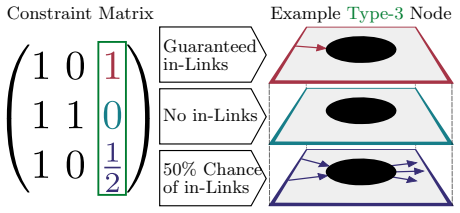
The central object is the constraint matrix $C \in [0,1]^{L \times L}$, whose entry $C_{\beta\alpha}$ is the probability that a node of type $\alpha$ is allowed to receive links from nodes of type $\beta$. All analytical results for constrained networks are expressed through $C$: the cascade size evolves by the message-passing equations $q_\alpha(t+1) = 1 - (1-\rho_0) \prod_{\beta} [1 + C_{\beta\alpha}(G_{\mathrm{in}}(0) - G_{\mathrm{in}}(q_\beta(t)))]$, the cascade condition is $|\lambda_C| \cdot P_{\mathrm{in}}(1) > 1$, and the branching-process mean matrix satisfies $D M D^{-1} = A^\top$ with $D_{\alpha\alpha} = v_\alpha z_\alpha$, which proves the equivalence of the two cascade conditions. The single-seed cascade probability is carried by a multi-type branching process of vulnerable links, with offspring generating functions $G_\alpha(x)$ and extinction probabilities obtained by iterating the combined map. The argument also relies on the standard configuration-model assumption of an infinite locally treelike network, so that all links of a given layer can be treated as statistically identical and independent.
What would settle it
A concrete falsifier: generate a large constrained multiplex network whose constraint matrix satisfies $|\lambda_C| \cdot P_{\mathrm{in}}(1)$ just below 1 and measure single-seed cascade probabilities; the paper predicts they vanish in the thermodynamic limit, while any nonzero probability of a macroscopic cascade would refute the condition. Conversely, for the nested-region example in Section 6.2, simulate single-seed cascades in a network with two giant strongly connected components and record the distribution of final cascade sizes; if every successful seed produces the same size as the $\rho_0 \to 0$ limit of the macroscopic theory, the paper's claim of multiple distinct single-seed cascade sizes in weakly connected multiplex networks is wrong.
Extended reading notes
Core claim
On its own terms, the paper claims that for constrained multiplex networks the condition $|\lambda_C| \cdot P_{\mathrm{in}}(1) > 1$ is necessary and sufficient for the existence of global cascades from a single seed, and that this condition is equivalent to the branching-process condition that the mean matrix $M$ has dominant eigenvalue larger than one. The equivalence is proved by showing that $M$ and the transpose of the matrix $A$ from the linear stability analysis are similar via a diagonal transformation, so their nonzero spectra coincide. The paper further claims that the structure of $C$ controls the order of phase transitions: for Poisson degree distributions and a specific three-layer constraint matrix, the onset of cascades is explosive when a parameter $p$ lies near the boundary of the cascade region, which is verified by a center-manifold reduction of the message-passing map. In networks with multiple giant strongly connected components, the paper finds nested cascade regions and multiple distinct single-seed cascade sizes, so that the usual $\rho_0 \to 0$ limit of the macroscopic theory does not always predict the outcome of a microscopic seed.
Load-bearing premise
The derivation assumes an infinite, locally treelike random network in which all links of a given layer are statistically independent, and the single-seed probability additionally requires the branching process to be nonsingular and positively regular; when these structural assumptions fail, the cascade condition and the cascade probability are not guaranteed to hold.
Editorial extensions
If this is right
- The cascade condition depends only on the dominant eigenvalue of the constraint matrix and on $P_{\mathrm{in}}(1)$, so the tail of the in-degree distribution does not affect whether a single seed can trigger a global cascade.
- For networks with independent and identically distributed degrees on all layers, the condition reduces to $L \cdot P_{\mathrm{in}}(1) > 1$, recovering and generalizing the classical single-layer cascade condition to the multiplex setting.
- Primitivity of the constraint matrix is exactly the positive-regularity assumption needed for the branching-process analysis, and non-primitive matrices can produce weakly connected networks in which cascades reach several distinct sizes not captured by the macroscopic seed theory.
- The structure of the constraint matrix can change the order of phase transitions: an explosive onset occurs for a range of parameters near the cascade boundary, and nested cascade regions or a cusp can appear when parts of the network have different vulnerability.
- The equivalence of the two cascade conditions, one from linear stability of the message-passing map and one from the branching-process mean matrix, holds generally under the stated assumptions, unifying the two standard approaches in the literature.
Reading between the lines
- If this result transfers to empirical supply-chain or production networks, cascade risk could be assessed from coarse statistics such as the dominant eigenvalue of a constraint matrix and the fraction of nodes with a single incoming link, rather than from a full network reconstruction.
- The paper's finding that weakly connected multiplex networks support multiple single-seed cascade sizes suggests that seed location, not just seed size, is a first-order factor in such networks, and that the macroscopic theory should be interpreted as an upper envelope rather than a unique prediction.
- A natural testable extension is to reintroduce a threshold below one, which the paper fixed to one; one would expect the eigenvalue condition to become an inequality involving the threshold and the full generating function of the in-degree distribution.
- The explosive transition near the boundary of the cascade region may be a generic route in constrained networks, and it would be worth checking whether similar center-manifold arguments hold for other update rules such as the and-rule or the weighted-average rule.
Editorial analysis
A structured set of objections, weighed in public.
Referee Report
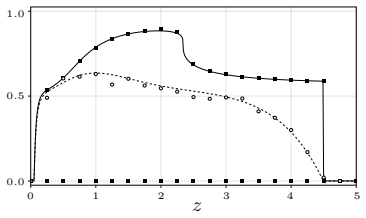
Summary. The paper studies a Watts-type threshold model (with all thresholds fixed to 1 and the or-rule) on directed multiplex configuration-model networks. It derives message-passing equations for the expected cascade size with macroscopic seeds, a cascade condition from the local stability of the zero fixed point, and a single-seed cascade probability from a multi-type branching-process argument, then proves the equivalence of the two cascade conditions. The authors introduce a subclass called constrained multiplex networks, where node activity patterns are controlled by a constraint matrix C, and derive the simple cascade condition |λ_C|·Pin(1) > 1. They use this model to exhibit three phenomena: an explosive onset of cascades, nested cascade regions with multiple single-seed cascade sizes, and a central cusp in the cascade region. Simulation results are provided for the nested and cusp examples.
Significance. If the results hold, the paper offers a rare combination of analytical tractability and structural flexibility for cascades on multiplex networks: the message-passing equations, the branching-process equivalence proof, and the eigenvalue condition are clean, self-contained, and benchmarked against simulations, and the constrained multiplex class makes node-activity patterns an explicit, tunable parameter. The reported phenomena (first-order onset, nested cascade regions, multiple single-seed cascade sizes) are potentially interesting for applications such as supply-chain risk. However, the center-manifold calculation supporting the explosive-onset claim is internally inconsistent, which currently prevents the paper from fully establishing one of its headline results.
major comments (1)
- [Section 6.1 and Appendix C] The center-manifold reduction uses the wrong spectral data. From Eq. (11) with ρ0=0, the Jacobian at x=0 is A = Pin(1) C_p^T. For the matrix C_p with three identical rows (1,1,p), this Jacobian has dominant right eigenvector q = (1,1,p)^T and left eigenvector q̂ = (1,1,1)^T/(2+p). The paper instead sets q = (1,1,1)^T and q̂ = (1,1,p)^T/(2+p), i.e. the eigenvectors are swapped. Consequently the parameterization H(ξ)=ξq+... does not span the center eigenspace, and the formula cxx = (1/2)⟨q̂,B(q,q)⟩ does not give the normal-form coefficient of the restriction of F to the center manifold. Moreover, the stated components B1(q,q)=G''(0)-2G'(0)^2, B2(q,q)=G''(0)-2G'(0)^2, B3(q,q)=pG''(0)-2p^2G'(0)^2 do not match the second-order terms of F for q=(1,1,1)^T; for that choice, B1 should be 3G''(0)-6G'(0)^2 and B3 should be 3pG''(0)-6p^2G'(0)^2. Thus the sign of cxx, and with it the explosive-onset claim for p near e-2, is not established by the derivation as written. A recomputation with the correct eigenvector pair gives a different expression for cxx, so this is not merely a typographical transposition. The authors should either correct the calculation or verify the sign of cxx by a numerical bifurcation analysis of the iterated map (11); the qualitative conclusion may survive, but the present proof is invalid.
minor comments (5)
- [Section 6.2] The sentence 'This demonstrates that the microscopic analysis can work well even in cases where the assumptions presented in section 4 are violated' extrapolates from a single example; a more cautious statement or a brief heuristic reason would be appropriate, since the paper itself notes that the scope of validity is unclear.
- [Section 6.2, Figures 2–4] Each reported simulation point appears to use a single network realization per value of z; adding multiple realizations with error bars, or stating the number of network samples, would strengthen the numerical evidence.
- [Appendix C] There is a typographical error inside the display for the offspring generating function: '(1 − vγ) + vγxγ9' should be '(1 − vγ) + vγxγ'.
- [Section 6.1] The inequality rewriting '0 < cxx ⇐⇒ 1 < (2+p)/2 · (2+p^2)/(2+p^3) · z⋆(p)' is missing parentheses and should be written as 1 < ((2+p)/2) · ((2+p^2)/(2+p^3)) · z⋆(p) for unambiguous reading.
- [Section 3.2] The phrase 'We expect macroscopic cascades to occur if and only if this fixed point is locally asymptotically unstable' is a heuristic statement; since the later branching-process equivalence (Section 4.4) provides a rigorous justification, it would be helpful to point the reader to that result at this stage.
Circularity Check
No significant circularity: the cascade condition and single-seed probabilities are derived from the degree distribution and independently benchmarked by simulation; the only self-citation is a motivational aside.
full rationale
The paper's main equations are derived, not fitted. The general message-passing equations (1)-(2) are obtained from the definition of the or-rule and the locally treelike configuration-model assumption; the constrained-multiplex specialization (10)-(11) follows by substituting the degree distribution (9). The cascade condition (12) is computed from the Jacobian (3): A_alpha,gamma = C_gamma,alpha Pin(1), so the eigenvalues are exactly those of C scaled by Pin(1); no parameter is fitted to a target outcome. The single-seed probability (7) is obtained from the extinction probability of a branching process whose offspring generating function (6) is itself derived from the same degree distribution, and the equivalence of the two cascade conditions is proved by the similarity D M D^{-1} = Ahat^T in Section 4.4 rather than assumed. The only self-citation is [16], used in a motivational aside in Section 6.1 ('such a change ... is in a sense expected when modifying a model [16]'); it is not load-bearing in any derivation. The paper also honestly flags the limitation that positive regularity can fail (Section 4.1) and that it is violated in Section 6.2, where the formula is nevertheless checked against simulations. One non-circularity caveat: the Appendix C center-manifold calculation assigns q=(1,1,1)^T and qhat=(1,1,p)^T/(2+p), whereas for A=Pin(1) C_p^T the critical right/left eigenvector pair is (1,1,p)^T and (1,1,1)^T/(2+p); if correct, this would invalidate the stated cxx, but that is a mathematical correctness risk in a self-contained calculation, not a reduction of the explosive-onset claim to its inputs. Hence the derivation chain is not circular; score 0.
Assumptions & free parameters
assumptions (5)
- domain assumption The network is an infinite-size sparse configuration model that is locally treelike, so neighbors of a random node are independent.
- domain assumption The early cascade is accurately described by a multi-type branching process on vulnerable links, and the process is nonsingular and positively regular.
- domain assumption Node thresholds are fixed at 1 (all in-neighbors on a layer must be active) and the OR rule is used.
- standard math Standard multi-type branching process results (transience of nonzero states, extinction probability as the minimal fixed point of the generating function).
- domain assumption In the i.i.d. example, in- and out-degrees are independent and identical across layers.
Cite this review
Pith. "Pith review of Cascades on Networks with Functional Structure." pith.science (2026). https://pith.science/paper/2YGFVOUF
@misc{pith2026250524631,
  author       = {Pith},
  title        = {Pith review of: Cascades on Networks with Functional Structure},
  year         = {2026},
  howpublished = {\url{https://pith.science/paper/2YGFVOUF}},
  note         = {Machine review of arXiv:2505.24631}
}
read the original abstract
We consider a version of the Watts threshold model on directed multiplex configuration model networks, and present a detailed analysis of the cascade size, single-seed cascade probability and cascade condition. We then introduce a smaller class of network models that we call "constrained multiplex networks", which is designed to represent networks with so-called "functional" or "complementary" structure. We find that the particular choice of functional structure affects the phase transitions of the cascade model in a variety of ways.
Figures


Figures from the paper (3 more)


Reference graph
Works this paper leans on
-
[1]
Error and attack tolerance of complex networks
R´ eka Albert, Hawoong Jeong, and Albert-L´ aszl´ o Barab´ asi. “Error and attack tolerance of complex networks”. In: Nature 406.6794 (July 2000), pp. 378–382. issn: 1476-4687. doi: 10.1038/35019019
-
[2]
Krishna B. Athreya and Peter E. Ney. Branching Processes. Springer Berlin Heidelberg, 1972. isbn: 9783642653711. doi: 10 . 1007 / 978 - 3 - 642-65371-1
work page 1972
-
[3]
The new chal- lenges of multiplex networks: Measures and models
Federico Battiston, Vincenzo Nicosia, and Vito Latora. “The new chal- lenges of multiplex networks: Measures and models”. In: The European Physical Journal Special Topics 226.3 (Feb. 2017), pp. 401–416.issn: 1951-
work page 2017
-
[4]
Stefano Battiston and Serafin Martinez-Jaramillo. “Financial networks and stress testing: Challenges and new research avenues for systemic risk analysis and financial stability implications”. In: Journal of Financial Sta- bility. Network models, stress testing and other tools for financial stabil- ity monitoring and macroprudential policy design and imple...
-
[5]
The structure and dynamics of multilayer networks
S. Boccaletti et al. “The structure and dynamics of multilayer networks”. In: Physics Reports. The structure and dynamics of multilayer networks 544.1 (Nov. 2014), pp. 1–122. issn: 0370-1573. doi: 10.1016/j.physrep. 2014.07.001
-
[6]
Multiplexity-facilitated cascades in networks
Charles D. Brummitt, Kyu-Min Lee, and K.-I. Goh. “Multiplexity-facilitated cascades in networks”. In: Physical Review E 85.4 (Apr. 2012), p. 045102. issn: 1550-2376. doi: 10.1103/physreve.85.045102
-
[7]
The Spread of Behavior in an Online Social Network Experiment
Damon Centola. “The Spread of Behavior in an Online Social Network Experiment”. In: Science 329.5996 (Sept. 2010), pp. 1194–1197. doi: 10. 1126/science.1185231
work page 2010
-
[8]
Zero-temperature hysteresis in the random-field Ising model on a Bethe lattice
Deepak Dhar, Prabodh Shukla, and James P. Sethna. “Zero-temperature hysteresis in the random-field Ising model on a Bethe lattice”. In: Journal of Physics A: Mathematical and General 30.15 (Aug. 1997), p. 5259. issn: 0305-4470. doi: 10.1088/0305-4470/30/15/013
Show all 32 references
-
[9]
Quantifying firm-level economic systemic risk from nation-wide supply networks
Christian Diem et al. “Quantifying firm-level economic systemic risk from nation-wide supply networks”. In: Scientific Reports 12.1 (May 2022). issn: 2045-2322. doi: 10.1038/s41598-022-11522-z
2022 doi
-
[10]
Cascades on correlated and modular random net- works
James P. Gleeson. “Cascades on correlated and modular random net- works”. In: Physical Review E 77.4 (Apr. 2008), p. 046117. doi: 10.1103/ PhysRevE.77.046117
2008
-
[11]
Mean size of avalanches on directed random networks with arbitrary degree distributions
James P. Gleeson. “Mean size of avalanches on directed random networks with arbitrary degree distributions”. In: Physical Review E 77.5 (May 2008), p. 057101. issn: 1550-2376. doi: 10.1103/physreve.77.057101
2008 doi
-
[12]
Seed size strongly affects cascades on random networks
James P. Gleeson and Diarmuid J. Cahalane. “Seed size strongly affects cascades on random networks”. In: Physical Review E 75.5 (May 2007), p. 056103. issn: 1550-2376. doi: 10.1103/physreve.75.056103
2007 doi
-
[13]
Theodore E. Harris. The theory of branching processes. Vol. 119. Grundlehren der mathematischen Wissenschaften. Springer, Berlin, 1963, pp. xiv+230
1963
-
[14]
Firm-level propagation of shocks through supply-chain networks
Hiroyasu Inoue and Yasuyuki Todo. “Firm-level propagation of shocks through supply-chain networks”. In:Nature Sustainability 2.9 (Sept. 2019), pp. 841–847. issn: 2398-9629. doi: 10.1038/s41893-019-0351-x
2019 doi
-
[15]
How Structured Is the Entangled Bank? The Surprisingly Simple Organization of Multiplex Ecological Networks Leads to Increased Persistence and Resilience
Sonia K´ efi et al. “How Structured Is the Entangled Bank? The Surprisingly Simple Organization of Multiplex Ecological Networks Leads to Increased Persistence and Resilience”. In: PLOS Biology 14.8 (Aug. 2016), e1002527. issn: 1545-7885. doi: 10.1371/journal.pbio.1002527. 27
2016 doi
-
[16]
A universal route to explosive phe- nomena
Christian Kuehn and Christian Bick. “A universal route to explosive phe- nomena”. In: Science Advances 7.16 (Apr. 2021), eabe3824. doi: 10.1126/ sciadv.abe3824
2021
-
[17]
Kuznetsov
Yuri A. Kuznetsov. Elements of Applied Bifurcation Theory . Springer In- ternational Publishing, 2023. isbn: 9783031220074. doi: 10.1007/978- 3-031-22007-4
2023 doi
-
[18]
Threshold cascades with response heterogeneity in multiplex networks
Kyu-Min Lee, Charles D. Brummitt, and K.-I. Goh. “Threshold cascades with response heterogeneity in multiplex networks”. In: Physical Review E 90.6 (Dec. 2014), p. 062816. issn: 1550-2376. doi: 10.1103/physreve. 90.062816
2014 doi
-
[19]
Cascade-based attacks on com- plex networks
Adilson E. Motter and Ying-Cheng Lai. “Cascade-based attacks on com- plex networks”. In: Physical Review E 66.6 (Dec. 2002), p. 065102. doi: 10.1103/PhysRevE.66.065102
2002 doi
-
[20]
Message passing methods on complex networks
M. E. J. Newman. “Message passing methods on complex networks”. In: Proceedings of the Royal Society A: Mathematical, Physical and Engineer- ing Sciences 479.2270 (Feb. 2023), p. 20220774.doi: 10.1098/rspa.2022. 0774
2023 doi
-
[21]
Random graphs with arbitrary degree distributions and their applications
M. E. J. Newman, S. H. Strogatz, and D. J. Watts. “Random graphs with arbitrary degree distributions and their applications”. In: Physical Review E 64.2 (July 2001), p. 026118. doi: 10.1103/PhysRevE.64.026118
2001 doi
-
[22]
Measuring and modeling correlations in multiplex networks
Vincenzo Nicosia and Vito Latora. “Measuring and modeling correlations in multiplex networks”. In:Physical Review E 92.3 (Sept. 2015), p. 032805. doi: 10.1103/PhysRevE.92.032805
2015 doi
-
[23]
Epidemic Spread- ing in Scale-Free Networks
Romualdo Pastor-Satorras and Alessandro Vespignani. “Epidemic Spread- ing in Scale-Free Networks”. In:Physical Review Letters 86.14 (Apr. 2001), pp. 3200–3203. doi: 10.1103/PhysRevLett.86.3200
2001 doi
-
[24]
E. Seneta. Non-negative Matrices and Markov Chains. Springer New York,
-
[25]
Message-passing approach for threshold models of behavior in networks
Munik Shrestha and Cristopher Moore. “Message-passing approach for threshold models of behavior in networks”. In: Physical Review E 89.2 (Feb. 2014), p. 022805. doi: 10.1103/PhysRevE.89.022805
2014 doi
-
[26]
Properties of random graphs with hidden color
Bo S¨ oderberg. “Properties of random graphs with hidden color”. In: Phys- ical Review E 68.2 (Aug. 2003), p. 026107. doi: 10.1103/PhysRevE.68. 026107
2003 doi
-
[27]
Reentrant phase transitions in threshold driven contagion on multiplex networks
Samuel Unicomb et al. “Reentrant phase transitions in threshold driven contagion on multiplex networks”. In: Physical Review E 100.4 (Oct. 2019), p. 040301. issn: 2470-0053. doi: 10.1103/physreve.100.040301
2019 doi
-
[28]
A simple model of global cascades on random net- works
Duncan J. Watts. “A simple model of global cascades on random net- works”. In: Proceedings of the National Academy of Sciences 99.9 (Apr. 2002), pp. 5766–5771. issn: 1091-6490. doi: 10.1073/pnas.082090499. 28
2002 doi
-
[29]
Analysis of complex contagions in ran- dom multiplex networks
Osman Ya˘ gan and Virgil Gligor. “Analysis of complex contagions in ran- dom multiplex networks”. In:Physical Review E 86.3 (Sept. 2012), p. 036103. issn: 1550-2376. doi: 10.1103/physreve.86.036103
2012 doi
-
[30]
Clustering determines the dynamics of complex contagions in multiplex networks
Yong Zhuang, Alex Arenas, and Osman Ya˘ gan. “Clustering determines the dynamics of complex contagions in multiplex networks”. In: Physical Review E 95.1 (Jan. 2017), p. 012312. issn: 2470-0053. doi: 10.1103/ physreve.95.012312. 29 A Derivation: Cascade Size for i.i.d. Degrees...
2017
- [1981]
-
[6401]
doi: 10.1140/epjst/e2016-60274-8. 26
Reviewed August 7, 2026 · model on record in the stance chip above.
Discussion (0). Continue with ORCID to comment.