REVIEW 2 major objections 4 minor 17 references
Control of habitat's carbon dioxide level by biomass burning
T0 review · 2 major / 4 minor · reviewed 2026-08-14 · deepseek-v4-flash
Pith's one-line read Burning stored crop waste can regulate CO2 in a space habitat
desk verdict A short conceptual proposal with a correct stoichiometric core and a genuinely new O2-neutral twist, but the control-authority claim needs a dynamic pass before it is fully earned. read the letter →
The pith
A machine-rendered reading of the paper's core claim, the machinery that carries it, and where it could break.
The reading
What carries the argument
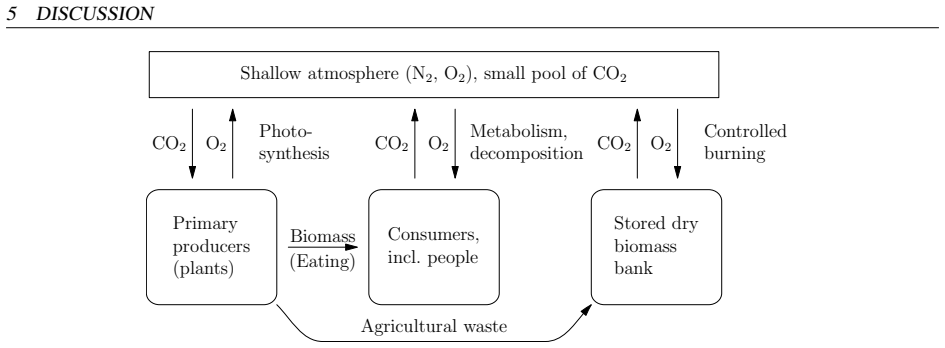
The load-bearing mechanism is the stored dry biomass bank: agricultural waste diverted from decomposition, stored so it does not rot by drying, freezing, or freeze-drying, and burned on demand. In the carbon cycle, burning biomass releases CO2 and consumes O2, while subsequent photosynthesis removes the same CO2 and releases the same O2, so the oxygen partial pressure is invariant. The paper's control criterion is a static stored-carbon condition: control authority is sufficient when stored carbon exceeds the maximum carbon fixed in living organisms at any one time, with the burner switched on and off as CO2 crosses its target.
What would settle it
In a sealed chamber with a 50-meter-equivalent atmosphere and actively growing crops, run the biomass burner at its maximum clean-burning rate while photosynthesis is at its peak; if the CO2 concentration falls below 300 ppmv before the burner can respond, the sufficiency claim is falsified. A simpler measurement is to compare the burner's maximum CO2 mass flow per square meter against the 2 kgC/m2/year rainforest fixation rate that the paper cites.
Extended reading notes
Core claim
The central claim is that biomass burning is a sufficient and practical CO2 controller for a shallow-atmosphere space habitat. Agricultural waste is a necessary byproduct of food production; by drying and storing some of it and burning it at a controlled rate whenever photosynthesis has driven CO2 below target, the settlement restores CO2 without changing O2. The control authority is declared sufficient if the total carbon stored in the settlement exceeds the maximum carbon mass that can be held in living organisms at any one time. Using a tropical-rainforest fixation rate, the paper estimates that burning roughly 0.5 kgC per square meter per year, about 34 kg of dry biomass per hectare per day, maintains authority, with ash output on the order of hundreds of grams per hectare per day and average heating of about 0.8 W/m2.
Load-bearing premise
The paper assumes that having enough stored carbon in the settlement is sufficient for control, without accounting for the rate at which the burner can release CO2 compared with the rate at which peak photosynthesis removes it; in the paper's own example, plant growth could draw CO2 down by 1000 ppmv in 4.5 days.
Editorial extensions
If this is right
- A settlement's CO2 can be regulated by routine agricultural management rather than by energy-intensive air-processing equipment such as cryogenic distillation or chemical scrubbing.
- The method scales from small habitats to large ones because both waste production and atmospheric volume scale with area; burning frequency, not burner size, changes.
- The build-up phase of a biosphere can be supplied with CO2 from burning sugar or elemental carbon sourced from carbonaceous asteroids, avoiding large biomass imports from Earth and avoiding net oxygen buildup.
- O2 partial pressure stays essentially constant during both steady-state operation and biosphere build-up, since burning and photosynthesis form a closed oxygen loop.
- The paper does not move materials through airlocks, so the method avoids losing atmospheric gases into space.
Reading between the lines
- We infer that the same storage-and-burn buffer could be adapted to closed non-rotating habitats, submarines, or long-duration spacecraft, with the same oxygen-neutral property, provided a dry carbon stock and fire safety can be maintained.
- The static stored-carbon sufficiency condition is not a dynamic guarantee: if a settlement's peak photosynthetic drawdown outpaces the burner's maximum CO2 release rate, the 300 ppmv floor could still be breached. A rate-based control model, absent from the paper, would set the required burner capacity and minimum stored reserve.
- If sugar or carbon synthesis from carbonaceous asteroids proves practical, the bootstrap scenario changes the mass balance of early settlement: the limiting resource shifts from Earth-launched biomass to asteroid-derived carbon and water, which is testable by comparing synthesis energetics with launch costs.
- Field experiments in sealed greenhouses, burning dried agricultural waste at controlled rates while crops photosynthesize, could measure real smoke and ash loads on windows and plants, a practical concern the paper lists but does not quantify.
Signed reviews
Editorial analysis
A structured set of objections, weighed in public.
Referee Report
Summary. The paper proposes controlling the CO2 level in a free-space settlement with a shallow (about 50 m) N2/O2 atmosphere by storing dried agricultural waste and burning it when plant growth has drawn down atmospheric CO2. The method relies on the stoichiometric pairing of photosynthesis (Eq. 1) and combustion (Eq. 2), which leaves the O2 partial pressure unchanged over the full cycle. The paper gives order-of-magnitude numbers: Earth's atmospheric and biospheric carbon stocks (1.66 and 1.08 kgC/m2, respectively), a maximum fixation rate of 2 kgC/m2/yr, and a 4.5-day timescale for a 1000 ppmv CO2 depletion in a 50 m atmosphere. It further discusses practical engineering issues (smoke, ash, fire risk, storage methods, backup techniques) and the possibility of bootstrapping the biosphere by burning carbon or sugar derived from carbonaceous asteroids. The central claim is that biomass burning robustly, low-techly, and scalably solves the CO2 control problem.
Significance. The core stoichiometric insight is correct, and the paper's order-of-magnitude carbon budget is internally consistent; the O2-constancy argument is a clean and useful observation for closed-ecosystem habitat design. The paper is candid about limitations such as dark seasons, smoke, and fire risk. If the control-authority question were properly settled, the proposal would be a genuinely practical, low-tech solution to a recognized problem in space-settlement engineering. However, the paper's stated sufficiency condition is a static capacity inequality rather than a rate or closed-loop condition, so the central claim that the problem 'can be solved' is not fully demonstrated by the present analysis.
major comments (2)
- [Section 3, paragraph beginning 'It is sufficient for only part of the biomass...'] The stated sufficiency condition is a static capacity inequality: total carbon in the settlement must exceed the maximum biospheric carbon stock. It says nothing about the rate at which CO2 can be released. The paper's own Introduction identifies the threat as a rate: maximal plant growth of 2 kgC/m2/yr can reduce CO2 by 1000 ppmv in 4.5 days in a 50 m atmosphere. To keep CO2 from falling below the 300 ppmv lower bound, the burning system must be able to inject CO2 at a rate at least matching the net photosynthetic drawdown whenever the controller calls for it, and the stored-biomass bank must be large enough to sustain that rate for the required period. Neither the maximum burning rate nor a dynamic model of the CO2 balance (e.g., dC_atm/dt = -photosynthesis + burning + respiration) is given. Therefore the abstract's claim that the problem 'can be solved' is not established; a quantitative rate check or a simple feedback analysis is needed.
- [Section 3, same paragraph] The sufficiency condition also leaves the upper bound unaddressed. If the total carbon inventory T is too large relative to the maximum biospheric stock M and the carbon equivalent of the upper CO2 limit A_upper, then the atmosphere cannot return below 2000 ppmv even with full plant uptake unless the excess carbon is permanently stored in a non-decomposing form. The paper should state the complementary condition on T (or, equivalently, on the required size and stability of the stored-biomass bank) and discuss what happens if storage integrity fails. Without this, the paper's assertion that 'if there is too much CO2, one ceases the burning activity for a while' is not sufficient as a control law.
minor comments (4)
- [Section 3] The term 'control authority' is used several times but never defined; a formal definition (e.g., the maximum cumulative CO2 that can be added, or the maximum sustainable injection rate) would improve precision.
- [Section 3, paragraph on burning activity] The claim that 'in a 50 m high atmosphere, enough constant CO2 is reached by a daily burning session' is unsupported by any calculation; a brief quantitative example would clarify the intended operating point.
- [References] Reference [6] is a Wikipedia article; a primary source for photosynthesis rates would be more appropriate for a journal publication.
- [Throughout] There are minor typesetting inconsistencies (e.g., 'O2' and 'CO2' without subscripts in some places) and the abstract phrase 'the atmospheric carbon buffer per biosphere area is smaller than on Earth' is slightly awkward; consider rewording to 'smaller than Earth's atmospheric carbon buffer per unit biosphere area.'
Circularity Check
No circularity found: O2 conservation follows from stoichiometry and the CO2-control argument is a bookkeeping/engineering estimate with external data; the rate limitation is a robustness concern, not a circular reduction.
full rationale
I walked the paper's derivation chain. The central claim is that burning stored, dried agricultural waste can replenish atmospheric CO2 in a shallow-atmosphere settlement while leaving O2 partial pressure unchanged. The O2-constancy claim follows directly from the balanced reaction pair (CO2 + H2O + light -> CH2O + O2 and CH2O + O2 -> CO2 + H2O + energy), not from an assumed conclusion. The CO2-control argument uses externally sourced carbon-stock and fixation-rate figures (Bar-On et al. [1], Sullivan et al. [2], Wikipedia/Ricklefs [6,7]) to size the biomass bank and burning rate; the 0.5 kgC/m2/year burned scenario is explicitly an illustrative conservative estimate, not a fitted parameter renamed as a prediction. The asserted sufficiency condition ('the control authority is sufficient if the total amount of carbon in the settlement exceeds the maximum mass of carbon that can be fixed in living organisms at any one time') is a static bookkeeping condition; it may be under-specified with respect to rates, since the paper's own 4.5-day drawdown example raises a dynamic-control concern, but it is not circular: the condition is not defined in terms of the conclusion, nor is the conclusion forced by the condition alone. The only self-citation (Janhunen 2018, for sectoring/illumination) appears in a side discussion about seasons and is not load-bearing for the biomass-burning method. No equation, parameter, or normalization is defined in terms of the target result, and no prediction is obtained by inverting an input. Accordingly, I find no exhibited circular step; the identified rate issue is a correctness/robustness concern rather than a circularity.
Assumptions & free parameters
free parameters (2)
- Burned fraction of agricultural waste =
50% (0.5)
- Average carbon fixation rate =
1 kgC/m2/year
assumptions (5)
- standard math Photosynthesis and metabolism are exact reverse reactions with biomass formula n(CH2O) (Eqs. 1-2).
- domain assumption A space settlement uses a shallow N2/O2 atmosphere of about 50 m depth.
- domain assumption Closed ecosystems are feasible based on terrestrial semi-closed examples such as gardens and Biosphere-2.
- domain assumption Plants and soil remove atmospheric impurities (Wolverton et al. [10]).
- domain assumption No net oxygen transfer between atmosphere and biosphere in metabolism.
Cite this review
Pith. "Pith review of Control of habitat's carbon dioxide level by biomass burning." pith.science (2026). https://pith.science/paper/2YWNO22V
@misc{pith2026190804113,
  author       = {Pith},
  title        = {Pith review of: Control of habitat's carbon dioxide level by biomass burning},
  year         = {2026},
  howpublished = {\url{https://pith.science/paper/2YWNO22V}},
  note         = {Machine review of arXiv:1908.04113}
}
read the original abstract
Consider a free-space settlement with a closed ecosystem. Controlling the habitat's carbon dioxide level is a nontrivial problem because the atmospheric carbon buffer per biosphere area is smaller than on Earth. Here we show that the problem can be solved by burning agricultural waste. Waste biomass is stored and dried, and burned whenever plant growth has lowered the atmospheric carbon dioxide level so that replenishment is needed. The method is robust, low-tech and scalable. The method also leaves the partial pressure of oxygen unchanged. In the initial growth phase of the biosphere, one can obtain the carbon dioxide by burning sugar or carbon, which can be sourced from carbonaceous asteroid materials. This makes it possible to bootstrap the biosphere without massive biomass imports from Earth.
Figures

Reference graph
Works this paper leans on
-
[5]
Janhunen, P., Natural illumination solution for rotating space settlements, NSS Space Settlement J. (2018). https: //space.nss.org/media/NSS-JOURNAL-Natural- Illumination-for-Rotating-Space-Settlements.pdf
work page 2018
-
[1]
Bar-On, Y .M., R. Phillips and R. Milo, The biomass dis- tribution on Earth, Proc. Nat. Acad. Sci. 115 (25) (2018) 6506–6511. https://www.pnas.org/content/pnas/115/ 25/6506.full.pdf
work page 2018
-
[2]
Sullivan, M.J.P., J. Talbot, S.L. Lewis et al., Diversity and carbon storage across the tropical forest biome, Scien- tific Reports 7 (2017) 39102. https://www.nature.com/ articles/srep39102
work page 2017
-
[3]
O’Neill, G.K., The colonization of space, Physics Today 27 (9) (1974) 32–40
work page 1974
-
[4]
O’Neill, G.K., The high frontier, New York (1977) 288
work page 1977
-
[6]
wikipedia.org/wiki/Biomass_(ecology)
Wikipedia article on biomass (ecology), https://en. wikipedia.org/wiki/Biomass_(ecology)
-
[7]
Ricklefs, R.E. and G.L. Miller, Ecology (4th ed.), Macmillan (2000), 192
work page 2000
- [8]
Show all 17 references
-
[9]
Jewell, W.J. and L.S. Valentine, Biological processes in closed ecosystems, Space Manufacturing 14, Space Studies Institute, Oct. 29–31 (2010). http://ssi.org/2010/SM14- proceedings/Biological-Processes-in-Closed- Ecosystems-Jewell-Valentine.pdf
2010
-
[10]
Johnson and K
Wolverton, B.C., A. Johnson and K. Bounds, Interior land- scape plants for indoor air pollution abatement, Final re- port, NASA-TM-101766 (1989). https://ntrs.nasa.gov/ archive/nasa/casi.ntrs.nasa.gov/19930073077.pdf
1989
-
[11]
Soilleux, R.J. and S.D. Gunn, Environmental control and life support (ECLSS) for large orbital habitats: ventilation for heat and water transport and management, NSS Space Settlement J.(2018). https://space.nss.org/media/NSS-JOURNAL- ECLSS-for-Large-Orbital-Habitats-Ventilatio...
2018
-
[12]
Thomson, H. and C. Liddell, The suitability of wood pellet heat- ing for domestic households: a review of literature, Renewable and Sustainable Energy Rev. 42 (2015) 1362–1369
2015
-
[13]
Ragland and A.J
Misra, M.K., K.W. Ragland and A.J. Baker, Wood ash compo- sition as a function of furnace temperature, Biomass and Bioen- ergy 4, 2 (1993) 103–116
1993
-
[14]
Dentener, W
Lelieveld, J., F.J. Dentener, W. Peters and M.C. Krol, On the role of hydroxyl radicals in the self-cleansing capacity of the troposphere, Atmos. Chem. Phys. 4 (2004) 2337–2344. https://www.atmos-chem- phys.net/4/2337/2004/acp-4-2337-2004.pdf
2004
-
[15]
Floudas, D., et al., The Paleozoic origin of enzymatic lignin decomposition reconstructed from 31 fungal genomes, Science 336 (2012) 1715–1719
2012
-
[16]
Butler, J.H.A. and J.C. Buckerfield, Digestion of lignin by ter- mites, Soil Biology and Biochemistry 11 (1979) 507–513
1979
-
[17]
Gitelson and G.M
Salisbury, F.B., J.I. Gitelson and G.M. Lisovsky, Bios-3: Siberian experiments in bioregenerative lif support, BioScience 47 (1997) 575–585. 6 NSS Space Settlement Journal
1997
Reviewed August 14, 2026 · model on record in the stance chip above.
Discussion (0). Continue with ORCID to comment.