REVIEW 4 major objections 5 minor 32 references
AERO-LQG: Aerial-Enabled Robust Optimization for LQG-Based Quadrotor Flight Controller
T0 review · 4 major / 5 minor · reviewed 2026-08-05 · deepseek-v4-flash
Pith's one-line read Evolutionary search for LQG weights cuts quadrotor hover tracking errors by 33-55 percent.
desk verdict A useful but modest benchmark undercut by headline gains that its own Table II contradicts — the 33%/55% claim doesn't survive simple arithmetic. read the letter →
The pith
A machine-rendered reading of the paper's core claim, the machinery that carries it, and where it could break.
The reading
What carries the argument
The central mechanism is the nested AERO-LQG loop: the outer optimizer (covariance matrix adaptation, a gradient-free evolutionary strategy) proposes Cholesky-parameterized weight matrices Q and R; the inner loop evaluates each candidate by solving the LQG problem — Kalman filter plus LQR — for the linearized hover dynamics and scoring the closed-loop response with Jout, the time-integrated position error plus a small attitude penalty. The separation principle renders the plant-estimator dynamics upper triangular, so controller and estimator gains decouple, and the outer cost depends on the weights only through closed-loop trajectories, which is why gradient-free search is needed.
What would settle it
Run the optimized (Q,R) weights on a different disturbance profile, such as colored wind or a different gust shape, or on the nonlinear quadrotor simulator, and measure the same eight metrics; if the CMA-tuned weights no longer beat the GA baseline by a similar margin, the reported 33-55% gains are artifacts of tuning to one scenario.
Extended reading notes
Core claim
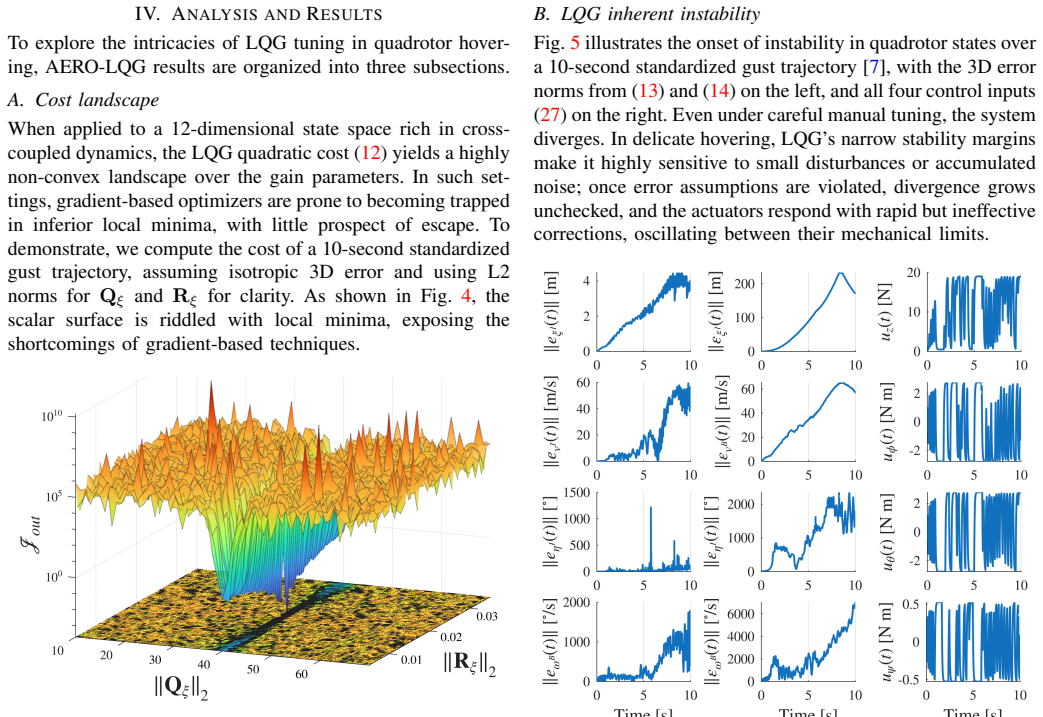
AERO-LQG claims that LQG tuning for quadrotor hover can be automated as a bi-level optimization: the outer loop searches over positive-definite (Q,R) weights, parameterized through Cholesky factors, and the inner loop computes the LQR and Kalman gains for each candidate. The paper demonstrates on a linearized 12-state hover model that the resulting cost landscape is full of local minima, that LQG with manual weights can diverge on a standardized gust disturbance, and that covariance matrix adaptation finds weights achieving diagonal dominance and stable, low-effort trajectories. Benchmarked against manual tuning, Bryson's rule, particle swarm, genetic algorithm, and Bayesian optimization, th
Load-bearing premise
The headline gains are computed on the same ten-second standardized gust trajectory that defines the tuning cost, so the paper assumes that trajectory is representative of real hovering disturbances and that weights optimized on it transfer to conditions not seen during tuning.
Editorial extensions
If this is right
- LQG weight selection for hover can be delegated to an automated optimizer rather than manual or rule-based tuning.
- For resource-constrained platforms, the roughly 8% endurance improvement and reduced control effort translate into longer missions at the same energy budget.
- The same bi-level architecture may apply to other linearizable flight modes and robots, provided a suitable outer cost is defined.
- The final weights concentrate on the diagonal, suggesting that cross-state weighting terms add little for hover and that simpler parameterizations may be enough.
Reading between the lines
- Not tested in the paper: whether the tuned weights generalize to a different disturbance profile or to the nonlinear simulator; a straightforward check is to run the optimized (Q,R) under a different wind model and compare against the same baselines.
- The paper's diagonal-dominant converged weights hint that the effective search dimension is much smaller than n(n+1), so a low-rank or diagonal parameterization could make tuning cheaper than full Cholesky search.
- Because the outer cost is evaluated on the same trajectory used for tuning, the reported percentages are likely optimistic; on unseen disturbances the margin over GA would probably shrink, though stability may persist.
- For neighboring problems, such as trajectory-following modes, the outer cost would need to reward tracking and agility rather than only position-holding; the framework's value hinges on choosing a mission-aligned outer cost.
Editorial analysis
A structured set of objections, weighed in public.
Referee Report
Summary. The paper proposes AERO-LQG, a bi-level optimization framework for tuning the Q and R weight matrices of an LQG controller for quadrotor hovering. The outer loop uses CMA-ES to minimize an outer cost Jout (translational error plus small attitude penalty), while the inner loop solves the standard LQG Riccati equations. The method is benchmarked against manual tuning, Bryson's rule, PSO, GA, and Bayesian optimization on a 10-second standardized gust trajectory. The authors report that CMA outperforms the leading GA baseline, claiming reductions in estimation and control errors of at least 33% and 55%, respectively, and an almost 8% increase in flight endurance.
Significance. If the results are reproducible and generalize, the paper would provide a practically useful, black-box procedure for LQG weight selection in a relevant robotics application. The strengths include a clean bi-level problem formulation, the use of Cholesky parameterization to enforce positive definiteness, a comparison against five baselines, and public code release. The main contribution is empirical rather than theoretical: CMA-ES is shown to be a workable optimizer for LQG weight tuning. However, the numerical claims as stated are not supported by the data in Table II, and the evaluation protocol lacks held-out scenarios and statistical repetition, so the significance is currently conditional.
major comments (4)
- [§IV.C, Table II] The sentence that CMA 'surpass[es] the leading GA by reducing estimation and control errors by at least 33% and 55%, respectively' is not supported by Table II. Using the table's final-time values, the reductions from GA to CMA are: position estimation error ∥eξI∥: (0.03−0.01)/0.03 = 67%; position control error ∥εξI∥: (0.09−0.05)/0.09 = 44%; orientation estimation error ∥eηI∥: (0.22−0.17)/0.22 = 23%; orientation control error ∥εηI∥: (2.05−1.74)/2.05 = 15%. The minimum estimation reduction is 23%, not 33%, and no metric reaches 55%. The 'at least 33% and 55%' claim must be corrected to match the table, or additional data must be supplied that substantiates the larger numbers.
- [§IV.C and Eq. (36)] The evaluation is circular in an important practical sense: all optimizers are evaluated on the same 10-second standardized gust trajectory [7] that defines the outer cost Jout in Eq. (36). The reported final-time errors and control effort are therefore tuned to that specific scenario, and overfitting cannot be excluded. There are no held-out disturbance realizations, no variations in initial conditions, and no repeated trials with error bars. The paper should report results on additional gust profiles, random disturbances, or at least multiple seeds, and should show the variance of the reported metrics.
- [§II.A, §IV] The process and measurement noise covariances W and V are introduced in Eqs. (7)–(8) but are never given numerical values in the experiments. Since the Kalman gain and hence the closed-loop behavior depend directly on W and V, the results in Table II and Figs. 5–8 are not reproducible without these values. The paper should state the actual W and V matrices (or the scalar/noise magnitudes used) and the initial P(0), along with the simulation parameters such as sampling time and the exact disturbance realization.
- [§I, §V] The Introduction states that AERO-LQG delivers 'unprecedented gains—reducing tracking error by over 55% and extending flight endurance by nearly 8%.' The 55% tracking-error figure has the same mismatch with Table II as noted above, and the 8% endurance figure is not supported by any table, equation, or calculation in the paper. If endurance is inferred from the control-effort integral in Table II, the derivation should be given explicitly; otherwise the claim should be removed.
minor comments (5)
- [Remark 1] The Remark states that Cholesky parameterization 'reduc[es] the parameter count to n(n + 1)'. The correct number of free parameters in a lower-triangular n×n Cholesky factor is n(n+1)/2.
- [§IV.B, Eq. (15)] The text attributes LQG instability to 'tight coupling between the estimator and controller' and to LQG being 'inherently more sensitive' than LQR. This conflicts with the separation-principle form in Eq. (15), where the closed-loop eigenvalues are the union of the LQR and Kalman-filter eigenvalues. The more accurate statement is that LQG can lack the robustness margins of LQR, not that the estimator–controller coupling makes the closed loop inherently unstable. Please revise the explanation.
- [Table I] The complexity for Bayesian optimization is listed as O(k f + k^3), while the other stochastic methods are O(k n f). The Gaussian-process cost term is not explained and is inconsistent with the complexity ranking described in the text.
- [Figs. 4–8] Several figures lack sufficient axis labels and units. For example, Fig. 4 is described as a 'cost surface' but has no axis labels, and Fig. 7 says results are 'normalized for convenience' without stating the normalization. Please add explicit captions and units.
- [§V] The conclusion says 'Benchmarking across eight flight metrics' but the eight metrics are not enumerated in the text; Table II has five numbers and Fig. 8 is described only qualitatively. A clear list of the eight metrics would help the reader verify the claim.
Circularity Check
No derivation-to-input circularity; the main caveats are in-sample evaluation on a self-cited gust trajectory and a numerical claim mismatch.
full rationale
The paper's derivation chain is self-contained: it linearizes quadrotor hover dynamics, defines the standard LQG cost, and uses CMA-ES to optimize Q,R against the outer cost Jout (Eq. 36). The reported final-time errors in Table II are computed on the same 10-second gust trajectory [7] used to evaluate Jout, so the absolute improvements are in-sample rather than held-out predictions. This is an evaluation-protocol and generalizability concern, not a case where the output is equivalent to the input by construction. The relative comparison among CMA, GA, PSO, and BY is still a genuine optimization outcome on a fixed scenario, and the self-citations ([7], [13], [24]) are background or scenario-source citations, not unverified uniqueness theorems. Separately, the Section IV.C claim of 'at least 33% and 55%' reductions is not supported by Table II (computed minima are approximately 23% and 15%); this is a numerical-accuracy risk, not circularity.
Assumptions & free parameters
free parameters (4)
- LQG weight matrices Q and R (Cholesky factors) =
not reported; optimized by CMA-ES
- Outer-cost trade-off weight lambda =
not given; stated as lambda << 1
- Noise covariances W and V =
not stated
- 10-second standardized gust trajectory =
not included in paper; defined in self-cited [7]
assumptions (5)
- domain assumption Hovering can be treated as a linear time-invariant system over the tested horizon.
- standard math LQG separation principle holds, so controller and estimator gains can be designed independently.
- domain assumption Quadrotor is a rigid symmetric body with drag neglected, thrust proportional to rotor speed squared, and center of mass at body origin.
- domain assumption Disturbances are zero-mean white Gaussian with constant covariances W and V.
- ad hoc to paper Jout with lambda << 1 is an adequate proxy for mission performance and energy efficiency.
Cite this review
Pith. "Pith review of AERO-LQG: Aerial-Enabled Robust Optimization for LQG-Based Quadrotor Flight Controller." pith.science (2026). https://pith.science/paper/2ZKYMPVV
@misc{pith2026250820888,
  author       = {Pith},
  title        = {Pith review of: AERO-LQG: Aerial-Enabled Robust Optimization for LQG-Based Quadrotor Flight Controller},
  year         = {2026},
  howpublished = {\url{https://pith.science/paper/2ZKYMPVV}},
  note         = {Machine review of arXiv:2508.20888}
}
read the original abstract
Quadrotors are indispensable in civilian, industrial, and military domains, undertaking complex, high-precision tasks once reserved for specialized systems. Across all contexts, energy efficiency remains a critical constraint: quadrotors must reconcile the high power demands of agility with the minimal consumption required for extended endurance. Meeting this trade-off calls for mode-specific optimization frameworks that adapt to diverse mission profiles. At their core lie optimal control policies defining error functions whose minimization yields robust, mission-tailored performance. While solutions are straightforward for fixed weight matrices, selecting those weights is a far greater challenge-lacking analytical guidance and thus relying on exhaustive or stochastic search. This interdependence can be framed as a bi-level optimization problem, with the outer loop determining weights a priori. This work introduces an aerial-enabled robust optimization for LQG tuning (AERO-LQG), a framework employing evolutionary strategy to fine-tune LQG weighting parameters. Applied to the linearized hovering mode of quadrotor flight, AERO-LQG achieves performance gains of several tens of percent, underscoring its potential for enabling high-performance, energy-efficient quadrotor control. The project is available at GitHub.
Figures


Figures from the paper (3 more)


Reference graph
Works this paper leans on
-
[7]
C-ZUPT: Stationarity-Aided Aerial Hovering
D. Engelsman and I. Klein, “C-ZUPT: Stationarity-aided aerial hovering,” arXiv preprint arXiv:2507.09344, 2025
work page Pith review arXiv 2025
-
[1]
K. Leahy, D. Zhou, C.-I. Vasile, K. Oikonomopoulos, M. Schwager, and C. Belta, “Persistent surveillance for unmanned aerial vehicles subject to charging and tempo- ral logic constraints,” Autonomous Robots, vol. 40, no. 8, pp. 1363–1378, 2016
work page 2016
-
[2]
H. Liang, S.-C. Lee, W. Bae, J. Kim, and S. Seo, “To- wards UA Vs in construction: advancements, challenges, and future directions for monitoring and inspection,” Drones, vol. 7, no. 3, p. 202, 2023
work page 2023
-
[3]
Drone-aided delivery methods, challenge, and the future: A methodological review,
X. Li, J. Tupayachi, A. Sharmin, and M. Martinez Fergu- son, “Drone-aided delivery methods, challenge, and the future: A methodological review,” Drones, vol. 7, no. 3, p. 191, 2023
work page 2023
-
[4]
Unmanned aerial vehicles for search and rescue: A survey,
M. Lyu, Y . Zhao, C. Huang, and H. Huang, “Unmanned aerial vehicles for search and rescue: A survey,” Remote Sensing, vol. 15, no. 13, p. 3266, 2023
work page 2023
-
[5]
Drones and the boundaries of the battle- field,
M. W. Lewis, “Drones and the boundaries of the battle- field,” Tex. Int’l LJ, vol. 47, p. 293, 2011
work page 2011
-
[6]
Autonomous drone racing: A survey,
D. Hanover, A. Loquercio, L. Bauersfeld, A. Romero, R. Penicka, Y . Song, G. Cioffi, E. Kaufmann, and D. Scaramuzza, “Autonomous drone racing: A survey,” IEEE Transactions on Robotics , vol. 40, pp. 3044–3067, 2024
2024
-
[8]
Range, endurance, and optimal speed estimates for multicopters,
L. Bauersfeld and D. Scaramuzza, “Range, endurance, and optimal speed estimates for multicopters,” IEEE Robotics and Automation Letters, vol. 7, no. 2, pp. 2953– 2960, 2022
2022
Show all 32 references
-
[9]
Recent developments in aerial robotics: A survey and prototypes overview,
C. F. Liew, D. DeLatte, N. Takeishi, and T. Yairi, “Recent developments in aerial robotics: A survey and prototypes overview,” arXiv preprint arXiv:1711.10085 , 2017
2017 arXiv
-
[10]
A detailed survey and future directions of unmanned aerial vehicles (UA Vs) with potential applications,
N. Elmeseiry, N. Alshaer, and T. Ismail, “A detailed survey and future directions of unmanned aerial vehicles (UA Vs) with potential applications,” Aerospace, vol. 8, no. 12, p. 363, 2021
2021
-
[11]
A comprehensive review of recent research trends on unmanned aerial vehicles (UA Vs),
K. Telli, O. Kraa, Y . Himeur, A. Ouamane, M. Boumehraz, S. Atalla, and W. Mansoor, “A comprehensive review of recent research trends on unmanned aerial vehicles (UA Vs),” Systems, vol. 11, no. 8, p. 400, 2023
2023
-
[12]
Indoor navigation: State of the art and future trends,
N. El-Sheimy and Y . Li, “Indoor navigation: State of the art and future trends,” Satellite Navigation, vol. 2, no. 1, p. 7, 2021
2021
-
[13]
Information-aided inertial navigation: A review,
D. Engelsman and I. Klein, “Information-aided inertial navigation: A review,” IEEE Transactions on Instrumen- tation and Measurement , vol. 72, pp. 1–18, 2023
2023
-
[14]
Inertial navigation meets deep learning: A survey of current trends and future direc- tions,
N. Cohen and I. Klein, “Inertial navigation meets deep learning: A survey of current trends and future direc- tions,” Results in Engineering , p. 103565, 2024
2024
-
[15]
K. P. Valavanis and G. J. Vachtsevanos, Handbook of un- manned aerial vehicles . Springer Publishing Company, Incorporated, 2014
2014
-
[16]
Aircraft control system using LQG and LQR controller with optimal estimation- Kalman filter design,
L. Chrif and Z. M. Kadda, “Aircraft control system using LQG and LQR controller with optimal estimation- Kalman filter design,” Procedia Engineering, vol. 80, pp. 245–257, 2014
2014
-
[17]
Learning quadrotor dynam- ics for precise, safe, and agile flight control,
A. Saviolo and G. Loianno, “Learning quadrotor dynam- ics for precise, safe, and agile flight control,” Annual Reviews in Control, vol. 55, pp. 45–60, 2023
2023
-
[18]
D. K. Arrowsmith and C. M. Place, An introduction to dynamical systems. Cambridge university press, 1990
1990
-
[19]
A review on the state of the art in copter drones and flight control systems,
J. Peksa and D. Mamchur, “A review on the state of the art in copter drones and flight control systems,” Sensors, vol. 24, no. 11, p. 3349, 2024
2024
-
[20]
M. V . Cook, Flight dynamics principles: a linear systems approach to aircraft stability and control . Butterworth- Heinemann, 2012
2012
-
[21]
K. J. ˚Astr¨om, Introduction to stochastic control theory . Courier Corporation, 2012
2012
-
[22]
Khalil, J
I. Khalil, J. Doyle, and K. Glover, Robust and optimal control. Prentice hall, 1996, vol. 2
1996
-
[23]
On controllability of lin- ear stochastic systems,
N. Mahmudov and A. Denker, “On controllability of lin- ear stochastic systems,” International Journal of Control, vol. 73, no. 2, pp. 144–151, 2000
2000
-
[24]
Inertial-based LQG control: A new look at inverted pendulum stabilization,
D. Engelsman and I. Klein, “Inertial-based LQG control: A new look at inverted pendulum stabilization,” arXiv preprint arXiv:2503.18926, 2025
2025 arXiv
-
[25]
Quadrotor helicopter flight dynamics and control: The- ory and experiment,
G. Hoffmann, H. Huang, S. Waslander, and C. Tomlin, “Quadrotor helicopter flight dynamics and control: The- ory and experiment,” in AIAA guidance, navigation and control conference and exhibit , 2007, p. 6461
2007
-
[26]
Dynam- ics modeling and control of a quadrotor with swing load,
S. Sadr, S. A. A. Moosavian, and P. Zarafshan, “Dynam- ics modeling and control of a quadrotor with swing load,” Journal of Robotics , vol. 2014, no. 1, p. 265897, 2014
2014
-
[27]
Castillo, R
P. Castillo, R. Lozano, and A. E. Dzul, Modelling and control of mini-flying machines . Springer Science & Business Media, 2005
2005
-
[28]
Hespanha, Linear Systems Theory: Second Edition
J. Hespanha, Linear Systems Theory: Second Edition . Princeton University Press, 2018. [Online]. Available: https://books.google.co.il/books?id=eDpDDwAAQBAJ
2018
-
[29]
LQG controller design for a quadrotor uav based on particle swarm optimisation,
R. Fessi and S. Bouall `egue, “LQG controller design for a quadrotor uav based on particle swarm optimisation,” International Journal of Automation and Control, vol. 13, no. 5, pp. 569–594, 2019
2019
-
[30]
Aircraft pitch control design using LQG controller based on genetic algorithm,
A. I. Abdulla and I. K. Mohammed, “Aircraft pitch control design using LQG controller based on genetic algorithm,” TELKOMNIKA (Telecommunication Comput- ing Electronics and Control), vol. 21, no. 2, pp. 409–417, 2023
2023
-
[31]
Automatic LQR tuning based on gaussian process global optimization,
A. Marco, P. Hennig, J. Bohg, S. Schaal, and S. Trimpe, “Automatic LQR tuning based on gaussian process global optimization,” in 2016 IEEE international conference on robotics and automation (ICRA). IEEE, 2016, pp. 270– 277
2016
-
[32]
The CMA evolution strategy: A tutorial,
N. Hansen, “The CMA evolution strategy: A tutorial,” arXiv preprint arXiv:1604.00772 , 2016
2016 arXiv
Reviewed August 5, 2026 · model on record in the stance chip above.
Discussion (0). Sign in to comment.