Completely Independent Spanning Trees in k-Outerplanar Triangulated Discs
Pith reviewed 2026-06-27 06:50 UTC · model grok-4.3
The pith
Every 3-connected 2-outerplanar triangulated disc contains two completely independent spanning trees.
A machine-rendered reading of the paper's core claim, the machinery that carries it, and where it could break.
Core claim
We first prove that every 3-connected 2-outerplanar triangulated disc has two completely independent spanning trees. Next, for a 3-connected 3-outerplanar triangulated disc G, we provide sufficient conditions for G to have two completely independent spanning trees. We provide an example of a 3-connected 4-outerplanar triangulation that does not have two completely independent spanning trees.
What carries the argument
Completely independent spanning trees, defined as a collection of spanning trees in which the paths between any vertex pair are pairwise openly disjoint.
If this is right
- Every 3-connected 2-outerplanar triangulated disc admits at least two completely independent spanning trees.
- Sufficient conditions on 3-outerplanar triangulated discs guarantee the existence of two completely independent spanning trees.
- There exist 3-connected 4-outerplanar triangulations that admit no pair of completely independent spanning trees.
Where Pith is reading between the lines
- The outerplanarity index appears to mark a transition point beyond which the existence of two CISTs can fail even under 3-connectivity.
- The structural proofs may adapt to other bounded-outerplanarity families that remain triangulated and 3-connected.
- The counterexample construction could be generalized to produce families without two CISTs for any outerplanarity index at least four.
Load-bearing premise
The input graphs must be 3-connected triangulated discs; the existence guarantee need not hold if connectivity or triangulation is relaxed.
What would settle it
A single 3-connected 2-outerplanar triangulated disc in which no pair of spanning trees has openly disjoint paths between every vertex pair would falsify the main theorem.
Figures
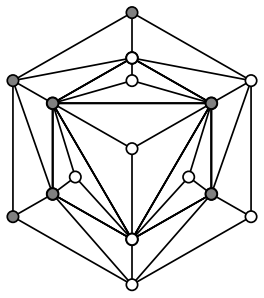
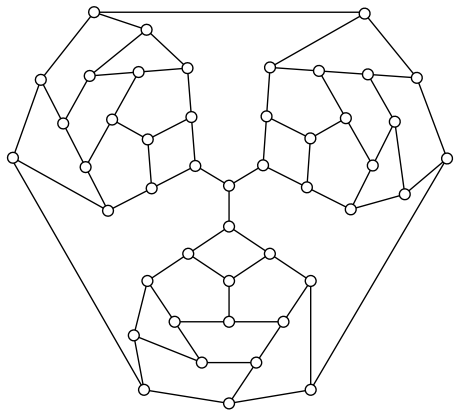
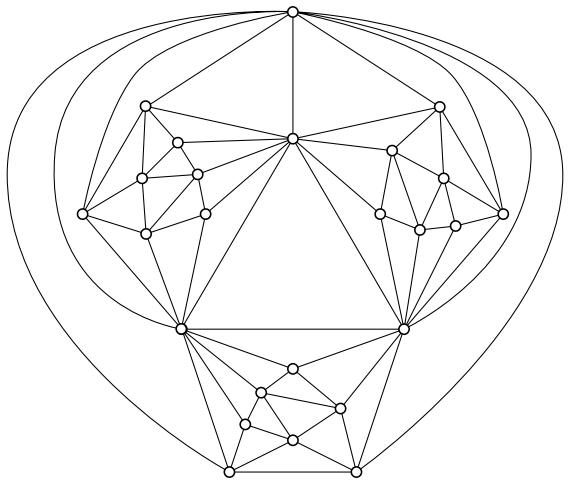
read the original abstract
Let $T_{1}, T_{2}, \dots, T_{k}$ be $k$ spanning trees of a graph $G$. For any pair of vertices $u$ and $v$, if the $u$--$v$ paths in the $k$ spanning trees are pairwise openly disjoint, then the spanning trees are called completely independent spanning trees (CISTs) of $G$. In this paper, we first prove that every 3-connected 2-outerplanar triangulated disc has two completely independent spanning trees. Next, for a 3-connected 3-outerplanar triangulated disc $G$, we provide sufficient conditions for $G$ to have two completely independent spanning trees. We provide an example of a 3-connected 4-outerplanar triangulation that does not have two completely independent spanning trees.
Editorial analysis
A structured set of objections, weighed in public.
Referee Report
Summary. The paper proves that every 3-connected 2-outerplanar triangulated disc has two completely independent spanning trees. For 3-connected 3-outerplanar triangulated discs it supplies sufficient conditions for the existence of two CISTs, and it exhibits an explicit 3-connected 4-outerplanar triangulation that admits no such pair.
Significance. The results delineate the range of outerplanarity parameters for which the CIST property is guaranteed under 3-connectivity and triangulation, supplying both a positive structural theorem for k=2 and a concrete negative instance for k=4. The explicit counterexample construction is a concrete strength.
minor comments (2)
- [Abstract] The abstract states that proofs and a counterexample exist but supplies no indication of the proof technique, key lemmas, or structural decomposition used; adding a one-sentence outline of the argument would improve readability without lengthening the abstract.
- The definition of completely independent spanning trees is given only in the abstract; repeating the definition (or a concise reference to it) at the start of the main technical section would aid readers who begin reading from the introduction.
Simulated Author's Rebuttal
We thank the referee for the careful reading and positive assessment of our results on completely independent spanning trees in outerplanar triangulated discs. The recommendation for minor revision is noted; however, no specific major comments were provided in the report.
Circularity Check
No significant circularity identified
full rationale
The paper presents direct existence proofs for two completely independent spanning trees in 3-connected 2-outerplanar triangulated discs, sufficient conditions for the 3-outerplanar case, and an explicit counterexample for 4-outerplanar graphs. No equations, fitted parameters, or statistical predictions appear. The central claims rest on structural hypotheses (3-connectivity and triangulation) that are explicitly stated in the theorem statements rather than derived from the conclusions. No self-citation chains, ansatzes smuggled via prior work, or renamings of known results are load-bearing in the provided abstract and description. The derivation is self-contained via graph-theoretic constructions and counterexample, with no reduction of outputs to inputs by definition.
Axiom & Free-Parameter Ledger
axioms (1)
- standard math Standard axioms and definitions of finite undirected graphs, spanning trees, k-outerplanarity, triangulation, and vertex-connectivity.
Reference graph
Works this paper leans on
-
[1]
T. Araki, Dirac’s condition for completely independent spanning trees, Journal of Graph Theory 77 (3) (2014) 171–179. doi:10.1002/jgt.21780
-
[2]
T. Araki, M. Matsushita, Y. Otachi, Completely independent spanning trees in (partial) k-trees, Discussiones Mathematicae Graph Theory 35 (2015) 427–437. doi:10.7151/dmgt.1806
-
[3]
Y.-H. Chang, K.-J. Pai, C.-C. Hsu, J.-S. Yang, J.-M. Chang, Constructing dual- CISTs of folded divide-and-swap cubes, Theoretical Computer Science 856 (2021) 75–87. doi:10.1016/j.tcs.2020.12.023
-
[4]
G. Chen, B. Cheng, D. Wang, Constructing completely independent spanning trees in data center network based on augmented cube, IEEE Transactions on Parallel and Distributed Systems 32 (3) (2021) 665–673
2021
-
[5]
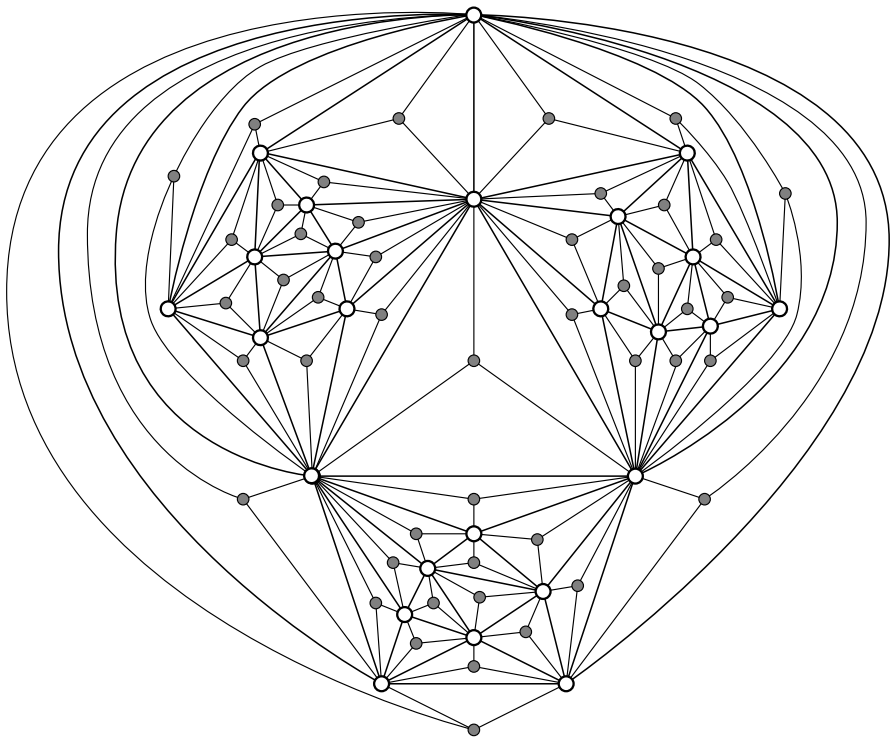
X. Chen, Q. Liu, X. Yang, Two completely independent spanning trees of split graphs, Discrete Applied Mathematics 340 (2023) 76–78. doi:10.1016/j.dam.2023.07.001 13 Figure 8: The graphD G that is made from the Tutte graph. The gray vertices are the vertices added to the dualG ∗ to constructD G. This graph does not have two completely independent spanning ...
-
[6]
B. Cheng, D. Wang, J. Fan, Independent spanning trees in networks: A survey, ACM Comput. Surv. 55 (14s). doi:10.1145/3591110
-
[7]
Hasunuma, Completely independent spanning trees in the underlying graph of a line digraph, Discrete Mathematics 234 (2001) 149–157
T. Hasunuma, Completely independent spanning trees in the underlying graph of a line digraph, Discrete Mathematics 234 (2001) 149–157
2001
-
[8]
T. Hasunuma, Completely independent spanning trees in maximal planar graphs, in: Proceedings of 28th Graph Theoretic Concepts of Computer Science (WG2002), LNCS 2573, Springer-Verlag Berlin, 2002, pp. 235–245
2002
-
[9]
Hasunuma, Minimum degree conditions and optimal graphs for completely in- dependent spanning trees, in: Z
T. Hasunuma, Minimum degree conditions and optimal graphs for completely in- dependent spanning trees, in: Z. Lipt´ ak, W. F. Smyth (eds.), Combinatorial Al- gorithms, Springer International Publishing, Cham, 2016
2016
-
[10]
T. Hasunuma, Completely independent spanning trees in line graphs, Graphs and Combinatorics 39 (2023) 90. doi:10.1007/s00373-023-02688-y
-
[11]
T. Hasunuma, C. Morisaka, Completely independent spanning trees in torus net- works, Networks 60 (2012) 59–69. doi:10.1002/net.20460
-
[12]
X. Hong, H. Zhang, A Hamilton sufficient condition for completely independent spanning tree, Discrete Applied Mathematics 279 (2020) 183–187
2020
-
[13]
X. Hong, Z. Zhang, Completely independent spanning trees inkth power of 2-connected graphs, Discrete Applied Mathematics 372 (2025) 268–273. doi:10.1016/j.dam.2025.04.051
-
[14]
K.-J. Pai, R.-S. Chang, J.-M. Chang, Constructing dual-CISTs of pancake graphs and performance assessment of protection routings on some Cayley networks, J. Supercomput. 77 (1) (2021) 990–1014. doi:10.1007/s11227-020-03297-9
-
[15]
Pai, S.-M
K.-J. Pai, S.-M. Tang, J.-M. Chang, J.-S. Yang, Completely independent spanning trees on complete graphs, complete bipartite graphs and complete tripartite graphs, in: R.-S. Chang, L. C. Jain, S.-L. Peng (eds.), Advances in Intelligent Systems and Applications - Volume 1, Springer Berlin Heidelberg, Berlin, Heidelberg, 2013
2013
-
[16]
Pai, J.-S
K.-J. Pai, J.-S. Yang, G.-Y. Chen, J.-M. Chang, Configuring protection routing via completely independent spanning trees in dense Gaussian on-chip networks, IEEE Transactions on Network Science and Engineering 9 (2) (2022) 932–946. 15
2022
-
[17]
F. P´ eterfalvi, Two counterexamples on completely independent spanning trees, Discrete Mathematics 312 (2012) 808–810. doi:10.1016/j.disc.2011.11.015
-
[18]
M. Wang, R. Liu, A note on the 4-connected line graph of a planar triangulation containing two CISTs, Graphs and Combinatorics 42, 5(2026). doi:10.1007/s00373- 025-03002-8
-
[19]
J. Yuan, J. Hao, A. Liu, S. Chai, S. Lin, The completely independent span- ning trees inP 4-free graphs, Discrete Applied Mathematics 377 (2025) 573–585. doi:10.1016/j.dam.2025.08.048 16
discussion (0)
Sign in with ORCID, Apple, or X to comment. Anyone can read and Pith papers without signing in.