REVIEW 3 major objections 5 minor 50 references
Full-Duplex OFDM Radar With LTE and 5G NR Waveforms: Challenges, Solutions, and Measurements
T0 review · 3 major / 5 minor · reviewed 2026-08-14 · deepseek-v4-flash
Pith's one-line read Standard-compliant LTE and 5G NR downlink waveforms can serve as monostatic OFDM radar signals when unused subcarriers are interpolated and transmitter self-interference is actively cancelled.
desk verdict Solid full-duplex OFDM radar demonstration with real measurements, but the measured ROC is computed in a local window around the known target and does not support the system-level false-alarm claim. read the letter →
The pith
A machine-rendered reading of the paper's core claim, the machinery that carries it, and where it could break.
The reading
What carries the argument
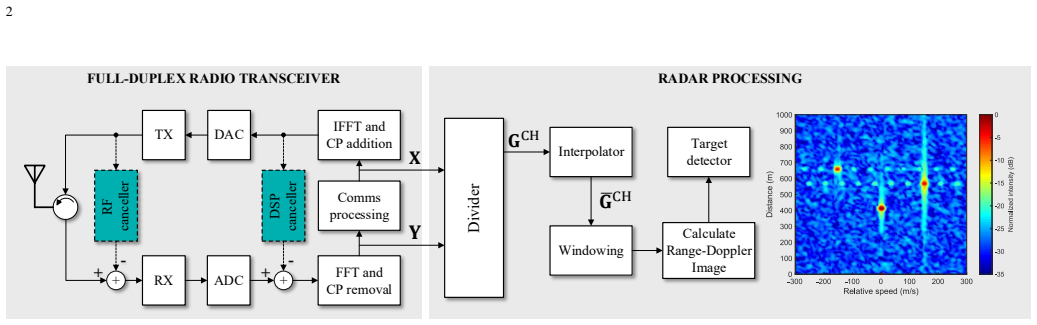
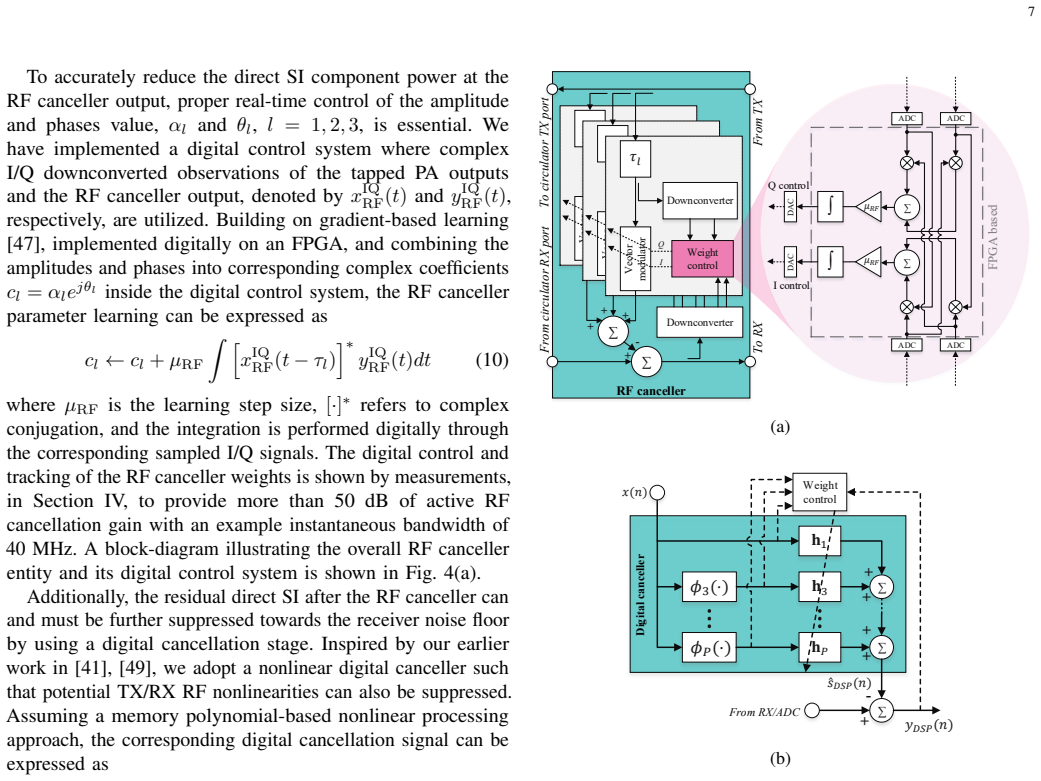
The engine of the argument is subcarrier-domain radar processing with the channel-estimation-style ratio $\bar{G}^{\mathrm{CH}}_{p,q}=Y_{p,q}/X_{p,q}$ on the LTE/NR transmit-receive grid, followed by a two-stage IFFT/FFT periodogram that maps delay to range and Doppler to velocity. Because LTE and NR leave some passband subcarriers unused, the paper inserts linear interpolation along the OFDM-symbol axis at those frequency positions before forming the periodogram. The companion hardware machinery is a three-tap RF canceller, whose maximum 10 ns delay intentionally keeps true target echoes beyond about 1.5 m intact, and a digital canceller using memory-polynomial basis functions $|x(n)|^{p-1}x(n)$ with a self-orthogonalizing update rule that avoids explicit basis orthogonalization. Together these carry the argument by converting an unreadable self-interference-dominated image into one in which real targets appear.
What would settle it
Take a shared-antenna base-station front end in an environment with a strong reflector 5--10 m from the antenna, such as a mast, building edge, or vehicle, and measure the residual self-interference after the 10 ns three-tap RF canceller and 5+5-tap digital canceller; if a static target at that range is still masked by leakage sidelobes, or if the measured residual coupling exceeds the roughly 100 dB isolation shown here, the central claim fails for realistic multipath. A complementary check is to place a target at 2 m: if the canceller suppresses it along with the leakage, the minimum-detectable-range design trade-off is confirmed.
Extended reading notes
Core claim
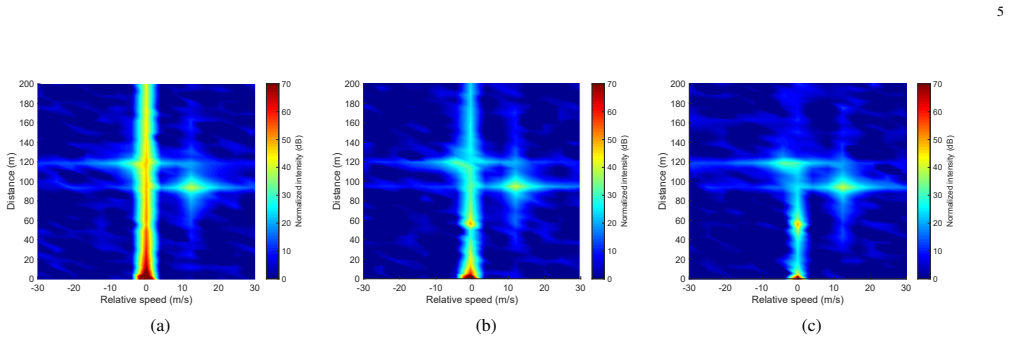
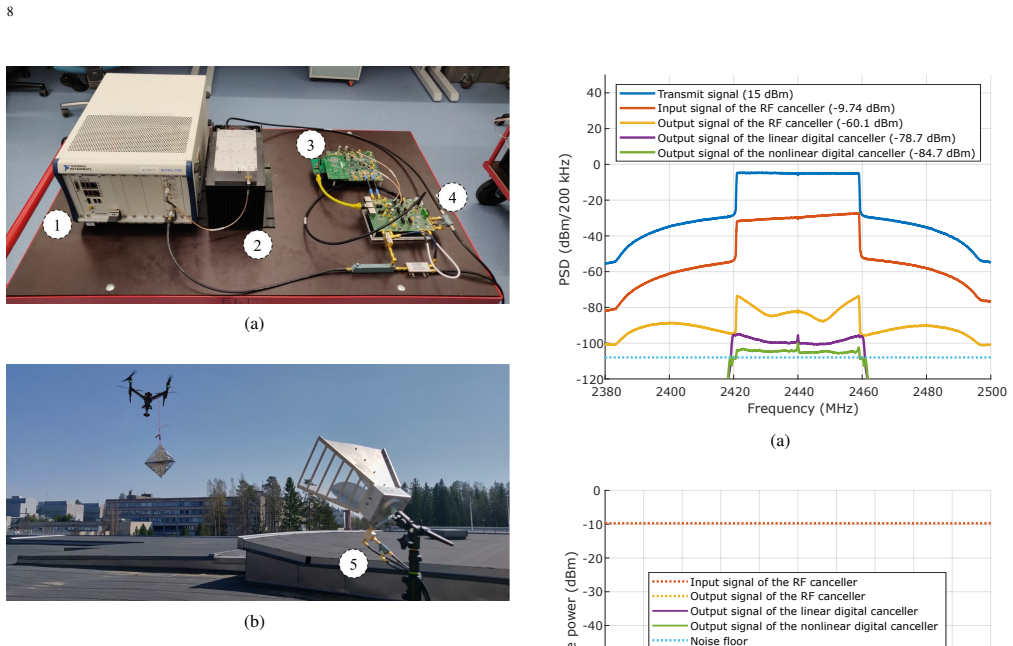
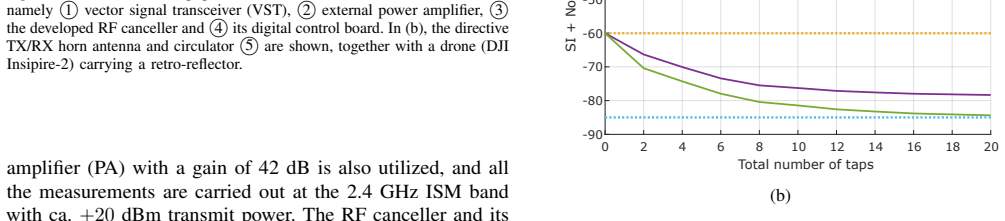
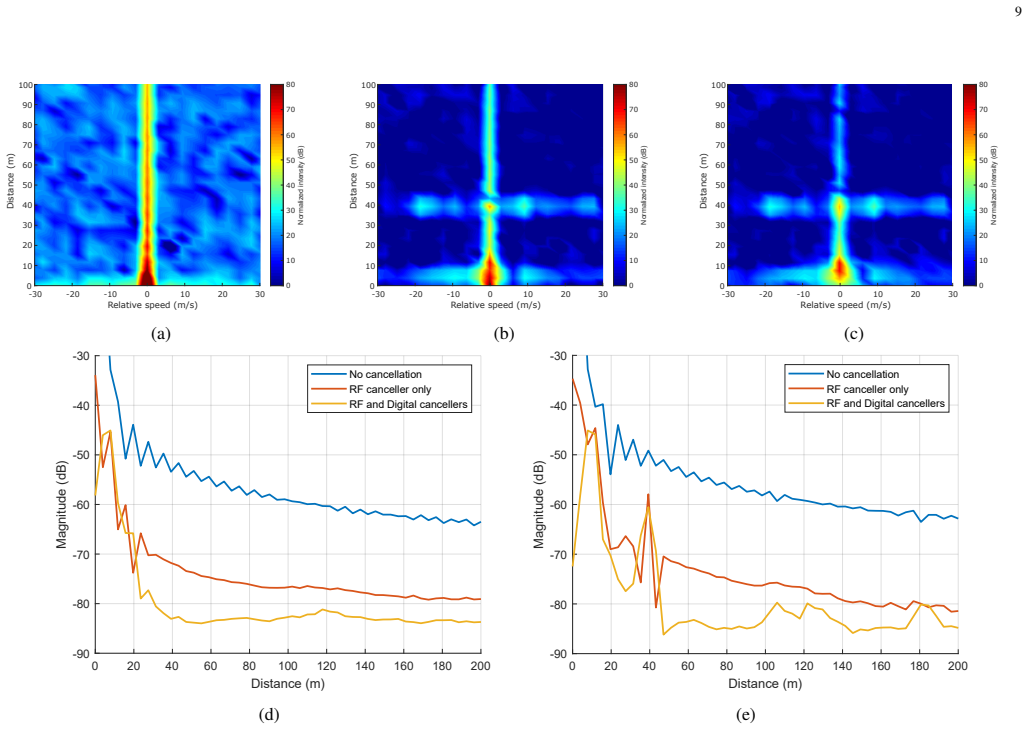
On the paper's own terms, the discovery is that the normal downlink transmission of an LTE or NR base station, processed in the frequency domain by element-wise division of the received grid by the known transmitted grid, yields a clean range-Doppler image once the gaps left by unused subcarriers are filled by linear interpolation across OFDM symbols. The transmitter's own leakage appears in that image as an extremely strong static target at zero range, and its sidelobes mask real static and slow-moving targets. The paper shows that a three-tap RF canceller with delays up to 10 ns, followed by a nonlinear memory-polynomial digital canceller with five precursor and five postcursor taps at 240 MHz, suppresses the leakage by about 100 dB in measurements while preserving echoes from targets beyond roughly 3 m. With this cancellation, a static drone at 40 m and three moving cars at 51--102 m are detected and their ranges and velocities estimated from a 40 MHz NR waveform at 2.44 GHz.
Load-bearing premise
The claim rests on the assumption that the direct transmitter-receiver coupling can be represented by an RF canceller with only three taps and delays up to 10 ns plus a 240 MHz digital canceller with five precursor and five postcursor taps, while echoes from targets closer than about 3 m are sacrificed; if real base-station coupling contains longer-delay multipath, or if the cancellers suppress close-range target returns, the demonstrated static-target detection will not transfer to practical deployments.
Editorial extensions
If this is right
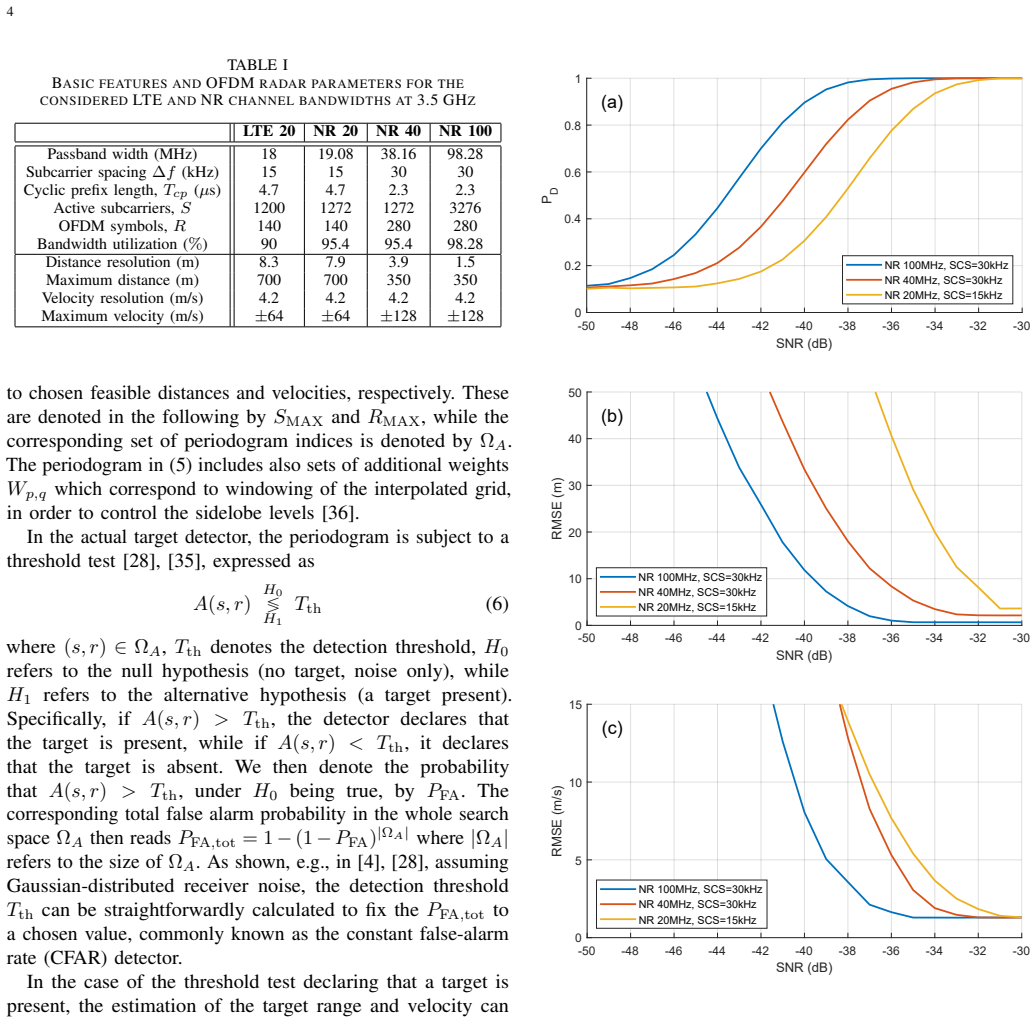
- At 100 MHz NR bandwidth with 30 kHz subcarrier spacing, the paper's simulations give distance resolution of about 1.5 m and reliable detection at input SNRs below $-30$ dB, implying that sub-6 GHz 5G base stations can support useful short-to-medium-range sensing without new spectrum.
- Because the transmitter self-interference behaves as a zero-range static target, moving targets are detectable even with weaker isolation, whereas static targets require the full RF-plus-digital cancellation chain; this orders the practical deployment difficulty.
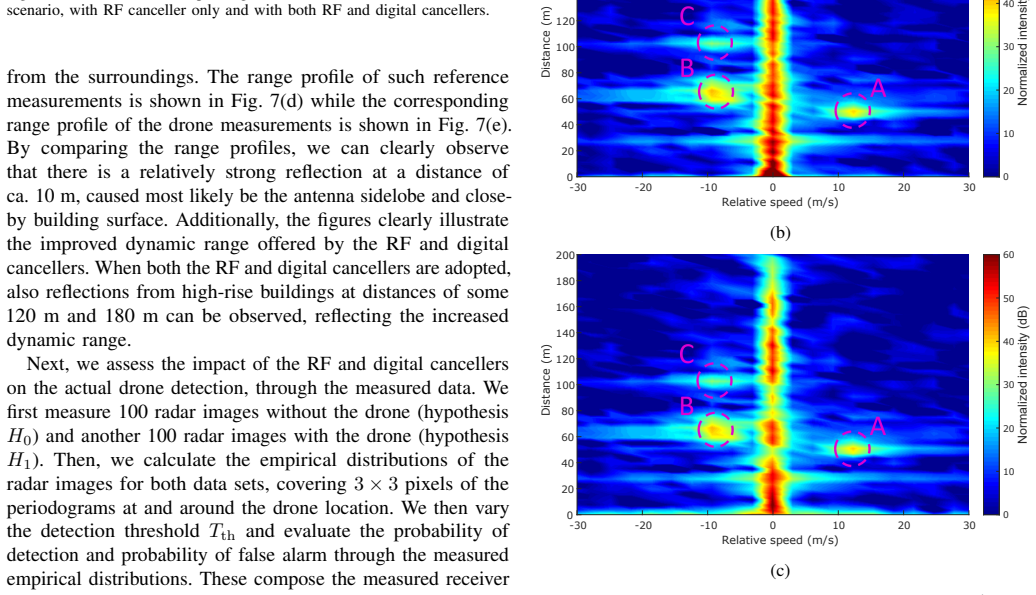
- With the cancellers active, measured range profiles reveal building reflections at 120 m and 180 m, showing the dynamic range needed for urban sensing is attainable in a real front end.
- The 10 ns RF canceller delay and 5+5 digital taps set a minimum detectable target distance around 3 m, an explicit design trade-off between cancelling close coupling and preserving close echoes.
Reading between the lines
- If the same cancellation chain scales to the 24--40 GHz NR bands, where 400 MHz contiguous carriers are already standardized, the distance resolution would drop below 0.5 m, making micro-Doppler signatures such as the drone-propeller effect seen in the measurements a practical sensing feature rather than a curiosity.
- A natural testable extension is to run the radar processing while an uplink signal is received inband; the cancellation chain would then need to separate the uplink user signal from the downlink echoes, which is a different interference geometry than the one measured.
- The static-drone experiment already shows propeller micro-Doppler sidebands at the target's range, suggesting that the same waveform could support classification of targets by their micro-motion, though the paper does not pursue classification.
- Deploying this in a live network would require the base station to know the transmitted resource grid exactly and to keep the radar receiver coherent with the transmitter; the measurements validate this on a controlled setup, so the main open engineering question is integration with real schedulers and MIMO antenna arrays.
Signed reviews
Editorial analysis
A structured set of objections, weighed in public.
Referee Report
Summary. The paper proposes and evaluates a monostatic OFDM radar concept that reuses standard-compliant LTE and 5G NR downlink transmissions. It formulates frequency-domain radar processing based on division by the transmit grid, introduces linear interpolation across OFDM symbols to handle null subcarriers, and derives target detection and range/velocity estimation via a periodogram. Simulation results for NR bandwidths of 20, 40, and 100 MHz show detection down to very low SNR and estimation RMSE approaching the resolution limits. The paper then addresses self-interference in shared-antenna operation, describing a three-tap RF canceller and a nonlinear digital canceller with a self-orthogonalizing update rule, and reports RF measurements at 2.4 GHz with a 40 MHz NR waveform: about 100 dB total isolation, detection of a static drone at 40 m, and detection of three moving vehicles with range/velocity estimates consistent with the scenario.
Significance. Assuming the central claims hold, this is a valuable end-to-end demonstration of joint communications and sensing using standard-compliant LTE/NR waveforms. The paper combines a standard frequency-domain OFDM radar processing model with a concrete solution to the self-interference problem: a three-tap RF canceller and a nonlinear digital canceller with self-orthogonalizing adaptation, measured to provide about 100 dB total TX-RX isolation. The simulations provide falsifiable predictions for detection and estimation performance across carrier bandwidths, and the outdoor measurements with a drone and vehicles are a rare hardware demonstration in this area. The radar-specific tailoring that preserves target echoes beyond a few meters is a clear distinction from generic full-duplex self-interference cancellation work. The paper is well written and the results are internally consistent; the most important weakness is the mismatch between the detector definition in Section II-B and the empirical ROC evaluation in Section IV-C.
major comments (3)
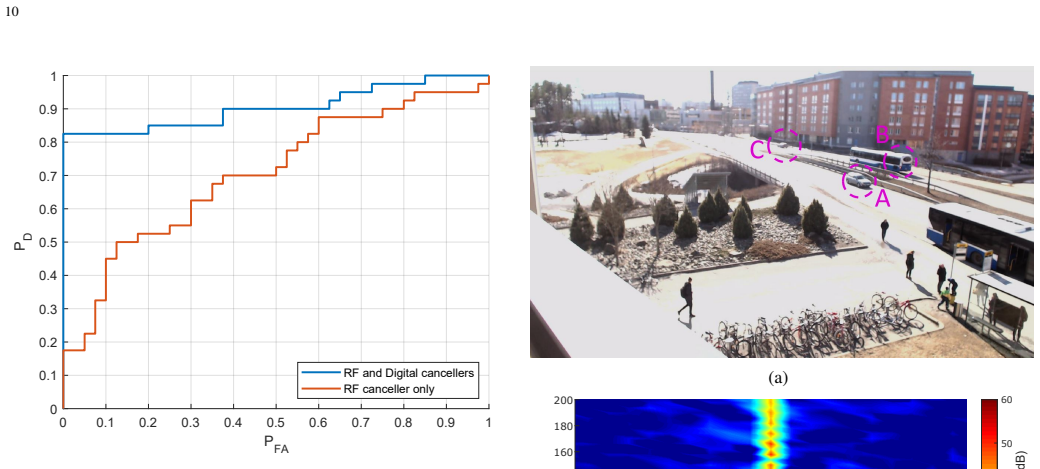
- [Section IV-C, Fig. 8] The measured ROC is not computed with the detector defined in Section II-B. In Section IV-C, the H0 and H1 empirical distributions are built from a 3x3 pixel window at and around the drone location, and the threshold is varied on those local distributions, whereas the detector in Eq. (6) operates on the full search space Omega_A and the text in Section II-B defines PFA,tot = 1 - (1-PFA)^{|Omega_A|}. Consequently, Fig. 8 reports a local per-cell trade-off, not a system-level ROC: a threshold with acceptable local PFA can still produce frequent false alarms elsewhere in the range-Doppler map, e.g., from SI sidelobes or the 10 m reflection visible in Fig. 7(d). The abstract's statement that the cancellation solutions are 'shown through RF measurements' to enable static-target detection at a specified PD/PFA is therefore not quantitatively substantiated. Please recompute the ROC over the full Omega_A or present map-level CFAR statistics over all range-Doppler bins, and adjust the claims accordingly.
- [Section II-C, Fig. 2] The simulation curves in Fig. 2 are presented without confidence intervals and without a stated number of Monte Carlo realizations. Because the detection probability and RMSE values are averaged over randomly drawn target distances and velocities (uniform over 20-200 m and -40 to 40 m/s), the reader cannot judge whether the sharp transitions in Fig. 2(a) or the RMSE floors in Fig. 2(b)-(c) are statistically stable. Please report the number of trials per SNR point and add confidence intervals or standard-error bars to the curves.
- [Section III-B and IV-B] The cancellation design assumes that the self-interference channel is sufficiently modeled by three RF taps with delays up to 10 ns (Eq. (9)) plus a 5+5 tap digital canceller at 240 MHz (Eq. (11)), and the paper argues that this preserves target echoes beyond roughly 1.5-3 m. The measurements validate this assumption for the particular anechoic-chamber and outdoor coupling environments, but the paper does not characterize the delay spread of the measured coupling channel nor test scenarios with longer-delay multipath in the SI path. Since a base-station deployment may have coupling reflections beyond 10 ns, the general claim in Section V that these cancellers are key ingredients for practical deployments is stronger than the evidence supports. I recommend either adding a coupling-channel delay-spread measurement or explicitly bounding the applicability of the cancellation parameterization.
minor comments (5)
- [Section II-C] The word 'probablity' should be 'probability' in the paragraph following Fig. 2.
- [Section IV-C] The ROC procedure is underspecified: please state whether the 100 H0 and 100 H1 measurements are independent, how the 3x3 pixel window is selected, and how the threshold sweep is mapped to PFA values. With only 100 images per hypothesis, confidence intervals on the ROC curves would also be informative.
- [Eq. (10)] The integral in Eq. (10) is written with dt over sampled I/Q signals; please clarify whether this is a discrete-time accumulation and how the integration window is chosen.
- [Eq. (12)] In Eq. (12), the correlation matrix C is said to be precomputed; please state whether regularization is used for the inversion and how C is estimated from the basis function samples.
- [Fig. 2 caption] The caption lists only NR cases; the text states that LTE 20 MHz is omitted because it is essentially identical, but the caption should also note this omission for clarity.
Circularity Check
No significant circularity: the OFDM radar processing chain is self-contained, and the SI-cancellation performance is directly measured rather than derived from the claims it supports.
full rationale
The paper's derivation chain is not circular. The received-signal model in Eq. (1) is the standard OFDM radar input-output relation with attenuation, delay, and Doppler terms, and the channel-estimation-like preprocessing in Eq. (3) is an adopted known method from the OFDM radar literature; the paper does not claim that this model alone predicts the measurements. The interpolation in Eq. (4) is a design choice for filling null subcarriers, and its benefit is evaluated in simulations with randomly placed targets, not fitted to the same target positions. The self-interference cancellation claims are supported by direct measurements: the RF canceller adaptation in Eq. (10) and the digital canceller in Eqs. (11)-(12) are fitted to the TX-RX coupling signal, and the resulting suppression (Section IV-B) and target images (Figs. 7 and 9) are measured with real drone and car targets. Moreover, the targets are deliberately placed outside the canceller memory (about 3 m), so detection of a 40 m drone or 50-110 m cars does not reduce to the cancellation fit. The self-citations to prior full-duplex hardware works [47], [41], [49] are implementation references rather than load-bearing uniqueness theorems or ansatzes; the active cancellation gain is re-measured here. The local-window ROC in Fig. 8 is a validation limitation, because the empirical H0/H1 distributions are taken from a 3x3 pixel region around the drone whereas Eq. (6) defines PFA,tot over the whole search space, but this is an external-validity concern, not a circular reduction of a prediction to its input.
Assumptions & free parameters
assumptions (4)
- domain assumption Received grid equals attenuated, delayed, and Doppler-shifted copies of the transmitted grid (Eq. 1).
- domain assumption The transmitter's resource grid X is fully known to the radar processing.
- ad hoc to paper Linear interpolation across OFDM symbols reconstructs the channel response at null subcarriers (Eq. 4).
- ad hoc to paper Three-tap RF canceller plus 5+5 tap nonlinear digital canceller sufficiently models the SI channel while preserving echoes beyond roughly 1.5 to 3 m.
Cite this review
Pith. "Pith review of Full-Duplex OFDM Radar With LTE and 5G NR Waveforms: Challenges, Solutions, and Measurements." pith.science (2026). https://pith.science/paper/2ZUIXELW
@misc{pith2026190803418,
  author       = {Pith},
  title        = {Pith review of: Full-Duplex OFDM Radar With LTE and 5G NR Waveforms: Challenges, Solutions, and Measurements},
  year         = {2026},
  howpublished = {\url{https://pith.science/paper/2ZUIXELW}},
  note         = {Machine review of arXiv:1908.03418}
}
read the original abstract
This paper studies the processing principles, implementation challenges, and performance of OFDM-based radars, with particular focus on the fourth-generation Long-Term Evolution (LTE) and fifth-generation (5G) New Radio (NR) mobile networks' base stations and their utilization for radar/sensing purposes. First, we address the problem stemming from the unused subcarriers within the LTE and NR transmit signal passbands, and their impact on frequency-domain radar processing. Particularly, we formulate and adopt a computationally efficient interpolation approach to mitigate the effects of such empty subcarriers in the radar processing. We evaluate the target detection and the corresponding range and velocity estimation performance through computer simulations, and show that high-quality target detection as well as high-precision range and velocity estimation can be achieved. Especially 5G NR waveforms, through their impressive channel bandwidths and configurable subcarrier spacing, are shown to provide very good radar/sensing performance. Then, a fundamental implementation challenge of transmitter-receiver (TX-RX) isolation in OFDM radars is addressed, with specific emphasis on shared-antenna cases, where the TX-RX isolation challenges are the largest. It is confirmed that from the OFDM radar processing perspective, limited TX-RX isolation is primarily a concern in detection of static targets while moving targets are inherently more robust to transmitter self-interference. Properly tailored analog/RF and digital self-interference cancellation solutions for OFDM radars are also described and implemented, and shown through RF measurements to be key technical ingredients for practical deployments, particularly from static and slowly moving targets' point of view.
Figures
Figures from the paper (6 more)
Reference graph
Works this paper leans on
-
[1]
Survey of RF communications and sensing convergence research,
B. Paul, A. R. Chiriyath, and D. W. Bliss, “Survey of RF communications and sensing convergence research,” IEEE Access , vol. 5, pp. 252–270, 2017
work page 2017
-
[2]
Joint wireless communication and radar sensing systems state of the art and future prospects,
L. Han and K. Wu, “Joint wireless communication and radar sensing systems state of the art and future prospects,” IET Microw., Antennas & Propag., vol. 7, no. 9, pp. 876–885, Aug. 2013
work page 2013
-
[3]
Waveform design and signal processing aspects for fusion of wireless communications and radar sensing,
C. Sturm and W. Wiesbeck, “Waveform design and signal processing aspects for fusion of wireless communications and radar sensing,” Proc. IEEE, vol. 99, no. 7, pp. 1236–1259, July 2011
2011
-
[4]
OFDM radar algorithms in mobile communication networks,
M. Braun, “OFDM radar algorithms in mobile communication networks,” Ph.D. dissertation, Karlsruhe Institute of Technology, 2014
2014
-
[5]
Doppler estimation in an OFDM joint radar and communication system,
Y . L. Sit, C. Sturm, and T. Zwick, “Doppler estimation in an OFDM joint radar and communication system,” in Proc. IEEE German Microw. Conf., March 2011, pp. 1–4
work page 2011
-
[6]
An OFDM system concept for joint radar and communications operations,
C. Sturm, T. Zwick, and W. Wiesbeck, “An OFDM system concept for joint radar and communications operations,” in Proc. IEEE V eh. Technol. Conf. (VTC) , April 2009, pp. 1–5
work page 2009
-
[7]
B. Schweizer, C. Knill, D. Schindler, and C. Waldschmidt, “Stepped- carrier OFDM-radar processing scheme to retrieve high-resolution range- velocity profile at low sampling rate,” IEEE Trans. Microw. Theory Techn., vol. 66, no. 3, pp. 1610–1618, March 2018
work page 2018
-
[8]
C. Knill, B. Schweizer, S. Sparrer, F. Roos, R. F. H. Fischer, and C. Waldschmidt, “High range and doppler resolution by application of compressed sensing using low baseband bandwidth OFDM radar,” IEEE Trans. Microw. Theory Techn. , vol. 66, no. 7, pp. 3535–3546, July 2018
work page 2018
Show all 50 references
-
[9]
Analysis of an LTE waveform for radar applications,
A. Evers and J. A. Jackson, “Analysis of an LTE waveform for radar applications,” in Proc. Eur . Radar Conf., May 2014, pp. 0200–0205
2014
-
[10]
OFDM radar with LTE waveform: Processing and performance,
C. Baquero Barneto, L. Anttila, M. Fleischer, and M. Valkama, “OFDM radar with LTE waveform: Processing and performance,” in Proc. IEEE Radio Wireless Symp. (RWS) , Jan. 2019, pp. 1–4
2019
-
[11]
Joint radar-communication: Low complexity algorithm and self-interference cancellation,
Y . Zeng, Y . Ma, and S. Sun, “Joint radar-communication: Low complexity algorithm and self-interference cancellation,” in Proc. IEEE Global Commun. Conf. (GLOBECOM) , Dec. 2018, pp. 1–7
2018
-
[12]
An in-band full-duplex transceiver for simultaneous communication and environmental sensing,
S. A. Hassani, A. Guevara, K. Parashar, A. Bourdoux, B. van Liempd, and S. Pollin, “An in-band full-duplex transceiver for simultaneous communication and environmental sensing,” in Proc. Asilomar Conf. Signals, Syst., Computers (ASILOMAR) , Oct 2018, pp. 1389–1394
2018
-
[13]
LTE- R based passive multistatic radar for high-speed railway network surveillance,
R. Blazquez-Garcia, J. Casamayon-Anton, and M. Burgos-Garcia, “LTE- R based passive multistatic radar for high-speed railway network surveillance,” in Proc. Eur . Radar Conf., Sep. 2018, pp. 6–9
2018
-
[14]
Ambiguity function analysis of Long Term Evolution transmission for passive radar,
Y . Dan, X. Wan, J. Yi, and Y . Rao, “Ambiguity function analysis of Long Term Evolution transmission for passive radar,” in Proc. Int. Symp. Antennas, Propag., EM Theory (ISAPE) , Dec. 2018, pp. 1–4
2018
-
[15]
28 GHz 5G-based phased-arrays for UA V detection and automotive traffic-monitoring radars,
Y . Wang, T. Phelps, K. Kibaroglu, M. Sayginer, Q. Ma, and G. M. Rebeiz, “28 GHz 5G-based phased-arrays for UA V detection and automotive traffic-monitoring radars,” in IEEE MTT-S Int. Microw. Symp. Dig. , Jun. 2018, pp. 895–898
2018
-
[16]
Dahlman, S
E. Dahlman, S. Parkvall, and J. Sk ¨old, 5G NR – The Next Generation Wireless Access Technology. Academic Press, 2018
2018
-
[17]
3GPP TS 36.104 v15.3.0,
“3GPP TS 36.104 v15.3.0, ”Evolved Universal Terrestrial Radio Access (E-UTRA); Base Station (BS) radio transmission and reception”, Tech. Spec. Group Radio Access Network, Rel. 15,” Jun. 2018
2018
-
[18]
3GPP TS 38.104 v15.4.0,
“3GPP TS 38.104 v15.4.0, ”NR; Base Station (BS) radio transmission and reception”, Tech. Spec. Group Radio Access Network, Rel. 15,” Dec. 2018
2018
-
[19]
In-band full-duplex technology: Techniques and systems survey,
K. E. Kolodziej, B. T. Perry, and J. S. Herd, “In-band full-duplex technology: Techniques and systems survey,”IEEE Trans. Microw. Theory Techn., pp. 1–17, 2019
2019
-
[20]
Full-duplex RF front ends: From antennas and circulators to leakage cancellation,
M. Biedka, Y . E. Wang, Q. M. Xu, and Y . Li, “Full-duplex RF front ends: From antennas and circulators to leakage cancellation,” IEEE Microw. Mag., vol. 20, no. 2, pp. 44–55, Feb. 2019
2019
-
[21]
In-band full-duplex wireless: Challenges and opportunities,
A. Sabharwal, P. Schniter, D. Guo, D. W. Bliss, S. Rangarajan, and R. Wichman, “In-band full-duplex wireless: Challenges and opportunities,” IEEE J. Sel. Areas Commun. , vol. 32, no. 9, pp. 1637–1652, Sep. 2014
2014
-
[22]
Passive self-interference suppression for full-duplex infrastructure nodes,
E. Everett, A. Sahai, and A. Sabharwal, “Passive self-interference suppression for full-duplex infrastructure nodes,” IEEE Trans. Wireless Commun., vol. 13, no. 2, pp. 680–694, Feb. 2014. 12
2014
-
[23]
Inherent self- interference cancellation for in-band full-duplex single-antenna systems,
S. Khaledian, F. Farzami, B. Smida, and D. Erricolo, “Inherent self- interference cancellation for in-band full-duplex single-antenna systems,” IEEE Trans. Microw. Theory Techn. , vol. 66, no. 6, pp. 2842–2850, Jun. 2018
2018
-
[24]
Non-magnetic 60 GHz SOI CMOS circulator based on loss/dispersion-engineered switched bandpass filters,
A. Nagulu and H. Krishnaswamy, “Non-magnetic 60 GHz SOI CMOS circulator based on loss/dispersion-engineered switched bandpass filters,” in Proc. IEEE Int. Solid-State Circuits Conf. (ISSCC) , Feb. 2019, pp. 446–448
2019
-
[25]
A 28GHz magnetic-free non-reciprocal passive CMOS circulator based on spatio-temporal conductance modula- tion,
T. Dinc and H. Krishnaswamy, “A 28GHz magnetic-free non-reciprocal passive CMOS circulator based on spatio-temporal conductance modula- tion,” in Proc. IEEE Int. Solid-State Circuits Conf. (ISSCC) , Feb. 2017, pp. 294–295
2017
-
[26]
Improved Tx-to-Rx isolation of radar transceivers using integrated full duplexer with PLL,
Y . S. Choi, C. S. Cho, and Y . Kim, “Improved Tx-to-Rx isolation of radar transceivers using integrated full duplexer with PLL,” in Proc. IEEE Int. Conf. Radar (RADAR) , Aug. 2018, pp. 1–4
2018
-
[27]
Adaptive RF front-ends using electrical-balance duplexers and tuned SAW resonators,
B. van Liempd, A. Visweswaran, S. Ariumi, S. Hitomi, P. Wambacq, and J. Craninckx, “Adaptive RF front-ends using electrical-balance duplexers and tuned SAW resonators,” IEEE Trans. Microw. Theory Techn., vol. 65, no. 11, pp. 4621–4628, Nov. 2017
2017
-
[28]
Richards, W
M. Richards, W. Holm, and J. Scheer, Principles of Modern Radar: Basic Principles . Institution of Engineering and Technology, 2010
2010
-
[29]
Linear FMCW radar techniques,
A. G. Stove, “Linear FMCW radar techniques,” IEE Proceedings F - Radar and Signal Processing , vol. 139, no. 5, pp. 343–350, Oct. 1992
1992
-
[30]
Short-range leakage cancelation in FMCW radar transceivers using an artificial on-chip target,
A. Melzer, A. Onic, F. Starzer, and M. Huemer, “Short-range leakage cancelation in FMCW radar transceivers using an artificial on-chip target,” IEEE J. Sel. Topics Signal Process. , vol. 9, no. 8, pp. 1650–1660, Dec. 2015
2015
-
[31]
Application of linear-frequency-modulated continuous-wave (LFMCW) radars for tracking of vital signs,
G. Wang, J. Muoz-Ferreras, C. Gu, C. Li, and R. Gmez-Garca, “Application of linear-frequency-modulated continuous-wave (LFMCW) radars for tracking of vital signs,” IEEE Trans. Microw. Theory Techn. , vol. 62, no. 6, pp. 1387–1399, Jun. 2014
2014
-
[32]
Through-the-wall sensing of personnel using passive bistatic WiFi radar at standoff distances,
K. Chetty, G. E. Smith, and K. Woodbridge, “Through-the-wall sensing of personnel using passive bistatic WiFi radar at standoff distances,” IEEE Trans. Geosci. Remote Sens. , vol. 50, no. 4, pp. 1218–1226, Apr. 2012
2012
-
[33]
Successive self-interference cancellation in a low-complexity WCP-OFDM radar receiver,
S. Mercier, D. Roque, and S. Bidon, “Successive self-interference cancellation in a low-complexity WCP-OFDM radar receiver,” in Proc. Asilomar Conf. Signals, Syst., Computers (ASILOMAR) , Oct. 2018, pp. 712–716
2018
-
[34]
Evaluation of clutter suppression in CP-OFDM based passive radar,
Y . Liu, J. Yi, X. Wan, X. Zhang, and H. Ke, “Evaluation of clutter suppression in CP-OFDM based passive radar,” IEEE Sensors J. , pp. 1–1, 2019
2019
-
[35]
Levanon and E
N. Levanon and E. Mozeson, Radar Signals . John Wiley & Sons, Inc., 2004
2004
-
[36]
Maximum likelihood speed and distance estimation for OFDM radar,
M. Braun, C. Sturm, and F. K. Jondral, “Maximum likelihood speed and distance estimation for OFDM radar,” in Proc. Eur . Radar Conf., May 2010, pp. 256–261
2010
-
[37]
Full duplex radios,
D. Bharadia, E. McMilin, and S. Katti, “Full duplex radios,” in Comp. Commu. Rev. (SIGCOMM) , vol. 43, no. 4. ACM, 2013, pp. 375–386
2013
-
[38]
Analog/RF solutions enabling compact full-duplex radios,
B. Debaillie, D. van den Broek, C. Lavn, B. van Liempd, E. A. M. Klumperink, C. Palacios, J. Craninckx, B. Nauta, and A. P ¨arssinen, “Analog/RF solutions enabling compact full-duplex radios,” IEEE J. Sel. Areas Commun., vol. 32, no. 9, pp. 1662–1673, Sep. 2014
2014
-
[39]
Full-duplex mobile device: pushing the limits,
D. Korpi, J. Tamminen, M. Turunen, T. Huusari, Y . Choi, L. Anttila, S. Talwar, and M. Valkama, “Full-duplex mobile device: pushing the limits,” IEEE Commun. Mag. , vol. 54, no. 9, pp. 80–87, Sep. 2016
2016
-
[40]
A full- duplex transceiver with two-stage analog cancellations for multipath self-interference,
Y . Liu, P. Roblin, X. Quan, W. Pan, S. Shao, and Y . Tang, “A full- duplex transceiver with two-stage analog cancellations for multipath self-interference,” IEEE Trans. Microw. Theory Techn. , vol. 65, no. 12, pp. 5263–5273, Dec. 2017
2017
-
[41]
Com- pact inband full-duplex relays with beyond 100 dB self-interference suppression: Enabling techniques and field measurements,
D. Korpi, M. Heino, C. Icheln, K. Haneda, and M. Valkama, “Com- pact inband full-duplex relays with beyond 100 dB self-interference suppression: Enabling techniques and field measurements,” IEEE Trans. Antennas Propag., vol. 65, no. 2, pp. 960–965, Feb. 2017
2017
-
[42]
Mitigation of loopback self- interference in full-duplex MIMO relays,
T. Riihonen, S. Werner, and R. Wichman, “Mitigation of loopback self- interference in full-duplex MIMO relays,” IEEE Trans. Signal Process. , vol. 59, no. 12, pp. 5983–5993, Dec. 2011
2011
-
[43]
Full duplex techniques for 5G networks: self-interference cancellation, protocol design, and relay selection,
Z. Zhang, X. Chai, K. Long, A. V . Vasilakos, and L. Hanzo, “Full duplex techniques for 5G networks: self-interference cancellation, protocol design, and relay selection,” IEEE Commun. Mag. , vol. 53, no. 5, pp. 128–137, May 2015
2015
-
[44]
Applications of self-interference cancellation in 5G and beyond,
S. Hong, J. Brand, J. I. Choi, M. Jain, J. Mehlman, S. Katti, and P. Levis, “Applications of self-interference cancellation in 5G and beyond,” IEEE Commun. Mag. , vol. 52, no. 2, pp. 114–121, Feb. 2014
2014
-
[45]
Recent advances in antenna design and interference cancellation algorithms for in-band full duplex relays,
M. Heino, D. Korpi, T. Huusari, E. Antonio-Rodriguez, S. Venkatasub- ramanian, T. Riihonen, L. Anttila, C. Icheln, K. Haneda, R. Wichman, and M. Valkama, “Recent advances in antenna design and interference cancellation algorithms for in-band full duplex relays,” IEEE Commun. M...
2015
-
[46]
Study of the target self-interference in a low-complexity OFDM-based radar receiver,
S. Mercier, D. Roque, and S. Bidon, “Study of the target self-interference in a low-complexity OFDM-based radar receiver,” IEEE Trans. Aerosp. Electron. Syst., pp. 1–1, 2018
2018
-
[47]
Wideband self-adaptive RF cancellation circuit for full-duplex radio: Operating principle and measurements,
T. Huusari, Y . Choi, P. Liikkanen, D. Korpi, S. Talwar, and M. Valkama, “Wideband self-adaptive RF cancellation circuit for full-duplex radio: Operating principle and measurements,” in Proc. IEEE V eh. Technol. Conf. (VTC) , May 2015, pp. 1–7
2015
-
[48]
Experiment-driven characteriza- tion of full-duplex wireless systems,
M. Duarte, C. Dick, and A. Sabharwal, “Experiment-driven characteriza- tion of full-duplex wireless systems,” IEEE Trans. Wireless Commun. , vol. 11, no. 12, pp. 4296–4307, Dec. 2012
2012
-
[49]
Cancellation of power amplifier induced nonlinear self-interference in full-duplex transceivers,
L. Anttila, D. Korpi, V . Syrj¨al¨a, and M. Valkama, “Cancellation of power amplifier induced nonlinear self-interference in full-duplex transceivers,” in Proc. Asilomar Conf. Signals, Syst., Computers (ASILOMAR) , Nov. 2013, pp. 1193–1198. Carlos Baquero Barneto (S’18) is a Ph...
2013
-
[2014]
He held various research positions at Aalto University School of Electrical Engineering from September 2005 through December 2017
He is currently an Assistant Professor (tenure track) at the Faculty of Information Technology and Communication Sciences, Tampere University, Finland. He held various research positions at Aalto University School of Electrical Engineering from September 2005 through December ...
2005
Reviewed August 14, 2026 · model on record in the stance chip above.
Discussion (0). Continue with ORCID to comment.