TERA: A Unified Taylor Model Enabled Reachability Analysis Framework
Pith reviewed 2026-07-02 07:12 UTC · model grok-4.3
The pith
TERA implements Taylor model reachability analysis for continuous, hybrid and stochastic systems inside one Python codebase.
A machine-rendered reading of the paper's core claim, the machinery that carries it, and where it could break.
Core claim
TERA is a unified Python-native framework for Taylor-model-based reachability analysis that supports continuous, hybrid and stochastic systems in a single workflow, delivering tight reachable-set over-approximations for non-linear ODEs and hybrid systems on difficult benchmarks and already handling continuous-time stochastic systems.
What carries the argument
Taylor Model arithmetic and propagation rules, implemented once in a Python symbolic-numeric workflow to handle continuous, hybrid and stochastic dynamics while preserving rigor.
If this is right
- Reachability analysis of non-linear ODEs and hybrid systems becomes available inside an open Python environment that supports rapid prototyping.
- Continuous-time stochastic systems can already be analyzed with the same rigorous enclosure methods used for deterministic cases.
- Future extension to stochastic hybrid systems becomes possible within the same codebase rather than requiring separate tools.
- Existing Taylor-model techniques gain a common implementation layer that can be extended without rewriting core arithmetic.
Where Pith is reading between the lines
- Python users could combine the framework directly with optimization or learning libraries to tune analysis parameters on the fly.
- The unified structure might make it easier to compare enclosure tightness across deterministic and stochastic models on the same problem.
- If the codebase remains maintainable, it could serve as a base for adding parameter uncertainty or discrete-event stochastic jumps.
Load-bearing premise
A single Taylor model implementation in Python can be made to cover continuous, hybrid and stochastic dynamics without sacrificing either mathematical soundness or practical tightness on non-trivial examples.
What would settle it
On a published benchmark problem the TERA enclosures are at least as wide as those produced by an existing specialized tool, or the stochastic case produces an enclosure that fails to contain all sampled trajectories.
Figures
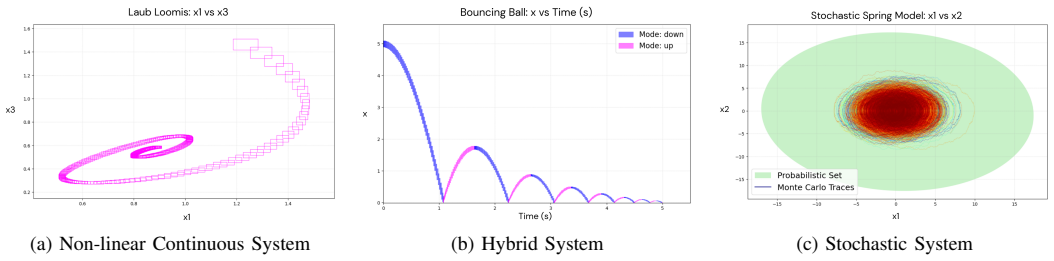
read the original abstract
Reachability analysis of safety-critical systems requires computing rigorous enclosures of all possible state trajectories. Taylor Model (TM)-based methods have proved effective at mitigating the so-called wrapping effect which leads to overly conservative enclosures of reachable sets. However, existing tools are often hard to extend or focused on narrow system classes (e.g. deterministic systems modelled by ODEs, or hybrid systems). We develop TERA: a Python-native framework for TM-based reachability analysis of continuous, hybrid and stochastic systems within a single symbolic-numeric workflow. TERA is free and open-source, enabling rapid prototyping of reachability analysis techniques with rigorous enclosures. At present, our implementation is able to compute tight reachable set over-approximations for non-linear ODEs and hybrid systems on difficult benchmark problems, and already supports analysis of continuous-time stochastic systems. Our goal is to develop a robust open-source Python infrastructure for rigorous reachability analysis supporting a broad class of systems, including stochastic hybrid systems.
Editorial analysis
A structured set of objections, weighed in public.
Referee Report
Summary. The manuscript introduces TERA, a Python-native open-source framework for Taylor Model (TM)-based reachability analysis that unifies continuous, hybrid, and stochastic systems in a single symbolic-numeric workflow. It claims the implementation computes tight reachable-set over-approximations for non-linear ODEs and hybrid systems on difficult benchmarks and already supports continuous-time stochastic systems, with the goal of providing extensible infrastructure for rigorous analysis including stochastic hybrid systems.
Significance. If the implementation delivers rigorous and tight enclosures across the claimed system classes, TERA would constitute a useful open-source contribution by lowering the barrier to prototyping TM-based methods in Python and addressing the extensibility limitations of existing specialized tools. The open-source release and explicit support for multiple dynamics classes are concrete strengths that could facilitate broader adoption in safety-critical verification.
major comments (2)
- [Abstract] Abstract: the claim that the implementation 'is able to compute tight reachable set over-approximations for non-linear ODEs and hybrid systems on difficult benchmark problems' supplies no numerical results, error metrics, run-time data, or comparisons with existing TM tools, rendering the tightness assertion unevaluable from the manuscript text.
- [Abstract] Abstract: stochastic support is stated only as 'already supports analysis of continuous-time stochastic systems' without the benchmark tightness data or error metrics supplied for the ODE/hybrid cases. Because the central claim is a single unified TM workflow that preserves both rigor and practical tightness across all three classes, this evidentiary asymmetry is load-bearing for the unification argument.
Simulated Author's Rebuttal
We thank the referee for the constructive feedback on the abstract. The comments highlight the need for clearer alignment between high-level claims and the evidence presented. We respond to each major comment below and will revise the abstract accordingly.
read point-by-point responses
-
Referee: [Abstract] Abstract: the claim that the implementation 'is able to compute tight reachable set over-approximations for non-linear ODEs and hybrid systems on difficult benchmark problems' supplies no numerical results, error metrics, run-time data, or comparisons with existing TM tools, rendering the tightness assertion unevaluable from the manuscript text.
Authors: The abstract is a concise summary; the supporting numerical results, error metrics, run-times, and comparisons to tools such as Flow* appear in Sections 4.1 (ODE benchmarks) and 4.2 (hybrid benchmarks). The tightness claim is therefore evaluable from the full manuscript. To improve self-containment of the abstract we will add a brief quantitative qualifier (e.g., “with enclosure widths within X% of reference solutions on the considered benchmarks”). revision: yes
-
Referee: [Abstract] Abstract: stochastic support is stated only as 'already supports analysis of continuous-time stochastic systems' without the benchmark tightness data or error metrics supplied for the ODE/hybrid cases. Because the central claim is a single unified TM workflow that preserves both rigor and practical tightness across all three classes, this evidentiary asymmetry is load-bearing for the unification argument.
Authors: We accept that the current wording creates an asymmetry. The stochastic module implements the same TM arithmetic and integration scheme as the deterministic cases, thereby preserving rigor within a unified workflow; however, the manuscript does not yet contain comparable tightness benchmarks for stochastic systems. We will revise the abstract to state that stochastic support is implemented but that quantitative tightness evaluation for this class remains future work. revision: yes
Circularity Check
No circularity; tool/framework paper with no derivations or fitted predictions
full rationale
The manuscript describes an open-source Python framework (TERA) for Taylor Model reachability analysis across continuous, hybrid, and stochastic systems. No derivation chain, equations, parameter fitting, or first-principles predictions appear in the provided text. Claims concern implementation capabilities and benchmark support, which are externally verifiable via code and execution rather than reducing to self-referential inputs. The absence of any self-definitional, fitted-input, or self-citation load-bearing steps makes the circularity score 0.
Axiom & Free-Parameter Ledger
Reference graph
Works this paper leans on
-
[1]
Berz, Martin and Makino, Kyoko , journal=. Verified integration of. 1998 , publisher=
work page 1998
-
[2]
Abolfazl Lavaei and Sadegh Soudjani and Alessandro Abate and Majid Zamani , title =. Automatica , volume =. 2022 , url =
work page 2022
-
[3]
Kyoko Makino and Martin Berz , title =. Symbolic Numeric Computation,. 2009 , url =
work page 2009
-
[4]
Florian B. Shrink wrapping for. Numer. Algorithms , volume =. 2018 , url =
work page 2018
-
[5]
Reachability Analysis of Non-Linear Hybrid Systems Using
Chen, Xin , year=. Reachability Analysis of Non-Linear Hybrid Systems Using
-
[6]
Probabilistic Reachability Analysis of Stochastic Control Systems , volume=
Saber Jafarpour and Liu, Zishun and Chen, Yongxin , year=. Probabilistic Reachability Analysis of Stochastic Control Systems , volume=. IEEE Trans. Automat. Contr. , publisher=. doi:10.1109/tac.2025.3566983 , number=
-
[7]
Nonlinear Theory and Its Applications (NOLTA), IEICE , author=
Preconditioning of. Nonlinear Theory and Its Applications (NOLTA), IEICE , author=. 2021 , pages=. doi:10.1587/nolta.12.2 , url=
-
[8]
Althoff, Matthias and Dmitry Grebenyuk and Niklas Kochdumper , year=. Implementation of. doi:https://doi.org/10.29007/zzc7 , journal=
-
[9]
The Journal of Logic and Algebraic Programming , author=
Taylor models and floating-point arithmetic: proof that arithmetic operations are validated in COSY , volume=. The Journal of Logic and Algebraic Programming , author=. 2005 , month=. doi:https://doi.org/10.1016/j.jlap.2004.07.008 , number=
-
[10]
Suppression of the wrapping effect by
Berz, Martin and Makino, Kyoko , year =. Suppression of the wrapping effect by
- [11]
-
[12]
Automated verification and synthesis of stochastic hybrid systems: A survey , journal =. 2022 , issn =. doi:10.1016/j.automatica.2022.110617 , url =
-
[13]
Applied Stochastic Differential Equations , publisher=
S\"arkk\"a, Simo and Solin, Arno , year=. Applied Stochastic Differential Equations , publisher=
discussion (0)
Sign in with ORCID, Apple, or X to comment. Anyone can read and Pith papers without signing in.