REVIEW 3 major objections 5 minor 28 references
An efficient implementation of mass conserving characteristic-based schemes in 2D and 3D
T0 review · 3 major / 5 minor · reviewed 2026-08-14 · deepseek-v4-flash
Pith's one-line read This paper claims that replacing tracked cells by balls, then correcting the transfer volumes with a two-step scaling and a minimal-adjustment optimisation, yields a locally and globally mass-conserving characteristic scheme whose…
desk verdict B-char is a genuinely new and practical ball-approximation idea for ELLAM, but the mass-conservation claim has an unproved feasibility gap and needs revision. read the letter →
The pith
A machine-rendered reading of the paper's core claim, the machinery that carries it, and where it could break.
The reading
What carries the argument
The key object is the ball approximation of a cell: each cell $K$ is filled with $n_K$ disjoint balls $B_{K,s}$, and a porous density $\rho_K$ distributes the cell's porous volume over the balls. The flow map $F_t$ moves these balls backward in time, and the paper assumes the image of a ball is again a ball, so a tracked cell is represented only by centers and radii; ball-ball intersections then give cheap estimates of how much mass each cell receives from every other cell. The argument is carried by the transfer-matrix corrections: equation (28) alternates column scalings that impose global mass balance with row scalings that impose local balance, and equation (29) solves a minimal-adjustment constrained optimisation on the nonzero transfer entries, restoring exact conservation with as little distortion of the initial ball-based approximation as possible.
What would settle it
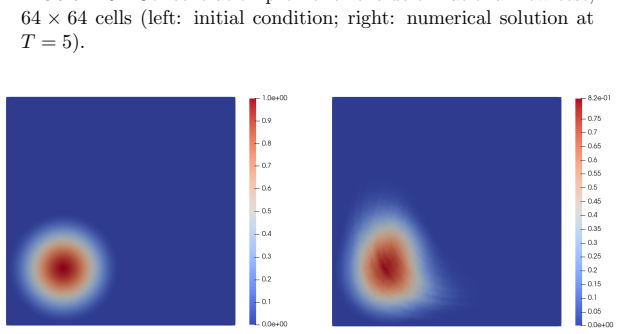
Run the B-char method on a strongly shearing flow (for instance the deformational-flow test with $T=5$) and advect a dense set of points on the surface of one initial ball to obtain the exact image region; compare that region with the ball that B-char tracks. If the area of the symmetric difference—the set covered by one but not the other—is not small when the initial radius is one-fourth of the smallest face diameter, then the volume constraints (28)-(29) are being satisfied by heavily distorting the transfer matrix, and the final solution will show visible distortion and amplitude loss.
Extended reading notes
Core claim
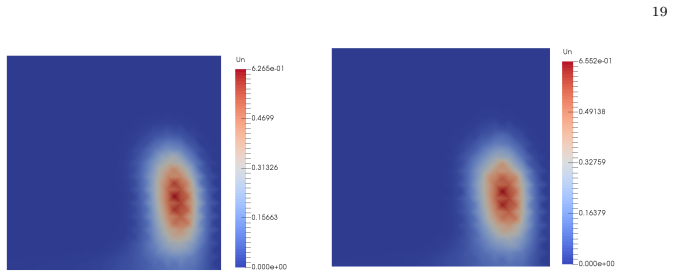
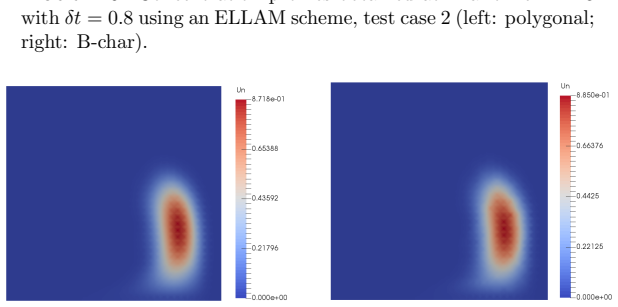
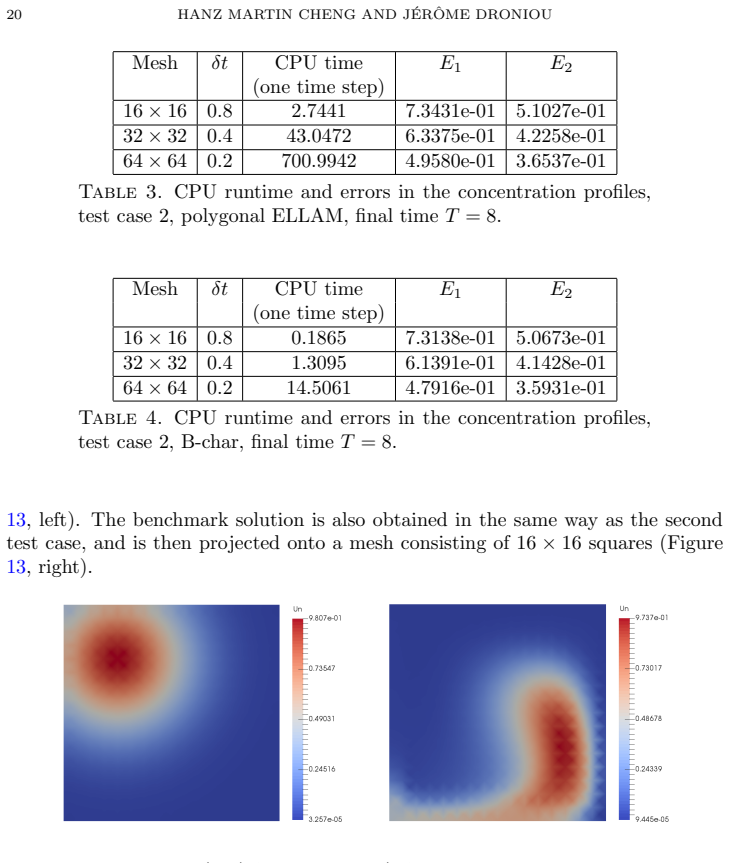
The central claim is that ball approximations, together with the two-step redistribution formula (28) and the minimal-adjustment optimisation problem (29), produce a locally and globally mass-conserving ELLAM-type scheme whose solutions are close to those of a polytopal-intersection implementation. The construction replaces each mesh cell with disjoint interior balls, assigns each ball an equivalent porous volume, tracks the balls backward in time under the flow, and computes ball-ball intersections to form an initial transfer matrix. A column scaling step enforces global mass conservation, a row scaling step enforces local conservation, and a quadratic program finds the minimal scaling that satisfies both constraints at once, so the correction is small when the ball approximation is good. Numerical tests on translation, rotation, solid-body rotation, and deformational flows in 2D, and on translation and rotation-stretching flows in 3D, report error levels close to the polygonal ELLAM's, with per-step runtimes up to about 40 times shorter in 2D, and 3D errors of similar magnitude to the 2D errors.
Load-bearing premise
The load-bearing premise is that a tracked ball remains a ball, so it can be described by its center and radius; this is false in general, and the paper relies on the heuristic that the balls start small enough (radius at most a quarter of the smallest face diameter) for the error to stay acceptable, without a quantitative bound.
Editorial extensions
If this is right
- Characteristic-based schemes such as ELLAM can be implemented in 3D without polyhedral intersection routines; the paper's 3D tests on a $16^3$ mesh run in tens of seconds per time step.
- The B-char scheme preserves constant solutions and enforces local and global mass conservation exactly, rather than approximately, by construction of the adjusted transfer matrix.
- The method extends to non-solenoidal velocity fields by tracking circumference points to approximate the deformed ball radius, at extra cost, as described in Remark 3.4.
- Increasing the number of balls per cell improves the initial volume approximation and reduces the number of redistribution iterations needed, giving a tunable accuracy-cost trade-off.
- Because the scheme is set in a general spatial-discretisation framework, the ball approximation can be combined with different cell-centred or hybrid discretisations used for the diffusive part of an advection-diffusion model.
Reading between the lines
- The tracked-ball assumption is the point most worth stress-testing: a quantitative bound on how far an advected ball deviates from a true ball under realistic velocity fields would upgrade the heuristic radius limit (one-fourth of the smallest face diameter) into a convergence statement.
- The same ball-intersection idea should transfer to other characteristic schemes whose bottleneck is region intersection, such as MMOCAA, and to remap or particle-deposition tasks in Lagrangian methods; this is a natural extension the paper only mentions as future work.
- A testable prediction is that the optimal number of balls per cell grows with flow distortion: coarse packing should suffice for translations, while shear-dominated flows would require more balls, smaller time steps, or both, to keep the tracked-ball approximation credible.
- The reported speedups are tied to the prototype implementation; a production comparison would measure total time to reach a target error, including the cost of solving the optimisation problem and of packing balls on generic meshes.
Signed reviews
Editorial analysis
A structured set of objections, weighed in public.
Referee Report
Summary. The paper proposes the B-char method, a ball-approximation strategy for implementing characteristic-based schemes such as ELLAM for pure advection problems. Each mesh cell is approximated by a collection of disjoint balls; back-tracking their centers gives approximate trace-back regions, and ball-ball intersections replace expensive polytopal intersections. The paper derives an initial volume transfer matrix V in Eq. (25), performs iterative row/column scalings in Eq. (28), and then solves a constrained least-squares problem in Eq. (29) to enforce exact local and global mass conservation. Numerical tests in 2D compare B-char ELLAM with a polygonal ELLAM on Cartesian meshes, report similar errors at substantially lower CPU time, and further demonstrate the method on solid-body rotation and deformational-flow benchmarks and on 3D test cases. The abstract claims that the scheme is both locally and globally mass conserving and achieves results similar to polytopal intersections at much lower cost.
Significance. If the central claims hold, this is a practically valuable contribution: it offers a simple, cheap way to implement ELLAM-type schemes in 3D, where polyhedral intersection computations are notoriously difficult. The strengths of the paper include a clean derivation of the ELLAM update (12), a transparent construction of the initial volume approximation (25), the explicit encoding of local and global mass conservation as constraints (26)-(27), and a substantial set of numerical benchmarks, including the solid-body rotation and deformational-flow tests. The reported CPU-time reductions are striking (up to roughly 40x on the finest 2D tests), and the 3D simulations demonstrate that the approach is usable in practice. The mass-conservation properties are true by construction when the constrained problem is feasible, so this is an engineering-oriented contribution rather than a new convergence theory. The main weakness is that the feasibility of the central constrained least-squares problem is not established, which directly affects the claimed conservation guarantee.
major comments (3)
- [Section 3.2, Eq. (29)] The central conservation claim rests on the solvability of the constrained least-squares problem (29) with the implicit box constraint 0 <= 1+x <= 2. The paper does not prove that a solution exists for the support graph induced by A^(N). A nonnegative matrix with prescribed row and column sums and with zero entries fixed at zero exists only under Hall-type conditions on the support, and the additional upper bound 2 makes feasibility harder. If a tracked cell intersects balls of only one residing cell, its entire row demand must be supplied by a column whose total mass may be smaller, in which case no x satisfies (29). The paper itself concedes, two paragraphs before Eq. (29), that after iterating (28) 'there is no guarantee that such a result is achievable'; the same issue applies to (29). Since the algorithm as stated has no output if (29) is infeasible, the claimed local and global mass conservation is not unconditional. The authors should either prove feasibility under stated assumptions (e.g., on ball packing, time step, or mesh regularity) or provide a fallback procedure, such as a provably convergent rescaling algorithm or an explicit support-enrichment step.
- [Section 3.1, Eq. (25)] The definition of V_{\hat K,M} in Eq. (25) divides by the sum over M and l of rho_M phi_M |\hat B_{K,s} \cap B_{M,l}|. This denominator is zero whenever a tracked ball \hat B_{K,s} falls entirely into a gap between residing balls. The paper mentions this possibility in Figure 3 and suggests increasing the number of balls, but provides no rigorous rule that prevents the denominator from vanishing; the algorithm as written would then encounter division by zero. Even if the denominator is positive, the normalization in (24) can become ill-conditioned when the overlap is very small, which can amplify errors in the initial approximation. The paper should specify a deterministic handling of the zero-denominator case, for example by assigning the mass of such a tracked ball proportionally to the nearest residing cell or by a fallback that does not break the subsequent conservation correction.
- [Section 3, ball tracking paragraph] The method assumes that each tracked ball remains a ball, so only centers and radii need to be tracked and ball-ball intersections are exact. The paper acknowledges that this assumption is false in general and invokes the heuristic that the maximum ball radius be at most one fourth of the smallest face diameter, but it provides no quantitative error bound or distortion limit. Under strong shear or on nonuniform meshes, the initial volume matrix (25) can deviate substantially from the true transported volumes, and the least-squares correction in (29) may then have to distort the transport matrix heavily, degrading solution quality rather than merely correcting small errors. The deformational-flow test in Section 4.1.5 shows visible distortion and amplitude loss, which the paper attributes to mesh resolution, but no diagnostic is given to distinguish the ball approximation error from the usual discretization error. The authors should provide a quantitative measure of local deformation (e.g., a bound on the condition number of the deformation gradient over a time step) and report this diagnostic in the numerical tests, or restrict the claimed accuracy regime accordingly.
minor comments (5)
- [Section 3.2, Eq. (29)] The sentence 'Letting x = (x_j)_{j=1,...,n_c}' is a dimension mismatch: x is an n_z-vector, not an n_c-vector. This should be corrected to j=1,...,n_z.
- [Remark 3.2] The sentence 'This corresponds to a loss in mass that should be deposited in another cell' is confusing, because the preceding discussion describes overlapping tracked balls causing excess mass to be deposited, i.e., a gain rather than a loss, for the cells receiving the double contribution. The wording should be clarified to avoid the apparent contradiction.
- [Algorithm 1] Algorithm 1 states that the minimal change in volumes is found so that constraints (29) are satisfied, but it does not explicitly state the positivity and upper-bound constraints 0 <= 1+x <= 2 that are described in the text. The algorithm should list these constraints or reference the full problem statement.
- [Throughout] The name of the method is spelled inconsistently as 'B-Char' and 'B-char' (e.g., Section 3 vs. the abstract and Section 4). Standardize the spelling.
- [Section 4.1.4] When comparing with the results of Bochev et al., the paper reports relative errors E1 and E2 for its method and then converts the absolute errors from the literature to relative errors. The conversion is useful, but the statement that the absolute errors 'correspond to relative errors' should be accompanied by the value of the norm of the exact solution used in the conversion, for reproducibility.
Circularity Check
No significant circularity: mass conservation is imposed as explicit constraints, and the ball approximation is independently benchmarked; remaining concerns are feasibility and accuracy, not circular reasoning.
full rationale
The B-char method does not claim to discover or predict mass conservation from an independent principle; it enforces local and global mass conservation as explicit design constraints. The initial approximation V in Eq. (25) is built so that each row satisfies the local constraint (26) via Eq. (23), and the global column constraints (27) are then imposed by the alternating rescaling in Eq. (28) and by the constrained least-squares problem (29), whose constraints are exactly the row and column sums (26)-(27). The resulting conservation property is therefore true by construction, assuming a feasible solution to (29) exists; this is a transparent algorithmic guarantee, not a hidden fit or a prediction derived from its own output. The accuracy of the ball approximation is not forced by those constraints: Section 4 compares B-char ELLAM against polygonal ELLAM on the same advection test cases and against independent benchmarks (solid body rotation, deformational flow, and reference solutions), so the central utility claim is externally benchmarked. Self-citations to [8]-[10] supply background ELLAM/GDM convergence analysis and the generalized Liouville formula; they are not used to define the target result. The paper also openly flags its limitations, including the ball-preservation assumption that 'is not true in general' (Section 3) and the absence of a guarantee for the redistribution iteration (Section 3.2: 'there is no guarantee that such a result is achievable'), as well as deferring non-solenoidal fields to future work (Section 5). These are correctness and feasibility risks, notably the unproved existence of a nonnegative bounded solution to (29) with fixed support, but they are not circularity. Verdict: no significant circularity.
Assumptions & free parameters
free parameters (5)
- Number of redistribution iterations N =
N = 10
- Number of balls per cell =
4 in 2D; 8 in 3D
- Ball radius upper bound =
r <= (1/4) * min face diameter
- Circumference tracking points for radius (non-constant porosity) =
4
- Ball packing configuration =
not specified in general
assumptions (6)
- standard math Existence and uniqueness of the flow F_t solving dF_t/dt = u(n+1)(F_t)/phi(F_t).
- standard math Generalized Liouville formula Eq. (16): d/dt |F_t(A)|_phi = integral over F_t(A) of div u.
- domain assumption u.n = 0 on the boundary (no-flow boundary).
- domain assumption div u = 0 (solenoidal velocity) in the numerical tests.
- ad hoc to paper Each tracked ball remains a ball.
- ad hoc to paper The constrained least-squares problem Eq. (29) has a feasible solution with 0 < 1+x <= 2.
invented entities (2)
-
Balls B_{K,s} approximating mesh cells
-
Porous density rho_K
Cite this review
Pith. "Pith review of An efficient implementation of mass conserving characteristic-based schemes in 2D and 3D." pith.science (2026). https://pith.science/paper/32CAUUUP
@misc{pith2026190805834,
  author       = {Pith},
  title        = {Pith review of: An efficient implementation of mass conserving characteristic-based schemes in 2D and 3D},
  year         = {2026},
  howpublished = {\url{https://pith.science/paper/32CAUUUP}},
  note         = {Machine review of arXiv:1908.05834}
}
read the original abstract
In this paper, we develop the ball-approximated characteristics (B-char) method, which is an algorithm for efficiently implementing characteristic-based schemes in 2D and 3D. Core to the implementation of numerical schemes is the evaluation of integrals, which in the context of characteristic-based schemes with piecewise constant approximations boils down to computing the intersections between two regions. In the literature, these regions are approximated by polytopes (polygons in 2D and polyhedra in 3D) and, due to this, the implementation in 3D is nontrivial. The main novelty in this paper is the approximation of the regions by balls, whose intersections are much cheaper to compute than those of polytopes. Of course, balls cannot fully tessellate a region, and hence some mass may be lost. We perform some adjustments, and also solve an optimisation problem, in order to yield a scheme that is both locally and globally mass conserving. This algorithm can achieve results that are similar to those obtained from an implementation which uses polytopal intersections, with a much cheaper computational cost.
Figures


Figures from the paper (17 more)





Reference graph
Works this paper leans on
-
[1]
T. Arbogast and C. Huang. A fully mass and volume conserving implementation of a charac- teristic method for transport problems. SIAM Journal on Scientific Computing , 28(6):2001– 2022, 2006
work page 2001
-
[2]
T. Arbogast and C.-S. Huang. A fully conservative Eulerian-Lagrangian method for a convection-diffusion problem in a solenoidal field. J. Comput. Phys., 229(9):3415–3427, 2010
work page 2010
-
[3]
T. Arbogast and W.-H. Wang. Stability, monotonicity, maximum and minimum principles, and implementation of the volume corrected characteristic method. SIAM J. Sci. Comput. , 33(4):1549–1573, 2011
work page 2011
- [4]
-
[5]
M. A. Celia, T. F. Russell, I. Herrera, and R. E. Ewing. An Eulerian-Lagrangian localized adjoint method for the advection-diffusion equation. Advances in Water Resources, 13(4):187 – 206, 1990. 27
work page 1990
-
[6]
T. M. Chan. A simpler linear-time algorithm for intersecting two convex polyhedra in three dimensions. Discrete & Computational Geometry , 56(4):860–865, 2016
work page 2016
- [7]
-
[8]
H. M. Cheng and J. Droniou. An HMM–ELLAM scheme on generic polygonal meshes for miscible incompressible flows in porous media.Journal of Petroleum Science and Engineering, 172:707 – 723, 2019
work page 2019
Show all 28 references
-
[9]
H. M. Cheng, J. Droniou, and K.-N. Le. A combined GDM–ELLAM–MMOC scheme for advection dominated PDEs. ArXiv e-prints, 2018
2018
-
[10]
H. M. Cheng, J. Droniou, and K.-N. Le. Convergence analysis of a family of ELLAM schemes for a fully coupled model of miscible displacement in porous media. Numerische Mathematik, 141(2):353–397, 2019
2019
-
[11]
D’Elia, D
M. D’Elia, D. Ridzal, K. J. Peterson, P. Bochev, and M. Shashkov. Optimization-based mesh correction with volume and convexity constraints.Journal of Computational Physics, 313:455 – 477, 2016
2016
-
[12]
Dobrindt, K
K. Dobrindt, K. Mehlhorn, and M. Yvinec. A complete and efficient algorithm for the in- tersection of a general and a convex polyhedron. In Algorithms and Data Structures , pages 314–324, Berlin, Heidelberg, 1993. Springer Berlin Heidelberg
1993
-
[13]
Douglas, F
J. Douglas, F. Furtado, and F. Pereira. On the numerical simulation of waterflooding of heterogeneous petroleum reservoirs. Computational Geosciences, 1(2):155–190, 1997
1997
-
[14]
Droniou, R
J. Droniou, R. Eymard, T. Gallou¨ et, C. Guichard, and R. Herbin.The gradient discretisation method, volume 82 of Mathematics & Applications . Springer, 2018
2018
-
[15]
Droniou, R
J. Droniou, R. Eymard, T. Gallou¨ et, and R. Herbin. A unified approach to mimetic finite difference, hybrid finite volume and mixed finite volume methods. Math. Models Methods Appl. Sci., 20(2):265–295, 2010
2010
-
[16]
D. Durran. Numerical Methods for Wave Equations in Geophysical Fluid Dynamics . Texts in Applied Mathematics. Springer New York, 1998
1998
-
[17]
R. Ewing. The Mathematics of Reservoir Simulation . Society for Industrial and Applied Mathematics, 1983
1983
-
[18]
R. W. Healy and T. F. Russell. Solution of the advection-dispersion equation in two dimen- sions by a finite-volume eulerian-lagrangian localized adjoint method. Advances in Water Resources, 21(1):11 – 26, 1998
1998
-
[19]
Hertel, M
S. Hertel, M. M¨ antyl¨ a, K. Mehlhorn, and J. Nievergelt. Space sweep solves intersection of convex polyhedra. Acta Informatica, 21(5):501–519, 1984
1984
-
[20]
Kreiss and J
H.-O. Kreiss and J. Lorenz. The navier-stokes equations. In Initial-Boundary Value Problems and the Navier-Stokes Equations , volume 136 of Pure and Applied Mathematics , pages 1 –
-
[21]
D. Kuzmin. Algebraic flux correction for finite element approximation of transport equations. In A. B. de Castro, D. G´ omez, P. Quintela, and P. Salgado, editors,Numerical Mathematics and Advanced Applications, pages 345–353. Springer Berlin Heidelberg, Berlin, Heidelberg, 2006
2006
-
[22]
P. H. Lauritzen and J. Thuburn. Evaluating advection/transport schemes using interrelated tracers, scatter plots and numerical mixing diagnostics. Quarterly Journal of the Royal Me- teorological Society, 138(665):906–918, 2012
2012
-
[23]
R. J. LeVeque. High-resolution conservative algorithms for advection in incompressible flow. SIAM Journal on Numerical Analysis , 33(2):627–665, 1996
1996
-
[24]
Muller and F
D. Muller and F. Preparata. Finding the intersection of two convex polyhedra. Theoretical Computer Science, 7(2):217 – 236, 1978
1978
-
[25]
R. D. Nair and P. H. Lauritzen. A class of deformational flow test cases for linear transport problems on the sphere. Journal of Computational Physics , 229(23):8868 – 8887, 2010
2010
-
[26]
D. W. Peaceman and H. H. Rachford, Jr. Numerical calculation of multidimensional miscible displacement. Society of Petroleum Engineers Journal , 2(4):327–339, 1962
1962
-
[27]
T. F. Russell and M. A. Celia. An overview of research on Eulerian–Lagrangian localized adjoint methods (ELLAM). Advances in Water Resources, 25(8):1215 – 1231, 2002
2002
-
[28]
Thom´ ee.Galerkin Finite Element Methods for Parabolic Problems (Springer Series in Computational Mathematics)
V. Thom´ ee.Galerkin Finite Element Methods for Parabolic Problems (Springer Series in Computational Mathematics). Springer-Verlag, Berlin, Heidelberg, 2006. 28 HANZ MARTIN CHENG AND J ´ERˆOME DRONIOU Department of Mathematics and Computer Science, Eindhoven University of Tech...
2006
Reviewed August 14, 2026 · model on record in the stance chip above.
Discussion (0). Continue with ORCID to comment.