REVIEW 4 major objections 5 minor 1 cited by
Using simulation based inference on tidally perturbed dwarf galaxies: the dynamics of NGC205
T0 review · 4 major / 5 minor · reviewed 2026-08-10 · deepseek-v4-flash
Pith's one-line read A tidally perturbed dwarf galaxy's sky-projected velocity field, mapped across its face, carries enough information to infer both its orbit and its total mass density profile without any proper-motion measurement.
desk verdict A useful proof-of-concept for SBI on tidally perturbed dwarfs, honest about its failure on NGC205 itself, but the abstract overstates what the mock test actually shows. read the letter →
The pith
A machine-rendered reading of the paper's core claim, the machinery that carries it, and where it could break.
The reading
What carries the argument
The machinery is an iterative simulation-based inference loop. The forward model is an N-body simulation of the satellite, initialized from a truncated generalized NFW profile $\rho(r) = \rho_0 (r/r_h)^{-\gamma}(1 + r/r_h)^{\gamma-3}/(1 + (r/r_{\rm tidal})^4)$ with Eddington-inverted isotropic velocities, back-propagated along a test-particle orbit for 500 Myr in a static M31 potential (Hernquist bulge, Miyamoto-Nagai disk, NFW halo), and then evolved forward through the present; a tracer sub-population is selected by an energy-dependent inclusion probability fitted to NGC205's observed surface brightness, so simulated observations mimic real data taking. The data compressor reduces each simulation to six interpretable summary statistics: the sky-projected semi-major axis angle $\Xi$, the turnaround radius $\xi_{\rm turn}$ and amplitudes $a_1, a_2$ of an anti-symmetric S-shaped spline $S(\xi_1)$, and the perpendicular velocity slope $s_\perp$, which together model the mean line-of-sight velocity field $\bar{w}(\phi_1,\phi_2) = S(\xi_1) + s_\perp \xi_2$, plus the central velocity dispersion ${\rm std}(w)_0$. The likelihood $\Pr(t|\theta)$ is emulated by an ensemble of four Gaussian mixture density networks, and an outer loop — draw parameters from the prior, simulate a batch, compress, retrain the emulator, then sample the posterior by MCMC to seed the next batch — concentrates computation in the data-compatible region until the posterior is stable over ten consecutive batches.
What would settle it
A proper-motion measurement of NGC205 is the cleanest test: if astrometry places it behind M31 or moving toward it, the paper's tidal explanation of the S-shape is contradicted. A cheaper check is an integral-field map of the dwarf's full face, which should show a perpendicular velocity slope $s_\perp$ with the same orientation as the S-shape and a central velocity dispersion that rises toward the center within 3 arcminutes.
Extended reading notes
Core claim
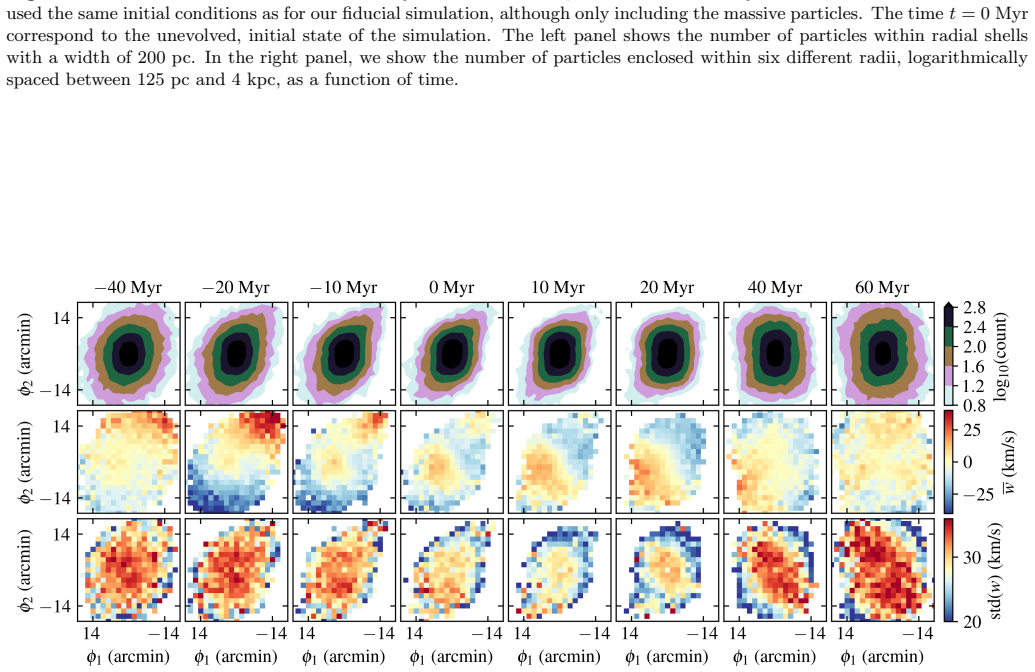
The central claim is that the precise shape of a tidally perturbed satellite's sky-projected internal velocity field, mapped across its face, is highly informative of both its orbit and its total mass density profile, even in the absence of proper motion information. To establish this, the authors run a likelihood-free Bayesian inference loop: an N-body satellite, initialized as a spherical, isotropic, steady-state system with a truncated generalized NFW density profile, is evolved through a recent pericenter passage in a static model of M31's potential; a stellar tracer sub-population is carved out by an energy-based inclusion function that matches NGC205's exponential surface brightness; and the simulated velocity field is compressed into six summary statistics whose likelihood is emulated by a neural density estimator. On mock data from a fiducial simulation, the loop recovers all six input parameters within one standard deviation of the posterior mode, constrains the density amplitude $\rho_{\rm 1kpc}$ to about 18 percent (0.08 dex in $\log_{10}$), partially constrains the inner slope $\gamma$ (preferring $\gamma = 1$ over $\gamma = 0$), and recovers the line-of-sight depth precisely. The authors do not present a posterior for NGC205 itself: no simulation simultaneously matches the observed short turnaround radius and high amplitude of the velocity S-shape, and the twisting isophotes are not reproduced by spherical, isotropic initial conditions — deficiencies they attribute to those idealizations and show can be mitigated by endowing the tracer population with modest internal rotation. Qualitatively, the S-shape is reproduced, which, if the feature is tidal, implies a recent (tens of millions of years) high-transverse-velocity passage in front of M31, with the orbital plane nearly parallel to the line of sight.
Load-bearing premise
The load-bearing premise is that NGC205 was spherically symmetric, isotropic, and in steady state immediately before its most recent pericenter passage, with the observed stars forming an energy-selected sub-population of that state; if the real galaxy carried significant rotation or anisotropy into the encounter, every mapping the inference loop learns from orbit and density to the compressed velocity features is misspecified.
Editorial extensions
If this is right
- A two-dimensional velocity map of a perturbed dwarf carries orbit information that a slit along the semi-major axis cannot: the perpendicular slope $s_\perp$ and the surface-brightness ellipticity (correlation 0.78 with line-of-sight depth) are informative, so a new round of observations covering the full face of NGC205 would substantially tighten the inferred orbit.
- If the S-shape is produced by M31's tides, NGC205 must have passed pericenter within the last few tens of millions of years, on a highly eccentric orbit with the line of sight nearly parallel to the orbital plane, and it must now sit in front of M31, moving away from it on the sky — a configuration that an earlier orbit search excluded by construction.
- The framework transfers to other strongly perturbed systems with similar S-shaped velocity signatures — NGC770, Crater II, the Sagittarius dwarf — enabling orbit and mass inference for extra-galactic dwarfs where proper motions are unavailable.
- Even under the idealized spherical-isotropic initial conditions, the mock-data test demonstrates a benchmark precision of 18 percent on the density at 1 kpc and partial discrimination between cusped and cored inner profiles, which is enough to speak to dark matter models that predict different central density slopes.
Reading between the lines
- Extension the authors leave implicit: the same inference loop could be run with the satellite's density profile replaced by a particle-model prediction, such as a fuzzy dark matter soliton, converting the method from a mass-measurement tool into a dark-sector discriminator; the paper's introduction already notes that perturbed dwarfs can develop long-lived breathing modes in that model.
- The 18 percent mock-data uncertainty is likely a lower bound on the real systematic error, because real dwarf ellipticals carry some rotation, and the paper's own rotational experiments show that initial rotation changes both the isophotal shape and the strength of the velocity S-shape, so it would shift the recovered density amplitude as well.
- A testable extension of the forward model: the back-propagated orbit neglects dynamical friction and mass loss during the passage, so running two-passage or live-halo variants would reveal whether the six summary statistics stay sufficient for lower-velocity, longer-interaction orbits, testing the first-passage conclusion itself.
- An immediate observing corollary is that an integral-field observation covering a few arcminutes around NGC205 would supply the missing perpendicular velocity slope $s_\perp$ and the two-dimensional dispersion map; given the reported ellipticity-depth correlation, it should also tighten the line-of-sight depth constraint well beyond the current 37 kpc prior uncertainty.
Editorial analysis
A structured set of objections, weighed in public.
Referee Report
Summary. This paper develops a simulation-based inference (SBI) pipeline for tidally perturbed dwarf spheroidal galaxies and applies it to NGC205. The forward model evolves a spherical, isotropic, steady-state satellite in a static M31 potential, and the compressed data vector consists of six hand-picked summary statistics of the line-of-sight velocity field and projected shape. In a mock test using the fiducial simulation as target, the pipeline recovers all input parameters within 1σ of the posterior mode, with about 18% precision on log10 ρ1kpc and a preference for cuspy over cored inner slopes. The authors report that the real NGC205 observations cannot be reproduced with sufficient S-shape amplitude at small turn radius, and therefore present no posterior inference for NGC205, attributing the discrepancy to the simplifying initial conditions (spherical symmetry, isotropy) and lack of internal rotation.
Significance. If the mock-test result holds up, the paper provides a useful proof-of-concept that the time-varying internal kinematics of a dwarf satellite can constrain its orbit and density profile without proper motions, which is valuable for extra-galactic studies. The paper is unusually honest: Section 6 explicitly states that the model cannot reproduce the data and does not present a posterior. The authors also provide a check of steady-state initialization (Appendix B) and a detailed description of the inference loop and convergence criteria. The main weaknesses are that the mock test is a self-consistency check under the same forward model and that the model is demonstrably misspecified for the target; as a result, the significance for real systems is not yet established.
major comments (4)
- [Abstract and Section 5.1] The mock test in Section 5 uses the fiducial simulation of Section 4 as the target, so the target is generated by exactly the same forward model that the inference pipeline inverts. This validates the pipeline's internal consistency but does not validate the model's adequacy for real systems. The abstract's claim that the velocity field 'can be highly informative of both an orbit and total mass density profile' is unqualified, yet Section 6 shows that for NGC205 the model cannot reproduce the observed S-shape (high a1, a2 near zero, ξturn ≈ 3′), and Section 4.3 shows that an internal-rotation component absent from the inference model is needed to reproduce the isophotal twist. Please qualify the abstract and add a sentence in Section 5 clarifying that the mock test assumes the model is correct, and that model misspecification is the dominant uncertainty for real applications.
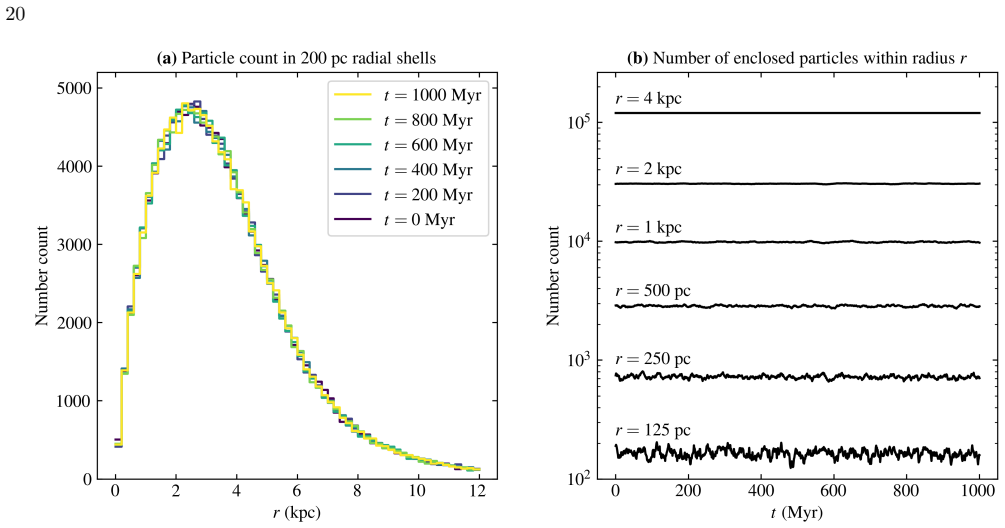
- [Section 3.3.2] The tracer inclusion probability I(E) is said to be fitted to the simulation's final state so that the tracer population matches NGC205's surface brightness profile. If the fit is performed on the fiducial simulation's final state and then used for all parameter realizations, the fiducial model's response to tidal perturbation is imprinted on the selection function, which could bias the inference for other parameters and artificially improve the mock recovery. The paper does not specify whether I(E) is re-fit for each simulation or held fixed, nor does it test sensitivity to this calibration. Please clarify the calibration procedure and add a robustness test (e.g., re-fit I(E) on a different fiducial or use an analytic energy-based selection matched to the initial profile).
- [Section 5] Only one mock test is presented, at a single fiducial parameter point, and the paper does not provide a coverage or calibration check of the neural likelihood emulator. The convergence criterion in Section 3.4.3 checks stability of the posterior between batches, but not whether the emulated likelihood yields correctly calibrated credible intervals. A standard simulation-based calibration (posterior coverage over many mock targets) or at least a posterior predictive check of the six summary statistics would strengthen the claim that the 18% density precision is a meaningful statement of inference accuracy rather than an artifact of the emulator or the single target.
- [Sections 3.4.1 and 5.2] The hand-picked compressor is central to the claim that the 'precise shape' of the velocity field is informative, but the paper provides no evidence that the six summary statistics are sufficient to capture the information in the full velocity field. Section 5.2 only reports linear correlations and notes that the parameter degeneracies make individual correlations hard to interpret. A comparison against a neural data compressor, or a test with subsets of the summary statistics to see how much information each adds, would substantiate the choice. Without this, the method's information-content claim rests on the unverified assumption that these statistics are informative by construction.
minor comments (5)
- [Section 2.1] There is a typo in the third paragraph: 'it it possible to reconcile a steady state' should read 'it is possible to reconcile a steady state'.
- [Section 3.3.1] The sentence 'the transverse velocities ˜w are shifted by sub-km/s values' appears to use the wrong symbol: the transverse velocities are ˜u and ˜v, while ˜w is the line-of-sight velocity.
- [Section 1] The telescope name 'Nancy Gracy Roman Space Telescope' is misspelled; it should be 'Nancy Grace Roman Space Telescope'.
- [Section 4.2] The text says observational errors are not applied in this section, but then quotes an uncertainty of about 1.8 km/s for the central area bins; please clarify what this number represents (e.g., internal velocity dispersion of the bin) so that the reader is not confused.
- [Section 7] The discussion extracts strong orbital conclusions (recent pericenter, high transverse velocity, satellite in front of M31) from a model that does not quantitatively reproduce the real data; these conclusions should be explicitly marked as conditional on the admittedly misspecified model.
Circularity Check
No significant circularity: the inference is a conventional forward-model self-consistency test, with acknowledged model-data mismatch for NGC205.
full rationale
The paper's central inference chain is self-contained forward modeling plus simulation-based calibration. The mock-data test (Section 5) draws the target from the same fiducial simulation (Section 4) that the pipeline is designed to invert; this is a self-consistency check, not a reduction of the inferred parameters to fitted inputs, because the inferred quantities (rho_1kpc, gamma, orbital components) are not used as training labels or summary definitions; they are forward-model inputs that generate the velocity summaries through N-body evolution. The tracer inclusion function I(E_i) is fitted to NGC205's observed surface brightness profile (Section 3.3.2), but the paper's predictive claim concerns the velocity field shape, which is not fit to the observed velocity data; the observed velocity summaries are only the target in Section 6 and are admittedly not reproduced, which weakens applicability but does not make the mock inference circular. No load-bearing uniqueness theorem or self-citation chain is invoked; the cited prior work by the same authors (Widmark et al. 2021a,b, 2024) is contextual, not load-bearing. The failure to reproduce the real S-shape and isophotal twist (Sections 4.3, 6, 7) is a model misspecification and correctness concern, not circularity.
Assumptions & free parameters
free parameters (5)
- Tracer inclusion function I(E) =
Mixture of 3 Gaussians fitted to match the 170 arcsec exponential surface brightness profile
- NFW scale length r_h =
4 kpc
- Tidal truncation radius r_tidal =
5 kpc
- Simulation softening length =
60 pc
- Time step =
2 Myr
assumptions (5)
- domain assumption The satellite was in a steady state, spherically symmetric, and isotropic before its most recent pericenter passage.
- domain assumption M31's gravitational potential is static and described by the median values of the Zhang et al. (2024) model.
- domain assumption The satellite's orbit is well approximated by a single test particle back-propagated in the static host potential.
- ad hoc to paper The hand-picked data compressor captures the informative features of the velocity field.
- domain assumption The neural density emulator provides an accurate likelihood approximation for the compressed data.
Cite this review
Pith. "Pith review of Using simulation based inference on tidally perturbed dwarf galaxies: the dynamics of NGC205." pith.science (2026). https://pith.science/paper/32DPFOKK
@misc{pith2026250113148,
  author       = {Pith},
  title        = {Pith review of: Using simulation based inference on tidally perturbed dwarf galaxies: the dynamics of NGC205},
  year         = {2026},
  howpublished = {\url{https://pith.science/paper/32DPFOKK}},
  note         = {Machine review of arXiv:2501.13148}
}
read the original abstract
We develop a novel approach to performing precision inference on tidally perturbed dwarf galaxies. We use a Bayesian inference framework of implicit likelihood inference, previously applied mainly in the field of cosmology, based on forward simulation, data compression, and likelihood emulation with neural density estimators. We consider the case of NGC205, a satellite of M31. NGC205 exhibits an S-shape in the mean line-of-sight velocity along its semi-major spatial axis, suggestive of tidal perturbation. We demonstrate that this velocity profile can be qualitatively reproduced even if NGC205 was in a spherically symmetric and isotropic state before its most recent pericenter passage. We apply our inference method to mock data and show that the precise shape of a perturbed satellite's sky-projected internal velocity field can be highly informative of both its orbit and total mass density profile, even in the absence of proper motion information. For the actual NGC205, our method is hampered because the available data only covers a line along its semi-major axis, rather than the full sky-projected field. This shortcoming could be addressed with another round of observations.
Figures


Figures from the paper (6 more)


Forward citations
Cited by 1 Pith paper
-
The Milky Way - Large Magellanic Cloud Interaction with Simulation Based Inference
Simulation-based inference on outer-halo star velocities gives a Milky Way reflex speed of 26.4 km/s and an LMC enclosed mass of 9.2×10^10 solar masses within 50 kpc.
Reference graph
Works this paper leans on
-
[1]
Adhikari, S., Banerjee, A., Boddy, K. K., et al. 2022, arXiv e-prints, arXiv:2207.10638, doi: 10.48550/arXiv.2207.10638
-
[2]
2019, arXiv e-prints, arXiv:1902.05569
Akeson, R., Armus, L., Bachelet, E., et al. 2019, arXiv e-prints, arXiv:1902.05569. https://arxiv.org/abs/1902.05569
arXiv 2019
-
[3]
2019, MNRAS, 488, 4440, doi: 10.1093/mnras/stz1960
Alsing, J., Charnock, T., Feeney, S., & Wandelt, B. 2019, MNRAS, 488, 4440, doi: 10.1093/mnras/stz1960
-
[4]
2023, MNRAS, 525, 3662, doi: 10.1093/mnras/stad2458
Alvey, J., Gerdes, M., & Weniger, C. 2023, MNRAS, 525, 3662, doi: 10.1093/mnras/stad2458
-
[5]
W., Coppin, P., Gentile, G., & Diaferio, A
Angus, G. W., Coppin, P., Gentile, G., & Diaferio, A. 2016, MNRAS, 462, 3221, doi: 10.1093/mnras/stw1822
-
[6]
2023, A&A, 673, A115, doi: 10.1051/0004-6361/202245518
Antoja, T., Ramos, P., Garc ´ ıa-Conde, B., et al. 2023, A&A, 673, A115, doi: 10.1051/0004-6361/202245518
-
[7]
2018, Nature, 561, 360, doi: 10.1038/s41586-018-0510-7 17
Antoja, T., Helmi, A., Romero-G´ omez, M., et al. 2018, Nature, 561, 360, doi: 10.1038/s41586-018-0510-7 17
-
[8]
Athanassoula, E., Fady, E., Lambert, J. C., & Bosma, A. 2000, MNRAS, 314, 475, doi: 10.1046/j.1365-8711.2000.03316.x
arXiv 2000
Show all 66 references
-
[9]
2010, in Ground-based and Airborne Instrumentation for Astronomy III, Vol
Bacon, R., Accardo, M., Adjali, L., et al. 2010, in Ground-based and Airborne Instrumentation for Astronomy III, Vol. 7735, SPIE, 131–139
2010
-
[10]
2022, Nature Astronomy, 6, 659, doi: 10.1038/s41550-022-01638-7
Battaglia, G., & Nipoti, C. 2022, Nature Astronomy, 6, 659, doi: 10.1038/s41550-022-01638-7
2022 doi
-
[11]
2016, Phys
Berezhiani, L., & Khoury, J. 2016, Phys. Lett. B, 753, 639, doi: 10.1016/j.physletb.2015.12.054
2016 doi
-
[12]
2008, Galactic Dynamics: Second Edition
Binney, J., & Tremaine, S. 2008, Galactic Dynamics: Second Edition
2008
-
[13]
F., Errani, R., & Fattahi, A
Borukhovetskaya, A., Navarro, J. F., Errani, R., & Fattahi, A. 2022, MNRAS, 512, 5247, doi: 10.1093/mnras/stac653
2022 doi
-
[14]
I., Guhathakurta, P., & Johnston, K
Choi, P. I., Guhathakurta, P., & Johnston, K. V. 2002, AJ, 124, 310, doi: 10.1086/341041
2002 doi
-
[15]
2020, Proceedings of the National Academy of Science, 117, 30055, doi: 10.1073/pnas.1912789117
Cranmer, K., Brehmer, J., & Louppe, G. 2020, Proceedings of the National Academy of Science, 117, 30055, doi: 10.1073/pnas.1912789117
2020 doi
-
[16]
R., Gair, J., et al
Dax, M., Green, S. R., Gair, J., et al. 2021, PhRvL, 127, 241103, doi: 10.1103/PhysRevLett.127.241103 de Andres, D., Cui, W., Ruppin, F., et al. 2022, Nature Astronomy, 6, 1325, doi: 10.1038/s41550-022-01784-y de Grijs, R., & Bono, G. 2014, AJ, 148, 17, doi: 10.1088/0004-6256/...
2021 doi
-
[17]
K., & Rix, H.-W
Dehnen, W., Odenkirchen, M., Grebel, E. K., & Rix, H.-W. 2004, The Astronomical Journal, 127, 2753, doi: 10.1086/383214 Del Popolo, A., & Le Delliou, M. 2021, Galaxies, 9, 123, doi: 10.3390/galaxies9040123
2004 doi
- [18]
-
[19]
Eddington, A. S. 1916, MNRAS, 76, 572, doi: 10.1093/mnras/76.7.572
1916 doi
-
[20]
F., & Frenk, C
Fattahi, A., Navarro, J. F., & Frenk, C. S. 2020, MNRAS, 493, 2596, doi: 10.1093/mnras/staa375
2020 doi
-
[21]
R., Besla, G., Mocz, P., et al
Foote, H. R., Besla, G., Mocz, P., et al. 2023, ApJ, 954, 163, doi: 10.3847/1538-4357/ace533
2023 doi
-
[22]
W., Simon, J
Fu, S. W., Simon, J. D., & Alarc´ on Jara, A. G. 2019, ApJ, 883, 11, doi: 10.3847/1538-4357/ab3658 Gaia Collaboration, et al. 2016, A&A, 595, A1, doi: 10.1051/0004-6361/201629272
2019 doi
-
[23]
Kirby, E. N. 2014, MNRAS, 444, 222, doi: 10.1093/mnras/stu1477
2014 doi
-
[24]
M., & Cooper, M
Geha, M., Guhathakurta, P., Rich, R. M., & Cooper, M. C. 2006, AJ, 131, 332, doi: 10.1086/498686
2006 doi
-
[25]
Geha, M., Guhathakurta, P., & van der Marel, R. P. 2005, AJ, 129, 2617, doi: 10.1086/430188
2005 doi
- [26]
-
[27]
R., Millman, K
Harris, C. R., Millman, K. J., van der Walt, S. J., et al. 2020, Nature, 585, 357–362, doi: 10.1038/s41586-020-2649-2
2020 doi
-
[28]
2021, MNRAS, 507, 1999, doi: 10.1093/mnras/stab2181
Louppe, G. 2021, MNRAS, 507, 1999, doi: 10.1093/mnras/stab2181
2021 doi
-
[29]
M., et al
Ho, M., Ntampaka, M., Rau, M. M., et al. 2022, Nature Astronomy, 6, 936, doi: 10.1038/s41550-022-01711-1
2022 doi
-
[30]
J., Chartier, N., et al
Ho, M., Bartlett, D. J., Chartier, N., et al. 2024, The Open Journal of Astrophysics, 7, 54, doi: 10.33232/001c.120559
2024 doi
-
[31]
M., Geha, M., Guhathakurta, P., et al
Howley, K. M., Geha, M., Guhathakurta, P., et al. 2008, ApJ, 683, 722, doi: 10.1086/589632
2008 doi
-
[32]
P., Tremaine, S., & Witten, E
Hui, L., Ostriker, J. P., Tremaine, S., & Witten, E. 2017, PRD, 95, 043541, doi: 10.1103/PhysRevD.95.043541
2017 doi
-
[33]
Hunter, J. D. 2007, Computing in Science & Engineering, 9, 90, doi: 10.1109/MCSE.2007.55
2007 doi
-
[34]
A., Gilmore, G., & Irwin, M
Ibata, R. A., Gilmore, G., & Irwin, M. J. 1994, Nature, 370, 194, doi: 10.1038/370194a0
1994 doi
-
[35]
2021, MNRAS, 501, 954, doi: 10.1093/mnras/staa3594
Jeffrey, N., Alsing, J., & Lanusse, F. 2021, MNRAS, 501, 954, doi: 10.1093/mnras/staa3594
2021 doi
-
[36]
V., Hernquist, L., & Bolte, M
Johnston, K. V., Hernquist, L., & Bolte, M. 1996, ApJ, 465, 278, doi: 10.1086/177418
1996 doi
-
[37]
V., Spergel, D
Johnston, K. V., Spergel, D. N., & Hernquist, L. 1995, ApJ, 451, 598, doi: 10.1086/176247
1995 doi
-
[38]
V., Zhao, H., Spergel, D
Johnston, K. V., Zhao, H., Spergel, D. N., & Hernquist, L. 1999, The Astrophysical Journal, 512, L109, doi: 10.1086/311876
1999 doi
-
[39]
Jones, K. G. 2008, Messier’s Nebulae and Star Clusters
2008
- [40]
-
[41]
A., Zasowski, G., Rix, H.-W., et al
Kollmeier, J. A., Zasowski, G., Rix, H.-W., et al. 2017, arXiv e-prints, arXiv:1711.03234. https://arxiv.org/abs/1711.03234
2017 arXiv
-
[42]
E., Rix, H.-W., & Hogg, D
Koposov, S. E., Rix, H.-W., & Hogg, D. W. 2010, ApJ, 712, 260, doi: 10.1088/0004-637X/712/1/260
2010 doi
-
[43]
2018, JCAP, 2018, 040, doi: 10.1088/1475-7516/2018/09/040
Lacroix, T., Stref, M., & Lavalle, J. 2018, JCAP, 2018, 040, doi: 10.1088/1475-7516/2018/09/040
2018 doi
-
[44]
R., & Majewski, S
Law, D. R., & Majewski, S. R. 2010, ApJ, 714, 229, doi: 10.1088/0004-637X/714/1/229
2010 doi
-
[45]
R., Majewski, S
Law, D. R., Majewski, S. R., & Johnston, K. V. 2009, ApJL, 703, L67, doi: 10.1088/0004-637X/703/1/L67 18
2009 doi
-
[46]
L., Zhao, Y.-H., Zhao, G., et al
Luo, A. L., Zhao, Y.-H., Zhao, G., et al. 2015, Research in Astronomy and Astrophysics, 15, 1095, doi: 10.1088/1674-4527/15/8/002
2015 doi
-
[47]
L., Charnock, T., Lemos, P., et al
Makinen, T. L., Charnock, T., Lemos, P., et al. 2022, The Open Journal of Astrophysics, 5, 18, doi: 10.21105/astro.2207.05202
2022 arXiv
-
[48]
P., & Ryder, R
Marin, J.-M., Pudlo, P., Robert, C. P., & Ryder, R. 2012, Statistics and Computing, 22, doi: 10.1007/s11222-011-9288-2
2012 doi
-
[49]
W., Irwin, M
McConnachie, A. W., Irwin, M. J., Lewis, G. F., et al. 2004, MNRAS, 351, L94, doi: 10.1111/j.1365-2966.2004.08076.x
2004
-
[50]
F., Frenk, C
Navarro, J. F., Frenk, C. S., & White, S. D. M. 1996, ApJ, 462, 563, doi: 10.1086/177173
1996 doi
-
[51]
D., Seth, A
Nguyen, D. D., Seth, A. C., Neumayer, N., et al. 2019, ApJ, 872, 104, doi: 10.3847/1538-4357/aafe7a
2019 doi
-
[52]
S., & Pe˜ narrubia, J
Petersen, M. S., & Pe˜ narrubia, J. 2021, Nature Astronomy, 5, 251, doi: 10.1038/s41550-020-01254-3
2021 doi
-
[53]
S., Weinberg, M
Petersen, M. S., Weinberg, M. D., & Katz, N. 2022, MNRAS, 510, 6201, doi: 10.1093/mnras/stab3639
2022 doi
-
[54]
Read, J. I. 2014, Journal of Physics G Nuclear Physics, 41, 063101, doi: 10.1088/0954-3899/41/6/063101
2014 doi
-
[55]
Rein, H., & Liu, S. F. 2012, A&A, 537, A128, doi: 10.1051/0004-6361/201118085
2012 doi
-
[56]
G., Jan´ o Mu˜ noz, C., Owen, J
Rogers, J. G., Jan´ o Mu˜ noz, C., Owen, J. E., & Makinen, T. L. 2023, MNRAS, 519, 6028, doi: 10.1093/mnras/stad089
2023 doi
-
[57]
2022, ApJ, 933, 113, doi: 10.3847/1538-4357/ac7139
Rozier, S., Famaey, B., Siebert, A., et al. 2022, ApJ, 933, 113, doi: 10.3847/1538-4357/ac7139
2022 doi
-
[58]
S., Fattahi, A., et al
Sawala, T., Frenk, C. S., Fattahi, A., et al. 2016, MNRAS, 457, 1931, doi: 10.1093/mnras/stw145
2016 doi
-
[59]
S., Peletier, R
Scott, N., Eftekhari, F. S., Peletier, R. F., et al. 2020, MNRAS, 497, 1571, doi: 10.1093/mnras/staa2042
2020 doi
-
[60]
T., Patel, E., Fardal, M
Sohn, S. T., Patel, E., Fardal, M. A., et al. 2020, ApJ, 901, 43, doi: 10.3847/1538-4357/abaf49
2020 doi
-
[61]
Strigari, L. E. 2018, Reports on Progress in Physics, 81, 056901, doi: 10.1088/1361-6633/aaae16
2018 doi
-
[62]
2020, Nature Meth., 17, 261, doi: 10.1038/s41592-019-0686-2
Virtanen, P., et al. 2020, Nature Meth., 17, 261, doi: 10.1038/s41592-019-0686-2
2020 doi
-
[63]
Widmark, A., Laporte, C., & de Salas, P. F. 2021a, A&A, 650, A124, doi: 10.1051/0004-6361/202140650
-
[64]
F., & Monari, G
Widmark, A., Laporte, C., de Salas, P. F., & Monari, G. 2021b, A&A, 653, A86. https://arxiv.org/abs/2105.14030
-
[65]
D., & Li, X
Widmark, A., Yavetz, T. D., & Li, X. 2024, JCAP, 2024, 052, doi: 10.1088/1475-7516/2024/03/052
2024 doi
-
[66]
2024, MNRAS, 528, 2653, doi: 10.1093/mnras/stae025 19 APPENDIX A
Zhang, X., Chen, B., Chen, P., Sun, J., & Tian, Z. 2024, MNRAS, 528, 2653, doi: 10.1093/mnras/stae025 19 APPENDIX A. M31 GRA VITATIONAL POTENTIAL For the gravitational potential of M31, we use results from Zhang et al. (2024). They use observation of stars, emission-line objec...
2024 doi
Reviewed August 10, 2026 · model on record in the stance chip above.
Discussion (0). Continue with ORCID to comment.