REVIEW 3 major objections 5 minor 15 references
The Kauffman bracket skein module of the handlebody of genus 2 via braids
T0 review · 3 major / 5 minor · reviewed 2026-08-14 · deepseek-v4-flash
Pith's one-line read The genus-2 handlebody skein module has two explicit braid bases.
desk verdict Likely true but under-verified: the central triangularity claim sits in figures with scalars omitted; still worth refereeing. read the letter →
The pith
A machine-rendered reading of the paper's core claim, the machinery that carries it, and where it could break.
The reading
What carries the argument
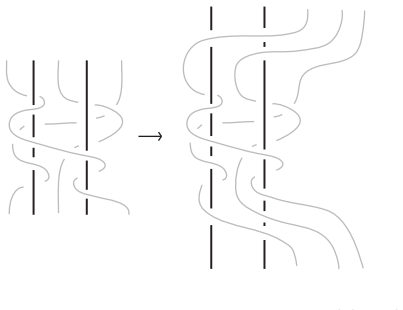
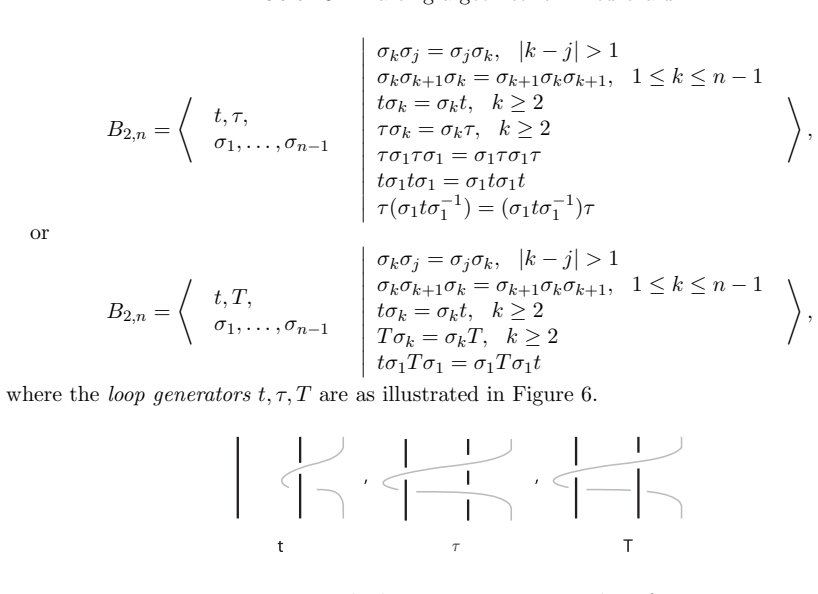
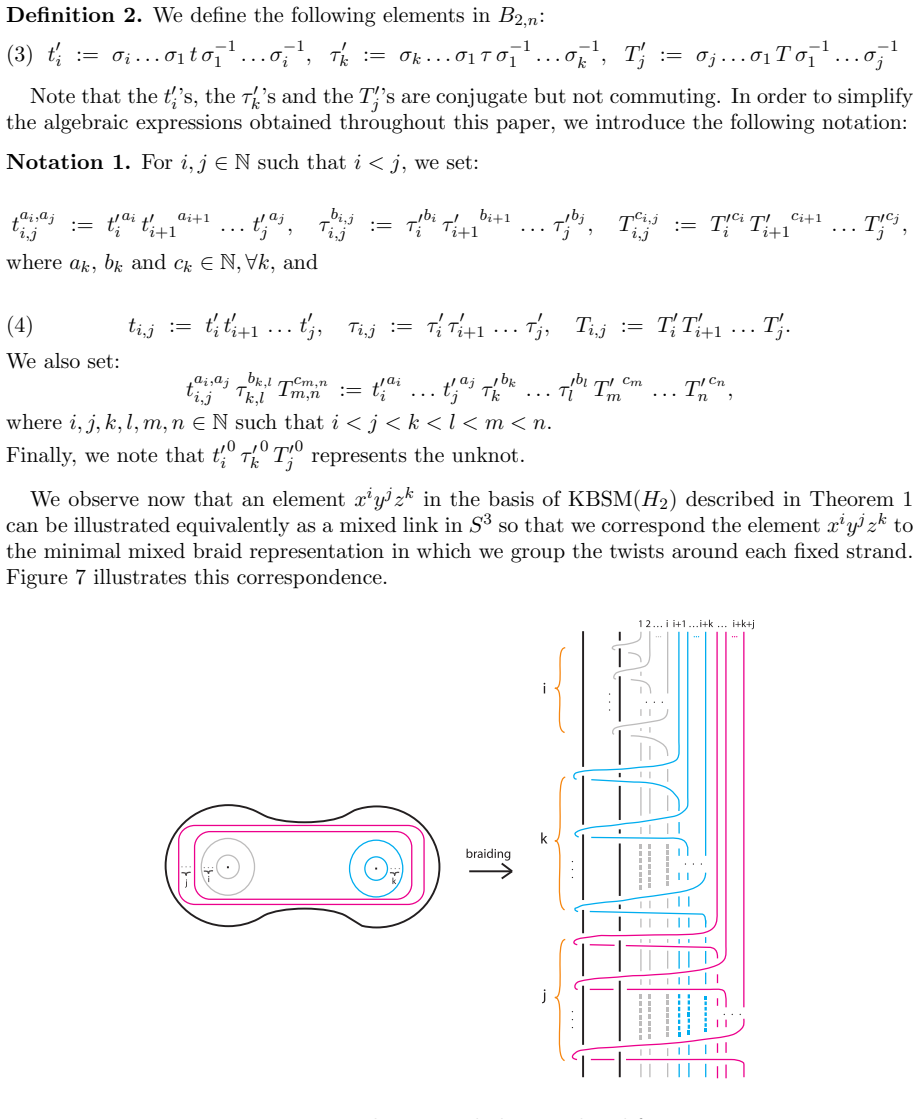
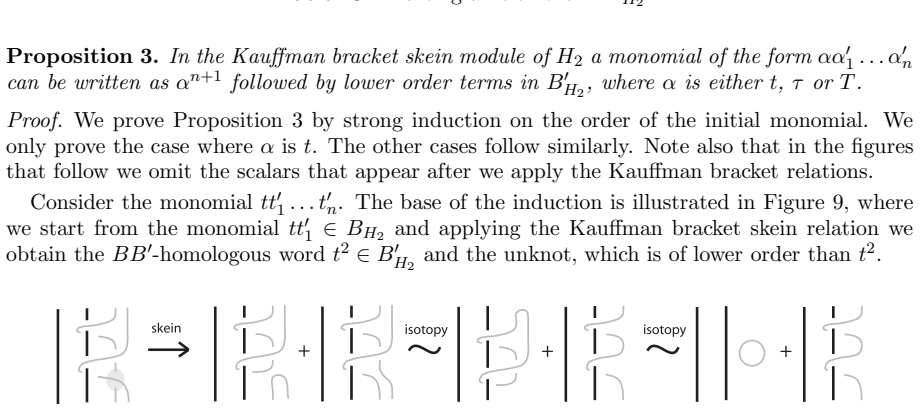
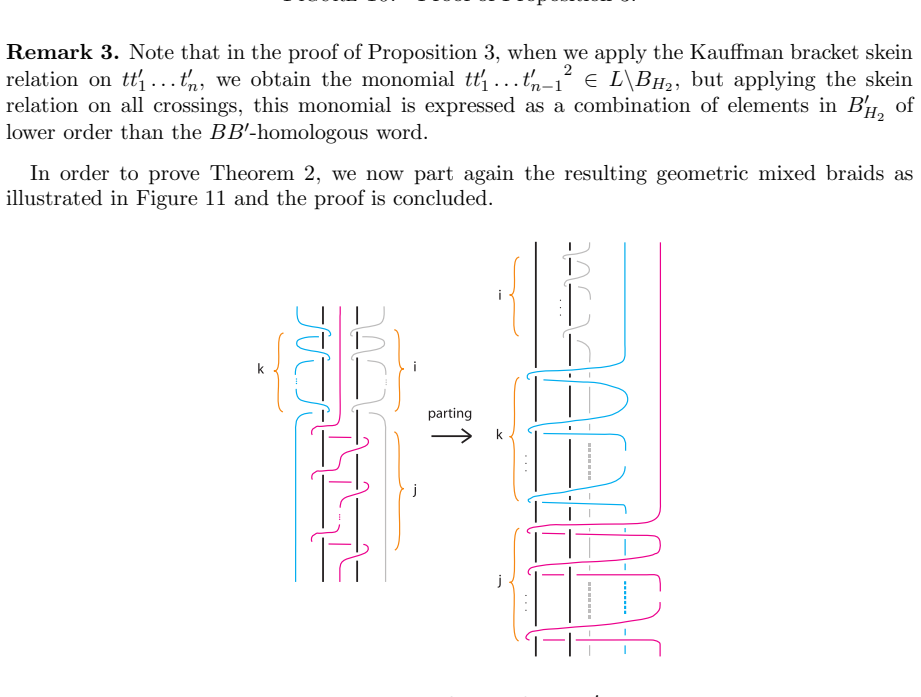
The machine that carries the proof is a three-part structure. First, 'parting' separates the fixed strands representing $H_2$ from the moving strands of a link, turning the known basis elements into algebraic mixed braids in the group $B_{2,n}$ generated by the loop generators $t$, $\tau$, $T$ and their conjugates $t'_i$, $\tau'_k$, $T'_j$. Second, an explicit total order on the monomial set $L$ compares words by total exponent, then by the highest indices of $T$-, $\tau$-, and $t$-factors, then lexicographically; this order is shown to be a well-order, giving a minimal element to attack by induction. Third, the Kauffman bracket skein relation is applied to crossings in the figures; the leading term is the homologous monomial in the target basis and the remainder consists of strictly smaller monomials, so the change-of-basis matrix is lower triangular with invertible diagonal entries. The unstated scalars in the figures are what the invertibility claim ultimately depends on.
What would settle it
Carry out the skein expansion of $t t'_1 \cdots t'_n$ keeping every coefficient, and check whether the coefficient of the leading monomial $t^{n+1}$ is a unit in $\mathbb{Z}[A^{\pm 1}]$; a single non-unit diagonal coefficient, such as $A+A^{-1}$, would break the triangular-basis argument.
Extended reading notes
Core claim
The central claim is that the sets $B'_{H_2}=\{t^i \tau_1'^k T_2'^j\}$ and $\mathcal{B}_{H_2}=\{t^i \tau^k T^j\}$ are each bases of $\mathrm{KBSM}(H_2)$, with $i,j,k\in\mathbb{N}$. The proof passes through the classical basis $B_{H_2}$, presented in open braid form, and uses the Kauffman bracket skein relation to express every classical basis element as the homologous monomial in the new set plus strictly smaller terms. Because the ordering on the monomial set $L$ is a well-order and the transition matrix is lower triangular with invertible diagonal entries, triangularity upgrades spanning to a basis. The set $\mathcal{B}_{H_2}$ is singled out as the more natural one because its elements have no crossings at the level of braids, which is exactly the form suited to describing isotopy moves in closed, connected, oriented 3-manifolds obtained from $H_2$ by surgery.
Load-bearing premise
The load-bearing premise is that every scalar omitted in the illustrated skein-relation computations is an invertible power of $A$; if one leading coefficient were a non-unit in $\mathbb{Z}[A^{\pm 1}]$, the triangular matrix would not force the new sets to be bases.
Editorial extensions
If this is right
- Every element of $\mathrm{KBSM}(H_2)$ has a unique expansion in the monomials $t^i\tau_1'^kT_2'^j$.
- Every element of $\mathrm{KBSM}(H_2)$ also has a unique expansion in the crossing-free monomials $t^i\tau^kT^j$.
- The change of basis from the classical diagrammatic basis to either new basis is lower triangular with invertible diagonal, so leading-term comparisons transfer directly between bases.
- The crossing-free basis is suited to describing isotopy moves in closed, connected, oriented 3-manifolds obtained by surgery on $H_2$, providing the stated route to computing their Kauffman bracket skein modules.
Reading between the lines
- The ordering-and-triangularization scheme is not obviously tied to two fixed strands, so the same method is a natural candidate for producing braid-level bases of $\mathrm{KBSM}$ of higher-genus handlebodies.
- The paper leaves the transition scalars implicit; computing them explicitly would turn the basis theorem into an algorithm for reducing any skein element of $H_2$ to normal form.
- Using the crossing-free basis for surgery descriptions should make braid band moves into local monomial rewrites; testing this on a concrete manifold such as the trefoil complement would show whether the intended computation becomes tractable.
Signed reviews
Editorial analysis
A structured set of objections, weighed in public.
Referee Report
Summary. The paper defines two sets of braid monomials in the mixed braid group B_{2,n}, denoted B′_{H_2} and B_{H_2}, and claims that each is a basis of the Kauffman bracket skein module KBSM(H_2). Starting from Przytycki's known basis B_{H_2}, the author presents basis elements in open braid form, defines a total order on an augmented set L of monomials in looping generators, and claims that the transition from the known basis to the new sets is given by a lower triangular infinite matrix with invertible diagonal entries. Theorem 2 asserts that B′_{H_2} = {t^i τ′_1^k T′_2^j} is a basis, and Theorem 3 asserts that B_{H_2} = {t^i τ^k T^j} is a basis; the latter is presented as a more natural, crossing-free basis on the braid level. The intended application is the computation of KBSM of closed connected oriented 3-manifolds obtained from H_2 by surgery.
Significance. If the proofs are completed, the paper would provide explicit braid-theoretic bases for KBSM(H_2), consistent with the known freeness of this module, and the crossing-free basis B_{H_2} could be a useful tool for surgery computations. The strategy is anchored to the Przytycki basis and to published L-move equivalence theorems, and the main claims are explicit and falsifiable. The main weakness is that the central triangularity argument is not fully verified: the scalar coefficients in the Kauffman bracket skein relation computations are omitted at exactly the point where the invertibility of the diagonal must be established. Because the diagonal coefficients must be units in Z[A^{±1}], and the skein relation also produces the non-unit factor δ = -A^2 - A^{-2}, this omission is load-bearing rather than cosmetic.
major comments (3)
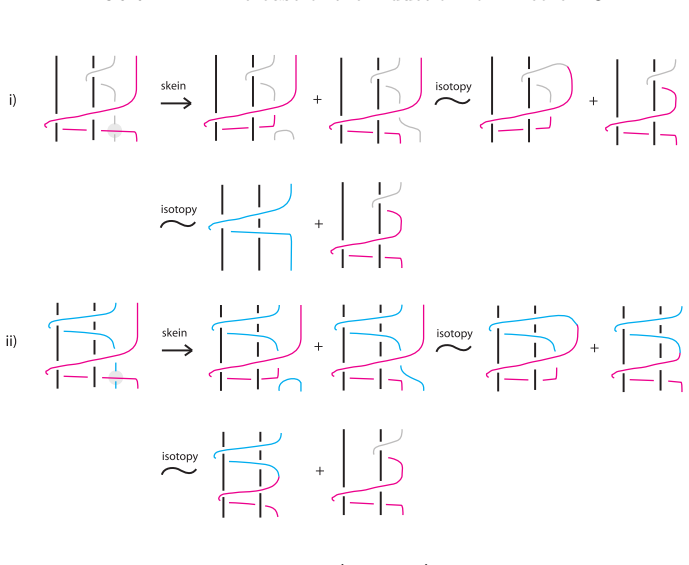
- [§2.2, Proposition 3 and Figures 9–14] The central claim that the transition matrix is lower triangular with invertible diagonal entries is not supported by the text. Section 2.2 explicitly states that 'we omit the scalars that appear after we apply the Kauffman bracket relations,' and no diagonal coefficient is ever displayed. Since the Kauffman bracket skein relation involves the non-unit δ = -A^2 - A^{-2} when a trivial component is split off, the assertion that the diagonal entries are units requires an explicit verification. The author should either display the relevant scalar factors, or give an argument that the diagonal terms arise only from the A and A^{-1} resolutions and never from a δ factor.
- [§2.1, Proposition 2] The proof of well-ordering is invalid as written. From the fact that the element t^0 τ^0 T^0 is the minimum element of B, it does not follow that every nonempty subset of B has a minimum element; well-ordering requires the latter property. Since the later proofs use strong induction on this order, a correct well-ordering proof is necessary. The order should be identified with a lexicographic order on tuples of natural numbers and shown to have no infinite descending chains.
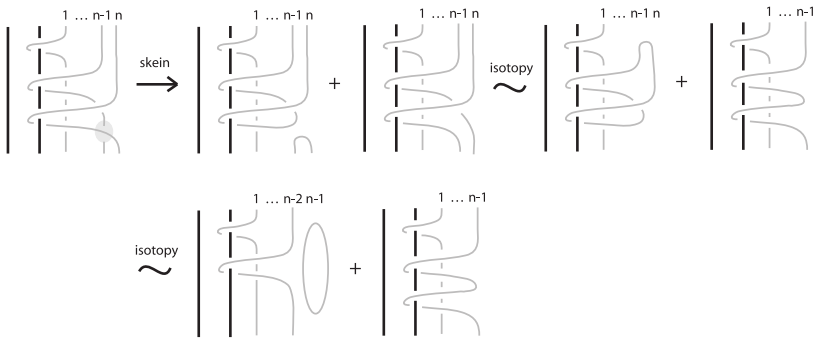
- [§2.2, Proposition 3, induction step] The induction step in Proposition 3 is not stated with enough precision to verify the claim. The text says that from tt′_1...t′_n one obtains the monomials tt′_1...t′_{n−2} ∈ B′_{H_2} and tt′_1...t′_{n−1}^2 ∈ L, but monomials in the t′_i's are not elements of B′_{H_2} as defined in Eq. (1), which consists of monomials in t, τ′_1, and T′_2 only. The intermediate set and the parting step need to be described explicitly so that the induction actually connects the starting monomial in B_{H_2} to elements of B′_{H_2}.
minor comments (5)
- [Theorem 3, Eq. (2)] The displayed set in Eq. (2) is written as {t^i τ′^k T′^j, i,j,k ∈ N}, but from the context and the abstract it should be {t^i τ^k T^j, i,j,k ∈ N}; the subscripts on τ and T appear to be missing.
- [Definition 5] Definition 5 contains several typographical errors: in case (δ)(II) the symbols '=' and '≡' are used in a nonstandard way, and in condition (I) the index comparison 'c_{k_x−1} < f_{n_x−1}' uses inconsistent subscript labels. These should be cleaned up for the ordering to be checkable.
- [Proposition 1 proof] In case (a) of the transitivity proof, the text concludes 'u < v' after assuming u < v, which is tautological; the argument should show w < v using the given assumptions.
- [Notation 1 and Definition 2] The element t^0 τ^0 T^0 is called the unknot, but t^0, τ^0, T^0 are not defined anywhere; Notation 1 defines t_{i,j} only for i < j. Please define the zero-exponent convention explicitly.
- [Figures 9 and 10 captions] The phrase 'BB′-homologous' in the captions is confusing; it should be written as 'B B′-homologous' and defined explicitly in the text before first use, since Definition 6 introduces the notation w ∼_{BB′} w′ but not the phrase used in the captions.
Circularity Check
No circularity: the new bases are anchored to the external Przytycki basis, and the self-citations supply tools rather than the target result.
full rationale
The derivation chain starts from the external Przytycki basis of KBSM(H2) (Theorem 1, [P]) and from braid-equivalence theorems of [OL] and [LR1]; these are not authored by Diamantis, so the target bases are not being derived from premises that already contain them. The ordering in Definition 5 is restated in full in the paper, and the homologous-word map in Definition 6 is an auxiliary bookkeeping device, not a theorem that assumes the new bases. The proofs of Theorems 2 and 3 proceed by induction using the Kauffman bracket skein relation, with triangularity and unit diagonal entries as the conclusion to be checked; no displayed equation identifies B'_H2 or B_H2 with the input basis B_H2 by construction. The statement in Section 2.2 that 'we omit the scalars that appear after we apply the Kauffman bracket relations' is a real gap, because without those scalars the invertibility of the diagonal is not verified. But a missing computation is a proof gap, not circularity: the claim is not forced by a definition or by a self-citation. The self-citations ([D], [DL1]–[DL4]) are used for parting techniques, ordering templates, and proposed applications, and the central ordering is explicitly defined here, so no load-bearing step reduces to an unverified prior result of the same author. Proposition 2's assertion that the minimum element implies well-orderedness is also logically incomplete, but that is a correctness concern rather than a circular derivation.
Assumptions & free parameters
assumptions (5)
- domain assumption Przytycki's theorem: {x^i y^j z^k} is a free basis of KBSM(H_2) (Theorem 1, [P])
- domain assumption L-move braid equivalence for links in H_2 (Theorems 4 and 5 of [OL])
- domain assumption The mixed braid group B_{2,n} presentation with loop generators t, tau and T ([La1], [OL])
- standard math Kauffman bracket skein relation and the blackboard framing convention (Definition 1)
- domain assumption The ordering on monomials defined in [DL2] can be extended to the augmented set L and remains a total and well order (Definition 5, Propositions 1 and 2)
Cite this review
Pith. "Pith review of The Kauffman bracket skein module of the handlebody of genus 2 via braids." pith.science (2026). https://pith.science/paper/32JBNNTZ
@misc{pith2026190808231,
  author       = {Pith},
  title        = {Pith review of: The Kauffman bracket skein module of the handlebody of genus 2 via braids},
  year         = {2026},
  howpublished = {\url{https://pith.science/paper/32JBNNTZ}},
  note         = {Machine review of arXiv:1908.08231}
}
abstract
In this paper we present two new bases, $B^{\prime}_{H_2}$ and $\mathcal{B}_{H_2}$, for the Kauffman bracket skein module of the handlebody of genus 2 $H_2$, KBSM($H_2$). We start from the well-known Przytycki-basis of KBSM($H_2$), $B_{H_2}$, and using the technique of parting we present elements in $B_{H_2}$ in open braid form. We define an ordering relation on an augmented set $L$ consisting of monomials of all different "loopings" in $H_2$, that contains the sets $B_{H_2}$, $B^{\prime}_{H_2}$ and $\mathcal{B}_{H_2}$ as proper subsets. Using the Kauffman bracket skein relation we relate $B_{H_2}$ to the sets $B^{\prime}_{H_2}$ and $\mathcal{B}_{H_2}$ via a lower triangular infinite matrix with invertible elements in the diagonal. The basis $B^{\prime}_{H_2}$ is an intermediate step in order to reach at elements in $\mathcal{B}_{H_2}$ that have no crossings on the level of braids, and in that sense, $\mathcal{B}_{H_2}$ is a more natural basis of KBSM($H_2$). Moreover, this basis is appropriate in order to compute Kauffman bracket skein modules of c.c.o. 3-manifolds $M$ that are obtained from $H_2$ by surgery, since isotopy moves in $M$ are naturally described by elements in $\mathcal{B}_{H_2}$.
Figures


Figures from the paper (12 more)





Reference graph
Works this paper leans on
-
[1]
I. Diamantis , An Alternative Basis for the Kauffman Bracket Skein Module of the Solid Torus via Braids, (2019) In: Adams C. et al. (eds) Knots, Low-Dimensional Topology and Applications. KNOTS16 2016. Springer Proceedings in Mathematics & Statistics, vol 284. Springer, Cham
work page 2019
-
[2]
I. Diamantis , On the Kauffman bracket skein module of the complement of the trefoil knot via braids, work in progress
-
[3]
I. Diamantis, S. Lambropoulou , Braid equivalences in 3-manifolds with rational surgery description, Topology and its Applications , 194 (2015), 269-295
work page 2015
-
[4]
I. Diamantis, S. Lambropoulou , A new basis for the HOMFLYPT skein module of the solid torus, J. Pure Appl. Algebra 220 Vol. 2 (2016), 577-605
work page 2016
-
[5]
I. Diamantis, S. Lambropoulou , The braid approach to the HOMFLYPT skein module of the lens spaces L(p, 1) , Springer Proceedings in Mathematics and Statistics (PROMS), Algebraic Modeling of Topological and Computational Structures and Application , (2017)
work page 2017
-
[6]
I. Diamantis, S. Lambropoulou , An important step for the computation of the HOMFLYPT skein module of the lens spaces L(p,1) via braids, arXiv:1802.09376v1[math.GT], to appear in J. Knot Theory Ramif., special issue dedicated to the Proceedings of the International Conference on Knots, Low-dimensional Topology and Applications - Knots in Hellas 2016
work page Pith review arXiv 2016
-
[7]
I. Diamantis, S. Lambropoulou, J. H. Przytycki , Topological steps on the HOMFLYPT skein module of the lens spaces L(p,1) via braids, J. Knot Theory and Ramifications , 25 , No. 14, (2016)
work page 2016
-
[8]
B. Gabrov sek, M. Mroczkowski , Link diagrams and applications to skein modules, Algebraic Modeling of Topological and Computational Structures and Applications , Springer Proceedings in Mathematics & Statistics (2017)
work page 2017
Show all 15 references
-
[9]
Kodokostas, S
D. Kodokostas, S. Lambropoulou A spanning set and potential basis of the mixed Hecke algebra on two fixed strands, Mediterr. J. Math. (2018), 15:192, https://doi.org/10.1007/s00009-018-1240-7
2018 doi
-
[10]
S. Lambropoulou , Braid structures in handlebodies, knot complements and 3-manifolds, Proceedings of Knots in Hellas '98 , World Scientific Press, Series of Knots and Everything 24 , (2000) 274-289
2000
-
[11]
Lambropoulou, C.P
S. Lambropoulou, C.P. Rourke (2006), Markov's theorem in 3 -manifolds, Topology and its Applications 78 , (1997) 95-122
2006
-
[12]
Lambropoulou, C
S. Lambropoulou, C. P. Rourke , Algebraic Markov equivalence for links in 3 -manifolds, Compositio Math. 142 (2006) 1039-1062
2006
-
[13]
Knot Theory and its Ramifications 11 , No
Reinhard H \"a ring-Oldenburg, Sofia Lambropoulou , Knot theory in handlebodies, J. Knot Theory and its Ramifications 11 , No. 6, (2002) 921-943
2002
-
[14]
Przytycki , Skein modules of 3-manifolds, Bull
J. Przytycki , Skein modules of 3-manifolds, Bull. Pol. Acad. Sci.: Math. , 39, 1-2 (1991), 91-100
1991
-
[15]
Turaev , The Conway and Kauffman modules of the solid torus, Zap
V.G. Turaev , The Conway and Kauffman modules of the solid torus, Zap. Nauchn. Sem. Lomi 167 (1988), 79--89. English translation: J. Soviet Math. (1990), 2799-2805
1988
Reviewed August 14, 2026 · model on record in the stance chip above.
Discussion (0). Continue with ORCID to comment.