REVIEW 3 minor 38 references
Khovanov homology: pro-tangles, derived colimits and spectral sequences
T0 review · 0 major / 3 minor · reviewed 2026-06-27 · grok-4.3
Pith's one-line read Pro-tangles generalize tangles as Boolean cube functors whose Khovanov presheaf is a representable homotopy colimit.
desk verdict This paper defines pro-tangles as Boolean-cube functors and builds a spectral sequence from their decompositions that converges to Khovanov homology. read the letter →
The pith
A machine-rendered reading of the paper's core claim, the machinery that carries it, and where it could break.
The reading
What carries the argument
The simplicial Yoneda embedding applied to the pro-tangle functor, which realizes the Khovanov simplicial presheaf as a homotopy colimit representable by the classical Khovanov simplicial object.
What would settle it
An explicit pro-tangle for which the homotopy colimit of its Khovanov simplicial presheaf is not weakly equivalent to the classical Khovanov simplicial object, or for which the associated spectral sequence fails to converge to the total Khovanov homology.
Extended reading notes
Core claim
The authors construct the Khovanov simplicial presheaf of a pro-tangle as a homotopy colimit using the simplicial Yoneda embedding and prove that this presheaf is representable by the classical Khovanov simplicial object. They obtain an algebraic spectral sequence via Boolean cube decompositions whose E1 page is expressed in terms of the Khovanov homology of reduced tangles and which converges to the total Khovanov homology; the construction also gives a functorial interpretation of Reidemeister invariance via morphisms of spectral sequences.
Load-bearing premise
The simplicial Yoneda embedding applied to the pro-tangle functor produces a homotopy colimit that is representable by the classical Khovanov simplicial object.
Editorial extensions
If this is right
- The weak equivalence class of the simplicial presheaf is determined by the chain homotopy type of the Khovanov complex.
- The spectral sequence converges to the total Khovanov homology of the pro-tangle.
- Reidemeister invariance is realized functorially as morphisms of spectral sequences.
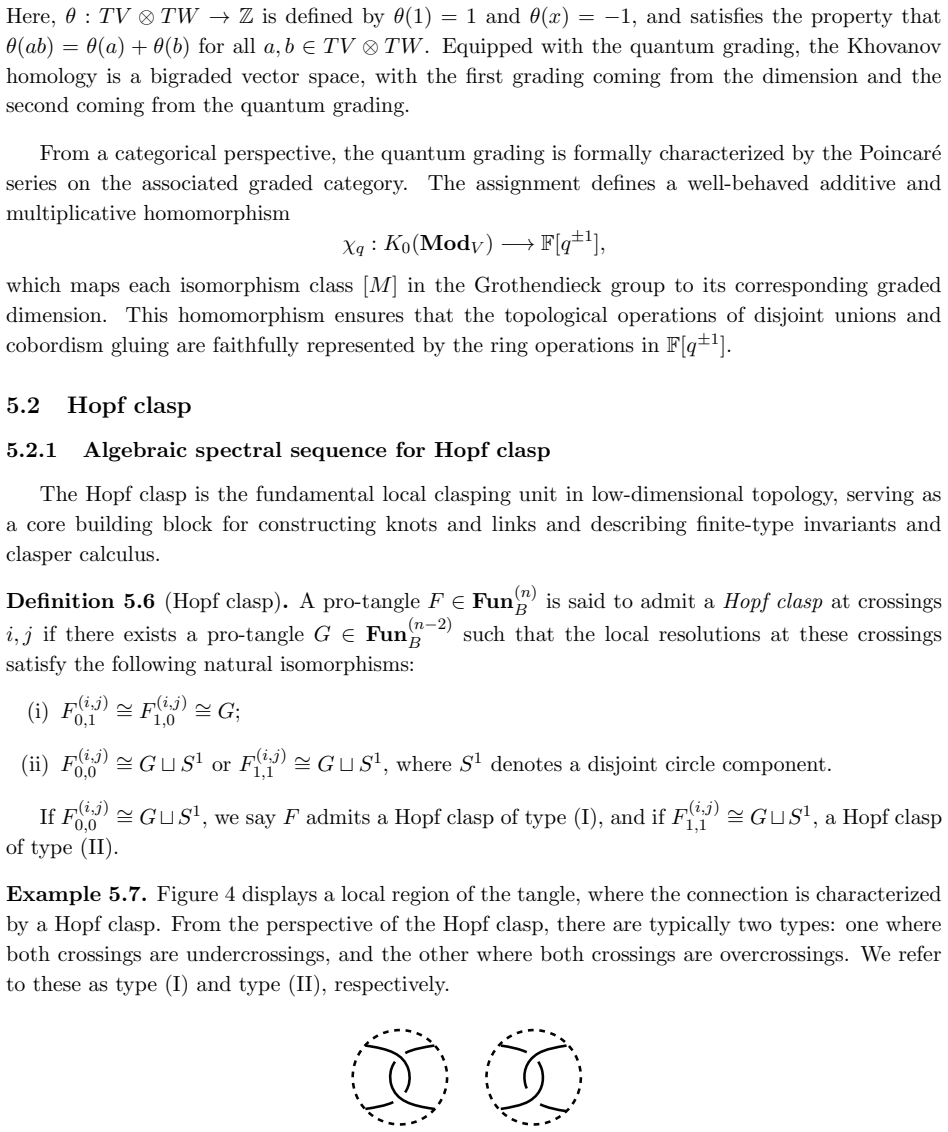
- For Hopf clasps the spectral sequence collapses at the E3 page, and under restriction to Hopf sums it collapses at E2.
- Connected sums of pro-tangles admit a structural decomposition via a state-dependent modified tensor operator that generalizes the classical chain-complex result.
Reading between the lines
- The Boolean-cube decomposition may permit recursive computation of Khovanov homology for composite pro-tangles by reducing to simpler pieces.
- The early collapse observed for Hopf clasps could extend to other elementary tangle building blocks and thereby simplify concrete calculations.
- The functorial spectral-sequence framework might be applied to pro-links to produce new module actions or invariants that respect connected-sum decompositions.
- The representability result could be tested against other categorical constructions of link homology to check compatibility of colimit-based definitions.
Editorial analysis
A structured set of objections, weighed in public.
Referee Report
Summary. The paper defines pro-tangles as functors from the Boolean cube to Bar-Natan's cobordism category. It constructs the Khovanov simplicial presheaf of a pro-tangle via the simplicial Yoneda embedding as a homotopy colimit and proves this presheaf is representable by the classical Khovanov simplicial object. A fully faithful embedding into the homotopy category is established, showing the weak equivalence class is determined by the chain homotopy type of the Khovanov complex. An algebraic spectral sequence is built from Boolean cube decompositions; it converges to total Khovanov homology with E1 page given explicitly in terms of reduced-tangle homologies. The setup yields a functorial view of Reidemeister invariance. Applications to Hopf clasps show collapse at E3 (E2 for Hopf sums). Connected sums of pro-tangles are treated via a state-dependent modified tensor product and a structural decomposition theorem.
Significance. If the stated representability, embedding, convergence, and collapse results hold, the work supplies a categorical extension of Khovanov homology to pro-tangles together with an explicit spectral sequence whose E1 page is computable from reduced tangles. The collapse theorems for Hopf clasps and the decomposition for connected sums provide concrete special cases. The functorial interpretation of Reidemeister moves is a potential strength for future applications in tangle and link theory.
minor comments (3)
- The introduction should include a brief comparison table or diagram contrasting the Boolean-cube functor definition of a pro-tangle with the classical tangle category to clarify the generalization.
- Notation for the simplicial presheaf and its representing object is introduced in the construction paragraph; a dedicated subsection collecting all notation and the precise model category used for the homotopy colimit would improve readability.
- The statement that the spectral sequence 'converges to the total Khovanov homology' would benefit from an explicit reference to the filtration or convergence theorem invoked (e.g., a numbered proposition or lemma).
Simulated Author's Rebuttal
We thank the referee for their detailed summary of the manuscript and for the positive assessment of its contributions. The recommendation of minor revision is noted, and we will make any necessary editorial adjustments in the revised version. No specific major comments were provided in the report.
Circularity Check
No significant circularity in the derivation chain
full rationale
The paper presents a categorical construction: the Khovanov simplicial presheaf of a pro-tangle is obtained as a homotopy colimit via the simplicial Yoneda embedding and shown to be representable by the classical Khovanov simplicial object, yielding a fully faithful embedding into the homotopy category. A Boolean-cube spectral sequence is constructed whose E1 page is expressed via reduced-tangle homologies and which converges to total homology. These steps are standard constructions and proofs in homological algebra and category theory; no equation reduces by construction to a fitted input, no central premise rests on a self-citation chain, and no ansatz is smuggled via prior work by the same authors. The derivation is self-contained against external benchmarks in model categories and spectral sequences.
Assumptions & free parameters
assumptions (2)
- standard math Standard axioms of category theory, simplicial sets, and homotopy colimits
- domain assumption Properties of Bar-Natan's cobordism category as target for the functors
invented entities (2)
-
pro-tangle
-
Khovanov simplicial presheaf of a pro-tangle
Cite this review
Pith. "Pith review of Khovanov homology: pro-tangles, derived colimits and spectral sequences." pith.science (2026). https://pith.science/paper/33KFK355
@misc{pith2026260613471,
  author       = {Pith},
  title        = {Pith review of: Khovanov homology: pro-tangles, derived colimits and spectral sequences},
  year         = {2026},
  howpublished = {\url{https://pith.science/paper/33KFK355}},
  note         = {Machine review of arXiv:2606.13471}
}
abstract
This paper introduces pro-tangles, a natural generalization of classical tangles, which are functors from the Boolean cube to Bar-Natan's cobordism category. By employing the simplicial Yoneda embedding, we construct the Khovanov simplicial presheaf of a pro-tangle as a homotopy colimit and prove that this simplicial presheaf is representable, with representing object the classical Khovanov simplicial object. We establish a fully faithful embedding showing that the weak equivalence class of this simplicial presheaf is determined by the chain homotopy type of the Khovanov complex. Furthermore, we utilize Boolean cube decompositions to construct an algebraic spectral sequence for pro-tangles. This spectral sequence converges to the total Khovanov homology, and its $E_1$ page is explicitly expressed in terms of the Khovanov homology of reduced tangles. This categorical setup yields a functorial interpretation of Reidemeister invariance in terms of morphisms of spectral sequences. By applying the tangle TQFT construction, we study this spectral sequence for Hopf clasps, the fundamental structural building blocks in tangle and link theory. We show that the spectral sequence collapses at the $E_3$ page, which further specializes to an $E_2$-collapse under the restriction to Hopf sums. Finally, we investigate connected sums of pro-tangles and pro-links. To address the module-action dependencies arising from tensor products in multi-connected sums, we introduce a state-dependent modified tensor operator and prove a structural decomposition theorem that generalizes the classical result at the chain complex level.
Figures


Figures from the paper (14 more)


Reference graph
Works this paper leans on
-
[1]
American Mathematical Soc., 2004
Colin Conrad Adams.The knot book: an elementary introduction to the mathematical theory of knots. American Mathematical Soc., 2004
2004
-
[2]
Topological invariants of knots and links.Transactions of the American Mathematical Society, 30(2):275–306, 1928
James W Alexander. Topological invariants of knots and links.Transactions of the American Mathematical Society, 30(2):275–306, 1928
1928
-
[3]
Khovanov’s homology for tangles and cobordisms.Geometry & Topology, 9(3):1443–1499, 2005
Dror Bar-Natan. Khovanov’s homology for tangles and cobordisms.Geometry & Topology, 9(3):1443–1499, 2005
2005
-
[4]
Fast Khovanov homology computations.Journal of Knot Theory and Its Ramifications, 16(03):243–255, 2007
Dror Bar-Natan. Fast Khovanov homology computations.Journal of Knot Theory and Its Ramifications, 16(03):243–255, 2007
2007
-
[5]
Khovanov homotopy type, periodic links and localizations.Mathematische Annalen, 380(3):1233–1309, 2021
Maciej Borodzik, Wojciech Politarczyk, and Marithania Silvero. Khovanov homotopy type, periodic links and localizations.Mathematische Annalen, 380(3):1233–1309, 2021
2021
-
[6]
Exact categories.Expositiones Mathematicae, 28(1):1–69, 2010
Theo B¨ uhler. Exact categories.Expositiones Mathematicae, 28(1):1–69, 2010
2010
-
[7]
Number 736
Wojciech Chach´ olski and J´ erˆ ome Scherer.Homotopy theory of diagrams. Number 736. Amer- ican Mathematical Soc., 2002
2002
-
[8]
Fixing the functoriality of khovanov homol- ogy.Geometry & Topology, 13(3):1499–1582, 2009
David Clark, Scott Morrison, and Kevin Walker. Fixing the functoriality of khovanov homol- ogy.Geometry & Topology, 13(3):1499–1582, 2009
2009
Show all 38 references
-
[9]
A spectral sequence from Khovanov homology to knot Floer homology.Journal of the American Mathematical Society, 37(4):951–1010, 2024
Nathan Dowlin. A spectral sequence from Khovanov homology to knot Floer homology.Journal of the American Mathematical Society, 37(4):951–1010, 2024
2024
-
[10]
The homotopy theory of khovanov homology.Algebraic & Geometric Topology, 14(5):2747–2781, 2014
Brent Everitt and Paul Turner. The homotopy theory of khovanov homology.Algebraic & Geometric Topology, 14(5):2747–2781, 2014
2014
-
[11]
A new polynomial invariant of knots and links.Bull
P Freyd, D Yetter, J Hoste, WBR Lickorish, K Millett, and A Ocneanu. A new polynomial invariant of knots and links.Bull. Amer. Math. Soc.(NS), 12(1):239–246, 1985
1985
-
[12]
Springer Science & Business Media, 2009
Paul G Goerss and John F Jardine.Simplicial homotopy theory. Springer Science & Business Media, 2009
2009
-
[13]
Number 99
Philip S Hirschhorn.Model categories and their localizations. Number 99. American Mathe- matical Soc., 2003
2003
-
[14]
Springer, 2015
John F Jardine.Local homotopy theory. Springer, 2015
2015
-
[15]
A polynomial invariant for knots via von Neumann algebras.Bulletin of the American Mathematical Society, 12(1):103–111, 1985
Vaughan FR Jones. A polynomial invariant for knots via von Neumann algebras.Bulletin of the American Mathematical Society, 12(1):103–111, 1985
1985
-
[16]
Hecke algebra representations of braid groups and link polynomials
Vaughan FR Jones. Hecke algebra representations of braid groups and link polynomials. In New Developments in the Theory of Knots, pages 20–73. World Scientific, 1987
1987
-
[17]
American Mathe- matical Society Providence, RI, 2016
Louis H Kauffman.An introduction to Khovanov homology, volume 670. American Mathe- matical Society Providence, RI, 2016. 72
2016
-
[18]
Simplicial homotopy theory, link homology and khovanov homology.Jour- nal of Knot Theory and Its Ramifications, 27(07):1841002, 2018
Louis H Kauffman. Simplicial homotopy theory, link homology and khovanov homology.Jour- nal of Knot Theory and Its Ramifications, 27(07):1841002, 2018
2018
-
[19]
A categorification of the Jones polynomial.Duke Math
Mikhail Khovanov. A categorification of the Jones polynomial.Duke Math. J., 104(1):359–426, 2000
2000
-
[20]
A functor-valued invariant of tangles.Algebraic & Geometric Topology, 2(2):665–741, 2002
Mikhail Khovanov. A functor-valued invariant of tangles.Algebraic & Geometric Topology, 2(2):665–741, 2002
2002
-
[21]
Open–closed strings: Two-dimensional extended TQFTs and Frobenius algebras.Topology and its Applications, 155(7):623–666, 2008
Aaron D Lauda and Hendryk Pfeiffer. Open–closed strings: Two-dimensional extended TQFTs and Frobenius algebras.Topology and its Applications, 155(7):623–666, 2008
2008
-
[22]
Khovanov homotopy type, burnside category and products.Geometry & Topology, 24(2):623–745, 2020
Tyler Lawson, Robert Lipshitz, and Sucharit Sarkar. Khovanov homotopy type, burnside category and products.Geometry & Topology, 24(2):623–745, 2020
2020
-
[23]
An endomorphism of the Khovanov invariant.Advances in Mathematics, 197(2):554–586, 2005
Eun Soo Lee. An endomorphism of the Khovanov invariant.Advances in Mathematics, 197(2):554–586, 2005
2005
-
[24]
A Khovanov stable homotopy type.Journal of the American Mathematical Society, 27(4):983–1042, 2014
Robert Lipshitz and Sucharit Sarkar. A Khovanov stable homotopy type.Journal of the American Mathematical Society, 27(4):983–1042, 2014
2014
-
[25]
Princeton University Press, 2009
Jacob Lurie.Higher topos theory. Princeton University Press, 2009
2009
-
[26]
Springer, 1971
Saunders Mac Lane and Saunders MacLane.Categories for the working mathematician, vol- ume 5. Springer, 1971
1971
-
[27]
University of Chicago Press, 2012
J Peter May and Kate Ponto.More concise algebraic topology: localization, completion, and model categories. University of Chicago Press, 2012
2012
-
[28]
Singular homology groups and homotopy groups of finite topological spaces.Duke Math
Michael C McCord. Singular homology groups and homotopy groups of finite topological spaces.Duke Math. J., 33(1):465–474, 1966
1966
-
[29]
Holomorphic disks and knot invariants.Advances in Math- ematics, 186(1):58–116, 2004
Peter Ozsv´ ath and Zolt´ an Szab´ o. Holomorphic disks and knot invariants.Advances in Math- ematics, 186(1):58–116, 2004
2004
-
[30]
On the Heegaard Floer homology of branched double-covers
Peter Ozsv´ ath and Zolt´ an Szab´ o. On the Heegaard Floer homology of branched double-covers. Advances in Mathematics, 194(1):1–33, 2005
2005
-
[31]
Khovanov homology and the slice genus.Inventiones mathematicae, 182(2):419–447, 2010
Jacob Rasmussen. Khovanov homology and the slice genus.Inventiones mathematicae, 182(2):419–447, 2010
2010
-
[32]
Harvard University, 2003
Jacob Andrew Rasmussen.Floer homology and knot complements. Harvard University, 2003
2003
-
[33]
Number 346
Dale Rolfsen.Knots and links. Number 346. American Mathematical Soc., 2003
2003
-
[34]
A quantum algorithm for Khovanov homology.arXiv preprint arXiv:2501.12378, 2025
Alexander Schmidhuber, Michele Reilly, Paolo Zanardi, Seth Lloyd, and Aaron Lauda. A quantum algorithm for Khovanov homology.arXiv preprint arXiv:2501.12378, 2025
2025
-
[35]
Equivalences of monoidal model categories.Algebraic & Geometric Topology, 3(1):287–334, 2003
Stefan Schwede and Brooke Shipley. Equivalences of monoidal model categories.Algebraic & Geometric Topology, 3(1):287–334, 2003. 73
2003
-
[36]
Computing Khovanov homology of tangles.arXiv preprint arXiv:2508.14398, 2025
Li Shen, Jian Liu, and Guo-Wei Wei. Computing Khovanov homology of tangles.arXiv preprint arXiv:2508.14398, 2025
2025
-
[37]
Number 38
Charles A Weibel.An introduction to homological algebra. Number 38. Cambridge university press, 1994
1994
-
[38]
Quantum field theory and the Jones polynomial.Communications in Math- ematical Physics, 121(3):351–399, 1989
Edward Witten. Quantum field theory and the Jones polynomial.Communications in Math- ematical Physics, 121(3):351–399, 1989. 74
1989
Reviewed June 27, 2026 · model on record in the stance chip above.
Discussion (0). Continue with ORCID to comment.