REVIEW 3 major objections 3 minor 43 references
Inductive acceleration of ions in Poynting-flux dominated outflows
T0 review · 3 major / 3 minor · reviewed 2026-08-14 · deepseek-v4-flash
Pith's one-line read Ions in Poynting-flux outflows get accelerated to the Hillas limit, this paper argues.
desk verdict Solid, honest extension of inductive acceleration to ion-loaded flows; the main soft spot is an inconsistency in Eq. (38) and the marginal self-consistency at κ≈1, but the central result holds up. read the letter →
The pith
A machine-rendered reading of the paper's core claim, the machinery that carries it, and where it could break.
The reading
What carries the argument
The load-bearing object is the multi-fluid, cold-plasma perturbation scheme built on the small parameter $r_L/r$: the flow is treated as radial and uniform within a solid angle, with a frozen-in, sheared toroidal magnetic field whose reversals are concentrated in neutral sheets. The zeroth-order quantities evolve under three conservation laws — particle number, energy, and radial momentum balance — closed by Ampere's law relating the transverse current to the field. The new element is an ion fluid that carries no transverse current and whose charge is compensated by an excess of electrons. The central identity that organizes the solution is the saturation of the lepton transverse momentum at $p_{\perp eq}=\sqrt{(\eta_{\rm ion}^2+\eta_{\rm ion}\sqrt{\eta_{\rm ion}^2+8}+2)/2}$, giving $p_{\perp eq}\approx \eta_{\rm ion}$ in the ion-dominated case; this equilibrium forces the lepton Lorentz factor to ride along with the ions, producing the equipartition of power and the short acceleration length.
What would settle it
A particle-in-cell or multi-fluid simulation of an expanding, ion-loaded striped wind with low multiplicity that resolves the microphysics would falsify the central claim if it showed the current sheets dissipating by reconnection or electrostatic instability on a timescale shorter than the dynamical expansion time, or if the lepton transverse momentum failed to plateau at $p_{\perp eq}\approx\eta_{\rm ion}$ during the acceleration phase. Observationally, a detection of ultra-high-energy cosmic rays from a magnetar or pulsar wind whose inferred ion multiplicity violates the condition $\kappa_e \lesssim 10^5 (4\pi L_{38}/\Omega)^{1/4}/\max(\eta_{\rm ion}^{1/2},1)$ would also contradict the model's expectation that inductive acceleration dominates there.
Extended reading notes
Core claim
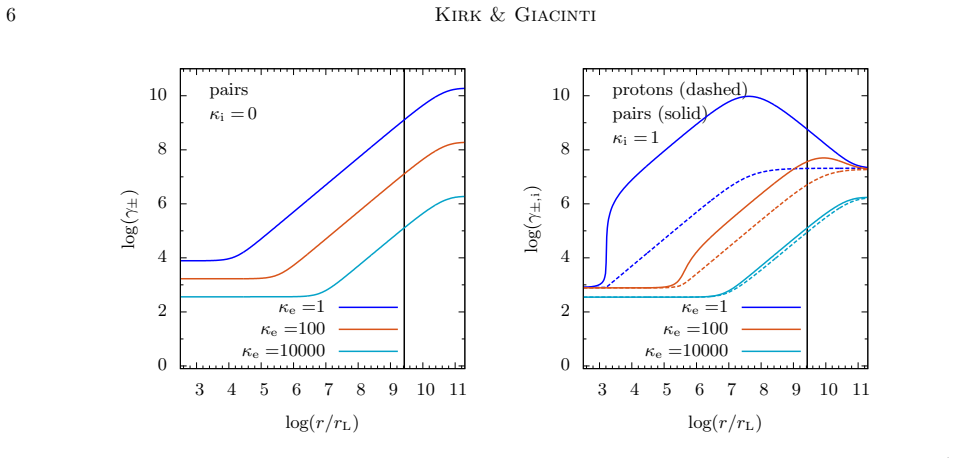
The central claim is that adding a cold ion fluid to the two-fluid (electron-positron) description of a Poynting-flux dominated outflow does more than add another accelerated species: it speeds up the whole acceleration process. In the acceleration phase the ion fluid's inertia forces the leptons to carry a transverse momentum $p_{\perp eq} \approx \eta_{\rm ion}$ when ions dominate the rest-mass flux, so the leptons rapidly reach a Lorentz factor $\gamma_e \approx \eta_{\rm ion}\gamma_i$. Because the ions are accelerated in lockstep, power is split roughly equally between the ionic and leptonic components. Quantitatively, the maximum Lorentz factors approach $\gamma_{i,\max} \approx a_{Li}/(4\kappa_i)$ and $\gamma_{e,\max} \approx a_{Le}/(4\kappa_{ep})$ for $\eta_{\rm ion}\gg1$, which coincide with the Hillas rigidity limit when the multiplicity is of order unity. The acceleration is completed at a radius $r_{\max}\approx a_{Le}r_L/[2(1+\eta_{\rm ion})]$, which shrinks as the ion content rises, so an ion-dominated flow reaches a given particle energy in a substantially shorter distance than a lepton-dominated flow.
Load-bearing premise
The cold-fluid, perturbation-theory description must remain valid through the acceleration phase, meaning the ion and lepton fluids stay cold and the frozen-in current sheets are not disrupted by kinetic instabilities such as the Buneman instability or the tearing mode before the Poynting flux is converted.
Editorial extensions
If this is right
- In an ion-dominated wind, both ions and leptons can reach the Hillas rigidity limit in a distance short enough to fit inside the Crab Nebula before its termination shock, unlike the purely leptonic case.
- The presence of ions raises the energy at which leptons are injected into pulsar wind nebulae by roughly an order of magnitude, and in blazar jets moves the acceleration zone inward, from about 1 pc to about 0.1 pc.
- Magnetic reconnection is rendered ineffective in low-density flows whenever the electron multiplicity satisfies $\kappa_e \lesssim 10^5 (4\pi L_{38}/\Omega)^{1/4}/\max(\eta_{\rm ion}^{1/2},1)$, so inductive acceleration rather than dissipation drives the energy conversion there.
- Radiation losses from synchrotron or jitter radiation are dynamically negligible in the acceleration zone for pulsar-like parameters, though they could matter for protomagnetars.
- The model provides a self-consistent conversion of Poynting flux into bulk kinetic energy, in contrast to unipolar-inductor models that do not yet treat the back reaction of the accelerated particles on the fields.
Reading between the lines
- Because the acceleration length shrinks as $\eta_{\rm ion}$ grows, the mechanism offers a concrete, testable signature: sources with higher ion loading should show particle spectra extending to higher energies from a more compact acceleration region, which could be checked against multi-messenger observations of magnetar flares and fast radio bursts.
- The same freeze-out condition for reconnection, derived in spherical geometry, plausibly applies to other low-density Poynting-dominated expanding flows such as AGN jets and gamma-ray burst outflows, where inductive acceleration could therefore be the dominant channel for ultra-high-energy cosmic rays.
- One could test the model numerically by launching a global simulation of an ion-loaded striped wind with low multiplicity and checking whether the predicted $p_{\perp eq}$ plateau and the $\gamma \propto r$ scaling emerge before any kinetic instability disrupts the current sheets.
- The equality of power in ions and leptons during the acceleration phase implies that any observed hadronic signal (cosmic rays or neutrinos) from such sources should arrive alongside a comparable leptonic energy flux, constraining models that attribute the emission to leptons alone.
Signed reviews
Editorial analysis
A structured set of objections, weighed in public.
Referee Report
Summary. This paper extends the inductive acceleration model of Kirk & Mochol (2011a) from electron-positron plasmas to outflows containing a cold ion fluid. Starting from multi-fluid continuity, Ampère, energy, and radial momentum equations, the authors derive a closed system for the pattern Lorentz factor and the lepton transverse momentum, solve it numerically, and provide analytic estimates for the MHD breakdown radius r_MHD, the saturated lepton transverse momentum p_⊥eq, the terminal Lorentz factors γ_i,max and γ_e,max, and the acceleration length r_max. The central physical claims are that in an ion-dominated flow each species reaches the Hillas-limit rigidity, that leptons and ions receive comparable power, that the acceleration is completed much sooner than in purely leptonic flows, and that magnetic reconnection is frozen out in low-multiplicity winds under the condition stated in Eq. (38). The paper is clearly structured and the derivation is internally consistent under its stated assumptions.
Significance. If the cold-fluid, perturbation-theory solutions survive the kinetic checks discussed in the paper, the manuscript supplies a concrete, self-consistent mechanism for converting Poynting flux into high-energy ions and leptons, with quantitative predictions for the maximum Lorentz factors (Eq. 31), the acceleration radius (Eq. 33), and the regime in which reconnection is ineffective (Eq. 38). The work connects a long-standing analytic framework to the UHECR source problem and yields falsifiable expectations for magnetar and pulsar winds, including comparable ion and lepton energy fluxes and a much shorter acceleration distance in ion-dominated flows. Several of the estimates are derived rather than assumed, and the numerical integration of Eqs. (15) and (24) is described. The authors are also explicit about the main limitations of the model, namely the cold-fluid assumption, the perturbation expansion, and the absence of a kinetic treatment of current-sheet stability.
major comments (3)
- [Eq. (38), Sec. 5.1] The displayed freeze-out condition is internally inconsistent. The left-hand expression, √a_Le/Max(η_ion,1), scales as η_ion^{-1} for η_ion≫1, whereas the numerical expression on the right, 10^5(4πL_38/Ω)^{1/4}/Max(η_ion^{1/2},1), scales as η_ion^{-1/2}. Substituting Eq. (31) into Eq. (36) for the ion-dominated regime yields κ_ep ≲ (a_Le/η_ion)^{1/2}, i.e., the η^{-1/2} scaling of the abstract and conclusions. As written, for the proton-dominated example η_ion=1836 the two sides differ by more than an order of magnitude. Because Eq. (38) is the quantitative demarcation between inductive acceleration and reconnection-dominated dissipation, this is a load-bearing point that must be corrected, with the derivation shown explicitly.
- [Eq. (40), Sec. 5.2] The perturbation expansion is marginal at the very point where the maximum Lorentz factors are quoted for the most interesting low-multiplicity regime. From Eq. (40), E^(1)/|B| ≈ r/(r_max κ_e,i), so at r = r_max the first-order electric field is equal to the zeroth-order magnetic field when κ=1. The numerical examples in Fig. 1 deliberately highlight κ_i=1, κ_e=1, and Eq. (31) evaluates γ_max at that radius. The manuscript notes that κ>1 keeps the expansion valid, but this leaves the headline claim for the low-multiplicity UHECR case resting on the boundary of perturbation theory. The authors should either restrict the claims to κ>1, or provide a quantitative estimate of the first-order corrections to Eq. (31).
- [Sec. 5.1, Fig. 2] The freeze-out argument is an order-of-magnitude estimate, not a stability proof, and it cannot exclude disruptive kinetic instabilities in the early acceleration phase. Equation (38) is evaluated using terminal quantities, while Fig. 2 shows ω_p/ω_dyn>1 near r_MHD for the κ_i=1, κ_e=1 case, so Buneman-type or tearing instabilities could in principle heat the leptons or disrupt the coherent current sheets before the inductive solution is established. The paper acknowledges this limitation, but since the central claim that ions reach the Hillas limit depends on the cold-fluid solutions remaining valid through the acceleration phase, a concrete test—for example, a PIC simulation of an expanding current sheet in this parameter regime—or a sharpened analytic estimate of the nonlinear saturation is needed before the general conclusion is fully supported.
minor comments (3)
- [Sec. 5.2, paragraph after Eq. (40)] The text contains the duplicated word 'when when'; it should read 'when r approaches κ_e,i r_max'.
- [Eqs. (26) and (40)] The symbol '/greaterorsimilar' appears to be a LaTeX artifact; it should be typeset as ≳ or ≥ throughout.
- [Abstract and Sec. 6] The abstract and conclusions quote the correct η_ion^{-1/2} scaling in the reconnection freeze-out condition, which is inconsistent with the displayed left-hand side of Eq. (38); fixing Eq. (38) will also remove this internal inconsistency.
Circularity Check
No circularity: the ion acceleration results are derived from the multi-fluid equations and energy conservation; the Hillas comparison is a consistency check, not an input.
full rationale
The derivation is self-contained. The system is closed by continuity (Eq. 3), Ampère's law (Eqs. 10-14), energy conservation (Eqs. 15-19), and radial momentum balance (Eqs. 23-24); these are written down from stated cold-fluid, perturbation-theory assumptions, not from the conclusions. The maximum Lorentz factors (Eqs. 31-32) follow by taking Ψ_Poynting → 0 in the energy-conservation equation and using the definitions of aLs and κs. No parameter is fitted to the quantity being predicted: the ion/lepton multiplicity and load ηion are inputs, and the γmax values are outputs. The agreement with Hillas' limit is explicitly presented as a post hoc comparison in §5.2 ('These limits coincide if...'), and the paper even notes the limit is not strict because it is set by the range of validity of the approximations. The cited prior work (Kirk & Mochol 2011a; Lyubarsky & Kirk 2001) supplies the underlying leptonic framework and a previously noted freeze-out point, but the new ion results (ηion scalings, equipartition, rmax reduction) are derived here; neither citation is invoked as a uniqueness theorem or as the sole justification for the central claim. The stability discussion in §5.1 is a self-consistency/validity estimate, with the paper acknowledging its limitations ('This does not establish the importance of dissipation...' and Eq. 40 showing first-order fields become comparable to B at rmax for κ≈1); such caveats bear on physical realism, not circularity. The apparent inconsistency in Eq. (38) between Max(ηion,1) and Max(ηion^{1/2},1) is an algebraic typo in a derived bound, not a reduction of a prediction to an input. Hence no circular step is present.
Assumptions & free parameters
free parameters (3)
- electron multiplicity κ_e =
1, 100, 10^4 in Fig. 1
- ion multiplicity κ_i =
0 (pairs) and 1 (protons) in Fig. 1
- relativistic Mach number M at launch =
5 in Fig. 1
assumptions (8)
- domain assumption The outflow is launched as a cold, radial, uniform, Poynting-flux dominated relativistic flow with negligible thermal pressure.
- domain assumption The plasma can be described by cold-fluid equations for electrons, positrons, and ions throughout the MHD and acceleration phases.
- ad hoc to paper The magnitude of the transverse lepton four-velocity is independent of wave phase, with the current carried by phase-dependent densities.
- ad hoc to paper Ions do not contribute to the transverse current (p⊥i = 0) and their charge is balanced by an excess of electrons (Z n_i = γ_e (n_e - n_p)/γ_i).
- standard math The perturbation expansion in r_L/r is valid, so first-order fields are small compared to zeroth-order fields.
- domain assumption Dissipation by magnetic reconnection is limited by the isotropization rate, estimated by the electron gyro-frequency ω_g, and the instability growth rate is of order the plasma frequency ω_p.
- ad hoc to paper The current-sheet structure contains two field reversals per wave period, and the precise structure does not affect the large-scale flow.
- domain assumption The flow is launched beyond the fast-magnetosonic point, so it is causally detached and supersonic with Mach number M ≥ 1.
Cite this review
Pith. "Pith review of Inductive acceleration of ions in Poynting-flux dominated outflows." pith.science (2026). https://pith.science/paper/33Q2U36W
@misc{pith2026190806507,
  author       = {Pith},
  title        = {Pith review of: Inductive acceleration of ions in Poynting-flux dominated outflows},
  year         = {2026},
  howpublished = {\url{https://pith.science/paper/33Q2U36W}},
  note         = {Machine review of arXiv:1908.06507}
}
abstract
Two-fluid (electron-positron) plasma modelling has shown that inductive acceleration can convert Poynting flux directly into bulk kinetic energy in the relativistic flows driven by rotating magnetized neutron stars and black holes. Here, we generalize this approach by adding an ion fluid. Solutions are presented in which all particles are accelerated as the flow expands, with comparable power channeled into each of the plasma components. In an ion-dominated flow, each species reaches the limiting rigidity, according to Hillas' criterion, in a distance significantly shorter than in a lepton-dominated flow. These solutions support the hypothesis that newly born magnetars and pulsars are potential sources of ultra-high energy cosmic rays. The competing process of Poynting flux dissipation by magnetic reconnection is shown to be ineffective in low-density flows in which the conventionally defined electron multiplicity satisfies $\kappa_{\rm e}\lesssim 10^5\left(4\pi L_{38}/\Omega\right)^{1/4} /\textrm{Max}\left(\eta_{\rm ion}^{1/2},1\right)$, where $L_{38}\times 10^{38}\textrm{erg s}^{-1}$ is the power carried by the flow in a solid angle $\Omega$, and $\eta_{\rm ion}$ is the ratio of the ion to lepton power at launch.
Figures

Reference graph
Works this paper leans on
-
[1]
Alves, E. P., Zrake, J., & Fiuza, F. 2018, PhRvL, 121, 245101, 1810.05154
arXiv 2018
-
[2]
Amano, T. 2016, ApJ, 831, 100, 1607.08487
work page Pith review arXiv 2016
-
[3]
Amano, T., & Kirk, J. G. 2013, ApJ, 770, 18, 1303.2702
work page Pith review arXiv 2013
- [4]
-
[5]
Barkov, M. V., & Komissarov, S. S. 2016, MNRAS, 458, 1939, 1602.02848 B´ egu´ e, D., Pe’er, A., & Lyubarsky, Y. 2017, MNRAS, 467, 2594, 1610.03673
arXiv 2016
-
[6]
Bell, A. R. 1992, MNRAS, 257, 493
work page 1992
-
[7]
Blasi, P., Epstein, R. I., & Olinto, A. V. 2000, ApJ, 533, L123, astro-ph/9912240
arXiv 2000
-
[8]
Bobrova, N. A., Bulanov, S. V., Sakai, J. I., & Sugiyama, D. 2001, Physics of Plasmas, 8, 759
work page 2001
Show all 43 references
-
[9]
Bogovalov, S. V. 1999, A&A, 349, 1017, arXiv:astro-ph/9907051
1999 arXiv
-
[10]
1977, MNRAS, 180, 125 B¨ uhler, R., & Blandford, R
Buckley, R. 1977, MNRAS, 180, 125 B¨ uhler, R., & Blandford, R. 2014, Reports on Progress in Physics, 77, 066901, 1309.7046
1977 arXiv
-
[11]
Cerutti, B., & Philippov, A. A. 2017, A&A, 607, A134, 1710.07320
2017 arXiv
-
[12]
2002, ApJ, 566, 336, astro-ph/0110183
Contopoulos, I., & Kazanas, D. 2002, ApJ, 566, 336, astro-ph/0110183
2002 arXiv
-
[13]
1999, ApJ, 511, 351, astro-ph/9903049
Contopoulos, I., Kazanas, D., & Fendt, C. 1999, ApJ, 511, 351, astro-ph/9903049
1999 arXiv
-
[14]
Coroniti, F. V. 1990, ApJ, 349, 538
1990
-
[15]
2002, A&A, 387, 714, arXiv:astro-ph/0112509
Drenkhahn, G. 2002, A&A, 387, 714, arXiv:astro-ph/0112509
2002 arXiv
-
[16]
Drenkhahn, G., & Spruit, H. C. 2002, A&A, 391, 1141, arXiv:astro-ph/0202387
2002 arXiv
-
[17]
2019, Nature Astronomy, 3, 88, 1807.04275
Gao, S., Fedynitch, A., Winter, W., & Pohl, M. 2019, Nature Astronomy, 3, 88, 1807.04275
2019 arXiv
-
[18]
Giannios, D., & Uzdensky, D. A. 2019, MNRAS, 484, 1378, 1805.09343
2019 arXiv
-
[19]
Goldreich, P., & Julian, W. H. 1970, ApJ, 160, 971
1970
-
[20]
Hillas, A. M. 1984, Annual Review of Astronomy and Astrophysics, 22, 425 IceCube Collaboration et al. 2018, Science, 361, eaat1378, 1807.08816
1984 arXiv
-
[21]
2015, SSRv, 191, 545, 1412.2451
Kagan, D., Sironi, L., Cerutti, B., & Giannios, D. 2015, SSRv, 191, 545, 1412.2451
2015 arXiv
-
[22]
G., & Giacinti, G
Kirk, J. G., & Giacinti, G. 2017, PhRvL, 119, 211101
2017
-
[23]
G., Lyubarsky, Y., & Petri, J
Kirk, J. G., Lyubarsky, Y., & Petri, J. 2009, in Astrophysics and Space Science Library, Vol. 357, Astrophysics and Space Science Library, ed. W. Becker, 421, arXiv:astro-ph/0703116
2009 arXiv
-
[24]
G., & Mochol, I
Kirk, J. G., & Mochol, I. 2011a, ApJ, 729, 104, arXiv:1012.0307 ——. 2011b, ApJ, 736, 165
-
[25]
G., & Skjæraasen, O
Kirk, J. G., & Skjæraasen, O. 2003, ApJ, 591, 366, arXiv:astro-ph/0303194
2003 arXiv
- [26]
-
[27]
S., Barkov, M., & Lyutikov, M
Komissarov, S. S., Barkov, M., & Lyutikov, M. 2007, MNRAS, 374, 415, astro-ph/0606375
2007 arXiv
-
[28]
Kotera, K., & Olinto, A. V. 2011, Annual Review of Astronomy and Astrophysics, 49, 119, 1101.4256
2011 arXiv
-
[29]
2013, in Journal of Physics Conference Series, Vol
Lemoine, M. 2013, in Journal of Physics Conference Series, Vol. 409, Journal of Physics Conference Series, 012007, 1209.6442
2013 arXiv
-
[30]
Colgate, S. A. 2003, Physics of Plasmas, 10, 2763
2003
- [31]
-
[32]
Lyubarsky, Y., & Kirk, J. G. 2001, ApJ, 547, 437, arXiv:astro-ph/0009270
2001 arXiv
-
[33]
2011, MNRAS, 413, 2031, 1012.0001
Bucciantini, N., & Quataert, E. 2011, MNRAS, 413, 2031, 1012.0001
2011 arXiv
-
[34]
Michel, F. C. 1969, ApJ, 158, 727
1969
-
[35]
Mochol, I., & Kirk, J. G. 2013, ApJ, 771, 53, 1303.6434 P´ etri, J., Takamoto, M., Baty, H., & Zenitani, S. 2015, Plasma Physics and Controlled Fusion, 57, 014034
2013 arXiv
-
[36]
2018, MNRAS, 477, 2917, 1804.00188 12 Kirk & Giacinti
Petropoulou, M., & Mastichiadis, A. 2018, MNRAS, 477, 2917, 1804.00188 12 Kirk & Giacinti
2018 arXiv
-
[37]
2018, arXiv e-prints, arXiv:1812.05654, 1812.05654
Reimer, A., Boettcher, M., & Buson, S. 2018, arXiv e-prints, arXiv:1812.05654, 1812.05654
2018 arXiv
-
[38]
Usov, V. V. 1975, Ap&SS, 32, 375
1975
-
[39]
R., Uzdensky, D
Werner, G. R., Uzdensky, D. A., Begelman, M. C., Cerutti, B., & Nalewajko, K. 2018, MNRAS, 473, 4840, 1612.04493
2018 arXiv
- [40]
-
[41]
2009, ApJ, 696, 1385, 0902.2074
Zenitani, S., Hesse, M., & Klimas, A. 2009, ApJ, 696, 1385, 0902.2074
2009 arXiv
- [42]
- [43]
Reviewed August 14, 2026 · model on record in the stance chip above.
Discussion (0). Continue with ORCID to comment.